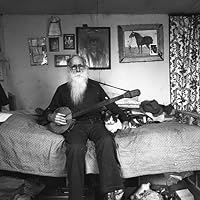
This collection of highly original narrative poems is written in the voice of frontiersman Daniel Boone and captures all the beauty and struggle of nascent America. We follow the progression of Daniel Boone's life, a life led in war and in the wilderness, and see the birth of a new nation. We track the bountiful animals and the great, undisturbed rivers. We stand beside Boone as he buries his brother, then his wife, and finds comfort in his friendship with a slave named Derry. Praised for his originality, Maurice Manning is an exciting new voice in American poetry.
The darkest place I've ever been did not require a name. It seemed to be a gathering place for the lint of the world. The bottom of a hollow beneath two ridges, sunk like a stone. The water was surely old, the dregs of some ancient sea, but purified by time, like a man made better by his years, his old hurts absorbed into his soul, his losses like a spring in his breast. -from "Born Again"
MAURICE MANNING, the author of four collections of poetry, was awarded the 2009 Hanes Poetry Award from the Fellowship of Southern Writers. His first book, Lawrence Booth’s Book of Visions, was selected by W. S. Merwin for the Yale Series of Younger Poets. Manning, a former writing fellow at the Fine Arts Work Center in Provincetown, Massachusetts, teaches at Indiana University and Warren Wilson College.
Written in the voice of Daniel Boone, Maurice Manning’s “A Companion for Owls” is most concerned with the fearsome questions “what is the meaning of life?” and “what is God up to?,” and doing what any god-fearing backwoodsman would do, i.e. concluding you’re not smart enough to know. Although the themes addressed could take place in any era and concern any believer, Manning gives them a particular flavor and context by couching them in the persona of Boone, the uneducated frontiersman, “rugged individualist” and “noble savage,” American folk hero who rescued his daughter from Indian kidnappers, land surveyor, husband, brother, father, failed speculator, and foe of the gentry.
Reading this book is a bit of a trip back in time, both in setting and voice, which forsakes all irony. Although not overtly dressed up that way, this is a book of religious poetry. The natural world and human interaction and relationships are addressed, too, but mostly Boone wonders about God’s purposes. In the end notes, Boone is quoted as having said “many dark and sleepless nights I have been a companion for owls. . .” God is mysterious and his intentions mostly impenetrable, leading to “our ragged life of questions” with its many loose ends.
The first poem in the book, “On God,” helps prepare the reader for all the questions to come, as it jumps in:
“Is there a god of the gulf between a man and a horse? A god who hovers above the trench of difference?”
Throughout the book, I was amazed how many questions emerged. For fun, here’s a brief selection:
Is the whole world endlessness? Is sunlight dripping on the leaves a question suitable for clocks? Can a wounded man be spoken of in terms of neutral hours? Whose dust will I become? Is grace forgetting we are but specks in the iris of a monstrous eye? What about a god of animal innards? Who discovered salt? Upon my soul I wonder, who invented beauty? Where does all gravity gather and what light does it make? Is there a cave against sorrow? Why is a woman like clover to a man? What in the name of Shadrach, Meshach, and that other one is an inalienable right? Aren’t we all worldlings, in a way? How many miles are all the rivers put together?
"A Companion for Owls" has a number of things in common with Manning’s "Bucolics." Both books set out to show the integrity of the “natural man,” someone honest and situated somewhat to the left of civilization. Both books puzzle after God. "Bucolics" is a series of innocent and contemplative psalm-like streams of consciousness while "A Companion for Owls" is more consciously narrated, and builds more on worldly experience, albeit of a certain sort.
“A Companion for Owls” is interesting and lively, earnest poetry with some stunning moments. In the end, though, I admit I left thirsty for a little modern absinthian irony. I occasionally tired of the voice and didn’t always take to the point of view. For example, in “Opposition to Bridges,” Boone says -
“If a man cannot cross a river on its own terms, then he doesn’t deserve the other side.”
I tried to board the train on this, but in the end I simply thought, what a load of horseshit. Build the bridges!
I spent a long time with this book because I like Maurice Manning's poetry and, being a Kentuckian, I'm interested in this period of Kentucky's history. I found that I appreciate the poems more the more I lived with them. The interesting thing about using Boone seems to me to be that, while he is an American icon, he is also a fictional construct. His legend lends itself to reinvention. Manning's Boone is less hero, more contemplative. Manning is a metaphysical thinker, a man of the people, and a nature poet. Interesting combination.
A Recipe for Chink Once you have felled and squared and notched and laid timber upon timber and allowed your cabin to assume its form and leveled the dirt floor as best you can and made a stone hearth and a chimney that draws good air and given thought to daylight and the likely direction of rain and resigned yourself to living crudely, you are ready now to render two bushels of salt.
Next make a log trough and fill it with water as deep as your hand is long. Scoop riverbank clay onto a hide and drag it to the trough. Combine the clay and water. Add to that confection small sticks, pine needles, and threshings if they are handy. Then add salt. Kneel before the trough as if it were an ancient alter in the woods and knead the dough lovingly until it is creamy as a woman’s hip flesh and you are taken away for a moment by a small dream.
Compose yourself and take a plank and smooth The dough between the timbers inside and out. Resist perfection; content yourself with small gaps. Sunlight will sneak through and give the dust a place to dance. Allow unevenness to bring you joy.
A Syllogism A river cuts the earth the way a man Removes a bear from the realm of air and light. Subtraction is a swift and clean event. A river is the tool of God; a man, the tool of other men, and like a river, a man will find the easy course. Our tendency to laziness is great. A river is the child of other rivers; a man, the child of parents – both depend on lines traced back to some initial point. Desire and water have the same design: to grow, then move and flow; to take and make, and leave, and want, then rest: to bend the world to fit a purpose which is good, despite the fact of loss.
The world is God’s canoe.
A Brief Religious Inquiry The Shawnees must have twenty-seven gods. My brother Squire has one. He say’s God’s eye is even on the sparrow. Could it be a sleepy eye? My brother is a miller. I say he should consider the god of corn, but he won’t. He’s stubborn on that matter, says he’s never speculated. He believes the god who loves the sparrow also loves the corn. But I believe it doesn’t hurt to pray for water, trusty stones, and grist to any god who’ll turn away from heaven.
Of his ten siblings, Boone was closest to his brother Squire. They spent months at a time hunting together in the woodlands. Squire eventually became a minister of sorts and retired to southern Indiana. What they talked about in the evenings, how pleasant were the days they passed together, we shall never know, which is, in its own way, charming.
Having lived pretty close to raw wilderness at one time and having a pretty good sense of American history (including having forebears from Kentucky), I think that Manning captures the voice of Daniel Boone and his circumstances very well, and that he uses form and language that authenticates this voice for a contemporary audience. I appreciate the detailed notes that do add to the reading. It is that kind of work, a blend of biography-in-verse and scholarship that lends itself to notes.
It has been a while since I read it, but it has stayed with me. Perhaps I am unduly empathetic because I find so little work that speaks to the living on the wilderness (as opposed to rural) outskirts of the nation as I was fortunate to experience in pre-oil boom Alaska. Companion for Owls. is not a typical work
I like this book, but it falls short of what it could be. At risk here is idealization of the past, the natural, and the "simple." It doesn't entirely give into these vices, but it's hard to know where Manning the author stands in regard to the God-fearing, common-sense clarity of Boone's voice in these poems. When it feels like Manning slips in to validate this archaic purity of vision, it's unearned - more like nostalgia or wishful thinking than an earnest evaluation of the implied critical distance between the poet and his subject. There is such a great deal of hero-worship and projection in Manning's delivery that the innovative structure, textured idiom, and brash regionalism of his conception get watered down. In many instance, though, this is a truly lovable book.
I must preface my comments by saying that I do not normally read much poetry. The last two works of poetry that I read were epic poems - Beowolf and Canterbury Tales. I was expecting this to be a story or history set to verse. It is not. This is a collection of smaller poems that taken as a whole tell the story of the life and times of Danial Boone. The author has taken the time to include footnotes at the end to show the historical relevance (or lack of) in each poem.
I enjoyed this immensely but cannot say if it will appeal to everyone. As I said, I am not a great reader or critic of poetry but this worked well for me. Give it a try.
Read this after reading "Bucolics," which blew my mind. This is quite different -- lacking the heart that "Bucolics" has. More intellectual. It's accomplished and well-done, but just didn't leap beyond that for me.
A poems-as-biography in five sections, including an interesting essay on death. Manning, through Daniel Boone, an 18th century frontiersman who helped "settle" present day Kentucky, exalts solitude and the virtue of struggling to live in nature. Many of the poems read like breathless invocations of a god that resides between the actions of a purposeless universe. Entire poems are series of queries to a purposeless and romantic essence in nature ("Who decides the shape of rocks,/the curl of cedar branches[...]Whose task is it/to grant the rain permission to fall and feed/the rivers?[...]Upon my soul, I wonder who invented beauty?" "Is grace forgetting we are but specks/in the iris of a monstrous eye?")
The poems-as-biography exercise is really fun and makes for page turning, which I usually don't do with a book of poems. These are clearly meant to be read in order, and each poem has commentary that situates the artifice of the writer with the historical or real context of his subject's actions (and also admits when he just makes shit up).
As lyrics poems, I quite like most of this book, especially the first two sections.
It's difficult, however, to not be skeptical about Daniel Boone as a romantic figure and to be skeptical of how Manning confronts that he is essentially a footsoldier for capitalist imperialists.
I don’t think that Boone, in the poems, holds himself above scrutiny (he admits that he can be an asshole), but in his critique of capitalist-colonialist expansion in the land he loves and shares with the various Native populations in which he encounters (and sometimes lives with, sometimes fights with), he doesn’t situate much blame onto himself.
Boone considers himself willfully ignorant of the aim of civilization (and science and thought) and is contemptuous of its desire for progress.
In one poem, Manning has Boone deliver a scathing list of rebukes to a colonel for making a sham treaty and basically ripping off Boone for a bunch of work he did. In an earlier poem, he laments the distances he traveled to mark off land distribution, sometimes simply guessing to mark out territories (presumably for sale or already purchased by some unreferenced settler).
His critiques come from being personally ripped off. That scrutiny doesn’t seem to reflect inward on why Boone himself is the capable frontiersman that capitalist-colonialist settlers needed to establish territory and rip off and relocate Native populations.
Manning clears up (what should be perceived as negative) connotation of Boone as a brave fighter of Indians. In one of the last poems, Boone laments, “I’ve got three dead Indians on my soul: What kind/ of civilization is that?”. The notes on that poem state that, despite his reputation for being a warrior, the three people he killed had been in self defense. I have not read any biography of Boone outside of this, but I worry that Manning is using some poetic artifice to make Boone, presumably a figure that the author admires, less guilty of violence towards Native people. Manning does not have Boone interrogate the idea (the fact) that he is an intruder and a willing participant in the land grabbing that led to the violence that he (willingly) participated in.
If you haven't read Maurice Manning, check out his book Bucolics instead. ("poems about shepherds, who historically constituted the lowest class of rural society but gained thereby an aura of purity.")
I was, first of all, disappointed that this was NOT the Commonplace Book of Daniel Boone! The title is very misleading. I think is was presumptuous of Manning to speak in Boone's voice in his poetry. He should, in my opinion, have called it A Companion for Owls, Being the Commonplace Book of a Frontier Woodsman, and removed all references to Boone's family and companions. I enjoyed some of the poetry but was not happy with a lot of it. And I could never get past the fact that it was written as though Daniel Boone was speaking.
Reading this book gives you a unique biography insight into Daniel Boone, of American pioneering lore. When each poem is read in conjunction with the notes the author has made in the back of the book, you are carried away to a time when a man spent a lot of time on his own and what his thoughts and discoveries could have been as he walked in the woods and kept himself alive by methods you can hardly imagine. The poems introduce us to some members of his family, his friends (especially his Indian friends), and to the various places he lived.
A whole book of persona poems from the perspective either of Daniel Boone or his friends/family. An interesting combo of history and fiction and poetry as “Daniel Boone” meditates on the world. I appreciated, also, the glimpses of Manning and the relationship he developed with his subject in the notes.
This series of poems is designed to look at and provide insights into the life and thoughts of Daniel Boone. They provide an overview of his life, but are not a true biography and the notes accompanying them give some biographical information, but are more focused on the influence that writings about his life and his possible encounter with an English author had on English nature poetry written by Wordsworth and others.
"Desire and water have the same design: to grow, then move and flow; to take and make, and leave, and want, then rest: to bend the world to fit a purpose which is good, despite the fact of loss.