Jump to ratings and reviews
Rate this book

The Day the World Ended: The Mount Pelée Disaster: May 7, 1902

Rate this book
The true story of a horrifying natural disaster—and the corruption that made it worse—by the New York Times–bestselling authors of Voyage of the Damned.

In late April 1902, Mount Pelée, a volcano on the Caribbean island Martinique, began to wake up. It emitted clouds of ash and smoke for two weeks until violently erupting on May 8. Over 30,000 residents of St. Pierre were killed; they burned to death under rivers of hot lava and suffocated under pounds of hot ash. Only three people managed to survive: a prisoner trapped in a dungeon-like jail cell, a man on the outskirts of town, and a young girl found floating unconscious in a boat days later.

So how did a town of thousands not heed the warnings of nature and local scientists, instead staying behind to perish in the onslaught of volcanic ash? Why did the newspapers publish articles assuring readers that the volcano was harmless? And why did the authorities refuse to allow the American Consul to contact Washington about the conditions? The answer lies in politics: With an election on the horizon, the political leaders of Martinique ignored the welfare of their people in order to consolidate the votes they needed to win.

A gripping and informative book on the disastrous effects of a natural disaster coupled with corruption, The Day the World Ended reveals the story of a city engulfed in flames and the political leaders that chose to kill their people rather than give up their political power.

308 pages, Kindle Edition

First published January 1, 1969

153 people are currently reading
418 people want to read

About the author

Gordon Thomas

119 books197 followers
Gordon Thomas (born 1933) is a Welsh author who has written more than fifty books.
Thomas was born in Wales, in a cemetery keeper's cottage where his grandmother lived. He had his first story published at nine years old in a Boy's Own Paper competition. With his father in the RAF, he traveled widely and was educated at the Cairo High School, the Maritz Brothers (in Port Elizabeth, South Africa) and, lastly, at Bedford Modern School. His first book, completed at the age of seventeen, is the story of a British spy in Russia during World War II, titled Descent Into Danger. He refused the offer of a job at a university in order to accompany a traveling fair for a year: he used those experiences for his novel, Bed of Nails. Since then his books have been published worldwide. He has been a foreign correspondent beginning with the Suez Crisis and ending with the first Gulf War. He was a BBC writer/producer for three flagship BBC programmes: Man Alive, Tomorrow's World and Horizon.

He is a regular contributor to Facta, the respected monthly Japanese news magazine, and he lectures widely on the secret world of intelligence. He also provides expert analysis on intelligence for US and European television and radio programs.His book Gideon's Spies: Mossad's Secret Warriors became a major documentary for Channel Four that he wrote and narrated: The Spy Machine. It followed three years of research during which he was given unprecedented access to Mossad’s main personnel. The documentary was co-produced by Open Media and Israfilm.

Gideon's Spies: Mossad's Secret Warriors has so far been published in 16 languages. A source for this book was Ari Ben-Menashe, a former Israeli intelligence agent, and legendary Israeli spy Rafi Eitan. According to Charles Foster in Contemporary Review: "Writers who know their place are few and far between: fortunately Mr Thomas is one of them. By keeping to his place as a tremendous storyteller without a preacher's pretensions, he has put his book amongst the important chronicles of the state of Israel."

Ratings & Reviews

What do you think?
Rate this book

Friends & Following

Create a free account to discover what your friends think of this book!

Community Reviews

5 stars
166 (38%)
4 stars
171 (39%)
3 stars
71 (16%)
2 stars
20 (4%)
1 star
6 (1%)
Displaying 1 - 30 of 50 reviews
Profile Image for Pramod Nair.
233 reviews212 followers
September 9, 2015
The Day the World Ended’, by Gordon Thomas and Max Morgan-Witts, is a comprehensive account of the 1902 eruption of Mount Pelée, situated in the Caribbean island of Martinique. The eruption of Mount Pelée, which happened in May 1902, is referred to as the ‘worst volcanic disaster of the 20th century’ and resulted in the complete annihilation of the resort town of St. Pierre – the largest city on Martinique at that time.

This volume, which is written in an investigative manner – after 4 years of research into official records and numerous interviews with eyewitnesses – gives painful insights into this epic disaster in great detail. While presenting an accurate chronicle of happenings leading to the final eruption the book also inspects why the authorities chose to ignore or downplay a series of warnings that the nature gave, and decided not to evacuate the town of St. Pierre before the eruption; an error in judgment which led to the terrible death of 30,000 people in a holocaust of mud & flame.

A series of warnings, sadly ignored

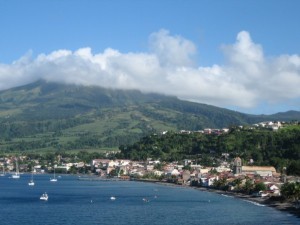
Saint-Pierre, with Mount Pelée in the background
Saint-Pierre, with Mount Pelée in the background [Source]

What makes the tragedy of St. Pierre more painful is the fact that for more than a year before the actual eruption, there was a steady stream of warnings from the nature about the disaster that was about to descend on the island community; a series of warnings in a modern day perspective, could have resulted in the evacuation of the town of St. Pierre and surroundings and a series a precautions which could have reduced the magnitude of the disaster.

In ‘The Day the World Ended’, the authors present the reader with details of a series of events that preceded the final disaster with great clarity and through excerpts from documents, letters and even through thoughts and memories of eye-witnesses. After yearlong minor seismic and volcanic activities the first observations on an imminent disaster from the Mount Pelée was made by ‘Fernand Clerc’, an industrialist, sugarcane planter and a prominent social figure in Martinique, when he observed steaming, boiling bitumen like phenomenon on the lake in the Mount Pelée. A report, which was, dispatched by him to the governor residing at Fort-de-France, Martinique’s capital, on the volcano becoming active was not taken seriously.

The first definite warning from the nature came on May, 2nd 1902, when a massive underwater shockwave created by the volcanic mountain destroyed marine life for kilometers and severed the telegraph cable between Martinique and the island of Dominica. On that same day there was a massive emission of volcanic ash, which covered the whole town of St. Pierre in a fine cement like powder reeking of Sulphar. This was followed by happenings of boiling mud gushing out of the volcano to some of the farmlands surrounding St. Pierre. At a sugar plantation 6 Kms from St. Pierre, an onrushing torrent of boiling mud trapped and killed the owner of the farm and 7 other people along with their horses.

Since the previous eruptions, which occurred in 1792 and 1851, were of minor nature, the community ignored these warnings and hoped the eruption, even if it happens will not reach the town of St. Pierre. An article, which was published on the front page of ‘Les Colonies’, assuring the public that the spewing of ashes and boiling mud were just a passing phase and the volcano will go dormant again soon, quoting “a leading authority on volcanoes” added to this sense of assurance. But the fact remained that this assurance from “a leading authority” was totally fabricated by the editors of the newspaper.

The political angle, which contributed to the continuation of the downplaying of these natural warnings

The newspaper published this assuring article both to lessen the public alarm and due to a political agenda. In this book the authors present some scenarios were they argue that the decision for this assurance through the newspaper was made to keep the conservative vote bank – which was essential for the ruling party to regain power – of St. Pierre not to leave before the election which was about to happen with in a week.

An attempt made by the American Consul, “Thomas Prentiss”, to contact Washington via cable to brief about the increase in volcanic activities was also put on stop by the authorities in Fort-de-France. Not only that, a curt note was send by the office of the governor to the Consul chastising him for “Spreading alarm abroad that could create a state of false fear & pessimism when none need appear”.

Volcanic and seismic activities increased through each passing hour, and another attempt made by ‘Fernand Clerc’ to convince the authorities to evacuate St. Pierre was rejected. On May 3rd, a bridge collapsed due to violent tremors resulting in 20 people losing their life. On the same day electric flames spewed out of the crater of Mount Pelée, which is described through an eyewitness statement:

“Every few minutes electric flames of blinding intensity cast a lurid pallor over the enshrouding black and purple clouds. It was as if we were standing on the brink of hell.”


A stream of Refugees and some strange phenomenons

On May 5th in a sugarcane plantation near to St. Pierre a bunch of workers were sucked in by earth when it was split open suddenly after a violent tremor. This started a flow of refugees from the surrounding farmlands and other villages from the foothills of the volcanic mountain into the town of St. Pierre. A commission that was created by the authorities to study about the threat gave its assurances through a report that the lava flow will not touch the town of St. Pierre.

On that same day the town of St. Pierre and surrounding farmlands were swarmed by hundreds of deadly fer-de-lance vipers causing 50 human and 100s of animal death. Then came hoards of ants and other insects down the mountain to the town adding to the chaos. This throng of animals where soon followed by a nine meter high wall of boiling mud which obliterated several of the plantations and its factories along with the inhabitants. This mudslide on reaching the ocean created waves of 15 meters height, which wrecked havoc along the St. Pierre harbor.

By May 6 the human death toll was already over 500 and still there was no move to implement the evacuation procedures in St. Pierre. By May 7 the situation was so grave that some people despite the assurances from the authorities decided on their own to take action on their own, but their number was very limited.

One of the witnesses who took the warnings seriously to leave St. Pierre was Captain Marino Lebotte, of the Italian ship Orsolina, who took his vessel to the ocean despite being denied the permission to leave.

“I ignored all their arguments, insisting that my own concern was the safety of my ship and that every minute I stayed arguing the risk grew grater”

Fernand Clerc gave orders to all his plantation workers to leave St. Pierre to Fort-de-France and took precautions for his family to move out at a moments notice. On that same fateful evening the governor of Martinique arrived at St. Pierre with his wife for lifting the morale of the town and decided to stay at a hotel there. The sight that welcomed them at St. Pierre was something of a nightmarish scale. Ash was piled everywhere, streets were silent, and those who had no shelter stood on the street covered in ash devoid of any emotion.

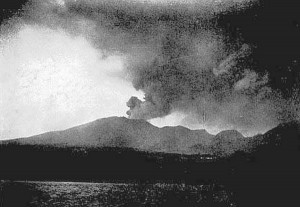
Mt. Pelee 1902 eruption, by Angelo Heilprin May 26, 1902

On the early morning of May 8th Fernand Clerc on observing a sharp deviation in atmospheric pressure, left the town to a nearby mountaintop just in time to escape an enormous explosion, which was emitted, from Mount Pelée. Through the words of Madam Clerc who stood looking at St. Pierre from this vantage point, the authors describe the final moments of St. Pierre.

“We saw a sea of fire cutting through the billowing black smoke and advancing along the ground towards the town. St. Pierre was doomed, our friends were doomed, Our world was doomed.


The whole town of St. Pierre and the ships in the port were engulfed in a huge wall of fire, with a constant stream of fire that kept pouring out of the crater. In a town, which was believed to have around 30,000 inhabitants at the time of this disaster, only two survivors remained. The volcanic activity continued for months with several more eruptions.

Did political reasons alone led to the non-evacuation of St. Pierre?

While the book focuses mainly on the political aspirations and political motivations of a string of key players in the social scene of Martinique as the reason for the non-evacuation, a further research that I did on the topic also presents some other key factors.

It is a fact that one after another, a series of deadly warnings – ranging from increased fumarole activities, tremors, explosions, mud slides and even death and destruction happening at the various areas surrounding the Mount Pelée – given by the nature before the actual deadly eruption and explosion were downplayed by the authorities, whatever may be the real reason. It was indeed a politically turbulent time in Martinique with an election just around the corner, yet lack of scientific insights about volcanoes, the insufficient knowledge of volcanic hazards and interpreting the increase in volcanic activities scientifically may also have contributed to the decision behind the non-evacuation of the town.

“The catastrophe of Saint-Pierre resulted from an insufficient knowledge of volcanic hazards at the time and particularly from the total ignorance of pyroclastic flow (nuée ardente) phenomena.”
Jean-Claude Tanguy observes in a 1993 article submitted at Journal of Volcanology and Geothermal Research.

Mount Pelée eruption of 1902 and its impact on modern volcanology

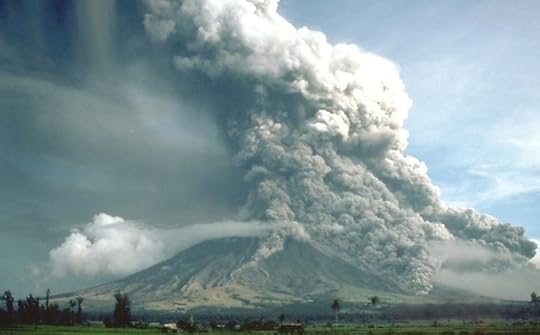
The epic proportions of the disaster and the way in which the volcano created an explosion, which annihilated an entire town, made the geologists to study the disaster with great scrutiny. It was Alfred Lacroix, who in 1904 coined the term “nuées ardentes” to describe the type of pyroclastic flows – a fast-moving current of hot gas and rock emitting from the volcano after an explosive eruption – that happened in the 1902 Mount Pelée eruption.

Pyroclastic flows descend the south-eastern flank of Mayon Volcano, Philippines, 1984

This type of volcanic emission – a combination of glowing ash, molten lava and superheated gases exploding with great force – was studied in depth, which helped in interpreting the signs of volcanic activities, detecting imminent eruptions and preventing loss of life.

The Expedition to Martinique & St. Vincent by The National Geographic Society.

Within a few days of the tragic disaster at St. Pierre, a special expedition consisting of eminent geologists and explorers sailed from New York, on May 14th, on the supply ship Dixie, which carried relief supplies worth $200,000 for the aid of the sufferers. The aim of this expedition formed by The National Geographic society was to study the actual volcanic action and submit a report regarding the volcanic conditions after the eruption. A series of illustrated reports on the findings by this scientific commission are presented in the June, 1902 and July, 1902 editions – with the July issue exclusively dedicated to the disaster at Martinique – of the National Geographic magazine. The July volume presents a whole range of reports that discuss the conditions after the disaster, the history of volcanic activities in the Caribbean Islands and provided scientific insights into the geological and chemical concerns regarding the aftermath of the eruption.

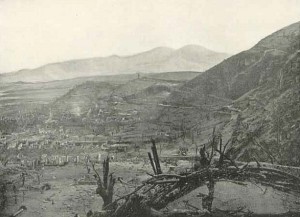
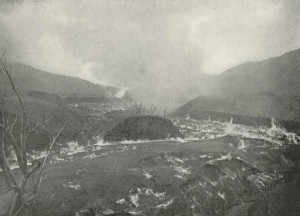
A photograph of the City of St. Pierre after the disaster. Photograph by Israel C. Russell, July 1902, scanned from my copy of the magazine.

There are also detailed reports on the eruption of the La Soufrière volcano, on the nearby island of Saint Vincent, of 7 May 1902, which happened just a few hours before the eruption of Mount Pelée on Martinique, with a death toll of 1,680.

A river of mud pouring from La Soufrière. Photograph by Israel C. Russell, July 1902, scanned from my copy of the magazine.

I took up this volume while researching some similarities I felt between the ‘Pompeii’ and ‘St. Pierre’ disasters. With the enormity of the disaster that it discusses, reading ‘The Day the World Ended’ which is written 67 years after the disaster, was a humbling experience. Both generic readers and those with interests in history and science can take up this volume. Even though based on history and recorded facts, the style of narration that the authors choose here is that of a novel to make it more popular and engaging for the generic reader.
Profile Image for Ozymandias.
445 reviews204 followers
July 8, 2019
I’ve done something unusual for me and rewritten this review several times. I suspect this will be the last one as I now feel I know enough to have an informed opinion.

This book is a highly entertaining and compelling account of the volcanic disaster that wiped out the lovely Caribbean city of St. Pierre on May 8, 1902. It manages to maintain a sense of escalating tension while following characters who do not much at all really. You get a feel for the city, the people, and life on a Caribbean island in the Belle Epoque.

It is also almost completely fictitious. Leaving aside matters of interpretation regarding specific accounts and the relative competence of government officials and their reactions, the book invents a narrative that fits the dramatic sense of building drama that we crave but bears no relation to actual events. I was absolutely astonished to read the account of a rapidly-growing humanitarian crisis culminating in a giant explosion. Each day the situation grows more dire and grotesque. It’s compelling. It’s also the biggest lie in the book. The situation was not devolving each day as the death toll skyrocketed. A factory was wiped out on Monday, but that was the sum total of deaths until the disaster of Thursday, May 8. Civilization didn’t break down as voodoo gangs ran wild. On the morning of the eruption the ferry service was still operating. Tourists were coming in from Fort-de-France to view the spectacle. People were scared, but life continued on as normal.

And the reason this lie (and it is a deliberate lie, not a misinterpretation or misunderstanding) is so damaging is that a sense of increasing danger was exactly what people were waiting for before they packed it in. If it had happened like this the town (or at least the part wealthy enough to book transport) would have fled. Instead, things remained hovering on a level of uncertain danger that was difficult to judge. Indeed, the city seemed the safest place around. The day after the eruption, when the rescue ships landed at the next town over, the people there pleaded to be evacuated to St. Pierre! I've included a few of the false statements at the end and they are doozies!

A big part of their problem is that they are inventing facts, quotes, and maybe even sources, but a lot of it comes from their source criticism. Or lack thereof. The disaster of St. Pierre was front-page news across the world, but naturally it took a long time for reliable facts to appear from a confused and disorganized island. Also naturally, the local rag-sheets and even respectable newspapers grabbed what they could find. Most of it was bullshit, invented by editors or spread by the rumors of terrified refugees (most of whom hadn’t even seen the disaster) and then treated as fact. Stories grew in the telling like a game of telephone. One man describes how the mountain seemed to open up in a fireball, the next tells of how the mountain exploded and bits of it scattered everywhere, and the next says clearly that he has seen for himself the hole where the mountain once stood. But none of it is true. And even when you do get to the actual survivors you’ve got to be very cautious about the various agendas (mostly shifting blame or identifying divine intervention). These guys don’t even try. They take the most sensationalized accounts as their starting point and build from there.

And that ties in with the book’s other problem: they don’t know much if any French. This is hugely problematic since it was French investigators who sat down and sorted out the reliable sources from the gobbledygook. Any book on St. Pierre has to start from these French reports. The information that got out to the foreign press was almost exclusively the type of information described above. The first English book on St. Pierre (published 1902) is a perfect example. It includes detailed testimonies, including one from the survivor in the prison cell. Problem is, the man was not Ciparis but a man called Pierre Bachere and the testimony is entirely false. He describes lava flooding through the streets, for example, and describes watching a convent of nuns slowly succumb to the fumes and ash. Whoever provided this “testimony” was clearly not a witness and never so much as set foot in the ruined city. I’m suspicious of this book's other English sources too. Father Alte Roche (almost certainly a pseudonym as it means “old rock”) is used because he was interviewed in the New York Times (which explains the focus on the American consul), but the extracts from his account often merge poorly with those found elsewhere. Or maybe he's just being misrepresented since they've expanded his brief interview into several chapters’ worth of material. Similar reliance on rumor probably account for mistaken claims like Ciparis' awaiting execution for murder. That's an astonishingly careless mistake to make and I can't convince myself they didn't know this was false when they wrote it.

Their unreliability is made much worse by their immense confidence in the little French they do have, which provides a grossly distorted view of the few French eyewitness testimonies they do look at and makes it hard to say where confusion ends and fiction begins. The most notable example is in the interview with Landes published in Les Colonies, where the claim that Landes got from Perrinelle (on the hills above St. Pierre) to Étang Sec (in the very crater of the erupting mountain) in a matter of hours is rightly ridiculed. But that is not what the French says and even the slightest attempt at analysis would show that such a claim could never be expected to convince locals who were more familiar with the terrain than people like me looking at maps (which the book doesn’t include incidentally). What it actually says is that he observed the Étang Sec from Perrinelle. Which makes perfect sense. It would have been impossible to see from down in the city. Translation problems may also account for the major differences between the account of survivors like Léandre and their version. Either that or they relied on legends and innuendo again. If that's the case though, it's odd that Léandre's account here is actually less exciting than that one. Possibly they changed it because it was too unbelievable. If I ran a casino I would not let that man into my doors. He was just too impossibly lucky.

And of course, the authors also know nothing of volcanoes. In fact, Landes, who died uncomprehending the nature of what killed him, knew more about volcanoes than they do, even if he didn’t know the one thing that mattered most (nobody then did). Their counterargument to his claim that the massive lahar (mudslide) had released pressure inside the volcano (a belief entirely in keeping with what was known at the time) was to say that “the volcano was still alive; anything could happen,” which is both factually incorrect and rather insulting. They then suggest the lahar proves that lava too could cut a new path, which is false both because the lahar didn’t carve a new path or threaten St. Pierre and because lava is much slower and less dangerous. The valleys would have protected the city, just as Landes had said. Furthermore, they repeat facts that weren’t true. Lava flows, for example, never happened. Nor did the opening of vents under villages, which I think is a confused account of a minor pyroclastic flow. And the descriptions of the ground opening up and swallowing people only to reseal itself is Grade-A baloney. The whole description of the mountain is more magic than science, and as this was one of the most-studied volcanoes of the 20th century I find the presence of magic mountain thinking more a matter of incompetence than style.

You can see the problem I have reviewing this book. Do I judge it by its entertainment value? Or do I judge it by its accuracy? Because it was one of the most enthralling books I’ve ever read, even if I was suspicious of the grandiloquence of some of its accounts. I can certainly recommend it as a great and imaginative work of fiction.

But I think the reason that I’m going to be harsh on this book is a very personal one. When I found out I’d been lied to, and quite deliberately too, I felt a tremendous sense of betrayal. If that sounds an overly emotional reason to make a decision that’s fair, but I do feel that there’s a certain degree of trust we give naturally to nonfiction writers. We have to trust them because otherwise what’s the point? Are we going to dig into the archives and research everything ourselves? And completely inventing and distorting facts to fit your agenda, even if it’s the largely harmless one of telling a good yarn, is not something I can forgive. We have enough trouble discerning truth in this world of fake news and propaganda. Had the authors set out to write a novel on the disaster I’d have given them an almost completely free pass because there’s no bond of trust broken. But this, I feel, is a different matter.

Anyone interested in a better account of the eruption should check out La Catastrophe, which is perhaps too revisionist and defensive but extremely good on what actually happened within the volcano and what the experts at the time were aware of. Mont Pelee and the Tragedy of Martinique is outdated, but as a study by an expert volcanologist of the day (1903) who personally visited the devastated area it can't be topped. At least not in English. I hear The Last Days of St. Pierre is good, but Lord knows I'm suspicious of reading another "popular" account after this one.


A few of the lies the book tells (or repeats when it should have known better):
Governor Louis-Guillaume (not just Louis) Mouttet sent no word of the month-long eruption to the Colonial Office in Paris until May 4, and then only to inform them it was dying out (he actually sent a message on May 3, the day after the volcano started erupting in earnest, and described it as a serious situation, though he didn’t request assistance)
Governor Mouttet lounged around his office, doing nothing to respond to the disaster (he rushed to Le Prêcheur, a village past St. Pierre, the morning after the eruption covered it in dust on May 2 and returned on May 5, after a fierce argument with the captain of the naval cruiser Suchet, to encourage its evacuation. To St. Pierre sadly, since it was widely regarded as the safest place in the area, but his response time to trouble spots was excellent and hardly indifferent)
The Progressive Party was all about white supremacy and monarchism (racial, and French, politics are complicated, but many of the chief local supporters of the party, including Marius Hurard, were mulatto. In fact, Hurard’s paper described itself as “the first newspaper for Colored Republicans in Martinique.” It’s more accurate to say it was conservative and secular bourgeois Republican)
Governor Mouttet was a radical Progressive, white supremacist, and monarchist (he was actually a rabid Leftist and thus Clerc’s opponent!)
Senator Amédee Knight was black and a member of the diametrically opposed Radical Party (he was in fact mulatto, a distinction of indifference to us but one that meant everything to contemporaries, and the Radical Party and Progressive Party were currently in a coalition. He also worked regularly with Governor Mouttet and they seemed to get along)
Governor Mouttet refused to go to St. Pierre until May 7, when he was to attend a banquet scheduled in his honor (he was there every day after the eruption began except for May 3 and 4)
The outside world was kept intentionally in the dark about Mt. Pelée’s eruption (The captain of the Roddam was told about the Guerin disaster within a day despite being on a different island. The eruption was no secret, it’s just that the English one happening at the same time looked worse)
Refugees were locked up and prevented from leaving (this never happened and they regarded St. Pierre as a place of safety)
Soldiers were brought in to keep people from leaving (again, they didn’t, and none of the Fort-de-France garrison died in St. Pierre so they couldn’t have been there!)
Dr. Guérin’s workers were wiped out because he was greedily trying to gather his sugar cane crop in before the volcano destroyed it (Sugar cane harvesting was already completed by May)
Professor Gaston Landes died in the arboretum among the plants he loved so much (he died in his own garden, which may be a further example of inept translation, and, apart from the nature of his wounds, this account differs drastically from other accounts)
Auguste Ciparis was about to be executed for murder (he was in prison for a violent brawl and was only in solitary because he had escaped and later turned himself in)
Governor Mouttet pardoned Ciparis right before the explosion to help win the election (well if he wasn’t about to be executed how could he be pardoned?)
Léon Compère-Léandre’s story, in direct quotes no less!, bears little resemblance to his actual account. But that was in French, so...)
Casualties are always greatly exaggerated. The Guérin disaster, for example, only killed 1/8 the number this book claims. And there were in fact no known casualties in Le Prêcheur and Ajoupa-Bouillon, the towns he claims were almost completely destroyed on May 4, until the day of the disaster
I believe most of the telegrams, like the quotes, are completely made up!

A few of the crucial facts it omits:
The elections were important, but they were for the French Chamber of Deputies, not any local position. Any local effects would have been minimal. Inasmuch as the political arguments can be reduced to a single idea, the fight seems to have been over how integrated/independent the colonies should be from the mother country, with the Progressives favoring greater independence and the Radicals greater integration. As there were important mulattos on both sides, the end of white supremacy cannot have been the leading issue.
Clerc (the disinterested nonpolitical man) had been mayor of La Trinité for the last seven years!
Mayor Fouché was an ally, not opponent, of Senator Knight.
There was nobody on the island better qualified than the admittedly-amateur members of the Commission of Inquiry. Seriously, who in a small city on the Caribbean could be considered an expert? And even if one of these rare experts had sailed from France on the day the eruption began he couldn’t have reached the city in time. They used who they had on hand because they had to.
Gaston Landes, the chief scientist in the Commission of Inquiry, was not “a scientist with a respected reputation in America and France” but a local schoolteacher with no geological training or experience. The French “professeur” is of lower status than the English “professor”. So the constant sniping at the incompetence of his “expert opinion” is entirely unfair. He never claimed to be one.

A few of the unsupported statements (slanders basically) it makes:
Governor Mouttet bribed Hurard to print stories keeping people in town so they could vote (think about it: only two people could have known this if it were true and both died in the explosion. Also, the two were not allies but rather opponents)
Mayor Fouché and Governor Mouttet spent all their time obsessing over a banquet instead of responding to the disaster (these two were very busy. Fouche even wrote a helpful poster and had it plastered on the walls)
The Commission of Inquiry was designed solely to get people to remain in the city (based on whose testimony?)
Governor Mouttet was a “raffish, conniving, and corrupt” “political hack” and wanted to work in the colonies because of the retinue of servants, long siestas, and high balls (I mean, this might be true, but these authors sure wouldn’t know it because they did no research in French)
With regards to Mouttet, authorial bias is so extreme as to be positively disgusting. He is lambasted on page after page for not reacting decisively or taking the situation seriously, but then a few pages later he’s castigated for establishing a Commision of Inquiry without seeking Paris’ approval first! And then he’s further criticized for making them rush instead of taking a month as the previous commission (investigating an inactive Pelée) had! It’s obvious that nothing this man did could have been right in the authors’ eyes!
Incidentally, L’Heure, their key source for the governor’s growing inability to confront reality, is more guilty of everything here than Mouttet ever was. Even after the disaster showed how lethal Pelée was, he forced refugees back to their villages by threatening to cut off their aid (1,500 died needlessly) and diverted rescue missions in order to recover the treasury stored in St. Pierre’s bank. I would not trust a negative assessment from this reprehensible man if he had been judging Adolf Hitler!
Profile Image for Joy D.
3,137 reviews330 followers
August 25, 2024
The authors have researched numerous archives around the world to assemble a fascinating account of the eruption of Mount Pelée in 1902, which destroyed the city of St. Pierre on the island of Martinique. This book is a day-by-day account of the chain of events leading to the disaster, covering May 2nd to May 8th. It not only covers the eruption itself, but related events such as a flood of mud that destroys a sugar factory, a prison riot, and a voodoo uprising. It shows the short-sightedness of those in charge due to politics of an upcoming election. This tragedy could have been much less severe in terms of loss of life if action had been taken sooner.

The authors employ the technique of weaving together individual stories with descriptions of the bigger picture. The narrative is strictly a historical account and is light on scientific explanations, but it is very readable and flows nicely. The authors provide an extensive bibliography, but no footnotes relating content to sources. I had not read anything about this disaster previously and feel I learned a great deal.
Profile Image for Joanne.
855 reviews94 followers
February 14, 2021
I added this book to my shelf after a friend had reviewed it. Last week while helping out at the library, I found it in the pile of books they were pulling from the shelves. I sat down and opened it up and the next time I looked up an hour and half had lapsed.

This is a riveting, day by day, account of the eruption of Pelee in 1902. Published in 1969, this book has stood the test of time. It reads more like an engrossing novel then a non-fictional account written by two news reporters. The research that went into this book is evident.

The story combines the everyday emotions and lives of the people living below the mountain, in St. Pierre. The authors also include all of the turmoil that was occurring: vodoo worshipers, the political motives, the involvement (or non-involvement) of the Catholic Church. So many lives were lost due to inaction by so many people. Insects and snakes invaded the town, even they were smart enough to come down off the mountain and "get out of Dodge". Political motives fueled those in charge and no evacuation orders were issued. Approximately 30,000 souls were lost, and an entire town wiped off the map.
Profile Image for Betsy.
1,126 reviews144 followers
September 26, 2020
This is a story of greed and stupidity, and all to win an election. In 1902 on the island of Martinique the volcano Pelee wiped out the town of St. Pierre, 30,000 strong, in less than five minutes. There had been warnings for almost a month, but those in power ignored the warnings because there was to be an election, and they didn't want to lose. Their opponents, known as the Radicals and black in color, had a good chance to win, so nothing would stop the powerful white officials from lying their way to victory. Nothing but a great fireball from Pelee.

This is a sad, but interesting book. It provides a lesson in what some people will do to stay in power, and what they will continue to do, no matter the cost in lives.
Profile Image for Anna.
140 reviews5 followers
November 30, 2015
The Day The World Ended is a horrific detailed account of the week preceding the massive eruption of Mount Pelée on the Caribbean island of Martinique, which killed 29,000 people in 1902. The most shocking part of this book was reading about the island's corrupt public leaders who were more concerned with political party advances in an upcoming election than the welfare and safety of the public, publishing lies in newspapers, burying and ignoring the alarms and calls for action, and actually encouraging people to stay in the city of St. Pierre, rather than heeding the warnings of local scientists and evacuating the town. Reading this account makes me question the content and truthfulness of current news and media, as well as the real motives and priorities of our government (this book has a lot of similarities to the disaster of Katrina). Despite being non-fiction and full of personal accounts (which tend to be a little on the dry end), this was a totally engrossing read and once started can not be put down.
Profile Image for Stefanie Robinson.
2,394 reviews17 followers
October 8, 2024
Mount Pelee is a volcano located on the island of Martinique. On April 23, 1902, the volcano began exhibiting activity. Steam and ash began erupting out of the volcano, concerning residents nearby. The activity went on with various degrees of intensity and frequency for several days. On May 5, a massive mudslide destroyed a sugar refinery and many people working and living in proximity. Tsunamis from underwater activity inundated the island. Lava began flowing as well. While many people died from these events, the worst part of the event would occur on May 8. A pyroclastic surge exploded down the volcano at hurricane speed, blasting everything in the path with extremely hot steam, gasses, and rocks. Escape was basically impossible, resulting in the deaths of 28,000 people in addition to those that had died in the previous days. Eruptions in the subsequent weeks would cause more deaths of rescue workers and those bringing in supplies. This event would continue sporadically until October of 1902.

For context, many probably remember the volcanic eruption in New Zealand. Whakaari/White Island erupted in 2019 while there were 47 people in the island. This eruption killed 22, including two who have never been recovered but are presumed dead, and injured the other 25. I follow a girl on Instagram who has documented her recovery and the loss of her father and sister on the island. This devastating eruption caused horrific injuries. There is a documentary out, I think on Netflix, about this...and this was just a Phreatic eruption. This type of eruption is what happened on Mount Pelee when the steam and ash were blasting out in the days before the worse eruption that killed 28,000 people. Imagining how horrible this event was and then comparing that to what happened at Mount Pelee is staggering to think about.

This book was really engaging. I wasn't familiar with this disaster, so I learned a lot. I also learned a lot about volcanic activity in general from this book. If you are interested, it only took me about six hours to listen to and is included in the Audible Plus catalog until October 15, 2024. Check it out if you have the opportunity. The physical copy is less than 300 pages if you are interested in that version.
Profile Image for Jonathan Orme.
28 reviews
December 20, 2024
Oh my dear goodness. I first encountered brief explanations of the 1902 Mt Pelee disaster in geology textbooks. Those clearly failed to capture the horrific nature of the actual disaster, which, in the end, took the lives of 30000 people. Yes, that is a three with four zeros. I do not misspeak.

The systems and structures that failed the town of St. Pierre and the nature of their ignorance is mind boggling. The unjustified optimism, the opportunism, the failures of the islands experts to diagnose and anticipate the danger, it’s all just too much to take. Near the end I was finding the inaction in the face of obvious danger unbearable. Then came the descriptions of the eruptions aftermath, and I realized that maybe I was better off not knowing.

As far as the narration itself, I found it quite good. With exception for the sections where the authors take time to lay blame at the feet of the colonial governor. While he is most definitely carrying a chunk of the blame in hell, the author’s conclusions are simplistic and give the impression that the guy was in his underwear dancing around his office while singing Oklahoma.

Overall, would highly recommend, with the caveat that you should probably know beforehand that it won’t be the happiest time you’ve had.
40 reviews
June 16, 2024
An astounding account, based on first-hand testimony through letters, observations, diaries, and logs (historical, nautical, religious), of the confounding stupidity, ignorance, and self-interest of humans in the face of a horrific volcanic eruption. 30,000 people wiped out in minutes, most of whom could have been saved had people acted with a bit of decency and sense. The book reads like a riveting documentary, and I enjoyed it thoroughly. You get to see the event from the perspectives of so many key figures, ranging from a cobbler to the governor.
Profile Image for Jim Dooley.
916 reviews69 followers
October 13, 2016
Before reading this book, I had not heard of the Mt. Pelee eruption of 1902 ... and yet it completely destroyed a city in Martinique and killed very close to 30,000 people. It was much more devastating than the eruption of famed Mt. Vesuvius.

The writers have poured through volumes of documentation to recreate the story, although their writing style is not bland or matter-of-fact at all. It details the happenings in the port city of St. Pierre from the perspectives of several of the town's inhabitants. Some survived and provided their stories during an inquest afterward. Others wrote letters or kept diaries that survived.

Since this was a port, the tragedy also reaches out to the numerous ships that were nearby. The crews and passengers that were caught unaware by the blast went through an experience possibly more hellish than the city-dwellers who were land-bound.

What is particularly sad (and that also has a most unfortunate ring of truth) is the massive deceit and incompetence in avoiding the loss of life. Officials and experts had an image to project as protectors of the people, and they went to unusual lengths to assure that only their viewpoints circulated among the inhabitants and outward to other governments. If the writers are correct, there is also evidence that the governor of the island may have been insane.

This book is the very definition of a page-turner. The story was so vivid that it almost seemed as if I was watching an exceptional disaster movie. Also, the details of the various hardships and intrigues of the people kept me wondering how their small portions of the tale would resolve, momentarily forgetting the pending force of nature that would destroy most of their lives. The bitterness of a wealthy romance going sour was the perfect example.

If the book has a fault, it would be that the details of the survivors after the event are very brief. There is mention made, although I would have liked to have had more details about some of them. There was a particularly intriguing, though brief, interview with a survivor who was quite young when the disaster occurred, but lived into her 90's.

For a close look at an amazing historical event that seems buried in memory, I can highly recommend this book.
Profile Image for LeeAnn.
13 reviews2 followers
May 2, 2018
I like true stories & this was incredibly interesting to me--in regards to the volcanic activity over the course of weeks, but more importantly how people can ignore such an obviously impending disaster. 30,000 people were killed in this city...only a few left the area while the rest believed nothing terrible was going to happen. I liken it to the condition of our culture today...so many warning signs that disaster awaits us, but no one seems alarmed & everyone carries on as if all is well.
Profile Image for Ginny Thurston.
335 reviews6 followers
February 14, 2017
Extremely suspenseful and well-researched...the true story of the explosion of Mount Pele in Martinique in 1902. 30,000 people died because of incompetent and selfish politicians...some things never change
Profile Image for Laura Gill.
Author 12 books53 followers
July 22, 2020
A real page turner. Most of the 30,000 deaths at St. Pierre were due to human incompetence; the volcano gave plenty of warning.
Profile Image for Timothy Abbott.
18 reviews2 followers
December 11, 2017
A Sunday matinee movie in the form of a book and a good one at that. I found a rare 1st edition hardcover with dust jacket in like-new shape at my local second-hand bookstore.
Researched and written 67 years after the eruption of Mt Pelee' on the Caribbean isle of Martinique that claimed over 30,000 lives on May 8th, 1902, the book has a few facts wrong, mostly that of the story of prisoner-survivor August Cyparis or Louis-Auguste Cyparis, depending on the source material, but is overall a well-researched tome for it's time. The book claims he was in prison for murder and was hours away from a death sentence. That's a fabrication, complete creative license was taken. He was on jail for drunk and disorderly and was expected to be released in due time. When an author takes THAT much liberty with one character, how much did they take with others? [ A recent book on the cataclysm from Cyparis' story angle is available today that confirms that much.]
There are heroes and villains and the mountain itself, which appears at times to be the vengeful hand of God aiming it's message at the political and social evils that festered on the colonial front. It especially felt that way when the mountain's rumbling sent all the escaping wildlife before it, which included hundreds of Fer-de-lances, a type venomous snake which inflicted a large number of casualties as they invaded the city of St. Pierre en masse'.
Everyone on the island thought St Pierre was one of the safest places to be after Mt Pelee' began to erupt, and the lone local newspaper, with it's eye on a big election in a few days and who didn't want to endanger the idea of a loss if people vacated for safety, published stories about "experts" who claimed the volcano was "safe" and calming down. The "expert" it turns out was the newspaper editor! The authorities even forbade shipping to leave the port, so determined were they to stop people from fleeing.
There is a racial animus here that deserves attention; the upstart blacks and mulattos were finding their political voice and legs in colonial 1902, and that was a deep concern for the wealthy whites who ran things with an iron fist. Therefore, any thing that might detract from the white voting base showing up, like, you know, a volcano, would deliver perhaps a bad result. So those in power colluded and lied. The town, swelled up now with refugees, became a sitting duck for a pyroclastic event. On May 8th, arounds 0:800, it happened. Two people survived out of at least 30,000+ souls. The stories of those who survived by fleeing in the nick of time are astounding, miraculous. The authors, Gordon Thomas and Max Morgan Witts, deliver a timeless book that is still being read 48 years after they released it. Score this book. It earned a place on my shelf.
Profile Image for Joshua.
Author 6 books38 followers
September 3, 2022
This book does a good job of summarizing and dramatizing (if it needed such a thing) the eruption of Mt Pelee in 1902; the eruption was the deadliest volcanic eruption in the twentieth century.

The book relies on a lot of the remaining documents we have quoting from letters, interviews after the fact, and other sources. It reads rather novellike, however, and that only gets interrupted toward the end, when the volcano erases any accounts of what was happening in the city itself as it burned. That said he does invent many conversations based on the information he had, so that it comes across more naturally, although it is at times difficult to tell what is a direct quote and what is a reconstructed one.

If I have a problem with the book it is that there is a significant trade off in favor of readability that takes away from this being a particularly academic work. Some parts seems more constructed than others, particularly the tales of the cobbler and Louis-Auguste Ciparis who survived, and a lot of time is spent on what these people thought, much of which is impossible to know with certainty. Still, he paints a vivid picture of the horror of the event, and first-hand accounts of the horror immediately afterward are deeply disturbing. This was a horrific event, and a disaster that could have been lessened significantly if anyone had heeded multiple warnings, even despite Pelee's unprecedented eruption.

Finally there is Louis-Auguste, or "Ludger Sylbaris" as he became known in Barnum and Bailey's circus. His exact circumstances are unclear, but this book goes with the (like inflated) tale that he murdered someone and was awaiting execution. More modern accounts think that the story of him as a murderer are untrue, and only came about years afterward. A 2002 book says that he was arrested after stabbing a friend in a drunken swordfight, and that he escaped the jail briefly to attend a celebration before turning himself back in, which is what landed him in the solitary confinement cell. You wouldn't think there was any question of his situation after reading this book, and the prisoner had multiple scenes that must be completely imagined.

All of that aside, tis is a story of human tragedy on an enormous scale, caught up in human politics and personal goals that all seem quite meaningless in the face of the enormous destruction sent casually by nature. The villain in this book though isn't Pelee, which is carless in its destruction and its horrors, but the human characters, who steadfastly ignored an obvious danger for their own reasons, which amplified what might have been a considerably lesser disaster. If you just want to read an account of this event, there is no better book - but if you want to be reassured by the idea that the sources are well documented, this one leaves a little more to be desired; Le Catastrophe by Alwyn Scarth is a little more academic in its treatment.
Profile Image for Margaret Walker.
Author 2 books14 followers
December 23, 2025
I have to confess, I’ve read this book dozens of times. It is my favourite volcano book and my favourite bedtime book. I love it.

A century after the disaster, in 2002, one of our newspapers ran a spine-chilling article about the Evil City of St Pierre that deserved what it got. Moses himself would not have been surprised by the succession of biblical plagues that assaulted St Pierre before it was finally destroyed by Mont Pelee so completely that only two out of a population of 28,000 survived. Swarms of yellow ants, fourmis-fous, large black centipedes, betes-a-mille-pattes, deadly vipers, fer-de-lances, sent from the rainforest as punishment for sins, preceded the knock-out blow, a monstrous pyroclastic flow at a time when no one knew what one was. Ignoring all the other towns on the island, it headed deliberately for St Pierre.

It all seemed so obvious.

I don’t think ‘The Day the World Ended’ is that bad, although I noticed that some reviewers have said so. The book I recommend is ‘Volcanoes in Human History’ by de Boer and Sanders Volcanoes in Human History: The Far-Reaching Effects of Major Eruptions. However, ‘The Day the World Ended’ is so much fun. The chapters on voodooism are almost as frightening as the volcano itself. The political wheeling and dealing, and the lies of the media prove that nothing has changed since 1902.

The only thing I didn’t like was that the authors are judgemental about people they don’t think behaved as they should have. However, Mont Pelee was a great villain and I suppose the book could be viewed as a type of murder mystery. Whodunnit: the media, the politicians, the governor, the white supremacists or the volcano?
Profile Image for Claudia.
1,288 reviews39 followers
November 7, 2024
Surprisingly enough, yes, there is a volcano in the Caribbean - the island of Martinique with the name of the Hawaiian fire goddess, Pelée and it is infamous for the eruption that occurred in early May, 1902.

The author goes through the days leading up to the disaster starting with billowing clouds of steam and ash, smoke and pungent sulfur fumes that killed indiscriminately. Plagues of centipedes, ants, fleur-de-lance snakes all attempting to flee what they sensed was a disaster in the making. Wildlife and domestic animals died from tainted water. Yet the people - for the most part - were more concerned with the upcoming election and the picnics, galas and engagement parties.

One must be aware that sexism as well as racism had a strong hold on the population of the island and the numbers of the dead - estimated at over 30,000 - is likely not accurate. The author gets a bit graphic with his descriptions of how Pelée's activity - which finally climaxed with pyroclastic mud flows, incandescent lava particles that raced down the mountain at hurricane speeds, incinerating everything and nearly everyone before it. The initial survivors begged for water that their bodies were unable to take in due to the internal burns. Many of those aboard the ships in the harbor didn't survive due to the heat instantly igniting parts of the wooden ships.

It does seem odd that those people wealthy enough to book passage away from the island did not do so. They seemed to merely look at the volcano as a local entertainment as all were far too concerned with the upcoming election, upcoming gala, an engagement party, etcetera. Of course, it didn't help that the volcano La Soufrière on St. Lucia was also bellowing smoke and those not on the island thought all the ash clouds were from that volcano instead of Pelée.

Survivors were very few - renowned was the felon Sylbaris who became a minor celebrity telling of the horror he experienced. Monetary assistance was offered and relief efforts were mostly to get survivors off the island.

Overall interesting and certainly those that are fascinated in what Mother Nature - or Mother Earth - can actually do when she comes awake will find a few morsels to consider.

2024-008
Profile Image for Brandon Carter.
112 reviews
July 24, 2021
I was actually pleasantly surprised by how good this book turned out to be. It started off kind of slow, with an introduction, through the people in the story, of colonial politics in 1902 Martinique. Since I knew next to zero about this event, I found it a bit odd, but later on in the book I found that it was absolutely essential for understanding why so many people (~30,000) perished in this event.

The story has a little bit of everything: political infighting, diplomatic intrigue, recalcitrant church leaders, roaming bands of voodoo practitioners digging up graves and assaulting people, animal sacrifice, swarms of centipedes, 6 foot killer snakes, tsunamis, exploding bodies, and of course the volcano itself. Part of it reads like a horror story.

But the most interesting part is the dissection of some of the effects of racism and colonialism on the island and how that shaped events. It’s surprisingly conscious, and honest, about these aspects, particularly for a book written in 1969.

While not a scientific study by any means, the book tells a compelling story in an engaging way, and people who are interested in natural disasters should really enjoy it.
Profile Image for Fiona.
770 reviews1 follower
October 1, 2025
Wow! Fascinating.

In May 1902 Mount Pelée exploded and destroyed the town of St Pierre, Martinique killing everyone in town except a few people. Many of the ships in the harbor sank. This book tells the story day-by-day of the week leading up to the explosion on May 8.

At the time, St Pierre was the main commercial town of Martinique although the capital, Fort-de-France, was in the south of the island. For the week prior to its explosion, Pelée spewed ash, caused small earthquakes, and caused molten mudslides. No one evacuated from St Pierre though. There was an election and the government (emissary of France) didn't want one party to have an advantage. Calling for an evacuation would not be advantageous to France. The local governor even traveled to St Pierre the day before the explosion for Ascension Day activities. He died there although his body was never found. 30,000 people died less a small handful who miraculously survived although burned. It is their stories and official documents that this book is based.

I'm going to Martinique in a few months. After reading this book, I now want to visit St Pierre and see some of the ruins left behind as reminders of Mother Nature.
Profile Image for Douglas.
137 reviews4 followers
November 10, 2020
This was a great read. I came upon it after watching the 1980 movie "When time ran out", which it inspired. The movie is not an account of the historical volcanic eruption of Pelee, but a decent disaster movie including: Ernest Borgnine, Paul Newman, Victoria Hamel, Burgess Meredith, Jacqueline Bisset, and Pat Morita.

I read this during the week leading up to, and after our historic 2020 presidential election, and interestingly the book includes the political shenanigans of the local election in Martinique in the spring of 1902.

The descriptions of the events (volcanic and otherwise) leading up to the devastating eruption are from those living there and the few survivors. The final chapter's descriptions of the horrific effects on the population are not for the faint of heart.

Along with harrowing descriptions of survival and perishing, the novel has everything from corrupt politicians, religious celebrations, women's liberation, voodoo and jilted lovers. In other words... something for everyone.
Profile Image for Ursula Johnson.
2,030 reviews20 followers
October 17, 2020
Thrilling Account of a Sadly Preventable Disaster

This book was a thrilling page turner about the Mount Pelée explosion of 1902. I had not known about this particular event and was interested in learning about it. This book details the recollections of several survivors and gives a thrilling account of the sadly preventable disaster. It is also a snapshot of the time period, detailing how life in a French colony was, including the rampant sexism and racism. The description of the actions taken and not taken by several prominent community leaders, including the Church are noted. The lives of 29,233 victims could have been saved and no one was held accountable. This book was hard to put down. I read this book using immersion reading while listening to the audio book. The narrator had a gravely voice that handled the French nomenclature easily. Highly recommend this book for the account of one of the worst volcanic disasters many have never heard of.
Profile Image for Leslie Dauer-Creek.
247 reviews8 followers
July 28, 2025
This is a day-by-day account, ripe with tension, based off of written and recorded oral recollections and events over the course of a week of the Mount Pelee eruption in 1902 on the island of Martinique. It is also a story of immense tragedy as horror after horror befalls the surrounding area of the volcano, particularly the main commerce center of St. Pierre. Like an Erik Larsen book, actual accounts were pieced together and fleshed out by fictionalized suppositions that built a picture or experience, especially for those who did not survive the events. The story of this eruption shows nature at its most lethal and fickle, made more tragic by the follies of human politics, greed, religious fervor, ignorance and a touch of insanity that made some of the individuals in the book border on looking like Nero fiddling while Rome burned
830 reviews5 followers
October 9, 2020
Wow, what a story!!!!

And it really happened. The book was a page turning treat, history combined with some social history of Martinique coupled with first hand accounts and the personalities involved. Thirty thousand people wiped out in the eruption even though the volcano had been giving fair warning for weeks. Brilliantly told day by day and moment by moment with suspense and the stories of a number of individuals' experiences. And a quantity of stupid official miscalculations, subterfuge, missed opportunities, lucky calls and serendipity. Oh, not to be missed, the marauding voodoo killers, crazed foot long centipedes, snakes, rats, biting insects and mad bulls. Great stuff!
Profile Image for James Reyome.
Author 4 books11 followers
March 13, 2019
Excellent, excellent, excellent...if completely horrifying. Talk about your end of time stories...this one is real. Find out how government and the church essentially slaughtered 30,000 people with the minor assistance of a volcano. Like Thomas and Witts' other books, this is a deeply detailed, almost minute to minute telling of the eruption (NOT earthquake, as this entry calls it) of Pelee in Martinique that essentially wiped the city of St. Pierre from the face of the earth. Brilliantly and chillingly told. Things really haven't changed a whole lot in this sad old world...
Profile Image for Ash.
62 reviews2 followers
February 11, 2021
A very interesting look at how, almost too similar to today, a political leaders blind denial, ideologies and pride can cost the lives of the very people they rely on and are supposed to serve. The descriptions of the volcanic event are harrowing - the suffering endured by the population of picturesque Pelee is heartbreaking, all the more so because though it couldn't have been predicted, it could have been prevented.
Profile Image for Tracy Barrett.
101 reviews2 followers
January 30, 2022
At first the political detail seemed overwhelming, but as the disaster on the island grew ever worse, and political leaders ignored the rising death toll to obsess over elections, I suddenly realized that the island was a microcosm for pandemic America and every other disaster in which the greater good is sacrificed for the status of the self absorbed. I knew nothing of this eruption, so it was a nice contribution to my knowledge of the Windies. Worth a read despite its early sluggishness.
Profile Image for Adam Meek.
449 reviews22 followers
April 6, 2022
History comes alive in this grim narrative of one of the world's worst volcanic disasters; we see the impact of the mountains increasing violence on every strata of society as it is met with official incompetence and indifference.

"Beloved and unfortunate victims! Priests, old men and women, sisters of charity, children, young girls, fallen so tragically, we weep for you, we the unhappy survivors of this desolation."
647 reviews
April 29, 2023
This one has lingered in my ebook collection unread for some time. So glad I finally decided to give it a try! It combines historial record, supposition, human stories, and science on volcanoes into a really interesting read. There's a little something for everyone here. The author made it flow (ha) the way it was written and it never felt like a textbook on either history or natural history. Would recommend!
Profile Image for Rita Ciresi.
Author 13 books62 followers
May 11, 2018
This is a very sobering look at how local government, the church, the media, and science failed to protect the 29,000 people who perished in the 1902 eruption of Mount Pelee on the island of Martinique. If you are interested in how human beings react (or don't react until it's too late) to natural disasters, this is a must read. I found this well-researched book a real page turner.
Profile Image for Chris Quartly.
46 reviews
May 8, 2020
A pretty fascinating chain of events with a lot of moving parts. I found the writing style a little hard to read at times for an odd reason, it seemed like the author painstakingly attempted to paint a vivid image with inventive prose, but it came across as though he was perhaps taking liberties vs giving solid information. Worth a read...
Displaying 1 - 30 of 50 reviews

Can't find what you're looking for?

Get help and learn more about the design.