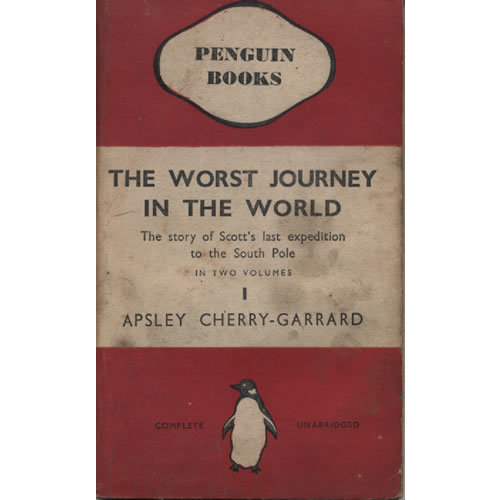
Apsley Cherry-Garrard (1886-1959) was one of the youngest members of Captain Scott's final expedition to the Antarctic. Cherry undertook an epic journey in the Antarctic winter to collect the eggs of the Emperor penguin. The temperature fell to seventy below, it was dark all the time, his teeth shattered in the cold and the tent blew away. 'But we kept our tempers,' Cherry wrote, 'even with God.'After serving in the First War Cherry was invalided home, and with the zealous encouragement of his neighbour Bernard Shaw he wrote a masterpiece. In The Worst Journey in the World Cherry transformed tragedy and grief into something fine. But as the years unravelled he faced a terrible struggle against depression, breakdown and despair, haunted by the possibility that he could have saved Scott and his companions. This is the first biography of Cherry. Sara Wheeler, who has travelled extensively in the Antarctic, has had unrestricted access to new material and the full co-operation of Cherry's family.
Sara Wheeler was brought up in Bristol and studied Classics and Modern Languages at Brasenose College, University of Oxford. After writing about her travels on the Greek island of Euboea and in Chile, she was accepted by the US National Science Foundation as their first female writer-in-residence at the South Pole, and spent seven months in Antarctica.
In her resultant book Terra Incognita: Travels in Antarctica, she mentioned sleeping in the captain’s bunk in Scott's Hut. Whilst in Antarctica she read The Worst Journey in the World, an account of the Terra Nova Expedition, and she later wrote a biography of its author Apsley Cherry-Garrard.
In 1999 she was elected a Fellow of the Royal Society of Literature. From 2005 to 2009 she served as Trustee of the London Library.
She was frequently abroad for two years, travelled to Russia, Alaska, Greenland, Canada and North Norway to write her book The Magnetic North: Travels in the Arctic. A journalist at the Daily Telegraph in the UK called it a "snowstorm of historical, geographical and anthropological facts".
In a 2012 BBC Radio 4 series: To Strive and Seek, she told the personal stories of five various members of the Terra Nova Expedition.
O My America!: Second Acts in a New World records the lives of women who travelled to America in the first half of the 19th Century: Fanny Trollope, Fanny Kemble, Harriet Martineau, Rebecca Burlend, Isabella Bird, and Catherine Hubback, and the author's travels in pursuit of them.
The reader may wonder if minus 60 feels any colder than minus 40. My own experience has taught me that it does. Once I threw a mug of boiling tea in the air at around minus 46 and the liquid froze before it hit the ice.
HOW TO GET REALLY RICH WITHOUT TRYING AT ALL
He was born in 1886. His father was a 53-year-old retired colonel who had been soldiering in India and South Africa for 25 years, then finally came back to England and got married. And the marriage was happy – imagine that!
It was known among the servants that they shared a bed – an unusual practice among the gentry
The soldier wasn’t rich but his elder brother was, and when the elder brother died without any children, viola, the retired colonel became a country squire with a big country house and farm and parklands and peasants and pheasants and all. Then some aunt or another died and left an even huger country estate to the colonel. So without lifting a finger, little Apsley became a millionaire.
The retired colonel was a rough diamond. When it turned out that Apsley had chronic short sight he refused to let his son wear glasses because the army did not allow soldiers to wear glasses. So his son stumbled and blurred his way through life until the old buffer relented when he was 15.
(Proust lovers will be interested to note that at his school Apsley became a prefect eventually and was then able to boss around the young Charles Scott-Moncrieff, future translator.)
When his father died aged 75, Apsley became Lord of the Whole Pile at the age of 21. Sweet!
SHAKING OFF THOSE POST-UNIVERSITY BLUES
He could have nibbled lark’s tongues and canoodled with duchesses for the rest of his life and no one would have dared to raise an eyebrow, but after he’d finished with Oxford University he got interested in the new Antarctic expedition which Captain Scott was assembling. He was 23 and he had nothing to do. Trekking to the South Pole with a bunch of Siberian ponies and dogs was something to do. More than that, it was a ripping adventure. He would be a man amongst men, like what you were supposed to be. And this turned out to be the first of the only two things he ever did in his life. The second thing was to write a book about the first thing.
But he couldn’t just waltz in to the expedition. Guys who actually had some useful scientific qualifications were queueing round the block to be hired for no pay, and Apsley was, frankly, just an enthusiastic short-sighted posh kid, so why should Captain Scott take him? He thought a minute and wrote a cheque for £1000 (= £110,000 in 2017). Later some of the guys joked that he had been selected “for his handy knowledge of Latin and Greek”.
So he was the youngest member of the expedition. And he was relentlessly cheerful. Scott wrote :
Cherry-Garrard has won all our hearts. He shows himself to be ready for any sort of hard work and is always to the front when the toughest jobs are on hand. He is the most unselfish, kind-hearted fellow
One of the tough jobs was being a stoker in the engine-room of the nasty old tub which was all Scott could afford. Shovel, shovel, shovelling all the coal for 4 hour shifts in the blazing heat.
Even stale, uncomfortable, and spotted with burning oil, he was happier than he had ever been.
Every other person on board the Terra Nova wrote a diary, and all the diaries were peppered with stuff like
Cherry is a rattling good chap and true as steel
Yes, it seems they really did talk like that in 1910.
LAUGHING HEARTILY AT CALAMITY
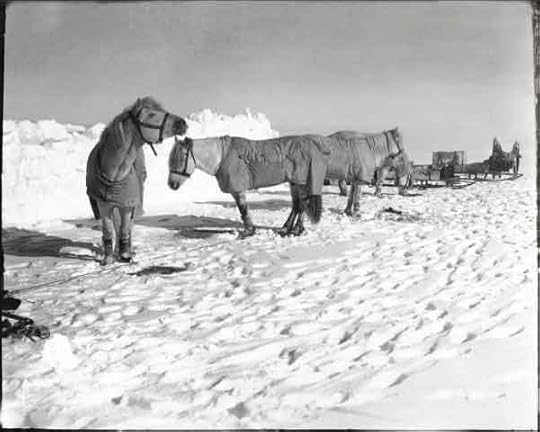
When they got to the Antarctic, all kinds of horrible catastrophes happened, which they thoroughly relished. For instance, they camped on sea ice which they thought was perfectly safe, but woke up in the middle of the night to find it had broken up, and they were all floating around on separate ice floes, with 12 foot killer whales leaping up between the ice floes and the ponies sliding into the water. They had to jump from floe to floe. Crazy times.
One guy summed up the living conditions :
Supper by candlelight in frozen sweaty gear with hoarfrost down one’s neck and over everything. Then a struggle to unroll the frozen [sleeping] bags, change into frozen finnesko [footwear] and wet warm socks… with luck you have melted the [sleeping] bag after two hours shivering and then you have all the feelings of a wet sponge bath till joy comes in the morning
But, wrote Cherry
there is many a worse and more elaborate life… the luxuries of civilisation satisfy only those wants which they themselves create
WRONG ABOUT PENGUINS
Why do guys put themselves through such horrible experiences? Well, just like the love of war, which not too many will admit to these days, they liked the extreme adrenalin rush of being challenged on a daily basis, of living at the extreme, of living a life opposite to that of the regulated besuited office and factory. And they loved to love the men they were with, and think they could lay their lives down for these men, and that the men would do the same for them. And finally, the thing was done in the name of a Noble Cause. For Scott the expedition was yes, to be the first to the South Pole, but also to do a whole lot of scientific research.
Scott’s expedition was scuppered from the very beginning though. He didn’t take enough dogs, and the Siberian ponies he was sold were old and clapped out; he also brought three motorised sledges which turned out to be unwieldy monstrosities.
The expedition was not a straightforward dash to the Pole at all, it was a series of scientific forages culminating in a journey to the Pole. Apsley and three other guys went off on one of these mini-expeditions, to collect the eggs of the Emperor penguin. This trip during winter nearly killed him and his colleagues, and it was all for nothing. The idea behind it was that the Emperor penguin was the most primitive bird on earth, and its embryos would show an evolutionary link between reptiles and birds. They thought that reptiles had evolved into birds via a flightless stage. This was the wrong way round; in fact, flightless birds evolved, or devolved, from flying birds. (The Natural History Museum in London ultimately declared that the three embryos the expedition obtained for them did not add to their existing knowledge of penguin embryology.)
A NOT UNTYPICAL SENTENCE
Finally, not having washed or changed their clothes for eight months, they sledged the 230 miles back to Cape Evans, still friends.
THREE YEARS OUT OF SEVENTY-THREE
The Antarctic expedition lasted from 1910 to 1913 and ended in disaster, as is well known. Scott was beaten to the South Pole by the Norwegian explorer Roald Amundsen, who knew what he was doing. Scott and the four colleagues chosen to accompany him to the South Pole itself all died. Cherry was racked with guilt for the rest of his life, he thought if he had pressed on with his revictualling trip Scott may have been rescued – the whole story is complicated. When he came back to England, still only 27 years old, he found he had very little to do except try to cope with these guilt feelings. The First World War came along to take his mind off his woes but he then developed the first of a lifelong series of ailments – colitis, rheumatism, bronchial this and that – plus depression. Then he thought of writing a book to purge all the demons, and that became the only other thing he ever did. It was called The Worst Journey in the World and was published to great acclaim in 1922 and is a classic of travel literature. He never wrote anything else.
Thorough and very well-written. It even answers some of the questions I had after reading an account of the "Northern Party" ... what happened to them afterwards? Well, Apsley Cherry-Garrard helped many of them, although in his own privileged way C-G also seemed stuck (or frozen) in the post-Antarctica void. This biography flags a bit as well, falling into the same void, although that is a reflection of C-G himself. His life was more interesting then, and overall he was a reflection of the times, from Victorian to 1960.
Sara Wheeler is one of the more talented writers I've come across during my Antartica reading binge.
Cherry-Garrard’s account of his time in the far south is called The Worst Journey in the World. In some ways, he returned from the south, but not from that journey.
I read Cherry's account of Scott's last expedition over 20 years ago, and was so caught up in it that I couldn't put it down. So when I heard there was a bio of the writer, I jumped on it. The book did not disappoint. It is a well-told description of a man haunted by PTSD before there was a name for it. Those interested in Cherry's story might enjoy the short BBC bio-pic on him starring Mark Gatiss.
In this biography, a survivor of Robert Scott's ill-fated 1910 polar expedition tries to grapple with a modern England.
I gather that the author became interested in this story after writing her Antarctica travelogue. I love the prior book, but this biography is not good. Wheeler is weirdly in love with her subject, eager to make apologies for him. ("The tension between competing demands and responsibilities, combined with a highly strung disposition, was a heavy burden for a young man. No wonder he got a third-class degree.") Her evaluation of his one book seems...overly generous: it was "a superlative piece of art that vaults above the human experience which gave it form." Also, she's apparently oblivious to how the historical record works. She makes a great deal about the amount of ink that Cherry-Garrad spills on his book deals and interprets this as a sign of his obsessive, neurotic fixation on the failed polar expedition -- which seems likely, but also, you know, letters about royalties to publishers is the kind of financial record that tends to survive. No historian worth her salt is going to see this particular documentary strata and think that their survival indicates anything about their biographical importance (beyond a possible plaintiff and a possible defendant keeping records in case of a possible lawsuit).
Also, the author is curiously...incurious about Cherry's patterns of human attachment. She blandly documents his passionately warm attachments to men, many of whom will later turn out to be either gay or into non-mainstream sexual practices. ("[T. H.] Lawrence suggested, 'If our sexes had been different (one of us, I mean) we could have pulled of a eugenicist's dream.'") Instead, Wheeler dutifully catalogs what information she has about his many girlfriends -- who never seem to have names or much in the way of documented existences, and who are treated with great ambivalence by Cherry-Garrad. ("In middle-age Cherry said he was afraid of women. He once told Lillie that a happy married life was impossible for him...") His eventual marriage, to a woman a generation younger than he, is presented by Wheeler as a happy union (and seems to be based on oral interviews with his surviving widow) but objectively seems less than satisfying. ("The irony was that the peaceful relief of his happy marriage allowed his anxieties to take hold.")
I read Cherry-Garrard’s The Worst Journey in the World many years ago without learning anything about the author except that the book itself was as good a tale as I’d heard.
Sara Wheeler’s biography is also a great book, well-written and sympathetic but man, he was a tragic character. He was, I think, the youngest and an unlikely member of Scott’s last Antarctic expedition in 1911; it was the high point in his life and nothing ever again came close. He was a privileged member of the upper-class but did not actually do anything beyond administer his family’s estate, which he didn’t like anyway and gradually sold off. It took him 10 years to write the definitive TWJITW and ever after he would keep rewriting the introduction in response to various criticisms and the publication of other books on the expedition. He was locked in depression throughout his life, mostly agonizing about whether he could have saved Scott (perhaps he was suffering from PTSD? Not sure, although he even appeared to benefit from ECT for a while). But that’s really all he did – obsess about what might have been or been done differently.
It's hard to know what to say about this book; it's a lot to take in, and it's not. Antarctica was the definitive experience of his life. I almost can't talk about it because I don't want to further analyze the man. It's an excellent read for anyone who loved The World Journey in the World and enjoys biography.
Once again, I am struck by what I think was the almost amateurish nature of the Scott expedition. It seemed both obsessively overplanned (dogs, ponies, machine sledges AND man-hauling) and underplanned (snap decisions about who would go to the Pole, bringing dogs further than everyone else expected, sending three men, Cherry included, on a murderous winter journey). I know I'm not an Antarctic explorer, but there seems to have been so much blindness, sentimentality, and emotion that went into the expedition. One expects attachments and friendships among the men, but not a kind of wobbling, emotional leadership. Ok, I've finished the Rant.
Cherry, as this biography leads me to conclude, was a victim of this expedition. Of course, as a young man, he showed monumental endurance and courage on "The Worst Journey in the World" - and the book of that title is itself an enduring marvel. But the biography shows how very disabled he was throughout his life. He suffered depressions that were sometimes catatonic. He had bodily ailments that were psychosomatic. He had ailments that were real and perhaps often due to his time on the expedition. For example he lost most of his teeth, I think, because they'd frozen! He seemed to seek shelter in class outlook and lifestyle (though I admit that this feature of British life in the past escapes me as I can't believe it was as revolting as I think it was). Yet, though he remained a very rich man, he sold off all his landed possessions. As a testament to his younger sweet nature, he was partner in a loving marriage.
The author of the biography presents all of these facets and contradictions of Cherry's life. The beauty of her accomplishment is that she shows us a beautiful, enthusiastic young man lifted by circumstance to the utmost acts of extended courage and loyalty; that he was subsequently able to work out some of his inner anguish (the right word, I think) in what is one of the world's greatest travel books; and that his subsequent intermittent happiness depended on a strong relationship with a remarkable woman.
I had mixed feelings buying this book because I thought it would mainly focus on the depression Cherrry had in his later life after the ill fated antarctic expedition and how he coped with it. Of course, a large part of this book is exactly about that incident, but it isnt boring or makes the reader skip pages.
This biography includes many information of his childhood, such as cute letters he wrote to his mother as a five year old! Cherry then studied at Oxford and after his fathers death became he basically a young multimillionaire. 1910 he met Wilson and signed up for the Terra Nova expedition. The only reason why I didnt rate this book 5 stars is, that the expedition is portrayed so shortly. Merely 2 chapters. the South Pole Journey is described in 2 pages only.
The part after the expedtion focuses on the friendships he made in antarctica and especially those friends to which he kept contact till his death. This and the story of his book "The Worst Journey In The World" (I STRONGLY RECOMMEND THIS ONE!!!) were the most interestong part in this book, for the most readers dont know much about these process.
I loved the writing style of the author, since its easy to understand, light but has a certain depth. So, for all people who want to know more about Apsley Cherry-Garrard and his life, especially after the expedition, this book is a goldmine!
My interest flagged after the telling of the ill-fated polar expedition of 1910-13; there's a lot of detail here about that. Cherry lived a fascinating life, well a few years of it was anyway to be sure, but first-rate adventure comes up against third-rate personality. In many ways this is an attempt to write the biography of a man whose big moment had been lived before he reached the age of thirty, and who shows little intellectual growth past his pampered public school days. "The world spun away from Cherry," writes Wheeler, and similarly her narrative struggles to find an anchor after 1913.
After reading The Worst Journey in the World, I became interested in Apsley Cherry-Gerrard's life. This is a well-researched biography that gives Cherry-Gerrard's book context.
‘Accept yourself: be yourself. That seems a good rule. But which self? Even the simplest of us are complicated enough.’
I read Worst Journey in the World and fell in love from the first word. I have read many polar books but very few have moved me like that. The author was endearing from the very start – endearing, sensitive, and beautifully evocative of the human spirit. I needed to know more about dear Cherry, the man who went from wide-eyed wonder to deep feelings of guilt and trauma.
This biography is a brilliant and emotional assessment of him. The sections about the Antarctic are fascinating and ultimately haunting. That continent followed Cherry to the end of his life, through PTSD, physical ailments, and the success of his brilliant memoir. I knew a bit about him before but was not wholly prepared for the sad tragedy that threaded throughout the rest of his life upon his return. It was not only that; there were moments of happiness and relief, but this biography is nevertheless heavy and moving.
Other polar explorers are intriguing, but there are not many who are so relatable. Despite Cherry’s great wealth and privilege, his life was troubled and riven with the same stresses and anxieties that many feel and anyone who has suffered with mental health issues (me included) will have sympathy for. There is something about him in particular that I find so captivating and moving. And I only realised through reading this just how much history Cherry witnessed, from the late Victorian period to the 1950s, from sailing ships to early spaceships.
I highly recommend the Worst Journey in the World. And I apologise to friends and family for bombarding them with information about Cherry over the last few months. But there’s a reason I am going on a pilgrimage to Wheathampstead soon, something I have done for very few historical figures, even as a total history nerd.
Fleshes out the life of Apsley Cherry-Garrard, member of Scott's Terra Nova expedition, and author of the most lasting account of the trip -- The Worst Journey in the World.[return][return]The book divides roughly into three parts: before, during and after the Antarctic journey. Whilst the "during" is well covered by "The Worst Journey", from the distance of 80 years further on Sara Wheeler is more able to objectively bring out more of the tensions of the trip. The "before" concerns Cherry's privileged upbringing and inheritance of vast amounts of property at a young age. This was at a time of social change in Britain, and this continues as a theme in the "after", where Cherry feels increasingly persecuted by it. The "after" follows Cherry's authorship of TWJ and his directionlessness after the Terra Nova expedition, having no career to return to. Throughout this time and to the end of his life, Cherry suffered greatly both mentally and physically conditions which were little understood at the time.[return][return]Like Sara Wheeler's other books on the poles, it is written with a lively style which, like TWJ, brings out the human and spiritual aspects of polar exploration. Of interest to both those unacquainted with polar exploration, and those who aim to fill in some of the gaps and surrounds in what they already know.
While Cherry-Garrard's exploits in the Antarctic are the centrepoint of this meticulous biography, I was equally fascinated by the bookends - the life of young and old Cherry. An Edwardian, old-fashioned, landed, conservative, he lived through two world wars and 'The Worst Journey in the World'. In many ways, his was an extraordinary life, and Sara Wheeler's book is compassionate and thorough. Absorbing reading.
Fabulous and yet utterly heartbreaking. Such a waste of a future life. It's hard to give a balanced review of a book that had me in tears more than once. One of those books that calls to be re-read but you know it will hurt you again.
A historian / polar enthusiast's wet dream. Intimidatingly well-researched and immensely stirring.
Its faults (self-indulgence in the main) are forgivable and perhaps even admirable. Like Cherry, they are an understandable and inseparable part of the whole.
I started this book but lost the desire to read further and shelved it, not sure why because ACG's book 'The Worst Journey in the World' is an all time best read. I picked it up again recently and read right through in a few days (quick for me). This time it grabbed me and I really enjoyed the biographer Sara Wheeler's writing style. Cherry was one of those privileged gentry who inherited big time wealth and never had to 'work' for a living. Being on the Scott expedition to the South Pole in 1911-13 (he bought his way in with a 1000 pound donation) as an assistant naturalist was to shape his whole life and he was an integral member of the party. His neighbor in the English counties was George Bernard Shaw who befriended, mentored and encouraged him in writing the account of his part in the expedition which became so widely read and loved. His life thereafter was full of anxieties despite his wealth and dogged by the persistent guilt and worry over whether he could have ventured a little further from One Ton Camp and possibly saved his friends Edward (Bill) Wilson and Henry 'Birdie' Bowers who perished with Scott and with whom Cherry had made the fabled winter journey to Cape Crozier in a quest for penguin eggs. An excellent biography for those with a fascination for Antarctica and the people who ventured out to explore its severe climate with supreme tests of endurance.
This is a hard book to review. I feel frustrated, mostly because I find its subject to be a frustrating character. I might be the only reviewer who hasn’t finished “The Worst Journey in the World.” I started it years ago and have not been able to power through the pit in my stomach that pops up whenever I read about the Terra Nova expedition. Perhaps now I am equipped to read it with a fuller understanding of its author and what he went through.
My sympathy for Cherry has increased now that I know about his terrible suffering. However, the sympathy is tempered by the knowledge that Cherry just wasn’t a very nice person. He “peaked” in Antarctica. He returned to England just as snobby as he always was. It’s hard to love people who don’t love themselves. Cherry’s mental health was not his fault, but it was his responsibility, and he failed to meaningfully address it until late in life. It seems that his young and energetic wife was the catalyst. Poor woman, I hope she found happiness eventually.
This book was a smidge too hagiographic for my tastes, and I disliked Wheeler’s uneven use of nicknames. The book ends quite abruptly with Cherry’s death, no conclusions or excerpts from obituaries or anything. Generally one would summarize or try to make a final point. But it’s hard to make heads or tails of this life. It was long and sad and mostly fruitless.
I have read a good bit about the Scott Antarctic expedition, and finally read Cherry-Garrard’s Worst Journey in the World this past year. Wheeler’s book Cherry, A Life of Apslety Cherry-Garrard is a wonderful treat. She writes beautifully and she explores all the issues that fascinate me about why people put themselves into dangerous, life-threatening situations, and how people respond ethically in such situations. I particularly liked that Wheeler had lived in Antarctica for 3months and was able to talk about being outside in minus 40 degree and minus 60 degree weather. I liked her choice of detail – Cherry’s own book is painfully detailed, so much so that I almost lost the impact of some of his experiences. I liked that she was sympathetic but also honest in her descriptions of Cherry and others on and that she looked at the impact of British Victorian-Edwardian culture on the expedition.
If you only read one book about the Scott expedition, it should be this one.
I highly rate this book. The author did a magnificent job researching and writing about Apsley Cherry-Gerard who himself wrote a brilliant book which I have read. It apparently was not easy to obtain much of the background and details she put in it and it all came together seamlessly. I was enamoured of her lyrical writing style and use of descriptive words, many of which were unfamiliar to me but easy to look up on the Kindle. I now have a fuller vocabulary as a result. The book was so wonderful that I am inspired to re-read The Worst Journey. Both, in my opinion, are works of art! The story of what Robert Falcon Scott's final journey to the Antarctic and what the men endured in a bleak but beautiful land is the stuff of epic and legend. And the biography of the man that documented it the best is a wonderful exploration into an exceptional human.
This is an absorbing but also rather sad biography of a man who was engaged in incredible and tragic events early in his life, and spent much of the rest of it dealing with the fallout - both his physical issues as a direct result of overwork (what he achieved without actually dying in Antarctica is mind boggling) and also what we might call today PTSD or survivor's guilt. The author's breezy style is easy to read, even when she is discussing difficult times. Her research includes some passages from expedition member's private journals, including Cherry-Garrard's, that are a contrast to the official accounts and reveal that things were not quite as rosy all the time as the official hagiography after the fact required. This injects some humanity into the group without detracting from their overall achievement. I do think her breezy approach leads her into some statements that I disagree with. In sum this is a worthwile complement to "The Worst Journey."
This was fascinating for someone who is obsessed with A.C-G. And so terribly sad. As others have said, his major life experience happened at 24. Although writing one of the best books ever was also an incredible achievement, it just seemed to keep him in a cycle he couldn’t escape from. Growing up never having to work nor want of anything messed him up badly. In some ways he sounds like a pretty awful adult; in others, it seems as if he just never grew up and as if he was craving guidance after losing his father and then Wilson (possible father figure?). I didn’t want this to end as now I know everything there is to know about Apsley Cherry-Garrard. I’ll never learn another new thing about him :(
His Antarctic experiences both made and ruined Cherry. They resulted in his magnificent book, The Worst Journey in the World, but were also instrumental in causing his prolonged bouts of depression which in turn caused much physical illness. Cherry also could not adjust to the changing times and ways of life after the First World War which did not help his mental state. He married late in life and his wife, Angela, thirty years his junior, was indeed an angel to look after him so selflessly.
Most people view Scott's ill fated journey to the South Pole via the lens of the 1948 movie featuring John Mills. Naturally, the reality is somewhat different. Some, like Cherry, contended Scott as stiff upper lip Sir Galahad style hero was wide of the mark. He apparently lacked humour and was somewhat curmudgeonly. But everyone has a different perspective and this is an energetic portrayal of a landowning toff who sought a reason for living throughout his life. The sheer strength of will of the Polar pioneers is admirable but many later faced demons in their less adventurous real lives.
What is sad commentary on the effects of aunt arctic exploration explanation and a man who became stuck in what he considered the biggest and deadly mistake of his life. Cherry was anything but cheery. It’s amazing to think of the changes he witnessed in his life. I’m only now starting to realize how badly England suffered from the wars, and for how long. It hasn’t ended.
This is a really excellent biography. It's quite hard to remain compelling reading when the pivotal event in a person's life happens early on, but Sara Wheeler manages it. It is ultimately a very moving book to the end.
Very well written, filled in a lot of blanks. It's a pity that we are not told what became of Angela after her dedication. I very much hope she had a happy and comfortable life, and that she found love after Cherry. Only thing I didn't like was the constant use of nicknames.