

What do you think?
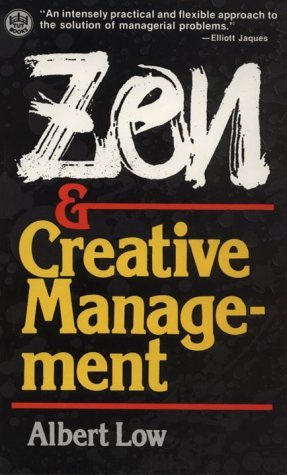
Zen and Creative Management
Book by Low, Albert
280 pages, Paperback
First published January 1, 1976
About the author
Albert Low
50 books7 followersAlbert William Low was a western Zen master in the Philip Kapleau-lineage, an internationally published author, and a former human resources executive. He lived in England, South Africa, Canada, and the United States and resided in Montreal since 1979. He held a BA degree in Philosophy and Psychology, and was a trained counselor. In 2003, he was awarded an honorary degree of Doctor of Laws for scholastic attainment and community service by Queen's University, in Kingston, Ontario.
Ratings & Reviews
Friends & Following
Create a free account to discover what your friends think of this book!
Community Reviews
Displaying 1 - 1 of 1 review

May 12, 2026
I went through most of this book thinking, where is the Zen? Is this really Zen and creative management, i.e., applying Zen to creative management, or a Zen master's views on (creative) management? What even is creative management? Does it just apply to business, or beyond?
It will become clear from the conclusion that the whole book is steeped in Zen, according to the author. To him, Zen is learning how to live creatively, which means how to handle dilemmas, which are problems with no solutions that arise out of polarities, which themselves are essential to existence. And businesses are microcosms of the universe, since they are a field in which structure and process play out. Structure is basically creating the conditions for the game, and process is how to play it.
It is often disdained about talking directly in Zen about Zen. This is called "stinking of Zen". So it seems that the author wanted to avoid the Zen stink, and write a Zen book without the reader really knowing it for most of the book, expect for a mention of zazen (curiously capitalised in the book) here and there. Yet, it also felt that Zen was shoehorned in the end of the book. It went very heavy. Low even recommended the manager to practice zazen for general improvement of character, known as "ordinary Zen" in this tradition.
There are many fascinating insights about business, psychology, spirituality and even metaphysics in this book. I totally agree with his assessment that businesses are not owned solely by their shareholders, but rather also the employees and the customers, and that businesses should not prioritise profit above all else. So he anticipated ESG and corporate responsibility in many ways. He takes a positive view of the potential of business, and this is a bit contagious. I also really liked his insights about territory and how different business departments can complement each other.
It will become clear from the conclusion that the whole book is steeped in Zen, according to the author. To him, Zen is learning how to live creatively, which means how to handle dilemmas, which are problems with no solutions that arise out of polarities, which themselves are essential to existence. And businesses are microcosms of the universe, since they are a field in which structure and process play out. Structure is basically creating the conditions for the game, and process is how to play it.
It is often disdained about talking directly in Zen about Zen. This is called "stinking of Zen". So it seems that the author wanted to avoid the Zen stink, and write a Zen book without the reader really knowing it for most of the book, expect for a mention of zazen (curiously capitalised in the book) here and there. Yet, it also felt that Zen was shoehorned in the end of the book. It went very heavy. Low even recommended the manager to practice zazen for general improvement of character, known as "ordinary Zen" in this tradition.
There are many fascinating insights about business, psychology, spirituality and even metaphysics in this book. I totally agree with his assessment that businesses are not owned solely by their shareholders, but rather also the employees and the customers, and that businesses should not prioritise profit above all else. So he anticipated ESG and corporate responsibility in many ways. He takes a positive view of the potential of business, and this is a bit contagious. I also really liked his insights about territory and how different business departments can complement each other.
Displaying 1 - 1 of 1 review