

What do you think?

Le Séminaire #1
Les Ecrits Techniques De Freud
Hard to Find book
448 pages, Pocket Book
First published January 1, 1953
About the author
Jacques Lacan
189 books1,309 followersJacques-Marie-Émile Lacan was a French psychoanalyst, psychiatrist, and doctor, who made prominent contributions to the psychoanalytic movement. His yearly seminars, conducted in Paris from 1953 until his death in 1981, were a major influence in the French intellectual milieu of the 1960s and 1970s, particularly among post-structuralist thinkers.
Lacan's ideas centered on Freudian concepts such as the unconscious, the castration complex, the ego, focusing on identifications, and the centrality of language to subjectivity. His work was interdisciplinary, drawing on linguistics, philosophy, mathematics, amongst others. Although a controversial and divisive figure, Lacan is widely read in critical theory, literary studies, and twentieth-century French philosophy, as well as in the living practice of clinical psychoanalysis.
Lacan's ideas centered on Freudian concepts such as the unconscious, the castration complex, the ego, focusing on identifications, and the centrality of language to subjectivity. His work was interdisciplinary, drawing on linguistics, philosophy, mathematics, amongst others. Although a controversial and divisive figure, Lacan is widely read in critical theory, literary studies, and twentieth-century French philosophy, as well as in the living practice of clinical psychoanalysis.
Ratings & Reviews
Friends & Following
Create a free account to discover what your friends think of this book!
Community Reviews
Displaying 1 - 30 of 39 reviews

October 26, 2018
All the people in the world who know I'm baptizing myself in Lacan could fit in the same car with me. They've already heard what I think, there's probably some understanding, a few care. But I'll say it again. The path of traversed fantasies leading through subjective destitution is narrow and crooked, but the paradisaical lure of shedding one's mortal contingencies is heavenly.
October 24, 2011
I'm not quite as blown away as I was with Seminar no.3 on the Psychoses, but, as always, Lacan is a pleasure to read, if not a little frustrating/demanding. This is earlier in his career when he's more interested in the symbolic register's situation over and against the real and the imaginary (as opposed to his later work which is trendier among humanities' students, wherein the real as impossible or as lack is emphasized against the imaginary and the symbolic orders)--for that reason it gives a clear if rudimentary account of the symbolic.
And again, as with The Psychoses, this course begins at a slow crawl; the first forty pages or so seem to wander in all directions (dry, disparate, needless directions). But Lacan is a tailor of a pedagogue: he promises to piece together any loose threads and he delivers. The occasional explosive spurts of enrapture are worth the dry spells. Good read.
And again, as with The Psychoses, this course begins at a slow crawl; the first forty pages or so seem to wander in all directions (dry, disparate, needless directions). But Lacan is a tailor of a pedagogue: he promises to piece together any loose threads and he delivers. The occasional explosive spurts of enrapture are worth the dry spells. Good read.

September 30, 2021
Freud, eu te amarei para sempre

June 1, 2026
intr-o zi voi reusi sa inteleg totul, dar azi ma gandesc doar la flori, oglinzi si vaze
March 15, 2026
Bueno, le hice la promesa de escribir una reseña a cierta usuaria de goodreads que lanzó brutales acusaciones de que pertenezco a una secta (quizás tiene un punto):
Tuve el placer de leer este 1er Seminario en grupo durante un año, tarea que me hubiese sido imposible de forma solitaria. Gracias a eso me terminé llevando un montón de cosas de un autor que durante la facultad se me hacía hermético, incomprensible, irritante.
Ya veré adónde fue después de esto, pero acá brilla todo el poder del estructuralismo para pensar la subjetividad y la realidad humana.
Recordar o revivir la historia en términos biográficos queda en un segundo plano durante el análisis, porque lo que cuenta es lo que se reconstruye y reescribe, y en todo la historia es lo que la palabra ha hecho con cada uno. El lenguaje, el discurso, y el inconsciente como realidad material; sistema simbólico en torno al cual el resto de los registros de la realidad se ordenan. Escuchar lo que en el discurso del analizante o paciente el significante manifiesta a través, o a pesar, del sujeto.
De a momentos sigue siendo tan difícil de entender como antes, pero me queda la convicción de que fue un pensador y psicoanalista brillante.
Tuve el placer de leer este 1er Seminario en grupo durante un año, tarea que me hubiese sido imposible de forma solitaria. Gracias a eso me terminé llevando un montón de cosas de un autor que durante la facultad se me hacía hermético, incomprensible, irritante.
Ya veré adónde fue después de esto, pero acá brilla todo el poder del estructuralismo para pensar la subjetividad y la realidad humana.
Recordar o revivir la historia en términos biográficos queda en un segundo plano durante el análisis, porque lo que cuenta es lo que se reconstruye y reescribe, y en todo la historia es lo que la palabra ha hecho con cada uno. El lenguaje, el discurso, y el inconsciente como realidad material; sistema simbólico en torno al cual el resto de los registros de la realidad se ordenan. Escuchar lo que en el discurso del analizante o paciente el significante manifiesta a través, o a pesar, del sujeto.
De a momentos sigue siendo tan difícil de entender como antes, pero me queda la convicción de que fue un pensador y psicoanalista brillante.

May 21, 2025
Lacan has absolutely shattered my mind, his technical precision is so so good even when I don’t understand entirely what he is saying it’s enough to trust his thinking. His dissection of ego the unconscious the Oedipal complex formed the next 60 years of theoretical thinking, I see it reverberated everywhere museums, movies plays Im a massive dickrider idgaf. I have to read more of his seminars such a rewarding speaker.

February 5, 2023
I don’t know what I’ll ultimately get from reading through Lacan’s Seminars but I do feel like I had to stretch my thinking and test my reading and interpretive skills. I felt fairly confident in reading the first 100 pages or so and needed some additional references to help with probably the last 50 when Lacan and company started to incorporate reference to Hegel, Sartre, Augustine, and others. It would have helped if I had read a few of Lacan’s essays from Ecrits before starting here. I’ll add that I’m not a fan of the editor’s work here. More contextual footnotes would have been especially appreciated; maybe even a smart preface to give me a sense of some of the debates and case studies being engaged with here. I had some issues with the inconsistencies in which some of the German and French gets translated and other times it wasn’t. Foucault’s lectures by comparison were excellently translated and edited to help guide readers through a lot of unfamiliar context, terms, developments in Foucault’s thought and the thought of his contemporaries. Looking forward to reading Seminar 2 but not because of the editorial work.

June 22, 2024
Oh my - I have dreaded writing this review.
Upon completing Lacan's first seminar, I found myself at a loss for words, my initial reaction being simply, "WTF?"
As a matter of fact, I postponed writing it as much as I could - I am at the moment deep into Lacan's seminar I have chosen to read next, "The Four Fundamental Concepts of Psychoanalysis" (Seminar XI).
Lacan is some kind of a sorcerer of words - every sentence makes sense, some paragraphs do and some don't. Yet reading a whole bunch of them together, there appears to be no sense at all, no unifying theme on a first inspection. However, I found myself clearly enjoying this borderline nonsense quite intensely, and having finished reading it - I feel as if I have learned a lot, even though I cannot describe what it is that I have learned at all.
It seems like the general recommendation is to start with Lacan's 11th and 7th seminars, and to read this first seminar only later - too bad I encountered this advice only when I was more than 100 pages into this one! No harm done - I plan to continue reading Lacan's seminars as I have enjoyed reading this one quite a lot, taking this beautiful chaos in.
It is quite certain I have missed a lot of what Lacan has to say, and would probably re-read this seminar again at a later date, armed with a better understanding of Lacan, better reading comprehension - especially of his unique style, and a better grasp of the history of psychoanalysis around this period.
Lacan's style
Lacan is probably the most chaotic "serious" author I have encountered, at least in this seminar. He never states his points clearly, instead using allegories, examples, wordplay, and optical schemas, "commenting on his own ideas". The following quote might shed some light on his aims:
Ego-ideal and ideal ego - an exemplification of Lacan's style
Lacan's associative writing jumps from topic to topic without clear demarcation, never stating his claims explicitly. The text disguises itself as an intertextual commentary and an interpretation of cultural phenomena and works - mostly by Freud. I say "disguises itself" as Lacan's interpretations are definitely not the intention of the original authors commented on by him. A good example is Freud's use of Ich-ideal ("ego-ideal") and Idealich ("ideal ego"), which are - according to most Freud scholars - used interchangeably, and were replaced by "Über-Ich" ("superego") in "The Ego and the Id" and subsequent writing.
The origin of the distinction is Freud's short paper "On Narcissism: An Introduction". I went ahead and read the English translation, and given Freud's generally readable style and stating of newly defined terms, I would find it extremely unlikely that such a distinction was intended by Freud. The term "ideal ego" is mentioned twice on page 24, upon the introduction of the idealization process, and is never repeated again. "Ideal ego" is used as the syntax of common language would dictate prior to coining the "ego-ideal" term (and Freud, unlike Lacan, follows syntactical rules and does not attempt to break them). Of course, stating this claim with confidence would require learning German and reading the original which I do not intend to do, but I am content with my conclusion.
Lacan distinguishes these three different constructions dealing with the self-perception of the human being:
Lacan uses an optical allegory next to help explain his distinction:
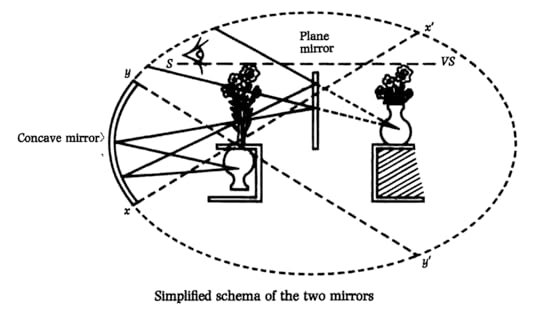
For Lacan, the ego-ideal is the process of the ego viewing itself from the perspective of its own ideal standard (often judging itself as currently insufficient), while the ideal ego is the ego identifying with and striving for this perfect ideal (Similar points were made independently by Karen Horney in her explanation of the neurotic process in Neurosis and Human Growth).
I do not think Lacan was wrong to make this distinction, but attributing it to Freud is completely unsound.
Such is Lacan's style. Reading him is sometimes similar to reading the Jewish Talmud and Jewish Midrashim, an intertextual commentary pretending to explain the original, while introducing new concepts and original ideas in the process.
Lacan's writing is ripe with wordplay (including interlingual ones in German - French - English), allegories from mathematics and optics, and more exotic forms of presenting his ideas. However, one central thing is missing - stating his ideas clearly. Most authors would start by presenting their ideas, follow them with examples, allegories and historical references - for Lacan (at least in this seminar) only the second part exists.
Moreover, Lacan's geometrical, mathematical, optical and wordplay-ish allegories are definitely well thought out in advance - often he will make some geometrical schema, explain it in the context of the currently discussed topic, and refer to it dozens of pages later in a different chapter, commenting about the meaning of some geometric structure in it not previously discussed. A genius, no doubt, but a didactic catastrophe.
Lacan's purpose
Lacanian psychoanalysis is a method of interpreting and generating texts, mainly the speech of the patient in clinical settings. Lacan's message is to listen to what the client has to say between the lines - interruptions, jokes, wordplay and allegories chosen by the patient.
In these, he argues, the truth comes through - there are censoring processes in our psyche, but they often fail on the occasions when the complexity of the text rises beyond a certain threshold or when the response is immediate (as in interruptions).
It seems as if his "didactic" style adopts this same interpretation method - to understand Lacan, the student needs to develop the capability of reading the subtext of all the allegories and word play, hence stating his points clearly would be counterproductive.
This makes reading his text self-exemplifying and isomorphic to that of an analysand lacking in self-awareness in psychotherapy.
I have lately gotten a copy of his magnum opus, the Écrits (Review definitely not forthcoming any time soon). In one of the introductory papers, serving as a sort of prologue, "On My Antecedents", he writes:
Lacan asks to be judged from the perspective of someone who has already familiarized himself with his ideas, and claims to have sown the seeds for what is to come in his earlier texts - and an early text this seminar is. He also mentions "insertion of the unconscious into language" - and given the way the unconscious shines through in "inappropriate speech", lalangue as Lacan coins the term, I would say he did what he intended to do.
Metadata
Before attempting to read this seminar, make sure you have either a dictionary application for French and German or some web service that would aid you with translation of the different terms as they arise, as otherwise you would be completely lost.
I found great joy in Lacan's various references and stories interwoven into the text, and I plan to continue reading Lacan's seminars. However, I cannot give it a rating higher than 6/10, due to the lack of clarity around the purpose and main points of this text, which purports to be didactic in the usual, non-metadiscursive sense. A book of linear algebra written in mirrored text and applying shear to fonts would not get a higher score either.
Length: 5/10
Joy of reading: 8/10
Language difficulty: 9/10
Difficulty of comprehension: 9/10
Rating: 6/10
See original at: https://kanhar.notion.site/Lacan-s-S1...
Upon completing Lacan's first seminar, I found myself at a loss for words, my initial reaction being simply, "WTF?"
As a matter of fact, I postponed writing it as much as I could - I am at the moment deep into Lacan's seminar I have chosen to read next, "The Four Fundamental Concepts of Psychoanalysis" (Seminar XI).
Lacan is some kind of a sorcerer of words - every sentence makes sense, some paragraphs do and some don't. Yet reading a whole bunch of them together, there appears to be no sense at all, no unifying theme on a first inspection. However, I found myself clearly enjoying this borderline nonsense quite intensely, and having finished reading it - I feel as if I have learned a lot, even though I cannot describe what it is that I have learned at all.
It seems like the general recommendation is to start with Lacan's 11th and 7th seminars, and to read this first seminar only later - too bad I encountered this advice only when I was more than 100 pages into this one! No harm done - I plan to continue reading Lacan's seminars as I have enjoyed reading this one quite a lot, taking this beautiful chaos in.
It is quite certain I have missed a lot of what Lacan has to say, and would probably re-read this seminar again at a later date, armed with a better understanding of Lacan, better reading comprehension - especially of his unique style, and a better grasp of the history of psychoanalysis around this period.
Lacan's style
Lacan is probably the most chaotic "serious" author I have encountered, at least in this seminar. He never states his points clearly, instead using allegories, examples, wordplay, and optical schemas, "commenting on his own ideas". The following quote might shed some light on his aims:
Yes... You see, there are two ways of applying a discipline which is structured as a teaching. There's what you hear, and then what you make of it. These two planes do not overlap, but they can be made to join up in a certain number of secondary signs. It is from this angle that I see the fertility of every truly didactic action. It is not so much a question of transmitting concepts to you, as of explaining them to you leaving you the task, and the responsibility, of filling them in. But something else is perhaps even more imperative, which is to point out to you those concepts which should never be made use of.
- Chapter XXII, The concept of analysis
Ego-ideal and ideal ego - an exemplification of Lacan's style
Lacan's associative writing jumps from topic to topic without clear demarcation, never stating his claims explicitly. The text disguises itself as an intertextual commentary and an interpretation of cultural phenomena and works - mostly by Freud. I say "disguises itself" as Lacan's interpretations are definitely not the intention of the original authors commented on by him. A good example is Freud's use of Ich-ideal ("ego-ideal") and Idealich ("ideal ego"), which are - according to most Freud scholars - used interchangeably, and were replaced by "Über-Ich" ("superego") in "The Ego and the Id" and subsequent writing.
The origin of the distinction is Freud's short paper "On Narcissism: An Introduction". I went ahead and read the English translation, and given Freud's generally readable style and stating of newly defined terms, I would find it extremely unlikely that such a distinction was intended by Freud. The term "ideal ego" is mentioned twice on page 24, upon the introduction of the idealization process, and is never repeated again. "Ideal ego" is used as the syntax of common language would dictate prior to coining the "ego-ideal" term (and Freud, unlike Lacan, follows syntactical rules and does not attempt to break them). Of course, stating this claim with confidence would require learning German and reading the original which I do not intend to do, but I am content with my conclusion.
Lacan distinguishes these three different constructions dealing with the self-perception of the human being:
Let us say that, in the animal world, the entire cycle of sexual behaviour is dominated by the imaginary. On the other hand, it is in sexual behaviour that we find the greatest possibilities of displacement occurring, even in animals. We already make use of it for experimental purposes when we present the animal with a lure, a false image, a male partner which is only a shadow bearing the dominant characteristics of the said animal. At the time of the manifestations of the phenotype that, in many species, occur at this biological moment which calls for sexual behaviour, the offering of this lure is sufficient to release the sexual behaviour. The possibility of displacement, the illusory, imaginary dimension, is essential to everything pertaining to the order of sexual behaviour.
Is this true for man, yes or no? This image could be it, this Idealich we've just been talking about. Why not? Still, it wouldn't occur to us to call this lure the Idealich. So where are we going to put it? Here my little apparatus reveals its virtues.
What are its implications? I've already explained to you the physical phenomenon of the real image, which can be produced by the spherical mirror, be seen in its place, be inserted into the world of real objects, be accommodated in it at the same time as real objects, even bringing to these real objects an imaginary disposition, namely by including, excluding, locating and completing them.
- Chapter XI, Ego-ideal and ideal ego
Lacan uses an optical allegory next to help explain his distinction:
For Lacan, the ego-ideal is the process of the ego viewing itself from the perspective of its own ideal standard (often judging itself as currently insufficient), while the ideal ego is the ego identifying with and striving for this perfect ideal (Similar points were made independently by Karen Horney in her explanation of the neurotic process in Neurosis and Human Growth).
I do not think Lacan was wrong to make this distinction, but attributing it to Freud is completely unsound.
Such is Lacan's style. Reading him is sometimes similar to reading the Jewish Talmud and Jewish Midrashim, an intertextual commentary pretending to explain the original, while introducing new concepts and original ideas in the process.
Lacan's writing is ripe with wordplay (including interlingual ones in German - French - English), allegories from mathematics and optics, and more exotic forms of presenting his ideas. However, one central thing is missing - stating his ideas clearly. Most authors would start by presenting their ideas, follow them with examples, allegories and historical references - for Lacan (at least in this seminar) only the second part exists.
Moreover, Lacan's geometrical, mathematical, optical and wordplay-ish allegories are definitely well thought out in advance - often he will make some geometrical schema, explain it in the context of the currently discussed topic, and refer to it dozens of pages later in a different chapter, commenting about the meaning of some geometric structure in it not previously discussed. A genius, no doubt, but a didactic catastrophe.
Lacan's purpose
Lacanian psychoanalysis is a method of interpreting and generating texts, mainly the speech of the patient in clinical settings. Lacan's message is to listen to what the client has to say between the lines - interruptions, jokes, wordplay and allegories chosen by the patient.
In these, he argues, the truth comes through - there are censoring processes in our psyche, but they often fail on the occasions when the complexity of the text rises beyond a certain threshold or when the response is immediate (as in interruptions).
It seems as if his "didactic" style adopts this same interpretation method - to understand Lacan, the student needs to develop the capability of reading the subtext of all the allegories and word play, hence stating his points clearly would be counterproductive.
This makes reading his text self-exemplifying and isomorphic to that of an analysand lacking in self-awareness in psychotherapy.
I have lately gotten a copy of his magnum opus, the Écrits (Review definitely not forthcoming any time soon). In one of the introductory papers, serving as a sort of prologue, "On My Antecedents", he writes:
I thus find myself situating these texts in a future perfect: they will have anticipated my insertion of the unconscious into language. In seeing them spread out over the years that were not very full, aren't I exposing myself to the reproach of having given into dwelling on the past?
Apart from the fact that I certainly had to gain a following in our field of practice, I will plead that I could do no better during that time than prepare my audience.
- Écrits, “On My Antecedents”
Lacan asks to be judged from the perspective of someone who has already familiarized himself with his ideas, and claims to have sown the seeds for what is to come in his earlier texts - and an early text this seminar is. He also mentions "insertion of the unconscious into language" - and given the way the unconscious shines through in "inappropriate speech", lalangue as Lacan coins the term, I would say he did what he intended to do.
Metadata
Before attempting to read this seminar, make sure you have either a dictionary application for French and German or some web service that would aid you with translation of the different terms as they arise, as otherwise you would be completely lost.
I found great joy in Lacan's various references and stories interwoven into the text, and I plan to continue reading Lacan's seminars. However, I cannot give it a rating higher than 6/10, due to the lack of clarity around the purpose and main points of this text, which purports to be didactic in the usual, non-metadiscursive sense. A book of linear algebra written in mirrored text and applying shear to fonts would not get a higher score either.
Length: 5/10
Joy of reading: 8/10
Language difficulty: 9/10
Difficulty of comprehension: 9/10
Rating: 6/10
See original at: https://kanhar.notion.site/Lacan-s-S1...

Read
November 2, 2020Ne esco frastornato

Read
April 27, 2024UPDATED REVIEW: Saturday, August 31, 2024
In The Seminar of Jacques Lacan Book I: Freud's Papers on Technique, psychoanalyst Jacques Lacan explains, in a rough-and-tumble fashion, his approach to psychoanalysis and tries to spell out how he believes his approach is consistent with the spirit of Freud's. For Lacan, psychoanalysis is about getting the patient to overcome resistances to the therapeutic process and give voice to his or her unconscious wants. Lacan believes that psychological problems generally develop because in the past instead of the person giving voice to what he or she wants deep down, he or she has chosen to repress those wants. That's about the sum of the content of this book, it's rather simply put, but the fun of the read is going along with Lacan on the journey as he works through his process with his students.
ORIGINAL REVIEW: April 27, 2024
This is the first of Jacques Lacan's many seminars that was released, and it concerns Lacan's interpretation of Freudian clinical technique. Basically, Lacan argues that what he and the assembled ought to be doing as psychoanalysts is waiting for the patient's problems to rise to the surface of conversation, not by trusting the direction the patient wants to take the conversation so much as the things the patient reveals in the course of the sessions through slips of the tongue, free association, revelations from dreams, the patient's repeated insistences (positive or negative), and so on. The underlying assumption is that the patient has real problems and real desires but does not know how to pinpoint them to full effect, so the therapist's goal becomes trying to shake loose these real problems and desires from the patient's unconscious and get the patient to recognize them and take responsibility for them.
Although not always expressed in the same terminology throughout his career, what I've outlined above is essentially what Lacan will always advocate. This first seminar just sets the tone. One might even say that the above is pretty much orthodox psychoanalysis. So much the better for not being novel.
In The Seminar of Jacques Lacan Book I: Freud's Papers on Technique, psychoanalyst Jacques Lacan explains, in a rough-and-tumble fashion, his approach to psychoanalysis and tries to spell out how he believes his approach is consistent with the spirit of Freud's. For Lacan, psychoanalysis is about getting the patient to overcome resistances to the therapeutic process and give voice to his or her unconscious wants. Lacan believes that psychological problems generally develop because in the past instead of the person giving voice to what he or she wants deep down, he or she has chosen to repress those wants. That's about the sum of the content of this book, it's rather simply put, but the fun of the read is going along with Lacan on the journey as he works through his process with his students.
ORIGINAL REVIEW: April 27, 2024
This is the first of Jacques Lacan's many seminars that was released, and it concerns Lacan's interpretation of Freudian clinical technique. Basically, Lacan argues that what he and the assembled ought to be doing as psychoanalysts is waiting for the patient's problems to rise to the surface of conversation, not by trusting the direction the patient wants to take the conversation so much as the things the patient reveals in the course of the sessions through slips of the tongue, free association, revelations from dreams, the patient's repeated insistences (positive or negative), and so on. The underlying assumption is that the patient has real problems and real desires but does not know how to pinpoint them to full effect, so the therapist's goal becomes trying to shake loose these real problems and desires from the patient's unconscious and get the patient to recognize them and take responsibility for them.
Although not always expressed in the same terminology throughout his career, what I've outlined above is essentially what Lacan will always advocate. This first seminar just sets the tone. One might even say that the above is pretty much orthodox psychoanalysis. So much the better for not being novel.

October 3, 2007
Lacan is easier to follow when he's talking than when he's writing.

April 3, 2015
I still don't really get the mirrors, vases and flowers.

November 19, 2025
Üç aylık aradan sonra Lacan okumalarıma geri döndüm. Geri dönüşü de Lacan'ın ilk seminerleriyle yaptım. Bu metine Lacan Freud'un Teknik Yazıları ismini vermiş. Freud'un temel analiz kavramlarını didik edip kendi kuramıyla tekrar yorumluyor. Tabii bunu yaparken adı üstünde seminer olduğu için dinleyicilerle etkileşimli bir şekilde gidiyor. Bazen soru-cevap işliyor. Bazen başka bir analist belli bir konuda sunum yapıyor, onun üstüne yorumlama yapılıyor. Lacan okuyanlar bilir metin çok lineer ilerlmez çoğu zaman. Hep yorar insanı. Bazen birden fazla okumak gerekiyor anlamak için. Her seferinde insan biraz daha yakınlaşıyor anlamaya ama değil. Zaten Lacan da bizden anlamak için çaba istiyor.
"Aşk, sevilmeyi arzu edenin aşkı, esasen ötekini kendi içinde yakalama girişimidir, kendi içinde bir nesne olarak yakalama."
"Analizde es geçtiğimiz, açıkça tanınma işlevi olarak sözdür. Söz, öznenin arzusunun, simgesel düzeyde otantik biçimde dahil olduğu bir boyuttur. Arzu her ne olursa olsun yalnızca formülleştirildiği, adlandırıldığı zaman kelimenin tam anlamıyla tanınır. Söz konusu olan ne arzunun tatmini, ne de ne bileyim primary love değil ama net olarak, arzunun tanınmasıdır."
"Aşk, sevilmeyi arzu edenin aşkı, esasen ötekini kendi içinde yakalama girişimidir, kendi içinde bir nesne olarak yakalama."
"Analizde es geçtiğimiz, açıkça tanınma işlevi olarak sözdür. Söz, öznenin arzusunun, simgesel düzeyde otantik biçimde dahil olduğu bir boyuttur. Arzu her ne olursa olsun yalnızca formülleştirildiği, adlandırıldığı zaman kelimenin tam anlamıyla tanınır. Söz konusu olan ne arzunun tatmini, ne de ne bileyim primary love değil ama net olarak, arzunun tanınmasıdır."

February 9, 2025
"That the ego is a capacity to fail to recognise is the very foundation of the technique of analysis."
Mainly an examination of resistance and transference (which for Lacan here seems to expand to mean everything within the dialectical interaction), and how they intersect with the imaginary and the symbolic. Speech opens up a dimension of truth and being, simultaneously allowing mistakes to mark out the deceptions (traumas) within the errors. He makes use of notions like intersubjectivity and full speech which I believe he gives up later for more radical conceptions, so this is interesting from the point of view of tracking Lacan's evolution. Of course fun schemas, like the subject as a spiral around a mirror between two mirrors.
Mainly an examination of resistance and transference (which for Lacan here seems to expand to mean everything within the dialectical interaction), and how they intersect with the imaginary and the symbolic. Speech opens up a dimension of truth and being, simultaneously allowing mistakes to mark out the deceptions (traumas) within the errors. He makes use of notions like intersubjectivity and full speech which I believe he gives up later for more radical conceptions, so this is interesting from the point of view of tracking Lacan's evolution. Of course fun schemas, like the subject as a spiral around a mirror between two mirrors.

August 18, 2017
É um dos seminários mais "compreensíveis" do Lacan, quando ele ainda não havia deixado a IPA, mas já se mostrava insatisfeito com muitos aspectos da escola. Nesse seminário ele lê e analisa os textos sobre a técnica psicanalítica de Freud, como o Introdução ao Narcisismo, e fala muito sobre a tópica do Imaginário, o esquema óptico e a resistência. Gostei bastante.
December 20, 2022
Honestly, not enough bangers per page to recommend as general reading and not lucid enough to serve as a way in. You'll learn about early Lacan, mid century ego psychology, and the how Hegel and Heidegger were swirling about in the French intellectual atmosphere at the time, but I think few readers now will set this down and be changed by the experience.
January 9, 2023
I quite enjoyed this book. It’s much clearer than a lot of Jacques Lacan’s later work and holds many interesting insights on Freud and psychoanalysis more generally. However, it is also quite chaotic in a sense, with Lacan tending to go on long tangents. This can make it quite difficult to follow, but said tangents are always interesting (particularly the ones on psychosis and the super-ego).

December 18, 2024
Always fun (and absolutely horrible) reading Lacan's seminars, especially getting to see the engagement in his classes of other famous scholars like Mannoni, Leclaire, and Hyppolite. Definitely tests your reading ability and he rarely makes sense in any straightforward way. I've been reading Lacan for 5 years now and keep oscillating between "He's practically just free-associating at this point" and "Every single word he says is extremely carefully chosen", between being completely lost in the weeds but then having a major revelation and feeling like I finally understand, then realizing I don't understand at all, back and forth. In this first seminar he lays out how much of psychoanalysis has fascinated itself with the imaginary and he introduces the symbolic as a central dimension of analytic work. Really fascinating stuff and foundational to all his further theorizing.

July 13, 2026
Gruelling, but I’m more than proud to have finished one of Lacan’s seminars. It took more than being vulnerable, accepting that one cannot understand everything, and that’s completely fine. I’ll be back here someday when I feel the need. Right now, I wanna discover some other seminars as well.
August 8, 2026
The start is slow and it is difficult if you do not read along with the texts the seminar examines or if you have little knowledge of Hegel's phenomenology (esp. master and slave bit) or the basic orientation American ego psychology, but it is well worth the effort by the end.

October 15, 2017
I actually read a brief text called something like The hysteric question.

August 16, 2020
Provavelmente o mais lúcido
September 19, 2020
Supongo que me falta más Freud para entender y disfrutar mejor este libro.

July 26, 2021
Pisa menos...

May 1, 2023
Brings another dimensionality to Freud.

December 11, 2024
Por fin terminado, cuántas nociones que luego reaparecerán elaboradas una y otra vez, aparecen aquí por primera. Vale mucho la pena ubicar cosas de aquí que luego se dicen mucho y no se dicen bien.

March 15, 2025
Я в ахуе.
October 2, 2025
Seminal reading for any film or psychoanalysis based critical theory at the 5300 seminar or Master's level.

October 18, 2025
Mad Lad

January 24, 2026
Interesting on the ego with the repression and the transference.
Displaying 1 - 30 of 39 reviews