Described on its first publication by John Buchan as the finest English novel since Jude the Obscure, Rogue Herries tells the story of the larger than life Francis Herries who uproots his family from Yorkshire and brings them to live in Borrowdale where their life is as dramatic as the landscape surrounding them. Proud, violent and impetuous he despises his first wife, sells his mistress at a county fair and forms a great love for the teenage gypsy Mirabell Starr. Alongside this turbulent story, runs that of his son David, with enemies of his own, and that of his gentle daughter Deborah with placid dreams that will not be realised in her father’s house.
Sir Hugh Seymour Walpole was an English novelist. A prolific writer, he published thirty-six novels, five volumes of short stories, two plays and three volumes of memoirs. His skill at scene-setting, his vivid plots, his high profile as a lecturer and his driving ambition brought him a large readership in the United Kingdom and North America. A best-selling author in the 1920s and 1930s, his works have been neglected since his death.
The first book in the Herries Chronicles series, which comprises Rogue Herries, Judith Paris, The Fortress, Vanessa. Two later Herries books were The Bright Pavilions and Katherine Christian.
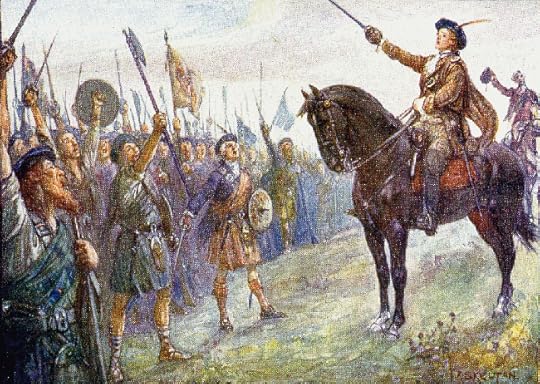
As historical background, link: the Jacobite rising of 1745: it was the attempt by Charles Edward Stuart to regain the British throne for the exiled House of Stuart. The rising occurred during the War of the Austrian Succession when most of the British Army was on the European continent. Charles Edward Stuart, commonly known as "Bonnie Prince Charlie" or "the Young Pretender", sailed to Scotland and raised the Jacobite standard at Glenfinnan in the Scottish Highlands, where he was supported by a gathering of Highland clansmen. The march south began with an initial victory at Prestonpans near Edinburgh. The Jacobite army, now in bold spirits, marched onwards to Carlisle, over the border in England. When it reached Derby, some British divisions were recalled from the Continent and the Jacobite army retreated north to Inverness where the last battle on Scottish soil took place on a nearby moor at Culloden. The Battle of Culloden ended with the final defeat of the Jacobite cause, and with Charles Edward Stuart fleeing with a price on his head, before finally sailing to France.
An important fact to be mentioned about Hugh Walpole's as a writer: from FadedPage: he was one of the most popular authors of his times, until his literary reputation was destroyed by Somerset Maugham.
Herries Chronicles series: 5* Rogue Herries TR Judith Paris TR The Fortress TR Vanessa TR The Bright Pavilions TR Katherine Christian
Rising City series: TR The Duchess of Wrexe TR The Green Mirror TR The Captives
Hugh Walpole is an author not well known these days but he tells a really good story, and writes extremely well. He was popular in the early twentieth century. Rogue Harries is the first book in a series of four which is published under the title 'The Herries Chronicle'. This chronicle takes you through several generations of a family that lives in the Lake District, England, starting in the late seventeen hundreds. Hugh's descriptions of that area are superb. He had such a great love of it that he imparted a great sense of its presence throughout the four novels. His characters, too, become so alive to the reader because, I think, he immersed himself in them totally. They are described in great detail and you come to know them as well as you know your own family. Not every novel reader wants that, but I love it, especially when the characters are quirky, which Walpole's often are. At the risk of giving away my age, I admit to having owned the Herries Chronicle for the best part of thirty years (I was very, very young when I first obtained it!) and have read it time and again. This is a 'must read' chronicle for readers who love total immersion, and who love English literature.
High Walpole was a popular and prolific author in his day, and he was one of those very traditional story tellers who fell out of fashion when modernism came to the fore. I liked the one, quite early, novel of his that I read, a few years ago, and so I had high hopes for this much later work.
It had much to recommend it to me.
It was a big book; it was a family saga; it was a historical novel; and it was set in a part of the country that the author loved; the place he moved to in middle age, to live for the rest of his life.
I wish I could say that I loved it, but I’m afraid that I can’t.
What I can say is that though I saw many weaknesses I was sufficiently interested to read to the end.
The story opens in 1732.
Francis Herries, a man who has clearly done much to earn the sobriquet ‘Rogue’, has uprooted his family from their Yorkshire home, because he knew that his sins would soon catch up with him if he stayed. The travelling party includes his wife; his two daughters, Mary and Deborah; his only son, David; his loyal manservant; a woman who carries the title of housekeeper but is in fact his mistress; and a priest who held some very strong views….
He plans to settle in his childhood home, near Borrowdale. His brother, who lives nearby is horrified, because the house is remote, the land is poor, and the property has been decaying for a great many years; but Francis Herries is set on his plan and will brook no argument.
In the years that followed the two families would meet and cross paths, but Frances Herries would never again set foot in his brother’s house.
He was a proud and independent man, he was slow to trust and slower to love, but he had a strong sense of right and wrong, and he was strong and prepared to work to establish his family in their new home.
Margaret Herries loved her husband dearly, and forgave him everything; and though he didn’t feel the same way he appreciated that and did his best to look after her. He sold his mistress at a country fair after she upset the household, and the scene rang true but it made me compare Walpole with Hardy, and that comparison did not flatter him.
I thought that sale might have consequences later in the story, but it didn’t. Nor did the departure of the priest, or the compassion shown to a woman judged to be a witch, or the introduction of the wider family, or the flight of Mary, who had inherited her father’s pride and independence, and who thought that she deserved a better life.
David would have liked to make his own way in the world but he felt tied to the family home. He was his father’s pride and joy, he had promised his dying mother that he would always watch over him, and he didn’t want to abandon Deborah, who had inherited her mother’s reserve.
In time though, things changed. Deborah fell in love with a clergyman, who told her that he was prepared to wait until she was ready to leave her family. David fell in love with a young woman who he had to wrestle away from her cruel guardian – quite literally. And – most extraordinarily – Francis Herries developed a passion for Mirabell, the daughter of a gypsy woman he had helped and who had asked her to watch over her daughter after her death. He loved her as he had never loved before, she didn’t feel the same way, but she was buffeted by life and he became her refuge.
Time and place were wonderfully evoked, the descriptions were wonderful, but the book fell down for me on character and relationships. There was no depth, there was no evolution, and there was little to suggest that they were active in setting the course of their own lives. They were simple people, so I wasn’t looking for too much, but many of the moments that would have illuminated their lives, were rushed over or even missed completely.
I might make an exception for the man who gave the book its title. On one hand he was a wonderful character, but on the other I can think of other more interesting rogues.
Time passed, things happened, but no more than that. There was little progression and there were rarely consequences.
The skill of the storyteller and interest in what might happen kept me going.
I couldn’t help thinking that this read like a draft, and that the author hadn’t troubled to go back over what he had written and think about the book as a whole. A good editor could have made such a difference.
The final act was the strongest part of the book. It led to a wonderful – if melodramatic – ending that set things up beautifully for the sequel.
I can only say that I loved this book. Warpoles discriptions of the landscapes and countryside surrounding the setting of the book are so visible to the minds eye! The characters are such a complete mixture of personalities that I found the book compelling reading. The father is a strange and fearsome man that uproots his family to the bleak landscape of his childhood. He is cruel and hard, but somehow intriguing. He was so odd you just had to read on to see how the family survived the hardships he put them through.
Hugh Walpole is one of the best novelists in the English language.
I adore the Herries saga, however don't ignore his other works - some of the short stories are works of art.
These books are wildly romantic in the broader sense - no twee little romances like Mills and Boone. These are about hard people with hard lives. I love this whole series, although Judith Paris has to be my favourite. Don't be put off by some of the older covers - usually made by people who knew nothing of the book but what some overworked editing clerk threw down in a short note, or from an inaccurate pre-publishing blurb.
These novels are written in excellent English, which is very restful to me, as I find bad grammar and poor construction very distracting; the constant nuisance spoils what I'm reading, and there is none of that here. Everything flows freely, you are not treated as an imbecile, and are left to infer the obvious, without having to be clubbed over the head with it.
Walpole knows his human beings inside and out... not a little to do with his own personal adversities, I expect... and is extremely adept at putting whole people on the page.
One never feels as if one is reading about simulacra; you can almost draw a living, breathing, person in their entirety from out the pages, as if the author were the world's greatest magician.
My Mother had these on her bookshelves, and I think I must have been around eleven, when I first took down this book. I was immediately transported and made captive. I read them all in quick succession. I admired all of these people for merely surviving in these times - old Rogue was and is a brilliant character - I so admired the author's skill in calling him out of the ether, both then and now.
Sir Walpole is so very good at entwining a few small lives with the larger sweep of history - these books are vastly entertaining, and eternal favourites. I read them every few years, and my enjoyment is not dimmed.
Until I had come across this novel in a bookshelf in a rented cottage in Ambleside, I had never heard of Hugh Walpole. However my interest was piqued by the Lake District location and the references to Galsworthy's Forsyte Saga.
The Herries Saga is certainly a weighty tome and as thoughtful and meticulous a "romantic" family saga as I have come across. To the modern reader "thoughtful and meticulous" might be perceived as slow and over-elaborate but I personally liked very much the careful unveiling of the 50 or so years covered by this first of four volumes.
The main characters, Rogue Herries and his son David are well drawn with Francis (Rogue) being especially complex and troubled. The real star of the show is however the dramatic and beautifully wrought landscape of the area around Borrowdale with its ever changing weather and moods almost as dark as those of Francis. The novel is set in the early to mid eighteenth century and Walpole captures the mood of change very well. His depiction of the period feels very alive with all of its rural poverty, middle class pretension and the overall fragility of life. I particularly liked Walpole's capture of the people's adherence at this time to what are almost medieval beliefs and the mystical feel to some events.
The whole saga was unbelievably cheap on Kindle and I will look forward to catching with the Herries family in the future.
I read all of The Herries Chronicle when I was quite young, say 11 or 12. We had an old copy in the book cupboard at home, probably belonging to my mum. I found it then completely eye popping and couldn’t put it down. I don’t know what happened to that volume. I think it had maps in the endpapers of all the locations in the Lake District where the stories unfold.
Later I visited the Lakes many times, with my mum, with a friend and several times on my own.
Now, in lockdown it’s impossible to travel anywhere, so for a Lakes lover Rogue Herries is a lovely book to read especially as it is rich with detail about the 18th century in which it is set.
No longer are the events as eye popping as they were to me as a child, but I bathed in the descriptions and the characters and the language. I didn’t recall all of the plot so it was enjoyable to read it as if for the first time in places. I know Hugh Walpole the author was mocked in his day but he also was as popular as Dickens for a while. And many authors disagreed with his detractors.
This was a much longer book than I expected but, for me at least, none the worse for that. I’m pretty sure my mother’s book must have been an abridged version of all four novels although I remember at the time I’d been proud and surprised I’d read such a big book. 😁
So this is a tour de force. My five stars are for the pleasure it has given me reading it again.. quite a personal thing, but there you are. See what you think?
So badly I wanted to like this long book given that it is a family saga which is set at a time and place which I love - the 18th century and the Lake District. And even though the descriptions are so vivid that I could literally experience the cold, the strong winds, the chills, see the ever changing weather of Borrowdale and the surrounding valleys, I found the main character so extremely frustrating in his stubbornness (and manic depressive symptoms?) and hoped and hoped for some form of illumination to come to him. The rogue-ness could have been more interesting - there was a big void somewhere, some evolution of character would have made his existence more meaningful. I though the character Sarah summed up the grand love story in 2 lines. Apart from this, it was a beautifully written book, the descriptions brought the Lake District alive to me, and I will not forget the tragic scene with the poor lady Mrs Wilson - I couldn’t hold back the tears. Similarly how beautifully it ended, the last page - another moment where I couldn’t hold back the emotions.
Not even remotely what I expected going into it. Dark, with happy endings for some, tragedy and misunderstandings which were entirely avoidable by simply being an adult and having a conversation about stuff, and some disturbing storylines, presumably more appropriate away back when? Disposable characters, and a protagonist who, though I'm sure some people are like that, was mercurial and imo had some sort of personality disorder, make for a strange story, with many subplots. Part of me is curious about the next installment, but I may leave it for a while.
I inherited Rogue Herries and thought I’d give it a whirl. I can see why it was popular – nearly every chapter is vivid and leaving you to want to know what happens next. It opens in the early eighteenth century with Francis Herries travelling to live in a remote family home in the Lake District together with his wife, three children, his mistress and a Roman Catholic priest. But I found it deeply frustrating that the incidents don’t hang together. We never know why Herries, who is not a Catholic, protects this priest. The wife dies off early and the mistress is dismissed in a dramatic scene never to appear again. The priest does reappear and introduces Herries to Bonny Prince Charles during the 1745 rising and then just disappears. Nothing further is made of the meeting, which would be at the centre of most historical novels.
The most powerful chapter describes a pathetic old woman being lynched as a witch, but again I couldn’t see any thematic let alone narrative connection with the rest of the book. (Possibly she is an example of hostility to outsiders, like Herries himself.)
A number of other members of the Herries family are introduced with a lot of generalizations about their character, but since Francis is the least typical of them there seems little point. Presumably they will figure in further episodes of the family saga.
The second half of the book is held together by Francis Herries’ obsessive love for his second wife, a much younger woman of a vagabond background. Unfortunately, I did not find the relationship convincing. Although I read wanting to know what happens next, either I wasn’t told or when it did I wasn’t interested.
This would not be an obvious candidate for the reading list but for my parents' constant championing of it - probably helped by the Borrowdale setting. For much of the book I had to just get on with it, doing my best to get through the strange half story telling - by which I mean that some of the key events seem to have just happened, or be about to happen, when the narrative touches them. There seem to be a few red herrings of potential stories, which are left to dwindle, for example for a moment I thought we might be in for a look at the Jacobite side of the '45 rebellion, but nothing came of it. The three stars come from the final scenes, where age and illness bring the blinds down in a most poetic way. I may read another, but it won't be a sprint through the full saga.
To be honest, and at the risk of sounding like a complete philistine ... I didn't really enjoy this book at all. I only read it because I like the Watendlath area, so felt I should, but that's a bit like reading "Tess of the D'Urbevilles" because Stonehenge is in it. The descriptive narrative was far too much to bare and half way through the book, it occurred to me that not a lot had actually happened at all. A bit of action kicked in when Bonnie Prince Charlie appeared ... but only a bit. Lovely to come across Tullie House in a book, though! This was not gripping in any sense of the work and could probably have been condensed to about ... ooh ... 3 pages. At a push.
I first heard about Hugh Walpole more than fifty years ago and have just got around to reading some of his work. This novel is the first of a series of six and I am looking forward to reading the remaining five before too long.
One of the best books I have ever read. I absolutely loved this book and couldn't put it down. Highly recommended. This novel is the first of a series of six and I am looking forward to reading the remaining five! Loved it.
I worked out I bought this series when I was 18. I vividly remembered reading it and some parts are fresh in my mind. So I unpacked a box of books after moving, found it and decided to read it again, nearly 50 years later. I can see why I was so enthralled as a teenager. The alive characters , flawed yet human and likeable (so tired of modernist novels with no likeable, engaging characters), their adventures, their trials, their courage, their flaws. But also the setting. This is so vividly alive: you can feel the cold of the snow and rain, the heat in the summers, the sheep on the fells, the rushing streams, the towering hills that create claustrophobic valleys. And the people: eccentric, fiercely proud of Borrowdale and environs, all living through a fascinating time in English history. I understood the flawed and temperamental Frances but my favourite had to be his son David. A caring honest boy who grows into a great man whose only wish is to carry on the Herries name, to get on with his fellows and to be part of an England that he cherishes. That sounds a bit twee but he is a robust and likeable man. He is kind. He loves his father. He's not a greatly complicated or driven man but he thinks about his world, notices the nature that is around him and cares very dearly for his sister Deborah. All of this comes together in a remarkable story of the personal and historical within an amazing setting of land and sky. My second read 50 years later was not a disappointment.
Hugh Walpole is a neglected early 20th century novelist who wrote weird tales of devils and magic co-existing with pedestrian English characters and settings. His books are utterly unique. He sold well (especially in America), but one rarely hears about him anymore (although a new collection of his poetry has recently come out). He was not a modernist, an experimenter, or innovator, but his books reveal a gift for story-telling and a queer sensibility that he could barely contain. Rogue Herries, his attempt at an 18th century family saga, has delightful moments, but ultimately fails with its too-wide scope, its precious need to show off details of the time period (i.e. a two page description of the interior of a house) and characters whose speech seem utterly unalive. It’s Wurthering Heights with only the lows. For the first time in my experience reading him, Walpole’s gay glances (lots of naked men standing at windows, bathing, caressing, giving each other massages or whippings!) are a distraction. This for me was my least favorite Walpole novel. Can I recommend Portrait of a Man with the Red Hair instead?
Complex characters, engaging, and kept my attention for hundreds of pages before it became a bit of a slog, although it quickly got me engaged again.
The title character has a lot of despicable characteristics but is multi-layered enough to empathise with, and later on in the novel, even sympathise with. The other characters are just as complex, although more likeable. For most of the story, I felt there was little filler, I could see a lot of the text justifying its length. As it went on, a bit less so. There are some beautiful lines and descriptions. The prose style, especially at the start of chapters, is a bit too telling than showing for my liking, but as I got more enthralled I noticed it less. It also carries a writing style of the time of going deep into describing too many things. Some story elements could be described as 'of their time' but not as many as you would expect from a novel published in the 1930s.
A dismal story about dismal people leading dismal lives. Francis 'Rogue' Herries is landed gentry who does whatever he wants to whomever he wants with no empathy or consequences. He kind of reminds me of the nutjob from This Other Eden or Andrew Tate. Later in life he develops an obsession with Mirabel. He calls it love but it's really an unhealthy obsession. Author Hugh Walpole seems to have really loved this part of England and gives you plenty of land porn. There are several books in this series so someone was enjoying reading it.
A rereading after many years. Although Mr. Walpole always spends about a third of each paragraph describing sky, clouds, hills, state of weather, etc., I now find on re-reading that it is actually rather relaxing and helps set the atmosphere. Rogue Herries was written with the intention of being the beginning of the Herries family saga. If you read on through the series (Judith Paris, The Fortress and Vanessa), the various members of the Herries clan appear and reappear with usually tragic effect upon their kin. Mr. Walpole's style of writing is an acquired taste, but you like this, you may become hooked.
Just finished re-reading this book which I first read as a teenager. Having become enamoured by Walpole's "Jeremy" books, I took this only to find that this was something quite different! Basically a love story set in Borrowdale at the time of the Jacobite rebellion (history does intrude on the book, often as an unecessary distraction) and it is the meticulous detail in which he presents the motivations behind its principal character, revealing much about the author himself, and also his intimate knowledge and love of the Lake District that lend credibility to what might otherwise be an unbelievable situation.
This is the kind of Romance novel I can read, a Family Saga to boot, written nearly 100 years ago and now pretty much forgotten: dense, flowery prose inclined to digress and ramble, guaranteed to upset modern sensibilities, not for anyone who needs likeable characters and happy ever afters. I loved it!
Most of the book I read while walking the first part of Wainwright's Coast to Coast, plodding up & down and through its Lake District setting-we stayed overnight in Rothswaite where Rogue Herries makes his family home in beautiful Borrowdale.
Set in the Georgian 18th C, turbulent, bawdy, pre-industrial, transformative, there's history thrown in- Jacobites and the '45 for eg- but more Socio-economic than Political, far from the Austen period drama our TV and filmmakers keep remaking.
Definitely not for everyone but if you've the appetite this doorstopper, first in a series, offers something to get your teeth into, with warnings as to upsetting, heartbreaking, shocking scenes true to its time and period, so expect Thomas Hardy not Regency Romance.
Set in the Lake District, this is a little like Poldark, I feel: a family saga featuring a red-haired beauty. The language is flowing, in a 'stream-of conciousness' style - apparently largely unreviewed by the author. At 700+ pages, I think his editor should have been firmer! Some passages require reading two or three times to get the proper sense of them. Francis 'Rogue' Herries and his son David are believable and likeable characters. First published in 1930 as the first of four volumes.
I listened to the BBC 4 adaptation which I enjoyed enough. The only complain I have were frequent foreshadowing of one tragedy or another, only to find out that nothing horrible happened. Love that Rogue Herries felt was a sickness and listening to him pine after Maribel was like watching someone throw up, but it was refreshing when compared to the characters of HF written these days. The females were also likable. Some were weak, some strong and none of them was beating the "reader" over the head with her swength and indepandence.
A truly captivating novel which captures not only the wild idyll of the valley of Borrowdale, and the northern lakes, but equally the complex, flawed, and all too human nature of Herries the man. The characters come to life through Walpole's prose, as does the time in which the story takes place, with all of its violence and dirt, nobility and passion and beauty; a time that without works such as this would be lost to us. I cannot recommend this book highly enough, especially to any who have enjoyed such classic works as Wuthering Heights or Lorna Doone.
Too big to be a curate's egg, this novel is horribly dated. There are vivid scenes (the seige of Carlyle and the fotball game) but the characters are often caricatures, and he is very poor when trying to deal with heterosexuL LOVE. HE HAS BEEN COMPARED WITH HARDY, AND THERE ARE ECHOES OF THE MAYOR OF CASTERBRIDGE, BUT THIS LACKS ITS AUTHENTICITY AND POWER. I DOUBT I'' PERSERVERE WITH THE REST OF THE CHRONICALS.