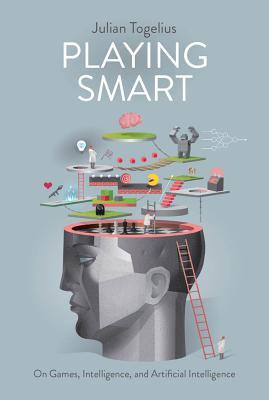
A new vision of the future of games and game design, enabled by AI.
Can games measure intelligence? How will artificial intelligence inform games of the future? In Playing Smart, Julian Togelius explores the connections between games and intelligence to offer a new vision of future games and game design. Video games already depend on AI. We use games to test AI algorithms, challenge our thinking, and better understand both natural and artificial intelligence. In the future, Togelius argues, game designers will be able to create smarter games that make us smarter in turn, applying advanced AI to help design games. In this book, he tells us how.
Games are the past, present, and future of artificial intelligence. In 1948, Alan Turing, one of the founding fathers of computer science and artificial intelligence, handwrote a program for chess. Today we have IBM's Deep Blue and DeepMind's AlphaGo, and huge efforts go into developing AI that can play such arcade games as Pac-Man. Programmers continue to use games to test and develop AI, creating new benchmarks for AI while also challenging human assumptions and cognitive abilities. Game design is at heart a cognitive science, Togelius reminds us—when we play or design a game, we plan, think spatially, make predictions, move, and assess ourselves and our performance. By studying how we play and design games, Togelius writes, we can better understand how humans and machines think. AI can do more for game design than providing a skillful opponent. We can harness it to build game-playing and game-designing AI agents, enabling a new generation of AI-augmented games. With AI, we can explore new frontiers in learning and play.
Julian Togelius is a Professor in the Department of Computer Science and Engineering at New York University, the director of the NYU Game Innovation Lab, and co-founder of the game AI startup modl.ai.
This is an unpretentious and funny book. If you're curious about technology, particularly artificial intelligence and games, you definitely should check it out. In a field constantly hyped to the stratosphere be unpretentious and funny is a huge compliment.
Professor Togelius goes from cats ( we can't deny how influent these fluffy creatures are in pushing the frontiers of science) to the narrative of a non-player-character's life in a friendly way. You will be surprised about so many things that it will be hard to play a game again and face it just like that.
I got particularly interested in the game as a learning tool, of itself and its players. It's stated in the book that when you're playing you're more yourself than you can expect. AI techniques take advantage of your (in-game) freedom, get data from you, and suit the game to make you even more into it.
Many of the AI algorithms applied to develop the games are explained in the book. But don't worry, you don't need an extra pen and paper to follow them as you would in a scientific text. Everything is presented in a clear and very welcome informal way.
In the end, Professor Togelius shows a list of topics that are among the ones responsible for cutting-edge research on AI for Games (and Games for AI). The book also brings a lot of footnotes that can lead you to know more about the topics, as well as academic conferences for those who want to go deep in the introduced subjects.
Finally, it doesn't take long to finish, and it is highly recommended for those who like titles that entertain and inform at the same time.
Nice introduction on what the title says. Unless you're a whiz in all these areas, you'll find something deeply thought-provoking and you'll learn. In the areas where you are a whiz, you might be bored and think the author takes a long time introducing fundamental ideas, but it's for a purpose--he builds on everything he talks about, especially explaining common AI algorithms (my favorite parts -- RIP Enemy 362). Keep in mind this is a general audience book. Chapter 7 in particular sees many previous topics coming together in examples of how AI can be used to generate levels, rules, and entire games. Claims are supported throughout the book, and it ends with some neat applications of what the book has discussed. Really enjoyed it.
Very well written book and provides an insight into how AI could be used in making games dynamically adapt to the player. It even talks about how to create new levels which matches the ability of the player. I really enjoyed reading this book. Also talks about general intelligence vs task specific intelligence. At the moment in 2019 humans still don't have an AI which is good at playing both chess and Go or general board games. It is very task specific. There is some research about making AI which can play all the board games.
It's always a pleasure to see someone, who really enjoys his job, and also is able to speak about it with passion and in such a manner, that people from other fields can understand what he does (this especially concerns scientist). And this is what I liked most in this book. Togelius speaks clearly about his field of research (AI) and how novel AI methods can be applied in real world (namely, video games, in context of the book).
Also, Togelius gives interesting explanation of why modern game development industry is reluctant to implement novel AI methods. It turns out, that developers of the early games were limited by the technologies of their time (surprise), which led to a number of design choices that would not have been made had better AI been available. The thought is simple, however, this is what can be seen in many industries - unwillingness to say goodbye to the old approaches. Say hello to Google Spreadseets (at least I hope, that I'm not the only one, who uses it).
Interesting note on intelligence: Now and then you run into people (or tabloid newspapers) who claim that "dolphins are really as intelligent as humans" or "pigs are more intelligent than dogs" or similar nonsense. It's nonsense not because it is false, but because it makes no sense to make such claims without first establishing the environment and life conditions in which intelligence is measured. Put a dolphin in an office chair, or a human in the ocean, and neither of them will see much success
I think this book provides the reader with a nice introduction to the discipline and how the two fields of Machine Learning and game design and development can help each other. Although, I suggest reading this book only to those people who have just started learning about games and AI. There are some good resources introduced in this book for further reading, but if you are more kind of an expert in this field, you would not find this book as insightful.
A gentle introduction to AI in games. Fun written, but mostly white basic. However, the observation, that we are kinda stuck with game design perspective created in the 80s is brilliant (for me). Fact that certain decisions where made because they were the only feasible ones and we stuck with them until now opened my eyes on a whole range of possibilities.
Five stars for writing and accessibility, but given that it's working in artificial intelligence, it probably needs a new chapter on the current state of play in 2026.
A nice little book on AI for games and games for AI. It's really a book for complete beginners in AI. But I appreciated the playful style and the research presented very briefly in simple words. Of course, it's not the complete picture. if you want to know more, you'll have to read the academic papers.
But it has the charm that can get someone to go study more. And that's impressive.
Delightful no frills introduction to intersection of games and AI. As a CS undergrad mostlt familiar with the algorithms presented in this book, I fould the text a good source of assimilation.
The discussion is lucid, flows easily and is pretty comprehensible even for a non technical reader. It does a good job of summarising the development in the field of game playing AI and AI for game development, etc
I particularly found the chapter regarding search based procedurally generative content interesting as I already had some experience with procedural graphic comtent generation using CFGs.
This is a great easy read on the intersection of AI, games, and cognitive science. I decided to read this because I cannot help but think about the algorithms behind well-designed games. I enjoyed reading about the mechanisms behind the design of games. The author points out that games are the future of AI since it’s the perfect benchmark for how AI challenges human cognitive abilities. I’m excited to see how game-based AI will progress in the next few years, especially with the rise of the metaverse.