Jump to ratings and reviews
Rate this book

The Dialogues: Conversations about the Nature of the Universe

Rate this book
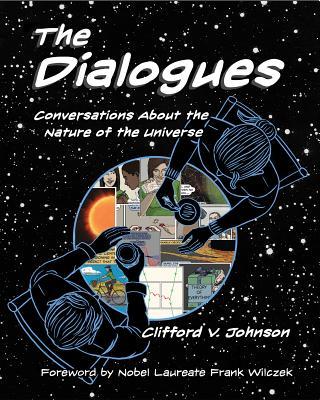
A series of conversations about science in graphic form, on subjects that range from the science of cooking to the multiverse. Physicist Clifford Johnson thinks that we should have more conversations about science. Science should be on our daily conversation menu, along with topics like politics, books, sports, or the latest prestige cable drama. Conversations about science, he tells us, shouldn't be left to the experts. In The Dialogues , Johnson invites us to eavesdrop on a series of nine conversations, in graphic-novel form—written and drawn by Johnson—about “the nature of the universe.” The conversations take place all over the world, in museums, on trains, in restaurants, in what may or may not be Freud's favorite coffeehouse. The conversationalists are men, women, children, experts, and amateur science buffs. The topics of their conversations range from the science of cooking to the multiverse and string theory. The graphic form is especially suited for physics; one drawing can show what it would take many words to explain. In the first conversation, a couple meets at a costume party; they speculate about a scientist with superhero powers who doesn't use them to fight crime but to do more science, and they discuss what it means to have a “beautiful equation” in science. Their conversation spills into another chapter (“Hold on, you haven't told me about light yet”), and in a third chapter they exchange phone numbers. Another couple meets on a train and discusses immortality, time, black holes, and religion. A brother and sister experiment with a grain of rice. Two women sit in a sunny courtyard and discuss the multiverse, quantum gravity, and the anthropic principle. After reading these conversations, we are ready to start our own.

246 pages, Paperback

Published October 23, 2018

24 people are currently reading
1553 people want to read

About the author

Clifford V. Johnson

6 books11 followers

Ratings & Reviews

What do you think?
Rate this book

Friends & Following

Create a free account to discover what your friends think of this book!

Community Reviews

5 stars
84 (24%)
4 stars
120 (35%)
3 stars
95 (27%)
2 stars
34 (10%)
1 star
7 (2%)
Displaying 1 - 30 of 70 reviews
122 reviews20 followers
March 30, 2025
I absolutely love this new graphic novel by a well-respected scientist, which innovates science communication along several different axes simultaneously. In addition to the beautiful drawings and science explanations, as well as the novel approach to communicating science with pictures, I really admired its inclusivity: The emphasis on giving a large role to non-scientists in science conversations, the depiction of scientists as ordinary people with a certain passion (rather than mythical geniuses), and especially the diverse representations of scientists and science enthusiasts. Finally, I was excited to see a book that aims at dispelling the common fear of equations, and that brings them them back into popular science as an integral part of the aesthetics of science.

There are so many science gems contained in this book. I especially loved the visual explanation of Maxwell’s equations, as well as the depiction of research as a giant jigsaw puzzle. There seem to be many new opportunities for science communication opened up by this medium.

The topics covered here extend from electromagnetism and special relativity up to AdS/CFT and the Multiverse. There are also many beautiful additional elements mixed in including depictions of everyday life, the science of food and cooking, superheroes and comic book design, and a rich trove of references for additional information on many topics.

My only complaint is that I wish the book featured a bio of the author, since I'm sure many readers (especially the younger ones) would be inspired to hear more about his research, career trajectory, and what got him excited about science in the first place.

If I ever teach an introductory physics course or seminar I will strongly consider assigning this as a supplemental text, and in the meantime I will highly recommend it to my non-physicist friends who would like to understand what I do.
Profile Image for Stewart Tame.
2,473 reviews121 followers
December 15, 2018
Wow! That took a lot longer to get through than I expected. I consider myself tolerably well-versed in physics, and science in general. But chapter 9 introduced some concepts that were new to me, and I confess I got bogged down a little …

Most of what you need to know about this book is right there on the cover. And when it says, “... the Nature of the Universe …,” that's not a metaphor. This book is more physics than metaphysics, not that that's a bad thing. Johnson has resurrected the dialogue as teaching method, and recast it in comics form. There are some nice touches to the art that help underscore the points he’s teaching. He draws tolerably well, though his figures seem a bit stiff.

I don't know. I think I would have been happier with prose than comics for communicating these ideas. It's an interesting experiment, and it may work better for some than it did for me. It just seems more interesting as an artifact than as something to read ...
Profile Image for Ed Erwin.
1,183 reviews128 followers
March 24, 2019
Scientists and philosophers have for years used the 'dialogue' form to present complicated ideas in an engaging way. Johnson, a scientist, here expands on that technique by constructing graphic versions of dialogs. This could be intensely boring, because who wants to watch people have a conversation? (Apart from the 2 or 3 fans of "My Dinner with Andre".) But it largely works here because the ideas being discusses are interesting, and the illustrations do go beyond simply showing people talking; also including images of the things being talked about.

Johnson is a competent artist. Not so good that he is likely to be hired on a mainstream comic, but good enough. He can draw people and buildings competently, and he is more than competent at arranging panels and dialog bubbles on the page. When he deviates from straightforward layouts, it never becomes confusing what order you should read the words and images in, and that is something even great comic artist can do badly.

No human beings would ever have conversations as well-structured as this, but that isn't the point. These fictional conversations exist to get ideas across to us readers, and they do that well.

Each chapter contains tons of notes to lead to more readings.

One quibble: he, or his characters, seem unfair in their dismissal of critics of string theory:
He: I've only ever read about people taking one side or another. It's the best thing ever, or it's a total waste of time.
She: Frankly, that's mostly driven by the press, and a few attention-seeking individuals. Most people have a more nuanced view... It just does not sell newspapers or books.
Some of the promoters and detractors are no doubt 'attention-seeking individuals', but the critics have a good point. Since we don't know whether string theory will turn out to be the right answer, and it hasn't yet made any testable predictions, it is unfair that scientists wanting to study other topics or approaches have found it very hard to get jobs or grants. This is changing now, but for so many years all of our eggs have been in one basket.
Profile Image for Brian Clegg.
Author 161 books3,173 followers
December 11, 2017
The authors of science books are always trying to find new ways to get the message across to their audiences. In Dialogues, Clifford Johnson combines a very modern technique - the graphic novel or comic strip - with an approach that goes back to Ancient Greece - using a dialogue to add life to what might seem a dry message.

We have seen the comic strip approach trying to put across quite detailed science before in Mysteries of the Quantum Universe. As with that book, Dialogues manages to cover a fair amount of actual physics, but I still feel that the medium just wastes vast acres of page to say very little at all. This is brought home here because quite a lot of the sections of Dialogues start with several pages with no text on at all, just setting up the scenario.

As for using a discussion between two people to put a message across, Johnson makes the point that, for instance, Galileo's very readable masterpiece Two New Sciences is in the form of a dialogue (more accurately a discussion between three people, as a dialogue is only two way). This is true, though what we really mean is that it's very readable compared with other books of the period. It still feels quite stiff and stilted compared to a well-written modern popular science book.

In the end, other people's conversations are often frustrating and boring - and the actual conversational language used is hardly natural. Try this randomly selected snippet:

Scientist: The key point is that there's one thing that makes that picture all hang together - you need something that all observers agree on.
Science fan: What's that?
Scientist: The speed of light. It is simply the conversion factor that allows on person's time and space to be mixed together and re-sliced into a different space and time for another person.

Not my idea of a fun conversation in a bar. Part of the problem here is, oddly enough, that the graphic novel format doesn't allow for good use of diagrams. The discussion of spacetime would have been helped a lot by some of these.

In all fairness, the content is very variable. For example when Johnson has a physicist dressed in a superhero costume (don't ask) explain Maxwell's equations to an interested bystander it's one of the best attempts to explain them I've ever seen. But it takes Johnson many, many frames, when it all could have been done in a couple of pages of a normal book with plenty of room for lots more interesting stuff. At other times, Johnson drops in a term like 'domain' in a way that isn't used in ordinary English.

One of the problems with the graphic novel format is you don't have much text, so you have to edit ruthlessly what's included. So, for example, when a science fan says 'Einstein discovered quantum mechanics? I thought he hated it?' The reply is 'No, no, he was one of the key shapers of it.' Though the answer is strictly true, there's a huge "but" to cover his increasing dislike of quantum mechanics and repeated attempts to show it was wrong.

In reality, what we get often aren't really dialogues, they're monologues with prompts (there are a couple of exceptions where we have equals talking, but most are physicist talking to semi-ignorant enthusiast). This means, for instance, that rather than debating the merits of string theory, loop quantum gravity etc. as you might expect in a classical dialogue, we just get a strong push on string theory.

I don't want to seem too hard on this book. It's a worthy effort, which is why I've given it three stars. And with his physicist characters, Johnson certainly gets one thing spot on, which is the way they often don't understand what they're being asked, something you frequently get when a layperson asks a physicist a question. The illustrations, all by Johnson himself, are very professional - and as I mentioned, there are occasions when he has a great take on explaining an aspect of physics. It's just, for me, both a graphic novel and dialogues get in the way of good communication, rather than helping.
431 reviews4 followers
September 22, 2018
Oh my, this was such a deeply frustrating book. I really, really wanted to like "The Dialogues"; I put it on my Holiday list last year, and my loved ones said they looked hard for it but could not find a copy. I believe them. Eventually, I found a copy. The book is a totally original idea - a graphic "novel" containing dialogues about the nature of the physical universe, with an emphasis on quantum theory, string theory, cosmology, and other topics in that vein. It's in the form of dialogues between "regular people" - only most of them are pretty damn smart. Here's what's wrong: first, the writer, physicist Clifford Johnson, is also the illustrator - and he's not a very good one. The bad art seriously detracts from the story, even though using drawings and diagrams ought to be (and occasionally is) a very nice way to teach modern physics.

Second, the dialogue is frequently incredible. I quote verbatim: "So we assume there is maybe a multitude of universes, all with different values of this uncomputable number ... and we happen to live in one that has just the right value to give us a universe complex and long-lived enough ... for intelligent life to evolve, develop physics, measure the cosmological constant, contemplate its un-computability, and" - "And so discover multiverses. Ha Ha! Yes, putting it that way almost makes it seem like that was the entire purpose of the multiverse: to have us come along and think of it." - "Thereby bringing it into existence? That would make a cool short story, yes."

That's a knee slapper, eh? What's a shame is that that particular exchange actually comes from an interesting chapter in many ways. But the interest is drowned in an ocean of maladroit presentation.

I'm not sure how to rate this. 5 stars for an ambitious idea (I'm all for bringing physics to the masses), but about half a star for execution. Call it 2.5 stars, and I'm rounding down. Will someone try this and do it effectively?
Profile Image for Julie.
1,487 reviews40 followers
August 17, 2018
This book has an interesting concept of discussing some hot scientific topics (Black Holes, String Theory, etc.) in the much more accessible format of a graphic novel. But beyond the initial concept, the execution just didn't meet the expectations or the possibilities of what this book could have been.

One of the strengths of a graphic novel is the ability to show movement, emotion, and use all the power of pictures -- worth a thousand words right? But this graphic novel ended up being images of very stilted people having conversations about theoretical physics. One of the problems is that the author is not a very good artist, so compared to other graphic novels, the images are really lacking. The conversations also range from simple science experiments to difficult magnetic field theory, so I can't imagine who the target audience is for this book. Even with years of Physics under my belt, I waffled between being a little bored to 'what?'

I'm sort of surprised by the high reviews of this book. It was our book club selection and was panned by all but one person in my book club. Hoping that the idea of non-fiction in graphic novel format finds a better implementation.
Profile Image for Derek Royal.
Author 16 books74 followers
January 29, 2018
There aren't many comics that attempt to take on what Clifford V. Johnson has accomplished in this book. Outside of the presentation of complex astrophysical concepts, this text is notable in that it's one of the few to use comics in an expository manner. In this way, it's much like McCloud's Understanding Comics, in that it uses sequential graphics to explore concepts and get across ideas...not tell a story. There is a narrative element to The Dialogues, but it's secondary -- or even tertiary -- to the text's main goals. Along with this, the book is fascinating in that it participates in what I've called elsewhere the "graphic cycle" format, the comics equivalent to the short-story cycle. All 11 stories, or dialogues, in this work are interlinked in one form or another in ways that reveal a more "novelistic" project, while at the same time, each section is able to stand on its own.
Profile Image for Rick.
3,110 reviews
December 11, 2020
This was a wonderful book. Basically it’s just people sitting around having conversations about physics. Yep. That’s all it is. And it’s brilliant! The point is summed up in the last chapter, in there is the explanation about why make a graphic novel that’s just people sitting around having conversations about physics. And I’m not going to spoil it. Read the book. ;)
Profile Image for Hind.
566 reviews8 followers
January 15, 2024
Not quite logicomix, but it comes close. Enjoyable comic book on some topics in physics! I think some of the physics might be a bit much for a layman though.
Profile Image for Ronda Gómez-Quiñones.
1 review1 follower
December 21, 2017
How can you not fall in love with a graphic novel that encompasses “conversations about the nature of the universe”, conversations that range from a brother and sister trying to figure out how one cup of rice kernels ends up as a full pot of rice, to the cycle of life and death in the universe. . .and more, oh, so much more. Read this book slowly – ponder, and “listen” to it. For example, one of my favorite sections was the discussion between two people on Einstein’s equations for spacetime, and comparing it to cooking. That’s my simplistic shorthand for what is an absolutely dazzling discussion of Einstein’s work in “general relativity”, and making it understandable to me, a complete dodo bird when it comes to science, math, and physics.

This book is breathtakingly brilliant. This is a perfect Christmas gift for both science mavens, and, as I said, dodo birds like me! And did I neglect to mention the artistic joy of the graphics? Well, I just did. Now it’s your turn to delight in the world of Clifford Johnson’s The Dialogues – buy it; gift it; read it.
Profile Image for Kaylie Longley.
273 reviews3 followers
January 27, 2018
It is an absolute joy to experience new thoughts on cosmology in graphic novel form. Author, physics prof, and overall professional nerd Clifford Johnson worked hard to develop this story, creating conversations between scientists and strangers, all based on research. His medium? Comics. His message? Physics is ever-changing and should be talked about, in and outside the classroom and lab. Science is all about observing and asking questions, and it's built from theories and tools. Equations shouldn't be feared, they suggest answers on spacetime, kitchen chemistry, quantum mechanics, and life itself. I found this graphic novel to be the perfect display of physics, as formulas spill on to the pages and conversations fall into fun tangents. Intelligent yet fun, this book genuinely excites and encourages me to keep exploring, think scientifically, and ask questions.
Profile Image for Krish.
17 reviews4 followers
February 7, 2018
This book was an interesting new concept: physics in the form of a graphic novel. I really loved how everyday conversations in the book become the base to discuss high school physics to higher dimensional physics. The notes section after each chapter provided commentary (sometimes also on comic book style - the professor has really geeked out this whole thing, and it makes me really happy) and recommendations on other books to read. I wish for more such books!
Profile Image for Kent Archie.
624 reviews6 followers
January 8, 2020
A wonderful book. I thought this was a graphical version of Galileo's dialogs but is instead about modern physics.
The art work is great.
I learned a fair amount and I expect to read this again to help me understand some of the more abstract parts.
My favorite part was about two children discovering the scientific method while
trying to understand how a small amount of rice made a big amount of cooked rice.
Buy a copy or check your library, in either case, read this book.
2 reviews
January 4, 2018
Clifford Johnson's The Dialogues as a science book, but it is not only about science. In fact, it is difficult to pidgeon-hole it into any particular bibliographic category; it is something that is completely and refreshingly new.

The book is composed of 11 loosely connected short stories based on dialogs about physics. It radically diverges from the typical "science explainer book" where the author-as-expert lectures to a captive-and-unquestioning audience. The Dialogues, on the other hand, focuses on the interaction between characters to explore ideas. One such character is a curious layperson who asks questions, expresses surprise and skepticism, and is the voice that ultimately pieces together scientific insights---in doing so, the character is a proxy for readers who are also curious laypeople who are naturally filled with questions, surprise, an skepticism when presented with a new idea.

One could have filled the entire book with dialogues between a learned master and an intelligent-but-inexperienced proxy for the reader. However, Johnson goes further than this and deftly shifts the characters in each story: the conversationalists rotate between physicists, science enthusiasts, skeptics, and children. If you have any curiosity about physics, then you will find a voice in this book, no matter what your background or formal scientific training. One of the joys of this arrangement is that rather than feeling the pressure to ingest an author's ideas, one is invested in communicating one character's ideas effectively to another. I caught myself speaking out loud to the fictional characters, "Yes---when you explain it that way, he'll surely understand your point."

The Dialoges are the opposite of a science lecture. It doesn't try to teach you a lesson about physics, though you may pick up a thing or two. Instead, it is about how we share science with each other as human beings. It follows how ideas incubate and develop through the chance encounters with different people.

In the book's foreword, Nobel Prize winner Frank Wilczek reminds us that using dialogue as a vessel for sharing ideas is a tradition that hearkens back to Hume, Galileo, and Plato. The new life that Johnson breathes into this approach is a novel platform: a graphic novel. One might think that a modern take on the dialog format would be a YouTube video or a podcast, but Johnson makes a compelling point that dialogues belong on paper. This is a medium where the reader is encouraged to ponder---along with the characters---the topics in the dialogue, unchained to anyone else's pacing. This freedome to "rewind" and let ideas simmer over the illustrated pages let one appreciate the nuances of the characters' ineractions and what they imply about the stories being told. One page invites one to meditate over what happens when something falls into a black hole, with the panels guiding the reader's eyes along a spiral trajectory to the singularity.

While the book is difficult to categorize---fiction or non-fiction, graphic novel? science?---it is certainly a gem for its insights. It has an amorphous target demographic precisely because its different characters are proxies for many different kinds of readers of a range of science backgrounds. It doesn't teach a specific subject, hovering on many ideas from basic to contemporary physics, but throughout it focuses on the fact that science is a human endeavor. The book's eleven chapters come together as the story of how science is done, how it exists outside of universities and laboratories, and how it belongs to laypeople and scientsits alike.

Whether you are a scientist, a future scientist, a science enthusiast, or someone who likes to argue with scientists, you'll find a dialogue in this collection where you'll think, "that's exactly what I would have said."
Profile Image for Leah Kessler.
Author 1 book17 followers
April 6, 2019
I rarely abandon a book partway through (especially not a graphic novel) and I really gave this book the old college try. I think I made it about 2/3 of the way through.

I am so sad that this book was not good. I was thrilled when I received it as a gift and it fits right into my current mild obsession with complex scientific concepts-for example, I currently working my way through A Brief History of Time, which I am enjoying tremendously-so my problem with this book is not the subject matter. The problem is that it was poorly executed.

It is a graphic novel, which should be an excellent medium for illustrating (pun somewhat intended) complex scientific ideas that can be difficult to understand through words alone. However, the author did not take advantage of the format at all. The book is essentially comprised of scenes involving two talking heads having somewhat argumentative conversations in locations that have little to nothing to do with the content.

There were occasional references to the characters' dialog in the illustrations - for example at one point, two characters discuss putting the pieces of a puzzle together as an analogy for the process of scientific discovery and suddenly the table they are sitting at is covered in puzzle pieces which they look at and occasionally touch over the course of the next three pages. Just prior to that unenlightening section, one of the characters says, "It's like trying to answer the question of why the sky is blue, before knowing about the molecular composition of the atmosphere," and magically, for that panel only, there is blue sky behind her, in what previously appeared to be an indoor space. It adds nothing to the concepts being presented and it isn't even interesting. Images that illustrated the composition of the atmosphere to accompany that statement would at least have been interesting and informative, even if they also would not have contributed to the understanding the author is trying to convey.

Sometimes the illustrations were more "scientific" in nature, like the page of increasingly perfect circles to accompany dialogue about increasingly perfect circles. This is something it is not all that difficult to picture so, again, it didn't really take advantage of the tremendous possibility inherent in the graphic novel format.

I also found the way the text was presented to be confusing in places. In each section, the dialogue is presented in speech bubbles of three different colors: white, and the colors of the shirts worn by the two speakers. Since none of the characters have different personalities or vocal patterns, it was sometimes difficult to tell whose dialogue was appearing in the white bubbles. The colored ones matched the shirt of the person speaking, otherwise that would have been difficult too, as they did not always have arrows leading back to the speaker and were sometimes just random bubbles in space. This is not uncommon in comics and graphic novels, but it only works when used with characters who don't all sound exactly alike.

If you've seen the movie Mindwalk, this was like that, but less interesting and with a less visually stimulating setting.

141 reviews26 followers
December 15, 2018
I love the concept here, and there are a few moments when the idea shines. Johnson and Wilczek couple graphic novel style with real, challenging science. I deeply appreciate trying to bring the thrill of science (yes, I’m being serious – I find science to be literally thrilling) to a broader group, especially those convinced by poor instruction or stereotypes that they aren’t “science people.” But the final product just didn’t work for me. I found the difficulty factor all over the place. I have previously studied some of these topics, and still couldn’t understand some of the discussions. I found myself wanting more story, more of an arc, or something like that. The art was fine but too static, with too little motion to really carry the reader through the story as a more mainstream graphic novel would.

------------------------------------------
2018 Reading Challenge Update
book number: 31 / 40

scorecard (see below):
W: 16/20
NW: 14/20
NA: 14/20
D: 1/3
F: 19
NF: 11

-------
Notes: I'm trying to read 40 books this year. To make sure I'm getting a broad range, I'm tracking some metrics. Open to more if folks have suggestions. My goal is to read books that are:
half by women
half not by white people
half by non-americans
at least 3 that I don't think I'll like or agree with going in

I'll also go for about half fiction and half non-fiction.

This year, I'm also adding the What Should I Read Next categories since they should provide some good ideas, and I love the recommendations I get from the podcast: https://modernmrsdarcy.com/reading-ch...
X A classic you've been meaning to read
X A book recommended by someone with great taste
X A book in translation
O A book nominated for an award in 2018
O A book of poetry, a play, or an essay collection
X A book you can read in a day
X A book that's more than 500 pages
X A book by a favorite author
O A book recommended by a librarian or indie bookseller
O A banned book
X A memoir, biography, or book of creative nonfiction
X A book by an author of a different race, ethnicity, or religion than your own
Profile Image for Raymundo Vázquez.
175 reviews6 followers
December 31, 2020
"Los diálogos" es una extraordinaria idea con una decepcionante ejecución. Me atrapa su prólogo con su reseña de como otros grandes pensadores del pasado redactaron sus ideas en forma de diálogo aportándole un enfoque innovador, reflexivo e inquisitivo. Me fascina también la idea del comic de divulgación que se vale de lenguaje visual y sirve de tanto apoyo a las matemáticas y las ecuaciones.
Y pese a esa introducción, el libro se atora en una lista de desaciertos que, a mi gusto, pudieron evitarse. Los dibujos y la estructura de los diálogos pudieron ser mejores. Entiendo que el autor también efectuó las ilustraciones, pero quizá le faltó un poco de asesoría. Los diálogos, que en ocasiones son muy profundos y en ocasiones son muy rebuscados, a veces también son difíciles de seguir en una serie de cajas de textos que a veces resultan confusas. En algunas ilustraciones se siente que falta algo, falta contexto, quizá es solo que la explicación esta en la mente del autor ... y se olvidó de incluirla en el libro.
Hay temas sin duda interesantes y cosas rescatables. Me gusta la historia de un par de adolescentes tratando de responder una pregunta sobre ciencia e ingeniando métodos para probar sus teorías, experimentos para llegar a una conclusión. También ese debate acerca de lo subjetivo que resulta hablar de una "teoría del todo". O la concepción de la velocidad de la luz como una convención de referencia para todo expectador de nuestro espacio-tiempo, en lugar de un límite como tal. Hay un debate de multiversos y también esa sutil e incompleta historia de cómo poder "ver" cinco o más dimensiones. Son temas frescos, con enfoques novedosos y que al leerlos percibes que hay algo más, pero el libro no te lo da.
¿Es parte de la estrategia del autor para volcarte a sus notas adicionales y emprender tu propia investigación? Puede ser. Pero también resulta cierto que reduce bastante el atractivo y no pocos abandonan el libro en el primer intento.
En conclusión, no creo que haya sido malo, disfruté varias secciones; pero creo que pudo haber sido mejor.
Profile Image for Rick Silva.
Author 12 books74 followers
July 13, 2021
This is an overview of important current ideas in physics, with emphasis on cosmology, as well as a lot of material on the nature and practice of science, and some of the philosophy behind science.

All of it is presented in a series of conversations between a variety of characters, some professional scientists and some not. The conversations have the occasional awkward moment for the sake of moving the discussion along, but in general I was impressed with how naturally the conversations went, especially considering the subject matter. These were enjoyable intellectual discussions, always respectful, and full of insights and ideas. Some of the information presented gets technical, but it always quickly circles back to plain language.

There is a lot of emphasis on the idea of the multiverse, but the conversations touch on many aspects of relativity, theories-of-everything, spacetime, the relationship between science and mathematics, and even a chapter on the traditional scientific method.

The book has a diverse cast of characters, with many of them appearing in more than one dialogue. I was left wanting to learn more about several of them, past the brief glimpses we get of their lives.

Also included is a foreword by physicist Frank Wilczek, as well as extensive notes after each dialogue with recommended reading on the topics discussed.

This is a great look at science and a fascinating use of the graphic novel format.
Profile Image for Natalie Waddell-Rutter.
691 reviews4 followers
February 27, 2021
This is not a book you're going to sit down and read straight through. Overall, I thought the book started slow, but my interest picked up the more I read. Even though it's "just" a graphic novel, Johnson provides some pretty heavy discussions of physics. He doesn't shy away from equations when appropriate, either. Johnson actively takes advantage of the graphical format of the book to present information. It's not just a series of panels of people talking, although there is a fair bit of that. Instead, Johnson adds a graphical representation of the discussion to many of the panels. The images reflect the words and help the reader digest the information more easily. Johnson also ends each chapter with a series of notes on where to find more information on the topic if you're interested. He generally provides books written for the general public, but some of the chapters are discussing topics that haven't made it to pop science books yet. In that case, he provides information on more technical sources.
Profile Image for Jonathan.
372 reviews9 followers
June 23, 2018
I found myself repeatedly frustrated with this book that I wanted so badly to like. It is a graphic novel comprised of 11 chapters, or dialogues, about physics. The idea being to present modern physics in a conversational and layman style.

This experiment failed. The artwork is OK, struggling in particular with faces,making people look alien and angular. the dialogue is completely unrealistic and unnatural. The physics jumps from too basic to too advanced without striking a proper balance on explaining full concepts in order to grasp more advanced ones.

I hope to read a book on the standard model to bolster my understanding of particle physics, because this certainly was not geared for a beginner, instead this seems like a nov way to represent facts known to people already in the field.

The book is not without more interesting sections, a highlight being the discussing of electromagnetism, but overall very disappointed. I would NOT recommend.
Profile Image for Kiri.
Author 1 book42 followers
March 16, 2019
An innovative and creative way to talk about physics! Here we get to listen in on people having chats in museums and cafes and trains about electromagnetism, relativity, cosmology, and more. Conversations, with their give-and-take nature, are often more accessible than a lecture or a monologue. They also give participants the chance to ask questions, and we get drawn in with our own curiosity about the answers - and in many cases, the answer is "we don't yet know." Overall, this book presents a fun and (unusually) humble view of physics. Conversations that don't turn into arguments (even when God gets mentioned) are refreshing, and I enjoyed seeing so many examples of friendly, open discussion, with no winners or losers, even when the participants disagreed. What a great model for all of us to follow in our own conversations!
762 reviews21 followers
June 2, 2018
An novel approach to illustrating the concepts of modern physics. While the conversational approach may appeal to some, it is a technique with much overhead. The conversation is one-sided and predictable.

The graphics seem contrived and as conversations lead to fairly repetitive graphics, the introduction of some metaphors seem to be an aid more to the art-form than to understanding. The analogies of cooking and arena in chapter 6 are good examples as they don't really work. An exception was the chapter 7 analogy of science to a jigsaw puzzle - really good.

However, the book did present a good overview of many of the concepts in modern physics. The bibliography, in the notes at the ends of the chapters, was good.
Profile Image for Ilana.
120 reviews
August 13, 2022
I thought the format was really good, I really liked the dialogues and how visual it was, but it could use some tune ups in terms of editing, and I also found it not ideal to flip back and forth to other chapter end notes for references and then back to that chapter to see what said notes referenced.

I thought it was pretty cool the way the characters were recurring. Many of the concepts were over my head, I’m not a scientist, just find astrophysics and whatnot fascinating.

I found it a bit weird the way the green shirted lady was so wistful, I know that’s not the point, but she seemed so sad to not be a scientist, and as we knew more about her than anyone else, I wish we knew what she DID do.
Profile Image for Karen.
482 reviews
September 8, 2018
I love science podcasts. One of my great regrets is that I never took a physics class. And so when I heard about this book on a podcast I immediately ordered it. I found that the drawings, the analogies and the conversational format helped me have the beginnings of understanding of how scientists are working on understanding the nature of the universe. I actually feel like I understand better this statement; "Well, Eisnsten taught us that spacetime is flexible. Gravity is really just that change in shape." Five dimensions. Black holes. Multi-verse. It is all in here and presented in a thought-provoking, often intuitive way. Mind-expanding, not mind-exploding.
Profile Image for Tomas.
75 reviews4 followers
April 7, 2022
I love the thesis of this book - essentially that making science accessible is important and that science is relevant and worth learning about even if not for a career. The actual content was fairly cool, but I didn’t super read into the background of each section. Each part, however, is written with a ton of love for the people and ideas in the book, and a lot of thought put into how the ideas are communicated and debated. There were a few typos in my copy, dunno if that’s in all versions. I’m not necessarily saying it’s an all time great pop science book but it is super worth a read for people who aren’t in hard science (I’m not, really) or don’t think it’s relevant or interesting
334 reviews9 followers
November 15, 2018
I thought this book was great. I’ve been meaning to read it for a while now, and I’m happy I did. The art is great, and as a fellow artist, I enjoyed the author’s knack for sequence. Plus, I love that he’s a physicist too, so he knows what he’s talking about. I don’t find there are enough people who cross over from the sciences to the arts, so it was great to read this book. I thought the concepts were interesting, and they aren’t super watered-down versions of science either. The endnotes after each chapter are great too.
1,891 reviews9 followers
July 16, 2019
This is such a great idea! It's well-executed and informative and WAY over my head.

The only chapter I really understood was the one with the two kids and the grain of rice.

I didn't particularly like the way the adults talked to each other. They kept cutting each other off, and "well, actually" was bandied about quite a bit.

Towards the end, I wasn't retaining jack shit that I was reading; in one eyeball and out the other.

For science lovers or those becoming science lovers, this is a must-read. It was just... not my bag.
199 reviews1 follower
November 23, 2024
YouTube videos about the Nature of the Universe have been my portal to the subject, and I was curious for a different approach. Clifford V. Johnson uses the graphic format to good effect, but I suspect I am not the target demographic. A few specifics, such as Maxwell's equations and guage theories were new to me, thus the book achieved the aim of expanding this reader's knowledge. However, my tendency to equate the graphic format with comic books got in the way of building interest instead of stirring intrigue.
Profile Image for Vinny.
28 reviews
March 12, 2018
This is a fantastic book. Especially for the layperson, like me, that is not well-versed in deep scientific concepts. The graphic comic format brings to life the characters and makes it feel as if I am not even reading. The author does an excellent job of breaking down heady concepts, while incorporating depth of character in his speakers. I truly enjoyed the book as it sparked my imagination and interest in science.
Displaying 1 - 30 of 70 reviews

Can't find what you're looking for?

Get help and learn more about the design.