Jump to ratings and reviews
Rate this book

Transparent City

Rate this book
In a crumbling apartment block in the Angolan city of Luanda, families work, laugh, scheme, and get by. In the middle of it all is the melancholic Odonato, nostalgic for the country of his youth and searching for his lost son. As his hope drains away and as the city outside his doors changes beyond all recognition, Odonato’s flesh becomes transparent and his body increasingly weightless.

A captivating blend of magical realism, scathing political satire, tender comedy, and literary experimentation, Transparent City offers a gripping and joyful portrait of urban Africa quite unlike any before yet published in English, and places Ondjaki, indisputably, among the continent’s most accomplished writers.

320 pages, Paperback

First published December 5, 2012

100 people are currently reading
3208 people want to read

About the author

Ondjaki

58 books328 followers
Ndalu de Almeida (born 1977) is a writer from Angola, writing under the pen name Ondjaki. He lives in Luanda, the capital of the country, and has written poetry, children's books, short stories, novels, drama and film scripts.

Ondjaki studied sociology at the University of Lisbon, and wrote his graduation paper about Angolan writer Luandino Vieira. His literary debut came in 2002 with the novella O Assobiador (The Whistler), which was followed up with the childhood memoir Bom dia camaradas (Good Morning, Comrades) in 2003. To date (2010) he has published four novels, three collections of short stories, two collections of poetry and three children's books. His books have been translated to French, Spanish, Italian, German, English, Chinese and Swedish

Source: http://en.wikipedia.org/wiki/Ondjaki

Ondjaki was born in Luanda in 1977. He completed his degree in Sociology in Lisbon in 2002 with a study on the great Angolan writer Luandino Vieira. A versatile young talent and a most promising writer of the Portuguese language in Africa, he has already had paintings exhibited, given public performances as an actor, as well as published his own poems and novels. Ondjaki has been awarded the Grande Prémio de Conto Camilo Castelo Branco 2008 by the Portuguese Writers' Association for his novel Os da Minha Rua. In 2008 he was distinguished with the Grinzane for Africa award, in the category of young writer, and recently, Ondjaki has won the prestigious Jabuti Prize 2010 with his juvenile book AvóDezanove e o Segredo do Soviético.

Source: http://www.mertin-litag.de/authors_ht...

Ratings & Reviews

What do you think?
Rate this book

Friends & Following

Create a free account to discover what your friends think of this book!

Community Reviews

5 stars
572 (37%)
4 stars
654 (43%)
3 stars
223 (14%)
2 stars
49 (3%)
1 star
15 (<1%)
Displaying 1 - 30 of 210 reviews
Profile Image for Íris.
262 reviews71 followers
January 4, 2015
Um governo corrupto. Um homem que inicia um processo de transparência física. Um jornalista que tenta encontrar o caminho nos meandros da política. Um cientista honesto que é desacreditado por ter informações inconvenientes. Um carteiro que queria simplesmente ter um simples veículo que facilitasse a vida às suas pernas cansadas. Uma polícia que só funciona através de suborno e uma cidade que só respira na mesma medida em que as pessoas tramam.


Os Transparentes, a primeira obra que li de Ondjaki, é um retrato poderosíssimo da Angola actual.
Temos várias estórias a acontecer lado a lado, mas o palco principal é o prédio de seis andares em plena Luanda. Cada família nesse edifício tenta sobreviver à sua própria maneira com os meios de que dispõe. Alguns são honestos e vão sobrevivendo e outros, na sua corrupção, tentam roubar o suficiente para viver confortavelmente.
Temos um homem com uma condição de saúde rara que desperta a atenção dos media nacionais e internacionais, bem como comunidades médicas de todo o mundo. Vendo uma oportunidade para ganhar dinheiro com isso, considera a hipótese.
Temos um cientista americano que é convocado para analisar os protocolos de segurança utilizados por uma empresa que faz escavações na própria capital por acreditar que, debaixo das mesmas casas onde as pessoas habitam há petróleo.
Temos uma "mais-velha" que se recusa a falar Português. Recusa-se a deixar que a sua língua nativa, Umbundu, esmoreça no reboliço da urbe.
Temos um homem que, por tanto se esforçar pela família e tentar sobreviver, passando fome, começa a demonstrar transparência física.

Existem imensas metáforas e reviravoltas neste livro que, não deixam, no entanto, de ser bastante realistas sobre a crueza do que se passa em Angola: a corrupção, enraizada até mesmo nas pessoas mais simples, a pobreza, a percepção de que, por mais que se caminhe, acabamos sempre no mesmo beco sem saída. Infelizmente oportunidade e a hipótese de subir na vida não acontecem a toda a gente e neste livro apercebi-me que este tipo de coisas na maior parte das vezes depende puramente da sorte.
A prosa e estilo de escrita fazem-me lembrar uma junção de Saramago com Mia Couto, se bem que, talvez, menos "fantástico" e lírico (sem deixar de ser lírico à sua maneira).
Ondjaki torna o enredo interessante sem precisar de internacionalizar a sua forma de escrita: ele reinventou-a e a moldou-a de acordo à sua própria conveniência e, na minha opinião, ficou magnífico.

Não dei 5 estrelas apenas porque já conheci livro aos quais me apeguei com mais facilidade em geral. Não se trata de nenhum ponto negativo, pois não tenho nada a apontar nesse aspecto.


[...]
nada resta desse tempo
quieto de dias plácidos
e noites longas
flechas de veneno
moram no coração dos vivos
acabou o tempo de lembrar
choro no dia seguinte
as coisas que devia chorar hoje

Paulo Tavares
Profile Image for Paul Fulcher.
Author 2 books1,962 followers
September 29, 2021
Odonato’s chest was agitated as he felt an undeniable yearning for a Luanda that was there without being there, perhaps time had doubled back on itself to make him suffer, the birds of an older Kinaxixi with mannerisms from the Makulusu District sang, invisible, in his semi-transparent ear was it he who was speaking to the city or was it the city of Loanda, Luanda, Luuanda, that was flirting with him?

Transparent City is Stephen Henignan's translation of Angolan novelist Ondjaki's Os Transparentes. The original was published in 2012 and won the prestiguous José Saramago Literary Prize. The English translation was published in Canada and the US in 2018, and was longlisted for the 2019 Best Translated Book Award, and has now been published in the UK by Europa Editions.

This is an exuberant, and yet hard-hitting novel, set in modern-day post-Civil-war Angola, where the ruling left-wing party, the MPLA are increasingly allowing capitalism to run loose:

Luanda was boiling with people who sold, who bought to sell, who sold themselves to later go out and buy, and people who sold themselves without being able to buy anything

This paper sets the novel in the context of the author's oeuvre and the wider political context: https://www.researchgate.net/publicat...

The novel is centred on the denizens of a tower block in Luanda, with a colourful cast of characters and the story a heady mixture of magic-realism (at one point the authorities decide to cancel a solar-eclipse, first to the amusement of the rest of the world, until the earth's orbit changes as a result), family drama and political satire, comedy mixed with tragedy.

One such character is Seashell Man, who sells shells from the sea shore (I don't think in Portuguese this makes a tongue-twister), adapting his patter to his customers:

he had them in all colours and styles, for practical purposes or simple adornment, in so many shapes and prices that it was impossible to run into this young man without succumbing to the temptation of keeping a seashell for immediate or future use: to women he spoke softly, to give room to their imagination and needs, to bus conductors he offered seashell pendants they could give to their lovers to hang in their hair, to men he made practical suggestions about how to use them at the office or in their cars, to ambassadors’ wives he presented the seashells as exotic objects that no one would ever think of giving as Christmas presents, to makers of lamps he spoke of the advantages of enormous hollow seashells and of the effect of the light on that marine material, to priests he pointed out the difference they could make to an altar, to old women he recommended them as keepsakes, to young women as original trinkets, to children as toys to make other children jealous, to nuns he sold seashells stuck together in the form of a crucifix, to restaurant owners he sold them as ashtrays or side plates, to seamstresses he emphasized the material’s creative potential and its tinkling sounds, to hairdressers he made clear that beads had already gone out of fashion and, to thieves, Seashell Seller hastily excused himself for the fact that he was carrying nothing more than a bag full of worthless junk.

Others such as Scratch Man (who masquerades as a Colonel in the army when convenient) tell tall tales:

he paused in his theatrical Luandan manner, the professional pause of any Luandan when he starts to tell a more-or-less true tale, trying to figure out whether anyone present is going to refute him

But the key character, from whom the novel takes its title, is Odonato, wistful for the old city, and struggling to provide for his family in the new world:

far off, in that limited far off that Luanda allows, close to the sea walking along the Marginal, allowing the salt from the whitecaps to seep into his skin, Odonato walked around as he hadn’t done for a long time, absorbing the voices and the noises, the honking of car horns and the shouted insults, the finely tuned horizontal beauty of the National Bank of Angola, the smells of Baleizão Square now with no ice cream for sale, the strangely chaotic vision of the ruined buildings beneath the hilltop foundations of the São Miguel Fortress, the bay’s extensive, elongated breadth, like the smile of some Luandan adolescent, the peaceful murmur of the coconut palms that had withstood time and construction on the Marginal’s sidewalks, taking in the spectacle of the modern billboards announcing the latest and most expensive cellphones and jeeps

And as the novel progresses he gradually turns transparent and lighter (literally floating away at the novel's end):

"first it was my hands, my fingertips... it wasn’t that my body was transparent the way it is and looks now... the beginning my fingers felt lighter... and my stomach aches disappeared...” Odonato turned his hands towards himself and spoke without lifting his gaze from them “a man, when he talks about himself, talks about things from the beginning... like childhood and games, school and girls, the tugas and the independence... and later, something from the more recent past, the lack of decent jobs, about looking so hard and never finding work... a man stops looking and stays at home to think about life and his family, about feeding his family, to avoid spending, he eats less... a man eats less, as if he were a little bird, to give food to his children... and that’s when i got my stomach aches... aches inside me, from seeing that in our cruel times a person who doesn’t have money, doesn’t have a way to eat or take his child to the hospital... and my fingers started to turn transparent... and my veins, and my hands, my feet, my knees... but the hunger started to go away: that’s how i began to accept my transparency, i stopped feeling hungry and felt lighter and lighter... that’s my life..."

Alongside the character's own personal challenges (Odonato's troublemaking son Ciente-the-Grand is shot during a burglary; Mailmam purses a one-man campaign for postal workers to be given mopeds; entrepreneur João Slowly carries out various schemes such as setting up a rooftop cinema and a Church; two brothers This Time and Next Time act as semi-official tax collectors making sure they, and the Government, always get their cut; Little Daddy, a civil-war orphan, looks for his mother via a TV reality show), the novel's plot revolves around the Government's plan to drill for oil under the streets of Luanda, with predictably catastrophic results, which are previewed in the novel's opening pages.

whichever way you looked at it, the night was braided blackness and enclosure, the hide of a nocturnal beast oozing sludge from its body, there was a timid gleam of stars in the sky, the languor of certain whitecaps and the seashells on the sand popping open in an excess of heat, human bodies undergoing involuntary cremation and the city, sleepwalking, wept without the consolation of moonlight

An excellent novel and a strong contender for the 2022 International Booker.

Thanks to the publisher via Netgalley for the ARC
Profile Image for Rita.
163 reviews
June 13, 2016
Aquele jeito de transformar prosa em poesia que caracteriza a escrita de Ondjaki deixa-me com um sorriso nos lábios e enche-me a alma.

“Odonato já não tinha força para desenhar nos lábios um gesto mínimo de espanto ou o que fosse um vulgar sorriso, a temperatura chegava-lhe à alma, os olhos ardiam por dentro chorar afinal não tinha que ver com lágrimas, antes era o metamorfosear de movimentos internos, a alma tinha paredes - texturas porosas que vozes e memórias podiam alterar."

Opinião no blog:
http://clarocomoaagua.blogs.sapo.pt/o...
Profile Image for Shawn Mooney (Shawn Breathes Books).
707 reviews721 followers
did-not-finish
May 9, 2019
I read half of this, and while there were things I admired, I felt no strong emotions about any of the characters. So I have decided not to continue. I will try another, later novel by the same writer some day.
Profile Image for João Carlos.
670 reviews317 followers
December 31, 2017

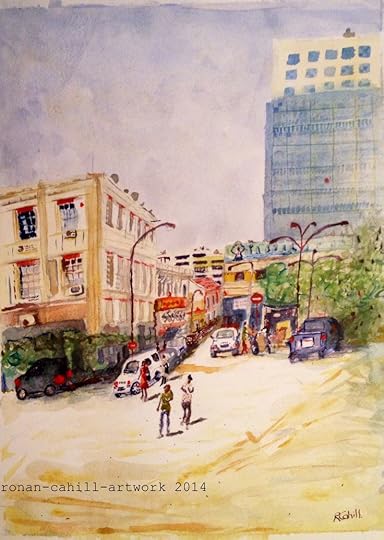
Baixa de Luanda - Angola - Pintura de Ronan Cahill

"- mas quem manda em tudo isto?
- gente muito superior.
- superior... como deus?
- não. superior mesmo! aqui em Angola há pessoas que estão a mandar mais que deus.


(da voz do povo)"


(página de cor preta e letras em branco) - Pág. 327


”Os Transparentes” é o último romance publicado em 2012 - Prémio Literário José Saramago em 2013 – pelo escritor, poeta e artista angolano Ondjaki, pseudónimo de Ndalu de Almeida, nascido em 1997 na cidade de Luanda a capital de Angola, oficialmente República de Angola.
”Os Transparentes” é um retrato quase sempre fiel, muita das vezes metafórico ou alegórico sobre as vivências – os seus problemas e as suas virtudes – de Luanda, uma metrópole africana no pós-independência (1975) e no pós-guerra civil (1975 – 2002), subjugada no passado por Portugal, o colonizador desde o século XV, que ao longos dos tempos vai interagindo de inúmeras formas e métodos, quase sempre negativamente, com os povos nativos, principalmente, com os habitantes das cidades do litoral, e, obviamente, com a sua capital.
Neste magnífico romance Ondjaki relata-nos – através de um conjunto absolutamente inesquecível de personagens – as especificidades de um regime comunista “democrático” (apenas em teoria) que pretende enquadrar-se no designado progresso económico e social, conjugando o denominado «desenrasca» do dia-a-dia das pessoas que ambicionam a todo o custo viver e sobreviver perante as adversidades – que vão desde a simples falta de água passando pela inexistência de alguns bens alimentares essenciais à subsistência de qualquer ser humano.
A estrutura e a descrição que Ondjaki confere às suas personagens e aos diferentes cenários – em especial o prédio de apartamentos em que decorre a maior parte da narrativa – é deslumbrante e original. Quase que não vislumbramos distinção ou contraste entre a atmosfera dos diferentes locais e as insólitas personagens que os habitam – o calor, por vezes, sufocante; a atmosfera melancólica e triste, mas igualmente com um humor tão característico e tão inconfundível de todos os “visitantes” de ”Os Transparentes” e dos angolanos nativos; igualmente, dos conflitos entre interesses pessoais e interesses políticos; dos desentendimentos ou da discórdia entre as tradições seculares angolanas e a proliferação das “novidades” tecnológicas, científicas e sociológicas; da complexidade psicológica das personagens inerentes a drama pessoais que revelam a subjugação, a subordinação ou a subserviência – que permanece indissociável da sua extrema humildade – fruto dos diferentes extractos sociais; em suma, muitos dramas pessoais que se envolvem e interligam uns com os outros, constituindo uma espécie de novelo de histórias que equilibram e perpetuam as inúmeras personagens com a confrontação entre o pessoal e o colectivo, ou entre a cidadã ou o cidadão habilidoso civilizado e amável e o político manhoso, corrupto e astuto.
Se a criatividade ou a particularidade que é transposta e que permeia a narrativa de ”Os Transparentes” é um factor ímpar e incomparável no atributo das personagens e dos diferentes papéis sociais que ilustram e explicam é na escrita e na riqueza das palavras – com uma apresentação gráfica sem maiúsculas (excepto, os nomes próprios (eles também originais), os locais e algumas instituições, e pela inexistência de pontos finais (apenas existem alguns) -; num linguajar característico das ruas de Luanda (presumo que sim! mas nunca lá estive) com expressões que exibem o quotidiano e as vivências das pessoas e da cidade, e que se enquadram excepcionalmente bem na narrativa; com os capítulos a serem separados com folhas pretas e letra branca com ou anotações do autor ou das personagens.
A dicotomia água e fogo contribui para a beleza do enredo e das personagens; mas também no que se refere a uma Angola repleta de contrastes, sociais, económicos e políticos, vivendo no momento actual um período complexo e por vezes incompreensível para um cidadão ocidental.
Num texto em que há sedutoras descrições poéticas, diálogos originais e extravagantes – com subtil e agradável "sotaque" angolano -, incluindo o lirismo e o realismo mágico, e que fazem de ”Os Transparentes” de Ondjaki um romance de leitura obrigatória.


Tobacco Shop Luanda - Angola - Pintura de Ronan Cahill


Trading outside Intermarket - Luanda - Angola - Pintura de Ronan Cahill
Profile Image for Os Livros da Lena.
298 reviews319 followers
October 23, 2020
Review Os Transparentes, de Ondjaki.
58/2020
5⭐️

Extraordinário. Lia mais quatrocentas páginas do Largo da Maianga.

Este é um livro feito de pessoas. É feito de amor, de dor, de capitalismo, de idealismo, de saudosismo e nostalgia.

Este livro tem Luanda e tem Angola. Tem o mundo. Tem as desigualdades, as disparidades, mas também as comunidades, as irmandades e a humanidade.

De todas as pessoas de que este livro é feito, gostava de destacar duas mais favoritas (porque todas o são, para sempre): o carteiro, representação perfeita de resiliência, de garra, de luta contra as burocracias e as injustiças constantes no mundo, contidas em pedidos humanos, feitos por humanos a outros humanos.
E, claro, Odonato. A metáfora perfeita de Luanda, da saudade do passado e do futuro.

Absolutamente apaixonante!

P.S. Obrigada @book_tasting por me teres sugerido e emprestado esta obra maravilhosa! Já sabes que confio cegamente em todos os teus 5⭐️, para sempre! ❤️

E vocês, conhecem esta obra? Já leram? Que outras obras aconselham de Ondjaki?
Profile Image for Sónia Carvalho.
196 reviews17 followers
August 18, 2021
Demorei a entrar no mundo de Ondjaki. No início achei que havia demasiados personagens e tinha dificuldade em saber quem era quem, mas com o desenrolar da história, senti que os ia conhecendo cada vez melhor, um pouco como acontece com os nossos vizinhos ou amigos recentes.

Em 'Os Transparentes', acompanhamos o quotidiano de luta diária dos habitantes de um prédio de 7 andares situado numa Luanda pós-independência, que após décadas de opressão colonial e guerra civil, ainda se encontra extremamente estratificada e economicamente desigual.

Ondjaki apresenta-nos uma vasta gama de personagens que retratam o povo “invisível”, gente simples, que vive em condições precárias, pessoas que estão gradativamente a tornar-se transparentes e que vivem à mercê da corrupção dos políticos, que só pensam em encher os bolsos de dinheiro com a possibilidade de encontrarem petróleo, mesmo que isso possa levar a uma tragédia. Não desistam desta leitura cedo demais porque vale muito a pena chegar ao fim :)
Profile Image for David.
1,685 reviews
August 21, 2018
Transparent city

Alea jacta, petroleum est (“no going back, petroleum it is”)

A Luanda farce that will make you laugh, and cry too.

“Transparent City” won the José Saramago prize in 2013 and Ondjaki was named one of the top five African writer in 2012 by the Guardian. A lot to live up to and I must say, I was impressed.

The book centers on a group of people living in a seven-floor apartment building in the city of Luanda. The cast is an entertainment itself. Blind Man and Seashell Seller are friends. Strong Maria is married to João Slowly. Little Daddy was separated from his mother during the war years. Although I am reading the English, their translated names give themselves away.

The main character of the book is Odonato. He lives with his wife Xilisbaba (Baba for short), his daughter Amarelinha and Ciente-the-Grand and mother -in-law Granma Kunjikise.

The book is all about schemes. João Slowly comes up with a scheme to create a roof top cinema. The movies are played in silence and the audience gives voice to the sound track. This is known as “the eight art” and the theatre is called Rooster Camões (yes named after the famous Portuguese writer and the rooster, that oh so obvious symbol of Portugal). This Time and Next Time are tax collectors, connected to the Minister. Crystal Clear runs Crystal Clear Waters, getting rich off the water system. Paulo Paused is a journalist with inside political connections with Scratch Man and Colonel Hoffman. Edú has an enlarged hernia called a mbumbi forcing him to wear a giant diaper. He hopes to make money off his story. The mailman writes a hand-written letter on 25-lined paper requesting a moped to make his job easier. He gives everyone he thinks who might have leverage a copy to help his fight.

But the biggest scheme comes from the government. They hire an American engineer to “discover” oil under the city. Every person, called Cirollers where oil is found, will get in on the action and Crystal Clear will use the water lines to move the oil around. In short, everyone gets rich. Except a local engineer, Davide, realizes that drilling oil under the sandy ground of Luanda might sink the city, or worse.

Through it all, the beloved Odonato has begun to disappear. Literally. His son Ciente is involved with crime and then the police. As you read on all these characters are intertwined and corruption is the rule of law. Except Odonato continues to disappear.

Symbolism and comedy underlines the story. Sometimes the beauty arises, but mostly it fades into the harsh reality of Luanda. A dark comedy or a ray of hope. Hmmm?


Profile Image for Rachel.
886 reviews76 followers
January 28, 2024
#ReadAroundTheWorld #Angola


This is a novel set in Luanda, Angola, by Angolan author Ndalu de Almeida, writing under the pen name of Ondjaki. It is a contemporary story set in an apartment block that shifts between many characters, some of them rather quirky.

I’m sure this is a clever book with much to say. It touches on capitalism, exploitation, colonialism, corruption, drugs and poverty. There are elements of humour, or the ludicrous, with an eclipse that is cancelled, a man seeking fame for his huge hernia, and other elements of satyr and the farcical, pointing out the failures of the government, colonial powers, the police and legal system. There is magical realism, with one of the characters progressively becoming transparent, I presume as a metaphor for the invisibility of poverty and hardship. However this was all wasted on me due to the storyline, or more precisely the lack of storyline, which I found unengaging and difficult to wade through. This was probably amplified by an audio-narrator that failed to distinguish between the many characters at all. Sadly although I was excited to read my first book from Angola by a local award-winning author, this was a disappointing read for me.
Profile Image for Valerie.
195 reviews
Read
January 7, 2020
An imaginative book, infused with magical realism, which offers a searing critique of Angolan politics and society and the effects of economic liberalisation. I really enjoyed the writing style, the meandering and slightly dreamy nature of the story-telling, and the humorous notes that infuse the book. The story is constructed around a polyphony of characters centred around an apartment building in a poor area of Luanda, which are meant to represent different strata of Luanda society. I really liked the tapestry that Ondjaki weaved through this form of story-telling, but it does mean that there is no character development in se. The characters are used as narrative devices for the purpose of social commentary, rather than being the object of the story. As others have pointed out, a key weakness of the book is the almost complete lack of female voices in the book and the often-misogynistic representation of women. Which makes it difficult for me to rate this book. I would give it 4.5 stars for its narrative quality and social satire, but 2 stars for its gender bias.
Profile Image for Rita (the_bookthiefgirl).
357 reviews85 followers
April 12, 2023
4,5⭐️

“o oculto é como um poema- chega a qualquer momento.”
.
Que livro incrível e rodeado de uma riqueza indescritível. As páginas fluem de uma maneira arrebatadora e, quando damos por nós, já estamos em Luanda, rodeados das personagens mais diversas e interessantes. 😊
.
“era um prédio , talvez um mundo ,
para haver um mundo basta haver pessoas e emoções. as emoções , chovendo internamente no corpo das pessoas, desaguam em sonhos. as pessoas talvez não sejam mais do que sonhos ambulantes de emoções derretidas no sangue contido pelas peles dos nossos corpos tão humanos . a esse mundo pode chamar-se “vida” ❤
.
Através de uma escrita invulgar, que roça a gíria e o vocabulário tipicamente angolano, Ondjaki carrega uma poesia nas suas palavras, de tal maneira que nos sentimos transportados num vão de humanidade e, também, de humor satírico. É possível sentir a corrupção na capital angolana, a miséria, o amor e o espírito de comunidade das pessoas do prédio do bairro, com as suas águas ao nível do chão e os seus dilemas pessoais. Apetece-nos embalar as personagens e, por isso, rimo-nos, choramos , acometemo-nos do ridículo que é a vida delas.
.
.
A transparência não é mais do que uma metáfora bela acerca da dor e da humanidade , um retrato das disparidades da sociedade angolana. Ondjaki, com este livro tão belo, consegue levar-nos a querer ler outros livros do mesmo molde 😊 Só quero voltar àquele prédio, ao corpo transparente de Odonato, ao Cego, ao Vendedor de Conchas, às mulheres belas e aos políticos corruptos.
.
“(...) e as dores de dentro , de uma pessoa ver que na crueldade dos dias , se não tem dinheiro , não tem como comer ou levar um filho ao hospital...e os dedos começaram a ficar transparentes... e as veias, e as mãos , os pés , os joelhos ... mas a fome foi passando : foi assim que comecei a aceitar as minhas transparências... deixei de ter fome e me sinto cada vez mais leve...”"
Profile Image for Rui Ferreira.
Author 2 books49 followers
April 11, 2021
Os Transparentes foi o meu primeiro contacto com o autor, vencedor do Prémio Saramago em 2013. O livro é maravilhoso. Mais do que um quadro, a leitura torna-se um filme, porque a escrita é tão envolvente e os diálogos tão naturais, que estamos mesmo naquele prédio a assistir e a ouvir as personagens. Há um equilíbrio genial entre o carinho e a crítica mordaz à cidade de Luanda e ao povo angolano. Há parágrafos de enorme emoção e sensibilidade e outros de feroz sarcasmo social e político. É uma Luanda dividida - pela ambição desmedida do progresso, pela corrupção económica, feridas do pós-guerra e miséria social -, que nos assusta e nos apaixona.
Profile Image for Miguel F. Carvalho.
32 reviews1 follower
June 23, 2013
"- mas quem manda em tudo isto?
- gente muito superior.
- superior... como deus?
- não. superior mesmo! aqui em angola há pessoas que estão a mandar mais que deus.

[da voz do povo]"

A típica literatura dos países africanos de língua portuguesa, cheia de expressões locais e devidamente contextualizada. E um certo realismo mágico africano nos pormenores.

Para quem não conhece in loco a realidade deste tipo de países, muitos destes pormenores poderão passar ao lado.
Profile Image for Graciosa Reis.
539 reviews52 followers
July 8, 2023
Começo por afirmar que adoro os livros de Ondjaki. É um maravilhoso contador de estórias. E neste, tudo é encantador e comovente: a escrita poética, os nomes das personagens, o vocabulário tão particular, a mensagem…
“- não te assustes - murmurou o VendedorDeConchas abraçando-a devagarinho -, eu sou o mar a chegar perto de uma concha…
- não me assustei – sorriu Amarelinha -, estou a olhar a lua”

Este livro, como muitos dos que já publicou, tem como cenário Luanda e apresenta uma panóplia de personagens-tipo fantásticas que abarcam todas as classes sociais.
Ondjaki revela-nos uma Luanda actual, mas muito degradada, corrupta e sobretudo desumana. A sua visão crítica desta cidade em transformação é-nos revelada de forma precisa e irónica, claro, mas também humorística. Há descrições sublimes.
“- mas quem manda em tudo isto?
- gente muito superior
- superior… como deus?
- não. Superior mesmo! Aqui em Angola há pessoas que estão a mandar mais que deus.”

É através dos modos de vida, dos dramas e sobretudo dos diálogos fabulosos das personagens que vivem no prédio, do LargoDaMaianga, que percebemos a agitação que assola o povo africano, a corrupção que reina na capital e por inerência no país, a miséria e a fome de muitos, mas também a dignidade de um povo que luta, a solidariedade dos vizinhos…

“- a verdade é ainda mais triste, Baba: não somos transparentes por não comer… nós somos transparentes porque somos pobres.”

“era um prédio, talvez um mundo,
para haver um mundo basta haver pessoas e emoções. as emoções, chovendo eternamente no corpo das pessoas, desaguam em sonhos. as pessoas talvez não sejam mais do que sonhos ambulante de emoções derretidas no sangue contido pelas peles dos nossos corpos tão humanos. A esse mundo pode chamar-se”vida”.

nós somos a continuidade do que nos cabe ser. a espécie avança, mata progride, desencanta, permanece. a humanidade está feia – de aspeto sofrido e cheiro fétido, mas permanece
porque tem bom fundo.

É isto! Leiam!
Profile Image for Inês.
217 reviews65 followers
July 9, 2013
Numa altura em que Luanda é a pista de aterragem para tantos emigrantes portugueses, é essencial que este livro faça parte da mesinha de cabeceira de todos eles. Ler Os Transparentes é como espreitar por uma janela e ver Luanda inteira. Mais do que isso, a cada página o leitor é absorvido pela cidade e convidado a ver através dos olhos de quem a ela pertence.
Encontraremos, claro, a história que todos conhecemos, de governantes corruptos que forçam a miséria de cidadãos honestos («fui comendo cada vez menos para que os meus filhos pudessem comer o pouco que eu não comia») enquanto exploram e dividem entre si as muitas riquezas de uma terra que tem tudo. Mas o livro não nos deixa no abismo da história única, mostra-nos um povo alegre e desenrascado, que inventa negócios excêntricos e formas de sobreviver, rindo e dançando com a boa disposição que lhes permite esquecer o tanto que lhes tiraram e tiram todos os dias.
Vamos reencontrar personagens queridas de outros livros, mergulhar numa banda sonora escolhida criteriosamente, rir quase sempre, emocionar-nos algumas vezes. Tudo isto com a qualidade literária que já se espera de Ondjaki, mas num estilo menos fechado do que, por exemplo, em Quantas Madrugadas Tem a Noite.
Dos livros que li do autor, este foi o romance que teve mais espaço para ser romance.
Profile Image for Ensaio Sobre o Desassossego.
428 reviews217 followers
September 13, 2019
Apesar de nunca ter estado em Angola, com este livro de Ondjaki transportei-me imediatamente para Luanda. Senti o cheiro da capital angolana, a sua agitação, a corrupção, a exploração trazida pelo capitalismo e pela globalização. É um retrato muito humano e realista, sobre as injustiças do poder, sobre a ânsia de querer ser desenvolvido e como este desenvolvimento, normalmente, é só para os "superiores", nunca para os mais pobres.
"- mas quem manda em tudo isto?
– gente muito superior.
– superior.. como deus?
– não. superior mesmo! aqui em Angola há pessoas que estão a mandar mais que deus."

https://www.instagram.com/p/BxF37H5Bp0g/
Profile Image for Isa.
15 reviews13 followers
May 18, 2019
This book is poetry written in prose (I read it in Portuguese). It is a story about the lives of a group of people that live in a six store building, that never was completly build. So there is a 'vertical corridor' but no elavator. Everything seems in this Luanda to work only through schemes. It seems to be a picture of Luanda at the begining of the 21st century, dense narrated with a very dark humour.
Profile Image for Bradley Frederick.
135 reviews6 followers
January 14, 2022
A surprisingly funny novel about a government rooted in corruption and the people trying to survive under it. The use of magical realism makes this a less accessible book, but I enjoyed the stylistic choices made by the author. While it is a slower read, it is entertaining throughout the entire plot.
Profile Image for Carol.
216 reviews108 followers
November 6, 2024
review completa aqui

é uma leitura lenta e desafiante. por vezes sentia que não avançava e lá ia eu apanhando todas as migalhinhas que ondjaki deixava sobre aqueles personagens. não conheço luanda, mas para mim, tornou-se a cidade d’os transparentes.

recomendo também a leitura do “invisível” de tom percival!
Profile Image for Andrea Gagne.
363 reviews25 followers
February 8, 2023
Well that was certainly interesting. It left me a bit disappointed, to be honest!

The book follows so many characters and side-plots that I couldn't keep track. The main plot, the one written on the back cover, is around an apartment building in Luanda and the cast of characters that live there - one of whom, Odonato, is turning transparent. The relationships between the people in the building, the life they have together, the antics they get into, and the challenges they face together as a community was what I liked most about this book.

However, there were so many side plots and side characters that I struggled to keep track of everything. And it was hard to see if all that needed to be there. I think the author's goal was to show how many different lives are coexisting side by side in Luanda, some interconnected and others barely touching. But it was too much for me, personally. The oil drilling company, the eclipse, the American, the journalist, the colonel, the Minister and Advisor, so much was happening, so much felt like filler that didn't advance the plot in any way. And so many of those plotlines didn't end up getting resolved.

I liked the plotline of Odonato and Xilisbaba, I liked Seashell Seller and Blind Man and Amarelinha. I liked Granma Kunjikise. I liked Strong Maria and Little Daddy and Comrade Mute and Edú and Nga Nelucha and the mailman and the theater on the roof. I liked the satirical look at the city's corruption, and I liked the view of everyday life for people relying on one another to get by, dreaming big, and enjoying life where they can - when a water pipe floods the ground floor of your building, take off your shoes and stick your feet in the water to cool down on a hot day. And I liked how the author wrote the dialogue, in a way that felt very fast-moving and lively, with some funny quips and banter.

But I think a lot of the rest could have been shortened considerably.

2.5 stars, rounded up to 3.
Profile Image for Federico Escobar Sierra.
302 reviews118 followers
August 15, 2020
Las mesas de ofertas de las librerías dan sorpresas. En el FCE encontré por casualidad este libro. Un autor desconocido: Ondjaki, de un continente muy poco leído por mí: África. Pocas reseñas, solo traducido al español en esta edición de Almadía, con algunos premios y muy raro en Colombia. Lo tomé.

Los transparentes es un libro que respira, palpita por medio de su colección de personajes tan bien caracterizados, tan cercanos, historias de los que cuando todo está agotado, tienen que seguir viviendo. Hay mucha vida en este libro, por eso mismo tiene que haber mucha muerte, y la hay.

Es África pero no hay leones, selvas ni tribus. Hay un gran proyecto que termina en tragedia, en una ciudad real y absurda. Todo el colorido de la marginación y la resistencia del pueblo. Música, alegría y profundas tristezas. Es Angola, y somos también nosotros contados desde un edificio, como vecinos o visitantes , pero conectados.

Ondjaki escribe según sus propias reglas. En la puntuación, las mayúsculas o la construcción de las frases está su estilo. El tono fluye con perfección entre buen humor e ironía para contar lo real y lo fantástico. Razones de sobra para que Ondjaki sea uno de los escritores africanos más relevantes de esta década, lástima que su llegada a nosotros solo se logre haciendo cacería entre las mesas de ofertas. El libro y su autor merecen muchísimo mas.

Quien vea un libro suyo no dude leerlo o decirme dónde está. Es de verdad un placer.
Profile Image for Beatriz.
41 reviews28 followers
February 23, 2021
“— o que é bonito nesta cidade, Odonato… são as pessoas. as festas, o ritmo, até os enterros
— passámos muitos anos, Xilisbaba, em busca do que é bonito para suportarmos o que é feio. e não estou a falar dos prédios, dos buracos na estrada, dos canos rebentados. já é hora de encararmos o que não está bem”

Odonato torna-se transparente quando se torna lúcido, consciente de que não verá em Luanda as cores que outrora imaginara. Mais do que corroído pela fome, que o emagrece desde o início da existência, Odonato é corroído pela saudade da Luanda do sonho, da Luanda que não se concretizou.

Esta inusitada transparência é também a invisibilidade literal dos impotentes, dos pobres, presos num ciclo de miséria numa cidade onde pouca gente “sabe falar sem dinheiro nas mãos”; reféns de um país que é deles de coração, mas cujo leme foi, e é, manobrado ao sabor dos interesses de apenas alguns.

Um romance também ele transparente, despido de floreados, terno no contar da história — e destaco a comovente saga do Carteiro, personagem encantadora —, mas duro na mensagem que encerra. Bem ao modo de Saramago.
Profile Image for Areeb Ahmad (Bankrupt_Bookworm).
753 reviews262 followers
October 4, 2022
"whichever way you looked at it, the night was braided blackness and enclosure, the hide of a nocturnal beast oozing sludge from its body, there was a timid gleam of stars in the sky, the languor of certain whitecaps and the seashells on the sand popping open in an excess of heat, human bodies undergoing involuntary cremation and the city, sleepwalking, wept without the consolation of moonlight"



Ondato remarks early on in the book: "Luanda was boiling with people who said, who bought to sell who sold themselves to later go out and buy, and people who sold themselves without being able to buy anything" At its core, Ndalu de Almeida aka Ondjaki's novel, examines the lives of a disparate group of people residing in or whose lives are tied to the decrepit Maianga building. It is a colourful cast of characters, all of them hustling to survive in a rough city that is always on the verge of giving up the ghost, caught up in the birthing pains of the Civil War.

It is fascinating to see how Ondjaki injects the narrative with appreciable depth. It occupies a wide variety of emotional registers that seek to encompass the totality of the human condition. While their lives might be ringed in tragedy as well as uncertainty—the book certainly doesn't end on a happy note—they still find time to be happy and make merry, to engage in quotidian forms of community, and to lighten their days. The prose is rich. The absence of periods and inventive chapter breaks are unique elements in this satirical, hard-hitting, innovative novel.


(I received a finished copy from the publisher in exchange for an honest review.)
Profile Image for sónia.
226 reviews86 followers
May 23, 2017
Ainda não li mais de Ondjaki para além deste livro e de um ou outro poema escrito por ele. Ainda assim, este autor já é um dos meus favoritos. A história lê-se com gosto, rapidamente e com uma ânsia por mais. O romance em si é muito humano e realista, mostra-nos uma realidade de um povo que não escapa nada, que chega a todos os pontos pertinentes pois todos devem ser celebrados e descritos em minúcia mas descontraidamente. Adoro a marca da oralidade em todas as falas e discursos, a presença do sobrenatural e a humanidade que contrasta com as injustiças do poder. Adorei o espírito dançante, eufórico, também erótico que se vive, a animalidade que o escritor não esquece e o poder do título através de Odonato. Definitivamente um livro que deve ser lido por todos. Um dos meus favoritos, também.
Profile Image for Francisco M Cortez.
6 reviews
October 12, 2017
Vou ter saudades das personagens, tão diferentes a passar por tantas coisas diferentes, que às vezes até parecem aleatórias, mas no fim tem tudo um significado! Toca nos em todos os pontos do coração: amor, sofrimento...partes engraçadas, partes profundamente tristes, partes que nos fazem pensar e por muito em causa, regressar a simpliciadade das coisas, da vida...
980 reviews16 followers
May 28, 2019
i enjoyed the characters, the city, the magic. i didn't think much of the action, it was too messy and often without context.
Displaying 1 - 30 of 210 reviews

Can't find what you're looking for?

Get help and learn more about the design.