Aleš Kot is a post-Chernobyl, pre-revolution, Czech-born, California-based writer/producer who started in graphic novels and now makes films, television, and an occasional novella.
A. believe in art and community. A. doesn't believe in borders nor cops. A. believes in love, which they know is a very Libra answer. And what about it?
Over the course of the movie series I know there has been much swooning over James Bond and his body. I recall that Daniel Craig coming out of the water in blue bathing trunks in Casino Royale caused the temperature to rise for many. So, it goes without saying that The Body is an important part of James Bond lore, and there is now a series of graphic novels which take one story and focus on specific parts of the it in each issue.
I thought this was a pretty creative approach to a well-known series. Since there have been so many books and movies, I am sure it can be difficult to come up with new and creative ideas. While the over-arching story is typical bond, giving a very specific focus to a part of the body in each adds some depth that makes what might normally be ordinary more extraordinary.
The story has one author, but each issue has a different illustrator. Sometimes this bugs me, but in this case, it worked to give several artists a piece of the story and let them run with it. While some of the illustrations I enjoyed more than others, overall it was a visually satisfying adventure.
If you have thought about trying the James Bond graphic novel series, this is one worth checking out. You get some of the typical bond tropes you know and love with and interesting and creative twist on presentation.
The name’s Bland. James Bland. At least it is when Ales Kot is writing him!
Bond fights an assassin. Then a terrorist. Then some Nazi arms dealers. He chills out with some lady in the mountains. He fights another bad guy. And that’s James Bond: The Body. Still awake? Me too - barely.
This anthology is sooooo unimaginative - Bond by-the-numbers. It was kinda shocking to see Bond waterboarding someone (does Ales Kot even like Bond? Why is he writing this comic - Kot seems very anti-authoritarian to me) but otherwise the stories here were instantly forgettable.
Dull writing, very weak characterisation all round and the art is nothing special. Ales Kot is Borefinger – he’s the man, the man with the snoozy touch!
“Whatever glamour we see in Bond—it’s not worth the price”—Ales Kot
So this is book seven in the “new Bond” Dynamite comics series, the intent of which is to bring Bond up to the present, offering various artists’ takes on how to bring the tone of the original, Ian Fleming's Bond and not the Sean Connery film Bond, into contemporary Bond stories. In some ways all of them can be seen as reflections on Bond and Fleming. For instance, in this and some of the other Dynamite comics volumes James Bond is much more violent than in the squeaky clean films, and more of the brooding existentialist you find him to be in the early Fleming books. Yes, James is also a “woman’s man,” in some of the books, but he’s also more of an invent-your-survival killing machine than an MI6 Mr. Suave Martini Gadget Guy. More of a bourbon man, yes, but also less escapist fun we have associated with the Bond franchise. This more tortured Bond is the Bond Kot is interested in.
So as you can imagine, some of these twenty-first century Bond tales are a mixed bag. The best of the bunch so far has been the volume of Warren Ellis, imo. But this very volume is one such mixed bag itself, written by Ales Kot, and drawn by different artists. There isn’t an attempt to make the art styles sync in any way, or to even make the Bonds look alike. He’s on steroids/testosterone in the contemporary fashion in one, then leanly muscular in the next. That is clearly deliberate in this volume; the thing that unites all the stories is that they were written by Kot and that each issue features action in terms of Bond’s body, as in The Heart, Lungs, and so on. It takes an opportunity to reflect on Bond and his legacy. Each volume is connected to injuries he has suffered, which correspond with psychological injuries. The last story is an attempt to tie things together, connect them all to one larger story of Bond and The Damage Done.
There’s a tone in Kot’s writing here I was having trouble fixing on that I was helped with by reading the afterword, where Kot says of Bond that he is an “imperialist, colonialist construct,” and also racist and misogynist, too, in that he is a white man who uses women of various ethnicities “without regard to their well-being.” Now, Bond as lover is one of the chief reasons both men and women (okay, more men than women, at a glance at the Goodreads ratings/reviews) read Bond, so we are getting into touchy territory here, I know. But Kot has his various points to make, and he makes his various them throughout this volume without losing sight of him as a human being. So I reread it from the perspective of his afterword and I began to understand what he was doing.
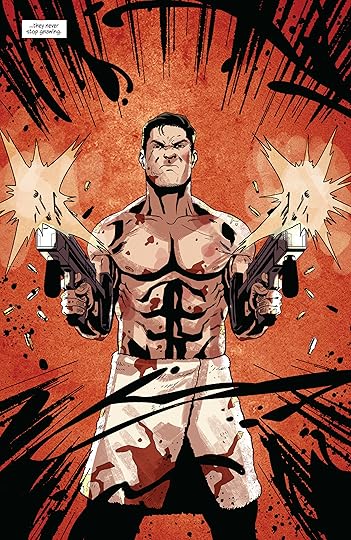
Example: Bond is working undercover at some soiree, out to find a guy who is going to try to kill a woman. Bond’s protecting this woman. We don’t know why the guy would kill the woman or why Bond would protect her. At one point another woman calls him a “hunk meat mountain.” I almost stopped reading right there, I’ll admit it, on first read. Why, that isn’t Bond language! Or, on reread, maybe it is, in that when Bond walks in the room women all turn their heads, and he makes his choice of them if wants to. He’s a body, and “his” women are bodies. And Bond in this first issue is not the lean Sean Connery, but is seen here almost as Thor and Hulk are depicted, and even Batman now, with monster pecs and arms. He’s the contemporary muscular hyper-masculine male. He’s male eye candy; he’s a body!
On reread I see Kot as deconstructing him in an anti-colonialist fashion. Bond figures out who is the assassin, in a room full of white rich people. Why, surprise, it is as it was in Fleming’s day as he wrote it, the swarthy dark-skinned guy! So Bond kills this guy, saves a rich woman, and Bond finds a note on the guy, a goodbye note explaining why he happened to be doing this hit job--forced to do so through poverty and strong-arming, and telling his family he loves him. This part of the story would not have happened in Fleming books--sympathy for the assassin, seeing things from his point of view. But afterwards, Bond feels badly about having killed this guy. When the doc offers him pain meds he declines: “I want it to hurt.”
In another issue or chapter here, Bond actually waterboards a woman who is critical of England’s continued colonialist legacy, from 1763—when England gave blankets infected with small pox to indigenous Americans on orders from military high command--through Margaret Thatcher to Brexit. The woman says to Bond: You just follow orders, doing what the government wants you to do, right? You’re part of this “great country.” Whew! Political critique in a Bond book??! I can see why this is a low-rated Bond book, because it is actually a critique of Bond as unquestioning imperialist representative, but it is good and interesting as a fresh angle. And you know, it is also part of Fleming's Bond.
In another issue/chapter Bond is talking to a bunch of white nationalist arms dealers, and (spoiler alert), Bond ends up slaughtering ALL of them. Would James Bond do this?! Well, Fleming’s Bond WAS very violent, not the suave Connery that was more a lover than a fighter. But we see what the legacy of violence might have been for secret agents like 007 who only get assigned those numbers IF they are killers. Bond pays for killing, in body and soul, but he also IS a killer. Do we really want to slaughter all the neo-Nazi haters out there?
In the final chapter there’s a chat in a pub between fellow agent Franz Leiter and Bond as Leiter arranges for a guy to be killed in the pub. The guy dies, and they go on drinking. There’s a certain level of anguish, depression, existential angst in this volume that you find in the early Fleming Bonds—or in Goldfinger, where there is an extended meditation on death, and what it means to kill people and have your own brushes with death. Kot in places is not unsympathetic to Bond, the killing machine; he finds him complex, both troubling and troubled.
So, again, the Goodreads rating for this is low as I said and I’m not surprised. There’s not much fun action, because it's not, when you come down to it, really fun action to kill people. There’s a lot of talk, because this one is primarily reflective. It’s a very dark socio-political commentary on Bond in the current climate, with neo-Nazis, extra-judicial torture, and the world going to hell. I have already begun reading Goldfinger (for the first time) and will not be able to keep this critique out of my head as I read on. I think Kot is brave and smart to have done this work WITHIN a Bond series! I can’t say I loved it, but I admire the heck out of it.
Congratulations Ales Kot. You've managed to make James Bond boring. Six loosely connected solo stories, most of them consisting of sitting around talking and Kot isn't enough of a wordsmith to make that interesting. But even the issues that feature more action like when Bond is chasing after a guy with a bomb aren't interesting due to the obtuse narration. This just doesn't feel like Bond. In fact, if Bond's name was stripped out of this, you'd just think this was another generic spy thriller written by Ales Kot. There's a different artist on each issue with varying degrees of skill.
Received a review copy from Dynamite and NetGalley. All thoughts are my own and in no way influenced by the aforementioned.
Six separate James Bond stories, with a tenuous link, form this graphic novel collection that never really comes to life. A couple of the stories are interesting, but some are just dull & pretentious. Even the decent artwork cannot save this one.
I received this from Netgalley in exchange for an honest review.
This is the seventh volume of the James Bond series, and it keeps getting better. In this volume, we get even deeper into the psyche of Bond as he tries to unravel a tangled web involving Afghan assassins, deadly biological weapons, neo-Nazi gangs, supersmart scientists switching sides, and of course, EU and American politics.
It was also quite cool how the author tied it all into injuries that Bond has experienced.
This is really good. A series done in a style similar to Kot's Zero, with each issue featuring artwork by a different artist, and an episodic nature tied to a different part of Bond's body--heart, lungs, etc.--as he takes part in a mission or recovers from one. The various stories don't seem to have any connection to each other until the final chapter, featuring Felix Leiter, suggests that they all relate to a single conspiracy, which Kot explains in an interview in the extras, he might come back and follow up on in another series. Here's hoping he gets the chance. This is one of, if not the best Bond series that Dynamite has put out to date. Strong recommendation.
Five apparently unconnected tales, each centered on a body part, before they all tie up at the end. Each tale focuses on some of Bond's pains. Be they physical or not, they hurt him, day by day, bit by bit. Because of his acute understanding of who he is, of what he does and to which endgame.
No fancy cars, casinos and martinis here, only the dark and lucid take of one man on his life, on his job, on his depression-while saving a few thousand lives. For 007 is not a happy man.
A good modern approach of Bond. Darker and more self-reflective than usual, it does a great deal to humanize our secret agent without sacrificing the plot.
The weak point is the cast of pencillers: with the exception of Luca Casalanguida (opening and closing issues) they are all very mediocre and make for a good story but a rather ugly comic book.
Once again, Dynamite Comics undercooked a buffet of short stories, hamfisted by one man - Ales Kot. He obviously fancies himself a wordsmith, given how each of these six minisodes fail to take advantage of what is a visual medium. If THE BODY was anything to go by, the height of his talents cap out with the low-standards expected from quippy, tawdry superhero comics, except those are usually fun.
I've never been a James Bond fan. Never grew up with the character, other than playing Golden Eye. I got bored too quickly with the marathons. What seemed so stylish THEN seemed so dated to me me Now.
My other exposures had been through other media, such as Casino Royale via the book, the parody and the recent film--which I actually enjoyed.
In many ways, James Bond was wish-fulfillment that I didn't wish to embody. He was tall, annoyingly charming. Catch my surprise with this recent spat of quality writers--with Warren Ellis, and now Ales Kot.
Kot writes the character if he caught a bit of self-awareness. Awareness that he's part of the military industrial complex, awareness that he's a womanizer and a perhaps a misogynist, and that he has a duty to QUESTION Queen and Country.
The fact that this is now canonical, and not just an emulation (i.e. Kingsman, Zero, etc.) makes it all the more special. The character has actually been allowed to grow, imo. Rather than put back in the box and just come back shiny, new and different every few years.
I suppose it's natural that a writer as sceptical of state power as Ales Kot keeps being drawn to writing secret agents; they're what that power looks like when the lights are off and the need to put on a nice front is removed. But whereas his own creations such as Zero can really dig into that, it leaves him in a more awkward position when he's playing with someone else's toy such as Agent Coulson or, here, the exemplar of the species. And perhaps that tension is why he's created a somewhat fractured story, six one-issue looks at Bond with a vague thematic link, but which show very different sides of him. The variety, verging at times on a sense of disjointedness, is emphasised by using different artists, some of whom handle the gig much better than others. The first chapter, 'The Body', has Casalanguida, one of the stand-out Dynamite Bond artists, who captures the appopriate air of elegant menace; this is the traditional, heroic Bond, preventing an assassination in spectacular style (though the explosions and helicopters remain off-panel, the comic instead showing us the prelude and the aftermath, the important stuff often overwhelmed by pyrotechnics). But that's followed by 'The Brain', essentially an interrogation scene, which means a lot of repeated panels of Bond in the same pose. Some artists can carry that off; Antonio Fuso just makes Bond look wet, a bit confused - almost Daniel Craig-esque - and as if a stock picture has been repeated with comic intent. Not that the story is otherwise funny, as Bond sits getting harangued about the horrors of Britain's past (Kot's occasional tendency to regurgitate his research undigested is in full effect here) by a scientist accused of giving terrorists access to bioweapons. The third issue, drawn by Rapha Lobosco, looks almost like Goran Parlov; it ends with a fabulous, knowingly homoerotic money shot as Bond goes undercover in a neo-Nazi sauna. This feels to some extent like the synthesis of the first issue's trad heroic Bond and the second's foolish catspaw, but if you attain that harmony halfway through the collection, where do you go next? Well, it turns out the short stories may be more linked than they first appeared, and the second half feels much more consistent, both in tone and in the quality of the art - though there's still a massive and appropriate variation between Eoin Marron's low-key vignette The Heart and Hayden Sherman's tense, intricately designed work on The Lungs. And then it's back to Casalanguida again as Bond and Leiter go for a drink and the main action is again resolved offscreen. Not without its flaws, but still definitely the most interesting Bond I've seen in any medium since Tomorrow Never Dies. I'm just disappointed that, given both Kot and the Bond franchise have a bit of form for on-the-nose names, he didn't manage to include a Bond girl called Patriarchy Kristeva or something.
For what it’s worth, I happen to appreciate when some relevant and prescient subtext is included beneath the surface of established IP and licensed material.
This wasn’t that. This was basically Ales Kot, the author, hijacking the name “James Bond,” and writing a manifesto that had little to do with the reason anyone opens a James Bond book.
And please, make no mistake, I am not slinging some low rent accusation of “wokeness” at this. I like wokeness. I like it when tropes are challenged, or when the writer uses a story to critique norms or give voice to marginalized experiences. That’s good writing.
This is just virtue signal after virtue signal. There’s an entire vignette about how torture is bad. There’s an entire vignette about how killing henchman is bad. There’s an entire vignette about how Nazis are bad. One issue decides to use Bond as a way of criticizing imperialism. These are positions I fucking agree with!!!
However, I didn’t buy this James Bond comic to have these relatively beginner level moral positions preached at me. I wanted a James Bond story, with a cool villains and exciting spy shit. If I want to be preached at, there are better places to go. There’s better analysis out there that doesn’t interfere with my James Bond spy adventures escapism time. I don’t even think this author likes James Bond. Which is fine. Not everyone does. Just… if you don’t, than don’t fucking write it. Is that fair?
Last thing;
I wouldn’t terribly mind this if it wasn’t a Bond story. If they named the character something else, these would be decent little socially critical vignettes. Don’t get me wrong… they’d still be relatively shallow… but at least they wouldn’t be insulting me by hijacking a character that I enjoy BECAUSE OF THE TROPES in order to host these virtue signals and critiques.
What a ride. Kot is a great choice for writing the acerbic and disgruntled Bond, especially since he seems to have free reign in this series. The tone jumps with each issue, going from somber to funny to heartbreaking and then back again. Ales manages to deliver more quotable lines in 6 issues than Diggle did in 12. Definitely up there with Ellis among the Bond comics.
'James Bond: The Body' by Ales Kot is a graphic novel about James Bond and various parts of his body. At least, I think that was the idea.
Each volume focuses on a different body part. In the first, Bond goes after an unknown assassin and winds up with some broken ribs and time off, but he's not convinced the assassination attempt was a lone incident. In other stories, he infiltrates a group of white supremacists and interrogates a scientist about a viral agent she helped create.
I liked the stories here. They are all a bit different in approach and the stories they tell and I like that they were linked. The art for each issue is by a different artists and is kind of inconsistent because some is better than others.
I received a review copy of this graphic novel from Diamond Book Distributors, Dynamite Entertainment, and NetGalley in exchange for an honest review. Thank you for allowing me to review this graphic novel.
Like to thank Net galley giving me an opportunity to read and review this graphic Bond novel.
A different take on James Bond, an action adventure in terms of Bond's body, brain, gut, heart, lungs and final chapter titled burial. Though each story looks unconnected but in the final chapter all the episodes are inter-connected.
Ales Kot (I don't know how to pronounce) is the author and have five illustrators for six plots. I liked the illustrations of Luca Casalanguida. I liked the issue #2 and #4, second issue, Bond interrogating a woman who had plans of killing the innocent people by lethal virus and issue four, without a weapon and badly wounded Bond meets a girl a writer in a solitary place.
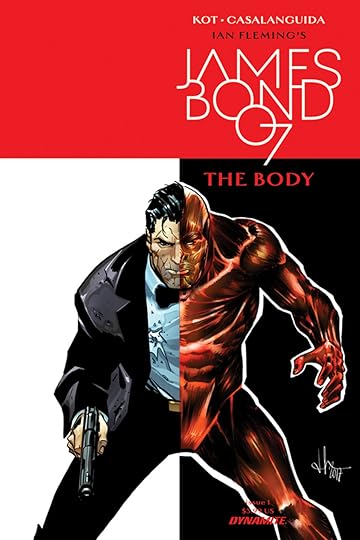
James Bond: The Body by Aleš Kot (illustrated by Luca Casalanguida, Rapha Lobosco, Valentina Pinto, Tom Napolitano and Eoin Marron) finds secret agent 007 recounting how he got each cut and bruise on his last mission. This graphic novel collects the six issues which make up The Body story-line.
Issue #1: The Body – James Bond tells the story of his previous mission to a medical examiner. Each bruise and bump has a connection and a purpose – either to kill or to save a life.
Issue #2: The Brain – In this issue Bond interrogates a scientist who let a terrorist organization steal a lethal virus.
Issue #3: The Gut– To find the virus, Bond has to infiltrate a group of Neo-Nazis who intend on selling the weapon.
Issue #4: The Heart – Bond finds himself without weapons, and wounded, in the Highlands. A woman who chose a solitary life helps him heal and Bond finds that he likes the peaceful place.
Issue #5: The Lungs – The story now comes together in a terror attack – maybe!
Issue #6: The Burial – James Bond meets his old friend and CIA counterpart Felix Leiter in a pub where the secret agent must face the consequences of his actions.
I started reading this graphic novel thinking this would be another secret agent on a mission story but instead I got an excellent James Bond arc. James Bond: The Body by Aleš Kot (illustrated by Luca Casalanguida, Rapha Lobosco, Valentina Pinto, Tom Napolitano and Eoin Marron) is something different and deeper than the previous graphic novels.
The story is clear and concise, there is no outrageous plot to take over the world, and there are no beautiful women to save (or kill when they eventually backstab Bond). This story is grounded and fresh, the comics work together to bring a cohesive story to life.
The writer shows how Bond struggles with the decisions he makes and the actions he takes. He knows he will pay for bad decisions his superiors make, yet he executes his mission faithfully.
Bond also sees another side of life, one that doesn’t have people who want to kill you behind every corner, and that tranquility might actually work for him at some point. The audience certainly gets the feeling that Bond is tired, mentally and physically broken from the world he lives in.
This arc is a change of pace for the series, and goes in its own direction. The art in this graphic novel is a mixed bag, the story is really good but the backdrops seem to be boring (a sauna, house, pub) which is exactly the time for the artist to shine.
I really wanted to like this. I really, really did. I've been a Bond nerd much of my life. Thanks to my Grandpa, I've read nearly all the Bond books, and have seen all the movies. So naturally, I picked up a bunch of the comics. Finally making my way to The Body, I was seriously expecting something different. While that is not normally a problem, I don't feel like this is the Bond we all know and love. I know Kot is trying to "bring him into the modern age" but there are way better ways to do that. Case in point with the recent Daniel Craig Bond films. This just isn't Bond.
I don't know, read it if you must, but don't put too much stock into it. Kot isn't an awful writer, he's just not a good Bond writer. Hopefully they will find something that better suits his talents.
Ich kam gerade frisch vom „Casino Royale“-Band, IMHO ein Comic-Meisterwerk. Was sollte schon danach kommen? Oh Gott, eine Sammlung von sechs Kurzgeschichten? Der eigentlich exzellente Kieron Gillen ist schon nicht mit 44 Seiten klar gekommen. Wie soll ein Autor mit einer nur 27seitigen Kurzgeschichte genügend Flughöhe für Spannung, Intrige und Charakterzeichnung bekommen?
Es hat mich umgehauen. Autor Ales Kot und die fünf unterschiedlichen Zeichner haben es geschafft.
Der Band enthält Kurzgeschichten namens „The Body“, „The Brain“, „The Gut“, „The Heart“, „The Lungs“ und „The Burial“. In „The Body“ sehen wir Bond bei einem Arzt, der ihn notdürftig zusammenflickt. Während der Behandlung erzählt Bond, wie er bei einem Botschaftsempfang nach einem Attentäter Ausschau hält.
Bereits diese erste Geschichte schärft die Sinne für einen Ales Kot, der neue, unorthodoxe (zumindest für Bond-Comics) Inszenierungen erfindet: eine Agentengeschichte mit Verfolgungsjagd, die von Bond in Form von Rückblenden beim Arzt erzählt wird, während der Arzt nur so vor Frotzeleien sprüht.
„The Brain“ zeigt ein Verhör zwischen Bond und einer Wissenschaftlerin. Da ist wieder das kammerspielartige von „Casino Royal“. Zeichner Danielo Fuso setzt konsequent fast ausschließlich Seiten im 3x3-Raster ein.
Und so geht es weiter: jede Kurzgeschichte hat seinen eigenen Charakter, aber Autor Ales Kot sorgt für die Klammer. „The Body“, „The Brain“, „The Gut“ etc… sind nicht nur metaphorisch die Körperteile die im Zentrum stehen und in Mitleidenschaft gezogen werden. Am Ende der fünften Story ist Bond ein gebrochener Mann, der nur noch auf Autopilot läuft.
Der majestätische Kniff von Autor Kot ist die sechste Kurzgeschichte, die plötzlich diese scheinbar lose Kurzgeschichtensammlung miteinander zu einem einzigen Plot verknüpft und auflöst – in einer 27 Seiten langen Szene in einer Kneipe. Am Tresen sitzen James Bond und Felix Leiter und reden. Abgesehen von einem kurzen Toilettengang von Bond, besteht die Abschlussstory nur aus Dialog am Tresen, mit Schnitten auf die beiden aus unterschiedlichen Positionen in der Kneipe. Und auch wenn Bond und Leiter ihren Platz am Tresen nicht verlassen: am Ende der Story stirbt ein Mensch und eine Verschwörung ist vereitelt.
Es ist keine hohe Kunst oder kein Meisterwerk wie „Casino Royale“. Aber es ist nicht minder magisch. Kot ist ein Strippenzieher, bei dem aber am Ende mehr als nur Effektheischerei steht, sondern Substanz. Substanz in Form eines James Bond, der nicht mehr der gleiche sein wird.
Als Leser habe ich mich noch Stunden später gefragt, wie mich Kot da an die Nase geführt hat und in der letzten Story mit seiner Kameraführung subtil gesteuert hat.
This graphic novel is my hole, it was made for me (queer, autistic imp who developed a special interest for James Bond over ten years ago and craves angst and deeper character study)
Joys: - Bond having a sense of humour!! Very Dalton era humour specifically which makes me very happy!!! Specifically the cutaway gag of the sob story he gives to the Neo Nazis is so good!!! - Bond covering for M by calling them Mum (Oh My God, He Admit It) - Bond experiencing not only remorse, but some self-hatred and genuine misanthropy in response to the world he's chosen to make himself a part of is just *chefs kiss* -The whole story he tells the Doctor to introduce us to a Bond who doesn't have the blockbuster glamour we've come to associate with his name, that the reality is far sadder, is why this is my HOLE. - FELIX LEITER PROSTHETIC ARM FELIX LEITER PROSTHETIC ARM FELIX LEITER PROSTHETIC ARM - Bond killing Neo Nazis (cool) - Bond with the glamour entirely removed and only the fear, violence and malaise left in its place (very very cool) - Bond being allowed to have One (1) action one-liner and it being for the purpose of killing Neo Nazis (stunning, brilliant, showstopping, never the same) - "Cheers to therapy, then!" - You Are Not Immune To The Body's Response To Being Tasered!
Minor gripes: - Slightly inconsistent character design though that's understandable between artists, but specifically going from The Body to The Brain is like whiplash. Though I do feel like both capture the aspect of Bond they're going for; the great, hulking pile of muscle for The Body and the more perfectly groomed, normal looking one (seriously might as well be Tanner) for The Brain, but I prefer the around-the-middle design of the others (The Heart especially, I like how goofy he looks in some of the panels. And definitely in The Gut) - Never a huge fan of the "bigot is actually a repressed homo" trope, even if the protagonist does take the time to tell me all about how some bigots are actually repressed gays! Although the tiny "this isn't gay" is genuinely quite funny. Also I can't decide if I hate Bond exclusively using the term 'homosexual' (though at least he also uses bisexual once for variety) because it's something that I in real life find off-putting, but also I think it's in character and that James Bond does not have even a passing familiarity with the community. I appreciate that at the end of it it's "doesn't matter if you are, a Nazi is a Nazi" which is something we can all get behind.
Consensus: Ales Kot ily pls write more Bond stuff for me to read
I like Bond. Gritty spy thriller Ian Fleming Bond. Early movie Bond. Even sometimes maybe later movie Bond when it was all gadgets and parkour. But it seems to me, especially lately, that some of the most interesting Bond is to be found in graphic novels. And this one is especially interesting, if untraditional.
Bond has always been a bit tormented and repressed, but this is full blown angsty existential crisis Bond; he's still apparently calm and in control, but he's also now been shaken, if not stirred. The amazing thing to me is not that we've gone in this direction, but that in this novel the approach is handled so well.
This volume collects the first six issues of the Bond "Body" arc. They are thematically joined in that each issue flirts with a different aspect of the body - brain, heart, nerves, etc. (MILD SPOILER). The actual stories seem to be standalones. Until the end, that is, when they all interconnect and lead the reader to a satisfying, if dark, conclusion.
I don't know where you stand, but I'm generally left unimpressed by talky, deep comics. Especially action or fantasy comics. They can be single minded, heavy handed, and awkwardly written. And boring. Not so here. The volume does start out a bit slowly and the reader does wonder if this is going to be some repetitive angst-fest or an anti-authoritarian wallow. But by approaching Bond from different angles we get different versions of his doubts and fears and we get different sorts of monologues and dialogues and different ways of thinking about who Bond is and what he represents. This skipping around and the overall thoughtfulness of the approach actually keep the reader interested and invested.
The upshot for me was that this was a real, satisfying, and engaging surprise, and a refreshing new look at Bond, James Bond. A nice find.
(Please note that I received a free advance will-self-destruct-in-x-days Adobe Digital copy of this book without a review requirement, or any influence regarding review content should I choose to post a review. Apart from that I have no connection at all to either the author or the publisher of this book.)
Hmmm… I thought I was going to get more out of this book – but then I started without knowing it was designed to look like six short stories. The end result is sort of six short stories – and kind of not, and either way there are problems. You have to take the comment that the first part is relevant with a pinch of salt, and while the tale meanders through its distinctive parts, you get too much that is a beat away from the full rhythm. So the conclusion of the bit with the woman is stupid ("oh by the way, I'm only here to prove a woman can spend the night with you with her knickers on" she might as well have said), the bit where he goes full-on Punisher is stupid, and I could also have done with the snide comments about Brexit, too. Stupid. But at the same time, by the time everything is wrapped up, it's proven itself to be OK. It's one of those books where you think it's being lame, but have to give it the benefit of the doubt. It's more interesting than entertaining, as a result, giving us more character than action – so I'd say try it, but don't rush to buy, unless you feel compelled to for completism's sake.
This was a different look at James Bond. The volume contains six different vignettes, all following a common thread, that illustrate different aspects of Bond's character. We seem him ruthless, and we see him about as moral as he gets. We see him introspective and we see him acting as judge, jury and executioner. We see him driven and we see him reduced to the point of exhaustion. All this in a single book. Well done Mr. Kot!
This Dynamite series continues to entertain and keeps the Bond character in the light envisioned by Ian Fleming. A number of illustrators are at work in this series, but all capture a physicality suggestive of a coiled panther, ready to spring. Luca Casalanguida continues to be my favorite, but there is a lot of talent on display here that succeeds in spades. The writing covers a gamut of different scenarios from action to long dialogue sequences and is entertaining throughout.
I have read a large number of graphic novels over the years and I do not recall any that have remained so consistent in their output as this one. Keep up the good work Dynamite and I will keep sending you money and praise!
A sometimes interesting collection of disconnected short story adventures until the last book where two talking heads reference each previous adventure for way too long and try to connect the dots while drinking beer from various angles.
The best stories are the ones where Bond fails at his task, but they are not really Bond stories per se. The ones where Bond is the hero are pretty rote and not very exciting. Both factors make me think Kot does not like Bond very much and took this job out of spite.
Overall it is too much telling and not enough showing and the telling is not compelling. It especially should not have ended with 20+ pages of the same medium shot/closeup cutaway of two talking heads over and over, mostly taking about eggs and alluding to all the stories you just read in the preceding pages.
Read the one with the interrogation scene with the commentary from Skyfall in mind, and it makes an interesting statement about Bond, albeit the same one Skyfall was making.
The hardcover collection of THE BODY brings all 6 issues together in one volume. It is satisfying to see that almost every issue presents another artist's rendition of our contemporary hero, James Bond. The collection allows you to read just one issue (as a complete story) or continue on and read all six. I was interested by the different approaches the artists had to drawing Bond. I really liked the scientist who is being questioned for her apparent malfeasance. These stories are not as fantastic as the cinema movies of Bronson and Moore, but they present a contemporary, intelligent figure. I enjoyed the series so much that I had to read it over once I completed the first run-through. Now, I'm still reading it but slower as I try to savor the nuances Ales has created for the character and the situations. If you're a Bond fan, this collection belongs in your library.
I really didn’t get on with this book. The other Dynamite hardback collections have been superb, but this anthology felt all over the place.
For a start, there are 5 different artists across the 6 issues in this collection, so from a visual perspective, it feels disjointed. Bond’s physical appearance is inconsistent in a story that’s meant to be connected. In the films I understand this isn’t a problem, but in a single connected story, it’s like swapping Connery for Craig halfway through Goldfinger. It just doesn’t work.
Then there’s the story, a great idea in principle but poorly executed. The narrative is all over the place and whilst it’s meant to all come together and connect by the final issue, it barely does. Certainly not in a satisfying way.
In my opinion this is a rare Dynamite Bond collection that I’d recommend avoiding.
This contains both an overall arc and an anthology series. Each issue goes through a specific story modernizing Bond for a new audience. Colonization, terrorism, torture, misogyny and racism are explicitly covered.
It does bring into focus what it means to do thigs that regular citizens will not do for themselves. It makes me question how black and white we should be about these issues. I mean, we are basically contracting out our ethics so we don't have to get our hands dirty.
This isn't West Wing like but it does show that right things may not even be possible because the system is so messed up. The author has said that he believes he has a larger story available that does take on systemic issues. Given how he handled this one, it is something that I would be interested in reading.
Fragmented stories that focus on the psyche and inner workings of Bond. Somewhat connect together in the last issue, but the arc as a whole is certainly more therapy insights than plot-driven storylines. Much of the series takes place in the calm before the storm or recovery discussions between Bond and other characters. Kot does a great job at addressing current events as they might impact Bond/spies, but some of it is certainly heavy-handed. Of the 7 or so arcs of Dynamite’s Bond series, this is middle of the pack in writing and slightly below that in art.
Review copy courtesy of NetGalley and Dynamite Comics.