Jump to ratings and reviews
Rate this book

Ничейного отца дети

Rate this book
Трилогия Арно Шмидта "Ничейного отца дети" - ранняя проза одного из самых влиятельных послевоенных немецких писателей. Он был выдающимся интеллектуалом-аутсайдером, стилистом-новатором, реформатором прозаической речи и привычной повествовательности, оставаясь преданным ценителем немецкой литературной традиции. В 1951 году под одной обложкой вышли два первых романа Шмидта - "Брандова пуща" и "Черные зеркала", в 1953-м - третий, "Из жизни одного фавна". С 1963 года эти романы писателя публикуются как трилогия, под общим названием "Ничейного отца дети" (Nobodaddy's Kinder). Действие романов разыгрывается в Люнебургской пустоши, к северу от Гамбурга, в круге радиусом около 5 км, который можно очертить вокруг крошечного городка Бомлиц, в окрестностях коего - рядом с мельницей на речке Варнау, в доме, населенном 50 беженцами, - Шмидт поселился с женой, когда в 1946 году вернулся из английского плена. Кем бы ни был повествователь - писателем, начинающим жизнь заново в послевоенном хаосе ("Брандова пуща"), единственным выжившим в атомной войне ("Чёрные зеркала"), чиновником в гитлеровской Германии ("Из жизни одного фавна"), - с нами всегда с точностью и трагичностью очевидца говорит сам Шмидт, а Люнебургская пустошь неизменно становится, по выражению Ханса Волльшлегера, "подмостками мирового театра, на которых разыгрывается вся проблематика XX столетия".
В то, что существование сложнейшей прозы Арно Шмидта на русском языке возможно, ещё недавно трудно было поверить. Эту виртуозную работу проделала Татьяна Баскакова, лауреат специальной Немецкой премии за лучший перевод 2015 года, известная нашим читателям по переводам "Реки без берегов" Ханса Хенни Янна, романа Альфреда Дёблина "Горы моря и гиганты". Татьяна Александровна написала также статью и подробный комментарий к романам.

648 pages, Paperback

First published January 1, 1963

31 people are currently reading
1118 people want to read

About the author

Arno Schmidt

236 books209 followers
Arno Schmidt, in full Arno Otto Schmidt, (born January 18, 1914, Hamburg-Hamm, Germany—died June 3, 1979, Celle), novelist, translator, and critic, whose experimental prose established him as the preeminent Modernist of 20th-century German literature.

With roots in both German Romanticism and Expressionism, he attempted to develop modern prose forms that correspond more closely to the workings of the conscious and subconscious mind and to revitalize a literary language that he considered debased by Nazism and war.

The influence of James Joyce and Sigmund Freud are apparent in both a collection of short stories, Kühe in Halbtrauer (1964; Country Matters), and, most especially, in Zettels Traum (1970; Bottom’s Dream)—a three-columned, more than 1,300-page, photo-offset typescript, centring on the mind and works of Poe. It was then that Schmidt developed his theory of “etyms,” the morphemes of language that betray subconscious desires. Two further works on the same grand scale are the “novella-comedy” Die Schule der Atheisten (1972; School for Atheists) and Abend mit Goldrand (1975; Evening Edged in Gold), a dream-scape that has as its focal point Hiëronymus Bosch’s Garden of Earthly Delights and that has come to be regarded as his finest and most mature work.

Schmidt was a man of vast autodidactic learning and Rabelaisian humour. Though complex and sometimes daunting, his works are enriched by inventive language and imbued with a profound commitment to humanity’s intellectual achievements.

Ratings & Reviews

What do you think?
Rate this book

Friends & Following

Create a free account to discover what your friends think of this book!

Community Reviews

5 stars
106 (47%)
4 stars
75 (33%)
3 stars
33 (14%)
2 stars
7 (3%)
1 star
4 (1%)
Displaying 1 - 30 of 39 reviews
Profile Image for Vit Babenco.
1,784 reviews5,787 followers
July 21, 2020
“Why art thou silent and invisible, Father of Jealousy? Why dost thou hide thyself in clouds From every searching eye?” William BlakeTo Nobodaddy
Nobodaddy is William Blake’s Urizen – a gnostic demiurge of our defective world…
Scenes from the Life of a Faun is a dreary presentiment of the colossal social catastrophe…
Not a continuum, not a continuum ! : that’s how my life runs, how my memories run (like a spasm-shaken man watching a thunderstorm in the night) :
Flash : a naked house in the development bares its teeth amid poison-green shrubbery : night.
Flash : white visages are gaping, tongues tatting, fingers teething : night.
Flash : tree limbs are standing, boys play pubescing; women are stewing; girls are scamping open-bloused : night !
Flame : me : woe : night ! !

For the protagonist the continuous reality falls apart into separate fragments and Arno Schmidt portrays his hero’s life as the series of discrete impressions. The narration is expressively metaphoric and full of the vivid and grotesque imagery…
The whole nation is in the grip of a mania for medals and badges, enthusiastically weaving away on the legend of its own grandeur ! : The sort of thing that truly fits the Germans to a T !

Society is sick and the hero, not wishing to partake in the total mass hysteria, hides away in books, historical documents, daydreams and, similar to faun, in the woods… And like a faun he finds a nymph… And everything is destined to end up in the fiery apocalypse of air raid…

Brand’s Heath is an autobiographical episode of Arno Schmidt’s life.
The author, a former prisoner of war, gathering materials for his book, joins a small community and endeavours to survive the aftermath of the greatest national calamity…
I consider “intellectual” a title of honor : it is after all man’s most distinguishing characteristic ! If everybody was one, at least brawls would be fought with pens, or with mouths. Would be a considerable improvement !

He hunts for food and other needful stuff, dreams dystopian dreams, writes his book, gets acquainted with some people and contemplates the nature of creativity…
– Art for the people ? ! : they yowl with emotion when they hear Czarevitch’s Volga song, and turn icy-cold with boredom at the Orpheus of Chevalier Gluck. Art for the people ? ! : leave that slogan to the Nazis and Communists : it’s just the opposite : the people (everyman !) are obligated to struggle their way to art ! –

He even falls in love but all in vain… A man of creative mind always remains a stranger.

Dark Mirrors is a post-apocalyptic prognostication… Dark mirror is a mirror of melancholia…
By way of precaution, I aimed my carbine’s month at the greasy wreck : the windows thickly dusted; only after I hit it with the butt did the car door open a little. Backseat empty; a skeletal lady at the wheel (so, same as always for the past five years !); well : enjoy your bliss ! But it would be dark soon too, and I still didn’t trust creaturiness : whether ferny ambush or mocking birds : I was ready with ten rounds in the automatic : so pump onward.

The nameless protagonist seems to be the only living man left in the world so he is like an intellectual version of the ultimate Robinson Crusoe having not just the desert island but the entire world for himself. And to make his life more comfortable he salvages a lot of things…
And I was only in my early forties : if everything went well (?) I could ramble the earth void of man for a long while yet : I needed No One !

The unpopulated world is an ideal place for a loner. Any recluse is a demiurge of his own world.
Profile Image for Geoff.
444 reviews1,525 followers
September 1, 2015
Why darkness & obscurity
In all thy works & laws,
That none dare eat the fruit but from
Thy wily serpent's jaws?

-William Blake (To Nobodaddy)

~~

description

~~

description

~~

description

~~

description

~~

description

~~

Why dost thou hide thyself in clouds, from every searching eye?

~~

description

~~

description

~~

"...and into the eternal hunting grounds of fantasy : ought to link the identity of the Flying Dutchman and Odysseus sometime with a story. Wind began and the tall firs spoke deep and bellowy." - Dark Mirrors

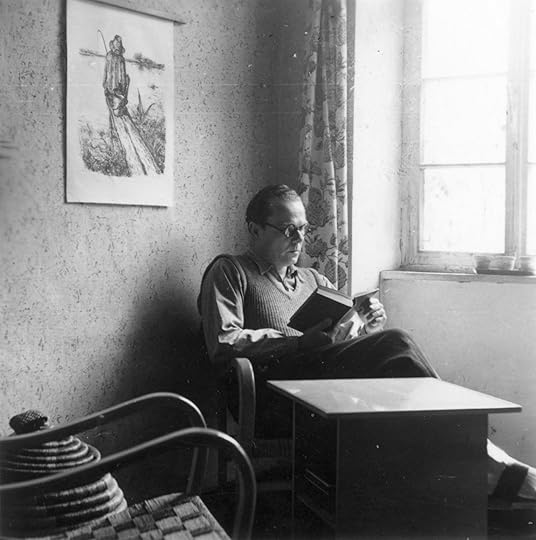
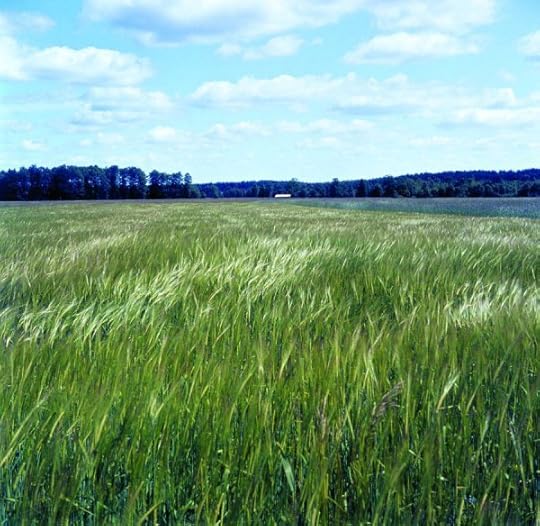
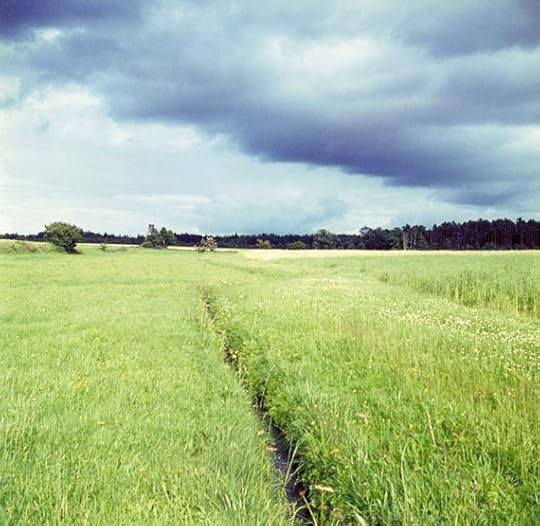
(photos by and of Arno Schmidt)


Profile Image for Nathan "N.R." Gaddis.
1,342 reviews1,653 followers
Read
May 20, 2017
Arno Schmidt. Teutonic knight of the heath, well=buried; :deservedly supposedly for reasons not one of us can reckon. I have gathered evidence for a preliminary hearing. I have little doubt that one has come too late; the hangman has assuredly done his work, done his work quite well. Arno has good company. Let you and I step out onto the heath, grab a handful of peat or spade deeply into it -- dig with ‘em if you gottem -- and gander into what’s down there.

We postulate that Herr Schmidt has been unjustly unread for longer than many of us have pulled breath :: we need a BREATHER. Saint McElroy, we petition you to send among us your ANGELS that we might BREATH more deeply the engelisch aires.

Exhibit 1a). We submit the photographic indication, gathered and preserved for us by Spade Officer, First Rank, Nate D, [linked here] ! ! ; a few pages of Abend mit Goldrand, wherein we see that either this Schmidt is a fool, a madman, a prankster, or a Knight of Letters.

Exhibit 1b) Eric, himself a corpse preserved by a similar peat, has proffered corroborating photographic evidence, employing the widely recognized Women and Men standard, [linked here] ;; : furtherly, Eric, in all good conscience much beyond the capacity of this humble Schmidtian, has embarked on the tradition of reading Evening Edged in Gold even as precisely such a tradition is unknown thoroughly to our world, and has provided the following excerpt of this “fairytalefArse”:
Watch out, get away from that electric=fents ! -?-:oh, 't's alot worsen barbwire; The shock isn't just 'nasty', that's high=tension. The vet was telling Olmers thother day about how a farmer was climbing over it n toucht it with his 'nutshell'; keeld rite over;lips all blue, 'cookt his balls', 'rippt rite off' ! And they say it kn happen if a man just takes a leak on it.
Such excerption, not being legally binding, is certainly convincing to any spade-wielder possessing the correct presuppositions and predispositions.

Exhibit 1c) This video, and if ‘viral’ should mean anything, it would infest and shut down our precious internetz. [again, shoveled out of the mould by the bog-corpse Eric] [attention hither].

Exhibit 2) John E. Woods.

Exhibit 3) [Dalkey Archive] : or more precisely, Collected Novellas: Collected Early Fiction 1949-1964 :;: Nobodaddy's Children: Scenes from the Life of a Faun, Brand's Heath, Dark Mirrors :;: The Collected Stories of Arno Schmidt :;: Two Novels: The Stony Heart and B/Moondocks.

Your Most Honorable Readership :?! I submit that something is wrong not just in Denmark and not merely upon a barren Teutonic heath but that there is something askew with the World of Letters : namelich, either Arno Schmidt should NOT have been so deeply buried, ODOR[stench of corpses!!], there are those among us who would insist that such unreada=babble books should be read by the masses and thus himself must be mad and ought to be re-MANded to a peat bog as deep into which he shall be BURIED :: menschlichmöglich.

This is a review of three novellas, but you may believe that they constitute a single novel :: warum nicht? “Scenes from the Life of a Faun,” whose action takes place 1939/1944; “Brand's Heath,” action 1946; “Dark Mirrors,” action 1960. Already you see how these novels might constitute a single history of a point of view of civil-servicehood from within WWII Germany, followed by a refugee vignette digging out of the rubble, and finished up with a post-WWIII survival story of the last remaining human(S??) in Europe and perhaps for as far as we can tell in all of the wide wide WELT. But what about these three novellas? I will tell you :: an author’s work -- his/her WERK -- is a singularity : not a gesamtkunstwerk [Wagner] but a Conceptual Continuity [Zappa]. A diversified unity ; but you see that there is something in a name whereupon one might hang one’s hat. Can you see, from the cozy valley of The Portrait of the Artist as a Young Man clear into the dreamy heights upon clouds of Finnegans Wake? Neither could I. But there is a path there unto.

And Schmidt: a sample of a novel, of a trilogy, of a collection, of a few pages :: enjoyment follows understanding and understanding is a road.

The above exhibits may be taken as self-evident : they are evidence of their very selves. And it is as follows :: these are promises. And such promises strike fear into the heart of the justifiably trepidatious reader. Our trilogy of novels under present review are not of this nature, but only a Portrait on the path thereunto. No columnar play; very little of the etym which holds promise upon the peak [and the Etymites, I should insert here, will also feed quite well upon the BURIED corpus of [Julián Ríos] ] ; BUT there is the re-conVENTionalization of the period, the colon, the ?-mark, etc, a potentiality of convention which Schmidt resurrects into meaning; and there is this warning about the lack of ribbons ::
My life ? ! : is not a continuum ! (not simply fractured into white and black pieces by day and night ! For even by day they are all someone else, the fellow who walks to the train; sits in the office; bookworms; stalks through groves; copulates; small-talks; writes; man of a thousand thoughts; of fragmenting categories; who runs; smokes; defecates; listens to the radio; says “Commissioner, sir” : that’s me !) : a tray full of glistening snapshots.
Not a continuum, not a continuum ! : that’s how my life runs, how my memories run (like a spasm-shaken man watching a thunderstorm in the night ) :
Flash : a naked house in the development bares its teeth amid poison-green shrubbery : night.
Flash : white visages are gaping, tongues tatting, fingers teething : night.
Flash : tree limbs are standing, boys play pubescing; women are stewing; girls are scamping open-bloused : night !
Flame : me : woe : night ! !
But I cannot experience my life as a majestically unrolling ribbon; not I ! (Proof).
Books will teach you how to read them :: and in some possible universe only those books which require that they provide a lesson in their own reading are books which might count as WORTH reading.

I shall return to these hallowed halls at a future yet unspecified date with further evidence culled from the Dalkey Archive, three volumes chuck-n-full of Schmidtian fiction.

Meanwhile, dear brav reader, shovel-ready, join the Ranks of Friend Eric and get to work upon the masterworks straight-away, unearthing Evening Edged in Gold or impatiently awaiting a revolution in the book=welt which might provide the actualization of the possiblization of the publication of the Woods=ing of Zettel’s Traum :: OR you with trepidation leaking out of the eaves which give shelter to your book shelves, begin early here with the children of Nobodaddy or with either colLECTed stories or the Sammlung of Novellas. Easy does it when ease=ing into the Conceptual Continuity of that solipsistic Stimme upon the Haide.

Profile Image for Jonathan.
1,009 reviews1,230 followers
January 26, 2016
The KIRKUS REVIEW of Faun which, unusually for them, does not irritate the hell out of me:

It's too bad, really, that this 1953 novella didn't arrive here before the 1980 translation of Schmidt's dauntingly dense and Joycean Evening Edged in Gold: it might have made the latter's excesses and impossibilities seem a bit more coherent. For, as this shorter but no less literary book amply demonstrates, Schmidt (1914-1979) was a continuously outrageous imagist and a kind of stonemason of self-perceptive prose: block by block, the story builds on, knocking the sides off anything that finally isn't about literary style. Set in 1939, the book focuses on Heinrich During, a bureaucrat with large scorn for his Nazi bosses and for his countrymen's willful obtuseness; During also has a frigid wife and a comically throbbing lust for an office typist, Fraulein Kramer. And, in a cascade of tropes, each one paragraph-sized and introduced by a seemingly unconnected rubric (which however acts as the note to which the successive prose-block is tuned), During observes the moon in a dozen flowery aspects, considers the merits of Gnosticism and the works of Wieland, surveys a local district, or experiences a department store: ""Rifles barrel bamboo reptiles glasses twitter dunes of coffee lips gone crooked buckled clucking words out trotting rippling hot-dogs bronzed with dots of mustard scales with clawing pointers subtle yellow tiny show-offs thick potboilers brash trash photos rigid jackets upright stairways ramble rosy gristled earfuls napes of buffet-worthy matriarchs with earnest censure luggage boxing doorways flailing as you leave."" All the while, too, During prepares for the catastrophe of defeat he knows the Allies have in store: he lays in supplies at a forest hide-out--to which he brings Fraulein Kramer during the climactic, horrifying, gorgeously described firestorm (Schmidt's style really pays off here). A fine, stimulating book altogether--which, in Woods' extraordinarily vital and brilliant translation, may do what the white-elephant-like Evening Edged in Gold failed to do: establish Schmidt--whom the Germans consider a major modernist figure--as an important writer for the English-speaking literary world."


:: see, that was actually pretty good - usually Kirkus reviews make me want to go on a murderous rampage of hyperbolic rage, but with this one, we all good.

So, Faun was the best of the three (and, were it on its own, would get a full 5 star raving), Heath the worst (lets say 3 stars). Dark Mirror was a bit like a more fucked up and eccentric version of The Road if there were no kid and no(?) other people. Oh, and no hope (lets say 4 stars for that one, because god forbid I don't hold up the score cards).

Would Schmidt? Schmidt Wood. Jarno Schmood. To read this in translation is obviously to read something else, a text with a chimeric author. But what a lovely writer this two-headed beast is! There is a beauty in the sentences in Faun in particular, some of which I quote in my updates, that stunned me. And placed, as they are, within the textual eccentricity, they gain a power from their lyricism that would be denied otherwise.

Go read Nathan, Ronald and Nate's reviews. Oh and look at Geoff's pretty pictures.

Profile Image for Nate D.
1,654 reviews1,252 followers
October 10, 2011
Arno Schmidt hit the literary ground running in post-WWII West Germany with a series of novellas and this bitter trilogy moving from the war years into the post-apocalyptic future. Stylewise, Schmidt took the lessons of Joyce into territory all his own: it wasn't enough for language to do whatever we wanted it to -- now syntax must follow suit. Thus this reads really like nothing else, a series of fragmentary, poetic bursts of thought and observation that move across each day in jumps and lurches without wasting any space on transitions. There's a quote somewhere that the best literature teaches you how to read it, and that's sort of how Schmidt's writing is, gradually coming into focus as you absorb its rhythms and thought-patterns. The Joyce comparisons seem pretty apt -- dense and over-smart, yet simultaneously lewd and funny -- but Schmidt alternates his more abstract and allusive burbles with more direct bits, the whole parsed into smaller, more digestible fragments. And since this is post-war, he's more naturally comfortable at the blending of high and low elements that Joyce dabbled in. (Did Joyce ever attempt science fiction, I wonder?) I'll review the parts separately, as they were published that way.

Scenes from the Life of a Fawn: In Germany, in the months leading up to the Second World War, a bored, embittered government clerk is charged with reviewing local village and parish records. The exact purpose of his task is never really elaborated, but it can be presumed that he is supposed to be locating families of Jewish or other unacceptable heritage. Instead, in what petty rebellion is open to him, he spends his time tracking the movements of a Napoleanic deserter with whom he feels some across-age affinity. Once the style sinks in, this is actually pretty brisk and entertaining without a lot of wasted words. Workplace buffoonery, extremely vivid descriptions of clouds, some rather interesting discussion of German lit (as in, way more focused and narratively useful than the literature chapters of Against Nature). It is strange, though, to be reading a description of this era of Germany from so close within -- and by an author who was conscripted into the German Army, no less. Like a good post-war German, he's quick to denounce everything going on before the war, the "correct" response for anyone who wanted a future. Schmidt's (and his narrator's) bitterness and disgust really do seem sincere, but still, it's a little uneasy spend time watching normal Germans at the height of Nazi-ism going on about their lives. Maybe that is part of the eerie interest here too, though. And Schmidt doesn't really let anyone off the hook -- though his protagonist hates the system, he's still essentially a complicit cog in it. A warning to moderate or distracted dissidents. 3.5 stars or so.

: And it was another Reichstag session, with Hurrah and Heil and glee club and lusty bellowing; for closers : "passed unanimously". (Plus : "A song !". And were so proud : in England there's always that disgusting pro and con in parliment : but we're united, from top to bottom !). And throughout the populace the serene, happy conviction : the Fuhrer will take care of it ! God, are the Germans stupid ! 95% ! (I.e., the others are no better either : just let the Americans elect themselves a Hindenburg sometime !)


Brand's Heath: Schmidt's first novel, and it kinda shows, both in the simpler material (war survivors begin rebuilding lives in the countryside) and a slightly less refined style (though his formatting was always and forever his own, a clean, definite break with all pre-war lit -- or really all lit other than himself). As with Faun we're almost entirely in the narrator's head, but since the narrator is a version of Schmidt himself, his erudition and wide-ranging knowledge of various languages and plenty of authors I've never heard of, classical germanic and otherwise, assures that tons of the material will be completely inaccessible to causal readers (me) without serious study. And with its somewhat narrower story and subject, the allusions make up far more of the content. Many of the best parts, to me, were actually the bits Schmidt's avatar read aloud from his own and others' writing, as these function best as straight storytelling. Likewise a couple excellent dream-recitations and account of crazy devil-in-the-woods style local folklore. So impressive again, but seems less compelling to the non-german, non-Schmidt reader, perhaps. 2.5 stars.

Dark Mirrors: Ah, here we go again: in post atomic-armageddon 1960, another Schmidt-version wanders the depopulated north-German countryside, musing on the lack of bureaucrats (at last), sending ironic postcards that no postal employees will ever carry and no recipient will ever see ("returning enclosed: the Messiah", a long hilarious complaint letter to Reader's Digest), and attempting to scrape out an existence amongst surviving wild foxes and horses. A much better balance of eerie finely-observed landscape, the mundane adventures of seeking sustenance and shelter, and naturally weird internal musings and allusions, but these much more intelligibly worked in for someone not as familiar with Schmidt's sources. Totally entertaining so far. This one was actually written between the other two. 3.5 stars.
Profile Image for Ronald Morton.
408 reviews207 followers
September 6, 2016
I pulled this definition off a random website (I’m lazy and don’t feel like going and rummaging through the bookshelves to supplement this with a Joyce reference): Nobodaddy: The silliest-sounding of Blake's gods, Nobodaddy is a comical reduction of imaginary, abstract, paternal sky-gods on the model of Zeus, Jupiter and other scary and punitive God-the-Fathers.

First experience reading Schmidt: Immensely impressed; glad I have others; a bit pissed that I’m pretty certain I at one point bought all 4 of the Dalkey issues, but can now only locate 2; don’t actually remember the other 2 arriving; I was in the middle of a heavy buying spree during that time though. Need to organize my books prior to buying them again though.

Two major observations from reading these three pieces – 1) Schmidt removes almost all unnecessary action from his narrative, mostly transitions or physical movement of location (so, as opposed to having the narrator travel from place to place, you – as the reader – simply drop in (and pull back) from the narrator whenever Schmidt has something to impart. So, for instance, the narrator might leave for work, and in the next paragraph he’s at work, with only context to show that). This gives the feel of collage to begin with – I was uncertain what specifically was happening with narrative chronology for a while in the first book – but eventually coalesces into an understanding that you’re reading a progressive narrative, constantly moving in a single direction. Once I wrapped my head around that the reading went faster; also, I kind of love the way Schmidt writes / composes: I’m pretty sure I’ve never seen it’s like. 2) The punctuation is a bit crazy – John E. Woods (fucking John E. Woods) comments on this in his translator’s introduction:
A note is also in order about the unusual punctuation of these texts, which is sure to look strange to the American eye. It reproduces that found in the German original (i.e., the “Bargfeld Edition” [Haffmans Verlag], the most accurate to date). But why such slavish faithfulness in a translation? Perhaps Schmidt’s own “Calculations III” may help explain:
We are not dealing with a mania for originality or love of the grand gesture, but with . . . the necessary refinement of the writer’s tool. I shall begin with punctuation. - It can be used as stenografy ! When I write : , the out=come (with an “=”, I despise Websterian rules for compound words : it’s not an outcome, but an out=come !) is that the colon becomes the inquiring opened face, the question mark the torsion of the body turned to ask, and the whole of "The Question” retains its validity - no : is far better ! : the reader is intentionally not force-fed a stale salad of words, a la ... Let us retain the lovely=essential freedom to reproduce a hesitation precisely : “well - hm - : Idunno - - : can we do that ....... ” (Instead of the rigidly prescribed : “Well, I don’t know . . .” . . . Perhaps many will wonder why I sometimes place the period before the parenthesis; sometimes after; sometimes use none at all : I have my reasons -in almost every case (and with a little thought, anyone could discover them.)
That “almost every” is a hedge-yes, Schmidt usually had his reasons, but sometimes he was careless. Despite his avowals of meticulously orchestrated punctuation, I must admit I often find no real consistency; usage varies from text to text and can even seem out of sync within a given text.
Which is helpful both as an explanation, and even more so as a reassurance to the reader to not get to caught up in what Schmidt is doing – a specific understanding is unnecessary to enjoy the work.

The texts themselves are loosely related – again, Woods discusses this in his introduction, where it appears likely the linkage between the three might have more a happy accident than a truly planned trilogy of works – though they were written and published in an order different than published here, the chronological (in-story chronology) order presented is what Schmidt claimed was the intent all along; though an argument could be made that they three works operate as a trilogy: it’s more likely that the overall feel of the works being similar is mostly related to Schmidt’s singular voice than any true linkage.

This is an excellent set of works – truly original, briskly paced, and, taken as whole (intended or not), vast in scope. I would say that the first and the third pieces are the strongest of the three, with the second not quite containing the same energy as the others – this is likely due to it’s more contained setting – and I think I liked the final work the best, and found that Schmidt’s style of narrative was best suited by the setting and story.

Great stuff, check it out.
Profile Image for od1_40reads.
280 reviews116 followers
July 31, 2023
In a recent post I said that there are great books I love because they are exactly that. Great. Works of genius. Things to be marvelled at, applauded and in awe of. Then there are books I love because they absorb me into their world, with characters I feel drawn to, and almost feel like I care about their stories in real terms.

Arno Schmidt without a doubt falls into the first camp. A writer of formidable talent.

‘Nobodaddy’s Children’ is comprised of three novellas in one collection, and is certainly a work of genius in my opinion. It was my virgin Schmidt work.

It’s hard to describe the experience of reading Schmidt… unless of course you’ve also read him. It definitely feels like you need to be in the know. For a newcomer, at first it feels intimidating and exclusive. His use of language is not hard to grasp, but it’s his use of punctuation which at first, appears to get in the way… <>, - - ! ! - once you’ve got yourself oriented it’s unlike anything you’ve read before. It’s extraordinary what he achieves using seemly quite straight forward text, but combining it with this most unusual way of punctuating. (I worked in book publishing for six years as an editor, and certainly would not have liked the task of editing his text!)

He is also hilariously sarcastic and witty.

As I understand it, this particular work is one of his more accessible, and so I certainly won’t be attempting ‘Bottom’s Dream’ just yet. However that said, my attention has been grabbed; and so I will continue to seek out more works (if I can afford them!), as he is for sure a writer not to be ignored.
Profile Image for Harris.
153 reviews22 followers
Read
November 20, 2020
I thought constantly of what Deleuze and Guattari might say about this book. Schmidt's humor in this English translation feels like the humor D&G probably found in the French translation of Kafka. The search for freedom is abundantly present as well.

Going into this, I had only really looked at his massively intimidating Bottom's Dream. However, these stories are easy to read. They often feel similar to Gass instead of someone more opaque.

This is really some of the best ficition I've read in a while.

"(Since he found no boundary within himself, he hated everything that was border and boundary post, and whoever had erected them)."

"My life ? ! : is not a continuum ! (not simply fractured into white and black pieces by day and night ! For even by day they are all someone else, the fellow who walks to the train; sits in the office; bookworms; stalks through groves; copulates; small-talks; writes; man of a thousand thoughts; of fragmenting categories; who runs; smokes; defecates; listens to the radio; says 'Commissioner, sir' : that's me !) : a tray full of glistening snapshot."

Profile Image for Griffin Alexander.
218 reviews
September 23, 2016
This is my first Schmidt, and I am duly impressed. Here I was introduced to his most original and effective style of collated moments set apart like an annotated bibliography (i.e., each paragraph is reverse indented, the first line beginning in italics & running the length of the page with each additional line indented at its left-margin). Within the first page of Scenes From the Life of a Faun, Schmidt seems to elucidate this style aesthetically:
My life ? ! : is not a continuum ! (not simply fractured into white and black pieces by day and night ! For even by day they are all someone else, the fellow who walks to the train; sits in the office; bookworms; stalks through groves; copulates; small-talks; writes; man of a thousand thoughts; of fragmenting categories; who runs; smokes; defecates; listens to the radio; says "Commissioner, sir" : that's me !) : a tray full of glistening snapshots.

Faun itself is worth the entirety of the book and makes great use of Schmidt's inventive and infamous compound words , though he has yet to start to throw the <=>, or to break up other larger compound words in said fashion. Its perspective and style is novel and has more of an affection for an American sensibility to post-war experimental fiction in terms of its plot (i.e., it uses the arcane or detailed historical anomaly and applies it to modern issues of existential dread). The other two are worthwhile in their thematic relation, but markedly less mature and clearly earlier pieces of Schmidt's work—their pacing is simply not as good, nor their content as rich. Faun packs it in dense, rendering its 96 pages as having the impression of a much larger novel and world, while the latter two feel almost like stretched-out short stories, with a thin=Schmidt as first person narrator.

Who knows though, maybe I'll come around as I sit on having read them.
Profile Image for George.
Author 20 books337 followers
Read
February 16, 2022
This is early Schmidt. Fragmentary, like memory, moon= and wind=obsessed and in general a lot of heath pastoral. Digressive, with commentary on obscure German authors as well as more popular writers like Goethe. Critical of Nazis and authoritarianism in general, including the celestial variety, easy targets admittedly. Slightly lascivious at times, which gets capitalized on later, as with the prose style overall, including the sex puns in BD, for instance.

Unfortunately, all this made for a nice first novella with a war=booming ending, but the second and third novellas did next to nothing for me, written in a similar but lesser style. The last one, Dark Mirrors, which is a post-apocalyptic heath pastoral, should have started not long before he meets the last woman on earth, but even by the time I got there, the relationship wasn't intriguing enough to keep me engaged.

In some ways, it's a stretch to call this writing experimental, and maybe that's why the ever-idiotic Kirkus called Schmidt the "rarest of rarities: an experimental writer who's actually fun to read." It certainly has the seeds of what's to come, but I can't say I'd recommend this volume aside from the first novella, Scenes From the Life of a Faun, which was published separately by another press, as it happens, although it's not the John E. Woods translation.

Here's an example of the pastoral prose at one of its more successful moments:

Bright Blue : the puddles fluttered and pulsed beneath the spring wind; quiver clouds swished about; you walked, you pushed the bike, and rode through the green springy cage of twigs. (And the farmers rattled past with dung-water. Children spun like tops around houses, hogs gnashed, cars hummed. And the clear cold wind bound us all.)
Profile Image for Josh Doughty.
97 reviews
December 6, 2024
Up to Dark Mirrors, I was sure this would be 4 stars, but I changed my mind reading this standout story about a man who hasn’t seen a human in 8 years.

Won’t go into heavy detail, but this “trilogy” feels more like Celine in humor, Sebald in nature/moonlight prose, and JR/CG in how the stories progress. Not much Joycean/Wake stuff here, but it goes without saying that book is often in his orbit. Who isn’t?
Profile Image for Armin.
1,196 reviews35 followers
October 25, 2014
Zwischenbericht (Ausführliche Rezi mit Würdigung aller drei Teile folgt)
Teil II Brand‘s Haide

Subjektiver Faktor - Warum ich dieses Buch nicht mag

Brand‘s Haide ist so etwas wie Arno Schmidts Beitrag zur Trümmerliteratur, denn hier werden die üblichen Themen der unmittelbaren Nachkriegsjahre abgearbeitet, auch wenn diese Erzählung sechs Jahre nach dem Kriegsende entstanden ist. Die entscheidende Differenz ist natürlich wieder der Arno-Schmidt-Faktor, das misanthropische Element, der seine Bücher irgendwie gleich, aber auch qualitativ miteinander vergleichbar macht. Und neben dem Faun und dem Steinernen Herz wirkt diese Liebesgeschichte unter Flüchtlingen vergleichsweise flach, aber vielleicht hat AS auch nur zu intensiv und immer wieder dieselbe Saite strapaziert, jedenfalls für meine Verhältnisse. Mich nervt der besserwisserische Bücherwurm, der sich mit welchen literarischen Vorlieben auch immer, irgendwie durchs Dritte Reich und den Krieg gewurschtelt hat, ganz schön an. Auch wenn er dabei unvorstellbar richtig gelegen hat, so vergällt einem diese plakative Rechthaberei mit der er, etwa zu Beginn von Seelandschaft, mit der Tür ins Haus fällt und erst einmal seine Füße auf den Tisch legt, ehe er zu seiner literarischen Sache kommt, die Lektüre.
Schmidt ist mit seiner Rechthaberei gegenüber der unterbelichteten Mitwelt so gut oder schlecht wie eine ganz nett aussehende Nachbarin, die permanent über die Ungerechtigkeiten klagt, die ihr die bisherigen Männer in ihrem Leben angetan haben, während sie einem unterschwellig das Gefühl vermittelt, man könnte vielleicht eines Tages der Erlöser sein, während einem längst klar ist, dass langfristig nicht mehr als die nächste Schurken- oder Versagerrolle drin ist.
Wer es nicht ganz so hoch hängen will, der mag sich eine liebe Oma vorstellen, die unausgesetzt und immer dieselben Themenbereiche runterbetet. Wie dem auch sei, mir erscheint Arno Schmidt inzwischen als misanthropisch-literarisches Pendant zu Modern Talking, nur war die Maxi-Single ein Phänomen der Siebziger und Achtziger Jahre, während Arno Schmidt in den Fünfzigern seinem Bau vor sich hin schrieb und die gerade noch einmal so davon gekommenen Täter und Mitläufer mit seinem Hohn und seiner Häme überzog. Und da diese permanente Rumkläfferei eines Bücherwurms, der sich wie die Wiedergeburt von Till Eulenspiegel vorkommt, etwa ein Viertels des Buches ausmacht, weitere zwanzig Prozent sind instrumentalisierte Vorlagen von Fouqué oder Dokumente aus seiner Familiengeschichte, bleibt nicht mehr viel für die Gegenwartshandlung übrig. Allerdings ist das Mit- und Nebeneinander von Flüchtlingen mit seinen zahlreichen Organisationsproblemen auch nicht unbedingt der Grundstoff für Weltliteratur.
(Auch Arno Surminski, dem es meist gelingt, Alltäglichkeit spannender als einen einschlägigen Thriller zu gestalten, führt seine Leser in Kudenow durch allerlei Durststrecken.)

Der Plot

Ein entlassener Kriegsgefangener namens Schmidt, der nicht mehr in seine alte Heimat zurückkehren kann, wird nach Blakenhof eingewiesen, wo er ein wenig in Sachen Fouqué recherchieren will und schon beim Einzug zwei Frauen als potenzielle Ziele ausmacht. Anfangs hat es der Neuankömmling schwer, doch man muss ja miteinander auskommen, zudem sind die beiden Frauen ebenfalls Schlesier. Ein Paket von der Schwester aus Amerika macht den Helden, der am Anfang sogar eine leere Fischdose als Trinkgefäß nutzen muss, zum Sugardaddy für die beiden Frauen. Die Arbeiterin Grete hat mehr Substanz und ist in ihn verliebt, schätzt ihre Chancen neben Lore aber so weit realistisch ein, zumal sich Schmidt sich von vornherein auf Lore kapriziert hat, die er im Prestigeduell dem von vornherein als Hohlkopf abqualifizierten Lehrer abjagt. Die Literatur ist zunächst das Mittel zum Erfolg, bietet aber keine gesicherte Perspektive, insofern genießt er ein Idyll mit vorhersehbarem Ablaufdatum, auch wenn ihm das nicht so recht bewusst ist. Zehn Pakete Kaffee dürften nichts daran ändern, diese schmerzvolle Einsicht kommt ihm, als alles zu spät ist und er die Schmisse im Gesicht seines Widersachers mit dem uneinholbaren Vorsprung in Sachen Finanzen und Sicherheit gesehen hat.
Nach meiner Lesart erwies sich die Falschmeldung von dem Russenüberfall als Entscheidungshelfer für Lore, falls es denn überhaupt ein Schwanken gibt, in Sachen Charakteristik der Mitmenschen und ihrer Reaktionen bietet die Erzählung nicht viel, das mag der an Ignoranz grenzenden Selbstbezogenheit der Erzählers Schmidt geschuldet sein, der in seiner bildungsmäßigen Überlegenheitspose und seinem Paket-Machismo wenig emotionale Intelligenz aufbringt, die eher bei Grete verortet scheint. Trotzdem bietet mir Brand‘s Haide zu wenig Menschlichkeit, in seiner rückwärtsgewandten Oppositionshaltung verpasst der Nostalgiker Schmidt die Gegenwart.
Der romantische Reflex mit der Tochter des Ritters, die lieber in einer selbstbestimmten Hölle als am Hof des Kaisers und unter dem frommen Diktat leben möchte, bringt diese Haltung eindrucksvoll mit sämtlichem romantischem Zauber beeindruckend zum Ausdruck. Aber auch dieser faszinierende Einbruch in die schäbige Gegenwart von Blakenhof kann mein persönliches Unbehagen an dieser literarischen Einseitigkeit nicht besänftigen. So kurz Brand‘s Haide auch sein mag, die Lektüre gleicht einer literarischen Wüstenwanderung mit ganz wenigen Oasen.
Als Psychogramm eines literarisch hochgradig gebildeten Ignoranten hat Brand's Haide sicherlich fünf Sterne verdient, das Lesevergnügen tendiert gegen einen Stern.
Profile Image for Omar Z.
41 reviews3 followers
March 7, 2025
Writing a review may be difficult after completing the last story, for the ending is dumbfoundedly, beautifully-crafted work; Dark Mirrors' concluding-half brings forth images in the style of Gustav Klimt, his mentee Egon Schiele--reading the ending induced sensations of frigidity (the cold definition, not the other, you freak), like a cool breath spreading, I hadn't felt since I read William Faulkner's 'As I Lay Dying' or Samuel R. Delany's 'Dhalgren,' or Mishima's 'The Sailor . . .' and I'm not sure why it happened, but from what could be deduced, it's the specter that haunts one briefly when reading a great text, and the best thing to do is to stay in that atmosphere for as long as you can before it dithers behind the page--I wasn't at all expecting the direction this was taking in spite of a criticism you'll be seeing later in my review; let's start real quick with the obvious:

Arno's work is the furthest thing from accessible--not only are every English publication well over a $50 margin ('Bottom's Dream' [$700-1000], 'Evening Edged in Gold' [$500], and various Dalkey releases being way over the hundred-dollar mark on listing-sites [I obtained mine for a total of about $11: I was part of the quick-acting, luckier few [not to mention I secured a copy of 'The School for Atheists: A Novella=Comedy in 6 Acts' for around $17, which is below market value one would be discovering when ordering from Green Integer or third-party sellers]); but it's also inaccessible in another way: his syntactic-linguistic experimentations with prose brush against you like coarse, steel-wool at times, proving a semi-difficult read for a while before one gets 'used' to the manner in which he writes (need I mention it's brilliantly translated from the German by John E. Woods? [who I believe wrote the most befitting introduction for this collection, it really can't get any better, including excerpts from Arno's wife's diary about the conception of a certain idea which concluded in the publishing of 'Scenes from the Life of a Faun']); here's an excerpt from one of my favorite passages in the aforementioned story (for the record, it's set a bit different on the page compared to this review, this is as best as I could position the text; apart from that, this is exactly how it's written):

"𝘚𝘪𝘵𝘵𝘪𝘯𝘨 𝘪𝘯 𝘵𝘩𝘦 𝘢𝘳𝘮𝘤𝘩𝘢𝘪𝘳 : the clock obediantly twitched its little numbers at me. (Sometimes the big one inside would let out a haughty and squeezed laugh : "Ah !"; "Oh !"; then the hum of the courtier chorus returned). The cats pulsed inside their fur; breathing. Pulse means life. Maybe we are born between two breaths of the sun (ice-age; inter-ice-age). Presumably the conception of "time" is also dependent on the size of the living being in question; I have another conception than does a 4000-year-old sequoia, or an infursorium with a second of life, or a δ-cepheid star, or the Leviathan, or the stranger nearest me, or my neighbor . . ."

But of course, there're various other nice passages, some certainly nicer than the one above; and I believe it's important to mention that his books contain various asides to the text, half the time in different languages (Dutch, Spanish, Latin, French); but let me go over the criticisms I've got against this work: each story in this collection seems to follow the same formula, with each narrator (the one in Brand's Heath being Arno's self-insert [think auto-fiction]) being almost exactly the same--so one could gather from the writing itself that Arno isn't the best with creating contrasting characters (at least at the time, this collection if fairly recent in his bibliography) so take that in mind--but there're a couple differences: Faun's narrator comes of *deliberately* as an incel, he's difficult to like, but very whitty, funny, and hateful; Brand's Heath's narrator is nearly indentical, with the only difference being that he's less of a nihil and doesn't have the inner-monologue of someone that hates women; and the third is essentially the same narrator from Brand's Heath but with the capabilities of a carpenter--each novel features the narrator as a writer, an avid cyclist, a reader, an intellectual, a viscious critic; each novel features a female role (surprisingly enough, they aren't too flat as characters, they don't come off much as accessories to the narrator like in other books, which I appreciate, but they're all nearly the same as well--no variety); each novel features anti-Christian, anti-nazi, anti-certain-authors, anti-natal themes, motifs (which become deadpan after the Faun story); and recurring scenes / passages about the sky or the weather (but with the moon snapshots [which occur every other paragraph for all three novels], I just want to say that I greatly appreciate the variety and the creativity with which Arno presents these scenes, it's nearly different everytime even though one knows it's the same sky); all in all, I read this book with the idea of this being a singular novel with the narrator's perceptions (and settings) changing throughout this 'singular' text.

Here're a couple more excerpts from the book before I include my ranking of each story whilst including my reasons for their ranking:

Scenes from the Life of a Faun:

"𝘈𝘯 𝘪𝘯𝘤𝘢𝘯𝘥𝘦𝘴𝘤𝘦𝘯𝘵 𝘤𝘰𝘳𝘱𝘴𝘦 swooned and fell to its knees before me, offering its smoldering serenade; one arm was still flickering and broiling petulantly : it had come out of thin air, "From heav'n above", the apparition of Mary. (The world was altogether full of them : whenever another roof rolled up, they shot out from cornices like divers, helmeted or in their naked hair, flew a little distance, and burst like paper bags on the earth below. In God's own scalawag hand !)"

Brand's Heath:

"𝘈 𝘴𝘵𝘳𝘢𝘯𝘨𝘦𝘳 (although he strode in silence) : what did that gringo want in our delightful duolitude ? ! (Two-toned : oh woods and glass air !)

"𝘉𝘳𝘪𝘮𝘮𝘦𝘥 𝘮𝘶𝘴𝘩𝘳𝘰𝘰𝘮𝘴 : there are two sorts : both leather-brown, rolled under at the edge, flat or most often with adecidedly concave caps; one sort with a coffee-dark velvet stream. The somber pine clearing; trunks stared firedly, brown-black silent columns, fruitful creatures, in frightful order; mute snails silently gruffed into the fungoid flesh, and the plump boletus louted brownish pink amid things coniferous. : "Just imagine if these pillared reptiles could move, if ever so slowly; tormented by 10,000 parasites deep in their wood : if only we could wipe out insects !"

Dark Mirrors:

"Then he walked back into the frosted garden, down among the fanning leaves, bent like thin hoops and mighty with feathers, along a narrow white path, which - you could see it quite clearly - led to the level shore of a wide frozen sea with the pink sun rolling at its edge."

"[. . .] wild width, sweet and monotone, in the black radiation, till I rubbed my shoulders in my jacket [. . .] modest meadow solitude - long and lazily, I perched these [. . .] sometimes a star spark fell, hours beyond Stellichte; at times a slushy windette crept up on me and tousled my hair, like a lackadaisical tomboy lover; and at once, even when I had to take to the bushes, she followed after."

"𝘛𝘢𝘬𝘦 𝘩𝘪𝘮 𝘱𝘳𝘪𝘴𝘰𝘯𝘦𝘳 𝘢𝘯𝘥 «𝘯𝘦𝘶𝘵𝘳𝘢𝘭𝘪𝘻𝘦» 𝘩𝘪𝘮 : 𝘮𝘰𝘴𝘵 of all I would have liked to scratch my head : what does neutralize mean in this case ? ! What if the jerry torches my cabin two days later, or butchers me in my sleep ? ! -"

"𝘔𝘪𝘥𝘯𝘪𝘨𝘩𝘵 𝘭𝘰𝘯𝘨 𝘴𝘪𝘯𝘤𝘦 𝘱𝘢𝘴𝘵 : she folded the pages carefully together and held them firmly in her hand. I stood at the window and watched the quarter moon (crescit : he lies) creep slowly and slouched across the meadows; meadow moon through autumnal silence; all clocks are dying down; one ought to be a spirit : hovering above autumn meadows, that's how my dewed paradise would look. She stood behind me in the curtain; she laid her hand on my sleeve : "Was that very hard for you ?" she asked, bemused-rueful, naturally I did not answer, and we listened as it pined and husked about the house."

Reflecting on my time reading 'Nobodaddy's Chidlren,' I believe I could've circumvented the tediousness of Arno's apparent repetition had I read these with more time in between instead of reading one after the other; anyhow, it was great even with that element in play.

My ratings:

'Scenes from the Life of a Faun': 95/100; a near-perfect novel: the pacing's perfect, the writing's eclectic, ambitious (the thought of him potentially scrapping this for being too similar to the next two novels and reaping fragments for a 'poetry collection' is insanity,) and hilarious; while inhaling the book in a day or two, the only thoughts that occupied me were "literature couldn't get any better than this"; this feels as though the final form a book, and prose, could take on before it would inevitably implode--Arno taking it further with his later works is an unfathomable idea at the moment; the reason it isn't a complete 100 through-and-through is due to incellic moments that would leave a sour taste hanging from your uvula, and they're clearly deliberate, but if this is your first read of anything Arno, it's a little too convincing to say the least.

'Brand's Heath': 83/100: at first, the story feels impenetrable, not because of the prose, but by the manner which the story presents itself; the best analogy I could make is that it's climbing a steep hill, staying at the top for a bit too long waiting for something specific you aren't even aware of, then you decide to drop yourself and actually enjoy your way down.

'Dark Mirrors': 90/100: this one's somewhat of a Brand's Heath situation, but being the shortest of both novels, the pacing's an iota better than Heath; the second half of this novel was a lifesaver--this and Samuel R. Delany's 'Dhalgren' may be the best 'wandering-in-the-city' novels I could read without feeling it a complete slog.

The overall rating on this collection:
90/100; the positives greatly outweigh the negatives--I could go further into detail but I rather let you decide for yourself; i'm hoping to read and acquire more Schmidt in the future; I'm not sure what I'll be reading next--maybe I'll comb further through Foucault's 'Madness & Civilization,' picking up where I left off, or I'll pick up Djuna Barnes' 'Nightwood' or Gerald Murnane's 'Border Districts'; so many things to choose . . .
Profile Image for Pavel.
18 reviews
November 14, 2016
“Where was the wind exactly?” (p. 200) Generally speaking, Schmidt’s language betrays a suspicion of the metaphysical implications of the assumption that words have a single origin. Insofar as Schmidt’s language bears a concern with its origins, it does so without the intention of legitimising its presence. Is it under the auspices of such suspicion that we should read him? It was in this way that I read him. In consequence, history became at once the light productive of shadows, and the shadows produced – Schmidt’s language is the thing.


Profile Image for Bárbara .
296 reviews20 followers
November 28, 2015
4,5. "Momentos de la vida de un fauno" es absolutamente fantástico.
Profile Image for César.
294 reviews88 followers
December 2, 2016
Abandono después de "Momentos de la vida de un fauno", al que se refiere la puntuación. Decepción.
Profile Image for Andrew Sare.
255 reviews
December 11, 2025
"Why did you ever write books ?" (Answer : to earn money. Words my sole knowledge... I enjoy fixing images in nature, situations in words, and kneading away in short stories... she said pursedly : "so never for your readers then ? Never for some kind of propagandistic or purpose?"... "For readers ?" I asked in profound astonishment..."

This is a trilogy of short novels of life in post war Germany, though actually, first in Scenes from the Life of a Faun our protagonist (a version of Schmidt) escapes the war machine to live on the lam in nature. In Brands Heath, in post war years, the protagonist makes do with veterans' rations to settle in a shanty, and in Dark Mirrors, in a post-apocalyptic world the protagonist goes about making a life, exploring and building a cabin, though there are infinite homes he could settle in around him - preferring to be some type of neo-unhoused hobo. In each story Schmidt finds finds a lover similarly set on escape, but in different ways.

Now, if you read the excerpt preceding my summary, what you will understand is that the plot, charters and lessons are mostly ornamental or incidental. Its Schmidt's thinking and writing style which is the star. Its flow and coming into being so complex.

Though Schmidt will always come back to Poe, the writing is more akin or a relative to Joyce or Pynchon.

It's nor for you the reader - no apologies - hope you like it.
Profile Image for Dionysius the Areopagite.
383 reviews164 followers
Read
October 25, 2014
Italicize, italicize

pull out = hbis'eyes =

italicize

Arno Schmidt, the mastodon of post-WW II diction. I assume Heinriech Bull is around there somewhere, but nobodaddy cares about Ginricky Bowl wtihout a subscripotion to Oprah Winfrey amagazinea. itsa trilogy in reversed order, configured over 100-proof schnapps. Good news! That's what had the sad grocerwoman smiling earlier, as we packed up my library books and she commented on my healthy, heal=thy lunch of a lime and a bottle of tonic water and a sta;le roll. "it didoesnt get any better then that," she said readjusting eye-patch. Drinking and reading I thought she must do it often. Life gets us that way. What else after the atomic bomb. Take a shit, read Schmidt; masturbate, read Montaigne. Tattoo the wicked cross! Life, you whoring interlude. Great disruptance. Find your love with a library stacked with Schmidt and Symbiopsychotaxiplasm on the brain. Good=bye ;.
Profile Image for Anna Carina.
682 reviews340 followers
July 16, 2022
Genau 1 Jahr ist vergangen, seit dem ersten Teil „Aus dem Leben eines Fauns“ , der für mich beeindruckendste Teil mit 5⭐️
„Brand‘s Haide“ hätte ich ohne Kommentar (Zusatzlektüre) nur teilweise begriffen. Das war eindeutig der anspruchsvollste Text- 4,5⭐️
„Schwarze Spiegel“ habe ich mir bewusst etwas aufgespart, da ich Arno Schmidt so besonders finde, dass ihm volle Aufmerksamkeit gebührt. Der Beginn war extrem lustig. Hier schlägt am deutlichsten sein trockener Humor durch. War für mich dann doch der schwächste Text. Liegt evtl. daran dass mich vieles davon nicht interessiert hat bzw. ich keinen Bezug oder geschichtlichen Kontext dazu habe. Er verliert sich in Hausbaubeschreibungen und einem Hassbrief an einen Professor?, dessen Buch er gelesen hat. Das Zusammentreffen zweier Überlebender und dem was sie daraus machen, war nur mäßig gelungen. 2,5-3⭐️

Arno scheint eine Affinität zum Wacholder, dem Baum des Lebens, zu haben. Dieser taucht mehrfach, in jeder der Geschichten auf.
Außerdem Mondbeschreibungen in jeglicher Ausführung. Der Leviathan darf auch nicht fehlen.
Ganz wunderbar finde ich, dass Natur bei ihm interagiert und etwas lebendiges, handelndes bekommt.
Der Morgen widerte ihm entgegen! 😀 Herrlich- Lass das bloß nicht Mr Frohlockissimo:David Henry Thoreau hören - hrhrhr……
Profile Image for Bob Schnell.
651 reviews14 followers
May 20, 2025
I picked up "Nobodaddy's Children" out of curiosity. German authors writing about WWII pique my interest. However, Arno Schmidt's very stylized prose often left me scratching my head and wondering what exactly was going on.

The more straightforward parts, especially the third "novel" were memorable. Slowly, the theme of a lone intellectual surviving in anti-intellectual times became clear and I got drawn in. Unfortunately, many of the reference points were beyond my education and I felt like a grade-school student reading a doctoral thesis. Still, I'm glad I tried.
Profile Image for Jake Beka.
Author 3 books7 followers
June 10, 2025
Where to start with this book? : Well, this is probably going to remain one of my most favourite, anticipated, and profound reading experiences both of the year, and maybe my life? (Despite Schmidt’s novella’s leaving me utterly stunned and dumbfounded (I literally have no idea what happened))

First of all, this is a hard book. And I don’t mean like Burroughs hard, or even Pynchon hard, even though said comparisons can be made, and easily too; this book is on another level of difficulty. Not only is language itself is deconstructed, cut-up, fragmented, discarded, rearranged, but the book’s narrative structure and general conventions too. This book, and outright stated too, refuses to be understood properly by readers and critics: “‘Why do you still keep on writing really? … never for your readers then ?”’ pp. 330.

The scattered fragments and deconstructed connections refuse to be put back together and pieced together in a comprehensive way. But that doesn’t mean I’ll try.

I’m also still utterly shocked that this was written and conceived in the 1950s. Just before Burroughs too, who for the longest time, at least to me, was the prime example of an author deconstructing language as a means to illustrate its tyrannical and oppressive nature.

The format of this book is also super interesting. I’m still not sure what to make of it, but my best friend made an interesting comment the other day when I showed him a couple pages from it. He noted how it sort of looks like a dictionary or a works cited page, and that struck me as interesting, because if that is the case, this book, and it’s very structure and scaffolding (I dislike this metaphor but no other way of putting it) works also as critical critique of ‘classical’ academic structures. Very neat. Also, side note, despite the book being incredibly hard, one I got used to the structure and format, it wasn’t that difficult to read. I had to sort of let go of any hopes that I’d understand Schmidt’s decisions, and just give into the neurosis that this book produces.

For that purpose, I think as opposed to saying what I think this book is about, I think this book lends itself to being understood via sensibility and affect, because more than anything, this book made me feel. The ending of the first novella, and the entirety of the last, were incredibly evocative, especially in their descriptions of landscape and profound images.

In this regard, this book feels very much like an imagist experiment, but also a cubist painting. I’ve only read a bit of Stein’s poetry, but I can imagine that all of Tender Buttons is like this too.

I’m not sure what else to say, but seriously so glad this book is back in print. I pre-ordered it as soon as it was announced, thanks to Seth at Waste Mailing List for getting me fascinated in him via his two videos on Schmidt. Most likely will reread this sooner than later. And definitely need to try and get my hands on more of Schmidt’s work.
Profile Image for Facundo Melillo.
203 reviews46 followers
November 9, 2020
«La especie humana, por naturaleza, está dotada de todo lo necesario para percibir, observar, comparar y diferenciar las cosas. Para estas operaciones no solo tiene a su entera disposición las experiencias de épocas anteriores y las acotaciones de una cantidad de hombres sagaces que, en la mayoría de los casos, vieron correctamente. Gracias a estas experiencias y observaciones es evidente desde hace mucho tiempo bajo qué leyes naturales debe vivir y actuar el hombre ―sea la que fuere la sociedad y la circunstancia actual que lo determine― para ser feliz según su especie. Gracias a ellas, todo lo que es útil o nocivo para la especie en su totalidad, en todos los tiempos y bajo todas las circunstancias, está irrefutablemente establecido; las reglas cuya aplicación puede ponernos a resguardo de errores y conclusiones erróneas ya se encontraron; con tranquilizadora certidumbre podemos distinguir lo que es bello de lo que es feo, lo que es justo de lo que es injusto, lo que es bueno de lo que es malo, podemos saber por qué las cosas son como son y en qué medida son así; no podemos inventar ninguna tontería, vicio o maldad cuya insensatez o carácter nocivo no hayan sido probados hace mucho tiempo con la misma rigurosidad que un teorema de Euclides. Y pese a todo esto, y pese a todo esto, los hombres, desde hace varios miles de años, vuelven a ese mismo círculo de tonterías, errores o abusos, y no devienen más inteligentes, ni por las experiencias ajenas ni por las propias; resumiendo, en el mejor de los casos un individuo puede volverse más gracioso, más sagaz, más erudito, pero nunca más sabio.»

"¡¿ El sol?!: ¡Un loco furioso que allá arriba se pasea en su carro de fuego, masa ígnea, de estridentes líquidos en fusión! (¡Y nosotros en nuestra decencia lo llamamos aún «astro» y como seres bien educados alabamos el velado resplandor de este infernal semillero de males!) Le escupí en su manchada cara a ese sol. Desmenucé la tierra con mis tacones y de furor hice que saltaran los botones de mi camisa que dejó al descubierto un incipiente vello cubierto de sudor. De rabia me puse a golpear la horquilla de un tronco pensando en ese malhadado inútil que estaba allá arriba. ¡Según dicen lo ve todo, lo oye todo, lo huele todo! ―¡Por cierto que no lo envidio nada!― ¡Y ahora hace que se desencadene una nueva guerra! ¡¿La habría tenido prevista en su presunto plan cósmico?!"
Profile Image for Trevor Arrowood.
452 reviews11 followers
September 29, 2025
Extremely interesting and oddly constructed series of books. Three independent novels that have similar structures and thematics. But all three take place in different times and highlight unique problems. Schmidt is also insanely intellectual in his subject matter at times and he lost me with certain allusions that I simply didn’t have time to look up.
Profile Image for Laurel.
136 reviews
November 14, 2023
What an amazing read! I was first struck by Schmidt's signature usage of punctuation as pictogram, that is, he uses symbols in the way that we now use emojis to convey facial expressions as emphases within text. The syntactical complexity of his writing shows a playful and experimental appreciation for language and meter that inventively guides and encourages deeper reading. He also carefully crafts his words and includes his impressive range and depth of knowledge by integrating references to numerous authors, musicians, artists, philosophers, scientists. A reader of Schmidt's writing must be an active reader.

I kept wondering how did he amass all this information? He didn't have the internet. He didn't live in a major city with library facilities. He worked in the little house in the woods that he shared with his wife. I learned that he collected a huge library of his own and cataloged information that he read in the news and other sources on index cards as well. His writing is blended and choreographed with great care. He also applied sub headers, archivist's labels, as a structural format in the writing that organized the thoughts of his narrators in another innovative way.

The trilogy is comprised of three separate novels, well woven as one. They are each set in Germany and all focus on the impact of WWII. In the first book, and my favourite, Scenes from the Life of a Faun, is featured in pre-war Germany. Schmidt drops the reader right into the narrator's shoes, whose "look-alive steps stirred beneath me." Daily life is depicted in an oppressive bureaucratic world. The narrator commutes to his tedious clerical job and understands his limited power. He covertly rejects the complacency displayed by his colleagues who seem oblivious to the business of war encroaching in their lives. He endures the tedium of his clerical job, the stamping and archiving of an endless backlog of papers, passports and permits, while questioning the stupidity and gullibility of the general populace. He critiques people's "serene, happy conviction: the Fuher will take care of it!" and observes nobody took "their cue from the dupes of milenia past," And he makes a getaway plan, gathering up the necessary papers and supplies and stashing them in his hideaway hut, also used for sexual encounters with his mistress. The story is rife with gorgeous, sensual descriptions of nature, references to history, and appreciation for philosophy, literature, and culture that distinguish humans from animals. Schmidt evokes the angst of wartime, and most notably clarifies war is a time that exceeds the years of active battle. Wartime insidiously extends into the years leading up to the conflict, lingers in the post-war starvation years, and resumes as a dreaded post-apocalyptic, post-American era dystopia, when Europe and the world fails to find its humanity.
Profile Image for michal k-c.
894 reviews121 followers
December 27, 2022
Scenes From the Life of a Faun might be up there with my all time fave Schmidt fiction (haven’t read Bottoms Dream of course since a copy of that will run you almost 5 grand now).

Even early on (maybe especially early on since so much of this - structure and content - was improvised rather than meticulously planned like some of his later work) Schmidt was expanding our ideas about what a sentence could look like and what a novel could be. And a guy like me is forever grateful for that
24 reviews
January 25, 2013
Beeindruckend. Dank Schmidts unnachahmlicher Sprachverdichtung ist es, als ob man noch einmal lesen lernt.
94 reviews5 followers
June 15, 2013
4.5 stars. Reminded me of Ingmar Bergman films. Sexy. Sui generis.
71 reviews3 followers
November 9, 2023
Nobodaddys children is a trio of some of Schmidts earliest works, and unfortunately they showcase some of his worst tendencies without the experimental style he became famous for later on.

The first novel, Scenes from the Life of a Faun, is actually the last one written, and is the only novel of the 3 with prose worth writing home about. His imagery crackles and syntax leaps madly about, and his words and punctuation melt together and reform in interesting ways. Sadly the content of Scenes is Schmidt at his worst: misanthropic, solipsistic, and totally unable to depict normal relationships that aren't fueled by lust at first sight. His main character hates his wife, shrugs when his son dies, and the whole arc of his familial relationships is so weirdly hostile and undercooked it actually comes across as alien at best and terribly written at worst.

On top of this he heaps his usual hatred for mankind, his polemics about the need for population control, and the stupidity and weakness of all Germans and humanity at large. He positions himself as the special man who sees through it all, without offering any real introspection into the Nazi regime or the people caught up in it. I understand the need postwar to paint a strong anti Nazi stance, especially for one who was conscripted into the German military, but Scenes devolves quickly into Schmidt ranting exhaustively. Paired with his dreadful portrayal of the main character's family, even his snappy and elastic prose cannot save this novel.

Brand's Heath, his first novel, reads like one. It is stylistically vanilla and straightforward, and I find as I read more and more Schmidt that his prose is really the primary driver of my interest, and these early works lacking in this department makes it hard for me to really enjoy them. Brands Heath is surprisingly warm and human, especially so coming on the heels of Faun. It's a pleasant if meandering tale, but ultimately feels rather slight.

Dark Mirrors suffers for similar reasons, prose straightforward and fairly bland, most of this very short novel is a post atomic Robinson Crusoe, coupled with a brief romantic tryst that pales in comparison to what he accomplished in similar veins in Lake Scenery and The Displaced. Frankly these last two novels are totally forgettable, and Faun is notable for the wrong reasons. Schmidt has much stronger works than these.
Displaying 1 - 30 of 39 reviews

Can't find what you're looking for?

Get help and learn more about the design.