Bae Suah, one of the most highly acclaimed contemporary Korean authors, has published more than a dozen works and won several prestigious awards. She has also translated several books from the German, including works by W. G. Sebald, Franz Kafka, and Jenny Erpenbeck. Her first book to appear in English, Nowhere to be Found, was longlisted for a PEN Translation Prize and the Best Translated Book Award.
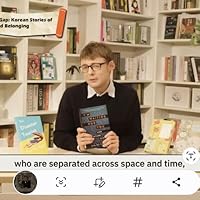
“For #KoreaBookClub, @barrypwelsh introduces us to the unconventional and unique writing style of Bae Suah in her book ‘Time in Gray' (trans. Chang Chung-hwa and Andrew James Keast), which explores ideas of time and memories. #KoreanLiterature #AsiaPublishers #배수아 #회색시”
aș fi vrut sa dezvolte mai mult conceptul filosofic al relativitatii timpului si fenomenologia transcedentala a lui Husserl mentionata in postfață :,) amintirile sunt fantasmagorice, iar viitorul este mai concret decat trecutul prin simplul fapt ca poate fi prezis de catre actiunile esuate ale trecutului. mintea este un spatiu liminal, suah spune-ne mai mult
"Time passes through itself by a process more random and spontaneous than we can guess, an it seems as if there was a wall, a mirror of illusions set up between what we can see here in our world and what we can see in our mind."
Another short work by Bae Suah, Time in Gray begins with an essay on past and future time, saying that we know the future (as wish) better than the past and connects the past (or past-ness) with shame and guilt; then has a rant by a vegetarian friend of the narrator about eating meat (as an example of guilt), before it proceeds to the real story (and we don't realize at first that it is the real story; it begins as if it is another example). The story is about a crush the narrator had in high school on a woman named Su-Mi. (The Afterword by the editor assumes the narrator is a man, but this is never stated; I assumed it was about two women, but it is actually totally ambiguous.) After giving a short description of the narrator's crush, it then has him (or her) meet Su-Mi twenty years later, also in the past tense, but the Afterword assures us (with a diagram) that it is actually in the wished-for future. The story seems fairly meaningless, but is much more experimental if we accept the explanation of the editor, which is undoubtedly correct -- I just don't like stories that only make sense if you read a commentary by someone other than the author. So for me this was a failure. It was also not formatted correctly for the Kindle, and it is only available in Kindle format.
The story has been translated by the husband-and-wife team of 장정화 (Chang Chung-hwa) and Andrew James Keast and comes with an afterword from a literary critic, in this case, 정은경 (Jung Eun-kyoung), although unlike in the more recent K-Fiction series there is no author's afterword.
Bae Suah herself was BTBA longlisted, alongside her translator Sora Kim-Russell 2016 for her excellent Nowhere to be Found (my review), although too little of her other work is available in English, so even if only on these grounds, this book is to be welcomed.
But Time in Gray is a less powerful and satisfying work than Nowhere to be Found, albeit more complex. In English, at least, the prose can be a little dense, although my Korean isn't sufficient to say if this is inherited from the original.
The story falls into two parts; indeed a significant weakness is that Bae Suah needs to spend the first half of the book on an essay explaining the novelistic (at least per the male narrator's view) aesthetic of the story in the second half.
The first half starts:
"Without any specific reason, some very trivial moment from out of the past may appear in one's mind."
The text goes on to explain a theory that such recollection of past events, reflect hints of, and our wishes for, the future. "As time goes by, the scenes of the past become more foreign and more dubious, and those impending events will feel closer and also more approachable ... [the future] has already happened and moved on - it would not even be awkward to employ the past tense."
Indeed as the past becomes increasingly vague - a gray time - "the future then comes through the wall, a mirror, and it becomes a prophecy of the past
And:
"Guilt itself is the universal mirror of the past. Even those happiest moments, moments that might shine in memory, will become things of shame and guilt once they have become a part of the past."
This is part illustrated by the example of a vegetarian friend, racked with guilt at the years he spent before becoming a vegetarian as well as guilt for his membership of the human race, for whom he feels both love but also sees as "a cruel tribe, a tribe who regarded the destruction of life as the highest form of pleasure, destroying life to produce first rate luxury items, symbols of the upper class, items for the gourmand, for athletic leisure, and for collection."
The second half starts:
"More than twenty years ago, for a short period, I was in love with a girl who was four years my senior, and whose name was Sumi."
Despite being "in love with" Sumi, the narrator merely observed her from afar and gossips about her with classmates, but never once actually speaks to her. In the story, he meets her again, many years later (despite having been told that she had died in an accident in the interim). But read according to the aesthetic expressed in the first half, this meeting, told in the past tense, is a possible future event that the narrator imagines to face the shame he feels about how he acted back then.
I'm struggling to do the story justice, but I'm tempted to say the story itself, at least in English translation, struggles to do itself full justice. In that regard, the critical commentary was, in this case, particularly helpful to my understanding.
Overall, Bae Suah is definitely an author who I look forward to reading more, and I believe a novel translated by the Man Booker International winning Deborah Smith is due out in 2017. But this particular story would not be an ideal starting point for those new to her work.
Bae Su-ah is one of my favourite authors. She writes such intriguing and enigmatic books. This short chap book embodies both of these qualities. When reading Su-ah’s works, I have to truly read the words. I cannot skim read at all or the meaning of her words are lost. I feel as if Su-ah takes infinite care in choosing every word she writes, every punctuation mark. To me, her books feel as if they have been crafter not through her hands and fingers, as they type, but through her intellect. Bae Su-ah’s intellect is what attracts me to her work. This book, as with her other writing, is not an easy or fun read but a deeply satisfying read. I truly wish the story had been a chapter in a longer narrative. However, as it is, the story is about time and feelings. More correctly perhaps, it is about the experience of time: of past, present and future and how we and others in our lives occupy time. The story through which the experience of time is explored is a man who meets a woman in a college class and is attracted to her but never speaks to her. In his narration, he dissects his first, and then ongoing encounter with the woman a reflects upon her meaning to him back then, at other points in his life, in the present, and finally in the projected future. Bae Su-ah includes a quotation from Husserl which she uses to guide the reader through her embodiment of the meaning of time.
A fascinating short read that I thoroughly enjoyed.
Probably the deepest novella I've read all year. The atmosphere was quite melancholic, but without going overboard. I have no idea how much it changed with the translation, but I did enjoy it and I look forward to reading more by this author.