The man who led the salvage efforts to raise a sunken US Navy submarine recounts the mission in a tale "that will surely rank among the epics of the sea" (The Philadelphia Inquirer).
The sinking of the submarine S-51 was one of the greatest tragedies in American naval history. Due to a miscommunication and subsequent collision between the sub and a passing steamship on a September night, the S-51, including thirty-three of its crew of thirty-six, sank to the ocean depths. The tragedy of the S-51 captivated the nation, and was a fixture in the pages of American newspapers. The story took on a whole new dimension when the navy decided to take over the salvage of the thousand-ton behemoth from a civilian company.
Heading the crew tasked with this impossible feat was Edward Ellsberg, at the time a lieutenant commander. On the Bottom is Ellsberg's account of the successes and failures he and his men experienced as they attempted an astonishing feat of engineering and the first salvage of a submarine from the open ocean.
Edward Ellsberg (1891-1983) graduated first in his class from the United States Naval Academy in 1914. After he did a stint aboard the USS Texas, the navy sent Ellsberg to Massachusetts Institute of Technology for postgraduate training in naval architecture. In 1925, he played a key role in the salvage of the sunken submarine USS S-51 and became the first naval officer to qualify as a deep-sea diver. Ellsberg later received the Distinguished Service Medal for his innovations and hard work.
Rear Admiral Ellsberg was awarded the C.B.E. by His Majesty King George VI, and two Legions of Merit by the United States Government.
A harrowing account of raising the submarine S-51 along with all of her drowned crew but for three. The author headed up this salvage mission that took the most of a year in very deep water, with technology available in 1925. Setback after setback, crawling blindly in a cramped submarine, getting air hoses tangled, dealing with extreme water pressure and freezing water, digging tunnels under the hull to pass lines, all dodging storms. A truly grueling effort. Did they succeed? You’ll have to read the book.
On the Bottom is Ellsberg's first popular book, an account of the salvaging of submarine S-51 from 160 feet of water in 1926 by a team of US Navy divers. Compared to the other books I've read, it's more technical and has less human interests, this is after all a team of competent professionals without any of the cultural conflicts that make his other books so interesting.
The story of men against the sea has enough drama. Deep sea diving is one of the most hazardous and extreme activities people do, and crude technology of 1926 meant that everything had to be done by hand in the dark and cold, where divers survived in a precarious equilibrium and a single mistake could prove fatal.
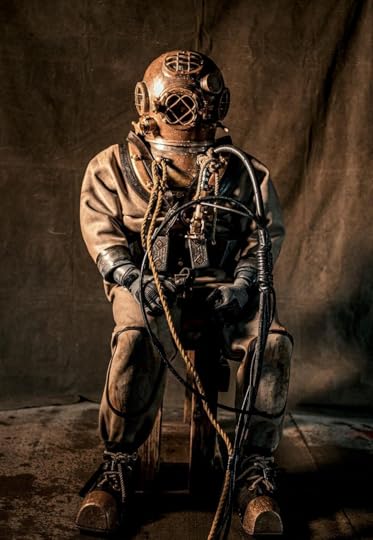
Mark V Standard Diving Dress, of the kind used by Ellsberg. From Will Kutscher
Perhaps the most terrifying way to die was a squeeze, where air pressure in the suit dropped below the water pressure and the diver was compressed into the helmet. Conversely, if air pressure built up too high, the suit would blow up, forcing the diver spread eagle and unable to operate their relief valves as they shot to the surface. Ascend too quickly and the diver would be crippled or killed by the bends. At depth, oxygen itself had an intoxicating effect, so try thinking while five drinks drunks, and moving while carrying hundreds of pounds of extra weight. Visibility at the bottom was between feet and nil, with much work having to be done by feel. One diver got helplessly loss for a half-hour in a 15 foot triangle between the sunken submarine and a house-sized pontoon. A narrow lifeline connected the diver to the surface, carrying air and a balky telephone, and if that line got snarled or the diver got stuck, there was little chance of help. Suits leaked, dives and decompression sequences took hours, and their were ordinary risks of exhaustion and pneumonia.
The plan to raise S-51 was complex. First the remaining good compartments of the damaged submarine would have to be made watertight and pumped full of air. Divers practiced on the sistership S-50 until they could turn the necessary valves blindfolded, and then did the same same thing on the bottom, in a listing wreck full of corpses. Repairs and special hatches had to be installed to keep the pressurized air in, which was literally backbreaking labor.
Next, a cradle of chains had to be laid around and under submarine. The bow and stern rose above the bottom, making this easy, but the two middle cables had to be passed through tunnels dug undersea. These were dug with water-pressure, leading to one of the more incredible feats of bravery I've read, where Diver Smith was in a 20' long tunnel that caved in on him. He managed to get the hose turned around and held it between lead-booted feet to dig himself out. Then he caught his breath and went back into the hole, a calm and cold-blooded heroism under literal and metaphorical pressure to get the job done.
After that, pontoons had to be submerged and laid alongside the submarine, a process Ellsberg compares to lowering a train car into place from the top of a 16 story building in a midnight gale. And once all this was done, there were the sundry matters of accidentally raising the submarine before a storm and having to sink and untangle the entire mess to do it again, running the wreck around in the East River and having to salvage it a third time in shifting tides, and finally bringing the ship and the men home.
As a first book, Ellsberg's writing is a hair weaker, and salvage doesn't have the same historical weight as World War 2. Yet for a certain type of nautical geek, this is a fantastic yarn and well worth the read.
This book is special to me. My late father read it to me when I was too young to read, and when I could read, he always said I read it back to him. (I don't really remember that second part. I learned to read freakishly young.) He, in turn, read this book when he was young, since it was published the year after he was born.
Personal history aside, this is an excellent book. If you want a manual on how to tell a technologically complex tale, Ellsberg does it. He brings you the cast of characters, almost all men, who were there, who made the story happen. He gives one chapter of the physics of deep sea diving (as it was in 1925) so the reader knows what he's talking about later when "The Bends" comes up. But the focus is always on the human story. The hopes and fears, the resolve, the mental toughness that drove him and his men to push the technology of the day and raise the submarine, despite conventional wisdom being against them. When they suffer a catastrophic setback close to the end of raising the sub, you feel it with them. When they finally get the thing above the waves, you cheer with them, only to endure the nail biting tow home.
I especially like the Flat Hammock Press hardbound edition of this book: ISBN-13: 978-0971830301. This edition, published in 2003, has afterwords and appendicies that give the reader more context, spell out the histories of all the ships in the story, and give some brief biographical information on Ellsberg himself, as well as some of the more famous people he worked with at the time. It also contains a DVD of newsreel footage shot at the time. (1925 - don't be surprised that there's no soundtrack. Widespread commercial adoption of movies with sound didn't happen until 1927 with Al Jolson's The Jazz Singer). Some of them do have an audio track of Ellsberg narrating them much later.
Summary: A book that's personally important to me, and also just a darn good book. Highly recommended.
This entire review has been hidden because of spoilers.
My experience with this book is oddly similar to that of James, the last person to review it. My father, a career Navy officer, didn't read it to me, but I think it may have been the first non-children's book I ever read when I swiped it off his bookshelf at age 7 or 8. That's probably why, decades later, I read Clive Cussler's Raise the Titanic and came away so totally disgusted that I've never been able to read anything else that author has written. It's as clear and well-written an account of a deepwater salvage operation as you'll find, and it will leave you totally in awe of an entire generation of servicemen.
Ellsberg was a perfectionist in his chosen career of naval salvage, and entirely too much of a prickly SOB to stand any chance of getting on in the peacetime military. His commanding officer in this book, then-captain Earnest King, was picked as Chief of Naval Operations immediately after Pearl Harbor. King's first comment was, "When things get tough, they send for the sons of bitches." That said, not even King could take too much of Ellsberg. See Wikipedia for a summary of his career. For civilians reading that, please note that it is most unusual for Congress to award service medals or intervene directly in the promotion of a naval officer below flag (admiral) rank.
Ellsberg is every bit the sailor. You'll need to go to the terms glossary frequently to understand all of the nautical terms he uses and I served in the USN. The book is written in nearly mind numbing detail. I found myself skipping over much of this to focus on the highlights of the story line, which was excellent. To think what they accomplished in 1925 in raising S-51, is just incredible. We landlubbers don't realize the power of the sea. That fact comes home loud and clear. Glad I read the book.
This is a good book. It is the story of how a commander and a group of sailors managed to raise a wrecked submarine i had the impression that this is the first time that it was done. The explaination was rather technical but I could follow it. The ending was worth it.
Excellent read if you're interested in early diving technology or naval history. The men in the story developed underwater technology that's still used today. Can be a bit technical, but written in short, bite-sized chapters. Incredible story of courage, commitment, and ingenuity.
Excellent read. The ony thing I didn't like was that the author neglected to mention the date of the accident, but despite that, I recommend this book.
In 1925 an early US Navy submarine, the S51, was struck by a passing ship. With a huge hole in her side, she sank quickly to approximately 125 feet deep in the open Atlantic Ocean. Only a handful of crew members managed to get out before the sub sank, the rest went down with her. The US Navy was embarrassed by this loss, and was also having a hard time of it in the post World War I era, needing both to modernize its ships and deal with international treaties that reduced allowable national tonnage. An earlier sub mishap, sinking the S5, had seen salvage and crew recovery efforts fail. Enter Commander Edward Ellsberg, who convinced the Navy brass that he could raise the sunken vessel so the dead crew could be returned to their family for burial.
At this time, diving was very primitive. This is the era you see in old movies and book illustrations of divers in heavy brass helmets with lead belts and lead shoes tethered to an air hose. They did have decompression chambers but there were no warm diving suits, divers had to be able to take the pressure, and decompression was dangerous and lengthy. Telephones were crude, tools had to be invented, and a diver in trouble usually could not be rescued.
In short, well-written chapters that anyone can read and understand, even if they aren't familiar with nautical terminology or diving, Commander Ellsberg relates how he located the sunken sub, essentially invented a way to keep his diving vessel moored over the wreck, and relates the tales of the divers descending into freezing inky blackness. First they enter the sub, barely able to fit, doomed if they get stuck, along with dead bodies, to seal off undamaged areas so they can be pumped out. Then he relates the difficulty of towing and lowering large pontoons to flank the wreck to provide lift. These divers literally had to lay on the sea floor and use hoses to wash tunnels out under the wreck and drag chains through the tunnels. Imaging laying in freezing black water, in mud, underneath a sunken ship, dependent on a narrow air hose for life while holding a fire hose to wash a tunnel through! At many points the work becomes pathbreaking-- Ellsberg has to make innovative improvements to the primitive underwater lights and torches of the era.
Finally he relates the harrowing raising of the ship and towing it to the Navy Yard, only to have a professional pilot ground the sub on an underwater ledge within sight of the goal! Eventually he refloats the wreck, gets it into drydock, the crew remains are removed and the ship investigated for how it was damaged and if improvements can be made.
The only real issue I had with this book was Ellsberg never explains what if anything was done to the ship that rammed the S51 because its navigation was clearly in the wrong. While the focus of this book is the salvage, a few sentences explaining would have been in order.
This book was written in 1929, almost 100 years ago, but is so good it has been reprinted several times since and is available. It is a truly amazing story! I came across an original 1929 first edition hardcover at a old book sale for $1 and despite being so old and not a sewn binding the book was in great shape, the pages, cover and binding still sound and very readable! I doubt modern hardcovers would survive so well! Quality still existed in 1929!
While everyone in this book is long dead, the story is exciting and interesting to read. All modern underwater salvage owes a debt of gratitude to this path-breaking expedition. Ellsberg went on to a long career in the Navy and wrote several additional books, all great reads, but perhaps none as exciting and page turning as this one!
Interesting to read how they managed to raise a submarine full of water in 1925, when scuba had yet to be invented. The author, a Navy man, wrote for other sailors as the text is full of naval terminology. It got to me in the end.
This entire review has been hidden because of spoilers.
An excellent account of the raising of the sunken S-51, a U.S. submarine rammed by the _City of Rome_, a merchant steamer, in 1925. The author, Lt. Commander Edward Ellsberg, a 1914 Naval Academy graduate, was the senior specialist attached to the flotilla assigned the task of raising the submarine. This is Ellsberg's account of the two-year salvage effort. It is a dramatic story of courage and perseverance in the face of multiple setbacks that tested the limits of existing technology. In the course of the effort Ellsberg invented the first effective underwater cutting torch which ever since has borne his name.
Compelling reading, easy to read. Kept me up at night not wanting to quit reading. A Detailed account of the trials and tribulations of the first successful raising of a large submarine after it was rammed and sunk with loss of most hands back in the late 20's. The risks those guys took while doing that work were unbelievable, and I"d guess many of the divers suffered aftereffects for the rest of their lives. I don't think, knowing what we know now, that anyone would work in such difficult circumstances today. A lot of unsung heroes.
I *love* this book. It reads like an action-adventure novel. The only way this could be improved would be to change the title. It kind of gives away the ending.
Called a "boy's Edition", this 1929 book is the story of a harrowing submarine salvage, one of the first, and the deepest until then by the U S Navy. The fortitude of these men is incredible.