Before I commence with my actual review of Torben Kuhlmann's Edison: The Mystery of the Missing Mouse Treasure (which has been translated from the author's original German Edison: Das Rätsel des verlorenen Mäuseschatzes by David Henry Wilson and is a 2019 Mildred L. Batchelder Award honouree) I have to admit that I find it rather interesting and also kind of strangely ironic that although mice in particular are often and rightfully so considered as being pests and vermin (and that our Anglo-Saxon noun mouse is even derived from the ancient Sanskrit musha which signifies a thief) there are considerably more positive and often even very much heroic stories of anthropomorphic mice in children's literature than there are tales of human-like mice behaving negatively and despicably (which indeed, considering their nasty reputation as vermin I for one consider this at best a bit weird in and of itself, but perhaps also partially so because I just do not all that much either like or appreciate mice as animals and therefore tend to find in particular mice talking like humans and acting like humans rather annoying and creepy, and yes, even in novels that are clearly meant to be a bit fantastical).
Thus with the above in mind, yes, I did in fact approach Edison: The Mystery of the Missing Mouse Treasure with a bit of trepidation and indeed also rather a major lack of personal reading interest. And truth be told, I only considered reading Edison: The Mystery of the Missing Mouse Treasure in the first place because the Children's Literature Group is reading the 2019 Mildred L. Batchelder Award books in June and my local library also happened to possess a copy of Edison: The Mystery of the Missing Mouse Treasure since I was certainly not interested enough to consider purchasing a copy of Edison: The Mystery of the Missing Mouse Treasure, as the thematics of mice attending university, of mice having travelled to the moon and in Edison: The Mystery of the Missing Mouse Treasure of mice travelling to the bottom of the ocean to look for some huge and important treasure just did not all that much if at all tickle my reading fancy in any way.
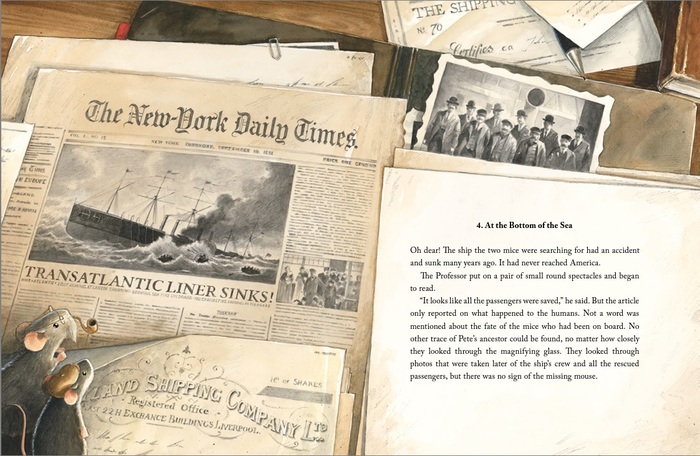
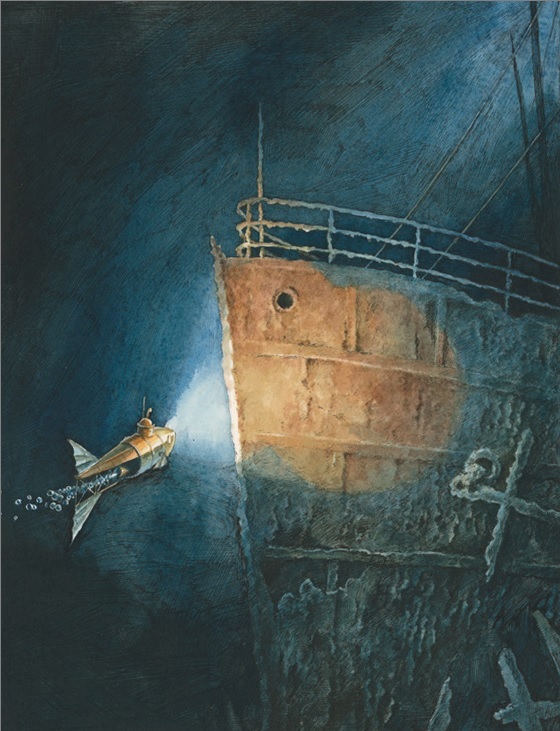
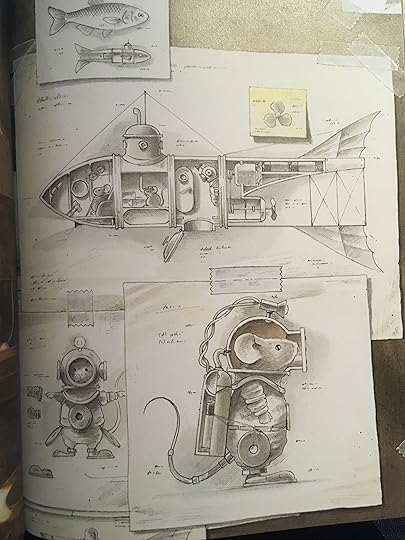
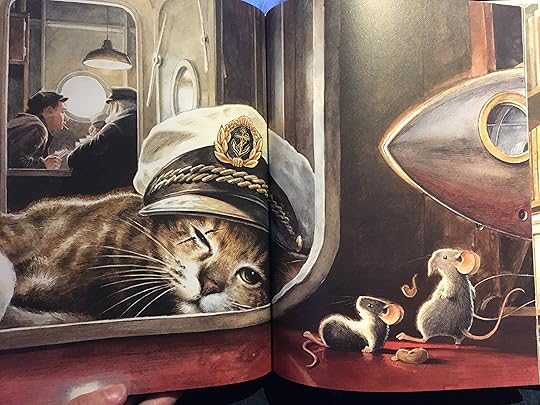
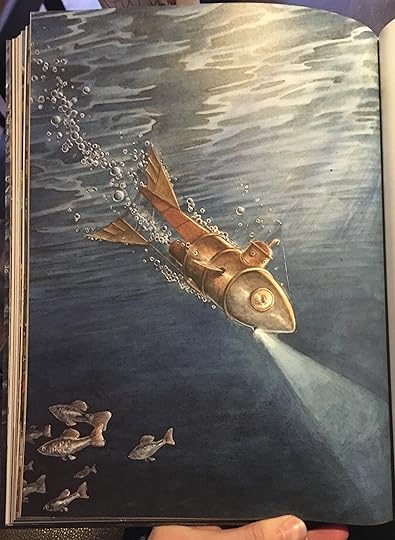
And while I have definitely found author/illustrator Torben Kuhlmann's accompanying pictures for Edison: The Mystery of the Missing Mouse Treasure aesthetically awe-inspiring and delightfully, imaginatively detailed (and often full page pictorial spreads at that), and although I can equally see how and that Kuhlmann's (and of course by extension Wilson's) presented verbal text is both engaging and also enlightening and historically, scientifically informative, with my at best only grudging acceptance of mice as characters in children's literature, Edison: The Mystery of the Missing Mouse Treasure would have had to have been truly absolutely special for me to have really and fully enjoyed my reading experience, and no, this definitely has not been the case. As while Torben Kuhlmann's aesthetically lovely and lushly detailed illustrations certainly have managed to retain my interest regarding what happens to Pete and the professor and whether they manage to locate their desired treasure, the printed words, the verbal narrative of Edison: The Mystery of the Missing Mouse Treasure really does read a bit sub-standardly, draggingly, unscientifically and to and for also bit like a fairy tale with an annoying and frustrating deus ex machina like ending (with Pete and the professor almost immediately in the located ocean shipwreck finding Pete's ancestor's locked sea-chest, which then also and naturally, magically houses the required information that Pete the mouse's ancestor in fact and indeed helped Thomas Alva Edison invent the first light bulbs).
Three stars for Edison: The Mystery of the Missing Mouse Treasure, but rounded down to a high two stars, for while I do appreciate that Torben Kuhlmann has included supplemental historic and scientific information on both the invention of electric light and on Thomas Alva Edison at the back of Edison: The Mystery of the Missing Mouse Treasure, he really should have, he really needed to also list his academic sources and suggestions for further reading and study regarding both Thomas Edison and the invention of electric light. And yes, while as a German and even hailing from the same home town as Heinrich Göbel (from Springe), I am thrilled that Torben Kuhlmann points him out in Edison: The Mystery of the Missing Mouse Treasure, considering that Heinrich Göbel's claims that he was in fact the real inventor of the electric lightbulb and not Thomas Alva Edison have always been at best rather controversial, a source list of where Torben Kuhlmann has found his information on Göbel is in my opinion absolutely necessary here. For in my academic opinion, it now just seems as though the blurb in Edison: The Mystery of the Missing Mouse Treasure on Heinrich Göbel just exists to perhaps even discredit Thomas Edison, which is unfortunate, as I did in fact do a bit of supplemental research on Heinrich Göbel, and for one, he never actually claimed that he invented the electric lightbulb and for two, after he immigrated to the USA, Heinrich Göbel considered himself an American and would probably have been rather aghast at as well as furious how his name has been used over the decades by some (including the Nazis) in Germany to make him appear not only as the true inventor of the electric lightbulb but also as someone who supposedly was shafted and cheated by Thomas Alva Edison, how he has been portrayed as some unfortunate German victim of American arrogance.