

What do you think?

Census
A powerful and moving new novel from an award-winning, acclaimed author: in the wake of a devastating revelation, a father and son journey north across a tapestry of towns.
When a widower receives notice from a doctor that he doesn’t have long left to live, he is struck by the question of who will care for his adult son—a son whom he fiercely loves, a boy with Down syndrome. With no recourse in mind, and with a desire to see the country on one last trip, the man signs up as a census taker for a mysterious governmental bureau and leaves town with his son.
Traveling into the country, through towns named only by ascending letters of the alphabet, the man and his son encounter a wide range of human experience. While some townspeople welcome them into their homes, others who bear the physical brand of past censuses on their ribs are wary of their presence. When they press toward the edges of civilization, the landscape grows wilder, and the towns grow farther apart and more blighted by industrial decay. As they approach “Z,” the man must confront a series of questions: What is the purpose of the census? Is he complicit in its mission? And just how will he learn to say good-bye to his son?
Mysterious and evocative, Census is a novel about free will, grief, the power of memory, and the ferocity of parental love, from one of our most captivating young writers.
When a widower receives notice from a doctor that he doesn’t have long left to live, he is struck by the question of who will care for his adult son—a son whom he fiercely loves, a boy with Down syndrome. With no recourse in mind, and with a desire to see the country on one last trip, the man signs up as a census taker for a mysterious governmental bureau and leaves town with his son.
Traveling into the country, through towns named only by ascending letters of the alphabet, the man and his son encounter a wide range of human experience. While some townspeople welcome them into their homes, others who bear the physical brand of past censuses on their ribs are wary of their presence. When they press toward the edges of civilization, the landscape grows wilder, and the towns grow farther apart and more blighted by industrial decay. As they approach “Z,” the man must confront a series of questions: What is the purpose of the census? Is he complicit in its mission? And just how will he learn to say good-bye to his son?
Mysterious and evocative, Census is a novel about free will, grief, the power of memory, and the ferocity of parental love, from one of our most captivating young writers.
256 pages, Hardcover
First published March 6, 2018
About the author
Jesse Ball
33 books944 followersJesse Ball (1978-) Born in New York. The author of fourteen books, most recently, the novel How To Set a Fire and Why. His prizewinning works of absurdity have been published to acclaim in many parts of the world and translated into more than a dozen languages. The recipient of the Paris Review's Plimpton Prize, as well as fellowships from the NEA, the Heinz foundation, and others, he is on the faculty at the School of the Art Institute of Chicago.
Ratings & Reviews
Friends & Following
Create a free account to discover what your friends think of this book!
Community Reviews
Displaying 1 - 30 of 702 reviews

February 14, 2018
There were a few times that I wanted to put this book aside because I wasn’t getting what was happening in this society, this country with unnamed towns designated by letters from A-Z. I wasn’t understanding what this census was all about, why this unnamed agency of the government was conducting it. It was just too philosophical in places. But I couldn’t stop thinking about what Jesse Ball tells us in the introduction:
“It occurred to me last month that I would like to write a book about my brother. I felt, and feel that people with Down syndrome are not really understood. What is in my heart when I consider him and his life is something so tremendous, so full of light, that I thought I must write a book that helps people see what it is like to know and to love a Down syndrome boy or girl. It is not like what you would expect, and it is not like it is ordinarily portrayed and explained. It is something else, different than that.”
I’m so glad I continued reading because I found moments of beauty and of joy among the things I didn’t quite get and a poignant tribute to Ball’s late brother. That tribute is depicted in the journey of a man, a widower, who is ill and near the end of his life, a surgeon who becomes a census taker for some unnamed agency of the government. He decides to do this so he can spend time with his adult son who has Down Syndrome. Like the places they travel through, the father and son are also unnamed. While I didn’t get the census thing or what this society was about, this journey and the people they meet and count along the way become a revealing mechanism for learning about his son through the reactions of the people to his son and the reactions of his son to them. They meet people who are accepting, people who are hostile, children who laugh with him and don’t want him to leave, a woman who understands in her heart because of her daughter who passed away and was “like” his son. They meet people who knew the man’s wife and we get to know her a little more through his reminiscences about her and her relationship with their son. The son is kind. He lets the man he is playing checkers with call it a draw when he is winning. The son is inquisitive. His father tells us :
“My son has gotten lost on many occasions....that thing he loved to do is wander off...When he is found it is clear that he was if anything, working adamantly to not be found, but in an entirely passive way. By that I mean, he joins the scenery of the place, delighted to learn the things he can learn there....I have never sought to change what is essentially to my eyes, a basic resourcefulness that finds at any moment something profound.”
The unconditional love and understanding of this man and his deceased wife for their son is touching and beautiful. I recommend that you watch Jesse Ball tell you about his brother Abram and hear him read an excerpt. You might not be able to pass up this book. It’s a meaningful story. http://youtu.be/47-ygyE-iUY
(The quotes are from an uncorrected proof.)
I received an advanced copy of this book from Ecco/HarperCollins through Edelweiss.
“It occurred to me last month that I would like to write a book about my brother. I felt, and feel that people with Down syndrome are not really understood. What is in my heart when I consider him and his life is something so tremendous, so full of light, that I thought I must write a book that helps people see what it is like to know and to love a Down syndrome boy or girl. It is not like what you would expect, and it is not like it is ordinarily portrayed and explained. It is something else, different than that.”
I’m so glad I continued reading because I found moments of beauty and of joy among the things I didn’t quite get and a poignant tribute to Ball’s late brother. That tribute is depicted in the journey of a man, a widower, who is ill and near the end of his life, a surgeon who becomes a census taker for some unnamed agency of the government. He decides to do this so he can spend time with his adult son who has Down Syndrome. Like the places they travel through, the father and son are also unnamed. While I didn’t get the census thing or what this society was about, this journey and the people they meet and count along the way become a revealing mechanism for learning about his son through the reactions of the people to his son and the reactions of his son to them. They meet people who are accepting, people who are hostile, children who laugh with him and don’t want him to leave, a woman who understands in her heart because of her daughter who passed away and was “like” his son. They meet people who knew the man’s wife and we get to know her a little more through his reminiscences about her and her relationship with their son. The son is kind. He lets the man he is playing checkers with call it a draw when he is winning. The son is inquisitive. His father tells us :
“My son has gotten lost on many occasions....that thing he loved to do is wander off...When he is found it is clear that he was if anything, working adamantly to not be found, but in an entirely passive way. By that I mean, he joins the scenery of the place, delighted to learn the things he can learn there....I have never sought to change what is essentially to my eyes, a basic resourcefulness that finds at any moment something profound.”
The unconditional love and understanding of this man and his deceased wife for their son is touching and beautiful. I recommend that you watch Jesse Ball tell you about his brother Abram and hear him read an excerpt. You might not be able to pass up this book. It’s a meaningful story. http://youtu.be/47-ygyE-iUY
(The quotes are from an uncorrected proof.)
I received an advanced copy of this book from Ecco/HarperCollins through Edelweiss.

September 3, 2020
Beautiful. Spare. Ethereal. Elusive. Unsettling. Inspiring. Profound. Puzzling. Unique.
This is a fable defined by absence, holes, and omission, conjuring detached empathy.
“We as humans are so full of longing; what is blank eludes us.”
It starts with a man digging a grave.
The people and places are nameless, the period and location are vague (simultaneously foreign and familiar), and adjectives and adverbs are barely used. We know the central character almost entirely from the reactions of others: he is both absent and a mirror.
It ends with a man digging a grave.
The message I took was that even the least of us leaves marks on the world, and on each other. Make sure they’re the right ones. Then maybe, just maybe, we can live without regret, as the central character does.

Image: A deserted road, through snowy woods (Source.)
Seed
“I would make a book that was hollow. I would place him in the middle of it, and write around him for the most part. He would be there in his effect.”
In the short Preface, Jesse Bell explains his older brother, Abram, had Down Syndrome, and that even as a child, Jesse assumed that one day, he would be Abram’s caretaker. It was not to be: Abram died aged 24. This novel reconfigures what might have been: a widowed father whose adult son has an unspecified condition that fits with Down Syndrome. When the father gets a terminal diagnosis, he makes arrangements for his son’s future care, then takes him on a road trip.
The road trip is not the usual kind: he will be a census-taker.
Census
The census is not the usual kind. The census is not kind. Nor, it’s suggested, is the country or its administration.
“I signed the paper joining myself and my will to the mission of the census.”
And all who do so “sign away their basic rights of protection.”
The father’s reminiscences (“traveling into my own past”) are interspersed with those of the people he interviews across the country, gathering data for a future he will not live to see.
Foreboding lurks, simmering from the sinister, sometimes painful requirements of a bureaucracy of unclear purpose. It’s a fresh twist on Kafka.
“It’s hard… convincing someone else to do something the value of which you do not understand.”
The census records “the inchoate shape of lives”, but what for, and should it be quantitative or qualitative?
Like the archetype of the wise fool, the census-taker’s son is, in some ways, more deserving of the title:
“His the true census, he whose eyes have seen all, whose heart has felt all.”
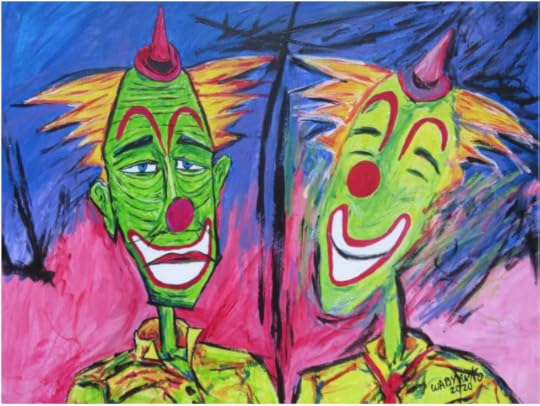
Image: Clown in the mirror after the show in circus, by Wabyanko (Source.)
Connecting clowns and cormorants
“The person she was in her letters was someone she herself did not know until the letter was written.”
The census-taker was instructed to consider himself an archaeologist, scientist, artist, and priest. As citizens pour out their lives, he ponders the fundamental unknowability of other people’s experiences, especially his son’s, but also the “many versions” of himself:
“Is that really you in the photograph? Or is it someone you have a connection with? Someone you once knew, but who now is foreign to you?”
Two absent women provide an allegory. Each strives to understand others by physical connection and transformation:
• The wife/mother was a performer: a clown who was “telepathic not with mind but body”: the perfect preparation for having a child whose language and understanding are simple and different, but not necessarily less. (The book she wrote before he was born, but never published, was titled “A Fool is a Mirror”.)
• Mutter, a fictitious (hence, named) German woman, studied and drew cormorants in Victorian times, but “her real desire was to leave her body and become in absolute terms a cormorant”. Not to be a human mind in a bird’s body, but actually be a cormorant. It reminded me of The Crane Wife in Japanese folklore (though when I checked, it’s rather different).
Connecting the two, when the wife was at clown school:
“She had found a place… between wing beats.”
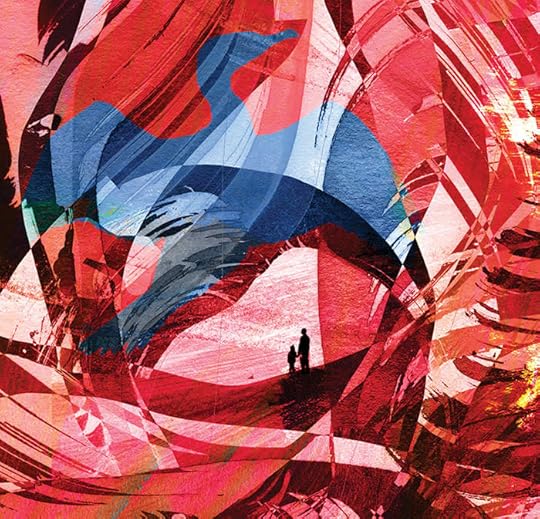
Image: Father, son, and cormorant, by Simon Pemberton (Source.)
For a very different novella, but where the philosophy of clowning also plays a role, see Josipovici's delightful, elegant, and ultimately very clever, bit of whimsy, Only Joking, which I reviewed HERE.
The end…?
Beautifully ambiguous. Heartbreakingly joyful. Totally fitting.
Quotes
• “Ever since he was born, our lives, my wife’s, mine, bent around him like a shield.”
• “Is there none who can simply wander alone beneath a sort of cloth tent painted with dreams?”
• “A name is almost always a kind of cowardice - an attempt to confine a thing to being only what it is, rather than what it may be.”
• “Brief blooms of wealth leave their impressions most in architecture… Something hollow is left when it fails.”
• “The freedom of burdens… somehow we are all seeking some appropriate burden. Until we find it, we are horribly shackled, can in fact scarcely live.”
• "Read widely because nothing has been everywhere applied... I took it to mean... a person with a wide range of interests will find the mirror of one thing in another."
• "It's your life, your presence is required."
See also
Four months after this, I enjoyed China Miéville's This Census-Taker. It’s similarly hard to place and unravel, with dubious intent behind the titular census, but it has more plot (albeit quite opaque) and is not as hauntingly beautiful as this. See my review HERE.
This is a fable defined by absence, holes, and omission, conjuring detached empathy.
“We as humans are so full of longing; what is blank eludes us.”
It starts with a man digging a grave.
The people and places are nameless, the period and location are vague (simultaneously foreign and familiar), and adjectives and adverbs are barely used. We know the central character almost entirely from the reactions of others: he is both absent and a mirror.
It ends with a man digging a grave.
The message I took was that even the least of us leaves marks on the world, and on each other. Make sure they’re the right ones. Then maybe, just maybe, we can live without regret, as the central character does.
Image: A deserted road, through snowy woods (Source.)
Seed
“I would make a book that was hollow. I would place him in the middle of it, and write around him for the most part. He would be there in his effect.”
In the short Preface, Jesse Bell explains his older brother, Abram, had Down Syndrome, and that even as a child, Jesse assumed that one day, he would be Abram’s caretaker. It was not to be: Abram died aged 24. This novel reconfigures what might have been: a widowed father whose adult son has an unspecified condition that fits with Down Syndrome. When the father gets a terminal diagnosis, he makes arrangements for his son’s future care, then takes him on a road trip.
The road trip is not the usual kind: he will be a census-taker.
Census
The census is not the usual kind. The census is not kind. Nor, it’s suggested, is the country or its administration.
“I signed the paper joining myself and my will to the mission of the census.”
And all who do so “sign away their basic rights of protection.”
The father’s reminiscences (“traveling into my own past”) are interspersed with those of the people he interviews across the country, gathering data for a future he will not live to see.
Foreboding lurks, simmering from the sinister, sometimes painful requirements of a bureaucracy of unclear purpose. It’s a fresh twist on Kafka.
“It’s hard… convincing someone else to do something the value of which you do not understand.”
The census records “the inchoate shape of lives”, but what for, and should it be quantitative or qualitative?
Like the archetype of the wise fool, the census-taker’s son is, in some ways, more deserving of the title:
“His the true census, he whose eyes have seen all, whose heart has felt all.”
Image: Clown in the mirror after the show in circus, by Wabyanko (Source.)
Connecting clowns and cormorants
“The person she was in her letters was someone she herself did not know until the letter was written.”
The census-taker was instructed to consider himself an archaeologist, scientist, artist, and priest. As citizens pour out their lives, he ponders the fundamental unknowability of other people’s experiences, especially his son’s, but also the “many versions” of himself:
“Is that really you in the photograph? Or is it someone you have a connection with? Someone you once knew, but who now is foreign to you?”
Two absent women provide an allegory. Each strives to understand others by physical connection and transformation:
• The wife/mother was a performer: a clown who was “telepathic not with mind but body”: the perfect preparation for having a child whose language and understanding are simple and different, but not necessarily less. (The book she wrote before he was born, but never published, was titled “A Fool is a Mirror”.)
• Mutter, a fictitious (hence, named) German woman, studied and drew cormorants in Victorian times, but “her real desire was to leave her body and become in absolute terms a cormorant”. Not to be a human mind in a bird’s body, but actually be a cormorant. It reminded me of The Crane Wife in Japanese folklore (though when I checked, it’s rather different).
Connecting the two, when the wife was at clown school:
“She had found a place… between wing beats.”
Image: Father, son, and cormorant, by Simon Pemberton (Source.)
For a very different novella, but where the philosophy of clowning also plays a role, see Josipovici's delightful, elegant, and ultimately very clever, bit of whimsy, Only Joking, which I reviewed HERE.
The end…?
Beautifully ambiguous. Heartbreakingly joyful. Totally fitting.
Quotes
• “Ever since he was born, our lives, my wife’s, mine, bent around him like a shield.”
• “Is there none who can simply wander alone beneath a sort of cloth tent painted with dreams?”
• “A name is almost always a kind of cowardice - an attempt to confine a thing to being only what it is, rather than what it may be.”
• “Brief blooms of wealth leave their impressions most in architecture… Something hollow is left when it fails.”
• “The freedom of burdens… somehow we are all seeking some appropriate burden. Until we find it, we are horribly shackled, can in fact scarcely live.”
• "Read widely because nothing has been everywhere applied... I took it to mean... a person with a wide range of interests will find the mirror of one thing in another."
• "It's your life, your presence is required."
See also
Four months after this, I enjoyed China Miéville's This Census-Taker. It’s similarly hard to place and unravel, with dubious intent behind the titular census, but it has more plot (albeit quite opaque) and is not as hauntingly beautiful as this. See my review HERE.

April 26, 2018
”Mama whispered softly time will ease your pain
Life's about changing nothing ever stays the same
And she said how can I help you to say goodbye
it's okay to hurt and it's okay to cry
Come let me hold you and I will try
How can I help you to say goodbye”
--How Can I Help You Say Goodbye, Patty Loveless, Songwriters: Burton Collins / Karen Taylor-Good
A father and son journey follows the father receiving the news from a doctor that he hasn’t much longer to live. His son, although adult, has Down syndrome, and the father now worries about how his son will manage, who will care for him, watch over him. His thoughts follow his path, as he follows the map, and as though a child recites the alphabet he begins their travels from towns A to Z, meandering as time and health allows. It is a journey for him to take, one last journey with his son.
”Ever since he was born, our lives, my wife’s, mine, bent around him like a shield.
“For his part, he simply lived without regret. It is hard to feel someone owes you anything when they live without regret. What you do for them you do for yourself, isn’t it so?”
Hopefully, he thinks, a trip to give his son some lasting memories. He signs up to become a census taker, and they leave home for the first town. They travel from town to town, each town’s name a letter of the alphabet from A through Z, and as they travel he ponders his son’s life after he is gone, he revisits old memories of his wife, and the early years, happier years, of their lives together. He visits with the people as he takes the census of each town, and hears their stories, and sometimes shares his.
In the preface, Jesse Ball shares that his brother Abram Ball died in 1998, at the age of twenty-four years old and had Down syndrome. This story is in some ways a re-imagining of his brother’s life; how Ball had once imagined it would be one day.
”A life is long, and we are many people, variously, in our guises, in our situations, but some part of us is the same, and what I felt as a boy I find myself able to feel now—a sad and powerful longing for a future that did not ever come, with all its attendant worries and fears.”
There is an ethereal quality to this story, as thoughts float by untethered, unsummoned, unheeded, memories rush in unbidden, unwanted, beckoning to another world beyond.
This story is a bit reminiscent of a crazy quilt, if you try to deconstruct it, or make sense of it while it’s in progress, there’s no way to really tell the direction it is heading, or how it will look when it is finished. You may think you have an idea, and then a piece is introduced that changes the course and you have to revise your ideas. Eventually realize that, if you just follow, appreciating each piece of this story, and knowing each piece holds a story in and of itself, you will see the overall picture as a whole when it is complete. You can listen as the stories of each piece of fabric are shared, and look again and see the love that went into this.
Many thanks, once again, to the Public Library system, and the many Librarians that manage, organize and keep it running, for the loan of this book!
Life's about changing nothing ever stays the same
And she said how can I help you to say goodbye
it's okay to hurt and it's okay to cry
Come let me hold you and I will try
How can I help you to say goodbye”
--How Can I Help You Say Goodbye, Patty Loveless, Songwriters: Burton Collins / Karen Taylor-Good
A father and son journey follows the father receiving the news from a doctor that he hasn’t much longer to live. His son, although adult, has Down syndrome, and the father now worries about how his son will manage, who will care for him, watch over him. His thoughts follow his path, as he follows the map, and as though a child recites the alphabet he begins their travels from towns A to Z, meandering as time and health allows. It is a journey for him to take, one last journey with his son.
”Ever since he was born, our lives, my wife’s, mine, bent around him like a shield.
“For his part, he simply lived without regret. It is hard to feel someone owes you anything when they live without regret. What you do for them you do for yourself, isn’t it so?”
Hopefully, he thinks, a trip to give his son some lasting memories. He signs up to become a census taker, and they leave home for the first town. They travel from town to town, each town’s name a letter of the alphabet from A through Z, and as they travel he ponders his son’s life after he is gone, he revisits old memories of his wife, and the early years, happier years, of their lives together. He visits with the people as he takes the census of each town, and hears their stories, and sometimes shares his.
In the preface, Jesse Ball shares that his brother Abram Ball died in 1998, at the age of twenty-four years old and had Down syndrome. This story is in some ways a re-imagining of his brother’s life; how Ball had once imagined it would be one day.
”A life is long, and we are many people, variously, in our guises, in our situations, but some part of us is the same, and what I felt as a boy I find myself able to feel now—a sad and powerful longing for a future that did not ever come, with all its attendant worries and fears.”
There is an ethereal quality to this story, as thoughts float by untethered, unsummoned, unheeded, memories rush in unbidden, unwanted, beckoning to another world beyond.
This story is a bit reminiscent of a crazy quilt, if you try to deconstruct it, or make sense of it while it’s in progress, there’s no way to really tell the direction it is heading, or how it will look when it is finished. You may think you have an idea, and then a piece is introduced that changes the course and you have to revise your ideas. Eventually realize that, if you just follow, appreciating each piece of this story, and knowing each piece holds a story in and of itself, you will see the overall picture as a whole when it is complete. You can listen as the stories of each piece of fabric are shared, and look again and see the love that went into this.
Many thanks, once again, to the Public Library system, and the many Librarians that manage, organize and keep it running, for the loan of this book!

June 15, 2018
Winner of the Gordon Burn Prize 2018
Jesse Ball's brother Abram, who suffered from Down syndrome, was only 24 years old when he passed away. Ball dedicated this book to him, and as he had planned his life assuming that he will one day become Abram's primary caretaker, this is not story about two brothers, but about a father with a son who has trisomy 21 - Ball thought this would be more suitable to mirror the relationship he and Abram would have had in the future.
In the book, the father, a surgeon, is diagnosed with a terminal illness and decides to become a census taker in order to be able to travel the country with his son. The mother has already passed, so the father is very worried about his son's future. While they are travelling they encounter numerous people from all walks of life, and we learn more about the past of the whole family.
Ball chose a very particular pacing that the reader needs to embrace, but then the flow of the text becomes absorbing. We also do not get any names, neither of people nor of the country they are crossing - they are simply traveling from A to Z. I was fascinated by the metaphor of the census, because the father is clearly not doing the work you might expect. Rather, the census stands for a mode of encountering people, one the father learnt from "my son who showed me, not in speech, but in his daily way, that we are by our nature a kind of measure, that we are measuring each other at every moment."
This measurement is crucial in all human relationships, because "there is a way in which each person wants to be known", so in this census, "my failure to obtain the quintessence of any individual interviewed is a very real failure." When one of the people interviewed tells the father that he has always been a census taker, I could not help but feel that what she meant is that all of us are census takers - at least when it comes to this kind of census. The significance of this becomes even clearer when you read the father's stories of how his disabled son has been ridiculed and treated cruelly by others.
Whenever the father and the son have talked to someone, they mark this person with a tattoo to indicate that they have been registered. In my quest to understand the meaning of this, I found this quote: "Telling stories is a visitation of this sort - for the stamp bears the impression not just of what it was to begin with, but of its every use." - just as the census takers left their mark on the person, the person changed the census takers who now carry on the story, in their own way.
It might sound cheesy, but these census takers can only do their task because they open up to people, which means that they are vulnerable and might get hurt: "In the census taker the modern martyr was found." Again, there's a parallel to the destiny of the son and what he has been through because of his condition: "It is so easy for humans to be cruel, and they leap to it. They love to do it. It is an exercise of all of their laughable powers."
And then there's the cormorant on the cover, which seems to stand for nature and is accordingly brought up in the context of a character named Mutter (German for "mother"). Mutter wants to be a cormorant, but she is aware that "anything changed becomes artifice, becomes less than it was, when it is made to suit the human hand. Our human victories by their nature have no glory."
Society also tried to change the son - but this would make him less than he already is. His deceased mother was a famous clown, and she knew that a real school must teach its pupils "to become a library of shapes", which is a little like - and now we've come full circle - the census.
As you see, this is a book full of puzzles, metaphors and ideas, and I really enjoyed trying to solve all of them. When the last sentence of this fascinating text brings tears to your eyes (which happened in my case), be careful to look at the pictures at the end of the book - I did not see that coming.
Jesse Ball's brother Abram, who suffered from Down syndrome, was only 24 years old when he passed away. Ball dedicated this book to him, and as he had planned his life assuming that he will one day become Abram's primary caretaker, this is not story about two brothers, but about a father with a son who has trisomy 21 - Ball thought this would be more suitable to mirror the relationship he and Abram would have had in the future.
In the book, the father, a surgeon, is diagnosed with a terminal illness and decides to become a census taker in order to be able to travel the country with his son. The mother has already passed, so the father is very worried about his son's future. While they are travelling they encounter numerous people from all walks of life, and we learn more about the past of the whole family.
Ball chose a very particular pacing that the reader needs to embrace, but then the flow of the text becomes absorbing. We also do not get any names, neither of people nor of the country they are crossing - they are simply traveling from A to Z. I was fascinated by the metaphor of the census, because the father is clearly not doing the work you might expect. Rather, the census stands for a mode of encountering people, one the father learnt from "my son who showed me, not in speech, but in his daily way, that we are by our nature a kind of measure, that we are measuring each other at every moment."
This measurement is crucial in all human relationships, because "there is a way in which each person wants to be known", so in this census, "my failure to obtain the quintessence of any individual interviewed is a very real failure." When one of the people interviewed tells the father that he has always been a census taker, I could not help but feel that what she meant is that all of us are census takers - at least when it comes to this kind of census. The significance of this becomes even clearer when you read the father's stories of how his disabled son has been ridiculed and treated cruelly by others.
Whenever the father and the son have talked to someone, they mark this person with a tattoo to indicate that they have been registered. In my quest to understand the meaning of this, I found this quote: "Telling stories is a visitation of this sort - for the stamp bears the impression not just of what it was to begin with, but of its every use." - just as the census takers left their mark on the person, the person changed the census takers who now carry on the story, in their own way.
It might sound cheesy, but these census takers can only do their task because they open up to people, which means that they are vulnerable and might get hurt: "In the census taker the modern martyr was found." Again, there's a parallel to the destiny of the son and what he has been through because of his condition: "It is so easy for humans to be cruel, and they leap to it. They love to do it. It is an exercise of all of their laughable powers."
And then there's the cormorant on the cover, which seems to stand for nature and is accordingly brought up in the context of a character named Mutter (German for "mother"). Mutter wants to be a cormorant, but she is aware that "anything changed becomes artifice, becomes less than it was, when it is made to suit the human hand. Our human victories by their nature have no glory."
Society also tried to change the son - but this would make him less than he already is. His deceased mother was a famous clown, and she knew that a real school must teach its pupils "to become a library of shapes", which is a little like - and now we've come full circle - the census.
As you see, this is a book full of puzzles, metaphors and ideas, and I really enjoyed trying to solve all of them. When the last sentence of this fascinating text brings tears to your eyes (which happened in my case), be careful to look at the pictures at the end of the book - I did not see that coming.

March 19, 2018
An unnamed widower receives news from his doctor that he is suffering from a fatal condition and will shortly die. He quits his medical practice and loads his adored son, a boy with Down Syndrome, into his car and takes off across the country to render the census. He is hoping to spend these fleeting remaining moments traveling and experiencing life with the one he loves most before he is forced to say goodbye forever.
And so starts one of the most cheerful, lighthearted, and downright jolly books of the Spring, Census by Jesse Ball. If this playful little caper doesn’t have you crackin’ wise, have the blue birds singing all day long, and put a little dance in your step than I just don’t know. Your heart must be made of Vibranium.
OK, maybe it’s not exactly a happy romp. But trust me this book is not completely doomy and gloomy either.
The first thing we have going is hotshot author Jesse Ball. Mr. Ball has a pretty sterling reputation, he has been long listed for the National Book Award and has won numerous awards. The New York Times, Chicago Reader, Boston Globe and many others all declared Census as one of the most anticipated books of 2018. And if you doubt for a moment the caliber of serious writer we are dealing with, just Google images of Ball. A more solemn and stoic individual has not been seen since Abraham Lincoln declared Civil War on the Confederate states of America. The pain of creation weighs so heavily on Ball, it appears that his head would shatter into a million dangerously sharp pieces if he were to force his lips into anything resembling a smile. Make no mistake, this guy is a major writer.
But even more than Ball’s impressive writing pedigree is that this book is a recognition—maybe even a valentine-- to his own brother who had Down syndrome. As he states in the opening pages, this deeply personal story was written to reconnect on some level to his brother who as a child he was looking forward to living, taking care of, and growing old with for the rest of their lives.
Census is written like a fable in the sense that it reads like an oral telling and there is minimal detail and verisimilitude used to ground the events (i.e. “The house was decorated all over with small cheerful gestures of color and textures”). The main characters have no names, the actual census sounds like something from a science fiction dystopian saga where those counted have the date of the interview tattooed on their ribs and the reason never clarified. Yet all other details indicate we are operating in our current world. In that way it resembles Mohsin Hamid’s super popular Exit West. To say I am not a fan of this type of format is somewhat of an understatement. I kind of loath it with a surge of animosity usually reserved only for those who kick their dogs, make young children bawl, or garnish their casseroles with crunched up potato chips. Still the emotional wallop at the end cannot be denied and hits you with all the force of an uppercut from feared Russian boxer Ivan Drago before Rocky Balboa cut him down to size in front of a sold out Moscow audience back in 1985.
I was hoping for more here, but this is still a poetic and intimate meandering that delivers in philosophical musings with an emotional conclusion.
And so starts one of the most cheerful, lighthearted, and downright jolly books of the Spring, Census by Jesse Ball. If this playful little caper doesn’t have you crackin’ wise, have the blue birds singing all day long, and put a little dance in your step than I just don’t know. Your heart must be made of Vibranium.
OK, maybe it’s not exactly a happy romp. But trust me this book is not completely doomy and gloomy either.
The first thing we have going is hotshot author Jesse Ball. Mr. Ball has a pretty sterling reputation, he has been long listed for the National Book Award and has won numerous awards. The New York Times, Chicago Reader, Boston Globe and many others all declared Census as one of the most anticipated books of 2018. And if you doubt for a moment the caliber of serious writer we are dealing with, just Google images of Ball. A more solemn and stoic individual has not been seen since Abraham Lincoln declared Civil War on the Confederate states of America. The pain of creation weighs so heavily on Ball, it appears that his head would shatter into a million dangerously sharp pieces if he were to force his lips into anything resembling a smile. Make no mistake, this guy is a major writer.
But even more than Ball’s impressive writing pedigree is that this book is a recognition—maybe even a valentine-- to his own brother who had Down syndrome. As he states in the opening pages, this deeply personal story was written to reconnect on some level to his brother who as a child he was looking forward to living, taking care of, and growing old with for the rest of their lives.
Census is written like a fable in the sense that it reads like an oral telling and there is minimal detail and verisimilitude used to ground the events (i.e. “The house was decorated all over with small cheerful gestures of color and textures”). The main characters have no names, the actual census sounds like something from a science fiction dystopian saga where those counted have the date of the interview tattooed on their ribs and the reason never clarified. Yet all other details indicate we are operating in our current world. In that way it resembles Mohsin Hamid’s super popular Exit West. To say I am not a fan of this type of format is somewhat of an understatement. I kind of loath it with a surge of animosity usually reserved only for those who kick their dogs, make young children bawl, or garnish their casseroles with crunched up potato chips. Still the emotional wallop at the end cannot be denied and hits you with all the force of an uppercut from feared Russian boxer Ivan Drago before Rocky Balboa cut him down to size in front of a sold out Moscow audience back in 1985.
I was hoping for more here, but this is still a poetic and intimate meandering that delivers in philosophical musings with an emotional conclusion.

February 17, 2018
This was my second reading of Census, motivated by the fact that I enjoyed it so much first time round.
I’ll start with a warning. Do NOT read this on the Kindle (or on any ebook reader, I guess, although I can only speak about the Kindle from my own experience). My first reading was not on a Kindle and the book ends with a series of photographs. These are very emotional photographs when you see them and they also figure in the narrative of the book. And they are not in the Kindle version (also they are not available if you listen to the audio version, so I would recommend avoiding that, too). This is a major omission in my view.
The book itself is just as wonderful, perhaps more so, than my first reading. And I still have the photographs from my first reading, so all was not lost when I used my Kindle for this reading.
An unnamed man, a doctor, receives news that he is soon to die from an incurable disease. He decides to enlist as a census taker and travel north with his son, who we understand to have Down syndrome, starting from A where they live and heading towards Z where their journey will end. It is no ordinary census that they take and no ordinary place in which they travel.
The census is not what you and I probably think of when we hear that word.
It is often true in this business of the census that one discovers one lacks the power to call out of the people one meets that which is indeed most peculiar to each. Of course, it is this very task that the census requires, and so my failure to obtain the quintessence of any individual interviewed is a very real failure and one that redounds to me again and again.
This census is not interested in names and basic facts about people but in their stories (see further down for more thoughts about names). As the pair travel north, they meet many different people and we read many short scenes describing these meetings. Some are funny, some are incredibly sad. All of them make you feel as though you are reading some kind of fable.
But this is a lot more than a fable. The introduction by the author that precedes the book is a “must read”. In it, Ball explains why he wrote this book. It is a portrait of his brother Abram who was also Down syndrome and who died at a young age. As Ball says
I knew that I would one day have to take care of him, that one day I would be his caretaker, and that we would live together, could live together happily. As a child I assumed that duty in my mind and it became a part of me. I forecast the ways in which it might happen. I even worried (as a boy) about finding a partner willing to live with my brother and me.
Because of Abram’s early death, this did not happen as the author expected it too. Jesse Ball’s adult life, in effect, has an Abram Ball shaped void in it. He decided to write a novel …that was hollow. I would place him in the middle of it, and write around him for the most part. He would be there in his effect. Jesse Ball chose to do this by writing not about two brothers but about a father and son as that is the kind of relationship he expected to have with his brother as they both grew into adulthood.
And so this is not just a road trip, not just a fable of some kind. It is a man writing about his brother, it is a love story. Along the way it looks at discrimination and acceptance as it looks at the way people react to the narrator’s son’s condition. I was very moved by the couple of whom it is written
They took to him immediately, and knew just the sorts of things he might want to do.
But not all reactions are as positive.
And at times the son takes centre stage. And here, the idea of names (ignored by the census) comes to the fore again (here Mutter is an author who writes about cormorants and whom the narrator reads at various points in the story):
Mutter writes about naming that a name is almost always a sort of cowardice—an attempt to confine a thing to being only what it is, rather than what it may be.
And our narrator goes on to say
So I would be speaking for, then, a world without names—wherein we see what is, and are impressed by it—the impressions push into us and change us forever. This is the world I believe my son lives in.
This is just a flavour of the book. It delights in little puzzles set by the encounters our pair have along the way ( a cemetery where the oldest graves are the ones furthest away?). The language creates a kind of otherworldly atmosphere although it is like a parallel world, not completely dissimilar to our own, just a few sideways steps away.
Beautiful. Just be careful to read a proper version, one that has the photographs at the end. When you see them and then work out how they fit into the narrative, they might just make you cry.
---------------
ORIGINAL REVIEW
---------------
This was my first experience of a Jesse Ball novel. I did however come across him in Granta magazine’s "Best of Young American Novelists" where he wrote a short story called "A Wooden Taste is the Word for Dam a Wooden Taste is the Word for Dam a Wooden Taste is the Word for" which was startlingly original enough for me to think I needed to read more and therefore to not turn my back on a chance to get a review copy of Census via NetGalley. My thanks to the publishers for approving this request and sending this copy for me to read.
Census is a remarkable book. The plot is simple: a doctor receives a diagnosis that tells him he does not have long to live so he decides to make a journey with his son who requires round-the-clock supervision. He registers as a census taker and travels, literally in this case, from A to Z. "Literally" because all the towns are named after letters of the alphabet and he lives in A and travels alphabetically to Z. This is the first sign that all is not quite "normal" in the world of Census.
A lot of the book is recognisably our world. But it is all slightly skewed. Take, for example, the idea of a census. Our unnamed narrator explains the census as follows:
"It is often true in this business of the census that one discovers one lacks the power to cal out of the people one meets that which is indeed most peculiar to each. Of course, it is this very task that the census requires, and so my failure to obtain the quintessence of any individual interviewed is a very real failure and one that redounds to me again and again. I must, in speaking to a person, know what is special about that individual, and that data must pass through me back to the offices of the census in such a way that what is most particular, most special about the nation, and indeed of all nations, some aggregate of all the particulars of its human population, that this could be known and felt"
Our narrator and his son travel from town to town taking this unusual census and marking each person with a tattoo to show they have been counted. The journey is both an encounter with a multitude of human experiences and a way for a father to say farewell to his son. It includes flashbacks as our narrator looks back on his life and his relationship with his wife. It includes bizarrely normal encounters with people. And it includes the narrator’s son who clearly has problems.
It is in this inclusion of the son that the story hides its power. In an introduction, Ball explains that his brother died twenty years ago and suffered from Downs’ Syndrome. He goes on to say:
"But it is not easy to write a book about someone you know, much less someone long dead, when the memories you have of him are like some often trampled garden. I didn’t see exactly how it could be done, until I realised I would make a book that was hollow. I would place him in the middle of it, and write around him for the most part. He would be there in his effect."
Once you have read those words, this sets up the rest of the book and, I think, makes it a very different book than you would experience if you skipped this introduction. Because you read with an awareness that Jesse’s brother is there even if you can’t see him. It makes it a very emotional book.
The only reason I have not given this 5 stars is that the cormorant is a recurring motif and, as a keen birdwatcher, I couldn’t help but notice that some of the facts given about cormorants were wrong (they DON’T have waterproof plumage, which is why you see them standing with their wings spread so often to dry them out, they CAN fly easily and the cormorant and the shag are DIFFERENT birds). However, I could easily be persuaded to increase my rating to the full 5 stars if someone can show me how these apparently wrong facts actually fit into the overall story as deliberate. (Update: an excellent review by Gumble’s Yard has both reminded me about this book and persuaded me of the need to up my rating).
Ball writes very economically. His narrative jumps around from topic to topic which makes the whole far greater than the sum of its parts, but I think this is the plan and one of the main attractions of Ball’s writing. The overall impression is a powerfully emotional story calling for compassion and tolerance.
An absorbing and refreshing read. I need to read some more of Ball’s work.
I’ll start with a warning. Do NOT read this on the Kindle (or on any ebook reader, I guess, although I can only speak about the Kindle from my own experience). My first reading was not on a Kindle and the book ends with a series of photographs. These are very emotional photographs when you see them and they also figure in the narrative of the book. And they are not in the Kindle version (also they are not available if you listen to the audio version, so I would recommend avoiding that, too). This is a major omission in my view.
The book itself is just as wonderful, perhaps more so, than my first reading. And I still have the photographs from my first reading, so all was not lost when I used my Kindle for this reading.
An unnamed man, a doctor, receives news that he is soon to die from an incurable disease. He decides to enlist as a census taker and travel north with his son, who we understand to have Down syndrome, starting from A where they live and heading towards Z where their journey will end. It is no ordinary census that they take and no ordinary place in which they travel.
The census is not what you and I probably think of when we hear that word.
It is often true in this business of the census that one discovers one lacks the power to call out of the people one meets that which is indeed most peculiar to each. Of course, it is this very task that the census requires, and so my failure to obtain the quintessence of any individual interviewed is a very real failure and one that redounds to me again and again.
This census is not interested in names and basic facts about people but in their stories (see further down for more thoughts about names). As the pair travel north, they meet many different people and we read many short scenes describing these meetings. Some are funny, some are incredibly sad. All of them make you feel as though you are reading some kind of fable.
But this is a lot more than a fable. The introduction by the author that precedes the book is a “must read”. In it, Ball explains why he wrote this book. It is a portrait of his brother Abram who was also Down syndrome and who died at a young age. As Ball says
I knew that I would one day have to take care of him, that one day I would be his caretaker, and that we would live together, could live together happily. As a child I assumed that duty in my mind and it became a part of me. I forecast the ways in which it might happen. I even worried (as a boy) about finding a partner willing to live with my brother and me.
Because of Abram’s early death, this did not happen as the author expected it too. Jesse Ball’s adult life, in effect, has an Abram Ball shaped void in it. He decided to write a novel …that was hollow. I would place him in the middle of it, and write around him for the most part. He would be there in his effect. Jesse Ball chose to do this by writing not about two brothers but about a father and son as that is the kind of relationship he expected to have with his brother as they both grew into adulthood.
And so this is not just a road trip, not just a fable of some kind. It is a man writing about his brother, it is a love story. Along the way it looks at discrimination and acceptance as it looks at the way people react to the narrator’s son’s condition. I was very moved by the couple of whom it is written
They took to him immediately, and knew just the sorts of things he might want to do.
But not all reactions are as positive.
And at times the son takes centre stage. And here, the idea of names (ignored by the census) comes to the fore again (here Mutter is an author who writes about cormorants and whom the narrator reads at various points in the story):
Mutter writes about naming that a name is almost always a sort of cowardice—an attempt to confine a thing to being only what it is, rather than what it may be.
And our narrator goes on to say
So I would be speaking for, then, a world without names—wherein we see what is, and are impressed by it—the impressions push into us and change us forever. This is the world I believe my son lives in.
This is just a flavour of the book. It delights in little puzzles set by the encounters our pair have along the way ( a cemetery where the oldest graves are the ones furthest away?). The language creates a kind of otherworldly atmosphere although it is like a parallel world, not completely dissimilar to our own, just a few sideways steps away.
Beautiful. Just be careful to read a proper version, one that has the photographs at the end. When you see them and then work out how they fit into the narrative, they might just make you cry.
---------------
ORIGINAL REVIEW
---------------
This was my first experience of a Jesse Ball novel. I did however come across him in Granta magazine’s "Best of Young American Novelists" where he wrote a short story called "A Wooden Taste is the Word for Dam a Wooden Taste is the Word for Dam a Wooden Taste is the Word for" which was startlingly original enough for me to think I needed to read more and therefore to not turn my back on a chance to get a review copy of Census via NetGalley. My thanks to the publishers for approving this request and sending this copy for me to read.
Census is a remarkable book. The plot is simple: a doctor receives a diagnosis that tells him he does not have long to live so he decides to make a journey with his son who requires round-the-clock supervision. He registers as a census taker and travels, literally in this case, from A to Z. "Literally" because all the towns are named after letters of the alphabet and he lives in A and travels alphabetically to Z. This is the first sign that all is not quite "normal" in the world of Census.
A lot of the book is recognisably our world. But it is all slightly skewed. Take, for example, the idea of a census. Our unnamed narrator explains the census as follows:
"It is often true in this business of the census that one discovers one lacks the power to cal out of the people one meets that which is indeed most peculiar to each. Of course, it is this very task that the census requires, and so my failure to obtain the quintessence of any individual interviewed is a very real failure and one that redounds to me again and again. I must, in speaking to a person, know what is special about that individual, and that data must pass through me back to the offices of the census in such a way that what is most particular, most special about the nation, and indeed of all nations, some aggregate of all the particulars of its human population, that this could be known and felt"
Our narrator and his son travel from town to town taking this unusual census and marking each person with a tattoo to show they have been counted. The journey is both an encounter with a multitude of human experiences and a way for a father to say farewell to his son. It includes flashbacks as our narrator looks back on his life and his relationship with his wife. It includes bizarrely normal encounters with people. And it includes the narrator’s son who clearly has problems.
It is in this inclusion of the son that the story hides its power. In an introduction, Ball explains that his brother died twenty years ago and suffered from Downs’ Syndrome. He goes on to say:
"But it is not easy to write a book about someone you know, much less someone long dead, when the memories you have of him are like some often trampled garden. I didn’t see exactly how it could be done, until I realised I would make a book that was hollow. I would place him in the middle of it, and write around him for the most part. He would be there in his effect."
Once you have read those words, this sets up the rest of the book and, I think, makes it a very different book than you would experience if you skipped this introduction. Because you read with an awareness that Jesse’s brother is there even if you can’t see him. It makes it a very emotional book.
The only reason I have not given this 5 stars is that the cormorant is a recurring motif and, as a keen birdwatcher, I couldn’t help but notice that some of the facts given about cormorants were wrong (they DON’T have waterproof plumage, which is why you see them standing with their wings spread so often to dry them out, they CAN fly easily and the cormorant and the shag are DIFFERENT birds). However, I could easily be persuaded to increase my rating to the full 5 stars if someone can show me how these apparently wrong facts actually fit into the overall story as deliberate. (Update: an excellent review by Gumble’s Yard has both reminded me about this book and persuaded me of the need to up my rating).
Ball writes very economically. His narrative jumps around from topic to topic which makes the whole far greater than the sum of its parts, but I think this is the plan and one of the main attractions of Ball’s writing. The overall impression is a powerfully emotional story calling for compassion and tolerance.
An absorbing and refreshing read. I need to read some more of Ball’s work.

September 22, 2023
Jesse Ball is one of the most consistently interesting writers I know of, and this book is no exception. A journey through an undefined country, with cities that are not known as more than initials, the author makes us think about human connection and the role of kindness in civilisation
Our actions echo, to be human is to tremble
Census takes us to a country, traversed by a widower and his son. The journey is more internal focused than on the world the main characters travel through. There is a seemingly despotic census, which turns out to be a way for people to be seen by a travelling psychotherapist annex tattoo artist. Leaving something behind, human connection and alienation, the harshness but also beauty of the world and life: Jesse Ball takes on a lot of themes in this meditative work. The places visited are at times dreamlike, for instance the rope factory, but the islands that humans are to each other, and sometimes oneself, are traversed in detail. The terminal diagnosis of the father, who is a surgeon, married to a clown/performer, brings a grim undertone to the travel and raises questions on mortality.
A fascinating book that is atmospheric, melancholy but also strangely touching and even beautiful at times.
Quotes:
A life is long and we are many people, variously
She lived down the road a short way, was indistinguished, unimpressive, gentle, wondetful
There id no need to die where you live
Speaking is such a confusion
You were young once, right?
There is a way in which each person wants to be known
For children these days suicide is like fallijg in love
It’s so easy for humans to be cruel
But the thoughtful ones are often the most stubborn, don’t you think, they have a sense of justice and injustice
Tradition to stand in for logic
That a name is almost always a sort of cowardice, an attempt to confine a thing to being only what it is, rather than what it could be.
Can we not feel two opposite things at once, to whom is it a crime?
This world that never gives without taking
Our actions echo, to be human is to tremble
Census takes us to a country, traversed by a widower and his son. The journey is more internal focused than on the world the main characters travel through. There is a seemingly despotic census, which turns out to be a way for people to be seen by a travelling psychotherapist annex tattoo artist. Leaving something behind, human connection and alienation, the harshness but also beauty of the world and life: Jesse Ball takes on a lot of themes in this meditative work. The places visited are at times dreamlike, for instance the rope factory, but the islands that humans are to each other, and sometimes oneself, are traversed in detail. The terminal diagnosis of the father, who is a surgeon, married to a clown/performer, brings a grim undertone to the travel and raises questions on mortality.
A fascinating book that is atmospheric, melancholy but also strangely touching and even beautiful at times.
Quotes:
A life is long and we are many people, variously
She lived down the road a short way, was indistinguished, unimpressive, gentle, wondetful
There id no need to die where you live
Speaking is such a confusion
You were young once, right?
There is a way in which each person wants to be known
For children these days suicide is like fallijg in love
It’s so easy for humans to be cruel
But the thoughtful ones are often the most stubborn, don’t you think, they have a sense of justice and injustice
Tradition to stand in for logic
That a name is almost always a sort of cowardice, an attempt to confine a thing to being only what it is, rather than what it could be.
Can we not feel two opposite things at once, to whom is it a crime?
This world that never gives without taking

February 1, 2019
I had trouble engaging with this book emotionally or intellectually, which isn't to say that it isn't intelligent or emotional, just that I personally did not find it particularly accessible. There is a very real possibility that a lot of this just went over my head, I will admit that, but so much of this book just felt wanting; the relationship between the father and son seemed generic, the experimental narrative came across as underdeveloped, the speculative element and the characters' journeys felt dissonant. I have no doubt that this was an intensely personal project for Ball based on the novel's introduction, and I'm sure it will be feel intensely personal to a lot of readers, but something about it just didn't click for me.

April 1, 2018
Absolutely stunning. Census is a deeply personal novel for Jesse Ball and you need to know this before starting the book. Mr. Ball has a thorough introduction that shares his inspiration for this novel: his brother Abram. Unfortunately, Abram is now deceased but Mr. Ball gifts readers with a loving and tender meet-and-greet with this beautiful soul throughout the story. Abram lived with Down syndrome which gave Mr. Ball a front-row seat to how Abram innocently experienced the world and how the world chose to experience Abram. Census was written to pay tribute to Abram and also to provide gentle education and perspective to readers about how people with Down syndrome are often misrepresented and not understood. This story may be fiction in its dystopian father/son road trip setting and census-taking tasks but the emotions it solicits are as real as they come: joy, humor, worry, fear, and a soul-aching longing for the world to be a better place for your favorite person. Census is my absolute favorite Jesse Ball novel to date. Please check it out ♥
My favorite quote:
"It is possible. The good is possible. It must be."
My favorite quote:
"It is possible. The good is possible. It must be."

October 30, 2018
“ “My son showed me, not in speech, but in his daily way, that we are by our nature a kind of measure, that we are measuring each other at every moment”
Where this book really stands out in its portrayal of the experience of living with a family member with Down's syndrome. This is outlined in an incredibly moving forward to the book, where Jesse Ball beautifully explains his own relationship with his brother and the way in which he felt he could only convey the profound experience of that relationship by writing a book where that character would be the hollow at the centre of the novel, around which the novel is written; as well as by transposing the relationship to a father/son one which more closely reflected the role he had always assumed he would take in his brother’s life.
The book is set in an unnamed country and time (albeit the author has made it clear that he sees it as a fictional representation of present day US) and opens with the first party narrator digging his own grave. The narrator was a surgeon, and married to a well-known “clown” (more of a performance artist mimic). His son, although never specified, has Down’s syndrome and for years the three formed a tight and loving family unit, in one of many, many poetical and emotional phrases, he tells us “Ever since he was born, our lives, my wife’s, mine, bent around him like a shield”.
The man’s wife has died sometime earlier and when he realises that he too is dying, and having arranged for someone to look after his son after his death, the man sets out on a road trip with his son, the man applying for and taking a role as a Census Taker – a role which consists of him travelling through the country through regions labelled (B to Z) to interrogate the occupants of the homes they visit, record their stories and lives and mark them with a tattoo.
As the book unfolds we: hear the life stories of those they visit; find more about the man, his son and his wife and their lives together; gain a greater understanding of the slightly Kafkaesque census process; find out perhaps more than we want about a (fictional) German writer’s study of the cormorant; understand more of how his son sees the world; and perhaps most importantly see something of how the world sees and treats him (and how this shows the real worth and reveals the real heart of people).
And this I think ultimately is the message of the book. The son is someone without artifice
“I have a sense of myself and I’m sure you have a sense of yourself, and in some ways we attempt to obtain from others a recognition of it. I attempt in meeting you ro ensure that you see who I think I am when you look at me. You do the same. But he does not appear to try very hard to do that.”
And the way others react to him and his vulnerability reveals humanity …
At its worst:
“It is so easy for humans to be cruel, and they keep to it. It is an exercise of all their laughable powers”
“How can this enormous conspiracy exist – where everyone has agreed ahead of time that it is completely alright to be hurtful to those harmless people who hurt no one?”
And its best:
“This is a proof of something I have long believed: that reason and sensical behaviour are not always necessary if there exists some small flood of kindness”
“It is true, though, that there is another side, which is that it made it easier to find people who are worthwhile, as they were and are in no way troubled by him, and would enter into an immediate camaraderie. Such a person is difficult to guess at – I would not always have known them from their appearance, for people with innate gentleness and sensitivity are often compelled to hide or disguise it”
And I feel that the real meaning of the census lies in here – the manner in which society and individuals react to the son and what it says about their values and worth is the real census being taken.
As Ghandi said “the true measure of any society can be found in how it treats its most vulnerable members' or as Jesus said in a parable “The King will reply, 'Truly I tell you, whatever you did for one of the least of these brothers and sisters of mine, you did for me"
The text ends as it begins, with the man facing his own grave and thinking of his son’s future.
And then the book ends as movingly as it begins – with a series of black and white photos of the author’s brother, photos which feature in the text of the novel.
Highly recommended – an outstanding read – 4.5*.
Three additional comments:
I first read this book as a NetGalley ARC – the ARC was badly formatted (as many of the Kindle editions are) but in this case also had what seemed to me sections written out of order – for example two runaways who start interacting conversationally with the man a few paragraphs before they are introduced. I was fairly sure that this was an error in the ARC as it did not seem to fit with the narrative style and eventually abandoned the book with regret, noting that based on what I had read it was a 4-5* read. I was pleased on reading a hard copy to have my suspicions about the errors and my hopes for the book confirmed.
The book reminded me very strongly of China Mieville's "This Census Taker" both in title/subject matter but also very much in style. (to the extent I was surprised not to see some form of acknowledgement of this I can only assume entirely coincidental link).
The book recently won the Gordon Burn Prize – a prize to remember the North East writer Gordon Burn who moved across the boundary of fiction and non-fiction – and which “seeks to reward .. fiction or non-fiction .. which represents the spirit and sensibility of [his] methods …. novels which dare to enter history and to interrogate the past and non-fiction brave enough to recast characters and historical events to create a new and vivid reality. Although I am entirely unfamiliar with Gordon Burn’s work, the past winners (Ben Myer’s Pig Iron. Paul Kingsnorth’s “The Wake”, Dan Davies “In Plain Sight: The Life and Lies of Jimmy Saville”, David Szalay’s “All That Man Is”, Denise Mina’s “The Long Drop”) had given me a certain impression as the type of book the prize rewarded, which was very different to this book. I was surprised to see it shortlisted and happily surprised to see it win.

June 30, 2018
* 4.5 *
One of the great things about subscribing to Powells Indiespensable program is they make you read books that in a million years I would not have chosen for myself. This is one such.
Census had experimental, lyrical warning signs posted all over it and some ho-hum reviews from people I follow. But startle me with a Double-crested cormorant if I didn't fall hard for this one.
The deeply personal introduction helped me orientate myself to what was to follow and I became more open to the story than I otherwise might have been. I feel like the author was asking me to try to imagine a world the way his brother may have viewed it. A brother, whom he writes about specifically in the introduction and more obliquely within the text.
This is an odd, almost Daliesque story, a melancholy road trip from towns A-Z, meeting random strangers in their homes and taking a "census" of their life. It's mood is philosophical, poetic, surrealist, certainly meant to puzzle. I think it does a disservice to potential readers to refer to this as a dystopian novel. Do not go in looking for world-building or literal census-taking or perhaps leave literal analysis at the door altogether ? This would be my advice. Do go into this happy to discuss cormorants, oddly appealing clown schools, what it means to be a citizen of the world, how it feels to be seen as 'other', these and many other disparate oddities are collected here.
David Mitchell can be found citing Census as the most recent book to make him cry. If you really take the time to read this, and I think it needs to be digested slowly but also in a few sittings to make the most of the atmosphere, then it is very hard not to also be tearful by the end of it.
As a reading experience it is a challenge, I think it is worth it.
( Edited - Bumped it up to 4.5 after mulling it over, reading reviews and just generally feeling I want to reread it almost immediately which is normally my signal for a 5-star read, but it is still just a hair too surrealist to do that )
One of the great things about subscribing to Powells Indiespensable program is they make you read books that in a million years I would not have chosen for myself. This is one such.
Census had experimental, lyrical warning signs posted all over it and some ho-hum reviews from people I follow. But startle me with a Double-crested cormorant if I didn't fall hard for this one.
The deeply personal introduction helped me orientate myself to what was to follow and I became more open to the story than I otherwise might have been. I feel like the author was asking me to try to imagine a world the way his brother may have viewed it. A brother, whom he writes about specifically in the introduction and more obliquely within the text.
This is an odd, almost Daliesque story, a melancholy road trip from towns A-Z, meeting random strangers in their homes and taking a "census" of their life. It's mood is philosophical, poetic, surrealist, certainly meant to puzzle. I think it does a disservice to potential readers to refer to this as a dystopian novel. Do not go in looking for world-building or literal census-taking or perhaps leave literal analysis at the door altogether ? This would be my advice. Do go into this happy to discuss cormorants, oddly appealing clown schools, what it means to be a citizen of the world, how it feels to be seen as 'other', these and many other disparate oddities are collected here.
David Mitchell can be found citing Census as the most recent book to make him cry. If you really take the time to read this, and I think it needs to be digested slowly but also in a few sittings to make the most of the atmosphere, then it is very hard not to also be tearful by the end of it.
As a reading experience it is a challenge, I think it is worth it.
( Edited - Bumped it up to 4.5 after mulling it over, reading reviews and just generally feeling I want to reread it almost immediately which is normally my signal for a 5-star read, but it is still just a hair too surrealist to do that )

March 29, 2018
I am an unabashed fan of Jesse Ball. I’ve read many of his books – The Curfew, The Lesson, Silence Once Begun, A Cure for Suicide, How to Set a Fire & Why – and have often marveled at his metafictional, fablelike, and sometimes provocative works.
But this time it’s personal – for the author and perhaps for this reader, too. Jesse Ball dedicates the book to his deceased brother, Abram Ball, who had Down Syndrome, and in the prologue, writes about the struggle to create this book and how he solved it: “I would make a book that was hollow. I would place him in the middle of it, and write around him for the most part. He would be there in his effect.” Like Jesse Ball, I have a loved one – a young nephew – with Down Syndrome and I was curious to see how he would develop this concept.
This is how: an ill widower, a doctor, takes on the role of census taker and sets off with his Down Syndrome son to take the census, from point A to point Z. Each census taker must forego his or her rights of protection. Consider the census as “a large instrument made up of living cells—and each cell is a census taker.” Yet half way through the book, the unnamed narrator develops a new method of the census – not gathering certain information but instead, deciding what information to look for. The journey into less urban, more unplanned areas is a metaphor for the father’s own journey into the edges of where life and death convene.
To that end, Census becomes a tapestry of representation – who will stand up and be counted. Indeed, father and son are discovering the heart and soul of America – the kindness, the anger, the humanity, the fear, the gentleness, the ignorance, and the brutality. Each person who participates in this census must allow the census taker to leave a tattooed mark. And indeed, the mark may well be a reminder of how they reacted to life and treated a boy who was not viewed by them as part of the norm.
The conceit is not quite as accessible than Mr. Ball’s previous works and if truth be known, there were times when I wondered what Mr. Ball was trying to tell me…and found myself admiring the book more than loving it. But the whole is greater than the sum of its parts and by the end of the book, I believed I knew. He was writing about the inevitability of saying goodbye and of being part of a world that demands we deal with the good and the bad.
But this time it’s personal – for the author and perhaps for this reader, too. Jesse Ball dedicates the book to his deceased brother, Abram Ball, who had Down Syndrome, and in the prologue, writes about the struggle to create this book and how he solved it: “I would make a book that was hollow. I would place him in the middle of it, and write around him for the most part. He would be there in his effect.” Like Jesse Ball, I have a loved one – a young nephew – with Down Syndrome and I was curious to see how he would develop this concept.
This is how: an ill widower, a doctor, takes on the role of census taker and sets off with his Down Syndrome son to take the census, from point A to point Z. Each census taker must forego his or her rights of protection. Consider the census as “a large instrument made up of living cells—and each cell is a census taker.” Yet half way through the book, the unnamed narrator develops a new method of the census – not gathering certain information but instead, deciding what information to look for. The journey into less urban, more unplanned areas is a metaphor for the father’s own journey into the edges of where life and death convene.
To that end, Census becomes a tapestry of representation – who will stand up and be counted. Indeed, father and son are discovering the heart and soul of America – the kindness, the anger, the humanity, the fear, the gentleness, the ignorance, and the brutality. Each person who participates in this census must allow the census taker to leave a tattooed mark. And indeed, the mark may well be a reminder of how they reacted to life and treated a boy who was not viewed by them as part of the norm.
The conceit is not quite as accessible than Mr. Ball’s previous works and if truth be known, there were times when I wondered what Mr. Ball was trying to tell me…and found myself admiring the book more than loving it. But the whole is greater than the sum of its parts and by the end of the book, I believed I knew. He was writing about the inevitability of saying goodbye and of being part of a world that demands we deal with the good and the bad.

June 21, 2020
أ: لقد خُلقتَ بطبيعةٍ استثنائية؛ شكَّلتْ مفاجأةَ غير منتظرة لوالداك في البداية، وتحدياً لكل من يراك لاحقاً، يختبر من خلاله عمق إنسانيته.
ب: طبيعتك تلك جعلت منك قلباً يمشي على الأرض؛ كلامك، شعورك، نظرتك، حتى وجهك اللطيف يشبه بشكله القلب.
ت: قلبك ذاك كان ينجح في استخراج أفضل ما في البشر غالباً، وأسوأ ما فيهم أحياناً.
ث: أفضل ما في البشر وجدتَهُ مستقراً في كيان أبٍ أحبك بلا شروط، أحبك بكل ما فيك، وبكل ما ليس فيك، وكان حولك دوماً راسماً لك جناحان ترفرف بهما، وآمن قبلك بوجودهما وقدرتهما على حملك والطيران بك بعيداً حيث قوس قزح.
ج: مهما ابتعدتَ عنه، ومهما أبعدتْهُ الأقدار، سيعود جناحاك ليحطّا بسكينة في دفء قلبه أبداً.
ح خ د ذ ر ز س ش ص ض ط ظ ع غ ف ق ك ل م ن ه و
ي: حيث هناك دفءُ أسرة، ليس ثمة خوف، وليس ثمة فراق.
.............
رواية سَتَسْرِقُ روحك منك.
" عيناه هو اللتان رأتا الجميع، وقلبه هو الذي شعر بالجميع، هو من سوف يحكي لهم عن هذا، وفي ذلك المكان، ذلك المكان غير الموجود، كل ما سيقوله سوف يُفهم كما لم يُفهم يوماً، وسيعبر إلى فضاءٍ أرحب وأرقى من إقياء هذه الأرض الهمجي التي تقضم بفمها وتبصق من بين أسنانها، هذه الأرض التي لا تعطي أبداً دون مقابل. "
ب: طبيعتك تلك جعلت منك قلباً يمشي على الأرض؛ كلامك، شعورك، نظرتك، حتى وجهك اللطيف يشبه بشكله القلب.
ت: قلبك ذاك كان ينجح في استخراج أفضل ما في البشر غالباً، وأسوأ ما فيهم أحياناً.
ث: أفضل ما في البشر وجدتَهُ مستقراً في كيان أبٍ أحبك بلا شروط، أحبك بكل ما فيك، وبكل ما ليس فيك، وكان حولك دوماً راسماً لك جناحان ترفرف بهما، وآمن قبلك بوجودهما وقدرتهما على حملك والطيران بك بعيداً حيث قوس قزح.
ج: مهما ابتعدتَ عنه، ومهما أبعدتْهُ الأقدار، سيعود جناحاك ليحطّا بسكينة في دفء قلبه أبداً.
ح خ د ذ ر ز س ش ص ض ط ظ ع غ ف ق ك ل م ن ه و
ي: حيث هناك دفءُ أسرة، ليس ثمة خوف، وليس ثمة فراق.
.............
رواية سَتَسْرِقُ روحك منك.
" عيناه هو اللتان رأتا الجميع، وقلبه هو الذي شعر بالجميع، هو من سوف يحكي لهم عن هذا، وفي ذلك المكان، ذلك المكان غير الموجود، كل ما سيقوله سوف يُفهم كما لم يُفهم يوماً، وسيعبر إلى فضاءٍ أرحب وأرقى من إقياء هذه الأرض الهمجي التي تقضم بفمها وتبصق من بين أسنانها، هذه الأرض التي لا تعطي أبداً دون مقابل. "

July 4, 2018
It was my son who prepared me for this work, my son who showed me, not in speech, but in his daily way, that we are by our nature a kind of measure, that we are measuring each other at every moment. This was the census he began at birth, that he continues even now. It was his census that led into ours, into our taking of the census, our travel north.
It was his life, his way of thinking that made the work of the census seem possible, even inevitable.
In the introduction to Census, “fabulist, absurdist” author (so it says on his website) Jesse Ball explains that when he was growing up, he idolised his older brother, Abram, who just so happened to have had Down syndrome. As he got older, Jesse understood that he would eventually be responsible for his brother's care, but health problems piled up for Abram and he died in 1998, aged twenty-four. Lately inspired by this caretaking journey he was never able to take, Jesse Ball decided to write a book about a father and his developmentally challenged son who hit the road – as census takers in an off-kilter world – and have the way that strangers react to and interact with the son illuminate what Abram's own life must have been (or perhaps, might have been). Ball writes:
It is not easy to write a book about someone you know, much less someone long dead, when the memories you have of him are like some often trampled garden. I didn’t see exactly how it could be done, until I realised I would make a book that was hollow. I would place him in the middle of it, and write around him for the most part. He would be there in his effect.
This concept is familiar to me from Rachel Cusk's recent Outline series and its use of annihilated perspective, and is made even more manifest when the father explains that he had read that, “A census taker must above all attempt, even long for, blankness”, in an effort not to mar their impressions of the scenes they enter; this is not a census in the usual sense of gathering names and ages, but an attempt to survey the world and how accepting it is of those who are different. I am glad that Ball put all of this into his introduction – so that I wouldn't have mistakenly thought I was simply reading about a road trip in which not much happens – and after building to a moving ending, I have to conclude that he succeeded in this effort.
We felt lucky to have had him, and lucky to become the ones who were continually with him, caring for him. I have read some books of philosophy in which the freedom of burdens is explained, that somehow we are all seeking some appropriate burden. Until we find it, we are horribly shackled, can in fact scarcely live.
As Census opens, an aged surgeon (no one is named in the story), recently widowered, is given a terminal diagnosis concerning his heart condition, and he decides to check his adult son out of the group home he's living at and enlist him as his assistant in conducting a census along the road north from their capital city of A; planning to hit every small town from B to Z, where the son will be able to board a train back home and meet up with the neighbour who has offered to take on his care. In the far-flung communities that they enter, some residents are friendly and accommodating, some are hostile and paranoid, and along the way, the father fills in events from his son's life: the joys he and his wife took in raising the boy, the playground cruelties to which he was subjected. Too, the father relates much of what he sees to the nature writings of an author who has long intrigued him:
Gerhard Mutter, seemingly a man, but in fact, the pen name of Lotta Werter, who led a public life as the mayor of a German town near Stuttgart, wrote compulsively her entire life about cormorants. To her, everything applied to them. Whatever principles she discovered day by day, they seemed mysteriously entwined with those dark nimble eyes, with that whispering, wild ungraspable diving. It must be a terrible thing, she writes, again and again in the same words (she uses the same sentences again and again – to the point where it ceases to be self-plagiarism and must be seen as a refrain), it must be a terrible thing, she writes, to be a fish, and know that a cormorant has observed you. It isn't terrible to die, she thinks. It is simply terrible to be observed, and therefore to be somehow in helpless peril. There is no distance a fish can go, she writes, that will save it. From the moment at which it is noticed, the fish is permitted a sort of grace that will be concluded, excruciatingly, with the bayonet of the beak.
So too, I suppose, has the dying father been “permitted a sort of grace” in being afforded this trip, but I confess to being among those readers who don't quite get the ongoing theme of Mutter and her cormorants. If it is dangerous to be observed, it seems ironic that “observation” is the father's hidden mission; that the dead mother had been a much-celebrated performance artist (called a clown, but she was so much more). And this world is dangerous: children can die from the chemicals their father brings home on his work clothes; young people have their thumbs cut off to save them from the killing floors of the local rope factory; a stage actor playing a piece of food must dodge the impaling cutlery swooping from the theater's rafters. And, of course, our world is dangerous: we're all just journeying blindly through life from A to Z, and the best we can hope for is to be put on a train at the end of the road and eventually be met by someone who loves us; shouldn't we all be kind to one another along the way?
I have to say that I admired this read more than truly loved it, but it's four stars nonetheless.

June 17, 2018
An interesting work of experimental fiction. Ball's purpose is a noble one and the underlying subject deeply personal to him, so it grieves me to say that this did not touch me as intended. From the introduction it is clear that I was meant to form some sort of deeper understanding regarding life with a special needs family member and the world's kindness and cruelty towards them; to feel things I did not. In that particular regard, the experiment failed.
There were moments that did click for me. My work puts me in close contact with children (and young adults) with Down Syndrome and their families and friends, so flashes of recognition did illuminate this often bleak, occasionally nihilistic fable:
"My son said to me about the driving of the car, he said this after driving the car: now I am a driver. I said, yes, but don't drive the car without me. He said you don't drive the car without me." This thought progression, as logical as it is unexpected, definitely puts me in mind of a person with Down Syndrome. Concrete, determined, utterly endearing. I wish such moments had not been so infrequent.
There were also occasions when Ball encapsulated the beneficial wisdom gained by those who care for the vulnerable. These are lessons of enlightenment we could all apply to our lives, regardless of circumstance:
"I told them it was important to figure out what things were worth doing - and then to just do those things, don't do any of the other ones. People will try to convince you, always they will try to convince you to do things you should on no account do. Negotiating these terrible pathways full of bad advice - it is the principal danger."
"This is sort of proof of something I have long believed: that reason and sensical behavior are not always necessary if there exists some small flood of kindness."
The rest of the book (cormorants, clown school, census protocol) was a chore.
2.5 Stars
There were moments that did click for me. My work puts me in close contact with children (and young adults) with Down Syndrome and their families and friends, so flashes of recognition did illuminate this often bleak, occasionally nihilistic fable:
"My son said to me about the driving of the car, he said this after driving the car: now I am a driver. I said, yes, but don't drive the car without me. He said you don't drive the car without me." This thought progression, as logical as it is unexpected, definitely puts me in mind of a person with Down Syndrome. Concrete, determined, utterly endearing. I wish such moments had not been so infrequent.
There were also occasions when Ball encapsulated the beneficial wisdom gained by those who care for the vulnerable. These are lessons of enlightenment we could all apply to our lives, regardless of circumstance:
"I told them it was important to figure out what things were worth doing - and then to just do those things, don't do any of the other ones. People will try to convince you, always they will try to convince you to do things you should on no account do. Negotiating these terrible pathways full of bad advice - it is the principal danger."
"This is sort of proof of something I have long believed: that reason and sensical behavior are not always necessary if there exists some small flood of kindness."
The rest of the book (cormorants, clown school, census protocol) was a chore.
2.5 Stars

December 28, 2018
The book starts with an author introduction, explaining that he had a brother with Down Syndrome who died, but he wanted to write something in tribute to him. Does this set up the reader to judge something fairly? I can see some of the connections he was making but to me most of this novel is not about the son (brother) character at all, except one vibrant scene near the end.
The story is about a doctor who is given a terminal diagnosis so he goes on a road trip as a census worker. But as the details unfold it becomes clear that this is more of some kind of dystopian unknown country with different regions where people act/believe/interact differently from the previous district. And census workers also tattoo the torsos of people they survey, and are unprotected from violence.
Everything is told in a somewhat fragmented way. I had to think long and hard about this because sometimes this works for me (Cusk) but I think that the reason it works when it works has to do with the realism of the rest of the novel, how much I can fill in with my brain. But in this surreal landscape, it just put me more at sea than a straight narrative would have.
So I can somewhat see what he is doing, even the change to straight symbols and metaphors at the end, but I didn't much enjoy it. Not for me. It might be for you.
The story is about a doctor who is given a terminal diagnosis so he goes on a road trip as a census worker. But as the details unfold it becomes clear that this is more of some kind of dystopian unknown country with different regions where people act/believe/interact differently from the previous district. And census workers also tattoo the torsos of people they survey, and are unprotected from violence.
Everything is told in a somewhat fragmented way. I had to think long and hard about this because sometimes this works for me (Cusk) but I think that the reason it works when it works has to do with the realism of the rest of the novel, how much I can fill in with my brain. But in this surreal landscape, it just put me more at sea than a straight narrative would have.
So I can somewhat see what he is doing, even the change to straight symbols and metaphors at the end, but I didn't much enjoy it. Not for me. It might be for you.

May 8, 2017
After Silence once begun and A Cure for suicide I had high expectations of the latest Jesse Ball, but Census didn't disappoint at all. It's an absolute triumph of imagination, writing skills and finesse. More than with his previous books there is a lot of -personal- emotion involved.
Don't miss this one!
Don't miss this one!

December 31, 2018
My final read of 2018 / first review of 2019, and a great end/start to each year.
The fact that we mar our impressions, mar the scenes we enter by even our presence alone—it is something census takers carefully, gently even, pretend not to know. If we knew it, we could not even begin our basic enterprise. For us, the census is a sort of crusade into the unknown. Someone once said about it, into a tempest with a lantern. Into a tempest with a lantern—these are words I have said under my breath many times, though for me the feeling is not heroic but comedic. There is a helplessness to the census taker. The limits of what can be done are very clear. Perhaps it is this very element that draws those who do it to this terrible and completely thankless work. For it is clear that whatever good it might appear to do, there can really be no meaning in such a thing, much less in some infinitely small part of such an impossibly large endeavor. My wife, now dead, would laugh to see me in an old coat approaching houses. But, I feel it still, the warmth of the little lantern, the storm of the tempest.
Most of all it was my son who prepared me for this work, my son who showed me, not in speech, but in his daily way, that we are by our nature a kind of measure, that we are measuring each other at every moment. This was the census he began at birth, that he continues even now. It was his census that led into ours, into our taking of the census, our travel north.
Jesse Ball's Census is explicitly a tribute to his brother as he explains in the introduction (reproduced here https://lithub.com/census/), and certainly the warmth of the writing, and the inclusion of real pictures at the end, ones integrated into the story, make for a powerful experience.
But the book is much more than that and I think deserves to be assessed irrespective of the back story, on its pure literary merits. And there it scores very strongly.
Ball's own acknowledged influences are many and impressive - many my own favourite authors - Gogol, Walser and Kafka, Sebald, Calvino, Agota Kristof and, perhaps above all, Thomas Bernhard and from the present day, Fleur Jaeggy and Samanta Schweblin. Some influences are more obvious than others - the nods here to the Castle and the Penal Colony, the Calvinoesque structure, the basic plot from Bernhard's Gargoyles (the 2nd book in recent days I have read where that plays a key role).
But Ball very much creates his own world and style - one not so much a coherent world-build (and all the better for not attempting it) but rather a series of (yes Kafka like) aphorisms told as parables as the narrator and his Down syndrome son journey to the remote town of Z, and the narrator's expected, but nevertheless poignant (in that he leaves his son behind) death.
Recommended - and Ball is an author I plan to revisit.
The fact that we mar our impressions, mar the scenes we enter by even our presence alone—it is something census takers carefully, gently even, pretend not to know. If we knew it, we could not even begin our basic enterprise. For us, the census is a sort of crusade into the unknown. Someone once said about it, into a tempest with a lantern. Into a tempest with a lantern—these are words I have said under my breath many times, though for me the feeling is not heroic but comedic. There is a helplessness to the census taker. The limits of what can be done are very clear. Perhaps it is this very element that draws those who do it to this terrible and completely thankless work. For it is clear that whatever good it might appear to do, there can really be no meaning in such a thing, much less in some infinitely small part of such an impossibly large endeavor. My wife, now dead, would laugh to see me in an old coat approaching houses. But, I feel it still, the warmth of the little lantern, the storm of the tempest.
Most of all it was my son who prepared me for this work, my son who showed me, not in speech, but in his daily way, that we are by our nature a kind of measure, that we are measuring each other at every moment. This was the census he began at birth, that he continues even now. It was his census that led into ours, into our taking of the census, our travel north.
Jesse Ball's Census is explicitly a tribute to his brother as he explains in the introduction (reproduced here https://lithub.com/census/), and certainly the warmth of the writing, and the inclusion of real pictures at the end, ones integrated into the story, make for a powerful experience.
But the book is much more than that and I think deserves to be assessed irrespective of the back story, on its pure literary merits. And there it scores very strongly.
Ball's own acknowledged influences are many and impressive - many my own favourite authors - Gogol, Walser and Kafka, Sebald, Calvino, Agota Kristof and, perhaps above all, Thomas Bernhard and from the present day, Fleur Jaeggy and Samanta Schweblin. Some influences are more obvious than others - the nods here to the Castle and the Penal Colony, the Calvinoesque structure, the basic plot from Bernhard's Gargoyles (the 2nd book in recent days I have read where that plays a key role).
But Ball very much creates his own world and style - one not so much a coherent world-build (and all the better for not attempting it) but rather a series of (yes Kafka like) aphorisms told as parables as the narrator and his Down syndrome son journey to the remote town of Z, and the narrator's expected, but nevertheless poignant (in that he leaves his son behind) death.
Recommended - and Ball is an author I plan to revisit.

June 18, 2018
Jesse Ball’s Census is the slow, contemplative, and deeply affecting story of a dying man’s deep devotion to and love for his intellectually disabled son: ”I felt weak. I have felt this way for years, though. I have kept on, have worked when perhaps I no longer should have practiced, because I wanted to keep my son in a good house, with good things. Ever since he was born, our lives, my wife’s, mine, bent around him like a shield” and ”we felt lucky to have had him, and lucky to become the ones who were continually with him, caring for him.”
Census recounts a nameless father and his nameless son's meandering automobile journey north through nameless towns, known only as letters of the English alphabet, in a nameless country. The father, anticipating his own imminent death, has abandoned his surgical practice and become a governmental census taker. Many mysteries, or at least questions, remain at the core of Census: what’s purpose of the census, both as a governmental and as a literary device?; what’s the purpose of the census tattoos?; why does the father choose to become a census taker? what does Ball hope to accomplish through keeping people, towns, and the country nameless?; why is the country divided, and why the increasing apparent poverty and isolation as the father and son move further north?; and perhaps most troubling of all, why the cormorants? Bell answers some of these questions, to others he provides hints, and to others none at all.
Reading Census, I found myself wondering what fiction I read years ago with similar plots and similar tones. Bernard Malamud’s classic short story, “Idiots First,” was initially published in the December 1st, 1961 Commentary, and provides an emotional wallop similar to Census but with a very different father. And tone? I remain unsure, but I’m wondering about Jerzy Kosinski’s Being There, which I don’t have currently available for rereading.
Census is probably best read and reread by only patient readers and those who tolerate ambiguity, enjoy allusions, enjoy mysteries, and can deal with sadness. As I read Census, I sometimes felt like a hitchhiker joining two strangers on a long road trip, not knowing just where the road trip was going or even why it was going there. But by the crushingly sad end of Census, the “where” and the “why” become clear, rewarding this reader’s patience.
4 stars.
Census recounts a nameless father and his nameless son's meandering automobile journey north through nameless towns, known only as letters of the English alphabet, in a nameless country. The father, anticipating his own imminent death, has abandoned his surgical practice and become a governmental census taker. Many mysteries, or at least questions, remain at the core of Census: what’s purpose of the census, both as a governmental and as a literary device?; what’s the purpose of the census tattoos?; why does the father choose to become a census taker? what does Ball hope to accomplish through keeping people, towns, and the country nameless?; why is the country divided, and why the increasing apparent poverty and isolation as the father and son move further north?; and perhaps most troubling of all, why the cormorants? Bell answers some of these questions, to others he provides hints, and to others none at all.
Reading Census, I found myself wondering what fiction I read years ago with similar plots and similar tones. Bernard Malamud’s classic short story, “Idiots First,” was initially published in the December 1st, 1961 Commentary, and provides an emotional wallop similar to Census but with a very different father. And tone? I remain unsure, but I’m wondering about Jerzy Kosinski’s Being There, which I don’t have currently available for rereading.
Census is probably best read and reread by only patient readers and those who tolerate ambiguity, enjoy allusions, enjoy mysteries, and can deal with sadness. As I read Census, I sometimes felt like a hitchhiker joining two strangers on a long road trip, not knowing just where the road trip was going or even why it was going there. But by the crushingly sad end of Census, the “where” and the “why” become clear, rewarding this reader’s patience.
4 stars.

March 13, 2018
It's no secret that I'm a Jesse Ball fanatic. I think he's one of the most exciting living writers. I hold his novels on a high pedestal, and find that he is unmatched in his ability to write surreal, experimental, abstract, yet still accessible works of fiction.
I liked Census quite a bit, but it's not the most intellectually exciting Ball novel, nor is it one that I would recommend to first-time Ball readers. Like most of his other books, there's a sense of mystery and unknowing, but the difference is that it remains largely unresolved. It's not the point. The characters (a father and his son with Down syndrome) are the point.
The father, knowing he is dying, gives up his job as a doctor and becomes a census taker so that he and his son can spend time together on the road. It's unclear what the point of the census is in Ball's world. It's different than how we know it—it's mysterious, perhaps authoritarian. But again, none of that is really the point.
As the father and son travel the county, they meet different people. Each town they enter, each person they meet serves as a sort of parable for human experience. There's not a lot of narrative here, mainly disparate encounters.
Ball wrote Census as a tribute to his brother with Down syndrome, who died when he was still young. You can feel that this is personal for him. Tenderness and sincerity fill every page.
Never do we learn the true purpose of the strange and elusive census, apart from what the father gains from it. Through the census, he explores the essence of life, humanity, and goodness. He copes with his own mortality, and with the gravity of leaving his son in this world alone.
A blurb on the back of Census described Ball's world view as "tender nihilism," and this is indeed a fitting description. Census is deeply meditative and moving; though not one of Ball's more bizarre and intellectually stunning stories, it's quietly profound and emotionally resonant.
I liked Census quite a bit, but it's not the most intellectually exciting Ball novel, nor is it one that I would recommend to first-time Ball readers. Like most of his other books, there's a sense of mystery and unknowing, but the difference is that it remains largely unresolved. It's not the point. The characters (a father and his son with Down syndrome) are the point.
The father, knowing he is dying, gives up his job as a doctor and becomes a census taker so that he and his son can spend time together on the road. It's unclear what the point of the census is in Ball's world. It's different than how we know it—it's mysterious, perhaps authoritarian. But again, none of that is really the point.
As the father and son travel the county, they meet different people. Each town they enter, each person they meet serves as a sort of parable for human experience. There's not a lot of narrative here, mainly disparate encounters.
Ball wrote Census as a tribute to his brother with Down syndrome, who died when he was still young. You can feel that this is personal for him. Tenderness and sincerity fill every page.
Never do we learn the true purpose of the strange and elusive census, apart from what the father gains from it. Through the census, he explores the essence of life, humanity, and goodness. He copes with his own mortality, and with the gravity of leaving his son in this world alone.
A blurb on the back of Census described Ball's world view as "tender nihilism," and this is indeed a fitting description. Census is deeply meditative and moving; though not one of Ball's more bizarre and intellectually stunning stories, it's quietly profound and emotionally resonant.

July 1, 2018
This is an immensely moving novel which I enjoyed much more than I expected to. Although it’s a four star read for me at this stage, Census is almost definitely a novel that will reward rereading, perhaps even repeated rereading, and I can genuinely see myself revising this rating up, as I come to greater grips with the many layers of meaning that exist in this book I’ve just read.
Census requires a high tolerance for plotless narrative from its reader. In this manner, I’ve been relatively blessed. As a reader I lean towards ideas and people, and this is certainly the basis of Ball’s novel.
I admit, Ball absolutely had me from his immensely personal introduction, which I’ve already quoted on a range of platforms, but will do so again here. “A life is long, and we are many people, variously, in our guises, in our situations, but some part of us is the same, and what I felt as a boy I find myself able to feel now- a sad and powerful longing for a future that did not ever come, with all its attendant worries and fears.”
This for me, really encapsulates the essence of this novel. Census is a meditation on the human condition. It is about the elusiveness and sometimes triviality of the many and disparate things that make us who we are, and the complexity of the ways we interact with each other on both personal and more broadly societal levels.
Ball’s triumph in his examination of this complex set of ideas is evident in the immense quotability of this book. There are innumerable moments, where Ball perfectly captures some of the most complicated and personal, emotional ways that we respond to the often senseless cruelty of being alive. Every one of these moments I felt that Ball had captured a moment in my own life, although my experience differs so much from the context of this novel.
Did I entirely understand this? Absolutely not. Do I even know what the census is? I really don’t think so. Does any of that matter? Not at all.
Census requires a high tolerance for plotless narrative from its reader. In this manner, I’ve been relatively blessed. As a reader I lean towards ideas and people, and this is certainly the basis of Ball’s novel.
I admit, Ball absolutely had me from his immensely personal introduction, which I’ve already quoted on a range of platforms, but will do so again here. “A life is long, and we are many people, variously, in our guises, in our situations, but some part of us is the same, and what I felt as a boy I find myself able to feel now- a sad and powerful longing for a future that did not ever come, with all its attendant worries and fears.”
This for me, really encapsulates the essence of this novel. Census is a meditation on the human condition. It is about the elusiveness and sometimes triviality of the many and disparate things that make us who we are, and the complexity of the ways we interact with each other on both personal and more broadly societal levels.
Ball’s triumph in his examination of this complex set of ideas is evident in the immense quotability of this book. There are innumerable moments, where Ball perfectly captures some of the most complicated and personal, emotional ways that we respond to the often senseless cruelty of being alive. Every one of these moments I felt that Ball had captured a moment in my own life, although my experience differs so much from the context of this novel.
Did I entirely understand this? Absolutely not. Do I even know what the census is? I really don’t think so. Does any of that matter? Not at all.

June 18, 2018
3.5 stars
Census was about a widower who goes on a journey with his son. He was a former doctor and his predeceased wife was a clown. So he had an understanding of humans from a physical standpoint but she understood people's emotions and how they projected those emotions. Their love story begins with the young woman "people watching". Since the young man presents himself as a sort of enigma to her, she approaches him. Later when they have their son who is special needs, both of them realize how cruel people can be and how harsh the world could be for their son. At one time, their plans had been to go on a journey through their country in order to to not only take in the physical landscape, but also interact with different types of people and enjoy the sights and wonders. But they never got the chance to do this as a family as she died from cancer. For years the father grieves, he and his son eking out an existence. This all changes upon the father learning that his heart is about to give out. He decides to take their son on this journey before he dies. His plan - to become a census taker. At first he guides his son through the towns and cities trying to follow the rules as set by the national census. Then the novel takes a noticeable turn as a father starts to allow his son to lead the way based on what he perceives and what his wants are. As they travel further through the country, the father becomes more ill and more nostalgic. He gets a sense of deja vu. It seems almost as if he is revisiting his past. In a way it feels as if he knows these people he is meeting in this strange land. Quite as if he should know them but doesn't remember them. For us as the reader what we see instead is him going through his lifetime, his history with his wife and how they came together and fell in love as well as how they fell in love with their son. So Census becomes more of a journey into his heart and what he feels for his wife, how he's coming to reckoning with his own death. What does this mean for his son? How can he allow his son to grow, let his son go and most importantly, let his son know how much he loves him before he dies? I just felt that it was such a gift to be finishing this book on Father's day because it really exemplified the love between a father and a child. At first, Census seemed to move rather slowly, but as the book progressed I started to like it more. I hung in there because it was part of the Tournament of Books and I wanted to be able to give valuable discussion points as we looked at the two books for July. I'm really glad that I did. For the past couple of years, Tournament of Books has been an invaluable resource for me when it comes to being introduced to new authors and genres outside of my wheelhouse. Honestly, if it weren't for the Tournament of Books I would have never picked up this novel. This is my first Jesse Ball but I think I might have to check him out again. So the end result is that Census walks away with 3.5 stars. The beginning was a 3 but the end a solid 4.
Census was about a widower who goes on a journey with his son. He was a former doctor and his predeceased wife was a clown. So he had an understanding of humans from a physical standpoint but she understood people's emotions and how they projected those emotions. Their love story begins with the young woman "people watching". Since the young man presents himself as a sort of enigma to her, she approaches him. Later when they have their son who is special needs, both of them realize how cruel people can be and how harsh the world could be for their son. At one time, their plans had been to go on a journey through their country in order to to not only take in the physical landscape, but also interact with different types of people and enjoy the sights and wonders. But they never got the chance to do this as a family as she died from cancer. For years the father grieves, he and his son eking out an existence. This all changes upon the father learning that his heart is about to give out. He decides to take their son on this journey before he dies. His plan - to become a census taker. At first he guides his son through the towns and cities trying to follow the rules as set by the national census. Then the novel takes a noticeable turn as a father starts to allow his son to lead the way based on what he perceives and what his wants are. As they travel further through the country, the father becomes more ill and more nostalgic. He gets a sense of deja vu. It seems almost as if he is revisiting his past. In a way it feels as if he knows these people he is meeting in this strange land. Quite as if he should know them but doesn't remember them. For us as the reader what we see instead is him going through his lifetime, his history with his wife and how they came together and fell in love as well as how they fell in love with their son. So Census becomes more of a journey into his heart and what he feels for his wife, how he's coming to reckoning with his own death. What does this mean for his son? How can he allow his son to grow, let his son go and most importantly, let his son know how much he loves him before he dies? I just felt that it was such a gift to be finishing this book on Father's day because it really exemplified the love between a father and a child. At first, Census seemed to move rather slowly, but as the book progressed I started to like it more. I hung in there because it was part of the Tournament of Books and I wanted to be able to give valuable discussion points as we looked at the two books for July. I'm really glad that I did. For the past couple of years, Tournament of Books has been an invaluable resource for me when it comes to being introduced to new authors and genres outside of my wheelhouse. Honestly, if it weren't for the Tournament of Books I would have never picked up this novel. This is my first Jesse Ball but I think I might have to check him out again. So the end result is that Census walks away with 3.5 stars. The beginning was a 3 but the end a solid 4.

February 23, 2018
I’d read and enjoyed Ball’s previous novel, How to Start a Fire and Why. This one is very different, though – probably closer to his usual style, based on accounts I’ve read from others. It’s strange, dreamy, and philosophical. With its flat, simple, repetitive language; short sentences and paragraphs; and no speech marks, it is fable-like and oblique, altogether hard to latch onto. (Sample line: “Who can comprehend blankness?”)
The author opens by saying this is a tribute to his brother, who had Down’s syndrome and died 20 years ago. But in the portion that I read, the character with Down’s syndrome has no apparent presence or personality. People who like dystopian allegories (Saramago and the like?) may well enjoy this, but it wasn’t for me.
The author opens by saying this is a tribute to his brother, who had Down’s syndrome and died 20 years ago. But in the portion that I read, the character with Down’s syndrome has no apparent presence or personality. People who like dystopian allegories (Saramago and the like?) may well enjoy this, but it wasn’t for me.

June 24, 2018
This book was written to commemorate his deceased brother who was born with Down syndrome. He wanted to highlight how we all see the world differently and to come to terms with the prejudice and abuse his brother was subjected to because of his condition. I understand what the author was doing here and respect Jesse Bell, who is incredibly smart, but the reading experience was a bit boring. I also live the idea that we are all taking a census in our lives in the people we meet and leave a mark on. Beautiful message and writing, but slow.

February 24, 2021
Nesta road trip em que um pai e moribundo e um filho com Síndrome de Down trabalham num censo, este serve-lhes de calvário e peregrinação, progredindo no espaço e apresentando a geografia humana que serve de espelho-retrato da aludida dupla, com as memórias e reflexões do pai (narrador) em pano de fundo e unidade narrativa.
Numa escrita despojada e acessível, é revelada a distopia deste país com cidades-letra de alfabeto, pejada de metaforizações de abordagens à vida, de ponderações sobre o percurso particular-universal de A a Z.
Jesse Ball cumpre com eficácia o objectivo visado (relatar como é amar alguém com Síndrome de Down) mas confia demasiado na sua capacidade criadora e projecta demasiado em altura quando é francamente melhor na horizontalidade da progressão na linha do asfalto.
Numa escrita despojada e acessível, é revelada a distopia deste país com cidades-letra de alfabeto, pejada de metaforizações de abordagens à vida, de ponderações sobre o percurso particular-universal de A a Z.
Jesse Ball cumpre com eficácia o objectivo visado (relatar como é amar alguém com Síndrome de Down) mas confia demasiado na sua capacidade criadora e projecta demasiado em altura quando é francamente melhor na horizontalidade da progressão na linha do asfalto.

January 30, 2021
At first I thought I was being somewhat stubborn putting off writing this review, but I think I just took almost a whole hour typing up notes, thoughts, and quotes. And I teared up again going back through the book. This is such a poignant and ruminative novel. A doctor who knows he hasn't much time left to live gives up his profession to become a census taker and thereby travel on one last adventure with his son who has Down syndrome (this, in and of itself, would probably set a touching enough tone, but this trip is also sort of a substitute for the one the family never got to take together before the mother died). Ball transports us somewhere between reality and fantasy for the towns they visit are alphabetical, sparsely populated, and the form the census takes is a sort of absurd exercise in futility where contact seems to trump any sort of bureaucratic record keeping (although, each participant is officially marked with a tattoo on the rib if they will accept such a procedure).
The census work becomes a kind of existential spiritual journey, the doctor's own moral imperative as performance art:
A subtle but moving cast of characters is encountered with some wonderfully moving moments:
- A mother who shares her experience about having a daughter with Down's reminding us just how powerful sharing a connection and your words can be;
- A young boy who wants his winter sniper soldier toy (Henry) to be counted in the census (we learn that the father had adopted Henry from a gruesome murder scene he had to investigate--the toy is “lying prone beneath the bed of one of the dead children… rifle and all.”) The father explains: “Henry needed a home. You can’t just go around sniping all the time. At some point you need a home.”
- The doctor's various memories of his wife and his son (his son's exuberance over having learned some sort of spinning sword maneuver that was very difficult for him physically; the son is so excited he's yelling to his father as he runs up the stairs to share his accomplishment; the father recalls: "A part of me is, I think, still there behind the door, full of joy, listening to his approach."
We are caught between the human need to name and measure, to confine, control, and understand, and the wondrous variety of life and the uniqueness of the individual. And the painful brevity of it all.
Ball had completely flown under my radar until last year and I'm delighted that there's already much more of his work for me to read.
--------------------------------
Jan. 2023 Update: The only other Ball I've read so far is this online story, but it's great and I wanted others to have access...
"Pieter Emily"
https://www.guernicamag.com/pieter_em...
"Most of all it was my son who prepared me for this work, my son who showed me, not in speech, but in his daily way, that we are by nature a kind of measure, that we are measuring each other at every moment. This was the census he began at birth, that he continues even now. It was his census that led into ours, into our taking of the census, our travel north."
The census work becomes a kind of existential spiritual journey, the doctor's own moral imperative as performance art:
"The census taker does not arrive as a child to a doll’s house, all seeing, all comprehending. We do not pry off the roof to investigate. In fact, the situation is quite the opposite. It is we who have no freedom, we who are bound to a running wheel that moves on a fixed path a thousand miles to its end with nary a moment to breathe or smile.
A subtle but moving cast of characters is encountered with some wonderfully moving moments:
- A mother who shares her experience about having a daughter with Down's reminding us just how powerful sharing a connection and your words can be;
- A young boy who wants his winter sniper soldier toy (Henry) to be counted in the census (we learn that the father had adopted Henry from a gruesome murder scene he had to investigate--the toy is “lying prone beneath the bed of one of the dead children… rifle and all.”) The father explains: “Henry needed a home. You can’t just go around sniping all the time. At some point you need a home.”
- The doctor's various memories of his wife and his son (his son's exuberance over having learned some sort of spinning sword maneuver that was very difficult for him physically; the son is so excited he's yelling to his father as he runs up the stairs to share his accomplishment; the father recalls: "A part of me is, I think, still there behind the door, full of joy, listening to his approach."
We are caught between the human need to name and measure, to confine, control, and understand, and the wondrous variety of life and the uniqueness of the individual. And the painful brevity of it all.
Ball had completely flown under my radar until last year and I'm delighted that there's already much more of his work for me to read.
--------------------------------
Jan. 2023 Update: The only other Ball I've read so far is this online story, but it's great and I wanted others to have access...
"Pieter Emily"
https://www.guernicamag.com/pieter_em...

March 30, 2018
How prescient this book's title? Census. When was the last time this process generated controversy. A correct census is necessary for so many reasons, but none of them are the focus of Jesse Ball's humane and bewitching novel. The landscape is rustbelt, but with a difference. Our unnamed narrator, a widower, has received a final diagnosis. Having been a surgeon, he is aware of the implications and doesn't question it, and decides to ditch his professional life and take up the position as a census taker. Thus he and his beloved son who has Down Syndrome take to the road. In a wrenching preface, Jesse Ball gives his personal motivation for the book, and the afterward photographs render the novel a metafictional quality that will remain for a long time. Challenging, and worth it.

June 27, 2018
This is a book that really rewards a reader's patience. Jesse Ball's tribute to his brother was difficult to find my way in to, but in the end I felt closer to the characters than I thought possible in the beginning. Ball's intention is to get to the essence of the characters in the novel, so everyone remains nameless in a recognizable, but vague, time and place. While he does make you work for it, and I won't pretend to have grasped everything, I think he succeeded.

Read
February 16, 2018‘A novel you feel you want to get a grip on before it gets a grip on you.’
Dear Reader
‘Part epic poem, part family history; Ball has crafted something unique and enduring.’
Otago Daily Times
‘An absurdist metaphysical parable, reminiscent of Beckett, Kafka, or Calvino…[Ball] is one of America’s most interesting high-concept voices.’
Australian Book Review
‘He is skilfully rendered; observed through the eyes of his father, who is deeply attuned to his son’s moods and tendencies […] There is nothing condescending in how father describes son. It is joyful, honest, funny, smart. Again, I returned to the foreword, and considered how magnificently Ball celebrates his brother’s memory.’
Lifted Brow
‘Its hopefulness is endearing, its purity shines…warrants a re-read.’
Bookmunch
‘Census, Ball’s eighth and latest novel, may be his most emotionally affecting book to date...a profound and stirring meditation on love, loss and paternity.’
New York Times
‘A detailed and moving portrayal of a kind of radical innocence, one that brings both the cruelty and the kindness in the world around it into sharp focus. For me, it was the most powerful of the many surprises in this unusual, impressive novel.’
Guardian
‘Census is the phantasmagoric road trip that breaks your heart in more ways than one and leaves you all the better for it.’
BookPeople
‘A beautiful story of two people trying to make their way through a world that is sometimes cruel or indifferent to beauty.’
Catherine Lacey
‘A wonderfully moving tribute to an obviously loved sibling.’
BookMooch
‘What could be a sentimental or treacly parable Ball transforms into a thrilling, imaginative work that explores both the limits and powers of language and empathy.’
National Book Review
‘Holds questions at every turn.’
Bustle, 15 Best Fiction Books of March 2018
‘Census is a novel about everything big, told in the miniature, heart-wrenching tableau of a census. We are grazed by the notion that something is a bit different in this world, breathing down our necks. These characters jump from the page into life, and a transformative journey is undertaken for both the reader and the characters.’
Nashville Arts
‘Jesse Ball has written a beautiful road trip novel, yes, but it is also so much more…What there’s no question about it Ball’s alternately fierce and tender portrayal of parental love, of how we grieve for the things we haven’t yet lost, and of how we are responsible for understanding our roles in perpetuating the destruction happening all around us. This is a book that will give you an expanded sense of what it means to have compassion, and what it means to love.’
Nylon, 10 Great Books to Read in March
‘Each new book from Jesse Ball reveals a new facet of his abilities as a writer; each one takes bold structural risks even as it ventures into heart-rending territories.’
Vol. 1 Brooklyn
‘Ball takes us on a dark journey into a troubled world, where the census taker leaves a tattoo on each individual’s rib…He ends with a heartbreaking farewell: the future, the father sees, is “his, and not mine.”’
BBC, Ten Books to Read in March
‘An understated feat, a book that says more than enough simply by saying, “look, this is how some people are.”’
Washington Post
‘Emotionally riveting and shot through with the most pressing issues of our time, Ball’s exploration of humanity in modern America is not to be missed.’
Pop Sugar, 20 Best New Books to Read in March
‘A powerful and moving new novel.’
Chicago Review of Books, Best New Books of March 2018
‘A powerful meditation on grief, weaving a father-son tale that proves as captivating as it is haunting.’
Paste Magazine, 10 of the Best Books of March 2018
‘In a world beset by untrustworthy government leaders, a book about a mysterious government bureau keeping track of a nation’s population feels both terrifying and completely within the real of possibility. And that’s exactly what I felt when reading Jesse Ball’s strange and wonderful new novel, Census…A melancholy and grief-filled book, Census also serves a healthy helping of compassion. I highly recommend it for fans of Paul Auster and Samantha Hunt.’
LitHub, 15 Books You Should Read This Month
‘A dying man and his disabled son travel as census takers in Jesse Ball’s thoughtful, dystopian-influenced novel. Written in part as an ode to the author’s late brother, the book explores the human experience for both caretakers and the people who crave care, as the duo traverses the country tabulating and tattooing citizens for a mysterious government agency.’
Harper’s Bazaar, 18 New Books You Need To Read in March
‘I defy anyone not to read its final pages through tears.’
Daily Mail UK
'It’s an emotional book that honors Jesse Ball’s own brother, who had Down syndrome and passed away 20 years ago.'
Hello Giggles
“There are glimpses in here of The Road and of the zany travels in Italo Calvino’s Invisible Cities, but in a style that is Ball’s very own. Census is the phantasmagoric road trip that breaks your heart in more ways than one and leaves you all the better for it.”
Book People Blog
'What’s impressive about Jesse Ball is not just how prolific he is—and he’s most certainly that; he is not yet 40 and has written 14 books, including six novels, since 2004—but how good and, more importantly, human his works are. The author consistently crafts high-concept fabulist tales with sensitivity and quiet poetry.'
A. V. Club
'What could be a sentimental or treacly parable Ball transforms into a thrilling, imaginative work that explores both the limits and powers of language and empathy.'
National Book Review: Hot Books This Week
'Absorbing, reflective and deeply moving, Census is the most necessary kind of book — one that urges us to see and feel with all the wonder that the world deserves.'
The Outline
'This is a book that will give you an expanded sense of what it means to have compassion, and what it means to love.'
Nylon: 10 Great Books To Read This March
' Census is an odd, poignant, vitalizing novel well worth the journey.'
La Review of Books
'Some books resonate more deeply than others; they don’t merely reflect the world we’re presented with, but instead they refashioned it, even warp it, revealing essential truths. Ball’s poignant dedication to his late older brother Adam, who had Down syndrome, adds yet another layer of complexity to this surreal and powerful story.'
Esquire: Best Books of 2018 (So Far)
'This novel is a devastatingly powerful call for understanding and compassion.'
Publishers Weekly: Picks of the Week
'Explore with Ball, fall into his quirky rhythms, and you’ll discover a burning plea for empathy. It will break your heart.'
Entertainment Weekly
‘Census, Ball’s new work, [is] his most personal and best to date...Think The Road by Cormac McCarthy with Ball’s signature surreal flourishes.’
New York Times
‘An understated feat, a book that says more than enough simply by saying, “Look, this is how some people are.”’
Washington Post
‘Census is a vital testament to selfless love; a psalm to commonplace miracles; and a mysterious evolving metaphor. So kind, it aches.’
David Mitchell, author of Cloud Atlas
Dear Reader
‘Part epic poem, part family history; Ball has crafted something unique and enduring.’
Otago Daily Times
‘An absurdist metaphysical parable, reminiscent of Beckett, Kafka, or Calvino…[Ball] is one of America’s most interesting high-concept voices.’
Australian Book Review
‘He is skilfully rendered; observed through the eyes of his father, who is deeply attuned to his son’s moods and tendencies […] There is nothing condescending in how father describes son. It is joyful, honest, funny, smart. Again, I returned to the foreword, and considered how magnificently Ball celebrates his brother’s memory.’
Lifted Brow
‘Its hopefulness is endearing, its purity shines…warrants a re-read.’
Bookmunch
‘Census, Ball’s eighth and latest novel, may be his most emotionally affecting book to date...a profound and stirring meditation on love, loss and paternity.’
New York Times
‘A detailed and moving portrayal of a kind of radical innocence, one that brings both the cruelty and the kindness in the world around it into sharp focus. For me, it was the most powerful of the many surprises in this unusual, impressive novel.’
Guardian
‘Census is the phantasmagoric road trip that breaks your heart in more ways than one and leaves you all the better for it.’
BookPeople
‘A beautiful story of two people trying to make their way through a world that is sometimes cruel or indifferent to beauty.’
Catherine Lacey
‘A wonderfully moving tribute to an obviously loved sibling.’
BookMooch
‘What could be a sentimental or treacly parable Ball transforms into a thrilling, imaginative work that explores both the limits and powers of language and empathy.’
National Book Review
‘Holds questions at every turn.’
Bustle, 15 Best Fiction Books of March 2018
‘Census is a novel about everything big, told in the miniature, heart-wrenching tableau of a census. We are grazed by the notion that something is a bit different in this world, breathing down our necks. These characters jump from the page into life, and a transformative journey is undertaken for both the reader and the characters.’
Nashville Arts
‘Jesse Ball has written a beautiful road trip novel, yes, but it is also so much more…What there’s no question about it Ball’s alternately fierce and tender portrayal of parental love, of how we grieve for the things we haven’t yet lost, and of how we are responsible for understanding our roles in perpetuating the destruction happening all around us. This is a book that will give you an expanded sense of what it means to have compassion, and what it means to love.’
Nylon, 10 Great Books to Read in March
‘Each new book from Jesse Ball reveals a new facet of his abilities as a writer; each one takes bold structural risks even as it ventures into heart-rending territories.’
Vol. 1 Brooklyn
‘Ball takes us on a dark journey into a troubled world, where the census taker leaves a tattoo on each individual’s rib…He ends with a heartbreaking farewell: the future, the father sees, is “his, and not mine.”’
BBC, Ten Books to Read in March
‘An understated feat, a book that says more than enough simply by saying, “look, this is how some people are.”’
Washington Post
‘Emotionally riveting and shot through with the most pressing issues of our time, Ball’s exploration of humanity in modern America is not to be missed.’
Pop Sugar, 20 Best New Books to Read in March
‘A powerful and moving new novel.’
Chicago Review of Books, Best New Books of March 2018
‘A powerful meditation on grief, weaving a father-son tale that proves as captivating as it is haunting.’
Paste Magazine, 10 of the Best Books of March 2018
‘In a world beset by untrustworthy government leaders, a book about a mysterious government bureau keeping track of a nation’s population feels both terrifying and completely within the real of possibility. And that’s exactly what I felt when reading Jesse Ball’s strange and wonderful new novel, Census…A melancholy and grief-filled book, Census also serves a healthy helping of compassion. I highly recommend it for fans of Paul Auster and Samantha Hunt.’
LitHub, 15 Books You Should Read This Month
‘A dying man and his disabled son travel as census takers in Jesse Ball’s thoughtful, dystopian-influenced novel. Written in part as an ode to the author’s late brother, the book explores the human experience for both caretakers and the people who crave care, as the duo traverses the country tabulating and tattooing citizens for a mysterious government agency.’
Harper’s Bazaar, 18 New Books You Need To Read in March
‘I defy anyone not to read its final pages through tears.’
Daily Mail UK
'It’s an emotional book that honors Jesse Ball’s own brother, who had Down syndrome and passed away 20 years ago.'
Hello Giggles
“There are glimpses in here of The Road and of the zany travels in Italo Calvino’s Invisible Cities, but in a style that is Ball’s very own. Census is the phantasmagoric road trip that breaks your heart in more ways than one and leaves you all the better for it.”
Book People Blog
'What’s impressive about Jesse Ball is not just how prolific he is—and he’s most certainly that; he is not yet 40 and has written 14 books, including six novels, since 2004—but how good and, more importantly, human his works are. The author consistently crafts high-concept fabulist tales with sensitivity and quiet poetry.'
A. V. Club
'What could be a sentimental or treacly parable Ball transforms into a thrilling, imaginative work that explores both the limits and powers of language and empathy.'
National Book Review: Hot Books This Week
'Absorbing, reflective and deeply moving, Census is the most necessary kind of book — one that urges us to see and feel with all the wonder that the world deserves.'
The Outline
'This is a book that will give you an expanded sense of what it means to have compassion, and what it means to love.'
Nylon: 10 Great Books To Read This March
' Census is an odd, poignant, vitalizing novel well worth the journey.'
La Review of Books
'Some books resonate more deeply than others; they don’t merely reflect the world we’re presented with, but instead they refashioned it, even warp it, revealing essential truths. Ball’s poignant dedication to his late older brother Adam, who had Down syndrome, adds yet another layer of complexity to this surreal and powerful story.'
Esquire: Best Books of 2018 (So Far)
'This novel is a devastatingly powerful call for understanding and compassion.'
Publishers Weekly: Picks of the Week
'Explore with Ball, fall into his quirky rhythms, and you’ll discover a burning plea for empathy. It will break your heart.'
Entertainment Weekly
‘Census, Ball’s new work, [is] his most personal and best to date...Think The Road by Cormac McCarthy with Ball’s signature surreal flourishes.’
New York Times
‘An understated feat, a book that says more than enough simply by saying, “Look, this is how some people are.”’
Washington Post
‘Census is a vital testament to selfless love; a psalm to commonplace miracles; and a mysterious evolving metaphor. So kind, it aches.’
David Mitchell, author of Cloud Atlas

March 13, 2018
4.5★s
“My wife and I always spoke of making a trip together to show our son the country, but it never came. For one reason or another, it never came, and so I felt when my wife passed, when the idea rose in me about the census, I felt finally it was time to take out the Stafford, to drive the roads north. In her death, I felt a sure beginning of my own end – I felt I could certainly not last much longer, and so, as life is vested in variety, so we, my son, myself, we had to prolong what life we had by seeing every last thing we could put our eyes upon.”
Census is the seventh novel by American poet and author, Jesse Ball. In his introduction, he explains the dedication to his older brother, Abram Ball, who had Down syndrome and died, aged twenty-four, in 1998. The surgeon and his son travel north in their (unnamed) country from City A to the town of Z in their Stafford Carriagecar, taking the Census.
In that role, they meet a large number of people, many of whom are welcoming and hospitable, whilst some others are quite the opposite. The surgeon asks his questions and hears many stories, some first-hand, others more removed. Most are kind to his son but: “It is easy for humans to be cruel, and they leap t it. They love to do it. It is an exercise of all their laughable powers.”
The father notes that his son’s behaviour is not always easily explicable, but “I have never sought to change what is essentially to my eyes, a basic resourcefulness that finds at any moment something profound. My wife was of the same opinion, but surely we did suffer for it. The long apologies we would have to give to the legions of helpers. But strangely, no one was ever angry about it. People became fond of him very quickly, and that has always helped.”
A couple with a now-deceased Down syndrome daughter told him: “There is a kind of understanding that can grow in a place, and then everyone, every last person can be a sort of protector for them. This is a thing she can confer on others – a kind of momentary vocation, and that is a real gift… Some people were cruel to her, but here, something grew. It was a fine place for her to live, and when she died, she was missed”
There are no quotation marks for speech, which may annoy some readers, although any speech is usually apparent from the context. Similarly, for almost three quarters of the book, characters are not given names, and are distinguished only by descriptors: my wife, my son, a boy, the man, the doctor, an old man. In a way, it reflects on the anonymity of the census and is partly explained by the father’s musings on our desire to name things.
Where Ball has the father saying “…we felt lucky to have had him, and lucky to become the ones who were continually with him, caring for him” it could not be clearer that this is what he and his family felt for his brother. This is a wonderfully moving tribute to an obviously loved sibling.
“My wife and I always spoke of making a trip together to show our son the country, but it never came. For one reason or another, it never came, and so I felt when my wife passed, when the idea rose in me about the census, I felt finally it was time to take out the Stafford, to drive the roads north. In her death, I felt a sure beginning of my own end – I felt I could certainly not last much longer, and so, as life is vested in variety, so we, my son, myself, we had to prolong what life we had by seeing every last thing we could put our eyes upon.”
Census is the seventh novel by American poet and author, Jesse Ball. In his introduction, he explains the dedication to his older brother, Abram Ball, who had Down syndrome and died, aged twenty-four, in 1998. The surgeon and his son travel north in their (unnamed) country from City A to the town of Z in their Stafford Carriagecar, taking the Census.
In that role, they meet a large number of people, many of whom are welcoming and hospitable, whilst some others are quite the opposite. The surgeon asks his questions and hears many stories, some first-hand, others more removed. Most are kind to his son but: “It is easy for humans to be cruel, and they leap t it. They love to do it. It is an exercise of all their laughable powers.”
The father notes that his son’s behaviour is not always easily explicable, but “I have never sought to change what is essentially to my eyes, a basic resourcefulness that finds at any moment something profound. My wife was of the same opinion, but surely we did suffer for it. The long apologies we would have to give to the legions of helpers. But strangely, no one was ever angry about it. People became fond of him very quickly, and that has always helped.”
A couple with a now-deceased Down syndrome daughter told him: “There is a kind of understanding that can grow in a place, and then everyone, every last person can be a sort of protector for them. This is a thing she can confer on others – a kind of momentary vocation, and that is a real gift… Some people were cruel to her, but here, something grew. It was a fine place for her to live, and when she died, she was missed”
There are no quotation marks for speech, which may annoy some readers, although any speech is usually apparent from the context. Similarly, for almost three quarters of the book, characters are not given names, and are distinguished only by descriptors: my wife, my son, a boy, the man, the doctor, an old man. In a way, it reflects on the anonymity of the census and is partly explained by the father’s musings on our desire to name things.
Where Ball has the father saying “…we felt lucky to have had him, and lucky to become the ones who were continually with him, caring for him” it could not be clearer that this is what he and his family felt for his brother. This is a wonderfully moving tribute to an obviously loved sibling.
Displaying 1 - 30 of 702 reviews