Jump to ratings and reviews
Rate this book

Truyện Kiều

Rate this book
Ngẫm hay muôn sự tại trời,
Trời kia đã bắt làm người có thân.
Bắt phong trần, phải phong trần,
Cho thanh cao, mới được phần thanh cao.
Có đâu thiên vị người nào,
Chữ tài chữ mệnh dồi dào cả hai?
Có tài mà cậy chi tài,
Chữ tài liền với chữ tai một vần!
Đã mang lấy nghiệp vào thân,
Cũng đừng trách lẫn trời gần đất xa.
Thiện căn ở tại lòng ta,
Chữ tâm kia mới bằng ba chữ tài!
Lời quê chắp nhặt dông dài,
Mua vui cũng được một vài trống canh.

187 pages, Paperback

First published January 1, 1820

232 people are currently reading
3905 people want to read

About the author

Nguyễn Du

22 books20 followers
Nguyễn Du (1766–1820), tên tự Tố Như (素如), hiệu Thanh Hiên (清軒), biệt hiệu Hồng Sơn lạp hộ (鴻山獵戶), Nam Hải điếu đồ (南海釣屠), là một nhà thơ, nhà văn hóa lớn thời Lê mạt, Nguyễn sơ ở Việt Nam. Ông được người Việt kính trọng tôn xưng là "Đại thi hào dân tộc".[1]

Tác phẩm Truyện Kiều của ông được xem là một kiệt tác văn học, một trong những thành tựu tiêu biểu nhất trong nền văn học trung đại Việt Nam.

Please do not combine with Nguyễn Dữ (16th-century): https://www.goodreads.com/author/show...

Ratings & Reviews

What do you think?
Rate this book

Friends & Following

Create a free account to discover what your friends think of this book!

Community Reviews

5 stars
920 (51%)
4 stars
581 (32%)
3 stars
230 (12%)
2 stars
48 (2%)
1 star
16 (<1%)
Displaying 1 - 30 of 252 reviews
Profile Image for Tim.
491 reviews837 followers
July 16, 2019


"Reader, may these plain but honest words I write
brighten the long hours of your own dark night."

The Song of Kieu is often said to be the greatest literary achievement in the Vietnamese language. I confess, I have not read any other Vietnamese books (only American and British books set during, of course, the Vietnam war, as that is apparently the only way English speaking countries can even think of Vietnam), but even with my extremely limited knowledge of the country’s writing, I would not be surprised if this was correct. This is a beautiful book. It is melancholy, thoughtful and a work of art that surpasses many European and American classics. This epic poem focuses on Vuong Thuy Kieu, who agrees to a marriage in order to pay off her father’s debts. Instead of the life of a bride, she finds that her husband only intended to sell her at the brothel he owns.

This is an epic poem about suffering. Through the course of fifteen years in her life, she will deal with slavery, bandits, war and religion. The author Nguyễn Du thoughtfully considers how women deal with adversity and the limited means they had to escape such dilemmas. He points out repeatedly that several of the men who enter her life could have had the power to prevent these events, but through inaction, or worse, outright taking advantage of her, Kieu's life becomes worse. While there is far more to it than this, I found it fascinating to see this tackled in a book written in 1820, where the author’s sympathies are obviously with our lead. While it definitely goes to some melodramatic territory, and could be viewed as at times condescending by modern standards, I think it is a case where the author never went to far and his goal was noble.

There is some absolutely stunning language in this book, with a translation that creates wonderful imagery (something that many poem translations fail at, for me at least). The translator of this new Penguin edition is Timothy Allen, who is a poet in his own right and it shows. This is a stunning book that took me a few days to read, not because of length or complexity, but because I became immersed in the language; reading, then re-reading passages. It’s a stunning work, with clever wording throughout. I cannot say to how accurate the translation is (though based on the footnotes explaining some lines, I would say at least fairly accurate) but it certainly captures the spirit and feelings the original intended.

There’s a very Chinese feel to the writing, which makes sense given the history of Vietnam during this time. It was also apparently based on a Chinese story which Nguyễn Du reworked (a fairly common practice I’ve noticed during the time). I also discovered that the story rather interestingly can be compared to the author’s own life. Vietnam at that time was ruled by the Lê dynasty, but real power rested in the Trịnh lords in the north and the Nguyễn lords in the south. Nguyễn Du was loyal to the Lê Dynasty, but in 1802 the Nguyễn conquered all of Vietnam forming the new Nguyễn dynasty. The new emperor apparently, summoned Nguyễn Du to join the new government and, preferring to continue being alive under the Nguyễn dynasty, than remaining a loyal, but dead, follower of the Lês, he accepted. Du's situation in terms of conflicting loyalties between the previous Lê king and the then current Nguyễn emperor part fits with Kiều herself who is forced to submit to circumstances but continually longed for her first love.

All in all, this is a fascinating little classic. One I truly enjoyed on all levels. The prose is beautiful, the story interesting and the parallels to the author’s own life fascinating. I cannot recommend this enough to anyone with any interest in Asian literature or fans of classic poetry. A full 5/5 stars

And let me close on a humorous note, with my favorite line from the work.

"As the proverb puts it: in difficult times,
there might be thirty-six possible plans,
but the best is always run like hell."
Profile Image for Thư Vũ.
53 reviews177 followers
February 9, 2016
đầu năm, muốn đọc một chút gì đó thật Việt Nam, muốn viết một chút gì đó của riêng Việt Nam, và "Truyện Kiều" có lẽ là lựa chọn tuyệt vời nhất.
một cốc trà nóng, 3254 câu kiều, sáng mùng 2 nắng mơn man ngoài cửa, cuộc sống cứ như vậy hẳn tốt đẹp hơn rất nhiều. :)))
mình thực sự không hiểu, tại sao người ta đưa Kiều vào học từ lớp 10. Cái tuổi 15, nhìn đời còn chưa rõ, làm sao hiểu được hết cái giá trị của những vần thơ. Mình khi đó cũng vậy, chỉ thấy tiếng việt đẹp, nội dung thì chẳng thấu thị được hết.
Mấy ai là người Việt mà không thuộc vài câu Kiều.
"trăm năm trăm cõi người ta
chữ tài chữ mệnh khéo là ghét nhau."
Hồi cấp 2, ở với ông, khi đó mỗi ngày nghe ông ngâm không biết bao nhiêu câu Kiều, từ chương này qua chương khác, khi ấy thấy yêu tha thiết tiếng Việt, như cái hồn Việt, cái giá trị xưa cũ của một dân tộc.
Hiếm có và có lẽ chẳng có một dân tộc nào ôm trong lòng một tuyệt tác đi sâu vào lời ăn tiếng nói, vào văn hóa sinh hoạt của nhiều thời đại đến vậy. Cái tài của Nguyễn Du ở chỗ, ông sử dụng nhiều từ thuần việt, hán việt, và hán việt được thuần hóa cho những trang thơ của mình. Chẳng từ nào lặp từ nào, chẳng ở đâu giống ở đâu.
cho đến bây giờ mình vẫn tiếc, tiếc vì học Kiều quá sớm mà không phải bây giờ hay khi mình lớn hơn chút nữa. Những gì được học ngày xưa giờ cũng chỉ còn nhớ mang máng, những giá trị nhân đạo hay hiện thực vẫn chưa hiểu hết, nên chỉ để 4 sao thôi, một ngày nào đó, khi mình đủ trải đời, đủ cảm nghiệm cuộc sống một cách sâu sắc thì có lẽ sẽ là 5 sao, không thể khác hơn.
ông mình từng bảo, sợ rằng một ngày nào đó, người ta không còn nhắc về Kiều với một niềm tự hào ngạo nghễ, không còn ai ngồi ngâm Kiều khi xuân sang, hạ đến, thu về, không còn ai buồn cho những nỗi buồn của Kiều nữa, như Nguyễn Du từng viết:
"chẳng biết ba trăm năm nữa
thiên hạ ai khóc Tố Như chăng?"
nhưng mình không nghĩ thế, như những đợt sóng, lớp này xô lớp kia, lớp trước xô lớp sau, một người có thể nhầm, một thời đại có thể nhầm, nhưng nhiều thời đại không thể nhầm. Truyện Kiều sẽ sống mãi, vì bởi:
"Truyện Kiều còn, tiếng ta còn
Tiếng ta còn, nước ta còn."
Profile Image for Anh.
488 reviews199 followers
December 18, 2015
ôi các cậu ơi phải nói là cuốn sách hay nhất trong năm 2015 mà mình đọc luôn í. thật không thể tin được hu hu.

bình tĩnh lại 1 chút để viết review cho tử tế nhưng mà đ' thể bình tĩnh đc =(( vì sao chúng ta lại học Kiều lúc chúng ta bằng tuổi Kiều bán thân (15t) trong khi cái đầu của bọn 15t thì không thể hiểu đc 1% của truyện Kiều? không khác gì cái câu "tuổi trẻ đọc sách như nhìn trăng qua cái kẽ" í. mình thề là hồi lớp 6 đc bố bắt đọc Kiều thì mình đọc kiểu bổ đầu ra nhét chữ vào còn thì chả hiểu cái con m. gì cả =)) vật vã thôi rồi hơn nghìn câu lục bát. lúc đi thi đề mà ra Kiều thì chém gió ảo tung chảo luôn điểm vẫn cao đúng là cái nghịch lý của đời học sinh, cái bọn chả biết yêu đương hi sinh con m. gì cả nhưng viết như đúng rồi =))

còn bây giờ 23t rồi và đọc Kiều chỉ mất có 1-2 ngày với tốc độ đọc rất thoải mái từ tốn, chú giải đến đâu hiểu đến đó. cảm giác giống như đang đọc chick lit luôn í =)) vì nội dung cũng yêu đương loạn cả lên (cháu xin lỗi cụ Nguyễn Du cháu chỉ đùa thôi cháu không có ý gì đâu. thơ cụ viết hay lắm.) mà í tóm lại là mình rất ngạc nhiên vì không hiểu vì sao bây h đọc truyện Kiều thấy dễ hiểu vl ra lại còn nhiều đoạn buồn cười vđ luôn =)) ngày xưa chật vật bao nhiêu vì đọc chả hiểu cái gì cả, bây giờ thì thích quá kiểu fan cuồng giả sử cụ Nguyễn Du tổ chức ký sách chắc lao đến =))

PS. thực ra có mấy chỗ hơi tối tối tí nhưng không hiểu cũng không ảnh hưởng gì đến nội dung truyện, chắc khi nào đọc lại ngồi nghĩ sẽ sáng hơn.

PPS. ủa bây h mới thấy trên này không có review nào cho truyện Kiều = tiếng Việt =)) xl mọi ng "review" của mình toàn vl với vđ này kia =))
Profile Image for 7jane.
825 reviews367 followers
December 2, 2020
This is the tragic story of singer-poet Kieu (of the part of her life she lived from very late teens to around mid-30s), who suddenly has to marry to save her family from debt punishment, but is thus tricked into working in a brothel, just the first of her many misfortunes. Over the course of this surprisingly feminist and fast-paced story she survives on her way with words and her talents, becoming a queen, wife, nun, slave, victim and avenger... will she find her place in the world, and a way to return to the people she loves?

It's an old story: good luck and good looks
don't always mix.
Tragedy is circular and infinite.
The plain never believe it,
but good-lookig people meet with hard times too.


(Penguin Classics' introduction is spoilery, so you might want to read it later.)

The author wrote this story from an earlier version, as told by a Chinese author in a more mediocre book; he wrote it secretly as an act of private rebellion, and this book was released soon after his death in 1820, becoming an instant success, still widely read and loved today. The Vietnamese have found it very relatably in its quiet melancholy, and silent mourning of a Chinese dynasty passing, similar to the passing of the Le dynasty, which must've been one reason why Nguyen chose to write his version on it. You can still bring it up in Vietnam, if you want to have something good to talk about, and it might give you a look into the spirit of Vietnam and its people.

At the start is a note on naming system (of the book title, translation of the nouns, poem divisions - it was first written without breaks). There is also two maps (the five journeys of the story, Vietnam in the Tay Son era). After the story is one of the earliest, short pre-book accounts of the Cuiqiao story, and some good notes.

Alone with her thoughts in the black night,
Kieu stares into the long road ahead.
She is a floating petal on a swollen stream.
She is a broken fern in a swift current
and she weeps because she knows that fate is cruel.


I found the story truly fresh and modern-feeling, just as the introduction promised. The poem could also be read, chanted, or sung aloud. Some parts of the story are truly historical (Kieu existed, though not as someone who could move around freely since feet were being bound already by Ming dynasty, but in Vietnam it never really happened; the ).
The elements of the story: the sense of loss which is deep within the story from the start as Kieu already expects something will happen; the sense that destiny can't be changed much, underlying north-south balance being kept in the background; betrayals (and she's not the only one); filial loyalty no matter how separated; being constanly moving around, sometimes (very) homesick; and I guess faith, the supernatural as part of life.

Mist swirls across the sand, towards a wooded hill.
Cocks crow from moonlit huts; she presses
fresh shoeprints onto a dew-soaked bridge.
Through the dawn and the sharp wind, the lone girl walks.


The imagery of the poem is very rich; sometimes the scene gets breaks of just observation of the scene, the nature, the scents etc. around where the story currently is. Water element is often around, in the nature, the weather, the tears running down Kieu's face... She feels, and sometimes is, helpless, but she's ready to take opportunities and make decisions when it comes along.

It was so great when I realised how fast-moving the story was, how easily it pulled you in again when you took a break from reading. It really leaves you with feels, and might make you think of life matters and nature within your own life. And I felt that it would feel just so fresh and good when I will reread it in the future, enjoying it again. Melacholic and refreshing and making you reflect, think deep things.
Profile Image for Nguyên Trang.
605 reviews702 followers
June 28, 2021
Ngày xưa có biết bao thành kiến về Kiều: Kiều ngu dốt không biết nhờ họ hàng, Kiều giật chồng Hoạn Thư, Kiều làm màu khiến Từ Hải chết, Kiều bắt em lấy người yêu rồi giờ lại về cướp lại,... Lại còn nhạo Bùi Giáng sao mê Kiều vậy. Âu cũng vì chính tôi ngu dốt, bản gốc không đọc lại nghe nói quàng nói xiên.

Để đánh giá được đúng Kiều cũng phải nói m��t phần nhờ đọc bản của Thanh Tâm. Đọc để thấy một cốt truyện đôi khi không có giá trị gì nhiều. Trong nghệ thuật, với tôi, giá trị nằm ở một từ được đặt đúng chỗ, một từ khơi dậy biết bao sóng lòng. Bản của Thanh Tâm là một góc ao đục. Bản của Nguyễn Du là biển khơi vần vũ. Hết lớp sóng này phủ lớp sóng kia. Cá nhân tôi, một người hết mực yêu thiên nhiên, đã đắm chìm trong vô vàn vàn cảnh sắc được gợi lên chỉ với vài từ. Không quá khi nói mọi người Việt đều nên đọc Kiều. Dù tôi rất ghét thơ bị đưa vào khuôn khổ nhưng cũng phải ngả mũ tâm phục khẩu phục. Một người chỉ cần thuộc truyện Kiều là đủ nói chuyện đàng hoàng cả đời.

Nhưng ở Truyện Kiều của Nguyễn Du, chút giá trị nhỏ của cốt truyện vẫn được phát huy. Đọc bản của Thanh Tâm tôi vẫn thấy tởm Kiều nhiều chỗ, nhất là chỗ trả thù Hoạn Thư. Sang đến bản Nguyễn Du, mọi thứ đã sửa lại hoàn hảo. Những ai nhạo quốc bảo nước Việt là đồ nhái TQ hẳn đều chưa đọc hai bản. Không chỉ được phủ một lớp duy mỹ trác tuyệt, mà cái tâm tình mỗi cảnh đều đào sâu chôn chặt ngàn thu, và trên tất cả, triết lý Phật giáo thấm nhuần từ khi Kiều gặp sư Giác Duyên. Ở một tuổi cũng từng trải qua nhiều chuyện, tu tập lâu năm và lại là người cực kỳ khó tính, tôi vẫn phải một lần nữa tâm phục khẩu phục Nguyễn Du. Mọi người Việt đều nên đọc Truyện Kiều của Nguyễn Du, không chỉ làm phong phú tâm hồn mình, mà còn để hiểu chính mình hơn.
Profile Image for Brendan.
Author 9 books42 followers
July 18, 2007
The Tale of Kieu is Nguyen Du’s masterpiece of Vietnamese poetry. Written at the beginning of the 19th century by a stressed-out mandarin whose beloved emperor had just been toppled, it tells the story of Kieu, a young woman who falls for the hunk next door. The hunk takes a long trip and, in his absence, Kieu’s father and brother end up in jail. The beautiful and talented Kieu must forsake her love (consummated just in time) in order to help her family, which in those days meant long stints as a prostitute, singer, and servant. There are violent battles, intervening loves, and plenty of sex. In the end, though, patience and loyalty pay off. After a 15-year absence, Kieu and the hunk reunite in a gorgeous, bittersweet wedding:

In their own room they traded toasts still shy
of their new bond, yet moved by their old love.
Since he, a lotus sprout, first met with her,
a fresh peach bud, fifteen full years had fled.
To fall in love, to part, to reunite --
both felt mixed grief and joy as rose the moon.

Suddenly boss-less and under pressure to show some love to the new regime, Nguyen Du used Kieu to make the broader political point that even during times of upheaval, the principles of fidelity and chastity must be defended at all costs.
Profile Image for may ➹.
524 reviews2,508 followers
Read
May 13, 2023
Not rating this—it is a classic whose importance and relevance to Vietnamese culture outweighs whatever silly arbitrary rating I might give it—but I enjoyed it! I feel like a lot of the beauty of the writing itself was lost in translation, but that is unfortunately the nature of translation... Still some beautiful language, though. Very tragic to read the suffering Kieu went through as a reflection of the hardships of being a woman, but I loved how the book explored karmic destiny and fate versus personal choice and will. Though the historical introduction at the beginning of my edition did help to provide some context, I truly wish I could sit in on a class discussion on this book!
Profile Image for Vy.
59 reviews
June 20, 2020
I read this with my dad, who was a high school Vietnamese Literature teacher with the ability to explain every single word of this masterpiece. From him I learned that Truyen Kieu is even greater a piece of classic literature than it’s taught in school - hell, schools only touched its surface. Reading and dissecting Truyen Kieu gave me new perspectives on the mother tongue that I dear. Vietnamese is a beautiful language indeed, but I tend to sigh when I think of the fact that it seems like nobody possesses a Vietnamese penmanship as skillful and thorough as Nguyen Du anymore. It saddens me to see words used in the wrong context, with the wrong connotation, and sometimes with the wrong spelling too, by so many people whose first language is Vietnamese. Call me a language freak alright, but I’d rather be one than letting this language be distorted to waste. Truyen Kieu really reminds me that I have to keep to my roots, no matter how far I am away from home.
Profile Image for T O À N P H A N.
514 reviews787 followers
March 4, 2020
"Thiện căn ở tại lòng ta,
Chữ tâm kia mới bằng ba chữ tài!
Lời quê chắp nhặt dông dài,
Mua vui cũng được một vài trống canh."


Cứ tưởng đời này không bao giờ tui đọc cho xong hết 3254 câu Kiều, nhưng trong một phút lên cơn tự thử thách bản thân tui đã quyết tâm làm được.

Lúc đọc, mặc dù đã biết hết nội dung và học qua hàng đống bài phân tích nghệ thuật Truyện Kiều hồi phổ thông, tui vẫn không ngừng ồ à vì tài năng trác tuyệt của cụ Nguyễn Du. Bài "mua vui" khiêm tốn của cụ, nó hay kinh khủng! Một, hai đoạn trích trong SGK chẳng thấm tháp gì, phải đọc nguyên vẹn mới cảm thấu hết nguyên vẹn một tuyệt tác.

Đọc xong, mới tự thẹn cái vốn từ vựng tiếng Việt của mình nó bé tí như cục kẹo sứt sẹo, đồng thời được học và trải nghiệm hoàng loạt từ cổ, từ mới. Tiếng Việt đẹp ngỡ ngàng.

Bản Truyện Thúy Kiều này giữ nguyên bản phường của cụ Phạm Quý Thích, là bạn đồng môn của cụ Nguyễn Du, nên có khác bản kinh thường đọc. Chú thích từ vựng có hơi khiêm tốn, nhiều lần tui phải google mới ra nghĩa, nhưng phân tích điển tích, điển cố thì cặn kẽ, khiến vỡ lẻ rất nhiều khi thưởng thức.

Nói chung là, tui biết Kiều hay xưa nay, nhưng lần đầu tiên tui công nhận Kiều một cách đích thực.
Profile Image for Kiran Bhat.
Author 15 books215 followers
August 9, 2020
A classic of Vietnamese literature, The Tale of Kieu is an epic poem recounting the harrowing life of Thuy Kieu, and how she resigns herself to prostitution in order to ascertain a future for her family. The book was written in the 1800s, and yet has both the classical feel of an older piece, and yet the universalities and relevance of theme of a more modern piece. Du's book is considered one of the foundational narratives of Vietnamese literature, and is absolutely deserving of a read for anyone who looks for classics outside of the mainstream Western canon.
4 reviews10 followers
August 14, 2007
A must read for anyone who wants to have a deeper understanding of Vietnam. Ask anyone in Vietnam, and they'll be able to recite the first couple of lines of this classic tale, which is regarded as one of the most important works in Vietnamese literature. It's a great piece of work, written in 6/8 meter. A tale of love, loss and the human condition.
Profile Image for Aliette.
Author 265 books2,233 followers
May 25, 2012
A masterpiece of classical Vietnamese literature, presented in a very good scholarly (and bilingual!) edition with copious notes. Essential.
Profile Image for Justus.
726 reviews125 followers
December 12, 2019
Nguyen Du's The Tale of Kieu is the most famous and important work in all of Vietnamese literature, published around 1820. I've lived in Vietnam for almost six years now and figured I should read it. Penguin has released this new translation, which seemed like a good excuse.

Kieu is an epic poem, around 150 pages, about the life of Kieu, a beautiful and talented young girl in her late teens. When her father is falsely accused of not paying off a debt (which would see him put in debtor's prison and destroy the family), Kieu sees the family as only having one option: she sells herself to the highest bidder. Over the ensuing years she is sold to a brothel (twice), forced to work as a slave, becomes a nun, is forcibly married to a random tribal chieftain, is basically betrayed by men at every turn (though the two worst villains are Ms. Tu and Mrs. Hoan), and then jumps into a river to commit suicide.

‘A woman’s world is weaved from woe,’ she says, ‘and the only thing we dream of is despair. God rips off our wings. God makes us die.


It is clearly a protofeminist work and deals with the tensions between individual freedom versus karmic destiny, Confucian filial duty versus Buddhist obligations, and what "fated love" might possibly mean in a world that is seemingly cruel and heartless.

Part of the fame of Kieu is that it is written entirely in lục bát, a fairly strict form of poetry and manages to sustain it for over a hundred pages. Lines alternate: six syllables, then eight syllables. There are also rules for tone (Vietnamese is a tonal language) and rhyme scheme.

This Penguin translation doesn't have any of that. Which is somewhat understandable -- translating is hard enough. But it does rob Kieu of some of what makes it unique. On the positive side, it makes it possible to create a very readable work. In contrast to some classic literature, you won't find opaque writing or antiquated words. As a first time reader of Kieu that made is pretty easy for me to figure out what was going on.

There is a fair amount of controversy over this edition. The subtitle proclaims it is a "reworking" of Kieu, not a translation. There are some fairly scathing reviews from Kieu scholars about the accuracy of the translation. From my very inexpert position, I can understand where they are coming from, though I am more sympathetic to flexible translations than perhaps they are.

I think the biggest failing of this particular edition is that the translator never really explains what made Kieu so famous in Vietnam. The long introduction focused almost entirely on the historical background of the story with the consequence that almost nothing is devoted to how those themes tied together to (them) contemporary Vietnamese culture.

Still, I liked it well enough to decide to (eventually) seek out another, more faithful, translation and read it for comparison. A few resources have told me that the English translation by Huỳnh Sanh Thông is "the best".
Profile Image for Yuki.
223 reviews56 followers
September 18, 2016
The most significant and exquisite work of Vietnamese literature, The Tale of Kieu not only illustrates the tragic life of an exceptionally dignified young woman, but also epitomizes the critical condition of Vietnam during the Nguyen dynasty. The number of works of subject is not small, but Nguyễn Du did so with such strikingly bewitching prose, that I can't help but feel like the English translations are inferior and don't do it enough justice.

Trăm năm trong cõi người ta,
Chữ tài chữ mệnh khéo là ghét nhau.
Trải qua một cuộc bể dâu,
Những điều trông thấy mà đau đớn lòng.
Lạ gì bỉ sắc tư phong,
Trời xanh quen thói má hồng đánh ghen. (I read the Nom version, but Goodreads apparently doesn't display the characters, so here's a modernize one)

Were full five-score the years allotted to born man,
How oft his qualities might yield within that span to fate forlorn!
In time the mulberry reclaims the sunk sea-bourn,
And what the gliding eye may first find fair weighs mournful on the heart.
Uncanny? Nay—lack ever proved glut's counterpart,
And mindful are the gods on rosy cheeks to dart celestial spite… (Translation by Vladislav Zhukov)

What tragedies take place
within each circling space of years!
‘Rich in good looks’ appears
to mean poor luck and tears of woe;
which may sound strange, I know,
but is not really so, I swear,
since Heaven everywhere
seems jealous of the fair of face. (Translation by Michael Counsell, following the original lục bát [6/8 meter])
_____________________________

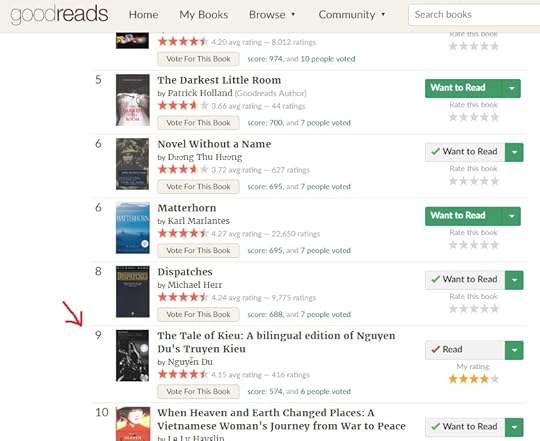
Regarding the list of Best Books on Vietnam, I can't believe this book places ninth, and note the description. Seriously?

description
Profile Image for Lê Tuyền ICHI.
497 reviews157 followers
April 25, 2021
Văn chương xứng đáng vào hàng Tuyệt Diệu, quỷ khóc thần sầu.
---
Từng vì nàng Kiều thổn thức đôi dòng:

"Lò trầm ai chửa dừng tay?
Cho hương thêm lạnh thêm dày với hương
Buông lơi bao tiếng đoạn trường
Đàn gieo một khúc bi thương kiếp người
Thềm mưa vách gió rã rời
Giấc mơ ngày cũ miệt mài đêm thâu
Đến bây giờ, đã bao lâu?
Tháng năm người vẫn âu sầu với hoa
Bốn mùa lặng lẽ trôi qua
Xuân đi, hạ mất, thu xa, đông tàn
Soi gương đập vỡ cung đàn!
Bóng hình dằng dặc, đường trần phai phôi
Đàn kia sầu bởi tay ai?
Trầm kia lạnh lẽo ai người khêu hương?
Đêm khuya trở giấc mơ màng
Người vương vẫn đấy, nàng Vương chẳng về."

(Holly)
Profile Image for Sophie (RedheadReading).
734 reviews77 followers
April 10, 2025
Girl was going through it!! Loved the poetry of this translation. "Within yourself you hold a precious gift, worth more than all the talents on this earth: a human heart."
Profile Image for Jinn.
287 reviews
May 31, 2017
Cụ Chế Lan Viên đã bảo thế này: "Nguyễn Du viết Kiều, đất nước hóa thành văn".
Vừa đọc cứ vừa tấm tắc sao cụ phán vừa chuẩn lại hay quá. Cụ Tố Như cứ yên trí nhé, không chỉ ba trăm năm, mà người đời sẽ còn mãi khóc cụ.
Profile Image for Kristie.
40 reviews
July 18, 2009
I read the english version before I moved to Vietnam to live for one year.
Profile Image for Vu K.
104 reviews103 followers
September 29, 2016
Thiên tuyệt tác trong văn chương Việt cổ.

Sau lần đọc này cũng đã hoàn thành đọc lần 2 nhưng là bản Nôm cổ nhất Liễu Vân Đường 1871.

Còn 2 bản nữa để đọc tiếp.
Profile Image for Rùa Con Mắt cận.
38 reviews7 followers
March 3, 2016
"Ngẫm hay muôn sự tại trời
Trời kia đã bắt làm người có thân.
Bắt phong trần phải phong trần
Cho thanh cao mới được phần thanh cao."

Có đọc trăm lần nữa cũng vần thấy hay thôi :)
Profile Image for NhaThuyen.
17 reviews23 followers
January 3, 2014
Ngày 1 đầu năm 2014 nắng đẹp, đứng chờ bạn ở vỉa hè Đông Anh và nhìn thấy một tiệm sách cũ bên kia đường, chúng tôi ghé qua... Đã nhiều ngày, tôi không qua Đinh Lễ thường xuyên như trước, tôi cảm thấy như thể ngại ngùng khi bước vào những tiệm sách quen và hầu như tôi không đọc các sách mới ra. Tôi lại trở về với những người đã chết của tôi và tôi yêu thêm một vài người lạ. Tiệm sách ở một thị trấn ngoại thành Hà Nội, tôi không tin là mình có thể tìm được sách gì, nhưng rút cục chúng tôi vẫn mang về hai cuốn, cuốn Truyện Kiều bản phổ thông in năm 1965 và cuốn Thơ Đường của Khương Hữu Dụng dịch. Tôi vẫn thỉnh thoảng đọc vài dòng Truyện Kiều hay lẩm nhẩm nhớ lại trong óc đôi khi, để bói toán, để xem mình nhớ tới câu bao nhiêu. Nhớ ngày lớp 10 đã từng có ý thuộc cả 3254 câu Kiều. Bây giờ thì hầu như bất khả.

Tôi không bận tâm nó có phải là một cuốn sách vĩ đại hay không, nhưng là một cuốn sách, với tôi, hữu ích. Nhất là để giải trí.
Profile Image for Martin Hassman.
322 reviews44 followers
May 13, 2018
Starý vietnamský epos, u nás prakticky neznámý, naštěstí dostupný aspoň v překladu z 50. let. Jakmile přijdete na chuť jeho zvláštnímu jazyku, tak vás chytne a nepustí. Příběh silné dívky, které osud nedopřál žít se svým milým, a přínáší jí jedno neštěstí za druhým.
Profile Image for V..
96 reviews37 followers
June 8, 2020
Phàm là người Việt Nam ta
Đọc Kiều mà nghĩ, ngẫm ra những điều.

"Trăm năm trong cõi người ta,
Chữ tài chữ mệnh khéo là ghét nhau
Trải qua một cuộc bể dâu,
Những điều trông thấy mà đau đớn lòng."

Thoát xong ba mấy nghìn dòng
Đoạn trường ai oái mấy vòng hồi luân
Thân Kiều lắm bể gian truân
Hồng nhan bạc phận, tuổi xuân gầy mòn.

Mười lăm năm cách biệt tròn
Ba chìm bảy nổi vẫn còn sắt son
Trung hiếu nghĩa đặng nước non
Càng bi sầu thảm, càng tôn sắc tài.

May thay phận đã an bài
Kết là hạnh phúc, kết cài nên duyên
Trải qua khổ ải triền miên
Người đi kẻ ở, còn nguyên chén thề.
Châu sa rơi rớt dầm dề
Thi ca cảm động, xin đề dòng thơ.

Kẻ hậu nhân trẻ người non dạ
Chữ nghĩa có chút gà mờ hạn hẹp
Đọc áng thơ của Tố Như tiên sinh không khỏi động lòng
Tức thơ sinh thơ gọi là
Nên xin để đây lời ngợi ca,
Thán phục tài nghệ của bậc tiền nhân.
Tài dùng thơ kể chuyện của Tố Như
Từ xưa đến nay được mấy người
Càng đọc càng thấy vốn từ của bản thân quá ư hèn mọn
Càng thẹn với lòng, càng kính cẩn ngã mũ nghiêng đầu.
Profile Image for nethescurial.
228 reviews76 followers
October 18, 2025
A masterpiece on a level I am unqualified to talk about and only just recently discovered (thank you Thích Nhat Hanh) but was easily my most valuable off-the-cuff read of the year. Kieu as a character is the definition of subtle heroism that is all the more momentous for being so understated, this story seriously got my lips quivering and gave me deep shivers more than once which is very rare for something I'm reading the first time. It's an incredibly dense story on all levels of the text and I'd love to be able to write more about it but I really gotta let it sit with me so I can do justice to the book itself and its cultural background. The liner notes are also super helpful and illuminating, this entire volume is a treasure trove of Chinese and Vietnamese historical, cultural, and mythical knowledge, and I can't imagine how good this would read/sound in the original language, as the translation job here is stellar especially with added context. So so so happy I found this, anyone interested in Vietnamese history, Buddhism, and honestly just culture and humanity in general would do well to read this
Profile Image for Mã Phong.
173 reviews29 followers
Read
January 10, 2021
Hình như năm ngoái hay hai năm trước có đọc truyện này rồi, nhưng đọc đến khoảng phân nửa thì phải bỏ dở vì mình không hiểu bối cảnh và diễn biến truyện, đọc truyện bằng thơ cũng mang đến một trải nghiệm rất khác so với khi đọc tiểu thuyết hay truyện ngắn. Sau đó mình có nghe sách nói trên đường về nhà, có cả phân tích truyện sau mỗi chương nữa, cảm thấy hiểu hơn trước nhưng nhiều lúc vẫn không để tâm lắm đến mạch truyện. Lần đọc này, cuối cùng cũng hoàn thành xong cuốn sách sau bao nhiêu lần trì hoãn, nhiều chỗ mình vẫn chưa thực sự hiểu, nắm bắt và cảm nhận được hết cái hay trong câu chữ của tác giả, nhưng nhìn chung vẫn khá hài lòng với trải nghiệm đọc lần này.
26 reviews2 followers
December 1, 2021
Amazing. I was not into Asian literature before reading this and now I am hooked. Definitely get yourself a copy if your looking for a great story, and it is also a great gateway to getting into Asian literature in general.
Profile Image for J.
178 reviews
April 25, 2021

With a golden knife, each cuts a lock of hair
which they mingle to form a single cloud.

Kieu is a cloud, a broken fern. She drifts about.


*
Displaying 1 - 30 of 252 reviews

Can't find what you're looking for?

Get help and learn more about the design.