

What do you think?
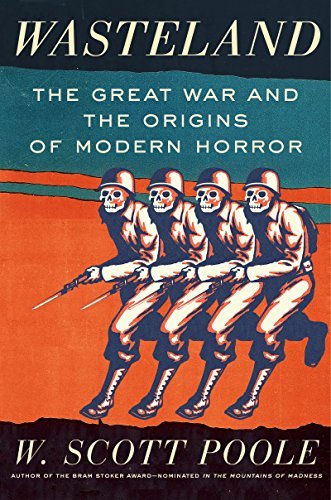
Wasteland: The Great War and the Origins of Modern Horror
Historian and Bram Stoker Award nominee W. Scott Poole traces the confluence of history, technology, and art that gave us modern horror films and literature
In the early twentieth century, World War I was the most devastating event humanity had yet experienced. New machines of war left tens of millions killed or wounded in the most grotesque of ways. The Great War remade the world’s map, created new global powers, and brought forth some of the biggest problems still facing us today. But it also birthed a new art form: the horror film, made from the fears of a generation ruined by war.
From Nosferatu to Frankenstein’s monster and the Wolf Man, from Fritz Lang, F. W. Murnau, and Albin Grau to Tod Browning and James Whale, the touchstones of horror can all trace their roots to the bloodshed of the First World War. Historian W. Scott Poole chronicles these major figures and the many movements they influenced. Wasteland reveals how bloody battlefields, the fear of the corpse, and a growing darkness made their way into the deepest corners of our psyche.
On the one-hundredth anniversary of the signing of the armistice that brought World War I to a close, W. Scott Poole takes us behind the front lines of battle to a no-man’s-land where the legacy of the War to End All Wars lives on.
In the early twentieth century, World War I was the most devastating event humanity had yet experienced. New machines of war left tens of millions killed or wounded in the most grotesque of ways. The Great War remade the world’s map, created new global powers, and brought forth some of the biggest problems still facing us today. But it also birthed a new art form: the horror film, made from the fears of a generation ruined by war.
From Nosferatu to Frankenstein’s monster and the Wolf Man, from Fritz Lang, F. W. Murnau, and Albin Grau to Tod Browning and James Whale, the touchstones of horror can all trace their roots to the bloodshed of the First World War. Historian W. Scott Poole chronicles these major figures and the many movements they influenced. Wasteland reveals how bloody battlefields, the fear of the corpse, and a growing darkness made their way into the deepest corners of our psyche.
On the one-hundredth anniversary of the signing of the armistice that brought World War I to a close, W. Scott Poole takes us behind the front lines of battle to a no-man’s-land where the legacy of the War to End All Wars lives on.
339 pages, Kindle Edition
First published October 16, 2018
Ratings & Reviews
Friends & Following
Create a free account to discover what your friends think of this book!
Community Reviews
Displaying 1 - 30 of 165 reviews

October 1, 2018
As a portrait of the many horrors of World Wars I & II, the book succeeds admirably. Poole is an exciting and excitable writer; his outrage at the bloodshed and senseless deaths of these wars is palpable. Many of the passages made me recall some of my favorite history teachers, and how their enthusiasm for their subjects made learning a treat. Subjects treated personally, and with emotion, are subjects that are often made all the more memorable. A dispassionate understanding of the reasons behind and outcomes from these wars is displayed, but delivered with a high emotional pitch and strong imagery; and so the book was a consistently powerful read. Interestingly, it is that same combination of dispassionate understanding and observation informing an emotional narrative which is told with strong imagery that often makes for a powerful horror novel or film.
As a rough sketch of the lives and opinions of a handful of artists during this time period, the book is a treasure. Poole visits and revisits a number of well-known people of the era, in particular: Fritz Lang, H.P. Lovecraft, James Whale, Arthur Machen, F.W. Murnau, Franz Kafka, T.S. Eliot, and Walter Benjamin. These are fascinating individuals and the author makes certain I remained fascinated by creating a narrative around each of them, feeding the reader little bits of their lives throughout his chapters, snapshots that are often delivered in chronological order, carefully noting their perspectives and outputs and their growths or regressions, ending with, of course, the ending of each of their lives.
As a thesis on the idea that "modern horror" truly began with The Great War... a bit of a wash, unfortunately. (More on this below.) I think I may have enjoyed this book more if I had just ignored its purported reason for being and instead focused on the narrative skills on display and the stories being told by the author. He is a compelling writer, but I think he became a bit lost in the recounting of various fascinating lives, and was perhaps so emotionally overcome at the idea of so much bloodshed during the two world wars that focus was diffused and the whole point of this effort was often submerged. Still, many good points not related to the central thesis were made. I certainly left this experience richer in knowledge. And I was often as angry as the author clearly is when contemplating the foolishness of mankind. This species seldom learns, and what it does learn is often horrific to consider.
☠
CHAPTER NOTES:
💀
October was my horror binge month, so in addition to reading this absorbing book, I tried to avoid and fib my way out of as many social obligations as possible in order to immerse myself in as many worlds of horror as possible. Part of my excitement in reading this book was in seeing how it correlated to my horror diet. And the reverse as well: seeing how those horror films and books perhaps supported Poole's thesis.
Anyway, I will have to consider any connections a bit more, because at first thought, I did not see a whole lot of correlation and supporting going on.
Alas, although October was a wonderful month in terms of my horror diet - it was delicious! (mainly) - it was not so wonderful when considering the various horror films, novels, and tv within the framework of Poole's ideas. There was not a good fit. I thought I would be able to write rather extensively on how his ideas connected with these examples of horror, but I really cannot. I can't compare apples and oranges and other clichés. Perhaps I should have focused on the horror films and literature of the period that Poole is discussing - namely the eras preceding and during World Wars I & II, rather than my focus on a diversity of eras (in particular, for films at least, the 60s & 70s).
But the book is subtitled with the phrase "Modern Horror"! I expected to see an argument developed on how WW I so impacted horror film and literature that that impact could be seen throughout the subsequent decades. Even the most superficially relevant example - "The Revenant", a novel about ghosts of the Civil War coming to haunt a family - was more about exploring the challenges within the modern nuclear family unit than about the banality of atrocity, the horror of disfigurement, or the terrible facelessness of mass death - although all three of those were present as devices within the book. But they were devices, not the actual theme of the book. The story most connected to the ideas discussed in Wasteland was, ironically, Leonid Andreyez's "Lazarus" - written prior to World War I. There was one example of a film that can be contextualized within Poole's thesis: the delirious Japanese movie "Genocide", which displayed the many horrors that come from the human hunger for more power, more weapons, more revenge.
Whether it was contagious excitement about death displayed in Sion Sono's "Suicide Circle", the zombies spawned by faulty, insect-controlling technology in Jorge Grau's "Let Sleeping Corpses Lie", the leftist nightmare of a reactionary world contained within the execrable tv show "The Purge", the potential horrors of spiritual transcendence and rebirth in Grant Morrison's "Nameless", the fear of sexuality displayed in "Incubus", or perhaps most relevantly, the toxic psychological backwash that can happen when guilty memories are repressed in Arthur Machen's "Children of the Pool"... I saw scarce evidence anywhere of a connection to the ideas discussed in this book.
That lack of connection is interesting to contemplate. Poole does makes a convincing case for how the themes he's noted are present in those particular films and stories created during the era under his review. That lack of connection is interesting, and also a caution, because it is an illustration of how quickly humanity is able to forget lessons learned and how thoroughly the past can be buried and forgotten.
💀
HORROR LISTS:
☠
As a rough sketch of the lives and opinions of a handful of artists during this time period, the book is a treasure. Poole visits and revisits a number of well-known people of the era, in particular: Fritz Lang, H.P. Lovecraft, James Whale, Arthur Machen, F.W. Murnau, Franz Kafka, T.S. Eliot, and Walter Benjamin. These are fascinating individuals and the author makes certain I remained fascinated by creating a narrative around each of them, feeding the reader little bits of their lives throughout his chapters, snapshots that are often delivered in chronological order, carefully noting their perspectives and outputs and their growths or regressions, ending with, of course, the ending of each of their lives.
As a thesis on the idea that "modern horror" truly began with The Great War... a bit of a wash, unfortunately. (More on this below.) I think I may have enjoyed this book more if I had just ignored its purported reason for being and instead focused on the narrative skills on display and the stories being told by the author. He is a compelling writer, but I think he became a bit lost in the recounting of various fascinating lives, and was perhaps so emotionally overcome at the idea of so much bloodshed during the two world wars that focus was diffused and the whole point of this effort was often submerged. Still, many good points not related to the central thesis were made. I certainly left this experience richer in knowledge. And I was often as angry as the author clearly is when contemplating the foolishness of mankind. This species seldom learns, and what it does learn is often horrific to consider.
☠
CHAPTER NOTES:
💀
October was my horror binge month, so in addition to reading this absorbing book, I tried to avoid and fib my way out of as many social obligations as possible in order to immerse myself in as many worlds of horror as possible. Part of my excitement in reading this book was in seeing how it correlated to my horror diet. And the reverse as well: seeing how those horror films and books perhaps supported Poole's thesis.
Anyway, I will have to consider any connections a bit more, because at first thought, I did not see a whole lot of correlation and supporting going on.
Alas, although October was a wonderful month in terms of my horror diet - it was delicious! (mainly) - it was not so wonderful when considering the various horror films, novels, and tv within the framework of Poole's ideas. There was not a good fit. I thought I would be able to write rather extensively on how his ideas connected with these examples of horror, but I really cannot. I can't compare apples and oranges and other clichés. Perhaps I should have focused on the horror films and literature of the period that Poole is discussing - namely the eras preceding and during World Wars I & II, rather than my focus on a diversity of eras (in particular, for films at least, the 60s & 70s).
But the book is subtitled with the phrase "Modern Horror"! I expected to see an argument developed on how WW I so impacted horror film and literature that that impact could be seen throughout the subsequent decades. Even the most superficially relevant example - "The Revenant", a novel about ghosts of the Civil War coming to haunt a family - was more about exploring the challenges within the modern nuclear family unit than about the banality of atrocity, the horror of disfigurement, or the terrible facelessness of mass death - although all three of those were present as devices within the book. But they were devices, not the actual theme of the book. The story most connected to the ideas discussed in Wasteland was, ironically, Leonid Andreyez's "Lazarus" - written prior to World War I. There was one example of a film that can be contextualized within Poole's thesis: the delirious Japanese movie "Genocide", which displayed the many horrors that come from the human hunger for more power, more weapons, more revenge.
Whether it was contagious excitement about death displayed in Sion Sono's "Suicide Circle", the zombies spawned by faulty, insect-controlling technology in Jorge Grau's "Let Sleeping Corpses Lie", the leftist nightmare of a reactionary world contained within the execrable tv show "The Purge", the potential horrors of spiritual transcendence and rebirth in Grant Morrison's "Nameless", the fear of sexuality displayed in "Incubus", or perhaps most relevantly, the toxic psychological backwash that can happen when guilty memories are repressed in Arthur Machen's "Children of the Pool"... I saw scarce evidence anywhere of a connection to the ideas discussed in this book.
That lack of connection is interesting to contemplate. Poole does makes a convincing case for how the themes he's noted are present in those particular films and stories created during the era under his review. That lack of connection is interesting, and also a caution, because it is an illustration of how quickly humanity is able to forget lessons learned and how thoroughly the past can be buried and forgotten.
💀
HORROR LISTS:
☠

October 20, 2018
Veterans Day 2018. As always, I emailed my friend the Colonel to tell him “thanks for your service” and to let him know I was thinking of him. But this time I added something else: “And I’m also thinking of Ypres, the Marne, the Somme, Belleau Wood . . .” What I didn’t tell him was that those memorable battles were on my mind not only because Sunday was the 100th anniversary of the Armistice, but because I had recently finished reading W. Scott Poole’s Wasteland: the Great War and the Origins of Modern Horror, and my imagination still seethed with the images Poole uses to supports his simple, compelling thesis:
In every horror movie we see, every horror fiction we read, every monster we fight in PC and console games, the phantoms of the Great War skittle and scratch just beyond the door of our consciousness. Numberless dead and wounded bodies appear on our screens, documents of barbarism co-authored by the Great War generations and all the forces that have fed off them in the decades since.W. Scott Poole, a professor of history at the College of Charleston and author of Monsters in America, Vampira: Dark Goddess of Horror, and In the Mountains of Madness (a critical biography of H.P. Lovecraft) is a man who certainly knows his horror. But Poole, also knowledgeable about literature and the visual arts, is adept at using his erudition to illuminate—or perhaps I should say “darken”— the consciousness of his reader with the penetrating images of carnage and death that infect the 20th century imagination.
Poole is at his best when he is summarizing narratives—like Murnau’s film Nosferatu or Kafka’s story “In The Penal Colony”— for he has an extraordinary talent for choosing the proper details and arranging them in the best order. Because of this, he does not have to develop his thesis in laborious paragraphs. Instead, he shows you what he means to tell you, and that showing, in itself, is often enough. He is also very good at choosing works of visual art, both essential and obscure, to illustrate his ideas. His treatment of Picasso’s “Guernica,” with which I am very familiar, was instructive, but I was also pleased to be reminded of the work of the surrealist painter Leonora Carrington, and to be introduced to a powerful painter of the trenches, the Weimar Republic's Otto Dix.
I was also pleased by Poole’s mordant point of view, which often guides his choice of biographical and historical details, some of which are only tangentially relevant: the fact that Metropolis director Fritz Lang like to wave his pistol around; that Franz Kafa’s sisters died in the Holocaust; that Dali got Bunuel fired from MOMA for being a commie; that there is strong evidence Walt Disney attended meetings of the German American Bund; that the American soldiers at My Lai found the massacre such exhausting work that they decided to break for lunch.
This is a rich book. It can be dipped into at a whim, or read right through, depending on your preference. If you have an interest in the Great War or the art of horror, you will find much to delight you here, but I would particularly recommend it to anyone who admires the silent films of the Weimar Republic or the classic Hollywood horror movies of the '30's, particularly the two Frankenstein films directed by WW I veteran James Whale.
But be warned . . . its the kind of a book that can haunt you, that may make a small but indelible mark in the manner in which you view things, particular those movies you watch late at night. The vampire, the zombie, the blank-eyed automaton, the reanimated creature assembled from the remnants of cadavers: they may appear to be something new to you now, uneasy spectres spawned in the trenches that bordered the reality called No Man’s Land. Like me, you too may find yourself thinking of Ypres, the Marne, the Somme, Belleau Wood.

June 23, 2019
11/11/19 UPDATE There was a Reddit AMA with the author today. It's a long thread but worthwhile reading.
I made 65 notes on this book and never wrote the review! That's terrible. A waste of note-taking not to use them for their intended purpose.
I enjoyed this fluid, fluent recounting of the modern horror genre's explosion after the nightmarish experience of WWI. The rise of the film industry, its ability to offer a new take on the Gothic tale and meld it to the lived reality of millions...well, that's a tale worth telling. Poole told it well, but used a choppy technique that might be off-putting to some readers; it does feel a bit like reading someone's index cards for a high-school research paper. To me, it reinforced the currents in culture that Poole was highlighting, and allowed him to be pithy but thorough in making his points about the whys and wherefores of the evolution of Gothic stories into horror stories.
At all events, it bums me out that I didn't write a real review months ago while this book's pleasures and strengths were fresh in my mind. Now I can't recapture that impetus. But I can and do say that anyone with more than a passing interest in horror storytelling would do well to read the text closely.
I made 65 notes on this book and never wrote the review! That's terrible. A waste of note-taking not to use them for their intended purpose.
I enjoyed this fluid, fluent recounting of the modern horror genre's explosion after the nightmarish experience of WWI. The rise of the film industry, its ability to offer a new take on the Gothic tale and meld it to the lived reality of millions...well, that's a tale worth telling. Poole told it well, but used a choppy technique that might be off-putting to some readers; it does feel a bit like reading someone's index cards for a high-school research paper. To me, it reinforced the currents in culture that Poole was highlighting, and allowed him to be pithy but thorough in making his points about the whys and wherefores of the evolution of Gothic stories into horror stories.
At all events, it bums me out that I didn't write a real review months ago while this book's pleasures and strengths were fresh in my mind. Now I can't recapture that impetus. But I can and do say that anyone with more than a passing interest in horror storytelling would do well to read the text closely.

August 27, 2018
Review Originally in SCREAM Magazine 2018
“Horror as an art form, as escape, as a rendition of what had just happened, became the only possible response for a world that could not stop screaming.” W. Scott Poole
I don’t read a lot of non fiction. I find that in order to get the most out of my recreational reading time, I like to spend hours immersed in the fictional horrors of our talented pool of horror authors authors available to us today.
However, when I saw that this book, Wasteland-- a book about the origins of modern horror--written by a historian and a history teacher of horror and pop culture...I couldn’t resist. Especially since I review books for Scream Magazine and I know that the Scream fanbase has mad love for monsters present and monsters past.
The perfect non fiction book for me to sink my teeth into.
Poole does an excellent job of setting the stage by bringing readers back in time to the early 1900s and the beginning of World War I. But he doesn’t tell the story in the same way I remember being told about it in my high school US history class. These aren’t boring, dry facts you can’t relate to and there’s not a pop quiz at the end of the chapter. There are threads of the early stages of horror woven throughout the World War I history lesson and for me, it made the whole topic insurmountably more engaging.
It’s unreal to imagine a time in history where the war machine was churning out corpses by the hundred thousands a year. In total, it claimed the lives of 40 million people over its 4 year duration. Poole then begins to build his case: A post war culture, shaken by what they have seen and what they have lost, find solace in the darkness of horror movies and literature. I found it incredibly interesting to see how the macabre poetry and stories told in the 1920s still resonate in today’s culture as we find ourselves entertained by and almost obsessed with stories of apocalypse and mayhem brought on by some global disease outbreak or zombie takeover. You see this in our movies, books, video games and comics of today but I never really knew why people seem fixated on these self destructive stories. Poole makes the argument that those stories of global catastrophe are an outpouring of emotions that we carry around with us in response to our fears and frustrations about war. I mean, the author doesn’t claim to be a psychologist but his theory makes a lot of sense to me.
This book makes well supported claims that fictional horror was born as an affective, creative outlet for a war-torn generation. I thoroughly enjoyed the countless references to all our favorite horror movies and literature spanning over the years between 1920 and and present day. From Nosferatu to Freddy Krueger. I highly recommend this book for any history buff or horror hound.
“Horror as an art form, as escape, as a rendition of what had just happened, became the only possible response for a world that could not stop screaming.” W. Scott Poole
I don’t read a lot of non fiction. I find that in order to get the most out of my recreational reading time, I like to spend hours immersed in the fictional horrors of our talented pool of horror authors authors available to us today.
However, when I saw that this book, Wasteland-- a book about the origins of modern horror--written by a historian and a history teacher of horror and pop culture...I couldn’t resist. Especially since I review books for Scream Magazine and I know that the Scream fanbase has mad love for monsters present and monsters past.
The perfect non fiction book for me to sink my teeth into.
Poole does an excellent job of setting the stage by bringing readers back in time to the early 1900s and the beginning of World War I. But he doesn’t tell the story in the same way I remember being told about it in my high school US history class. These aren’t boring, dry facts you can’t relate to and there’s not a pop quiz at the end of the chapter. There are threads of the early stages of horror woven throughout the World War I history lesson and for me, it made the whole topic insurmountably more engaging.
It’s unreal to imagine a time in history where the war machine was churning out corpses by the hundred thousands a year. In total, it claimed the lives of 40 million people over its 4 year duration. Poole then begins to build his case: A post war culture, shaken by what they have seen and what they have lost, find solace in the darkness of horror movies and literature. I found it incredibly interesting to see how the macabre poetry and stories told in the 1920s still resonate in today’s culture as we find ourselves entertained by and almost obsessed with stories of apocalypse and mayhem brought on by some global disease outbreak or zombie takeover. You see this in our movies, books, video games and comics of today but I never really knew why people seem fixated on these self destructive stories. Poole makes the argument that those stories of global catastrophe are an outpouring of emotions that we carry around with us in response to our fears and frustrations about war. I mean, the author doesn’t claim to be a psychologist but his theory makes a lot of sense to me.
This book makes well supported claims that fictional horror was born as an affective, creative outlet for a war-torn generation. I thoroughly enjoyed the countless references to all our favorite horror movies and literature spanning over the years between 1920 and and present day. From Nosferatu to Freddy Krueger. I highly recommend this book for any history buff or horror hound.

March 8, 2022
A nice exposition on the relationship between horror, as an entertainment genre, and World War I. The author’s approach is smart, scholarly and extensive; so extensive in fact that if your love of horror is utterly existential and you feel you are ready to commune with the Dalai Lama of Dread, W. Scott Poole is your man.
If there is a knock on Poole’s deductive reasoning it’s that he sometimes paints his speculations with a fairly broad brush. Sketching the connective tissue between the trenches of 1918 and the Hollywood backlots of 2018 is five parts historical referencing, three parts psychological analysis and one part blind faith. To say that ‘without Gallipoli there would be no Godzilla,’ or ‘without the Somme there would be no Salem’s Lot’ may indeed be true, but the plethora of other events within the time span dilutes the logic and throws a shadow of doubt on the interpretations.
Also, the author’s passion makes him prone to drift off topic now and again - so prepare yourself for a sociopolitical tangent* or two.
*hint, if you’re an easily offended fan of Salvador Dalí you might want to take a pass on this one.
If there is a knock on Poole’s deductive reasoning it’s that he sometimes paints his speculations with a fairly broad brush. Sketching the connective tissue between the trenches of 1918 and the Hollywood backlots of 2018 is five parts historical referencing, three parts psychological analysis and one part blind faith. To say that ‘without Gallipoli there would be no Godzilla,’ or ‘without the Somme there would be no Salem’s Lot’ may indeed be true, but the plethora of other events within the time span dilutes the logic and throws a shadow of doubt on the interpretations.
Also, the author’s passion makes him prone to drift off topic now and again - so prepare yourself for a sociopolitical tangent* or two.
*hint, if you’re an easily offended fan of Salvador Dalí you might want to take a pass on this one.

November 13, 2022
A book about horror and WWI should be perfectly catered to me, but this was disappointing. It falls into the trap of most popular history of being too broad in its scope and lacking depth in its analysis. Poole should have chosen to focus on either German Horror or American Horror, but not both. Both countries' post-war experiences were vastly different, and his attempts to connect the two were lazy and disjointed.
Horribly organized to the point many of Poole's arguments were lost, the thesis of the book is never actually realized or backed, imho, by proper historical analysis. I love theory, so it pains to me admit that there were parts where I wanted actual statistics to support his argument. There were (many) times when Poole would make superficial comparisons between a scene in a horror movie and the events of WWI that I desperately wanted to be backed either by first hand accounts from the filmmakers or by WWI veterans. Again, this stems from the lack of a directed and organized reading (he should have just focused on German Expressionism as a reaction to WWI and then made connections on how the figures of it influenced wider horror - which would allowed him to discuss interwar American horror films without him jumping around from topic to topic with little to no connections).
The strengths in this book lies in his discussion of the rise of fascism, its connection with German filmmaking, and by extension, German horror, and the various ways artists of the time accepted and rejected its ideologies. I think this was the heart of his original argument, and he followed the logical conclusion of the rise of fascism being tied with the end of WWI = therefore all modern horror stems from WWI. Again, I don't disagree with his overall argument, I just wished it was better supported/argued. I also enjoyed Poole's discussions of the various film-makers, writers, and creatives of this period and liked that in his conclusion he makes the point of asking readers to check out the work of under-appreciated artists.
Some other points:
-Accusations of presentism. I think this is unfounded. Poole is largely discussing ideas rather than people, but he does a good job at situating historical figures within their time (as, you know, traumatized people who had watched numerous of their friends, loved ones, and colleagues die in the war), and discussing the nuances of their ideas and actions. I suspect this accusations arises from the fact Poole calls out figures who sympathized fascism and held racist ideas for their beliefs, instead of just brushing it aside. Sorry, but actual historical work involves critical analysis and deconstructing past events and people outside of popular narratives, not mindlessly hero-worshipping someone. Lovecraft is a racist by both today's and the past's standards. I disagree with Poole's assessment of Lovecraft being a masterful writer though - Lovecraft sucked at that too.
-I saw some criticisms that Poole fails to properly critique communism enough in his book about interwar German horror.... girl, get a grip.
Horribly organized to the point many of Poole's arguments were lost, the thesis of the book is never actually realized or backed, imho, by proper historical analysis. I love theory, so it pains to me admit that there were parts where I wanted actual statistics to support his argument. There were (many) times when Poole would make superficial comparisons between a scene in a horror movie and the events of WWI that I desperately wanted to be backed either by first hand accounts from the filmmakers or by WWI veterans. Again, this stems from the lack of a directed and organized reading (he should have just focused on German Expressionism as a reaction to WWI and then made connections on how the figures of it influenced wider horror - which would allowed him to discuss interwar American horror films without him jumping around from topic to topic with little to no connections).
The strengths in this book lies in his discussion of the rise of fascism, its connection with German filmmaking, and by extension, German horror, and the various ways artists of the time accepted and rejected its ideologies. I think this was the heart of his original argument, and he followed the logical conclusion of the rise of fascism being tied with the end of WWI = therefore all modern horror stems from WWI. Again, I don't disagree with his overall argument, I just wished it was better supported/argued. I also enjoyed Poole's discussions of the various film-makers, writers, and creatives of this period and liked that in his conclusion he makes the point of asking readers to check out the work of under-appreciated artists.
Some other points:
-Accusations of presentism. I think this is unfounded. Poole is largely discussing ideas rather than people, but he does a good job at situating historical figures within their time (as, you know, traumatized people who had watched numerous of their friends, loved ones, and colleagues die in the war), and discussing the nuances of their ideas and actions. I suspect this accusations arises from the fact Poole calls out figures who sympathized fascism and held racist ideas for their beliefs, instead of just brushing it aside. Sorry, but actual historical work involves critical analysis and deconstructing past events and people outside of popular narratives, not mindlessly hero-worshipping someone. Lovecraft is a racist by both today's and the past's standards. I disagree with Poole's assessment of Lovecraft being a masterful writer though - Lovecraft sucked at that too.
-I saw some criticisms that Poole fails to properly critique communism enough in his book about interwar German horror.... girl, get a grip.

November 5, 2018
I've been waiting for someone to write this book for a long time and I'm glad this is what we got.
In Wasteland, W. Scott Poole takes us through the highlights of art forms and movements in the interwar years. The book is divided into chapters that deal roughly with topics, such as fear of the corpse and what he calls "death dolls." That tends to fall away after awhile but the chapters do move chronologically. They're not entirely self contained. Most chapters have sections that focus on particular artists, mostly writers, such as Arthur Machen, H.P. Lovecraft and Franz Kafka.
The book doesn't explore exclusively horror, but rather horrific imagery, discussing such films as J'Accuse, writers such as Kafka, and movements such as Surrealism.
If you are looking for a book that discusses the war or life in the trenches, this is not the one for you. There's a small discussion of some facts and figures of the war, but just enough to give a basic understanding so the reader can fully ruminate about the presented conclusions. That does not mean the book is an easy read. By necessity Poole discusses the major trauma that soldiers witnessed, so there's corpses and violence abound.
Poole does a good job of showing the main fears the Great War created and how they manifested in many media in both Europe and America and why they manifested differently or more slowly in each area.
There is quite a bit of discussion of film and film buffs will find the extensive coverage of Murnau's Nosferatu (which is a special focus for Poole, who brings this film up in more places than any other single piece he discusses) and the films of James Whale. I can't say I'm entirely convinced in some of his conclusions about Whale's films, but the section is still solid.
Poole writes the book from the perspective that the Great War never ended and makes a compelling argument for that. However, that also opens the gate for him to go off about World War II a little more than I would like. Facism is, of course, a horror of its own, was a result of WWI and had it's own effects on horror, but the book is about WWI, so we don't need to assert that WW2 was worse (which is a statement I would argue with) or about Hitler. It's unnecessary and smacks a little as hero worship of WW2 veterans.
That aside, I got what I wanted from this book. It may not be the most in-depth thing, but it's a great starting place for readers to go out and discover these artists and their works for yourself.
In Wasteland, W. Scott Poole takes us through the highlights of art forms and movements in the interwar years. The book is divided into chapters that deal roughly with topics, such as fear of the corpse and what he calls "death dolls." That tends to fall away after awhile but the chapters do move chronologically. They're not entirely self contained. Most chapters have sections that focus on particular artists, mostly writers, such as Arthur Machen, H.P. Lovecraft and Franz Kafka.
The book doesn't explore exclusively horror, but rather horrific imagery, discussing such films as J'Accuse, writers such as Kafka, and movements such as Surrealism.
If you are looking for a book that discusses the war or life in the trenches, this is not the one for you. There's a small discussion of some facts and figures of the war, but just enough to give a basic understanding so the reader can fully ruminate about the presented conclusions. That does not mean the book is an easy read. By necessity Poole discusses the major trauma that soldiers witnessed, so there's corpses and violence abound.
Poole does a good job of showing the main fears the Great War created and how they manifested in many media in both Europe and America and why they manifested differently or more slowly in each area.
There is quite a bit of discussion of film and film buffs will find the extensive coverage of Murnau's Nosferatu (which is a special focus for Poole, who brings this film up in more places than any other single piece he discusses) and the films of James Whale. I can't say I'm entirely convinced in some of his conclusions about Whale's films, but the section is still solid.
Poole writes the book from the perspective that the Great War never ended and makes a compelling argument for that. However, that also opens the gate for him to go off about World War II a little more than I would like. Facism is, of course, a horror of its own, was a result of WWI and had it's own effects on horror, but the book is about WWI, so we don't need to assert that WW2 was worse (which is a statement I would argue with) or about Hitler. It's unnecessary and smacks a little as hero worship of WW2 veterans.
That aside, I got what I wanted from this book. It may not be the most in-depth thing, but it's a great starting place for readers to go out and discover these artists and their works for yourself.

August 10, 2021
Poole obviously knows history, but unfortunately views his subject matter through a very thick lens. He is almost pathologically incapable of seeing white westerners as anything other than racists and colonialists, finding Nazis and fascists everywhere he looks, with an almost McCarthyite fervour.
Looking at this work from a structuralist point of view, what he leaves out is more telling than what he includes. He is quick to highlight the very clear links between horror and fascism, while stubbornly refusing to make any mention about the bottomless pit of horror that emerged from the Communist monster of 1917 onwards.
No doubt Poole is very popular with a certain type of student, that frames all aspects of masculinity as "the patriarchy", but his anthropological view of ordinary men and women from the early part of the last century makes no attempt to understand the mindset of the time. Instead regarding them with a detached superiority, as somehow less than civilised because they don't share his more enlightened 21st century viewpoint.
That said, I'm obviously not approaching this review from a neutral point of view. I'm bringing my own baggage into this, complete with my distaste for left-leaning interpretations of history. There were some really good and well considered observations in this book; notably the way the horror of the trenches gave rise to the concepts of body horror, and the rise of the monster as an analogy for war.
Looking at this work from a structuralist point of view, what he leaves out is more telling than what he includes. He is quick to highlight the very clear links between horror and fascism, while stubbornly refusing to make any mention about the bottomless pit of horror that emerged from the Communist monster of 1917 onwards.
No doubt Poole is very popular with a certain type of student, that frames all aspects of masculinity as "the patriarchy", but his anthropological view of ordinary men and women from the early part of the last century makes no attempt to understand the mindset of the time. Instead regarding them with a detached superiority, as somehow less than civilised because they don't share his more enlightened 21st century viewpoint.
That said, I'm obviously not approaching this review from a neutral point of view. I'm bringing my own baggage into this, complete with my distaste for left-leaning interpretations of history. There were some really good and well considered observations in this book; notably the way the horror of the trenches gave rise to the concepts of body horror, and the rise of the monster as an analogy for war.

March 4, 2021
I would have enjoyed this book much more if the author had not repeated his thesis -- that mass death and its iconography in the first world war led to the birth of horror as a modern genre -- on almost every page. Affirming an idea, of course, is not the same thing as demonstrating it. While the war certainly influenced Germany's outlook on pretty much everything and a few of Germany's postwar films contain most of the eggs that hatched into Universal's game-changing work in the 30s, I think cause and effect are pretty well hashed in Poole's argument. As much as the war shaped a generation, culture and literature were also overwhelmingly affected by modernism generally, and the reaction to it; the loss of traditional faith in god and governments; and the rise of mass media and the increased compartmentalization of content into genres. All a good deal more complicated than "all that slaughter." That criticism aside, I liked the book's excursions into realms unvisited by most books on the subject -- art, serious lit, and politics. There wasn't much here that I haven't read other places but it was nice to see it all put together as a coherent, if not convincing, narrative.

November 14, 2024
Finished this a while ago but put off contextualizing my thoughts until I’d see more of the films explicitly referenced. As a list of movies, great, very glad I read this. But as a book presenting a thesis… do not much care for this.
From the history side; it’s clear Poole is well-read about this particular moment and it’s the aspect of the book that is most successful, conveying the contradictions of the inter-war period, as well as the trajectory of theoretical and artistic understanding of The Great War. However, it’s most productive in tangential information and anecdotes which is frustrating. Notable lack of notes– twenty pages of endnotes is so worrying for me going into any nonfiction book, no matter how short– and so much of the empirical evidence necessary to prove the book’s argument are left unsourced for no real particular reason other than maybe readability. It all feels like a final cohesive whole that could have easily been about a half as long master's thesis (removing the agonizing repetition of the same points) or twice the size and more exhaustive. This is popular history splitting the difference, unfortunately, and it also results in a monograph who’s whole central thesis is sort of unfocused across too many mediums. Ends up sort of summarizing the effect of WWI on more than just film, when that history is pretty well-accepted, and never presents a coherent argument about what post-war horror looks like or reflects on the whole. Poole brings up Kracauer’s From Caligari to Hitler often, almost exclusively to challenge it, but can never quite formulate a counter-theory of horror other than that it represents all the ugly, horrible, and violent after-effects of the bloodshed and was often a method for war victims and veterans to reconcile with traumatic circumstances, which isn’t a huge leap.
From the film side, I know very little about actual film study in particular but Poole falls into a lot of pitfalls that like. historians writing about art/literature/etc for cultural histories trip over when they aren’t well-versed in the analysis necessary to dig deeply into the object in question. After watching the films I’m particularly struck by Poole’s reflex to refuse ambiguity or ideological complication, not out of a desire to simplify things, but just because he wants history to be able to “solve” or answer for a film’s larger purpose. Like I think it’s very silly to argue that Nosferatu has little to do with antisemitism just because the men who made it said it was a metaphor for the war– these things can coexist and you can’t prove a theory/reading more true with what people have said or what the intentions were. Similarly, Wegner’s golem films are mentioned and the discussion there feels particularly lackluster because Poole doesn’t know how to reconcile with a film which simultaneously engenders empathy for it’s jewish protagonists and utilizes a symbol of resistance (in the golem) and also still is foundationally working off deeply entrenched stereotypes. And to me this reads like a problem with the framework of analysis because Poole is so much more effective talking explicitly about propaganda film and their purpose and what you can read into them as a collective body of work, it's less about medium and more about being able to theorize about art. The lack of a substantial thesis also makes more sense too, since Poole less wants to analyze the development of technique (not technology, which is presented on a historical timeline) or rhetoric, but more so is interested in tracing the proliferation of (mostly surface level) trends or patterns or concepts in horror (zombies, body horror, the “death doll”, disfigurement, and so on) and from them extrapolating how the art could be connected to WWI as the proof that modern horror was born out of this specific instance of global casualty. This works really well when Poole just gets to really flesh out an artist’s experience with the war and create a narrative but often falls apart once that type of storytelling has to make way for discussion of that artist’s actual work, which seems backwards and counter-productive.
There’s other smaller issues, like I personally don’t love Poole’s tendency to position negative evaluation of white supremacist idiots like gossip. This is really most apparent whenever Poole brings up Dali but it factors in elsewhere. I absolutely do not care that this book rightly depicts nazi sympathizers as horrible miserable racists, even in their contemporaneous moment, I just think it minimizes the context for the momentary satisfaction of a sweet own or whatever, like saying Dali should be “cosigned to the dustbin” when you are actively writing about Lovecraft because, well, you have to in this context, is a little dumb. Otherwise, the discussion of fascism (specifically, again, the usefulness of rhetoric about the war and the functionality of propaganda preying on people’s fear) is really good. Though, another nitpick, it is odd that the Futurism section and Italian intellectual fascism takes up a lot of space but not a single Italian film is mentioned (by my remembrance).
Anyway. Ultimately just very much not my kind of history.
From the history side; it’s clear Poole is well-read about this particular moment and it’s the aspect of the book that is most successful, conveying the contradictions of the inter-war period, as well as the trajectory of theoretical and artistic understanding of The Great War. However, it’s most productive in tangential information and anecdotes which is frustrating. Notable lack of notes– twenty pages of endnotes is so worrying for me going into any nonfiction book, no matter how short– and so much of the empirical evidence necessary to prove the book’s argument are left unsourced for no real particular reason other than maybe readability. It all feels like a final cohesive whole that could have easily been about a half as long master's thesis (removing the agonizing repetition of the same points) or twice the size and more exhaustive. This is popular history splitting the difference, unfortunately, and it also results in a monograph who’s whole central thesis is sort of unfocused across too many mediums. Ends up sort of summarizing the effect of WWI on more than just film, when that history is pretty well-accepted, and never presents a coherent argument about what post-war horror looks like or reflects on the whole. Poole brings up Kracauer’s From Caligari to Hitler often, almost exclusively to challenge it, but can never quite formulate a counter-theory of horror other than that it represents all the ugly, horrible, and violent after-effects of the bloodshed and was often a method for war victims and veterans to reconcile with traumatic circumstances, which isn’t a huge leap.
From the film side, I know very little about actual film study in particular but Poole falls into a lot of pitfalls that like. historians writing about art/literature/etc for cultural histories trip over when they aren’t well-versed in the analysis necessary to dig deeply into the object in question. After watching the films I’m particularly struck by Poole’s reflex to refuse ambiguity or ideological complication, not out of a desire to simplify things, but just because he wants history to be able to “solve” or answer for a film’s larger purpose. Like I think it’s very silly to argue that Nosferatu has little to do with antisemitism just because the men who made it said it was a metaphor for the war– these things can coexist and you can’t prove a theory/reading more true with what people have said or what the intentions were. Similarly, Wegner’s golem films are mentioned and the discussion there feels particularly lackluster because Poole doesn’t know how to reconcile with a film which simultaneously engenders empathy for it’s jewish protagonists and utilizes a symbol of resistance (in the golem) and also still is foundationally working off deeply entrenched stereotypes. And to me this reads like a problem with the framework of analysis because Poole is so much more effective talking explicitly about propaganda film and their purpose and what you can read into them as a collective body of work, it's less about medium and more about being able to theorize about art. The lack of a substantial thesis also makes more sense too, since Poole less wants to analyze the development of technique (not technology, which is presented on a historical timeline) or rhetoric, but more so is interested in tracing the proliferation of (mostly surface level) trends or patterns or concepts in horror (zombies, body horror, the “death doll”, disfigurement, and so on) and from them extrapolating how the art could be connected to WWI as the proof that modern horror was born out of this specific instance of global casualty. This works really well when Poole just gets to really flesh out an artist’s experience with the war and create a narrative but often falls apart once that type of storytelling has to make way for discussion of that artist’s actual work, which seems backwards and counter-productive.
There’s other smaller issues, like I personally don’t love Poole’s tendency to position negative evaluation of white supremacist idiots like gossip. This is really most apparent whenever Poole brings up Dali but it factors in elsewhere. I absolutely do not care that this book rightly depicts nazi sympathizers as horrible miserable racists, even in their contemporaneous moment, I just think it minimizes the context for the momentary satisfaction of a sweet own or whatever, like saying Dali should be “cosigned to the dustbin” when you are actively writing about Lovecraft because, well, you have to in this context, is a little dumb. Otherwise, the discussion of fascism (specifically, again, the usefulness of rhetoric about the war and the functionality of propaganda preying on people’s fear) is really good. Though, another nitpick, it is odd that the Futurism section and Italian intellectual fascism takes up a lot of space but not a single Italian film is mentioned (by my remembrance).
Anyway. Ultimately just very much not my kind of history.

August 19, 2020
comprehensive and really great. it was so interesting to read this & think at length about horror acted as catharsis or morbid curiosity for a generation of people grappling with death and mental trauma and think how... you know... we're going to cope with the current situation. really relevant observations on how history like this doesn't end or stop. it becomes folded into storytelling and how we process and understand those things.

November 15, 2018
This was a surprisingly engrossing review of the western horror cinema, literature and art inspired by the European experience of WWI, with cinema, still in its infancy, receiving the most attention. Beginning with a quotation from Walter Benjamin, Poole's approach is academic without being dry, fact- and anecdote-filled without being shallow. Indeed, Poole has a point beyond his investigation of the origins of the horror genre, that being the contrast between the appropriation of the experience of the First World War and that of the Second. Further, and with some relation to this point, he considers the political manipulation of emotion, most pointedly by the fascists of the 30s and 40s, most recently by the alt-right and the Trump administration.
As is often the case with good books, I wish there had been more such as, for instance, a discussion of David Lindsay's literary work. What Poole does focus on are primarily well known films, writers and artists--enough points of contact to afford access to most readers.
As is often the case with good books, I wish there had been more such as, for instance, a discussion of David Lindsay's literary work. What Poole does focus on are primarily well known films, writers and artists--enough points of contact to afford access to most readers.

January 28, 2026
the premise of this book is exactly what i've been dying to read and is exactly my niche interest!! however, i wish i could rate this higher. that's not to say i didn't enjoy this- it was really fascinating and i was thoroughly engaged the whole way through. and i think i genuinely love learning about art and film history anyway!
but for some reason the more i read the more tenuous the author's argument became? we start off really strong with an understanding of the culture response to wwi with horror films, and the most interesting aspect of this book is reading about how horror's purpose changed as people tried to understand the incredible violence of their time period, then became tired of it and used it as an escape. i just wish that line of interrogation was explored more. instead it feels like we just pivot to the history of horror and that's fine too! just not really what i was expecting.
i liked it a lot and now i have a bunch of films to watch that i'd never even heard of + the context to fully appreciate them. yayyyy!
but for some reason the more i read the more tenuous the author's argument became? we start off really strong with an understanding of the culture response to wwi with horror films, and the most interesting aspect of this book is reading about how horror's purpose changed as people tried to understand the incredible violence of their time period, then became tired of it and used it as an escape. i just wish that line of interrogation was explored more. instead it feels like we just pivot to the history of horror and that's fine too! just not really what i was expecting.
i liked it a lot and now i have a bunch of films to watch that i'd never even heard of + the context to fully appreciate them. yayyyy!

July 3, 2020
There’s a lot of good information here, and I’d certainly recommend it to any horror fan. I did find the overall book to be a little disjointed. Some things felt like they were covered a couple of times over, and parts felt more like a collection of essays than a comprehensive whole. If you’re into horror in pop culture, and even if your into the military history of the two world wars, this book is worth your time.

November 14, 2018
The next time you hear that "horror isn't political", refer that person to this book...
November 8, 2019
4.8 Would have been five, but the structure and organization of chapters/topics was all over the place. Still, a fascinating work making solid connections between horror movies, art, and literature and the devastation of WWI. I was glad that the author covered how the creation of horror films in the era between the world wars was a mixture of warnings of the rise of Fascism and the resignation of human nature’s compulsion for self-destruction. Really excellent work, even pointing out the danger of trump and the nihilism of his embracing of white supremacy.

August 2, 2019
I'm putting this on the read shelf, though I only got half way. Planning on getting back to it, just stalled out. I was intrigued by the premise but the writing just didn't grab me. Too disjointed, as if during the rough draft phase all those 3x5 cards got a bit mixed up. If you think of it as a collection of Wikipedia stubs you won't be disappointed.

Read
August 21, 2025Really interesting look at the Great War and its effects! I wish this was almost a more comprehensive of many many different pieces of art because I would get snippets of others and almost wish for a whole chapter on them. I really had never considered the first time it was all of this mass death, to surrealism, to the rise of Nazi Germany. Great historical lesson for me.

November 3, 2020
Subject matter was already up my alley but must cop to buying for the kickass cover.
Ultimately the argument of the book is sorta too general to be really successful, but fun as a cultural review of Horror and surrealism in all sorts of art!
Chapter on the horror underpinnings of fascism with its grounding in fear and paranoia, and obsessions with monstrosities, conspiracies and unseen enemies generally was a standout
Also Turns out Dali…Not a cool guy!!! Very friendly with Franco and even Hitler! No bueno man.
Writing can be overdramatic, oftentimes a sorta zinger last line will be added to a paragraph, which was just annoying and distracting like 80% of the time. no bueno to that too.
3.5 high highs and low lows.
Ultimately the argument of the book is sorta too general to be really successful, but fun as a cultural review of Horror and surrealism in all sorts of art!
Chapter on the horror underpinnings of fascism with its grounding in fear and paranoia, and obsessions with monstrosities, conspiracies and unseen enemies generally was a standout
Also Turns out Dali…Not a cool guy!!! Very friendly with Franco and even Hitler! No bueno man.
Writing can be overdramatic, oftentimes a sorta zinger last line will be added to a paragraph, which was just annoying and distracting like 80% of the time. no bueno to that too.
3.5 high highs and low lows.

February 6, 2023
There are a lot of good ideas here, but the author meandered a little too much. By the end the book felt repetitive and didn’t go deep enough into the aspects that I was most compelled by. It was also frustrating that the author elaborates on the theme of the monster of the Golem but doesn’t enter into any meaningful conversation about antisemitism.

October 14, 2024
Will finish review, tl:dr will be it kicks ass.
I really loved this book! I have recently been dipping my toes into horror (mostly books) and really enjoying the genre and for a similar amount of time I have been very interested in the First World War so this is kind of a perfect intersection of my current interests.
Has a very strong voice and perspective
Really great at succinct recaps of both relevant history and media in a way that worked for me both when I was very familiar and completely unaware
Really analytical and still very fun to read
The title is from a T.S. Elliot poem. Nosferatu and other Dracula/general vampire media, Frankenstein adaptations, J'Accuse, H.P. Lovecraft, The Woldman, Stephen King, Orwell, Ernst, Dix, Murnau, Machen (probably top of my 'read next' list from this book)
Corpses, body horror, fascism, PTSD, mental instability, disabilities, disfigurement, and prostetics.
Direct address and ripples
I really loved this book! I have recently been dipping my toes into horror (mostly books) and really enjoying the genre and for a similar amount of time I have been very interested in the First World War so this is kind of a perfect intersection of my current interests.
Has a very strong voice and perspective
Really great at succinct recaps of both relevant history and media in a way that worked for me both when I was very familiar and completely unaware
Really analytical and still very fun to read
The title is from a T.S. Elliot poem. Nosferatu and other Dracula/general vampire media, Frankenstein adaptations, J'Accuse, H.P. Lovecraft, The Woldman, Stephen King, Orwell, Ernst, Dix, Murnau, Machen (probably top of my 'read next' list from this book)
Corpses, body horror, fascism, PTSD, mental instability, disabilities, disfigurement, and prostetics.
Direct address and ripples

June 8, 2025
It was definitely interesting to read horror through the lens of WWI, and to read WWI through the lens of horror. However, the thesis seems to be that WWI marked a specific turning point in horror as art, that it influences the genre since then, and i don't think the book totally supports that with the evidence. I think it COULD, i would definitely buy that claim, but a different organization would probably be necessary. While the book is organized basically thematically, i think differently themes might have been a better choice, such as phenomena of the war and how they find their place in horror, a more structured examination of general horror themes that groups the works and their WWI referents more clearly, or even a strict chronological format. Instead, the themes are really horror motifs, which just doesn't cohere as well. All in all, though, the book is interesting and does provide some really great insights. The best chapter is the fourth, "Fascism and Horror."

December 23, 2024
While the author presents some of his opinions as fact, I found this book fascinating and one of the most thought-provoking reads I've read this year. He explores horror through literature, art, movies and compares them to the reality from the major Wars in the past 100 years. It's an absolutely fascinating take on some strange pieces of art that we're all familiar with but probably haven't considered in this way. The audiobook is well done and easy to listen to, I don't know that I could have gotten through the physical or digital book as quickly because the material is so bleak.

July 29, 2024
really informative and very well researched! i think there were a few awkward parts or a little bit of droning here and there, but overall as a fan of western horror i loved the path this took me down. i learned so much about the foundations of european horror films and especially loved the part about uncanny valley.
will probably try to pick up more books of poole’s!
will probably try to pick up more books of poole’s!

December 28, 2018
Thoughtful, insightful, and empathetic. If you have any interest in the interwar years, film history, horror, surrealism, and/or the history of fascism, you will likely enjoy this quite a bit. It is well written and academic without being stodgy.

August 13, 2025
there were cool ideas here but by jove this man cannot write. this was less of a book and more of an assortment of bullet points stacked on top of each other in a trench coat.
just say skull. just use the word skull. you cannot use the phrase 'death's head' every twelve words.
just say skull. just use the word skull. you cannot use the phrase 'death's head' every twelve words.


July 19, 2020
Wildly disorganized, repetitive, shallow, and contradictory.

July 20, 2025
I really liked the writing, and the topic was interesting, but I have to say that, by the end, it was starting to feel a bit too long despite the page count.

April 13, 2023
When I was a little girl growing up in Memphis, TN, the our local PBS channel played old movies late at night. I had a little "portable" TV in my room and I used to stay up late (with a towel under the door to hide the light) watching these old movies in the dark. I fell in love with Greta Garbo, Marlene Dietrich, Bette Davis, and many more. I also fell in love with the old horror movies they played. I saw many for the first time there - Nosferatu, The Black Cat, Cabinet of Dr. Calgari, Frankenstein, Dracula, and Metropolis - many more. We also had Dialing for Dollars in the afternoon with a movie and they pulled a number to call from a big bin with all the numbers from the phone book - answer it and you won a prize! They didn't show as many horror movies as PBS did, but they showed lots of old Westerns - I particularly remember watching Destry Rides Again where I found Marlene Dietrich again (she could be anywhere).
I also really like history. In middle school I started reading books from an ALA list of books for the college-bound (I started to read when I was 3 so it's not as weird as it sounds) - among them All Quiet on the Western Front, and lots and lots of Hemingway. We had The Autobiography of Alice B. Toklas in the bookcase in our kitchen and I used to flip through it for the pictures and read bits and pieces while my father cooked - so many great writers and painters were in those pages. I got really interested in WWI and the period between the wars - lots of interesting things happening before we got into WWI part 2 and many voices were silenced.
Due to all of this, Wasteland was pretty much written for me - I remember thinking, "where have you been all my life?!"
I read a lot of non-fiction and a lot of history, but it can be tough finding non-fiction that's both interesting and readable - so much is dry and boring, even when the subject is interesting. Wasteland was very interesting and an entertaining read. Mr. Poole makes the argument that the death and destruction and literal hundreds of thousands of unburied bodies that were seen in Europe during the conflict led veterans of the war to process the devastation through movies, art, and literature, but most particularly horror movies. The book takes us through both major events of the war and the reactions of people who experienced it and the works that came after - the German expressionists - Fritz Lang, FW Murnau - feature broadly in the book along with their many disciples.
Mr. Poole's argument makes sense. Both Edgar Allan Poe and Ambrose Bierce fought in the American Civil War and both came out with many horror stories after their service - about the war and otherwise. 750,000 soldiers died in the Civil War - the number used to be set at 620,000, but this number was updated by a demographic historian Dr. J. David Hacker, who examined newly available census data and found that 620,000 was an underestimate. That's a lot of bodies.
For perspective, about 20 million soldiers died and another 20 million were wounded during World War I. In some battles the numbers were as high as 800,000+. You literally cannot bury that many corpses while a battle is going on around you. They were everywhere - shocking in their display. In Abel Gance's film, J'Accuse, these many bodies rise up and return to their homes in what is perhaps the first zombie movie.
Many different undead characters populate this post-war nightmare - vampires (Dracula) and body parts repurposed to become something else entirely (Frankenstein and in Lovecraft's story, Herbert West - Reanimator). Mr. Poole describes the presence of the death doll as common to these movies and in reaction to the war - they appear and reappear and disappear and are terrifying in their blankness. In some ways it all comes back to Nosferatu, the Vampyr - an unauthorized retelling of Bram Stoker's Dracula. He haunts us all.
Mr. Poole casts a broad net, which mostly works, and offers descriptions of the works he discusses. He never loses sight of the fact that the most frightening things are the horrors that we commit upon each other. It was a fascinating journey through the period after WWI that I hadn't experienced before. His prose is strong and clear, his work is well-researched with great citations (that will take you down dozens of other rabbit holes). I walked away with a list of movies I want to watch again and some authors I need to read. Highly recommended if you love history, or horror films, or creepy writing, or are just looking for something new to read about.
I also really like history. In middle school I started reading books from an ALA list of books for the college-bound (I started to read when I was 3 so it's not as weird as it sounds) - among them All Quiet on the Western Front, and lots and lots of Hemingway. We had The Autobiography of Alice B. Toklas in the bookcase in our kitchen and I used to flip through it for the pictures and read bits and pieces while my father cooked - so many great writers and painters were in those pages. I got really interested in WWI and the period between the wars - lots of interesting things happening before we got into WWI part 2 and many voices were silenced.
Due to all of this, Wasteland was pretty much written for me - I remember thinking, "where have you been all my life?!"
I read a lot of non-fiction and a lot of history, but it can be tough finding non-fiction that's both interesting and readable - so much is dry and boring, even when the subject is interesting. Wasteland was very interesting and an entertaining read. Mr. Poole makes the argument that the death and destruction and literal hundreds of thousands of unburied bodies that were seen in Europe during the conflict led veterans of the war to process the devastation through movies, art, and literature, but most particularly horror movies. The book takes us through both major events of the war and the reactions of people who experienced it and the works that came after - the German expressionists - Fritz Lang, FW Murnau - feature broadly in the book along with their many disciples.
Mr. Poole's argument makes sense. Both Edgar Allan Poe and Ambrose Bierce fought in the American Civil War and both came out with many horror stories after their service - about the war and otherwise. 750,000 soldiers died in the Civil War - the number used to be set at 620,000, but this number was updated by a demographic historian Dr. J. David Hacker, who examined newly available census data and found that 620,000 was an underestimate. That's a lot of bodies.
For perspective, about 20 million soldiers died and another 20 million were wounded during World War I. In some battles the numbers were as high as 800,000+. You literally cannot bury that many corpses while a battle is going on around you. They were everywhere - shocking in their display. In Abel Gance's film, J'Accuse, these many bodies rise up and return to their homes in what is perhaps the first zombie movie.
Many different undead characters populate this post-war nightmare - vampires (Dracula) and body parts repurposed to become something else entirely (Frankenstein and in Lovecraft's story, Herbert West - Reanimator). Mr. Poole describes the presence of the death doll as common to these movies and in reaction to the war - they appear and reappear and disappear and are terrifying in their blankness. In some ways it all comes back to Nosferatu, the Vampyr - an unauthorized retelling of Bram Stoker's Dracula. He haunts us all.
Mr. Poole casts a broad net, which mostly works, and offers descriptions of the works he discusses. He never loses sight of the fact that the most frightening things are the horrors that we commit upon each other. It was a fascinating journey through the period after WWI that I hadn't experienced before. His prose is strong and clear, his work is well-researched with great citations (that will take you down dozens of other rabbit holes). I walked away with a list of movies I want to watch again and some authors I need to read. Highly recommended if you love history, or horror films, or creepy writing, or are just looking for something new to read about.
Displaying 1 - 30 of 165 reviews