PETER PARKER and allies TERESA PARKER and J. JONAH JAMESON may have saved the past from the Tinkerer's nefarious scheme - but they've returned to a future they never knew! Have their heroic escapades destroyed the timeline or created the nightmare of an alternate future? A future where an even deadlier threat than the Tinkerer has taken over... COLLECTING: PETER PARKER: THE SPECTACULAR SPIDER-MAN 304-310
Chip Zdarsky is a Canadian comic book artist and journalist. He was born Steve Murray but is known by his fan base as Chip Zdarsky, and occasionally Todd Diamond. He writes and illustrates an advice column called Extremely Bad Advice for the Canadian national newspaper National Post's The Ampersand, their pop culture section's online edition. He is also the creator of Prison Funnies and Monster Cops.
We finally get to the end of the overall tiresome (although very well crafted and plotted) time travel / The Tinkerer story which dominated Zdarsky's run; he finishes with aplomb with the possible final fate of Sandman, and a wonderful testament to Spider-Man's impact on the everyday person, with street interviews of the public. 8 out of 12
Chip Zdarsky finishes up his run along with the time travel story he started in volume 3. Theresa, Pete, and Jonah get transported to an alternate universe where Pete gave up being Spider-Man and Harry Osborn became president. I'm always a sucker for alt-history stories and this one was solid. I liked how Jonah got a look at a world without a Spider-Man and realized how wrong he's been for years. After a couple of issues we get back to our time where the stupid Vedomi alien story is finally wrapped up. Andy Kubert's pencils (layouts really) look really rough and sloppy. Chris Bachalo guests on an asinine Sandman story where a Sandman from an alternate far future takes over our Sandman's body because all sand is connected or some dumb shit. Finally, Zdarsky writes and pencils his final issue about a college kid making a documentary about Spider-Man. For a writer known for cracking jokes, this volume was very dour and dark. I'm still not really a fan of Zdarsky's writing so bring on Sean Ryan.
This is a harder one to rate because most of this volume was pretty good and then the last issue hit.
And it was fan-fucking-tastic.
Hands down the last issue here is one of the best single Spider-man issues ever. It has so many great qualities to show who Peter is. Best part is there's no major villain, no major character dying, just Peter being Spider-man. Every day man doing every day crime fighting. However, you can see how it effects all the people around new york. It's wonderfully told.
The other half of the volume is finishing up the future storyline of Old Peter Parking giving up the Spider-man suit, while our current one fights his battle for him. The next story arc is about Sandman dying and Spider-man being...well a hero.
Good: Both the Sandman and final issue are pretty top notch. It captures the heart of Spider-man, and sadly, while Chip's run is good, if every arc was as good as those this would be the best Spider-man run of all time. I also think this wraps up all the major plot points that Chip introduced in satisfying ways, which isn't always easy to do.
Bad: The future storyline ends okay but it wasn't my favorite storyline. Also, it wraps up too quickly for my taste.
Overall, a pretty damn strong volume to finish. While they vary on how good each one is, the last issue overall is a 5/5. So I'll bump this all together from 3.5 to a 4.
I’ll be honest, I screwed up here. I assumed Volume 3 would include the issues in this volume, but instead both Volume 3 and Volume 4 are tiny in order to collect half an arc in each and let Marvel charge ridiculous prices for them. Of course!.gif
So, this volume is actually the second half of the arc that began in Volume 3 – Peter, Teresa, and Jameson find themselves in an alternate future in which Peter gave up being Spider-Man and the world went to hell, before heading back to their present in order to defeat the Vendomi threat once and for all.
The first half of this book is pretty depressing, although it ends on a high note. It’s a bit reminiscent of the final episode of Spider-Man: The Animated Series, right down to Gwen Stacy being the one to save the day. No Spider-Carnage though, so boo for that. The real Spider-Meat of the volume though takes place when Peter gets back to the present – Chip Zdarsky has danced around his concept of Spider-Man for a while, with it shining through in certain places and not others, but these two issues really hammer out exactly the kind of character Zdarsky (and most readers I expect) think Peter is. It’s heartwarming, but in a ‘Spidey lifts the rubble to save Aunt May’ kind of way.
The art is all covered by Adam Kubert and Juan Frigeri (meaning Frigeri doing the bulk of the work and Kubert basically just doing layouts), and they continue to be a solid tag team. I believe we’ll see more of Frigeri’s own talent on display after Zdarsky leaves, because he’ll be the sole artist alongside new writer Sean Ryan.
Spectacular Spider-Man’s momentum is kind of derailed thanks to the way Marvel have chosen to collect this arc. It’s a good conclusion, especially the final few issues, but it’s definitely just the second half of a story that started in the previous volume and was cut-off halfway through. Hopefully you can overlook that, but it’s definitely a niggle if you’re reading these separately rather than in quick succession.
In the previous volume, Peter Parker, his sister Teresa and former adversary J. Jonah Jameson went back in time in order to prevent an alien invasion set up by the Tinkerer. However, in doing so, a young version of Peter Parker discovers the future consequences of being Spider-Man and gives up the superhero life, and thus our unlikely trio travel to an alternative timeline where Norman Osborn reigns supreme.
It’s fair to say that Marvel loves an alternative universe where its colourful heroes have gone down a darker path and in this depiction of a world without Spider-Man, Chip Zdarsky is not being funny about it. Very much rooted in character, this dystopian story gives a new perspective on Peter Parker, who exists as the CEO of Parker Industries and refuses to participate in the resistance against Osborn, much to the frustration of his wife, Gwen Stacy.
No matter how old he is, Spider-Man has always had a youthful quality to his personality and so seeing a Peter Parker as an adult that has removed every ounce of his youth creates a compelling arc to how both versions of Peter see each other, whilst Gwen gives some insight and hard-hitting lessons to compel her husband into action, which is a great moment. Even a trip to this dark reality gives Jameson a new perspective about his own antagonism towards Spidey and realising his desire for a world without the web-slinger was not the most ideal.
Zdarsky isn’t doing anything radical with this Osborn-reigned New York, but has fun with the likes of Commissioner Octavius and other alternative takes on certain Marvel characters. Having drawn the majority of this run, Adam Kubert’s art has been up and down throughout, but his two issues here are the best he’s done for this title as they are not rough to look at, in comparison to before. That said, his panel layouts can be all over the place as he experiments pages that cram small and big panels and even presents his art through landscape pages, which is very odd.
In the next two issues, Kubert collaborates with Juan Frigeri in terms of art breakdowns, whilst the latter does the finishing touches, leading to a visually impressive climax for the Vedomi invasion. As the main narrative of this title, the alien race of sentient A.I. was my least favourite aspect as it does detract from Zdarksy’s comedic intimacy, but here at least he takes good advantage of characters, some of which are closing a chapter from the Tinkerer who gets a different kind of fight with Spider-Man, whilst Peter’s trusted sister has to bid farewell without meeting Aunt May for the first time, which is quite heart-breaking.
Speaking of closing chapters, the next two-parter is a send-off for one of Spidey’s classic villains: Flint Marko AKA Sandman. As the sand within Marko begins to crumble, Spidey approaches his enemy as a friend, despite Jameson’s insistence of apprehending the Sandman. For most of the first issue, it is all about the wordplay between Spidey and Sandy as oppose to their fighting that has comprised most of their history together and finds a sympathetic angle towards Marko, something that Spider-Man 3 failed to do.
Afterwards, the repercussions of Spidey’s recent time-travelling come back to haunt him with the evil presence of another Sandman, which not only loosely ties in with Zdarsky’s other Marvel title 2-in-One, but showcasing Chris Bachalo’s outlandish art. As much as Bachalo’s recent Marvel work can be amateur at times, with the action centralising on the amount of sand that flows through the city and Spidey battling within it is freakishly delightful.
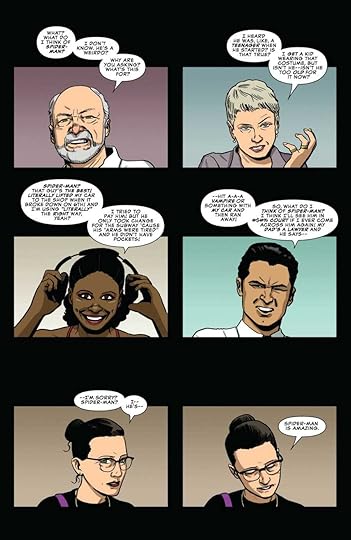
Having now read the entirety of this run, I’ve learned not to always expect the funny from Zdarsky, whose jokes doesn’t always land, but his use of silence to showcase characters’ emotions is what really shines, such as “My Dinner with Jonah”. Illustrating the final issue, which immediately proves to be one of the best people to draw the wall-crawler, Zdarksy is telling a story about the people of New York, telling their own diverse opinions towards Spider-Man. It is undoubtedly funny, but there is tragedy amidst the heroism, leading to one of the most heart-wrenching moments in recent comics history and reminds you that death has always been a defining theme for Spider-Man.
However, ending on a positive note, this issue really understands what makes Spider-Man special in how he could be anyone as he is the everyman hero who’s right down there with us, and the final page of Peter Parker giving his own opinion towards his alter-ego really put a smile on my face. A wonderful conclusion to a flawed but ultimately fun comic by the Sex Criminals artist.
Peter and all come to a reality where his self is not Spidey after giving up and Osborn rises to power and he has to team up with the Avengers of that time and save the world and maybe even inspire this self to take up being Spidey and its an amazing story and I loved the whole thing with Teresa and all. And finally coming back to the main reality where he takes on The Tinkerer one final time in the midst of Vedomi domination, its so cool and I love that moment in how he resolves the issues, the best representation of Spidey.
There is a story with Sand man and future self and all that and its ehh, not the best but what I love is how before he is dying, Spidey spends time with him showing who he really is and finally a story about different people telling their own stories of what Spidey means to them, and the story of Kyle was so good and probably my favorite and makes me fall in love with Pete all over again. It just hits all the right spots and shows who peter really is and a hero, selfless and courageous and helpful. The art was awesome.
This volume is a mix of stories and while some maybe misses, overall its good and makes you love Peter all over again.
3.5 stars+. It was good and heartfelt, but I walked into Zdarsky’s run expecting more of the hilarity and instead I got the drag-him-through-the-muck-of-his-shambles-of-a-life - which is *good* Spidey stories, but DAMN can we enjoy the dude for a while?
I guess what I need right now is a fix of Deadpool - life is too damned depressing in the dictatorship of the Great Orange Syphylitic.
I read this as single issues. This was probaly Chips best collection on spidey so far. Im still not a massive fan of his time travel story but this wasnt bad. It was to a point actually enjoyable.
Příběh s mimozemskou invazí je docela průměr, ale moc se mi líbí témata, s kterými Zdarsky pracuje. Starej dobrej Spidey je zpátky. --- Při druhém čtení snižuju na 3*, ale rozhodně jde o kvalitní pavoučí řadu.
Collects Peter Parker: The Spectacular Spider-Man (2017) issues #304-310
Chip Zdarksky's run of "Spectacular" has been a lot of fun to read, and this volume marks the end of that run (much too soon in my opinion). Volume 4 picks up right where Volume 3 left off. In the last volume, Spider-Man traveled into the past and messed up the timeline, and in this volume he travels back to the future, finding himself in an alternate version of the present-day. This new present-day reveals what the world would look like if Spider-Man had given up being a hero back in his teenage years.
There is also a 2-issue story featuring Sandman, followed by a fantastic story in Issue #310. That last issue in this collection is a heart-warming conclusion to Zdarksky's great run on this series.
3.5 Stars Continuing and finishing the story with Spidey against the Vedomi, we see Peter, Theresa, and Jameson return from the past/alternate reality with the answer needed. Having received a "capsule" from a Vedomi scout, Peter knows that he can use it to make the Vedomi leave. Throw in a final encounter with the Tinkerer (the guy who brought on the Vedomi invasion in the first place) and Peter saves the world, getting the Vedomi to leave. Despite their bonding, Theresa decides to turn herself in for her crimes, wanting to meet Aunt May with a clear conscience. I'll be glad to see when her story comes back into play. It will be nice to see Peter with new family. (Side question: When Peter's mind was opened wide by the effects of the capsule, did he see his forgotten past with MJ?)
Where this Volume really shines is in the later half of the Volume with a story about Sandman. Flint Marko is losing his mind and having trouble controlling his powers. Seeking out Spider-Man, Peter takes Sandman from the hospital to a beach where he grew up as a kid, allowing him to die, mixing with the sand of his happy childhood memories. But is he gone? NO. Marko now exists only has sand, his human form having died. There is a brief chaotic encounter where Sandman from the future comes back in time, trying to escape the destruction of the Earth, but that story gets resolved quickly with a plot element of Marko being able to pass control of his sand form..... Not sure if this will come into play again, but I really loved the tender moment of Spidey helping one of his villains pass away peacefully.
The last story in the Volume is very meta and deals with a film student making a documentary about Spider-Man and how great he is. Turns out that the student was helped by Spidey after a villain encounter ruined his clothes. Also features testimony from a mother who lost her son to tragedy, even after Spider-Man helped save him and additionally checked in on him and helped tutor him in math. A very somber but excellently written issue.
Overall, a pretty good Volume. The tender stories saved it for me, as the Vedomi stuff just needed to be over. Glad it is. Recommend.
This is another book that I know I read and wrote a review, but somehow it isn't in GR. I did a quick read through again.
The first four issues wrap up the previous story-lines with Peter returning from the past and dealing with the alien invaders. For the most part, it's a boilerplate story, but there's a moment at the end when Peter and Phineas share memories. In just one or two panels, it reminds the reader of what Peter carries with him everyday.
The next two are about the Sandman. Peter's actions, which are primarily to try and talk to Flint and help him are starkly contrasted with Jonah's who simply views him as a "villain". It's incredibly compassionate, and not something you would see very often in a standard superhero book, but I think it completely fits Peter's profile.
Lastly, a single issue recounts multiple everyday encounters with Spider-Man and the ways he helps and inspires people, one of which is terribly heart-breaking. Once again, it's another story that shows just how human Peter is. An exemplary story.
When "Peter Parker: the Spectacular Spider-Man" first came out it was amazing. In fact it's what brought me back to Marvel (After 40 years of reading Marvel and hating on all things DC I had reluctantly dumped Marvel and exclusively read DC and Image due to the unbelievably crappy writing that Marvel has had for years (including stupid plots like making Peter Parker a business mogul)).
But this sucked on so many levels. The art was terrible. The story was disjointed, rambling, uninteresting and at times confusing. The characters are starting to become like what made me dump Marvel in the first place.
If they continue books like these then I think my time "back at Marvel" will be short.
Zdarsky is leaving so I'll give the new writer a chance.
This book contained a 4 part conclusion to the main story from this run, a 2 part sandman story, and a finale issue. I loved the finale issue as I thought it was a great Peter and Spidey story and dives into why he’s so great. Felt it was a great send off for the series and could be read by anyone as it doesn’t require any prior reading. However I was not a big fan of the universe/time jumping going on in this book and the last. Art was pretty solid but it wasn’t strong enough to keep my interest with the plot. The sandman story was pretty middle of the road but did feature some unique art.
Main arc was more 3.5 out of five, but Zdarksy's PHENOMENAL issue 310 makes this a 5/5 easy. I had to go out and buy my own copy of the single issue, because it so perfectly encapsulated everything I loved about Spider-man as a kid. In that one issue, Zdarsky brings back the "Friendly Neighborhood" element of Spidey stories, and succinctly illustrates why Spidey matters to the common people.
The time travel/world hopping was a lot more heartbreaking than I expected for a series that started so light and fluffy, but it was beautifully done. The issues after the main arc were just as beautifully done and some of the most heartwarming, real, honest moments I've ever read in a Spider-Man comic.
In general, I love Chip Zdarsky's writing. Spider-Man Life Story is one of my favorite things ever. But overall, this wasn't the type of comic I typically go for. The highlights for me were the transformation of J. Jonah Jameson and the Sandman story to close out this volume.
First Arc--? 3 stars. Everything thereafter? 5 stars. So we'll call it even at four.
The first few issues of this volume finish up the story arc begun in volume three. In that volume Pete, Tessa, and Pete's new best pal J.J. Jameson go back in time to attempt to thwart the Thinker in the story-line that preceded volume three. Everybody following along there? They go to a slightly different reality so that they won't disrupt the future, do their thing together with beginner, teenage Pete-Spidey (still volume 3) and then return to the present--our MU's present supposedly. Of course they don't make it, and we get an alternate reality alternate future story line. Convoluted enough yet? Anyway, the resolution of that story was competently handled. I liked it. Three stars, but nothing, in itself, to write about.
The next two-issue short arc on w/Sandman however was fantastic. Its re-envisioning of the Sandman character was great, and it really showed, more than any comic I've read in a long, long time what makes Peter Parker unique in the MU. The character work here is deep and wonderful. I absolutely loved it, and it has come great comic book action moments in the second issue as Marko and Spidey deal with some of the fallout of the events leading to this re-envisioning of Sandman.
Finally, the last issue is clearly a goodbye by the creative team to the character and the book. I normally don't like these issues much. They feel contrived to me most of the time, but Zdarsky, channeling the same deep-character based storytelling that made the Sandman arc so wonderful captures everything fantastic about Spider-Man and all the difficulties that keep him from ever seeing anything but a supremely good man who is just like us, except for those superpower thingies. I know that sounds flippant, but I'm convinced the secret of Peter's success is that he never gets beyond life's problems. He never "makes it." This is not to say that he can't be successful--I totally bought Dan Slott's run with Peter as world famous Tech CEO, and it was great. But Pete never became billionaire playboy Peter Parker by day Spider-Man by night. He never stopped having to deal with work, and family, and superheroics, and, and, and...To my mind Peter Parker is the most human of superheroes, and his greatest power is the ability to stand up under all that responsibility he puts on himself and keep going. And this book absolutely captures that dynamic. Beautifully. As good a single-issue of Spider-Man as I've ever read.
After some timey wimey shenanigans - Peter, Jonah, and Teresa are back in the present - but things aren't back to normal...
Chip Zdarsky is such a good writer at writing very "human" emotions and moments. I think that's why his work resonates so well because underneath all the super heroing and time traveling and lasers and dinosaurs.... at the core of it there is the very real relationship between Peter and Jonah - and the budding sibling dynamic between Peter and Teresa - that grounds the plot very very well. I think without the interpersonal dynamics of the main characters, this book would spin out of control and collapse under the weight of its own narrative weight. But Zdarsky somehow manages to find a center in the middle of it all - and one that we can keep tapping into the keep us balanced. It's great to see Zdarsky take on one of Marvel's most iconic heroes and hold true to what makes Spidey, well... Spidey.
Special shout out for the Sandman story as to me, it was the highlight of the series maybe. Flint Marko coming to terms with everything he was and stood for while Peter was there to console him... was really high water mark for the series.
This was a wild book - but good nonetheless. It's no wonder Marvel went on to give Zdarsky the keys to some of their biggest books later down the road.
You get the high action and very, very, fun conclusion to the time travel/multiverse/alien invasion/Tinkerer story. And it feels very much like an even weirder version of the old Marvel Team Up series.
Then comes a good old fashion Spider-Man feueled morality story with The Sandman. These are the types of serious Spider-Man stories I really like. One where he isn't given a clear good vs. evil to fight or the right thing to do and the wrong thing. A story where there is what the law says is the right thing to do and what is actually the right thing to do. But anyone who knows Peter Parker knows which one he's going to choose.
And finally you get the type of story that so many modern comic creators try to do at the end of their run. An issue that sums up who they think the particular hero is. And Zdarksy hits all the right notes here. He gets Spidey exactly right.
If Zdarsky somehow sees this review, I hope he takes this the right way, but for me his run on Spectacular is up there with Peter David and J.M. DeMatteis. Not just in the sense of style but in how varied a story he can tell with the character. I wish he hadn't decided to leave the title after this.
I can't say that I enjoyed this whole arc as much as the first part of Zdarsky's run on Peter Parker. I'm not a fan of time travel/alternate timelines so the whole alternate future just didn't do a whole lot for me.
I continue to enjoy Zdarsky's writing of Spidey and I think it's a good take on the character. Unfortunately, I didn't enjoy the plot as much this time around. I do enjoy the JJJ redemption arc that's been featured throughout this arc, but I find myself having a hard time getting invested in the Peter/Theresa relationship.
The art from Kubert and Frigeri is solid. I think Zdarsky is one of the better voices at Marvel right now, so I'm inclined to view this as just a blip due to my general aversion to time travel and alternate realities. It's a solid Spider-Man story, otherwise.
3.5 stars. In the first part of this volume, Peter, Teresa and Jonah come back from the past only to find out everything is different since young Peter in the past overheard older Pete talk about the bad stuff with being Spider-Man. This made him stop being Spidey. So in this alternate time with no spider-man, Harry Osborne is president and Norman and the rest of the bad folk are running things. Without spoiling the story, they get that straightened out and get back to their actual timeline to finish of the threat of that alien invasion. The next part dealt with Sandman being taken over by a version of himself from the far future. This part I thought was just ok. Then the last issue. It was amazing! Wait, wrong book. It was Spectacular!! Awesome idea Zdarsky used to tell the story of what Spider-Man means to New York.
This run by Chip Zdarsky was mostly fun but a little silly. The time travel tinkerer story reminded me a lot of Back to the future I feel like it should’ve leaned into ripping it off a little more, i think I might’ve enjoyed it a little more.
This is something I’d read again though. I enjoyed it enough that it’s a spider man story worth reading. I just wish he didn’t do time travel at all, it’s kinda lazy. Chip had a really good starting to this and had a couple of complex narrative threads going but decided to deus ex machina them by time travel. Again, still saw some fun moments but eh.
The thing I really loved about this trade was the last issue. It was terrific, I love those little introspective issues where we analyse what we really love about a character/hero and loving them despite the faults they have. Really good stuff. I wish comics were more like that then the old romp.
Velké finále a s ním i moje velká spokojenost. Zakončení série dle mého dopadlo velmi dobře. Cesta zpátky z minulosti se neobejde bez problémů, které jsou pro Spider-mana prakticky na denním pořádku. K tomu všemu ho ještě čeká porazit Vědomí - svaz umělé inteligence odhodlaný vyhubit celé lidstvo. Za mě super a po minulém díle, který mě mírně zklamal, jsem opravdu spokojená. . Zmíním i dva sešity, které se nachází na konci 4. dílu. První s hodně temným zakončením se věnuje Sandmanovi, a druhý je o mladém filmaři, který o Spider-manovi natáčí dokument. Obojí jsem si užila a byla to příjemná tečka za koncem 4. dílu. . Za mě se Zdárskému série velmi povedla. Cestování časem, paralelní vesmír, skvělý vývoj postav a příběh, který vás zaručeně pobaví. Peter Parker Spectacular Spider-man je solidní komiks se skvělým příběhem a úžasnou kresbou, s jehož pořízením rozhodně nešlápnete vedle.
Me esperaba más de la etapa de Zdarsky. Estos cuatro primeros volúmenes se articulan alrededor de la aparición de Teresa Parker, presunta posible hermana de nuestro Peter. Hay viajes al pasado, poder y responsabilidad, encuentros con la galería de villanos y mucha presencia de Jameson. De hecho, el número de la entrevista de éste a Spiderman pasaría por ser lo mejor de estos números. El resto es una aventurilla alargada con el interés justo y cuya mayor gracia es rescatar al Chapucero, uno de los primerísimos villanos de Spidey. Me satura el punto elevadísimo de humor de los diálogos. Es uno de los rasgos clásicos del personaje, pero Zdarsky se pasa de la raya. El equipo artístico es de postín, con el combo Kubert + Bellaire para lo principal y Quiñones para la línea temporal alternativa. Por ello, deja la sensación de oportunidad perdida.