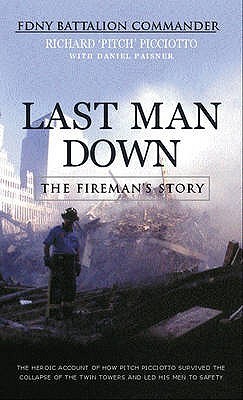
On September 11th, Battalion Commander Richard 'Pitch' Picciotto was the highest ranking fire department commander in the twin towers when the North Tower fell. Pitch and his men were on the 17th floor racing upward when the world seemed to explode around them. From his intimate knowledge of the Towers gained during service after the 1993 WTC bombing Pitch was able to lead the firefighters to an alternative stairwell to floor 12 where they were met with a horrifying sight - more than 50 workers too crippled, too old, or too weak to have made their way out on their own. Pitch ordered his firefighters to form a human chain and pushed and cajoled them down the stairs. They were in the 7th floor stairwell when the tower fell, and Pitch and a handful of survivors woke to find themselves buried on the landing of floor 2. This is the story of how Pitch Picciotto led his men and the survivors to safety.
As a career fire captain, I was really looking forward to this book. It did not take long for me to become dubious. I was turned off early on at the frequent references to his rank. Multiple times he bragged about his fitness, and how he was running past much younger firefighters on his way up the stairwell. He failed to mention that he was carrying (most likely) only a radio, while firefighters, lieutenants, and captains were carrying firefighting tools and rescue equipment.
This Chief's account of what happened seemed unbelievable. Not long after I read it, I heard several reports of outright lies, and embellishments. He even admitted in one interview that some of the accounts were written as he 'assumed' they had happened. Don't waste your money. There are plenty of good books about firefighters and 9/11 out there. This is not one of them.
“Last Man Down …” is one fireman’s (fire-fighter’s) terrifically American account of his working day on the 9th September 2001; the day that the World Trade Centre in New York was destroyed by terrorist attack. Anyone who missed the events taking place in New York on that day may find a reputable journalist’s report helpful; I suggest that at http://ajrarchive.org/Article.asp?id=...
Some of the phraseology in Picciotto and Paisner’s book baffleed me; for example “Maybe a doughnut fisted on the fly” (p.19). Visions of muscular doughnuts and chewy jam (jelly(US) came to mind. Also “I always made a point of taking their parking spaces, for chop-busting reasons” (p.22). “Chop-busting”? I still haven’t worked that one out. Unfortunately my UK Orion book edition missed an opportunity to provide helpful translations into British English. Two nations indeed divided by a common language.
Division of language aside, this book is an interesting read; describing events as it does from the inside, from the viewpoint of the Commander of Federal Department New York Battalion 11. Firefighters, or rather firemen, as we know them in Britain, here.
The narrative of this book does succeed in describing a reality that overcomes disbelief. Yet I was so positively discombobulated, that I literally did lose my bearings, both in time and in space: which in an oddly apposite manner could be interpreted as entirely fitting given the subject. This book is ‘high octane’ reading; and no, I’m not making a sick joke about aviation fuel here.
The buildings that I, and so many others had known, which so swiftly ceased as ordered substance in an ordered democratic society, now form part of world history. Picciotto and Paisner were faced with an acute difficulty in finding words appropriate to describe such gross and sudden change. Landmarks once familiar vanished. Time removed stability, sightlines and sense of place. Fear and confusion reigned.
Just how had such wickedness taken hold? How had this evil forced such appallingly unthinkable changes away from the daily working order of business, bagels and coffee; instead imposing a four dimensional maelstrom of fire, deformation and mass death? Survival overrides such thoughts; saving them for later. Right now flight is at the forefront of everybody’s mind. But how? And where is ‘safe’?
It is precisely that very narrative of time, fear, and loss of directional-sense that is so unnerving. How does any living human make sense of a reality of Hell? Yes, it would have been very helpful to have had a neat 3D schematic diagram of the plaza of the World Trade Centre’s seven buildings rather than the map given, a very rough, external 2D flat sketch map indicating three rescue routes. But on and below a ground bearing, yet like quicksand not bearing, such an unprecedented tearing upheaval of steel, concrete, glass and death; the original buildings’ plan had pretty much ceased to have any useful meaning attached to it. How to work together to survey and communicate the unapproachable and unexpected? What now? Where were, and at what angles, were floors, staircases, lifts, and the employees, dead or alive, mobile or injured, who had arrived at their conventional places of work that morning?, Who and what was realistically and ‘safely’ reachable? What was dangerous and unapproachable? How did it all relate? A constantly shifting mass of rubble, twisted steel, concrete, dust, debris, more dust, and death. Aviation fuel meant that fire and incineration was an ever present reality, barrier, and risk. Out of the frying pan and into the fire?
So very, very many did die, and died so very horribly. Picciotto angrily criticises those who jumped from the higher floors, who in seeking a quick death for themselves fell on and killed their escaping fellow humans on the ground. He accepts and finds an understanding but no pity for their selfishness. Alas, he has time, too much time, with his thoughts as he and others are immobilised; physically trapped alive, barely able to move, in a void, with little to do other than speculate on the present, whilst waiting for death … or rescue? His eyes, suffered from the ingress of ash and grit hurt terribly. Human nature, bloody determination, and brotherhood in terrible adversity takes over.
Later, and away from this book, Professor Edward Tufte aspired to a future of a stoic nation, http://www.edwardtufte.com/bboard/q-a.... The human spirit lives, reflects and learns.
So it is likewise with Commander Picciotto, who discovers that there’s nothing quite like surviving such a dramatic near brush with death, as to remind one of the preciousness of life. But whether or not he was ever able to return to work in his beloved NY Fire Service, we are not told.
Great story. But the narrative is so internal and so hagiographized, for lack of a better word, that it really took a ton of the book's power away. It felt like reading a smoothed-over politician's biography more than the harrowing account of a firefighter's survival inside the collapse of 1 WTC.
An interesting read however I found this a bit too self indulgent and struggled to find the author genuine or relatable. The constant reference to how strong, fit, capable or able he was seemed to diminish the role and efforts of the hundreds of other serving personnel who also contributed to the rescue efforts that day. Whilst I am aware he was seemingly the highest ranking officer there, he writes as though everyone else was milling around in blind panic whilst he was the only one issuing orders and guidance. I particularly objected to the reference to the officer who lost his dog- in the heat of the moment I can understand his frustration with someone seemingly being preoccupied with the safety of his dog whilst human life was at risk but to reflect on it, discover that the dog was actually the man's partner and a working dog and still poke fun at it in his memoirs I found particularly insensitive.
This entire review has been hidden because of spoilers.
This book is a good read, but not great. I think that Picciotto's egotism got in the way of what could have been a truly excellent book on the September 11th attacks. Having said that, I think that all the firefighters, police, EMS and rescue workers deserve credit, and I give him credit for being one of the Bravest. Unfortunately, he chose to boost himself with this book instead of the whole effort.
I saw Chief Picciotto speak at a national conference recently in California and it was a very moving presentation. He brought the audience to near tears and then brought us all into laughter. I found him to be humble, principled, and appropriately proud.
As I read his book I could hear him through the pages. And I laughed and (almost) cried all over again! He was a chief that cared about everyone. He may have come off brusque to some but, I think, that's a characteristic found in a lot of leaders and first responders. And, if you knew him, there was no doubt in your mind that he cared about you. That's exactly who I'd want in charge of rescuing me.
He explains that being a firefighter is like being in the military. My husband was in the military so I understand that mentality and I think his description is mostly accurate. He tells his story with important physical detail while explaining how he was feeling at every step. He wasn't always proud of what he was thinking but allowed himself to be human. He was always calculating what needed to be done, how it needed to be done, and why it needed to be done. Quitting wasn't an option to him. Injuries and all - he was going to save everyone that he could save.
It was a very exciting read and, sometimes, surprising. It was sad (but not too sad, as it was told) and proud. It was interesting and honest. I think it's a necessary read. Chief "Pitch" provides details of that horrible day that no one could know about unless you were there. I think it's important to know what the rescue teams faced that day and every time they save us from disaster.
A friend told me how good this book was. I'm about 30 pages from the end and have already lined my next book up.
The initial part of the book gives the typical 'lets rush in' american attitude. Picciotto should never have been there, he charged down and abandoned his own firehouse to help. Charged into the command centre and grabbed a group of firefighters, allocated himself a rescue. There ended up being no one to resuce so he abandoned the team he went up with and charged up further, found some more firefighters and then realised the other tower went down so they could be in danger, basically descended then clearing each floor and happened to find a group of stragglers / disabled, which he did have the fortune to help down.
Then the tower collapsed and he was trapped along with a civilian and some crew. Here is the interesting part where he describes his thoughts and views, then how he saw a light and climbed out, then he got all impatient again and risked his life to get out even though he could see a rescue team.
I found this guy to be generally a bit of an idiot with the charge in attitude, the self loving and the i saved the day attitude, but having said all that credit to those that do the job and save lives - i realise all he wanted to do was be there and help out but he ignored his command and abandoned his own firehouse, whcih would make me not trust him to watch my back - something he goes on about.
i would be interested to read another book on 9/11 from a more genuine character
I really enjoyed this book. I found the author to be a bit arrogant at times but it was interesting to get a point of view of what it was like for Firefighters on 9/11. After reading the book I read online a lot of the others mentioned in this book and trapped in the stairwell with Picciotto no longer speak to him because of liberties he took. Making up stuff and taking credit for actions taken by others - that kind of ruined the book for me. If it was all true it would be amazing.
Perhaps there was too much detail, or too much patting self on the back, but it took forever to finish this. That said, it did bring a better perspective and appreciation for those first responders who place their own lives behind those of others. I’m glad to have forged through to the ending as it never hurts to be reminded of the sacrifices others make on our behalf.
Massive respect to all the firefighters from this day, including this author, because I know they’re all heroes. Every single one of them. But this account of events was a bit stressful to read. I was looking to read about what happened inside the towers from a surviving firefighter’s pov, and while there was that, all the bragging was just a bit irritating.
Could not finish ... stopped on page 146. I was really looking forward to this book, but it included way too much self-praising for my taste (I’ve read quite a few 9/11 memoirs - this is the only one I’ve come across thus far that’s made me feel this way.)
Wow this guy really loves himself. I certainly appreciate the fact that he made it out, but does he sit on the right hand of God? Book overall was Ok a little difficult to read at times.
Last Man Down and first man published, firefighter Richard 'Pitch' Picciotto's 9/11 memoir climbed the bestseller charts on its release in 2002, but the comparative haste shows, years later. Pitch mentions on page 238 how he was already arranging for his writing collaborator, Daniel Paisner, to visit 'Ground Zero' in mid-October 2001, a few weeks after those infamous events, and this lack of pause is to the book's detriment now, more than twenty years later.
The haste in Last Man Down leads to a number of unedifying traits developing in Pitch's narrative. Other reviewers have remarked upon the author's self-centredness, and certainly there is a bit of disquiet in the reader's mind as we hear Pitch's version of events. There's a lot of 'I did this' rather than 'we did this', and a lot of brash energy that sees Pitch doing things on his own initiative, things that often seem to the reader to be uncoordinated or incomplete. Of course, the day itself was pure chaos, but Pitch's frenetic narrative doesn't do an especially good job of placing things into a needed context. He's certainly not an introspective fellow, and does not reflect deeply on the day or his actions. Instead, his memoir is a straightforward, action-packed narrative, as he shows up of his own accord at the World Trade Center, takes it upon himself to lead a band of firefighters (not his own men), helps evacuate parts of the North Tower and then survives the terrifying collapse of that building.
This should be enough; Pitch is one of the few firemen to survive the collapse and his account of it should be worth its weight in gold. But while the general depiction of events is useful and serviceable, not least that indescribable sensation of the 100-storey tower rumbling and booming in its collapse on top of him, it's too hasty, too unreflective, too unpolished to be a remarkable memoir in itself, even if it describes a remarkable day. And what is more serious is that a bit of online Googling will find you with plenty of people casting doubt on Pitch's version of events. And I don't mean 'Truthers' or any of that nonsense, but sober people referencing other survivors' accounts from 'The Miracle of Stairwell B', where Pitch ended up.
But even leaving aside this troubling accusation of embellishment or self-aggrandizement, the story is a bit all over the place. Anecdotes are dropped without being explored: for example, a 'Middle Eastern man' is handcuffed for acting suspiciously in the evacuation of the North Tower (pg. 85) but we never find out more about this. Pitch is trapped in the same stairwell as David Lim, a K-9 cop who asks his fellow survivors pleadingly about the police dog that accompanied him (pg. 149), but we are never told the fate of the dog. (Sadly, another Google search tells us that the dog, Sirius, did not survive.) Such things might seem insignificant, but there's a cumulative frustration in Pitch moving on with his story without pause and without filling in the details. Pitch's thoughts aren't fully organized, and the book suffers for it; had he waited a bit longer before writing the memoir, it might have been a smoother ride. Certainly, the man had a singular experience, one that (I hope) could never be experienced again, and to hear it, however it's told, is rewarding. But as Pitch himself says, "I'm a firefighter, not a writer" (pg. 244), and too often in Last Man Down the gulf between the two shows. Thankfully, when he was needed to be a firefighter, he was – and came through the fire.
I read this book over three days, starting on Sept. 10 and finishing on Sept. 12. Somehow it seemed entirely appropriate to immerse myself in this story of survival on the 18th anniversary of the events described in this book.
I grew up around volunteer firefighters and spent my early adulthood as a member of the emergency services. While I was never much of a firefighter (my interests focused more on the emergency medical services), I worked side-by-side with firefighters and considered them part of my larger emergency services family. But I had left that world before 2001, and didn't have any direct role to play that day, so I could only watch in horror as the images flashed across my television screen. Even before anyone said anything, I *knew* deep in my core that firefighters had died that day.
But not Chief Picciotto. And his survival is nothing short of an absolute miracle. The title of his account of that day is literally true. He was the last man to come down the tower and survive. By his account he was still between the 6th and 7th floors of the second tower when it collapsed, trapping him in the rubble. His account of how he escaped from the debris, and of the events that led him to be there, is powerful and gripping. He is a true hero, who saved many, many lives that day, including his own. His story is both remarkable, because it is so far outside anyone's normal experiences, and, at the same time, entirely unremarkable, because his actions and responses are so totally in keeping with the nature of firefighters everywhere.
In spite of the horrific nature of the tragedy of that day, this book was not, in any way, a depressing read. Instead, it was inspiring. It is a story of triumph over the most extreme adversity, and is a powerful testament to the will and character of this man.
I bought this book driven by the excessive euphoria that the 9/11 museum and the zero zone impart when you walk this sensitive must-visit spot if NYC. Besides, it is very well promoted in their souvenir stores and spread in many convenience stores around the city.
It is another book of many others that gives you a perspective of a survival of this historical and decisive fact, an institutional official point of view, the fire department´s one. As I have confirmed, these fellows are consider heroes in United States not only because of their life risking careers but also for their commitment with society ensuring welfare. I admire their job and I consider they would always do it as promised.
This book describes an extensive (too much) heroism in a critical job assignment, that is loaded with martian warrior, full of selfishness, intuition, corporal and verbal aggressiveness. Too much narrative, no-analysis, just a chief describing his regular functions in a very busy day.
The book was very disappointing. His job is remarkable though, the expected for a FDNY deputy chief.
This is not the first time I’ve read this, but it is the first time since high school. In school, I was enamored by the first department - my father and two uncles were (are) firefighters and I thought this was the coolest thing ever. Chief Pitch seemed like the definition of a hero. This book in part is what gave me the final push to join a firefighter as a junior member while I was in high school.
As an adult, 12 years since I first read this, I have mixed feelings. The reader in me says, this is kind of written terribly. The adult in me feels that some of his “heroism” and “mystic” was a vainglorious way of garnering fandom - “I’m a chief”, “I’m in incredible shape” and “I’ve been doing this forever”. All of these statements may be true. But do you say them 1937 times in the book? The firefighter in me is torn how to feel.
First, it needs to be acknowledged - 12 years of rural/suburban firefighting is STARKLY different than working for the FDNY for 28 years. But, as a firefighter some of the book felt over simplified in explaining things we regularly do. I’ve also read reports in training that this account may not be 100% historically accurate. On the other hand, I’ve also learned everyone is a Monday morning quarterback and will judge an incident in hindsight. No one but who went through an incident ever fully knows or grasps what happened or why.
I think I understand the differences in how I feel about this book. As an adult, I was a firefighter thinking I was reading a book about firefighting by a firefighter for other firefighters. What I think this book really is, is a memoir about a firefighter, by a firefighter for non-firefighters and history buffs. And I think that explains the wonderment I had in high school reading this compared to now.
This is a difficult book to rate as I feel there is credit to be given for the experience and survival of the chief. I have read a lot about those guys in stairwell B so I was really looking forward to this book. But my goodness the problems with this book extend past the horrifying writing, which i chose to read as his New York accent and speech not horrific grammar. I am glad he survived for sure but to hear him tell it, it’s almost as if he was the only responder who knew what they were doing. I don’t know but his ego really is large and I wondered how there was room for his wife in their house with that ego taking up so much space.
Also, what kinda grated on me was the way he charged off on his own so many times. Everything else I ever read expresses how FDNY was a team sport, not ego driven like this guy. Maybe he’s a nice guy and I got it wrong but that’s how it came across in the pages. Also, I’ve come to worship Jay Jonas and he has a little more credibility in his telling of the story in my opinion.
I thought it was in poor taste to make fun of officer David Lim worrying about his “dog” who was in fact a police K9 officer, officer Lim’s partner, killed in the collapse. Really, what purpose did that serve? Anyway my impression of this guy is that he is a big talker and most likely a bully but the story is a good one, just not this telling of it.
Volevo leggere questo libro da anni e dunque, a conti fatti, la delusione è stata parecchia :( Sebbene ci siano state un paio di scene che mi hanno fatto sentire fisicamente male (come era d'altronde prevedibile): la gente che, disperata, si butta dagli ultimi piani delle torri in fiamme e una stanza, verso l'undicesimo piano, piena di persone sulla sedia a rotelle, con problemi di deambulazione o semplicemente troppo anziane per arrivare fino al piano terra, in compagnia di persone coraggiose e altruiste che pur non conoscendole, le avevano aiutate fino a lì ed erano restie ad abbandonarle; ecco, nonostante questo, la narrazione non è riuscita a trasmettermi molto ed è stata assai pregiudicata dal narratore: è un eroe, io lo so.. Ma l'ho preso troppo in antipatia perché in lui non ho trovato un briciolo di umiltà ma tanta autocelebrazione (che sì, ci sta.. Ma forse andava espressa un po' meglio!). Il libro poi dal punto di vista stilistico - e qui la colpa non è del povero pompiere che si è invece affidato a Daniel Painser, un esperto di biografie a quanto pare, ma che secondo me avrebbe fatto meglio a lavorare nelle miniere della Patagonia - è un disastro completo.. Peccato :(
I read this sometime in 2006, but I can't really remember which month.
"Last Man Down" is the amazing story of Richard Picciotto, a NYC fireman who was at the scene of the 2001 World Trade Center attacks. Richard tells, in vivid detail, what it was like to experience that day. He describes his role as a fireman during the rescue efforts and tells just how crazy and chaotic the scene really was.
Surprisingly, the book isn't too emotional, except in the ending chapters. Picciotto tells the story like a guy who had a job to do - and on 9/11, that's what he was. And let me tell you, he did a great job.
Favorite part: The whole thing. It's all fascinating.
Wow. I believe the author wrote this book too soon after the tragedy. His whole attitude and the way he retells the tragic events of 9/11 are all about how he "took control of the entire situation" and repeatedly had to remind the reader of his rank. I also didn't enjoy how on a few occasions he wrote how encountered multiple firefighters he considered to be dumbasses. He could of left those parts out, but it seemed to fit his narrative of being super chief. I respect the author for his service, and what happened to him on that day, but honestly, skip this book. It gives little in terms of lessons.
Questa preziosa testimonianza, è stata trovata due anni fa in un mercatino da mia sorella, che ha pensato a me, non avrei immaginato che la storia qui raccontata fosse incredibilmente, diretta, cruda, vera, sembra di sentire l'odore del fumo, il calore del fuoco, l'urlo straziato delle sirene, il boato del crollo delle torri (sentito dalla tromba di una scala come successo al pompiere cinquantenne, Richard Picciotto...non oso immaginare la sensazione), quel triste giorno, morirono 343 pompieri, lui si salvò miracolosamente e riuscì a portare in salvo un piccolo gruppo di superstiti, all'interno della scala B della torre nord...o almeno cosa ne rimaneva.
This was another book I picked up at the station where I work. Read it in two days! Not a bad read at all. Richard Picciotto an FDNY Battalion Commander was in the World trade center on September 11th 2001 with a group of firefighters and one civilian when it collapsed sending him and the others into a fight for survival. This story gives me chills knowing what those firefighters were up against that dreadful day. And a whole new level of respect for the courage and sacrifices made that day. A true testament to the human spirit!
A fascinating insight into 9-11 from the eyes of a NYC firefighter. His inside info & harsh criticisms brought a realistic view of the heroics. He had a remarkable personal experience of miraculous survival, told brashly & with the toughness of a New Yorker. Some language was too vulgar for my tastes, dozen or so F bombs & smattering of others. But I still think it was worth the read & the language was probably tame for a NYC firefighter.
I really found a sense of closure in reading this book. I really hadn't understood all that happened after the collapse of the towers on Sept 11. I enjoyed seeing Ground Zero, and this story helped fill in the details. I didn't appreciate his vocabulary however. I think he could have cleaned it up a bit. I'm sure he wanted it to sound real, but I felt that he could have sounded more professional if he had left that out.