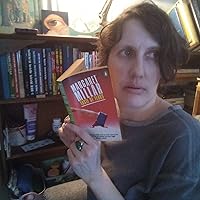
Fletcher Flora was born in Parsons, Kansas in 1914. Flora began writing soon after returning from World War II. His crime and mystery short stories and novels were published in magazines like Ellery Queen’s Mystery Magazine, Mr., Cosmopolitan, and in Alfred Hitchcock’s mystery anthologies. He received the Cock Robin Mystery Award for his first hard cover novel, Killing Cousins in 1960. Flora wrote over 150 short stories and 13 novels during his writing career. Three of his works are published under the house name, Ellery Queen. Timothy Harrison was also a pseudonym for his work, Hot Summer.
The title does not fit the book at all. There are three female characters in it, and none of them is so naughty that she should be left to Hell. That said, it is an okay book with a satisfying mystery. Weirdly light, perhaps, but well written. It felt like Fletcher Flora was a good writer going through the motions of writing a detective novel (to get paid).
Fletcher Flora was yet another pulp writer of the fifties. "Leave Her to Hell" appears to be a title bequeathed by a publisher. It's a rather odd private eye story that involves a fascination with the wealthy class, piano-playing virtuosity, a hoodlum running a club, and various soap operas about these upper classes. It feels like a slow jazz.
I enjoyed this one, but I certainly see how some could find the pace a bit languid. In some ways, it's not as sharp or as focused a story as it could be. It has all the classic hardboiled elements and a strange mystery. It however lacks a certain compellingness, has a certain awkwardness between characters, and ties up a bit too neatly in the end. It would in any event have made an interesting series.
My copy says Fletcher Flora wrote this in 1958, a year before Raymond Chandler died. It has a Chandleresque type plot with a traditional, hard-bitten detective at its center. The detective is hired by a beautiful woman to find out why a couple disappeared, moves among high and low, stumbles on bodies and double identities, faces death, and eventually finds out what happened. I liked it but if you haven't read Chandler yet, I would go with the original.
Disappointed to say that the title is the most interesting thing about this book. The first two thirds is mostly weak dialog trying to be witty and hard-boiled and failing at both. The last third has some action but is mostly exposition describing the solution to the mystery.
Good, suspenseful story with amusing dialogue from Fletcher Flora. Here's a sample:
"You have nice knees," I said. "Do you like them?" She bent over from the hips to examine them for a moment. "One of them has a dimple when I'm standing." "Only one? That's tough." "Oh, I don't know. I think it makes them rather intriguing for one to have a dimple and the other not." "You're probably right. The next time you're standing, remind me to look and see."