

What do you think?

Íslandsklukkan #1-3
Islands Klokke
Det er uår på Island i året 1700. Folket er fattig og utarmet, og landet er i hendene på et dansk handelskompani med enerett på fisket. Politisk og rettsmessig har islendingene ingen å stille krav til – de har ingen talsmenn. Selv den siste kirkeklokken på Island blir tatt fra dem – Islands klokke.
En høyættet kvinne, Snøfrid Islandssol, en kvinne av samme støpning som kvinnene i de gamle slektssagaene, står sentralt i ISLANDS KLOKKE. Som ganske ung møter hun den lærde boksamler og kongelige rådgiver Arnas Arnæus, et møte som blir avgjørende i Snøfrids liv – og ikke minst for Islands utvikling. Arnas og Snøfrid er sterke mennesker, og når de en sjelden gang treffer hverandre oppildnes begge til dåd som får betydning utover deres eget forhold: i Københavns slottsliv og islandske tingvollsmøter, i svenske og danske grensekriger, hos fattigfolk fra heiene og hos stattholderen Gyldenløve. Og gjennom alle prøvelser understøttes islendingenes stolthet og nasjonale selvbevissthet av kulturarven fra forfedrene, og av Snøfrid og Arnas som synes å gjenskape noe av Islands forgagne storhet.
En høyættet kvinne, Snøfrid Islandssol, en kvinne av samme støpning som kvinnene i de gamle slektssagaene, står sentralt i ISLANDS KLOKKE. Som ganske ung møter hun den lærde boksamler og kongelige rådgiver Arnas Arnæus, et møte som blir avgjørende i Snøfrids liv – og ikke minst for Islands utvikling. Arnas og Snøfrid er sterke mennesker, og når de en sjelden gang treffer hverandre oppildnes begge til dåd som får betydning utover deres eget forhold: i Københavns slottsliv og islandske tingvollsmøter, i svenske og danske grensekriger, hos fattigfolk fra heiene og hos stattholderen Gyldenløve. Og gjennom alle prøvelser understøttes islendingenes stolthet og nasjonale selvbevissthet av kulturarven fra forfedrene, og av Snøfrid og Arnas som synes å gjenskape noe av Islands forgagne storhet.
349 pages, Hardcover
First published January 1, 1943
About the author
Halldór Laxness
164 books875 followersBorn Halldór Guðjónsson, he adopted the surname Laxness in honour of Laxnes in Mosfellssveit where he grew up, his family having moved from Reyjavík in 1905. He published his first novel at the age of only 17, the beginning of a long literary career of more than 60 books, including novels, short stories, poetry, and plays. Confirmed a Catholic in 1923, he later moved away from religion and for a long time was sympathetic to Communist politics, which is evident in his novels World Light and Independent People. In 1955 he was awarded the Nobel Prize for Literature.
Ratings & Reviews
Friends & Following
Create a free account to discover what your friends think of this book!
Community Reviews
Displaying 1 - 30 of 236 reviews

September 6, 2016
It all starts with a church bell and a fishing line.
The first is legally removed by the Danish king and the second is borrowed by Jón Hreggvidsson, illiterate rogue and farmer.
Or are they?
Truth is both objects are robbed, just like the dignity of Icelanders when the church bell presiding the Alpingi, or national assembly where courts and government took place in Medieval Iceland, is usurped to finance the war between Denmark and Sweden.
Is this then an exalted apology to the national spirit of Icelanders after centuries of colonial exploitation under the Danish ruling? Far from it.
Following the epic tradition of the sagas, Laxness constructs a tale using three narrative voices, the ostensible criminal Jón Hreggividsson, the fair lady Snaefridur, the magistrate’s daughter, and the scholar Arnos Arnaus (based on the historical figure Árni Magnússon), and goes back to the eighteenth century to retell the stories that shaped the identity of Icelandic people.
Drunkards, wretched aristocrats and boorish crooks populate Laxness’ world and provide countless absurd situations that put Laxness’ characters in bizarre predicaments that are presented in a humorous, almost cartoonish light. Contrarily to the detached style of his prose, the themes treated in the book are anything but superficial: questions about the existing institutions, the fairness of law, trials and legal procedures, so subject to politics and superstitious tradition, the role of the state in the development of a country, the importance of folklore in the making of a national ethos or the concept of freedom are brought up in a surreptitious manner, evoking the eighteenth century French satirists and philosophers.
There is neither a whiff of glorification of the past nor of Icelanders of yore in Laxness’ terse prose, but he takes good care of his protagonists, in spite of showing the vices and weaknesses that make them look contemptible most of the time. Nevertheless, he doesn’t judge or punish them but rather depicts their actions through the prism of gallows humor, making light of serious matters without shying away from the absurd tragedies that befall on them.
My only reservation about the book, which is the reason why I couldn’t rate it any higher, is the lack of psychological nuance of the characters. They remain opaque, unreachable and distant from the reader, and unlike the other books I have read by the Icelandic laureate, there is no magical revelation or climatic ending that makes up for the bleak realism in which he drowns the reader’s hopes.
Even though the story starts out like a fable, I turned the last pages with the sad realization that this time around only dry wit would serve to fight against the inclemencies of life and love, and that high ideals are not always the appropriate weapons to win the pointless battles fuelled by pettiness and the self-deluded ambitions of the few who rule the destinies of many.
The first is legally removed by the Danish king and the second is borrowed by Jón Hreggvidsson, illiterate rogue and farmer.
Or are they?
Truth is both objects are robbed, just like the dignity of Icelanders when the church bell presiding the Alpingi, or national assembly where courts and government took place in Medieval Iceland, is usurped to finance the war between Denmark and Sweden.
Is this then an exalted apology to the national spirit of Icelanders after centuries of colonial exploitation under the Danish ruling? Far from it.
Following the epic tradition of the sagas, Laxness constructs a tale using three narrative voices, the ostensible criminal Jón Hreggividsson, the fair lady Snaefridur, the magistrate’s daughter, and the scholar Arnos Arnaus (based on the historical figure Árni Magnússon), and goes back to the eighteenth century to retell the stories that shaped the identity of Icelandic people.
Drunkards, wretched aristocrats and boorish crooks populate Laxness’ world and provide countless absurd situations that put Laxness’ characters in bizarre predicaments that are presented in a humorous, almost cartoonish light. Contrarily to the detached style of his prose, the themes treated in the book are anything but superficial: questions about the existing institutions, the fairness of law, trials and legal procedures, so subject to politics and superstitious tradition, the role of the state in the development of a country, the importance of folklore in the making of a national ethos or the concept of freedom are brought up in a surreptitious manner, evoking the eighteenth century French satirists and philosophers.
There is neither a whiff of glorification of the past nor of Icelanders of yore in Laxness’ terse prose, but he takes good care of his protagonists, in spite of showing the vices and weaknesses that make them look contemptible most of the time. Nevertheless, he doesn’t judge or punish them but rather depicts their actions through the prism of gallows humor, making light of serious matters without shying away from the absurd tragedies that befall on them.
My only reservation about the book, which is the reason why I couldn’t rate it any higher, is the lack of psychological nuance of the characters. They remain opaque, unreachable and distant from the reader, and unlike the other books I have read by the Icelandic laureate, there is no magical revelation or climatic ending that makes up for the bleak realism in which he drowns the reader’s hopes.
Even though the story starts out like a fable, I turned the last pages with the sad realization that this time around only dry wit would serve to fight against the inclemencies of life and love, and that high ideals are not always the appropriate weapons to win the pointless battles fuelled by pettiness and the self-deluded ambitions of the few who rule the destinies of many.

Read
December 8, 2021Iceland's Bell is a bargain of a book, as it is three novels in one; indeed the three parts of the novels were originally published separately in consecutive years. It would be a great first Laxness novel to read, but if you have already read some Laxness then I think it is fairly standard fayre. I felt it was the coda to his earlier writing before his style developed into mid period books like The Power Station and Paradise Reclaimed . The humour is not as black as in that "sheep saga" (as a word-wise woman described it), Independent People, but it is in some ways an elaboration of that book's themes, although here there is not even the possibility of self deception; the dependence is all to visible. A common refrain in the first, the picaresque section of the novel, is the lack of 'cord' to use as fishing lines. It is literally as if the Danish company managing trade with Iceland at that period (the late eighteenth century) had heard of the phrase that if you give a man a fish he'll eat for a day but if you teach a man to fish he'll feed himself for life (or as the joke has it sit in a boat and drink beer for life) and applied it in reverse to maxmise the money that they can squeeze out of the concession that they themselves have to buy from the King of Denmark. By not providing string or twine or as the translation as it 'cord' few Icelanders can fish so they need to buy their cod or pollock or haddock or herring from the Danes. The pig has been brought to Iceland but it is regarded with suspicion and hostility by the island born population.
The first section is expansive , the picaresque adventures of Jon Hreggvidsson who is beaten, accused of murder, and journeys through Holland, Germany and Denmark.
The second concentrated on the fate of the beautiful noblewoman Snaefridur and her marriage to possibly the most dissolute and hopeless drunk on the whole island of Iceland.
While the third chiefly deals with Arnas Arnaeus, manuscript collector, would be reformer, beloved of Snaefridur and occasional employer of Jon Hreggvidsson.
However all of these three main characters are present through the whole novel just in varying concentrations. All were, or are based upon, actual people.
In part this is a colonial parable, Denmark has at the time of the story, absolute ownership over Iceland to the extent that the king of Denmark is able to consider selling the entire island to foreign businessmen, which asserts the fundamental independence of the island from any and all external lordship and that more over Iceland's wealth is not in its moveable goods but in it's cultural capital. A treasury of creativity in part recorded in manuscripts (hence the importance of Arnas Arnaeus' collecting ) but in part this is about Laxness himself and other Icelanders - Iceland isn't for the icelanders, Iceland is the Icelanders. The author's ability to write, reflect, even with whimsy and humour is independence, is the impossibility of being owned and contained only within someone else's narrative. And Laxness's own book will become part of Iceland's literary heritage even as the manuscript fragments that Arnas Arnaeus searches for even in the bottom of old Ladies' beds are. Inevitably as so many of Laness's books do, it juxtaposes wealth and poverty, and how that is interlinked with incomprehension and the evasion of communication.
Anyway, a feast of a book, reading it was immersion in a horde of treasure.
The first section is expansive , the picaresque adventures of Jon Hreggvidsson who is beaten, accused of murder, and journeys through Holland, Germany and Denmark.
The second concentrated on the fate of the beautiful noblewoman Snaefridur and her marriage to possibly the most dissolute and hopeless drunk on the whole island of Iceland.
While the third chiefly deals with Arnas Arnaeus, manuscript collector, would be reformer, beloved of Snaefridur and occasional employer of Jon Hreggvidsson.
However all of these three main characters are present through the whole novel just in varying concentrations. All were, or are based upon, actual people.
In part this is a colonial parable, Denmark has at the time of the story, absolute ownership over Iceland to the extent that the king of Denmark is able to consider selling the entire island to foreign businessmen, which asserts the fundamental independence of the island from any and all external lordship and that more over Iceland's wealth is not in its moveable goods but in it's cultural capital. A treasury of creativity in part recorded in manuscripts (hence the importance of Arnas Arnaeus' collecting ) but in part this is about Laxness himself and other Icelanders - Iceland isn't for the icelanders, Iceland is the Icelanders. The author's ability to write, reflect, even with whimsy and humour is independence, is the impossibility of being owned and contained only within someone else's narrative. And Laxness's own book will become part of Iceland's literary heritage even as the manuscript fragments that Arnas Arnaeus searches for even in the bottom of old Ladies' beds are. Inevitably as so many of Laness's books do, it juxtaposes wealth and poverty, and how that is interlinked with incomprehension and the evasion of communication.
Anyway, a feast of a book, reading it was immersion in a horde of treasure.

October 25, 2010
I was recently in Iceland for a couple of days. A tour guide happened to be very literary and he strongly recommended the books by Nobel Prize winner, Halldor Laxness. He even pulled the van into a tourist stop with a tiny book shop way out in Iceland's amazingly beautiful wilderness, so that I could get a book to begin reading immediately. I am so glad he did. This was truly a brilliant novel, and a fascinating glimpse into Iceland's history---a history that I personally was completely uneducated in. The characters were so real to me---Snaefridur, or "Iceland's sun", a beautiful, strong young noble woman who was both constrained by her society and had the gumption to make her own way against proscriptions, has been added to my list of most interesting female characters in books.
I heartily recommend this book. I might go so far as to give it a four and a half stars. The prose was good enough that I read many passages aloud to my husband just for the enjoyment of the writing. The writer definitely knows how to write, and though much of the story is about people enduring often appalling situations and conditions, there is so much humor in the writing that I frequently laughed out loud.
I heartily recommend this book. I might go so far as to give it a four and a half stars. The prose was good enough that I read many passages aloud to my husband just for the enjoyment of the writing. The writer definitely knows how to write, and though much of the story is about people enduring often appalling situations and conditions, there is so much humor in the writing that I frequently laughed out loud.

March 7, 2013

Þingvellir church and Manor House - Þingvellir National Park
O escritor islandês Halldór Laxnees (1902-1998), Prémio Nobel da Literatura em 1955, publicou “O Sino da Islândia” em 1943.
No século XVII a Dinamarca exerce sobre a Islândia uma força repressiva e dominadora, oprimindo um povo e, consequentemente, uma população que vive na pobreza e na miséria extrema, que luta desesperadamente pela sobrevivência física e emocional.
As três personagens principais: Jón Hreggvidsson - um agricultor “ingénuo”, facilmente irritável, mas insubmisso perante os homens e a autoridade por eles exercida, é acusado de ter assassinado o carrasco do Rei da Dinamarca, que foi enviado para a Islândia, com a tarefa de confiscar o símbolo da sua independência, o sino de Þingvellir (Thingvellir ou Pingvellir), sendo sentenciado à morte. Jón empreende uma fuga pelas agrestes e belas paisagens islandesas, submetendo-se às agruras de um clima instável e imprevisível, numa tentativa de “limpar” o seu nome e a sua honra; Snaefridur Eydalin – a mulher mais bela da Islândia, que se casa inexplicavelmente com um bêbado, filha do magistrado que condenou à morte o Jón Hreggvidsson, acaba por salvá-lo, reencontrando-o passados dezasseis anos; e Arnas Arnaeus – o islandês aristocrata e coleccionador de livros e de manuscritos, ao serviço do rei dinamarquês, obcecado pela reconstituição história e pela preservação dos seus tesouros islandeses, um idealista com um comportamento dúbio, em busca de uma relação cada vez mais íntima com Snaefridur.
A mestria de Halldór Laxnees reside na conjugação das três partes - "O Sino da Islândia", "A Donzela Loira" e "Incêndio em Copenhaga" - escritas originalmente e agrupadas neste romance, numa narrativa esplendorosa e desconcertante, que se aglutina nos capítulos finais, num contraste perfeito entre o conflito e a tenacidade das personagens - inspiradas em figuras históricas.
"Sino da Islândia" possui uma beleza imaculada – ao mesmo nível de “Gente Independente” – brilhante e inesquecível.
As notas do tradutor João Reis são perfeitas para facilitar a compreensão da componente histórica do enredo e dos intervenientes islandeses e dinamarqueses.

Þingvellir church, early 19th century
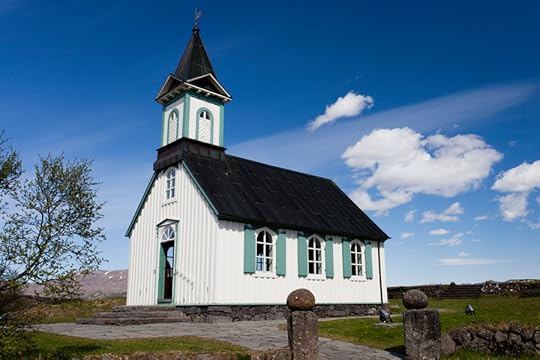
Þingvellir church, 21th century

April 7, 2013
There are several Icelands in history. Best known is the Iceland of the Vikings, roughly from the time of settlement in the 9th century to the transfer of the country to the Norwegian King Haakon in the 13th century. Then we skip the better part of a millennium to come to the hip modern Iceland, land of the runtur and of bankruptcy.
In between those two extremes was the Iceland of poverty and servitude. The Danes took over Iceland from the Norwegians and installed their merchants, gifting them with monopolies that made the merchants wealthy, but impoverished the natives. Halldór Laxness, the country's only winner of the Nobel Prize for Literature (in 1955), wrote Iceland's Bell to remind his countrymen of the utter waste and fecklessness of the Danish rule. (This theme is similar to the same author's World Light, which is set in a later period.)
Iceland's Bell is set early in the 18th century and is presented in three acts, each with a different hero. We begin with Jon Hreggvidsson of Skagi, who is arrested for stealing a length of cord. (Apparently, the Danes, not needing fish themselves, deliberately made it harder for the Icelanders to feed themselves with the piscine riches of their island.) Things go from bad to worse for Jon, who is then arrested for murdering the hangman who whipped him for his crime. But he is let loose on the night before his hanging by ...
Snaefridur Bjornsdottir, daughter of the magistrate who sentences Hreggvidsson, is a young beauty whose hand in marriage is sought by Icelanders of the best families. Unfortunately, the fair maiden weds a drunk, though really she loves the Icelander Arnas Arnaeus, a thinly disguised portrait of Arni Magnusson, famous for collecting texts of the old Icelandic sagas and advising the Danish king how to control his subjects.
Arnaeus is a patriot of sorts, but an unfaithful suitor to Saefridur. His belief is that the texts which he has collected, and which are almost burned in a massive fire in Copenhagen, are the source of his people's pride and fame. It is Arnaeus who says, "A fat servant is not much of a man. A beaten servant is a great man, because in his breast freedom has its home." On another occasion, he says, "I regret nothing that has happened, neither in words nor thoughts. It may be that thye most victorious race is the one that is exterminated."
And under Danish rule, Iceland did come close on several occasions to being utterly annihilated, from plague and smallpox; from the volcanic eruption at Lakagigur in the 1780s that led to an even more vicious plague; and starvation.
Laxness is not only a great Icelandic and Scandinavian author: He is perhaps one of the very best novelists of the Twentieth Century -- period! His love for Iceland and its sad plight shows itself frequently throughout the book:
In between those two extremes was the Iceland of poverty and servitude. The Danes took over Iceland from the Norwegians and installed their merchants, gifting them with monopolies that made the merchants wealthy, but impoverished the natives. Halldór Laxness, the country's only winner of the Nobel Prize for Literature (in 1955), wrote Iceland's Bell to remind his countrymen of the utter waste and fecklessness of the Danish rule. (This theme is similar to the same author's World Light, which is set in a later period.)
Iceland's Bell is set early in the 18th century and is presented in three acts, each with a different hero. We begin with Jon Hreggvidsson of Skagi, who is arrested for stealing a length of cord. (Apparently, the Danes, not needing fish themselves, deliberately made it harder for the Icelanders to feed themselves with the piscine riches of their island.) Things go from bad to worse for Jon, who is then arrested for murdering the hangman who whipped him for his crime. But he is let loose on the night before his hanging by ...
Snaefridur Bjornsdottir, daughter of the magistrate who sentences Hreggvidsson, is a young beauty whose hand in marriage is sought by Icelanders of the best families. Unfortunately, the fair maiden weds a drunk, though really she loves the Icelander Arnas Arnaeus, a thinly disguised portrait of Arni Magnusson, famous for collecting texts of the old Icelandic sagas and advising the Danish king how to control his subjects.
Arnaeus is a patriot of sorts, but an unfaithful suitor to Saefridur. His belief is that the texts which he has collected, and which are almost burned in a massive fire in Copenhagen, are the source of his people's pride and fame. It is Arnaeus who says, "A fat servant is not much of a man. A beaten servant is a great man, because in his breast freedom has its home." On another occasion, he says, "I regret nothing that has happened, neither in words nor thoughts. It may be that thye most victorious race is the one that is exterminated."
And under Danish rule, Iceland did come close on several occasions to being utterly annihilated, from plague and smallpox; from the volcanic eruption at Lakagigur in the 1780s that led to an even more vicious plague; and starvation.
Laxness is not only a great Icelandic and Scandinavian author: He is perhaps one of the very best novelists of the Twentieth Century -- period! His love for Iceland and its sad plight shows itself frequently throughout the book:
Over verdant lowlands cut by the deep streamwaters of the south hangs a peculiar gloom. Every eye is stifled by clouds that block the sight of the sun, every voice is muffled like the chirps of fleeing birds, every quasi-movement sluggish. Children must not laugh, no attention must be drawn to the fact that a man exists, one must not provoke the powers with frivolity -- do nothing but prowl along, furtively, lowly. Maybe the Godhead had not yet struck its final blow, an unexpiated sin might still fester somewhere, perhaps there still lurked worms that needed to be crushed.I have now read all but three novels by Laxness that have been translated into English. I intend to read them all, and to hope against hope that the novelist's other work finds a translator.

November 16, 2022
This is probably Laxness’s most important and memorable book. It is set in the 18th century, mostly in Iceland and partly in Denmark (Iceland was under Danish rule at the time). There are three separate storylines, the farmer Jón Hreggviðsson who gets into trouble with the law, the tragic love life of the beautiful lady Snæfríður Íslandssól, and the manuscript-collector Arnas Arnaeus, who loves Snæfríður. Epic and often tragic, the narrative gives a unique insight into the harshness of life in Iceland at the time. I have read both German and English translations from the Icelandic original, they were both terrific.

January 21, 2016
O Sino da Islândia é uma narrativa épica, cuja acção se situa durante os últimos anos do século XVII e os primeiros do século XVIII, numa Islândia sob domínio dinamarquês e parte na própria Dinamarca. Ao contrário do que o título faria supor não estamos perante a história de um sino, mas perante uma saga sobre o que esse sino simboliza - a independência, a tenacidade, a vontade indómita de um povo.
Ao longo da narrativa acompanhamos três personagens principais que dão corpo a esse simbolismo: Jón Hreggviðsson, um camponês condenado por roubo e acusado do homicídio do carrasco do rei da Dinamarca, que se deslocara à Islândia para confiscar o emblemático sino de Þingvellir (símbolo da independência islandesa) e o desmantelar para aproveitamento do cobre e do estanho necessários para a reconstrução de Copenhaga; Snæfríður Eydalin, a mulher mais bela da Islândia, filha do juiz que condenara o agricultor, mas que ela própria salvará da execução da sentença; e Arnas Arnæus, um aristocrata islandês, bibliotecário e assessor do rei dinamarquês, que se dedica à recolha e preservação de todos os documentos escritos relativos à história e tradição islandesas. No decurso da narrrativa estas personagens vão-se cruzar e interagir de diversas formas. E cada uma delas tem um propósito final no sentido de cuja consecução a narrativa evolui - Jón procura a sua absolvição, Snæfríður resgatar a honra e bom nome do juiz seu pai, Arnas preservar a identidade do seu povo indómito.
Confesso que o livro não me prendeu desde o início, apenas aos poucos fui desvendando os significados do que estava a acontecer e talvez só o tenha compreendido em toda a sua plenitude já próximo do final. Foi uma leitura que fui apreciando em crescendo e no fim senti-me amplamente recompensada. Um outro aspecto positivo a realçar foi o facto de ter aprendido um pouco mais sobre a história nórdica, da qual muito pouco conheço.
Uma nota menos positiva, não em relação à obra, mas em relação a esta edição, é a opção de atirar para o final do livro a mais de centena e meia de notas explicativas, o que obriga a estar sempre a saltar da página de leitura para as páginas finais, quebrando o ritmo de uma leitura que requer alguma imersão. Penso que a inclusão das notas em rodapé na própria página obviaria esta questão.
Ao longo da narrativa acompanhamos três personagens principais que dão corpo a esse simbolismo: Jón Hreggviðsson, um camponês condenado por roubo e acusado do homicídio do carrasco do rei da Dinamarca, que se deslocara à Islândia para confiscar o emblemático sino de Þingvellir (símbolo da independência islandesa) e o desmantelar para aproveitamento do cobre e do estanho necessários para a reconstrução de Copenhaga; Snæfríður Eydalin, a mulher mais bela da Islândia, filha do juiz que condenara o agricultor, mas que ela própria salvará da execução da sentença; e Arnas Arnæus, um aristocrata islandês, bibliotecário e assessor do rei dinamarquês, que se dedica à recolha e preservação de todos os documentos escritos relativos à história e tradição islandesas. No decurso da narrrativa estas personagens vão-se cruzar e interagir de diversas formas. E cada uma delas tem um propósito final no sentido de cuja consecução a narrativa evolui - Jón procura a sua absolvição, Snæfríður resgatar a honra e bom nome do juiz seu pai, Arnas preservar a identidade do seu povo indómito.
Confesso que o livro não me prendeu desde o início, apenas aos poucos fui desvendando os significados do que estava a acontecer e talvez só o tenha compreendido em toda a sua plenitude já próximo do final. Foi uma leitura que fui apreciando em crescendo e no fim senti-me amplamente recompensada. Um outro aspecto positivo a realçar foi o facto de ter aprendido um pouco mais sobre a história nórdica, da qual muito pouco conheço.
Uma nota menos positiva, não em relação à obra, mas em relação a esta edição, é a opção de atirar para o final do livro a mais de centena e meia de notas explicativas, o que obriga a estar sempre a saltar da página de leitura para as páginas finais, quebrando o ritmo de uma leitura que requer alguma imersão. Penso que a inclusão das notas em rodapé na própria página obviaria esta questão.

October 28, 2020
I had many expectations about this book, perhaps too many, and probably this is the reason why it did not completely convince me. It is too long and too slow, and I think this has contributed to making it a bit heavy. The story is beautiful, but narrated in a too diluted style, and Icelandic humor is sometimes really hard to understand. Perhaps calling it a book is wrong; perhaps this is an encyclopedic literary work, which sums up an Icelandic historical-political period: but then in the synopsis they shouldn't talk about thriller and gripping plot. The book gets off to a good start: we are in ‘600, and the order to take away the Pingvellir Bell arrives from the Kingdom of Denmark. Those who love Vikings know that Pingvellir is an almost sacred place, being the location of the Althings, the place where they administered justice and which is still considered the first real parliament in the world. The envoy from Copenhagen is found dead and charged with the murder is Jón Hreggviðsson, the protagonist of the plot. Jon obviously runs away and from there it starts a whole series of events aimed at clearing himself of this accusation. Its story is intertwined with the love between the beautiful Snæfríður and Arnas Arnæu, an eccentric scholar of ancient books. Their love is rather troubled and in the end Arnas chooses not to marry Snæfríður but the ancient texts. Snæfríður, wounded in heart and pride, decides to marry Magnus, a rich alcoholic. Of course, the story is much more complex, but this is the line; line that is used by the author to tell us about the socio-political situation of Iceland and its painful submission to Denmark. The author tells us how the Icelandic people are trampled underfoot by the Danish giant and how the lack of solidarity between the poor Icelanders facilitates the oppression of the Danes, even if the Icelanders do not give up and fight to the end of their energies. The author obviously loves his land and his people and this is very visible throughout history, in which he highlights the strengths and weaknesses of Iceland and the Icelanders, often using that somewhat particular humor I mentioned above.
All in all I'm glad I read this book, but I really don't think it will be one of the books I will re-read. I also take this opportunity to make a note to Iperborea (if any of them will ever read these lines): the format of your books is rather uncomfortable, especially if they are of considerable thickness like this: they are very little manageable, especially if one is used to reading even in bed.
All in all I'm glad I read this book, but I really don't think it will be one of the books I will re-read. I also take this opportunity to make a note to Iperborea (if any of them will ever read these lines): the format of your books is rather uncomfortable, especially if they are of considerable thickness like this: they are very little manageable, especially if one is used to reading even in bed.

Read
February 10, 2023It's forty-eight hours since I read the final paragraph of Iceland's Bell but I'm still living in its pages.
You probably don't need to hear anything further about my experience with this book but writing about it might be a way to prolong the pleasure of reading it, so here I am hammering the keyboard, and trying to imagine myself trekking across the rocks and bogs of Iceland in the company of a foul-smelling and foul-tongued rogue called Jón Hreggviðsson—who could be related to Rabelais' famous scoundrel, Panurge, his ability to mock the world of his masters (God included) is so similar—and oddly engaging. The two characters are not so far from each other in time either, since Panurge was abroad in the sixteenth century and Jón Hreggviðsson in the seventeenth.
I use the word 'abroad' in the sense of 'free to roam' because both of those characters might well have been in prison or worse considering their disregard for the laws of God and man, and Jón Hreggviðsson certainly was in prison for large stretches of this book—which I regretted very much. I wanted him to be free, and involved in the narrative on every page. And he did manage to get free several times—as a result of quite surprising twists of fate on each occasion. You see, Halldor Laxness seems to have liked his chief rogue as much as this reader did—though he allowed life to treat him very harshly at times—so he rescues him as often as he enshackles him. And after all, it was Halldor who gave Jón Hreggviðsson the irrepressible spirit that makes him so engaging. Faced with the scourge, the chopping block, the hangman's noose, Jón Hreggviðsson would sooner break into song than into lamentation.
Jón Hreggviðsson's story is part of a bigger story of course, the story of Iceland's history in the seventeenth and eighteenth centuries, and, according to Laxness's notes at the back of the book, there once was a person called Jón Hreggviðsson, living at a place called Rein on the Akranes peninsula in west Iceland. Perhaps it's because I was born in a little peninsula on the west coast of another rocky and boggy island in the Atlantic Ocean that I warmed so well to Jón Hreggviðsson's story. And my attention was caught by a comment Laxness mentioned in passing: that the population of Iceland was partly descended from Irish slaves. I'm guessing they were transported there by Norsemen who'd landed on Irish shores in earlier centuries, taking some of the local population as slaves or concubines before traveling over the waves to Iceland. Some of the Icelandic words scattered through the book remind me of Irish words and the alphabets have some similarities.
There now, I've hammered my keyboard sufficiently to satisfy my enthusiasm for this book—which at bottom is about books, in particular the pages of a very old book found stuffing the mattress of Jón Hreggviðsson's mother's bed at the beginning of the story so that Jón Hreggviðsson's fate and the book's fate become as entwined as a beautiful Celtic knot.
Oh and there's a woman who weaves such knots on her loom in an attic room like some Lady of Shallott, and who spies a beautiful Sir Lancelot riding up the road. The story of those two characters threads through Jón Hreggviðsson's story as well as through the story of his mother's book.
…………
My thanks to Jan-Maat who reviewed this book recently and caused me to order it láithreach agus go ðiograseach! It helped, of course, that I'd read a Laxness book before and loved it very much.
February 2023: I accidentally deleted this 2022 book from my shelves but managed to find the original review.
You probably don't need to hear anything further about my experience with this book but writing about it might be a way to prolong the pleasure of reading it, so here I am hammering the keyboard, and trying to imagine myself trekking across the rocks and bogs of Iceland in the company of a foul-smelling and foul-tongued rogue called Jón Hreggviðsson—who could be related to Rabelais' famous scoundrel, Panurge, his ability to mock the world of his masters (God included) is so similar—and oddly engaging. The two characters are not so far from each other in time either, since Panurge was abroad in the sixteenth century and Jón Hreggviðsson in the seventeenth.
I use the word 'abroad' in the sense of 'free to roam' because both of those characters might well have been in prison or worse considering their disregard for the laws of God and man, and Jón Hreggviðsson certainly was in prison for large stretches of this book—which I regretted very much. I wanted him to be free, and involved in the narrative on every page. And he did manage to get free several times—as a result of quite surprising twists of fate on each occasion. You see, Halldor Laxness seems to have liked his chief rogue as much as this reader did—though he allowed life to treat him very harshly at times—so he rescues him as often as he enshackles him. And after all, it was Halldor who gave Jón Hreggviðsson the irrepressible spirit that makes him so engaging. Faced with the scourge, the chopping block, the hangman's noose, Jón Hreggviðsson would sooner break into song than into lamentation.
Jón Hreggviðsson's story is part of a bigger story of course, the story of Iceland's history in the seventeenth and eighteenth centuries, and, according to Laxness's notes at the back of the book, there once was a person called Jón Hreggviðsson, living at a place called Rein on the Akranes peninsula in west Iceland. Perhaps it's because I was born in a little peninsula on the west coast of another rocky and boggy island in the Atlantic Ocean that I warmed so well to Jón Hreggviðsson's story. And my attention was caught by a comment Laxness mentioned in passing: that the population of Iceland was partly descended from Irish slaves. I'm guessing they were transported there by Norsemen who'd landed on Irish shores in earlier centuries, taking some of the local population as slaves or concubines before traveling over the waves to Iceland. Some of the Icelandic words scattered through the book remind me of Irish words and the alphabets have some similarities.
There now, I've hammered my keyboard sufficiently to satisfy my enthusiasm for this book—which at bottom is about books, in particular the pages of a very old book found stuffing the mattress of Jón Hreggviðsson's mother's bed at the beginning of the story so that Jón Hreggviðsson's fate and the book's fate become as entwined as a beautiful Celtic knot.
Oh and there's a woman who weaves such knots on her loom in an attic room like some Lady of Shallott, and who spies a beautiful Sir Lancelot riding up the road. The story of those two characters threads through Jón Hreggviðsson's story as well as through the story of his mother's book.
…………
My thanks to Jan-Maat who reviewed this book recently and caused me to order it láithreach agus go ðiograseach! It helped, of course, that I'd read a Laxness book before and loved it very much.
February 2023: I accidentally deleted this 2022 book from my shelves but managed to find the original review.

August 11, 2020
È un romanzo che fonde avventura, leggenda, tradizione popolare descrivendo uno dei periodi più duri per il popolo islandese oppresso dalla Danimarca. La vita di un uomo sempre in fuga dalla legge Si intreccia a quelle di uno studioso di libri e pergamene antiche e della sua bellissima amata.
L’Islanda è terra dura e ostile, non v’è solidarietà tra i poveri e questo favorisce l’affermarsi degli oppressori ma non impedisce che gli islandesi lottino con tutte le loro forze per liberarsi dal giogo danese.
Interessante, forse un po’ lungo, è considerato il capolavoro di Laxness.
L’Islanda è terra dura e ostile, non v’è solidarietà tra i poveri e questo favorisce l’affermarsi degli oppressori ma non impedisce che gli islandesi lottino con tutte le loro forze per liberarsi dal giogo danese.
Interessante, forse un po’ lungo, è considerato il capolavoro di Laxness.

August 6, 2019
Sensaciones algo encontradas después de terminar este libro.
Quería leerlo antes de conocer el país este verano y lo leí en lectura conjunta con una amiga.
Está ambientado a finales del siglo XVII, época en la que Islandia era una colonia Danesa y sufría una opresión tremenda por parte de la corona.
La historia empieza cuando un granjero es condenado al látigo por robar un trozo de cordón de pescar y hacer un desafortunado chiste sobre el Rey de Dinamarca delante del verdugo real. A la mañana siguiente, el verdugo aparece muerto y todas las sospechas recaen en nuestro protagonista. A partir de aquí la trama sigue las situaciones absurdas e irónicas que le van sucediendo, usando el humor como herramienta para describir la terrible opresión y discriminación que sufrieron los Islandeses.
Se divide en 3 partes (y 3 protagonistas) muy diferenciadas, tomando como protagonista en cada parte un personaje que es secundario en las otras dos.
La estructura de la historia y la construcción de los personajes imita a la estructura de las antiguas sagas islandesas. Son personajes que el lector siente bastante "distantes", nunca podemos afirmar que los hemos llegado a conocer en profundidad porque lo único que sabemos de ellos lo conocemos mediante sus acciones o aquello que dicen, pero nunca por aquello que sienten o piensan.
El proceso de lectura ha sido denso, y en algunas partes (sobretodo en la 2a) diría que hasta tedioso. No puedo decir que me haya resultado una lectura fácil ni ligera. Una vez acabado, eso sí, me ha dejado bastante poso (sorprendentemente más a medida que pasan los días) y sobretodo muchos conocimientos, así que me alegro de haberlo leído.
"She felt that the time had come for her to look in on him and to inquire about his health. Jón Hreggviðsson replied that he’d never had any physical or spiritual health, neither good nor ill—he was an Icelander, after all. Everything depended on what the king wanted."
Quería leerlo antes de conocer el país este verano y lo leí en lectura conjunta con una amiga.
Está ambientado a finales del siglo XVII, época en la que Islandia era una colonia Danesa y sufría una opresión tremenda por parte de la corona.
La historia empieza cuando un granjero es condenado al látigo por robar un trozo de cordón de pescar y hacer un desafortunado chiste sobre el Rey de Dinamarca delante del verdugo real. A la mañana siguiente, el verdugo aparece muerto y todas las sospechas recaen en nuestro protagonista. A partir de aquí la trama sigue las situaciones absurdas e irónicas que le van sucediendo, usando el humor como herramienta para describir la terrible opresión y discriminación que sufrieron los Islandeses.
Se divide en 3 partes (y 3 protagonistas) muy diferenciadas, tomando como protagonista en cada parte un personaje que es secundario en las otras dos.
La estructura de la historia y la construcción de los personajes imita a la estructura de las antiguas sagas islandesas. Son personajes que el lector siente bastante "distantes", nunca podemos afirmar que los hemos llegado a conocer en profundidad porque lo único que sabemos de ellos lo conocemos mediante sus acciones o aquello que dicen, pero nunca por aquello que sienten o piensan.
El proceso de lectura ha sido denso, y en algunas partes (sobretodo en la 2a) diría que hasta tedioso. No puedo decir que me haya resultado una lectura fácil ni ligera. Una vez acabado, eso sí, me ha dejado bastante poso (sorprendentemente más a medida que pasan los días) y sobretodo muchos conocimientos, así que me alegro de haberlo leído.
"She felt that the time had come for her to look in on him and to inquire about his health. Jón Hreggviðsson replied that he’d never had any physical or spiritual health, neither good nor ill—he was an Icelander, after all. Everything depended on what the king wanted."

July 17, 2020
L'impasto di cui è fatto il romanzo è frutto di un gran lavoro di destrutturazione e riassemblaggio di eventi storici e fittizi, presentati di volta in volta in chiave picaresca (che fa il verso alle saghe epiche del passato), vicenda giudiziaria o discettazione teologica.
Si avverte un po' di ripetitività qua e là; un centinaio di pagine in meno forse non avrebbero guastato, ma alla meta si arriva comunque soddisfatti anche grazie all'ironia, amara, che funge da basso continuo in questa miserevole rappresentazione dell'Islanda a cavallo tra seicento e settecento ma che vale ultra tempora, e ai personaggi, complessi, discutibili eppure così carismatici.
C’è al centro, direi, l'idea di dar corpo al Romanzo degli Islandesi, alla loro condizione di isolati in una terra dura “in cui esiste un unico tratto distintivo che sia comune a tutti gli abitanti: pessime calzature” e in perenne balia di questo o quel regnante.
Brillantissimi alcuni passaggi sulla giustizia dispensata a poveracci e notabili (la dea sarà pure bendata, ma ci vede benissimo lo stesso), sulla condizione delle donne, sul senso di appartenenza culturale costruito attraverso libri e biblioteche, per non parlare dei dialoghi tra la libera pensatrice Snæfríður e il reverendo Sigurður.
Infine, permettetemi una parentesi sulla stretta attualità: anche qui gli olandesi tutta sta gran figura non la fanno.
Si avverte un po' di ripetitività qua e là; un centinaio di pagine in meno forse non avrebbero guastato, ma alla meta si arriva comunque soddisfatti anche grazie all'ironia, amara, che funge da basso continuo in questa miserevole rappresentazione dell'Islanda a cavallo tra seicento e settecento ma che vale ultra tempora, e ai personaggi, complessi, discutibili eppure così carismatici.
C’è al centro, direi, l'idea di dar corpo al Romanzo degli Islandesi, alla loro condizione di isolati in una terra dura “in cui esiste un unico tratto distintivo che sia comune a tutti gli abitanti: pessime calzature” e in perenne balia di questo o quel regnante.
Brillantissimi alcuni passaggi sulla giustizia dispensata a poveracci e notabili (la dea sarà pure bendata, ma ci vede benissimo lo stesso), sulla condizione delle donne, sul senso di appartenenza culturale costruito attraverso libri e biblioteche, per non parlare dei dialoghi tra la libera pensatrice Snæfríður e il reverendo Sigurður.
Infine, permettetemi una parentesi sulla stretta attualità: anche qui gli olandesi tutta sta gran figura non la fanno.

July 6, 2025
This work is a must-read for a better understanding of Iceland and the hardships Icelanders endured (poverty, disease, political domination) throughout their history (the population had reached a critical mass and was almost threatened with extinction).
Furthermore, Laxness's style familiarizes us with and introduces us to the style of the legendary sagas and their Eddas, still present in the soul and spirit of the contemporary Icelandic population and its leading authors.
If you love Iceland and want to get closer to it, you must discover this book.
The translation is excellent!
Furthermore, Laxness's style familiarizes us with and introduces us to the style of the legendary sagas and their Eddas, still present in the soul and spirit of the contemporary Icelandic population and its leading authors.
If you love Iceland and want to get closer to it, you must discover this book.
The translation is excellent!

January 21, 2014
This is my third year with a group here in GoodReads called The World's Literature. In 2012 we read Japan, last year we read Turkey (which started me on all kinds of paths), and this year (2014), Iceland will be our theme. It is fitting that we started with a novel by Laxness, the only Icelandic citizen to be awarded the Nobel Prize for literature.
This is the story of Iceland during the 17th and 18th centuries, when it was poverty-stricken and controlled by Denmark. The bias against Icelanders causes all sorts of problems for the central characters, who are imprisoned, beaten, have property stolen from them, and are generally treated like trash. (Even I am not certain I'd want to smell an Icelander of this era if it's even half as bad as the Danes claim!)
The great irony of this, of course, is that Iceland is also the home of the great Scandinavian sagas, arguably the roots of the Danish traditions (at least, this is what the fictional characters are claiming in the centuries of this book.) One of the characters, Arnas Arnaeus, spends most of the novel trying to hunt down pages of these old hand-written tales from people who have resorted to using them in mending or for food because of their abject conditions.
Laxness modeled the book after the old sagas, and this adds an element of magic to the novel. Even the criminals feel heroic, particularly Jón Hreggviðsson, whose story is central to the novel. Sagas are treated as fact, as history, and are quoted verbatim on a frequent basis, usually in song (one in particular I think is made up for the novel.)
As Snæfríður Íslandssól quotes to Glyndenløve, a Danish royal:
Why only three stars? The novel is largely about court proceedings and the law, which has to be the absolutely least interesting element of any society (to me.) Also, almost all the important male characters are named Jon, adding a great deal of confusion to following the story lines. I've heard that Laxness writes differently in every novel, so I'm looking forward to another experience.
For the foodies: beyond generic foods like shark, soup, and steak being mentioned, one meal starts with bowls of raisin porridge. I found a few recipes online, and was most intrigued with this list of Icelandic Yule dishes. I'm sure I'll experiment with some before the year is out!
This is the story of Iceland during the 17th and 18th centuries, when it was poverty-stricken and controlled by Denmark. The bias against Icelanders causes all sorts of problems for the central characters, who are imprisoned, beaten, have property stolen from them, and are generally treated like trash. (Even I am not certain I'd want to smell an Icelander of this era if it's even half as bad as the Danes claim!)
The great irony of this, of course, is that Iceland is also the home of the great Scandinavian sagas, arguably the roots of the Danish traditions (at least, this is what the fictional characters are claiming in the centuries of this book.) One of the characters, Arnas Arnaeus, spends most of the novel trying to hunt down pages of these old hand-written tales from people who have resorted to using them in mending or for food because of their abject conditions.
Laxness modeled the book after the old sagas, and this adds an element of magic to the novel. Even the criminals feel heroic, particularly Jón Hreggviðsson, whose story is central to the novel. Sagas are treated as fact, as history, and are quoted verbatim on a frequent basis, usually in song (one in particular I think is made up for the novel.)
As Snæfríður Íslandssól quotes to Glyndenløve, a Danish royal:
Though a man loses his wealth and his kin, and in the end dies himself, he loses nothing if he has made a name for himself."
Why only three stars? The novel is largely about court proceedings and the law, which has to be the absolutely least interesting element of any society (to me.) Also, almost all the important male characters are named Jon, adding a great deal of confusion to following the story lines. I've heard that Laxness writes differently in every novel, so I'm looking forward to another experience.
For the foodies: beyond generic foods like shark, soup, and steak being mentioned, one meal starts with bowls of raisin porridge. I found a few recipes online, and was most intrigued with this list of Icelandic Yule dishes. I'm sure I'll experiment with some before the year is out!

May 5, 2020
This was a dense read, a rocky ride through the heavenly terrain and hellish situation of that oft-misunderstood island called Iceland. It is divided into three books, with the first being by far the best and describing vividly the sorry fate of the Icelandic people, the cruelty of their justice system, the practice of magic and belief in fairy tales, the middle being rather dull and uncertain with long-winded and Latin-filled (not that that was often a difficulty; even the butchered German was pretty understandable, though footnotes provide translations) dialogues that seem to go in circles over its 20 chapters, and the last being a worthy conclusion.
The abuses committed against the people of Iceland via the Danish monopoly in league with famine and plague make up a part of history that few know anything about. I've read many of the Icelandic sagas (to which are made such frequent allusions that I may have quit had I not already read most mentioned and so understood what was going on) set during the only part of their history that is close to well known. The latest event of Icelandic history of which I had some familiarity was the raids on Iceland by the Muslims who abducted and enslaved hundreds of people along the coast, a travesty that predated the deprivations documented, apparently quite honestly, in this novel by a number of decades and is not referenced herein.
That left everything in this novel as new terrain, for the most part. The Danish king's attempts to sell Iceland call to mind some very recent history and is one aspect of Iceland's history about which I should like to learn more. The fire in Copenhagen is only briefly portrayed in some of the final pages. I felt it deserved far more detailed treatment. On the whole though, this has been a book I am sure I will remember well for many years to come, and I'll be happy to do so.
The abuses committed against the people of Iceland via the Danish monopoly in league with famine and plague make up a part of history that few know anything about. I've read many of the Icelandic sagas (to which are made such frequent allusions that I may have quit had I not already read most mentioned and so understood what was going on) set during the only part of their history that is close to well known. The latest event of Icelandic history of which I had some familiarity was the raids on Iceland by the Muslims who abducted and enslaved hundreds of people along the coast, a travesty that predated the deprivations documented, apparently quite honestly, in this novel by a number of decades and is not referenced herein.
That left everything in this novel as new terrain, for the most part. The Danish king's attempts to sell Iceland call to mind some very recent history and is one aspect of Iceland's history about which I should like to learn more. The fire in Copenhagen is only briefly portrayed in some of the final pages. I felt it deserved far more detailed treatment. On the whole though, this has been a book I am sure I will remember well for many years to come, and I'll be happy to do so.

November 21, 2020
Iceland's Bell by the 1955 Nobel Prize winner Halldór Laxness and translated by Philip Roughton is set in Iceland in the late 17th century when Iceland was a Danish colony. The novel, a hodge-podge of different elements, is geographically and politically broad in scope.
The three parts span a couple of decades. Part one follows the mishaps of Jón Hreggvidsson, a drunken fisherman, punished for stealing a fishing line, accused of murder, awaiting execution in jail, and escaping with the help of Snæfridur, the magistrate’s daughter, known as the Iceland’s sun for her beauty. Embroiled in the political turmoil of the times, Jón has a penchant to burst into Icelandic song whenever the mood takes him.
Part two, which takes place years later, focuses on Snæfridur’s trials and tribulations with her drunken husband Magnus. She is in love with Arnas Arnæus, a character based on the historical Arni Magnusson who collected ancient manuscripts of Icelandic sagas with a goal of recording and reviving Iceland’s glory.
Part three takes place in Copenhagen where the war for political control of Iceland is waged. Snæfridur has gone to Denmark to reverse her father’s conviction by appealing to the Danish authorities. She speaks with eloquence, passion, and pride in Iceland’s cultural heritage while decrying the injustices it has suffered. Arnæus is tempted with the governorship of Iceland by German merchants on the verge of purchasing Iceland from Denmark. The novel concludes with a brief description of the fire in Copenhagen.
Throw in the mix a host of complex civil and criminal litigations; a critique of trials and legal procedures; examples of Denmark’s colonial exploitation of Iceland, stripping it of its resources to finance the whim and exploits of the Danish king; the poverty, famine, and abysmal living conditions of the Icelandic people; references to Icelandic folklore heroes and heroines; citations from the sagas; and then pepper the narrative with an abundance of Latin phrases for good measure. If all this sounds complicated, that is because it is.
Laxness populates his canvas with aristocrats, drunkards, criminals, and hypocrites. In the tradition of Icelandic sagas, his characters have no interiority. We are not made privy to their feelings or thoughts and see them exclusively through their words and actions. Laxness portrays them without judgment. Even the most outlandish, horrific experiences and actions are described with a detached, dark humor that borders on being cartoonish. The narrative rambles; the dialogue is choppy with characters seemingly talking at each other. The pronunciation guide at the beginning and the extensive notes at the end are helpful. But the constant need to refer to the end notes to understand references and context disrupts the flow of the narrative.
This dense, somewhat unwieldy narrative provides a panoramic view of the suffering of the Icelandic people under the colonial yoke of Denmark. What emerges from this rollicking, contemporary Icelandic saga is Laxness’ love for his country and his respect for its rich cultural heritage.
Recommended with some reservations.
More of my book reviews are available at www.tamaraaghajaffar.com
The three parts span a couple of decades. Part one follows the mishaps of Jón Hreggvidsson, a drunken fisherman, punished for stealing a fishing line, accused of murder, awaiting execution in jail, and escaping with the help of Snæfridur, the magistrate’s daughter, known as the Iceland’s sun for her beauty. Embroiled in the political turmoil of the times, Jón has a penchant to burst into Icelandic song whenever the mood takes him.
Part two, which takes place years later, focuses on Snæfridur’s trials and tribulations with her drunken husband Magnus. She is in love with Arnas Arnæus, a character based on the historical Arni Magnusson who collected ancient manuscripts of Icelandic sagas with a goal of recording and reviving Iceland’s glory.
Part three takes place in Copenhagen where the war for political control of Iceland is waged. Snæfridur has gone to Denmark to reverse her father’s conviction by appealing to the Danish authorities. She speaks with eloquence, passion, and pride in Iceland’s cultural heritage while decrying the injustices it has suffered. Arnæus is tempted with the governorship of Iceland by German merchants on the verge of purchasing Iceland from Denmark. The novel concludes with a brief description of the fire in Copenhagen.
Throw in the mix a host of complex civil and criminal litigations; a critique of trials and legal procedures; examples of Denmark’s colonial exploitation of Iceland, stripping it of its resources to finance the whim and exploits of the Danish king; the poverty, famine, and abysmal living conditions of the Icelandic people; references to Icelandic folklore heroes and heroines; citations from the sagas; and then pepper the narrative with an abundance of Latin phrases for good measure. If all this sounds complicated, that is because it is.
Laxness populates his canvas with aristocrats, drunkards, criminals, and hypocrites. In the tradition of Icelandic sagas, his characters have no interiority. We are not made privy to their feelings or thoughts and see them exclusively through their words and actions. Laxness portrays them without judgment. Even the most outlandish, horrific experiences and actions are described with a detached, dark humor that borders on being cartoonish. The narrative rambles; the dialogue is choppy with characters seemingly talking at each other. The pronunciation guide at the beginning and the extensive notes at the end are helpful. But the constant need to refer to the end notes to understand references and context disrupts the flow of the narrative.
This dense, somewhat unwieldy narrative provides a panoramic view of the suffering of the Icelandic people under the colonial yoke of Denmark. What emerges from this rollicking, contemporary Icelandic saga is Laxness’ love for his country and his respect for its rich cultural heritage.
Recommended with some reservations.
More of my book reviews are available at www.tamaraaghajaffar.com

April 6, 2017
Дългото издирване на "Камбаната на Исландия" си струваше. Великолепна книга, чудно написана. Интересен стил, пленяващ хумор, унищожаваща самоирония. Истинска исландска сага, в която няма една излишна дума. За това допринася и преводът на Айгир Сверисон - наполовина исландец, наполовина българин, потомък на славен исландски род, както става ясно и от една от бележките под линия. Бележките! Те са истинско богатство, истории в историята, истински и уникален наръчник по история, топография, вярвания и митология на Исландия. Стигат дори до въстанието на Петър Делян...
"Камбаната на Исландия" за мен е едно обяснение в любов на автора към Исландия и исландските хора. Историята обхваща мрачните години от края на ХVII и началото на XVIII век, когато хората от Севера мизерстват под властта на Дания. Историите всъщност са три, или по-точно голямата история е проследена през съдбита на тримата главни герои. Един селянин бедняк, крадец и вероятно убиец, чието митарстване из Исландия, Холандия и Дания е една истинска одисея. Една своенравна, свободолюбива и независима благородна дама и един датски книжовник и представител на закона. Съдбите на тримата се преплитат, всеки е зависим от другия. Поставени са общочовешки въпроси. Къде точно е границата между борбата за оцеляване и престъпността, виновен ли си, ако си беден, заслужаваш ли наказание, ако си богат... И още, и още. Така и не става ясно виновен или невинен е Йон, убил ли и е или не е, пролюбодействала ли е Снайфхридур или не, злоупотребил ли е или не с правата си съдията...
Книгата засяга реална личност - Арни Магнусон, учен, книжовник и антиквар, благодарение на когото са съхранени много исландски, и не само, ръкописи. В края на книгата е приложено писмо до него от селянина Йон Хреквидсон, в което той разказва патилата си, послужили за основа на "Камбаната на Исландия".
Има много цитати, които си отбелязах, но някои от тях заслужават особено внимание. А именно:
Животинките имаха цвета на голи хора и телеса като на богат човек, но гледаха с разбиращите очи на бедняка. (авторът говори за свинете)
Съвестта е ненадежден съдник за правилно и грешно - вметна той. - Тя е у нас онова куче, което, възпитавано по различен начин, се подчинява само на своя стопанин, определящия правилата в ситуацията. Тя може да има добър или лош стопанин според случая.
Плюя върху Ония Големите, които съдят грешно - рече Йон Хреквидсон. - Плюя върху им и когато съдят правилно, защото тогава се страхуват.
В страната, където хората живеят щастливо, не се извършват престъпления.
Битият роб е велик човек, защото в сърцето му живее свободата.
"Камбаната на Исландия" за мен е едно обяснение в любов на автора към Исландия и исландските хора. Историята обхваща мрачните години от края на ХVII и началото на XVIII век, когато хората от Севера мизерстват под властта на Дания. Историите всъщност са три, или по-точно голямата история е проследена през съдбита на тримата главни герои. Един селянин бедняк, крадец и вероятно убиец, чието митарстване из Исландия, Холандия и Дания е една истинска одисея. Една своенравна, свободолюбива и независима благородна дама и един датски книжовник и представител на закона. Съдбите на тримата се преплитат, всеки е зависим от другия. Поставени са общочовешки въпроси. Къде точно е границата между борбата за оцеляване и престъпността, виновен ли си, ако си беден, заслужаваш ли наказание, ако си богат... И още, и още. Така и не става ясно виновен или невинен е Йон, убил ли и е или не е, пролюбодействала ли е Снайфхридур или не, злоупотребил ли е или не с правата си съдията...
Книгата засяга реална личност - Арни Магнусон, учен, книжовник и антиквар, благодарение на когото са съхранени много исландски, и не само, ръкописи. В края на книгата е приложено писмо до него от селянина Йон Хреквидсон, в което той разказва патилата си, послужили за основа на "Камбаната на Исландия".
Има много цитати, които си отбелязах, но някои от тях заслужават особено внимание. А именно:
Животинките имаха цвета на голи хора и телеса като на богат човек, но гледаха с разбиращите очи на бедняка. (авторът говори за свинете)
Съвестта е ненадежден съдник за правилно и грешно - вметна той. - Тя е у нас онова куче, което, възпитавано по различен начин, се подчинява само на своя стопанин, определящия правилата в ситуацията. Тя може да има добър или лош стопанин според случая.
Плюя върху Ония Големите, които съдят грешно - рече Йон Хреквидсон. - Плюя върху им и когато съдят правилно, защото тогава се страхуват.
В страната, където хората живеят щастливо, не се извършват престъпления.
Битият роб е велик човек, защото в сърцето му живее свободата.

August 2, 2019
Numerosos sentimientos encontrados con esta novela. Por un lado me quedo con que es un gran documento sobre la historia de Islandia a principios del siglo XVIII, su gente, su sometimiento a la corona danesa y el proceso de su independencia. Pero por otro lado, hay algo que no ha conseguido hacerme click. Tal vez sea el estilo del autor, tremendamente detallista y minucioso de más; tal vez la sensación de que se daba mil vueltas a cosas que no eran tan relevantes para la trama. El caso es que al final me quedo con lo que me quedo: la parte histórica, alguno de los personajes y alguna de las descripciones del entorno. Por lo demás, confieso que hay momentos de esta lectura que he sufrido, pero no desistí por cabezonería.
Se divide en tres partes y la segunda es la que se me hizo insufrible del todo; las otras dos las encontré más agradecidas, incluso con momentos de humor negro (protagonizados en su mayoría por Jón Hreggvidsson). Es en general una novela melancólica, que nos acerca a una Islandia que hoy en día nos parece impensable, con sus habitantes en la más extrema pobreza, explotando a duras penas la aridez de la tierra nórdica y dejados de lado por el resto del mundo. El panorama es desolador y las descripciones de ríos, volcanes, piedras y granjas transmiten la desidia del lugar y sus gentes. En ese sentido me gustó mucho, pero ya digo que en general me costó leerlo en algunos pasajes. También con los nombres de personajes y lugares me confundí un poco y me costó "entrar" en el libro. No me arrepiento de leerlo, pero me quedo con impresiones cruzadas.
Se divide en tres partes y la segunda es la que se me hizo insufrible del todo; las otras dos las encontré más agradecidas, incluso con momentos de humor negro (protagonizados en su mayoría por Jón Hreggvidsson). Es en general una novela melancólica, que nos acerca a una Islandia que hoy en día nos parece impensable, con sus habitantes en la más extrema pobreza, explotando a duras penas la aridez de la tierra nórdica y dejados de lado por el resto del mundo. El panorama es desolador y las descripciones de ríos, volcanes, piedras y granjas transmiten la desidia del lugar y sus gentes. En ese sentido me gustó mucho, pero ya digo que en general me costó leerlo en algunos pasajes. También con los nombres de personajes y lugares me confundí un poco y me costó "entrar" en el libro. No me arrepiento de leerlo, pero me quedo con impresiones cruzadas.

October 24, 2011
While I admittedly learned quite a lot about Iceland and its people, I wouldn't want to read this book again, and I wouldn't recommend it either.
There is a difference between writing in great detail about hard or sad lives, and actually making the reader feel as devastated as the people in the book.
If the main characters meet other people, there is little or no impact on them at all and the conversations seem totally random.
I did have to look up a lot of things that were mentioned (and I learned more through looking up those things than through the book itself), but I still didn't make any important connections that would have helped me understand the characters, their emotions, or their motives.
What did not help at all was the writing style of the book. From assigning random names to characters without explanation which confuses the reader (like calling Jon a farmer before that is established), to a lact of direct speech (which I generally hate), this book is just not for me.
And I probably won't read another Laxness in the next few years to come.
I don't regret reading it, but I would not want to do so again. Mostly because (apart from some knowledge about Iceland), I didn't get anything from this book. Which makes two stars. And no recommendation.
There is a difference between writing in great detail about hard or sad lives, and actually making the reader feel as devastated as the people in the book.
If the main characters meet other people, there is little or no impact on them at all and the conversations seem totally random.
I did have to look up a lot of things that were mentioned (and I learned more through looking up those things than through the book itself), but I still didn't make any important connections that would have helped me understand the characters, their emotions, or their motives.
What did not help at all was the writing style of the book. From assigning random names to characters without explanation which confuses the reader (like calling Jon a farmer before that is established), to a lact of direct speech (which I generally hate), this book is just not for me.
And I probably won't read another Laxness in the next few years to come.
I don't regret reading it, but I would not want to do so again. Mostly because (apart from some knowledge about Iceland), I didn't get anything from this book. Which makes two stars. And no recommendation.

July 27, 2017
1700s in Iceland was not a happy place. Famine, epidemics and the ruling Danes doing everything to get rid of the place. Even the wealthiest of Icelandic folk live very modestly.
Written in three parts. The first focusing on Jon Hreggvidsson a poor farmer imprisoned for stealing a piece of rope. He is accused of murdering the King's hangman. The second part focus's on the beautiful noblewoman Snaefridur and the last on Arnaeus a collector of books.
Hreggvidsson's story looks at the injustice that exists, the harshness of life and the stoicism of the Icelandic people. The second and third parts focus on the relationship between Snaefridur and Arnaeus. I found it to be a little ponderous to read.
As with most of Laxness's works there is a lot of reference to the Iceland Sagas, a resigned respect to his countrymen and a sarcastic look at the Danes who treated Iceland in much the same way as England treated Ireland.
Written in three parts. The first focusing on Jon Hreggvidsson a poor farmer imprisoned for stealing a piece of rope. He is accused of murdering the King's hangman. The second part focus's on the beautiful noblewoman Snaefridur and the last on Arnaeus a collector of books.
Hreggvidsson's story looks at the injustice that exists, the harshness of life and the stoicism of the Icelandic people. The second and third parts focus on the relationship between Snaefridur and Arnaeus. I found it to be a little ponderous to read.
As with most of Laxness's works there is a lot of reference to the Iceland Sagas, a resigned respect to his countrymen and a sarcastic look at the Danes who treated Iceland in much the same way as England treated Ireland.

August 28, 2009
This was full of gallows humor, which I appreciated. Otherwise the poverty, the hardscrabbleness (the description of an old women's bed near the beginning of the book is absolutely revolting), the infanticide, the disease, the floggings, the executions, would have been a bit hard to take.
At the novel's center are several criminal and civil cases which take years to resolve, making this a sort of 17th century Icelandic Bleak House.
But I never really warmed to the characters' lack of psychological depth (this is intentional, Adam Haslett informs us in the introduction, as Laxness is creating his own version of an Icelandic saga). It made everything feel very remote. I'm also not keen on trolls or elves, of which there was just a bit.

September 1, 2009
I've never read a better historical novel, free of anachronisms and sentimentality, witty yet never 'light history,' as are too many historical novels written these days. Laxness writes such vivid, complex characters and depiction of life in the 17th century, when Iceland was under the heel of the Danes -- scorned in every way yet unbowed. The narrative sags in places, but is well worth one's patience. Joh Hreggvissson, Snaefridur, Arnas Arnaeus, are all unforgettable. I will be reading more Laxness, for sure.

May 7, 2012
I think I've officially become an Icelandophile, or at least obsessed with the works of Halldór Laxness. Iceland's Bell is written in the tradition of the sagas, presenting strong, stubborn, and independent characters whose paths intertwine over the course of many years as the result of seemingly innocuous occurrences. Set in the 17th and 18th centuries while Iceland suffered egregiously under the rule of Denmark, Iceland's Bell follows the actions of three main characters: Jón Hreggviðsson, a cord-thief and supposed murderer with a miraculous ability to evade authorities and keep his head, whose journey is reminiscent of The Odyssey; Snæfríður, the most beautiful woman in Iceland and daughter of the magistrate; and Arnas Arnæus, a man committed to preserving the great literature of Iceland and finding a way to save its people from their current destitution. Hreggviðsson often ends up tossed about in the power struggle between the lovers Snæfríður and Arnas Arnæus, as their interactions and especially legal and criminal cases stretch out over the expanse of some thirty years.
Laxness writes this historical novel with such passion, honesty, and dark humor that the result feels like a complex love declaration, for a country whose people were everywhere despised as "that collection of lice-ridden beggars on that shithole up north", but who persevered and preserved their literary traditions out of pride and something deeper, as exemplified by Snæfríður's speech:
"Why won't the king of Denmark leave us our names? We have done nothing against him. We deserve no less respect than he does. My forefathers were kings of land and sea. They sailed their ships over storm-wracked seas and came to Iceland at a time when no other race on earth knew how to sail... Do as you please, take my foremothers' silver, take all of it. Sell us like livestock. Send us to the heaths of Jylland where the heather grows. Or, if it suits you, keep beating us with your whips back at home in our own country. Hopefully we have done enough to deserve it... Excuse me for speaking up, excuse us for being a race of historians who forget nothing. But do not misunderstand me: I regret nothing that has happened, neither in words nor in thoughts. It may be that the most victorious race is the one that is exterminated: I will not plead with words for mercy for the Icelanders. We Icelanders are truly not too good to die. And life has meant nothing to us for a long time. But there is one thing that we can never lose while one man of this race, rich or poor, remains standing; and even in death this thing is never lost to us; that which is described in the old poem, and which we call fame."
Iceland's Bell was only translated into English in 2003, and it deserves to be more widely read. I will admit that at times I struggled with this novel, at times I thought I would never finish it, but now that I have finished it I feel exactly how I felt when I finished Laxness' more widely known Independent People: I cannot wait to read this masterpiece of literature again.
Laxness writes this historical novel with such passion, honesty, and dark humor that the result feels like a complex love declaration, for a country whose people were everywhere despised as "that collection of lice-ridden beggars on that shithole up north", but who persevered and preserved their literary traditions out of pride and something deeper, as exemplified by Snæfríður's speech:
"Why won't the king of Denmark leave us our names? We have done nothing against him. We deserve no less respect than he does. My forefathers were kings of land and sea. They sailed their ships over storm-wracked seas and came to Iceland at a time when no other race on earth knew how to sail... Do as you please, take my foremothers' silver, take all of it. Sell us like livestock. Send us to the heaths of Jylland where the heather grows. Or, if it suits you, keep beating us with your whips back at home in our own country. Hopefully we have done enough to deserve it... Excuse me for speaking up, excuse us for being a race of historians who forget nothing. But do not misunderstand me: I regret nothing that has happened, neither in words nor in thoughts. It may be that the most victorious race is the one that is exterminated: I will not plead with words for mercy for the Icelanders. We Icelanders are truly not too good to die. And life has meant nothing to us for a long time. But there is one thing that we can never lose while one man of this race, rich or poor, remains standing; and even in death this thing is never lost to us; that which is described in the old poem, and which we call fame."
Iceland's Bell was only translated into English in 2003, and it deserves to be more widely read. I will admit that at times I struggled with this novel, at times I thought I would never finish it, but now that I have finished it I feel exactly how I felt when I finished Laxness' more widely known Independent People: I cannot wait to read this masterpiece of literature again.

January 4, 2023
“There was a time, it says in books, that the Icelandic people had only one national treasure: a bell.”
And so opens the historic literary wonder that is Iceland’s Nobel prize winner, Halldór Laxness’ ‘Iceland’s Bell’. Originally written in 1943 the book wasn’t translated into the English language until 2003. Having just been privileged to read it I can honestly say that is a real cause for celebration for the English speaking world and brings to life an historic chapter of Iceland’s past.
Iceland’s Bell is set in the early 1700s and shines a light on the country’s Danish colonial history. Central to the novel is character, Jón Hreggviðsson, recalcitrant and super cranky farmer, bell dismantler and ‘cord-thief’ (cord is kind of an underpinning motif running throughout the book - a truly sought after possession - like fishing line), who is accused of murdering the king’s hangman. Caught in the middle of a political tousle between Denmark and its colony, Hreggviðsson finds himself constantly in the dark as to whether he is to be judged guilty or not for his crimes. Magistrate Eydalín, the highest authority in Iceland over legal matters pronounces initial sentence but is thwarted by his daughter, Snæfríður (Iceland’s Sun), who sets him free to carry out a mission of sending a message to Arnas Arnæus, the king’s antiquarian and assessor. A political and emotional merry-go-round ensues that serves to highlight the realities of this historic period.
Laxness’ character, Arnas Arnæus is amazingly built around Árni Magnússon, chief antiquarian who transcribed and translated so many of the literary Icelandic sagas that are available today. His passion for the manuscripts was so evident ... “but - there was a book called the Skálda. For years this book dominated my mind, and I sent men into every corner of the land to search for its leaves...” Coincidentally these leaves are found at none other than Jón Hreggviðsson’s farm house, thus weaving this story together in true saga-like style.
I absolutely loved the factual basis for the character Arnas Arnæus and naturally spent time researching and rereading some of the Icelandic non fiction history books I’ve collected over the last few years.
Iceland’s Bell is the second book by Halldór Laxness that I’ve read, the first naturally being his most famous Independent People. This one will certainly not be my last. Laxness breathes life into every page and brings to life something of the real essence of Iceland and its people.
What an awesome first read for 2023. 5 stars undoubtedly.
And so opens the historic literary wonder that is Iceland’s Nobel prize winner, Halldór Laxness’ ‘Iceland’s Bell’. Originally written in 1943 the book wasn’t translated into the English language until 2003. Having just been privileged to read it I can honestly say that is a real cause for celebration for the English speaking world and brings to life an historic chapter of Iceland’s past.
Iceland’s Bell is set in the early 1700s and shines a light on the country’s Danish colonial history. Central to the novel is character, Jón Hreggviðsson, recalcitrant and super cranky farmer, bell dismantler and ‘cord-thief’ (cord is kind of an underpinning motif running throughout the book - a truly sought after possession - like fishing line), who is accused of murdering the king’s hangman. Caught in the middle of a political tousle between Denmark and its colony, Hreggviðsson finds himself constantly in the dark as to whether he is to be judged guilty or not for his crimes. Magistrate Eydalín, the highest authority in Iceland over legal matters pronounces initial sentence but is thwarted by his daughter, Snæfríður (Iceland’s Sun), who sets him free to carry out a mission of sending a message to Arnas Arnæus, the king’s antiquarian and assessor. A political and emotional merry-go-round ensues that serves to highlight the realities of this historic period.
Laxness’ character, Arnas Arnæus is amazingly built around Árni Magnússon, chief antiquarian who transcribed and translated so many of the literary Icelandic sagas that are available today. His passion for the manuscripts was so evident ... “but - there was a book called the Skálda. For years this book dominated my mind, and I sent men into every corner of the land to search for its leaves...” Coincidentally these leaves are found at none other than Jón Hreggviðsson’s farm house, thus weaving this story together in true saga-like style.
I absolutely loved the factual basis for the character Arnas Arnæus and naturally spent time researching and rereading some of the Icelandic non fiction history books I’ve collected over the last few years.
Iceland’s Bell is the second book by Halldór Laxness that I’ve read, the first naturally being his most famous Independent People. This one will certainly not be my last. Laxness breathes life into every page and brings to life something of the real essence of Iceland and its people.
What an awesome first read for 2023. 5 stars undoubtedly.
December 27, 2013
Tells a fascinating/spellbinding story of Iceland's difficult years in the 17-18th centuries, when the country and its trade are beholden to support Denmark, which displaced the island's Catholicism with Lutheranism. It's more the story of how characters rich or poor (dispensing authority or being the object of it) respond to curtailments to acquire their livelihood and to retain their proper honor in society. As if the Danish trade monopoly were not enough hardship, the Icelandic justice institution produces injustice, without attention to rights commonly granted in constitutions. Such hardships, even taking fishing cord is prohibited, are complicated further upon the malnourished, lice-ridden population by smallpox, famine, volcanic eruptions, piracy, witchcraft persecution, disease from malnutrition, and illiteracy. In Iceland's history, this era is not the Golden Age of independent, saga-writing Icelanders during the Old Commonwealth, 930-1262 CE.
Nevertheless, that once, prolifically literary period takes importance in Laxness's novel. The historical/real-life character of Arni Magnusson goes everywhere to collect scattered pages of vellum manuscripts and lost Icelandic books, finding them by visiting other characters, as the items could be in a barn or even a mattress stuffing. There's an on/off again love affair between the scholarly manuscript collector (he's also the Danish assessor of Iceland's judicial adjudgments and of its land titles) and the aristocratic, presumably unhistorical female protagonist Snaefidur Iceland's Sun, who has the middle section of the book, part 2, all to herself. A third plot brings in both Arni and Snaefidur onto opposing sides for or against the historical, shadily accused farmer Jón Hreggvidsson, who seems to accept the label of bad guy and whose case being retried time and again over thirty years catapults him between Iceland's Althing and Denmark's king. Subplots surrounding each of these three characters bring in appearances by other characters for a rounded scenario of life.
Nevertheless, that once, prolifically literary period takes importance in Laxness's novel. The historical/real-life character of Arni Magnusson goes everywhere to collect scattered pages of vellum manuscripts and lost Icelandic books, finding them by visiting other characters, as the items could be in a barn or even a mattress stuffing. There's an on/off again love affair between the scholarly manuscript collector (he's also the Danish assessor of Iceland's judicial adjudgments and of its land titles) and the aristocratic, presumably unhistorical female protagonist Snaefidur Iceland's Sun, who has the middle section of the book, part 2, all to herself. A third plot brings in both Arni and Snaefidur onto opposing sides for or against the historical, shadily accused farmer Jón Hreggvidsson, who seems to accept the label of bad guy and whose case being retried time and again over thirty years catapults him between Iceland's Althing and Denmark's king. Subplots surrounding each of these three characters bring in appearances by other characters for a rounded scenario of life.

December 22, 2009
What interesting about "Iceland's Bell" is that it deserves more. It's a complicated book to rate and review, if only because it was a complicated book to read. That said, readers with some free time on their hands and the need to tackle some of the Nobel masters should definitely look at "Iceland's Bell" as an option.
There are three stories in "Iceland's Bell" and its downfall starts there. On the one hand, all three have their interesting aspects and all three have fairly strong central characters, but it's hard to enjoy the first plotline once you taste of the second and the third. In the end, I found myself wanting to read only about the love-story thread (interestingly enough), rather than the summary accredited main character, Jon Hreggvidsson.
The problem is that the story often feels very distant. This is easily rectified with the excellent endnotes, but characters have the tendency to feel far-off as well. Namely, Jon Hreggvidsson. I found myself bored by his many antics and wanting to read more from the two other stories, rather than working my way through a bizarre journey across Europe.
Yet even with my difficulties, I enjoyed the book. I thought certain parts were brilliant, there's a deep humanity to "Iceland's Bell", and it's got a very nice overall story. It's not a book for the impatient but for those who do take the time, there are rewards.
There are three stories in "Iceland's Bell" and its downfall starts there. On the one hand, all three have their interesting aspects and all three have fairly strong central characters, but it's hard to enjoy the first plotline once you taste of the second and the third. In the end, I found myself wanting to read only about the love-story thread (interestingly enough), rather than the summary accredited main character, Jon Hreggvidsson.
The problem is that the story often feels very distant. This is easily rectified with the excellent endnotes, but characters have the tendency to feel far-off as well. Namely, Jon Hreggvidsson. I found myself bored by his many antics and wanting to read more from the two other stories, rather than working my way through a bizarre journey across Europe.
Yet even with my difficulties, I enjoyed the book. I thought certain parts were brilliant, there's a deep humanity to "Iceland's Bell", and it's got a very nice overall story. It's not a book for the impatient but for those who do take the time, there are rewards.

April 27, 2008
Laxness has given us a crazy, wonderful, hysterical, silly account of an historical lawsuit in Iceland. Follow the misadventure of poor Jon Hreggvidsson as he gets kicked all over Europe by nasty upper crust rotters and smug Danes. My favorite Laxness novel...

December 4, 2022
Apesar das inegáveis qualidades da escrita de Laxness, O Sino da Islândia ora me prendeu, ora me aborreceu. Diversos elementos da história da Islândia e muitos personagens Jon, ambos me foram difíceis de acompanhar na ausência do contexto cultural islandês. A tradução de João Reis é exemplar, como sempre.
3,5*
3,5*

January 7, 2026
Í alvöru ein besta bók sem ég hef lesið á ævinni, þetta er meistaraverk (shocker…) Ég las hana hægt og hef eiginlega ekki getað hætt að hugsa um hana síðan ég byrjaði að lesa einhverntíma rétt fyrir jól. Þessi bók er íslenska þjóðin og það er ótrúlegt að það sé enn satt. Allir íslendingar ættu að lesa þessa bók og helst allir danir líka!

November 12, 2023
As Adam Haslett says in the introduction, Halldor Laxness rules!
4.5 ⭐️
4.5 ⭐️
Displaying 1 - 30 of 236 reviews