The mansion in Pellam Woods had been shipped in, piece by piece, and reconstructed in the forest at the edge of town. The citizens of Edgar Falls wondered who would build such a grand house in their sleepy little backwater. But the house sat vacant….
THEN THE DYING BEGAN….
A mother lights her home ablaze, burning her six children alive…
A young boy drowns himself in a lake....
Twelve year old Bobby Topin sensed something evil inside the house. Something that tried to crawl inside his mind. One by one, the townsfolk are falling victim to their darkest impulses. And only Bobby knows that the house where no one lives is home to a malevolent force...
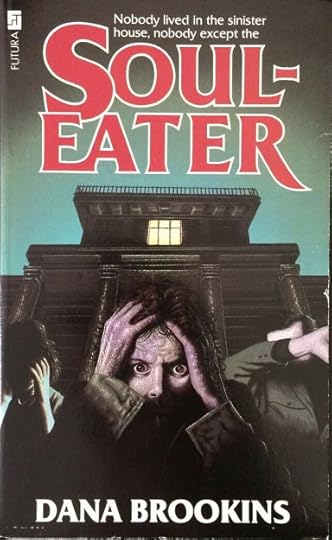
(Updated 12/18/19) [1987 Futura (UK) mass-market, with art by Terry Oakes. I'd meant to order the cheesy-awesome Zebra edition, but this one's not bad, and sets an entirely different tone. Weird how a cover painting can totally change my expectations going in.]
While I dug the small, backwoods town-setting where everybody knows each other (and their personal matters), the overabundance of tertiary characters and side-plots to keep track of distracted a bit from the main story concerning the sudden, mysterious construction of a new house that has everyone abuzz. Unbeknownst to them, however, some sort of evil force is emanating from the building, slowly infecting the townspeople with murderous impulses. It's up to one 12 year-old boy (because of course it is) with psychic abilities to convince others that the house -- or a presence within -- is responsible for the hot new fad taking over the community of everyone murdering the shit out of one other.
It was definitely a good thing during that regrettable era of all those haunted town infestations throughout the Carter and Reagan administrations that there was always at least one kid who was smarter than the adults. Otherwise this problem might still be plaguing the U.S. today. Fortunately across the pond there seemed to be more capable adults in positions of authority to handle these sorts of supernatural snafus.
For a no-frills 80s midlister, this provided some decent chills and was pretty entertaining overall, but it probably would have benefited from a tighter focus on fewer, more fully-developed POVs that the reader could connect with as opposed to the near-constant head-hopping. Still, a better read than the typical Zebra-published title from the era.
3.0 Stars.
BTW, glad to see Capricorn Literary reissuing forgotten old horrors like this one (I picked up their digital version for easier reading while at work*). And especially for introducing more fans of the genre to underrated authors like D.A. Fowler and Allen Lee Harris.
*Just kidding, of course I wouldn't do that when I'm supposed to be working. I got it to read while driving to work. Wish people would quit honking and flipping the bird at me, though--it's very distracting. What's their deal? Damn book-hating bastards.
What a classic from the past! We see a mysterious attraction coming to the slowly decaying small town of Edgar Falls, a house. It is moved into Pellam Woods. But who bought the property and put the house on it? Why were there strange headlines in the local newspaper beforehand? The inhabitants are drawn to the house like moths to a flame. You get a brilliant description of smalltown life (had to think about Bentley Little for many times) and the author presents a huge cast of characters in a very lively and interesting manner. You really feel for the characters like Bobbie (and his Grandpop) or Cindy Newman who needs a new foot (great interwoven tale). The story slowly evolves and gets eerier and eeriee by each chapter (absolutely love this slow building up of of suspension and the satire on this little town with all the nasty secrets). Who will survive the malevolant house? Who will be killed and how? What is Gloriana Reege's role? This is a really good 80s classic that got you hooked quite quick. I never read a haunted house tale like this before and can fully recommend that outstanding novel!
Bobby Topin has got it rough. His parents are dead, and at only 12 he has to live with and care for his grandpa who suffers from advanced dementia in a dead-end town. This Thanksgiving, he has only a small chicken to bake with no company with which to share the holiday. And his only Christmas present this year is a pair of socks. And to make things worse, Bobby has a secret that isolates him more from his small community. He knows things that no one else can know. And he knows something evil has come to town.
Out in Pellam Woods, which overlooks Bobby's house, a mansion has just been built. Why this warped and sprawling old place was deconstructed and moved to this isolated location is a subject of much speculation and gossip among the townsfolk. No one lives there, you see. But everyone wants to.
The house draws people like flies to the light, and bad things happen to those ensnared by the charm of the wonderous estate. Only Bobby can sense that the house is a malignant force. An eater of souls.
So that's the basic premise of this unusual twist on the traditional haunted house story. I found the book both very typical of it's time yet also unique in many ways.
It is typical in the sense that it concerns yet another set of child protagonists in another small town in fly-over Americana battling with an invading evil. It seems every horror writer in the 80s wanted to imitate Stephen King, and this is just another in a long line of coming-of-age scary stories. With that being said, I did find this largely effective.
The writing is quite good, by far superior to many it's paperback peers. Dana Robbins' style is very quirky, observant, clever, and sensitive. I only wish the novel had maintained the high standards it set in the first act. It seemed Robbins grew fatigued by the halfway point, and the art woven into the prose faded away. It's not that the writing ever grew bad, but it just ceased to be special, becoming just straightforward narrative that lacked the earlier spark.
I get annoyed easily with child characters, but the little urchins in this one are just fine. I even found their relationships and individual struggles quite moving. For example, Robbins did a fine job capturing the heartbreak and stress of watching a loved one diffusing their identity and losing the one thing that keeps our identity cohesive--our memories.
Also skillfully done was giving the ancillary characters sufficient motives for being attracted to the house in Pellam Woods. A house is more than just a box to shelter you from the weather. It is a macro-sized representation of the personality and psychological functioning of those who dwell in it. And so people imagine that if THEY could call the big house their own that it would say something different about them. They imagine they'd no longer be a lonely nobody living in a meager shack in a mediocre town. The house seems made for visitors, for entertaining, for showing off. It's the kind of place that needs maids, and occasional visits from ambassadors and the governor, and perhaps hosting a wedding reception or a community fundraiser event. So for many in the town of Edgar Falls who have suffered from layoffs at the local factory, who have not amounted to much since their high school athletics days, who realize they are over 50 and are nowhere near where they dreamed of being in their lives, they NEED this house. It is a sad indictment on what happens to the soul of citizens living in a town that is past it's prime, a place where families and manufacturing once thrived, where the American dream was once attainable and real, the kind of town upon which America was built in fact.
Now, let's address how well it delivers the genre goods. Honestly, this is one of the tamest of the paperbacks from hell I've read. There is no gore, no carnage candy, no crazed slashers. This is primarily psychological horror. You are kept guessing as to whether the whole scenario is really supernatural or merely an allegory for the decline of middle class main street. You won't get all the answers, and I respect the book for not holding the reader's hand.
Now don't get me wrong, some awful things happen in the course of this story, especially to children, so let that be your trigger warning. And there are some effective chills in a few places. But for the most part, the novel falls flat in the scares department. In fact, there are moments where I felt it dragged out unnecessarily. For example, almost to the end, we are introduced to a redneck pill pusher only to add to the kill count, but for some reason we linger on his nasty and shallow little white trash thoughts for page after page. He wasn't important at all to the story, his death had no consequence, and his trashiness belittled a story that had been somewhat classy up to that point. It was clear the author was padding the job, but there were some strange choices as far as where to put in the padding.
Another strange choice is the treatment of the House itself. Though clearly the central focus and prime motivator of the characters, it is hardly described. There are only a few scenes that take place within the house and we get no sense of the splendor, or the creepiness, or the vastness of the place. We only know that it's painted white on the outside, is built in funny angles, is full of antiques, and is big. It seems to me that some further descriptive establishing scenes of the house could have helped set the mood and develop it as a character in it's own right, which it is. Yet, if the house were considered the "villain" of this piece, it comes across as quite wooden, pun intended--the equivalent of a mustachio-twirling bad guy who has no personality or motivation other than just being evil. This may have been done by the author for artistic design, to essentially let the reader fill in the blanks, to allow the house to represent itself in the individual minds of the audience, just as it does for the characters in the book. But it left me with no real sense of scale or awe for the very centerpiece of the novel.
The ending was fairly satisfying, but felt rushed. So many authors seem to have trouble with endings. The main character, Bobby, has essentially been put through hell at this point, and so the story earned a much more epic finale. Instead, the book lingers on trailer trash characters, stupid nightmares, and repetitive inner monologue that contributed little. There is a sort of twist in the end, but you can see it coming a mile away even though it also feels forced and contrived. In all, not the greatest way to wrap things up.
"Soul-Eater" is certainly not the feel-good novel of the year, and will not necessarily keep you up at nights with fright. But it is an interesting and quirky read that I do recommend to fans of vintage pop books and paperbacks from hell.
Brookins enfuses this tale with large doses of dark humor that had me laughing throughout, which made me enjoy this more than the meandering plot might have otherwise. Our main protagonist is 12 y.o. Bobbie Topin, who lives with his grandpa in a sorry, dying little town in the midwest (Nebraska maybe). One day the big news is someone, a rich someone, is building a huge house in town, but it turns out the house is being moved there in pieces. Three stories tall, over 40 rooms, the thing is a monster.
Bobbie, however, has bad vibes about it from the inception, and he is something of a psychic. Yet, the town is overjoyed about it. The book starts with the big mystery of who in fact is bringing in the house, where did it come from, etc., but it turns out the house was donated to the town by some anonymous benefactor. Still, once people start dying around the house, Bobbie gets more than a little worried...
While the plot is not exceptional by any means, Brookins animates this with several colorful characters. One is, for example, Cindy Newman, who a while back had her foot stomped by a cow and it never healed correctly. The town has several events to raise money to fix her foot properly and of course, she suffers numerous trials and tribulations as a result. Cindy the 'foot' and Bobbie are pals, as he is also something of an outsider in town. Bobbie's grandpa is losing it mentally, although he has his good days, so Bobbie basically keeps house as well.
Sometimes in a horror tale, you root for the evil, and I surely did here. I did like Bobbie, however, but the rest of the people in town? Let them get their comeuppance! Many, if not most, were bigots, homophobic, sexists, etc. So, all in all, a fun tale for sure and I am looking forward to the sequel. Brookins did not write much in this genre, but I am glad Zebra published her work. BTW, the cheesy cover has nothing at all to do with the story. 3.5 evil stars, rounding up for the humor and the ending.
Since Paperbacks From Hell hit shelves last year, actually shortly before, as the buzz around the subject covered in the book got going, readers interest in the countless Horror Novels of the 80s has been at a higher boil than it has been in some time.
Around that time, several publishers started republishing the 'lost classics' and capitalizing on what could theoretically be a lucrative niche market in horror reading.
Cue the new imprint, Capricorn Literary, who have just released their flagship books, of which, Soul-Eater is amongst the first in the inaugural run of books hoping to be rediscovered.
I'm really quite excited for many of the books planned for release under the line, but honestly, a bit perplexed by the choice of Soul Eater to spearhead the lineup.
My befuddlement is not in that Soul Eater is particularly badly-written or poor. Rather, it's simply unremarkable when held up against its literary counterparts.
It's a haunted house novel through and through, with a cast of country bumpkins to populate it's story pulled from the pages of just about anything else published at the same time....
Edgar Falls is a small town that is hurting economically, who gets a surge of excitement when pieces of a large house start getting shipped in to be rebuilt. The town decides to capitalize on this, hosting tours and parties in the place. Of course, it's not all wine and roses for the townspeople, as nasty accidents start to occur.
Only Bobbie, a slightly psychic preteen, can hope to save the town.
...sounds familiar, eh?
Once again, it's not the Soul Eater is particularly awful, it's more that it's particularly bland. Nothing is happening here that you haven't read before. There's a low sex-and-violence quotient, which often tends to be the redeeming quality for some of these lesser-known titles. The townspeople aren't bizarre enough, the town isn't atmospheric enough.
Soul Eater just wasn't enough for me to stay particularly interested. I do remain hopeful that Capricorn Literary will put out some really cool stuff, as some of the titles on the horizon seem really worthy of a read. I also think a specific group of readers would enjoy this a bit more than I did...maybe a younger reader? Someone more inclined to Mystery novels?
You can get a copy of the recently republished novel, here.
I've gotta go with a 2/5 on this one.
originally posted on my blog at UndivineInterventions.blogspot.com
Outside the village of Edgar Falls, in the abutting Pellam Woods, a house is being built. A mansion, really, being assembled piece by piece. A reconstruction at the behest of a person or persons unknown. Not much happens in Edgar Falls and since the factory, the town’s major employer, is getting close to shutting down, the town’s populace is enjoying the mystery of who is building this mansion. But soon bad things start to happen. Personalities change, horrible house fires kill occupants, and more. Twelve-year-old Bobby Topin senses the house is behind these terrible events and is somehow controlling people to do its bidding.
This book was originally published in 1985 and was reprinted in 2018 as part of an effort to resurrect forgotten horror “classics”. Yes, this is essentially a haunted house story, but unlike any I’ve read before. While I enjoyed the setup of the story as well as parts of the unfolding plot, I think the novel really ran into trouble by overloading us with way too many characters and their individual subplots. I really didn’t need to know every single townsperson and what their individual problems and life complications were. More than once, I lost track of the main plot thread and wondered where the story was going.
The final chapters brought everything back in line and the final payoff was OK, if a little bit predictable. No attempt was made to reveal the nature of the house and its evil. I had to be content with an “it was just evil” sort of explanation.
Thank you to Capricorn Literary for a free review copy.
I'm absolutely obsessed with the covers on the old Zebra horror novels, and I'm not ashamed to admit I've bought several just based on that factor alone. That being said, I thought this book would be just as awesome as the original cover, and I wanted to love it so badly, but I just couldn't. For starters, it majorly needed an editor. There were so many typos and wrong words written, it became distracting and sometimes made entire sentences confusing. I still enjoyed the book;it was entertaining enough for me, but I wish there had been more action. I'm hoping the sequel will be better? Fingers crossed.
I wish I could say I loved the book, but alas, it didn't win me over overall. I mean, I've certainly read worse but the story didn't grab me as I thought it would. I remember that colorful Zebra cover vividly since like a lot of people I was way deep into horror during the '80s but I never got the chance to grab a copy, until it was handed to me recently by Capricorn Literary for an honest review. SOUL-EATER tells the tale of a small town run amuck by the arrival of a reassembled old house. Before you can say, there goes another Amityville tale, well, you not that wrong. Except the narrative in this one is a lot stronger; the scares, when there are some, as effective. What it lacks most, however, is the glue so needed to make everything stick together. Too many characters (none really memorable), off balance POVs, and some boring parts, make the experience of reading this novel a challenge at times. But underneath all of these mishaps one can still see a fine novel in the making. Too bad it didn't get there. 2 1/2 stars.
I am really enjoying these horror books from the past! What a delightful series. This was the second in the series and I enjoyed it every bit as much as the first. Wonderful characters and such a great capture of the emotions of the townspeople. This is a great story.
"I'll swallow your soul! I'll swallow your soul!" "Swallow this." (blows face off with shotgun)
Fine, you caught me. That's not a scene from this book. But when I heard the title Soul Eater, I couldn't help but assume it would be like that iconic Evil Dead II scene. Instead, the book was a lot less pulpy than I expected, going for a riff on Shirley Jackson with a house that makes people crazy. The house was kind of like the store in Needful Things only it doesn't sell anything, it just sticks a wooden spoon in your brain and gives your emotional stability a good stirring, then sets you loose on the town to see what happens.
So this book was good...ish! There were some positives but more negatives yet overall I enjoyed the plot enough to finish it!
I'll get the bad out of the way first. The main thing that bugged me was the number of POVs. It felt like it was chopping and changing too much for any of the characters to be fully developed!! I didn't connect to most of them and didn't really care what happened them. I feel like this could have been so much better had it been told by one person rather than so many! I also found the pacing to be hit or miss. I liked the build up to the house, and when something interesting happens with it, it was fast paced, but every other part was slow going and for the most part boring. I also didn't much like the ending. It just sort of ends. Maybe there's another one lined up, but I wish this had ended better.
Another thing that annoyed me was the whole town felt like a cliched kind of town. There's the obligatory "white trash" with a load of kids, a disabled child that the community feels like it needs to help and a few other characters that had me rolling my eyes. I didn't like when the rich lady rolls up and they were all shocked that she was black! I know it's set in the past, but still!!
Yet despite the negatives, I was still strangely enthralled with the story!! I liked some of the characters, I liked the atmosphere and the way the author builds up to the house, I liked the fact that the house had an effect on everyone and I liked the twist there was! I actually read this quickly enough and did end up enjoying it.
Jeffery Lynn Hutchins did a good job reading this. He was able to capture the personalities of the characters easily and bring each of them to life. He was clear and easy to listen to and I'll have to check out more from him.
I was given this audiobook at my request and have voluntarily left this review. This in no way affected nor influenced my thoughts.
I see some people didn’t like this one and thought it was cliche. I think that’s true to an extent, in that it’s about an evil house, but in the end I felt it was different because it’s really a story about a boy. He has a terrible life but keeps a good attitude, and his psychic ability plagues him when an evil house is discovered. As much as it’s about the things the house causes, I thought it was much more about the boy, whose character I was drawn to and felt sorry for. He’s alone in the world for the most part and no one believes him about the house, which isn’t new, but I thought his character was well drawn. I wanted him to succeed, and he goes through so many ups and downs it was hard to see if he would. I think this one is well worth a read.
I just couldn't get into this one, which was a disappointment because I love the cover art. It is kind of awesome in that Troll 2 kind of way, however, I only made it to page 32 before I decided that this one just wasn't for me. Even though I couldn't get into it, this book has a strange vibe to it that is truly noteworthy. The small town setting and it's odd-named inhabitants (Bruzz, Bitsy, etc...) are vibrant and alive, like a nightmarish version of a racist Stars Hollow on LSD. This book also has a line that contains the phrase, "You no good son-of-a-turd". Now there's one I've never heard before.
The Resurrected Horrors line is a great idea, reissuing (in digital format) some of the old paperback horrors that haunted grocery store spinner racks a few decades back. The second book in the series — Dana Brookins’ Soul-Eater — centers on a mysterious chateau raised amid the bogs of Pellam Woods whose clapboard walls exert an increasingly dark and deadly influence over the residents of the little town of Edgar Falls.
The theme is ‘kind-of-what-you-expect’ from 1980s mass market horror — not exactly original, but still potentially entertaining — and Brookins seems a capable enough author. But even given my overall enthusiasm for this line of books, I can’t get past the fact that Soul-Eater is a fair to middling horror story that spends too much time in town and not enough inside its titular house of horrors.
At the end, there is an attempt to put the pieces together — though I found the identify of the house’s mysterious benefactor to be fairly well telegraphed — but even the final explanation doesn’t go far enough to justify the supernatural powers of the house. And as a malevolent entities go, the evil wooden mansion isn’t exactly genius ... falling for one of the oldest tricks in the book ... the old ‘lit candle in the curtains’ ploy. Candles scorch about 21 homes every day in the U.S. ... so really ... monsters in wooden lairs should be a lot more savvy to the potential tools of their undoing.
(And there’s also a lot child death. I’m pretty tolerant of my horror, but when babies start dying, it kind of deflates any ‘escapism’ these stories have for me).
I’ll certainly give other books in this line a try, but Soul-Eater was more an item of nostalgia than it was of scares.
I received a copy of this story for an honest review.
I got about halfway through the audiobook version of this story. Needless to say, I wasn't a fan. I had a hard time staying focused and was bored because I felt like there wasn't much really going on. The author jumps from one character POV/backstory/daily life to the next and every so often something questionable would happen like the random newspaper titles, Betsie burning her house down, and the strange house that was brought to town. It wasn't enough for me.
I can say that the narrator, while not the best I've heard, did a pretty good job overall. There were a lot of random pauses when he spoke, but he did provide a variety of voices to go along with the characters.
Questions/Comments:
One questionable area I came across was when Lobe(?), the newspaper guy, wanted to find more information about the black woman (I forgot her name). He hires a detective/investigator who ends up finding four phone numbers that go along with the Rolls Royce she'd been driving through town in. First Lobe states that for $40 the investigator was able to find four numbers, then he states that he has to pay $120 for those numbers. I don't get where the difference in pricing came from?!
There was also the fact that the author repeatedly referred to Bobby's friend, Craig, as both Craig (first name) and Jorgenson (last name). I didn't get why this was done.
Unfortunately, I had more questions that I'd written on a piece of paper, but that paper seems to have disappeared. Oh well.
This is a book about a house, and a boy. Neither it what it appears to be at first glance. The story is filled with memorable characters: a dedicated local newspaperman, a disabled young girl, a clueless teacher, a grandfather slipping away into dementia, and more. The author has glimmers of an early Stephen King or Dean Koontz in his style (think of Salem's Lot or Odd Thomas). There is evil in the story, as well as an heroic young boy become man too soon. There is a lovely small town feeling, not without ugly undercurrents of us-versus-them in the general town disregard for the slovenly local white trash, Bitsy, with her shack and her five kids, who are only befriended by the local disabled girl, awaiting surgery on a crushed foot (crushed by a cow who escaped its pasture days after its owner had died--a harbinger of the horrors to come?) This is a good story, and I don't want to give away too much now or you won't enjoy the story as you should. And enjoy it you shall--just as the citizens of Edgar Falls enjoyed the mystery of the house at Pellam Woods, even as its evil threaded through the town like the noxious bog fumes of those woods. A+ Bravo!
Have you ever started a book and couldn't decide if you were going to keep on reading it? This was the book for me. But honestly, I got so hooked on the story that I couldn't stop reading until the end. Maybe it was because I grew up in a small area with not many people or maybe it was because I was married and had children and my children knew all of my grandparents, as well as their own grandparents. We seem to be a long living family. Anyway, I really liked the story and the characters. Give it a chance, you might be just like me and have to read it to the end. A warning though, there is another book that continues the story after this one.
Take a small, rural midwestern town. Add he small town editor of the paper receiving cryptic headlines paid for with cashier’s checks. Now add a mysterious car with an unseen passenger, a house that appears in pieces, and you have the beginnings of a strange tale indeed. This begins with oddities but soon descends into a horror filled landscape that quickly starts taking a toll on the population of Edgar Falls. The only one who knows what is happening is young Bob…but no one listens to him. And how they will suffer for their ignorance. I highly recommend this little jewel!
If you love Kinng and the likes, then this story is for you! I was hooked before the end of the first chapter. You kinda know what's happening but it still will get you. I don't want to save too much here and cause a spoiler. For all horror and thrillers fans, this is a MUST for you
I have three stars because, although the story is compelling, it is in serious need of editing. For example, one character, which starts it as Rose, is changed to Lily in a later chapter. All of the typos are very distracting.
More like 2.5-stars rounded down. Slow to start. A lot of the initial premise didn't work for me. Improved in the second half. Seemed much longer than its page count.
I’ve always had the utmost respect for haunted house horror writers. Writing is hard enough without tossing in the extra challenge of making an inanimate object terrifying.
And yet, a staggering amount of authors have pulled it off. Shirley Jackson, Richard Matheson, Jay Anson, Stephen King, Dean Koontz, Bentley Little, the list goes on. How do they do it? How do they take the cornerstone of modern comfort and turn it into a compelling horror story that will leave even the most skeptical (me) checking under the bed?
While I’ll probably wrestle with this question for the rest of my life, I think the answer lies in the way the authors focus on character. Sure, the house they’re in is filled with ghosts, but the story is really about the character’s inner demons and how they’re confronted with those demons through the haunting. Read the full review.
The opening of Soul-Eater, Dana Brookin’s 1985 horror novel, where a house exacerbates the prejudices, hatred and bitterness of Edgar Falls’ inhabitants to the point of homicidal madness, held a promise. The fairly personable prose and relaxed tone used in the first few chapters to set the story up and introduce a plethora of well-known characters both seemed to point towards an unusual take on the ‘haunted house’ genre, a sort of Payton Place meets The Amityville Horror. At least at first. But then it all fell apart when the book’s ambition, namely an exploration of the inherent darkness lurking within the human soul - a tall order but not a bad gig in itself - became glaringly obvious. Painfully so.
The book’s main protagonist, the tragically wholesome Bobbie Topin, a 12 years old lad living with and taking care of his seriously ill grandfather stands as a perfect opposition to the rest of the characters, all warped by pettiness, arrogance, greed, lust or hypocrisy. From Lobe Peter, the proprietor of the town’s only newspaper, ridiculously twisted by a thwarted ambition to Penny DuJong, the candy shop lady, a predictably embittered old maid and terminal gossip, all of them are merely cardboard cut-outs serving specific functions within the plot, each of their quirks or dialogues borrowed from a long list of b-movie characters. What could be said of cad extraordinaire Gary Purdy, so wilfully bad and misogynistic he constantly tests any reader’s suspension of disbelief? None of these characters have any coherence or real agency and tend to behave according to the story’s requirements. Another case in point: take little Bobbie whom, we find out in the course of the book, is somewhat a bit of a psychic. The extend of his talent is never explored - merely mentioned in passing - and yet proves incredibly handy as the book rushes towards its laughable Scoobidoo-like climax.
Soul Eater’s main draw back however is that it lacks conviction and is even coy in its description of the horror, never daring to look directly into the darkness. As a result, the sometimes clunky and often arch writing increasingly turns more and more gnomic as the story progresses, adding strange ellipses on top of each other to the point of making the narrative unfocused and confusing. This, in turn, gives the distinct feeling of a writer who progressively got tired of her own story and couldn’t wait to pass the finish line.
Now, I have no way of really knowing this for certain but I’m convinced that Soul-Eater was the work of a young and fairly inexperienced writer. Dana Brookins read all the right novels but had not yet developed a voice of her own. Or an original story for that matter. In fact, this novel is more than influenced by Shirley Jackson’s The Haunting of Hill House and Stephen King’s The Shining. Both classics are actually mentioned in this book and I don’t think that’s a coincidence.
Soul-Eater may be another title to add onto the Land Registry of Horror’s ledgers but a forgettable one.
Ok, but I actually liked this one, even though it's not quite my genre. I found it on Audible a few years ago and thought, sounds like fun! I had no idea that it was written in the 80s mostly because the way it was written, it sounds like it's set anywhere from the 40s to the 70s. It's like an amped-up, slightly sleazy version of Little House on the Prairie. That's where the book shines, when it goes full "Harper Valley PTA" and illustrates the malice and hypocrisy in small town life. Where the book falls short is the lack of depth and world-building in regards to the horror element. We never learn anything about the house, and that was frustrating. The characters were great, and there were some genuinely tragic scenes. The ending felt wasn't bad, but it felt abrupt.