Ha Ha Hu Hu tells the delightful tale of an extraordinary horse-headed creature that mysteriously appears in London one fine morning, causing considerable excitement and consternation among the city's denizens. Dressed in silks and jewels, it has the head of a horse but the body of a human and speaks in an unknown tongue. What is it? And more importantly, why is it here?
In the hilarious satire Vishnu Sharma Learns English, a Telugu lecturer is visited in a dream by the medieval poet Tikanna and the ancient scholar Vishnu Sharma with an unusual request: they want him to teach them English!
Velcheru Narayana Rao's elegant translation is accompanied by an erudite introduction and afterword which illuminate the fascinating life and works of Viswanadha Satyanarayana.
Reading this book was an enlightening experience!! I am amazed at the potency of Satyanarayana's writing. Comprising of two strong novellas, it was brilliantly funny and certainly gave much food for thought. ~ The titular novella is about a horse headed Gandharva (mystical beings in Hindu scriptures), suddenly appearing in London's Trafalgar square. He wears a dhoti, has wounds on his back and speaks in a strange tongue (Sanskrit and Prakrit). He is harmless but people around get afraid and out him in a huge cage. Huge debates take place, whether to let him live, or inspect him and kill him all in the name of science. The moral of this novella was simple, how humans have this weird tendency to blow things out of proportion. It was heavy but really really good. ~ The second novella, Vishnu Sharma learns English, was a brilliant satire on colonialism. It's about a Telugu lecturer, who in his dreams is visited by Vishnu Sharma (the author of Panchatantra) and Tikanna to teach them English. What follows are sharp observations on English colonizers and the damage they did on the culture of India. I loved how Satyanarayana didn't disparage himself by the 'English is superior' mentality that is so bombarded on us. He used Telugu, it's literature and wisdom to question colonisation. I admired his love for his language. I loved reading the grammar discussions and comparisons between English and Telugu. Satyanarayana managed to show the hypocrisy of the West who have put themselves on pedestals of justice, science and knowledge, but they don't often practice what they preach! ~ This was such an important and an enlightening read in today's times when people give more preference to people who speak in English are classy and sophisticated, and those who speak in their mother tongue are Ganwaar (illiterate). Tastefully translated by Velcheru Narayana Rao. I am curious to know more about Satyanarayana. Many called him a bigot, refusing to change with the times, but he was a genius and had quite an interesting personality.
This book is like a fine dish with exquisite flavours, each one getting pronounced with passage of time. A wonderful, breezy novella with 2 stories, this is a book of philosophy, satire, linguistics, tradition, contemplation,.. In fact, the brilliance of the writer is such that one can interpret the stories from multiple angles as they wish. Only towards the end, in the end notes, does one find the deep meaning behind the creation of these 2 wonderful masterpieces.
The first story is that of a horse-headed God (Gandharva) in Trafalgar Square. The interactions between this God and humans does evoke laughter, but poses serious questions to contemplate. The comments on “research” are truly thought provoking. In simple and succinct language, the author has brought out the multiple facets of modern life, where there is a constant conflict of tradition vs modernism.
The second story is lot more funnier, but begets a deeper thought process. We have 2 major authors from history revisiting the author. This story captures their experiences and travails with the author, with English as a language as central theme. I particularly loved the Ravana aspect and was totally bowled over by the pronoun example. Simple questions can have very deeper meaning.
To write more is to spoil the fun, but there are multiple layers to this wonderful book. I am sure another read after a few days would open up newer perspectives and windows of learning.
Anything less than MASTERPIECE would be an injustice to this magnificent book.
In India, colonial literature is its own genre. There are multitude of authors, poets and essayists who rose during peak independence movement where English literacy was accessible to Indians, some wealthy who managed to get educated in England and some in India alongside new schools. This slowly eradicated the existing system where class and caste provided access to education. While many authors wrote scathing works criticizing British presence and practices, some took a more pacifist route using humor and clever metaphors. This author seems to be one of them.
Both the novellas do justice to the underlying themes - be it alienation for being different linguistically, racially or ideologically. The first novella explores the methodology of scientific research, the ones that's been carried out for centuries that harmed cultures, colonies and multiple groups of people in the name of "knowledge". The protagonist of the novella, a horse-headed man challenges this along with the ideology of freedom and how some people are just free and some people aren't. And thus concluding without an actual conclusion but a thoughtful question.
While the second novella was tad bit funnier, its ideas hits on classism of scholars both in India and abroad, the association of English as a language to be that of the "better". The widespread use of it is also probably why am here writing in the said language instead of my native tongue.
Both novellas were interesting, echoes of literature that was predominant during an era of change and revolution.
Once in a while we come across a book that is written against the standard theme/trend. 'Ha Ha Hu Hu' is one such book. The author, renowned as one of the greatest writers of the Telugu literature believed in the acceptance of ones language and traditional values. He opposed the implementation of modernity and that can be seen in his stories. . This particular collection has 2 stories. The first- 'Ha Ha Hu Hu' starts when a 'gandharva' appears in the streets of London and talks about how everything one needs to know are written in the religious texts. This mix of horse, bird and man doesn't feel the need for modern amenities or knowledge because he knows his texts well and can prove the most learned of men to be fools when it comes to the ways and truths of life. . The second story- 'Vishnu Sharma learns English' talks about the author of 'The Panchatantra' visiting the author in his dreams just so he can learn English and prove his existence to people who are caught up in things like authenticity, proof and mistrust. Nothing is good enough for them because they are being influenced by the western culture and that their need to question everything is of utmost importance. . The stories are full of hilarious and sometimes outrageously stupid tidbits and coincidentally most of it makes sense. Two stories from a completely different perspective that will make you question if modernity has been taken too far and if its our religion and our roots that has enough in store for us to live a happy and fulfilling life.
While a lot of Indian literature from Satyanarayana's era - roughly the generation of my grandparents - is written from modernist and socialist perspectives, Satyanarayana was a traditionalist who wrote in a dense, Sanskritised Telugu and critiqued colonialism and its impact on India from what we could arguably deem a reactionary perspective. This is obvious in the first novella, in which a horse headed gandharva finds himself trapped in London. We are shown the superiority of his divine, indian wisdom over European scholarship and science. Fortunately, the story is not at all heavy handed. Satyanarayana has a real gift for satire and offers many pungent observations on scientism and cultural myopia, and the story also has a dreamlike, numinous aspect.
Vishnu Sharma Learns English is a critique of free India and how it apes the standards and structures of the English and their language without really understanding it. It can be seen as a rejection of western elements, or a critique of a country that is caught between two cultures, understanding neither, and second-rate in both. Again, a sharp eye for satire and skewering pretensions is in evidence and there is a matter of fact merging of realism and the fantastic that predates magical realism.
While it's hard to accept Satyanarayana's rejection of aspects of modernity, the power of his imagination and his critique of colonialism is undeniable.
Have been reading short books more recently to keep up my pace of reading.
One such book is HaHaHuHu (Story of a Gandharva) by Kavi Samrat Vishwanatha Satyanarana Garu. Surprised to know how come such a book came in 20th century itself. Translated to kannada by Ganesh Bhat in a series of Articles in Rashtraottana Magazine of Utthana.
A peculiar animal with a head of a horse has just landed on Trafalgar Square in London and what happens next is a series of events pertaining what is this creature whether it’s a animal or a human. Vada Prativada between Scholars, Biologists and even common people of Europe. There is discussion on language, science,Human behaviour and even religion. Pinch of Colonial racial bias also. A short novella that’s makes you wonder. Oh wait I didn’t think of it this way. Enjoyed it. I wanted it to continue onto Gandharvaloka.
Gandharva says “It is more rewarding to get to know a subject well experientially than to pile up all the things you want to know”
My last day in India, wandering the used bookshops of Church Street in Bangalore, I found this book at the bottom of pile. Somewhat delirious, sad to leave India, I thought, “It’s translated from Telugu and it’s titled ‘Ha Ha Hu Hu’ -- it HAS to be good!” Forgive me if this sounds flippant. But I was right. It’s a wonderful book. Just as important, it’s not like anything else I’ve ever read. (Despite an uncanny correspondence with Garcia Marquez. See below.)
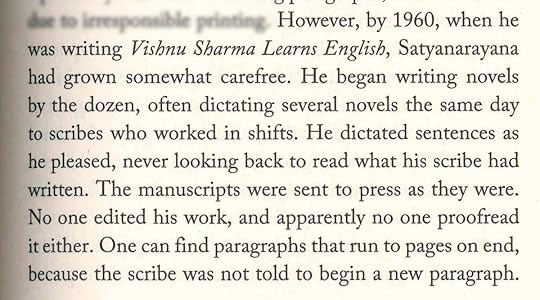
The introduction explains that this is an oral novel -- Satyanarayana dictated his novellas to a series of scribes. Sometimes more than one at a time! (As opposed to dullards like myself who think that writing a novel is an awfully big deal…) That sense of being spoken aloud comes through in the text -- it’s not all tidied up, there are digressions, and banter. It feels like a much “looser” style -- in a way that’s engaging and charming, as if the reader is sitting in the room beside the scribe.
There are 2 short novellas in the book. Either one can be easily read in an evening. The first is about a horse-headed man stranded without explanation in London. He speaks only Sanskrit. (If your Sanskrit is rusty you must look up the translations in the endnotes!) The second is a satire about the English language and the way it is taught. Both stories feature divine beings out of their element, feeling cranky.
Aside from Indian people seeking to know better the many strands of their national literature, this book is likely to appeal most to zealous Indophiles, oddballs like myself. If you are a lover of India -- perhaps a lifelong student of its religions or cultures -- you’re likely to adore this book. Imagine -- a novel about a gandharva! The legendary poets of Telugu tradition made to learn their ABCs! Prickly small jokes about Theosophy! I first visited Andhra Pradesh more than 30 years ago, but this is the first time I ever got to read a Telugu novel. I’m so glad I got the chance.
If a beleaguered professor of comparative literature happens upon this review, I have important news for you : a syllabus that included Garcia Marquez’s “A Very Old Man With Enormous Wings” accompanied by Satyanarayana’s “Ha Ha Hu Hu” would be fascinating and prone to brilliance. As Velchero Naryana Rao mentions in his capable afterword, the similarity between the 2 stories is uncanny, though it’s extremely unlikely that either man knew the other story.
This must be counted among my luckiest days in a bookshop. That I got the chance to read this book -- feels almost magical. This review is my way of saying thank you. If you are lucky to find a copy, by all means read “Ha Ha Hu Hu”.
Other than The Liberation of Sita by Volga, I can’t remember the last time I read a translated book from Telugu. So I have to thank my book club buddy @ for lending me this copy along with some glowing praise. And this turned out to be such a unique experience.
As an avid fantasy genre reader, I’m always lamenting on the fact that there are not too many fantasy authors in India (other than those who wrote mytho-fiction which is whole other thing) or even if there are, not too many of them are well known. Imagine my surprise that I come across this two novella volume, originally written in my mother tongue sometime in the 50s, which just happens to be fantasy. Now I’m left wondering how many other such fantasy/spec fic novels exist in my own language that I know nothing about.
Anyways, these two novellas are very nicely written, in worlds that are too familiar to us with just a touch of our mythological influences, making them a great vehicle for the author to critique both the western knowledge gathering enterprise - which more often than not causes immense harm to the people who are being studied; and also the way English language education and all that comes with it has destroyed centuries of native literary tradition, forcefully rendering them as old fashioned and without literary or scholarly merit. The author cleverly uses a gandharva as a character to examine the former, and two historical literary figures from Sanskrit and Telugu to ponder upon the latter.
I was left both entertained and thinking after finishing this book and I hope I’ll find more such gems among older Indian literature across languages.
Housed within this elegant Penguin modern classics cover, are two curious novellas, one about a horse-headed god in London and the other about a long-dead writer and a long-dead poet visiting a 20th-century poet in his dreams to learn English.
Ha Ha Hu Hu and Vishnu Sharma learns English are the works of the famed Telugu Professor Viswanadha Satyanarayana who through his works, expresses strong, seething hate towards British colonization and its future implications on the culture and language of our country.
The two stories, fantastically imagined, take root from Hindu mythologies and explore certain aspects of them in a colonized setting.
Ha Ha Hu Hu, tells the story of the appearance of a fallen, horse-headed Hindu God who appeared out of nowhere in London. The interactions of the English with this gentle demigod reflect man's interactions with the unknown. In a way, Ha Ha Hu Hu represented all the nations that were invaded and colonized, first out of curiosity than through outward hostility. It is a story that clings to the reader's mind, begging for thought about the implications it makes.
Vishnu Sharma Learns English on the other hand portrays the easy invasion of English as a language into a country of many languages. While this satirical comedy exacts a number of laughs from its reader, you can't help but wonder about the apparent rage that seems to rest in between the lines.
While the novellas are brilliant from an anti colonization POV, they reveal themselves to be an enemy of progress. The books establish Brahmin superiority and bring back a backward look at all the progress the country has made in terms of feminism, secularity, against racism, against untouchability, against casteism, as the ideal way of life.
This 'modern classic' that reads fantastically as anti-colonial literature but at the same time perpetuate hurtful and wrongful ideals of religious, gender, and caste supremacy can be compared to a pot of honey crawling with bees.
Read it for the honey, but be careful about the stings.
Four stars solely for the inventiveness. Both Ha Ha Hu Hu and Vishnu Sharma Learns English are fascinating pieces of story-telling. The former has a more serious tone and reminded me a lot of The Shape of Water(!), while the latter as something meant to be a clever sarcastic rant on the state of English education in a post-colonial India does evoke ample laughs.
What ultimately pulls these stories down is the utterly myopic view of the world (something I hear plagues the author's other book, Veyi Padagalu, as well). I've tried to look at it objectively, and see why the author had to do what he did, and thus was able to appreciate the book a lot better.
This is the story of a gandharva, a mythological character from the Puranas, the gandharva falls into Trafalgar Square in London and loses consciousness.
People gather around this huge 'animal' and start wondering what it could be. Police surround the animal and build a cage around it to prevent it from hurting anyone.
The gandharva wakes up and starts speaking Prakrit. Sanskrit professors from London University, try to speak to him in Sanskrit and ask, 'What did you say?"
The animal responds in perfect Sanskrit: atra samipe asti vā kaschinna- di-snätumicchami. 'Is there a river nearby, I want to take a bath.' That's how the story begins.
HaHaHuHu is a collection of two novellas written by one of the greatest Telegu writers, Viswanandha Satyanarayana.
The first one starts with a Gandharva, a mythological creature, A horse-headed man wearing choti and ornaments found in London. People became curious. The first time When he was found, he was unconscious for a long time, and people thought him to be harmful. So he was put in a huge cage.
But when he got back to his senses, it was discovered that he could speak! The language was Sanskrit not only that he meditated before he touched the food. No surprise, he became the center of debates. Scholars came to visit him. His Interviews started to come in daily newspapers.
The author has showcased the cruelty and snobbishness of the modern human being. Self-centered. Selfish.
The second novella is a masterpiece of British colonization. In the dream of the author, the author of "PanchaTanra," Vishnu Sharma, visited and wanted to learn English. Vishnu Sharma pleaded to learn particularly this subject because he thought people had forgotten his works, which are in Sanskrit.
The stories are simple and completely different from each other. They are easy to follow. I found the second story more hilarious., I felt the first story was a little dragged. But that has made the story more enjoyable.
Very rarely do we come across such real gems, unconventional plots and beyond brilliance writers. This book has two small novellas 'Ha Ha Hu Hu' and 'Vishnu Sharma Learns English' and both simply oozes wonder and amazement.
Ha Ha Hu Hu is about a horse headed man, presumably a gandharva who has fallen from sky in London and people are trying to understand him and his ways. The non-reality of the plot in itslef is brilliant. Still, written in the colonial times when Indian Lirlterature hadn't thrived enough proves promising.
Vishnu Sharma Learns English goes farther into the theme of magic realism when you realise that Vishnu and Tikkanna has come all the way from heaven to learn English from a scholar who himself doesn't understand the languages properly.
The difference are subtle but the depth in both the novellas are worth the effort. Both, short pieces they say a lot about the culture, languages and honesty with which we have been going on. (I guess still) All was good except the translation didn't quite grip at places, making it really drab but I will still suggest it for sheer magical thoughts, even though dreamy, definitely beliveable.
This is a short story( 60 pgs) of a Horse Headed Human who has fallen from the sky to Trafalgar Square in London. I had a very hard time finding the vernacular version( Telugu) of this book, so I picked up the translated version of this book on the same name.
what happens when a creature like that falls from the sky in India? At the time of author's that is around 1932, people would have believed that he is a creature existed in our myth, but now, we need proof for almost everything and can never believe a so-called '' different thing''
The very intent of the Modern world which needs proof and scientific evidences to things as trivial as possible is being lampooned in this novel. Our ignorance towards nature in the pursuit of more comfortable lives, and befitting terse replies to the inevitable questions like is there a God? What will happen when we die? Makes this one a more than a Good story.
I found a copy of this book at a Goodwill and I was pleasantly surprised at how much I enjoyed reading it. Both of the novellas within this book were entertaining and have a lot of character. I especially liked the character Vishnu Sharma because of his capacity to cook well and deliver a successful lecture to a crowd of rowdy students. I also liked his insightful critiques of the English language as well.
This entire review has been hidden because of spoilers.
3.5/5 I really loved reading the first novella in this collection titled 'Ha Ha Hu Hu'. It was poetic, philosophical, complex but still simple in it's writing. The other novella felt like a slog to sit through. I would say that's mainly because i highly disagreed with it but also the story itself at face value is just not entertaining enough.
A decent satire with unique ideas. There are two novellas translated from Telugu to English and ironically, the satire is against English taking over Sanskrit and Telugu in post independence India. The afterword is a good addition and talks about the idea behind the novellas.
The two novellas are somewhat different in terms of tone and motivation and this is explained in the afterword. The second novella stood out for me for its surreal humor and stronger satirical slant. The writing could need some minor editing though that did not diminish the content.
చాలా గొప్ప తెలుగు వైజ్ఞానిక కాల్పనిక నవల. పౌరాణిక పాత్రను భూమిమీదకు అందులోనూ లండన్లో కి తీసుకొని వచ్చి వైజ్ఞానిక శాస్త్ర వేత్తలనూ మన పౌరాణిక కథల నేపథ్యంలో చర్చించడం ఒక గొప్ప ప్రయోగం. చాలా చిన్న నవ్వు కావడంవలన మీరు ఒక్క పుటలోని పూర్తిచేస్తారు. పూర్తిచేసేందుకు వదిలిపెట్టరు.
"Ha Ha Hu Hu tells the delightful tale of an extraordinary horse-headed creature that mysteriously appears in London one fine morning, causing considerable excitement and consternation among the city's denizens. Dressed in silks and jewels, it has the head of a horse but the body of a human and speaks in an unknown tongue. What is it? And more importantly, why is it here?" I was charmed by the blurb and didn't hesitate before picking it up for the #2025IndianTranslationReadthon. Thankfully, I was not aware of the political ideology of the author, because if I knew that he was a reactionary who was against gender and social equity, I would almost certainly have lost out on reading these powerful works of satire. There are two novellas in this book, and in both, a sentient being/s from the past or from mythology appears in a modern context, setting the scene for conversations which examine colonialism and the duel between tradition and modernity. While the topic is heavy, the tone of the book remains light, proving yet again that humor is more effective in conveying ideas than harangue. While there are moments of levity in the stories and they can be enjoyed in isolation, many of the points made are hard hitting and continue being relevant even today. We, occasionally, make the mistake of thinking that magic realism is a relatively recent genre, but this book proves that Indian authors have been employing magic realism very effectively even in the middle of the last century.
A book more interesting than good, perhaps, but fascinating nonetheless: a sort of proto-first-contact novella (first published 1932), where the alien is a demigod rather than an extraterrestrial. This explanation of the author's working methods certainly elucidates the stylish infelicities in the book: