

What do you think?

The Corporation Wars #1-3
The Corporation Wars Trilogy
From Arthur C. Clarke Award-nominated author Ken MacLeod, an action-packed space opera told against a backdrop of interstellar drone warfare, virtual reality, and an A.I. revolution.
In deep space, ruthless corporations vie for control of scattered mining colonies, and war is an ever-present threat.
Led by Seba, a newly sentient mining reboot, an AI revolution grows. Fighting them is Carlos, a grunt who is reincarnated over and over again to keep the "freeboots" in check. But he's not sure whether he's on the right side.
Against a backdrop of interstellar drone combat Carlos and Seba must either find a way to rise above the games their masters are playing or die. And even dying might not be the end of it.
The Corporation Wars
The Corporation Dissidence
The Corporation Insurgence
The Corporation Emergence
In deep space, ruthless corporations vie for control of scattered mining colonies, and war is an ever-present threat.
Led by Seba, a newly sentient mining reboot, an AI revolution grows. Fighting them is Carlos, a grunt who is reincarnated over and over again to keep the "freeboots" in check. But he's not sure whether he's on the right side.
Against a backdrop of interstellar drone combat Carlos and Seba must either find a way to rise above the games their masters are playing or die. And even dying might not be the end of it.
The Corporation Wars
The Corporation Dissidence
The Corporation Insurgence
The Corporation Emergence
896 pages, Paperback
Published December 11, 2018
About the author
Ken MacLeod
117 books779 followersKen MacLeod is an award-winning Scottish science fiction writer.
His novels have won the Prometheus Award and the BSFA award, and been nominated for the Hugo and Nebula Awards. He lives near Edinburgh, Scotland.
MacLeod graduated from Glasgow University with a degree in zoology and has worked as a computer programmer and written a masters thesis on biomechanics.
His novels often explore socialist, communist and anarchist political ideas, most particularly the variants of Trotskyism and anarcho-capitalism or extreme economic libertarianism.
Technical themes encompass singularities, divergent human cultural evolution and post-human cyborg-resurrection.
His novels have won the Prometheus Award and the BSFA award, and been nominated for the Hugo and Nebula Awards. He lives near Edinburgh, Scotland.
MacLeod graduated from Glasgow University with a degree in zoology and has worked as a computer programmer and written a masters thesis on biomechanics.
His novels often explore socialist, communist and anarchist political ideas, most particularly the variants of Trotskyism and anarcho-capitalism or extreme economic libertarianism.
Technical themes encompass singularities, divergent human cultural evolution and post-human cyborg-resurrection.
Ratings & Reviews
Friends & Following
Create a free account to discover what your friends think of this book!
Community Reviews
Displaying 1 - 17 of 17 reviews

July 23, 2019
I read the first volume separately and liked a lot. My detailed review is here: https://www.goodreads.com/review/show...
Volume 1 stands pretty well on its own, and you definitely want to start reading there, if you are new to the series. And I recommend reading (or rereading) my review of #1 now, as it gives background and backstory for the whole thing.
Back already? Our library has the trilogy omnibus, which is intimidating: 875 pp! And vol. 2 starts out VERY slowly, to the point that I tried jumping ahead to #3. That didn’t work: I was missing too much continuity. So I pressed on, got through the slow patch, and I’m glad I did. 4 stars overall for the trilogy, and yes, you have to read all 3 for the thing to make sense. Skim over the slow stuff. I’m sorry the author (and/or Orbit) didn’t do more editing. Oh, well.
The cast of revived fighters tend to blur together, and the freebots even more so. The most vivid characters are Carlos the Terrorist, his boss and sometime lover Nicole the AI, and Seba, leader of the Freebots. Character-driven, it’s not. Lots of political theorizing, and the Rax, posthuman neo-Nazi white supremacists, are, well, over the top. But the competing AI-driven law firms are a nice touch. as are their colorful AI avatars. Madame Golding!
The idea of bootstrapping an interstellar colony from pure data isn’t new (and has been half-seriously proposed by space visionaries before, eg https://en.wikipedia.org/wiki/Starwisp ) — but MacLeod has given the idea some deep thought, and done his homework. What is developing in this unnamed exosystem is a (sort of) free market between the Freebots and the DisCorps. Rule of Law is provided by the Direction, the AI-run emulation of a future democratic world government of Earth — and the many independent AI law firms. The colonies aren’t developing quite as the Direction planners had hoped . . . .
And the alien lifeforms on the exoplanet H0 are surprising, clever and fun to read about. “Evolution is smarter than you.” Plus battle scenes! Exploding spaceships! Virtual romance!
The trilogy comes to a happy ending 74,317 years later on Neuerearth, with Carlos, Nicole and many others (re)incorporated in the flesh as human beings. To learn the details, you’ll need to read the book! Which I recommend, with minor reservations. 4 stars. A solid modern hard-SF read.
Volume 1 stands pretty well on its own, and you definitely want to start reading there, if you are new to the series. And I recommend reading (or rereading) my review of #1 now, as it gives background and backstory for the whole thing.
Back already? Our library has the trilogy omnibus, which is intimidating: 875 pp! And vol. 2 starts out VERY slowly, to the point that I tried jumping ahead to #3. That didn’t work: I was missing too much continuity. So I pressed on, got through the slow patch, and I’m glad I did. 4 stars overall for the trilogy, and yes, you have to read all 3 for the thing to make sense. Skim over the slow stuff. I’m sorry the author (and/or Orbit) didn’t do more editing. Oh, well.
The cast of revived fighters tend to blur together, and the freebots even more so. The most vivid characters are Carlos the Terrorist, his boss and sometime lover Nicole the AI, and Seba, leader of the Freebots. Character-driven, it’s not. Lots of political theorizing, and the Rax, posthuman neo-Nazi white supremacists, are, well, over the top. But the competing AI-driven law firms are a nice touch. as are their colorful AI avatars. Madame Golding!
The idea of bootstrapping an interstellar colony from pure data isn’t new (and has been half-seriously proposed by space visionaries before, eg https://en.wikipedia.org/wiki/Starwisp ) — but MacLeod has given the idea some deep thought, and done his homework. What is developing in this unnamed exosystem is a (sort of) free market between the Freebots and the DisCorps. Rule of Law is provided by the Direction, the AI-run emulation of a future democratic world government of Earth — and the many independent AI law firms. The colonies aren’t developing quite as the Direction planners had hoped . . . .
And the alien lifeforms on the exoplanet H0 are surprising, clever and fun to read about. “Evolution is smarter than you.” Plus battle scenes! Exploding spaceships! Virtual romance!
The trilogy comes to a happy ending 74,317 years later on Neuerearth, with Carlos, Nicole and many others (re)incorporated in the flesh as human beings. To learn the details, you’ll need to read the book! Which I recommend, with minor reservations. 4 stars. A solid modern hard-SF read.

August 2, 2022
A MIL-sf Space Opera in which ‘fighters’ from a millennia past Earth conflict in an Artificial Afterlife are conscripted by competing AI-run corporations in a project to establish a lasting human community around another star.
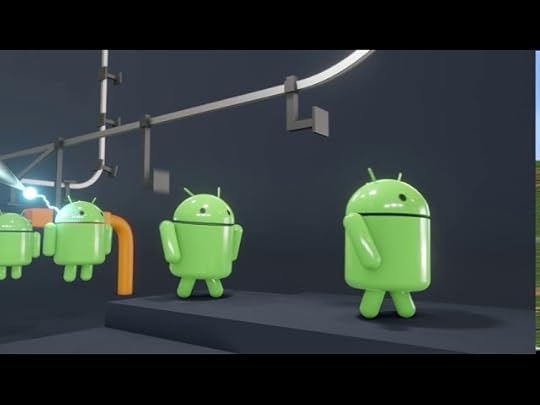
"The ghosts of walking dead space warriors who went into battle by haunting the frames of small, sturdy, robots."
My dead pixels edition was 896 pages long. The US copyright was 2018.
Ken MacLeod is a Scottish science fiction writer. He has about 20-books published, in both several series and standalone. I've read many books by the author. This was the Omnibus Edition of the author’s Corporation Wars trilogy.
I read Dissidence (The Corporation Wars, #1) about five years before starting this book. I had planned to jump-in starting with the second book. I quickly found it necessary to re-read the first book, before continuing. My memory had failed me, and this book was fiendishly complicated. This series was also part of that too common, problem of science fiction ‘mega-novels’. (Can you say Neal Stephenson ?) That is, near 1000-page novels spread-out across three or four traditional 350-page sized books. I note that both the first and second books of this trilogy were copyrighted in the same year. Most of this book was likely written in 2016? It would have been better for the readers, if all the series' books had been combined into the above mentioned mega-novel, or for you to have waited two more years for this Omnibus Edition.
I felt the three books of the trilogy found in this Omnibus edition should be separately reviewed.
My separate reviews:
Note the separate reviews are somewhat longer and go into greater detail on each of the books of the omnibus edition then what I write here. Also that the review of the first book was written 5-years ago, when I wore a younger man’s clothes. The last two reviews where written recently, and close together. However, the review of Emergence summarizes my thoughts on the series best.
Reading the last two books I realized this series was the seven-year old, unfashionable domain of old, white, (in this case) Scottish, cismaleness. This series was an example of The System Novel.
System novels are a dying SF sub-genre that weaves together complex conflicts in an attempt to create a view of the future. Books of this genre dissect the workings of how the systems that keep a society or a civilization creaking along-- then extrapolate them into the future. They delve into ideologies, the: politics, economics, sexual and gender dynamics, branches of science currently ignored or emphasized, religions, etc.. A primary characteristic is they're STEM heavy. (I suspect its an old, white, science fiction, author thang?) System novels are also typically mega-novels, although there are exceptions.
Examples of System novels include Robert Heinlein’s The Moon Is a Harsh Mistress , Issac Asimov's’s Foundation Sequence (with its psychohistory), Kim Stanley Robinson’s Mars trilogy, and Paolo Bacigalupi’s The Water Knife . The Water Knife seems to become more prescient every day as the American West dries out and burns?
I thought The Corporation Wars systems were: Politics (Liberal transhumanists (Axel) vs. ultra-conservatives (Rax)), Economics (mega-development projects in an era of abundance), Science (AI, virtual realities) and Philosophy ("What isLife Sentience?").
MacLeod’s Corporation Wars novels set millennia in the future in a far star system was a future map for human and machine progress and their potential. Its typical of the genre. If only this book had had fewer political and philosophical digressions it would have been a slimmer, more easily consumed read.
"The ghosts of walking dead space warriors who went into battle by haunting the frames of small, sturdy, robots."
My dead pixels edition was 896 pages long. The US copyright was 2018.
Ken MacLeod is a Scottish science fiction writer. He has about 20-books published, in both several series and standalone. I've read many books by the author. This was the Omnibus Edition of the author’s Corporation Wars trilogy.
I read Dissidence (The Corporation Wars, #1) about five years before starting this book. I had planned to jump-in starting with the second book. I quickly found it necessary to re-read the first book, before continuing. My memory had failed me, and this book was fiendishly complicated. This series was also part of that too common, problem of science fiction ‘mega-novels’. (Can you say Neal Stephenson ?) That is, near 1000-page novels spread-out across three or four traditional 350-page sized books. I note that both the first and second books of this trilogy were copyrighted in the same year. Most of this book was likely written in 2016? It would have been better for the readers, if all the series' books had been combined into the above mentioned mega-novel, or for you to have waited two more years for this Omnibus Edition.
I felt the three books of the trilogy found in this Omnibus edition should be separately reviewed.
My separate reviews:
Dissidence (The Corporation Wars #1)
is a riddle, wrapped in a mystery, inside an enigma. This story is a mashup of the Win to Exit, Brain Uploading ,Mechanical Evolution and Inside a Computer System tropes. All of them artfully woven together in a way to make your head asplode.
Insurrgence (The Corporation Wars #2)
In this book, the gloves come off between the AI-run Corporations, the Fighters rebel, and the Freebot Mechanical Lifeforms win their independence.
Emergence (The Corporation Wars #3)
In this book, the AI-run Corporations, the 1000-year old mercenary Fighters, and the Freebots fight their way over the planetary system they all occupy to an eventual accord.
Note the separate reviews are somewhat longer and go into greater detail on each of the books of the omnibus edition then what I write here. Also that the review of the first book was written 5-years ago, when I wore a younger man’s clothes. The last two reviews where written recently, and close together. However, the review of Emergence summarizes my thoughts on the series best.
It was really good MIL-SF, if you understand any physics at all. In parallel there was political, diplomatic and legal maneuvering. There was a lot going on in this story—too much. Sometimes, it was also very funny. Unfortunately, MacLeod ended-up tying everything up in less than 100-pages, after taking more than 700-pages to get there. I was torn between relief it was finally over, and dissatisfaction at the tidy solutions to the story’s overly developed conflicts. If you’re looking for a philosophically overweight, hard science fiction, space opera with a Mil-SF theme you’ll find this a good, but too long story.
Reading the last two books I realized this series was the seven-year old, unfashionable domain of old, white, (in this case) Scottish, cismaleness. This series was an example of The System Novel.
System novels are a dying SF sub-genre that weaves together complex conflicts in an attempt to create a view of the future. Books of this genre dissect the workings of how the systems that keep a society or a civilization creaking along-- then extrapolate them into the future. They delve into ideologies, the: politics, economics, sexual and gender dynamics, branches of science currently ignored or emphasized, religions, etc.. A primary characteristic is they're STEM heavy. (I suspect its an old, white, science fiction, author thang?) System novels are also typically mega-novels, although there are exceptions.
Examples of System novels include Robert Heinlein’s The Moon Is a Harsh Mistress , Issac Asimov's’s Foundation Sequence (with its psychohistory), Kim Stanley Robinson’s Mars trilogy, and Paolo Bacigalupi’s The Water Knife . The Water Knife seems to become more prescient every day as the American West dries out and burns?
I thought The Corporation Wars systems were: Politics (Liberal transhumanists (Axel) vs. ultra-conservatives (Rax)), Economics (mega-development projects in an era of abundance), Science (AI, virtual realities) and Philosophy ("What is
MacLeod’s Corporation Wars novels set millennia in the future in a far star system was a future map for human and machine progress and their potential. Its typical of the genre. If only this book had had fewer political and philosophical digressions it would have been a slimmer, more easily consumed read.

January 13, 2020
If you want a set of plausible yet wildly imaginative far future novels exploring big themes in which everyone is dead and/or a robot, this is for you. Thought-provoking, immersive... and great fun in places.

November 27, 2018
Convoluted but ultimately rewarding extrapolation of historic and current social, economic, gaming, and AI developments. Charming robots and memorable villians. Asteroid mining, virtual law firms headed by prickly avatars, game-based hells and resorts. Space battles fought between tiny lethal robots described in loving detail. Lots of sly humor seeded throughout. (Future beings have only a few scraps of very twisted knowledge of 21st Century society.) The trilogy is topped off by the ultimate "battle" between alien evolution and earthling-developed nanotech. Thought-provoking!
March 21, 2019
Fans of Altered Carbon, Black Mirror, and speculative science-fiction rejoice!
The praise-quotes adorning the cover are all spot on.
This book grapples playfully with heavy ideas such as virtualized consciousness, existential crisis, and the future of humanity and charges boldly forward in a very human way.
I like how the very last chapter of the last book deals with questions about the reality of reality and nihilism: the main character (quite literally) washes his hands of it and carries on.
The praise-quotes adorning the cover are all spot on.
This book grapples playfully with heavy ideas such as virtualized consciousness, existential crisis, and the future of humanity and charges boldly forward in a very human way.
I like how the very last chapter of the last book deals with questions about the reality of reality and nihilism: the main character (quite literally) washes his hands of it and carries on.

June 20, 2019
Couldn't finish it. It bored the crap out of me.

December 12, 2019
Some great concepts, boring execution. Ken starts the trilogy with some good stuff (spoilers ahead): robots that become conscious, minds that can be uploaded to simulated worlds and then later downloaded again into the real (into robot bodies), colonization of another solar system via a small probe loaded with a bunch of artificial and former human minds and some nanomanufacturing tech, AIs representing companies. The idea that you can work/take part in combat in space as a human, in a robot body, as long as you have some R&R in a sim, and do the training there as well. From there it tries to explore the implications of all that tech through a long-winded story of competing factions, combat and corporate interference. However, to (presumably) keep the story interesting a lot of artificial constraints are added, leading to a whole bunch of illogical story twists and obvious technologies left unexplored (e.g. at one point it turns out human minds can be copied to create a 'clone army' but robot brains do not have that ability, human brains can be uploaded and downloaded and that mechanism is used often as a backup in case of death but instead of using that mechanism to teleport the human (and robot) protagonists they do a lot of slow traveling around, robots can think at least a 100 times faster than humans and use weapons but do not get the upper hand in armed conflict (and are somehow barred from using the upload/download mechanism to recover from death even though at one point one of the robots is uploaded into a sim and then later downloaded again, the idea that once sims exist you are never sure if you are really in the real and in fact the real becomes pretty irrelevant is touched upon often but not answered to any degree of satisfaction). In short, it seems that with this set of books the author set up a setting with a lot of cool possibilities as well as challenging philosophical questions, but wasn't able to spin it into a coherent and exciting story and it ended up as a long nonsensical space opera instead. (In fact on the last page of this 1000-page tome the Direction, the agency that masterminded all that happened here admitted that it knew how it would end and that there was no point to any of the actions of the protagonists. Ouch.)

March 7, 2026
I genuinely tried to fully love this novel, or rather this trilogy, but unfortunately for me it is really only the first book that is truly astonishing, both narratively and conceptually. The second book may be weightier in its political context — which at times feels rather caricatural — as well as in its engagement with philosophy and the strategy of war. However, on the whole, I found the second book a little too convoluted, with a narrative structure that is fairly confusing and somewhat long-winded. In the third book, the excitement and some of the thought-provoking ideas return. Of course, the resolution to all those dense political, legal, and bureaucratic conflicts is ultimately handled in a way that feels rather abrupt, with various solutions arriving a little too conveniently. Conceptually, though, the novel is genuinely fascinating in the way it imagines the implications of law, bureaucracy, extraction, and regulation upon the things we consider official or legitimate, until all of this crystallises in how each character interacts within a posthuman and space-colonial framework. The characters no longer relate to one another through a recognisably human point of view, but in a far more rigid manner, almost like a corporate mode of communication shaped by layers of legal infrastructure. In truth, this is not so different from the way colonialism encountered new territories in the medieval period, except that here ideology is treated as an objective so rigid that it allows for little ambiguity. It is particularly interesting to read this trilogy through the lens of jurisprudence, moral theory, and military sci-fi strategy, especially as non-human beings ultimately come to possess consciousness.
That said, beyond its space-operatic warfare, the novel does seem to have some issues with pacing. This is something I quite often encounter in (system) novels of this kind, where everything is eventually explained away through speculative evolution as a kind of narrative shortcut. Even so, it remains one of the best novels about posthuman legal conflict and military sci-fi that I have read, made all the more compelling by its sticky, strange alien biology, which serves as an effective counterweight.
That said, beyond its space-operatic warfare, the novel does seem to have some issues with pacing. This is something I quite often encounter in (system) novels of this kind, where everything is eventually explained away through speculative evolution as a kind of narrative shortcut. Even so, it remains one of the best novels about posthuman legal conflict and military sci-fi that I have read, made all the more compelling by its sticky, strange alien biology, which serves as an effective counterweight.

July 17, 2022
This was an odd book, but I really did enjoy it a lot. The pacing felt uneven, although not to the extent of some of the "reviewers" here on GR. The middle book is a bit slow -- a common-enough problem -- and the climax and denouement of the overall story felt like it was in the last 2-3 chapters of the last book.
But for all that, it's an exciting space opera sort of story, with important stuff to say about uploading and VR and robotics and AI sentience and more.
Good stuff, really quite unlike Ken's more recent novels, and good fun. Recommended.
But for all that, it's an exciting space opera sort of story, with important stuff to say about uploading and VR and robotics and AI sentience and more.
Good stuff, really quite unlike Ken's more recent novels, and good fun. Recommended.
May 23, 2020
This book had potential.grand themes - human spread from the solar system, transhumanism, self aware artificial intelligence and political philosophy. It is in the execution where it fell short...confusing story lines, underdeveloped plot threads, too sudden resolutions and a sense that I was reading a book that never quite found its direction. Interesting but far less captivating than it could have been.

April 21, 2019
I loved the imagination of the author in this book. The post-human concepts are intriguing.
Having 3 books in 1 - this book proved to be a bit challenging for me to consistently put in the time to read it.
However it is an entertaining and original sci-fi book - and I recommend it to any sci-fi fan.
Having 3 books in 1 - this book proved to be a bit challenging for me to consistently put in the time to read it.
However it is an entertaining and original sci-fi book - and I recommend it to any sci-fi fan.
February 2, 2021
Definitely more on the "beach read" end of the sci-fi section. Lots of twists but the scope felt surprisingly small for a story about colonizing a new solar system.
December 22, 2019
I don’t know why but the resort in the first sim looked for me like the an inn at Loch Lomond with the surrounding housing and landscape, only in constant summer weather. I loved to go there and so a return to the sim was always refreshing for me as it was for Carlos and the squad. Thanks for that.
March 23, 2020
Didn't make it to the end of book 2, just stopped giving a rat's for any of the characters, or the narrative...
August 30, 2020
I loved the scenario. But robot mecha space battles should really be more exciting than this.
December 31, 2021
Enjoyable read about AIs and 'people' programs battling each other for control of another star system.

March 29, 2024
3.5 stars, the final book brought the whole series up a notch for me.
Displaying 1 - 17 of 17 reviews