

What do you think?

The Great Level
A ‘magical, haunting’ (Philippa Gregory) novel of a tragic love affair in a threatened worldIn 1649, Jan Brunt, a Dutchman, arrives in England to work on draining and developing the Great Level, an expanse of marsh in the heart of the fen country. It is here he meets Eliza, whose love overturns his ordered vision and whose act of resistance forces him to see the world differently. Jan flees to the New World, where the spirit of avarice is raging and his skills as an engineer are prized. Then one spring morning a boy delivers a note that prompts him to remember the fens, and confront all that was lost there.‘The most beautiful historical novel you’ll read all year… Extraordinary’ Simon Schama‘Richly involving… The story of a strange and passionate relationship’ Guardian‘If you want to be utterly transported to another time, another place, read The Great Level. A haunting depiction of love and difference’ Amanda Vickery
242 pages, Kindle Edition
First published September 17, 2019
About the author
Stella Tillyard
13 books75 followersStella Tillyard is a British novelist and historian. She was educated at Oxford and Harvard Universities and the School of the Museum of Fine Arts in Boston. Her bestselling book Aristocrats was made into a miniseries for BBC1/Masterpiece Theatre, and sold to over twenty countries. Winner of the Meilleur Livre Etranger, the Longman-History Today Prize, and the Fawcett Prize, Tillyard has taught at Harvard University, the University of California, Los Angeles, and the Centre for Editing Lives and Letters at Queen Mary, London. She is currently a Visiting Professor in the Department of History, Classics and Archaeology at Birkbeck, University of London. Her latest novel is Call Upon the Water (published in the UK under the title The Great Level).
Ratings & Reviews
Friends & Following
Create a free account to discover what your friends think of this book!
Community Reviews
Displaying 1 - 30 of 110 reviews

October 10, 2019
That is what I believed: that time nibbles away at the future, and in that moment puts the present behind its back. The past retreats as each present moment joins it, on and on. Yet that is far too simple. Inside us, time sways backwards and forwards from now to then, here to there, and nothing of it is lost or goes away, but it all hangs everywhere, translucent in the air. Some men turn away, and walk on, saying that the past contains only their former selves and ghosts of people and deeds. Others, like myself, live every day with it. One minute I am in Nieuw Amsterdam, the next pulled on a string into the other time that comes with me, so that here on the Heere Gracht, or as I walk across the marketplace, you and I talk.========================================
Looking back is a game for fools and not one that I like to play.It is 1664. Jan Brunt, a reclusive Dutch bachelor and engineer, lives in what will soon become New York. When he receives a letter announcing the arrival of an old friend, he looks back to the greatest professional and personal challenge of his life, the first his work as an engineer on one of the greatest European development projects of the pre-industrial age, The Great Level, a draining of five hundred square miles of wetland in southeastern England and transformation of it into farmland. The second, the relationship he forms with a local woman while working on that vast endeavor, the love of his life. His story flips back and forth between these two periods.
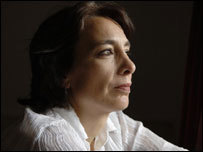
Stella Tillyard - image from BBC
Call Upon the Water is an historical novel of a time, during an ongoing English Civil War, when there was much turmoil, and much change happening in the world. It offers powerful portraits of significant places of the era, London of the interregnum, for example, with surreptitious street vendors peddling images of a decapitated King Charles, and a very visible military presence, of the sort one might expect in an occupied country. Another picture, of what is now East Anglia, shows its idyllic appeal as a natural place, in which the residents fight no wars against the natural order that provides them their livelihoods, and then later offers a dark view of the modernization, the denaturing of the place, with the use of hordes of slave laborers, prisoners of war from England’s ongoing battles. We get a look at 1664 New York, well, Niew Amsterdam, Manatus Eylandt, as the Dutch development of it grows northward, when Wall Street was still a wall, and the swampy edges of the island, as well as many wet inland spots beckoned the real estate developers of the time, and provided ample employment for an experienced Dutch engineer. We witness its handover to the English, who rename it for a crown favorite. And we get a look at the Virginia of the time, heavy with indentured labor, not yet so heavy with slaves. It appears that in the latter 17th century, every place is in need of draining, and conversion of wet land at the edges of solid land is de rigeur for the advancement of certain sorts of civilization, regardless of how that land provided for the residents, who are regarded as primitives, whether they are English fenlanders or Native Americans. Colonialism both at home and abroad requires denigration of the displaced residents.
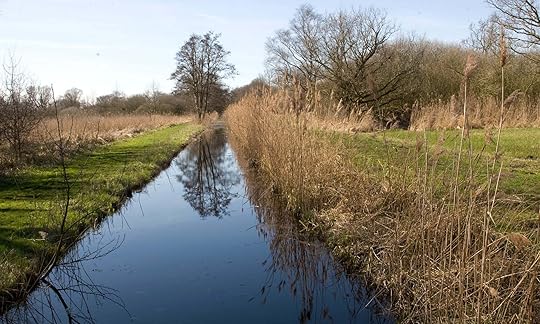
The fens - image from The Guardian
Eliza is one such. During his early paddling through the vast area to be redesigned in The Great Level, Jan comes across a group of local women bathing. One disrobes as he draws near, unaware. Virginal Janny is shocked
So I see her as I have never seen a woman, her whole nakedness, half in my plain sight, half reflected in the water. And in the same instant, or so it feels, she lifts her head and sees me there. Her furious eyes strip me of everything and make me as naked as herself.Well, not quite. Mortified Janny is smitten at the first instant of seeing his personal siren. When I look up I see the mere, the water and the sky, all unchanged. But I know that everything is altered and translated. I spin the coracle, work abandoned and paddle back to Ely, heavy with whatever is inside me. Guy never had a chance. Of course, he is bewitched in the way many a young man can be. (I was young once, I know) From that day on I live a different life. Something has happened to me…straight away I accept and ingest it. The woman I saw, who saw me, has taken up residence inside me… They begin to encounter each other on the water, then closer, then closer, then, well, you know, they become an item.
Each has something to teach the other, she the ways of the fenfolk, who make use of the bounty of their watery land. Like Professor Doolittle, although not to win a bet, he teaches her to read, write, very much at her request. He is making her over, as his company is making over the land. But she is no passive recipient. He teaches her also how to measure, in essence how to be an engineer. One might see Eliza not only as a siren figure but as a personification of the land itself.
From that day the sun shines on everything in the world. It feels to me as if I have a new knowledge, and that the change that came over me when you first fixed me with your glance was the beginning of it. This knowledge is not from a person or a book. It is a knowledge of what is, neither sacred nor profane, but just the world itself.Already open to such vision, he notes more and more of the nature of the place as he spends more time with Eliza.
Stand still in a full silence and it’s loud with noises. A heron takes flight; he creaks like a ship in sail. Ducks scuffle in the reeds. I hear the beat of wings, the movement of creatures in the grass, water rippling, and the wind that accompanies me everywhere, sighing and roaring. Nature, that seems so quiet, pours out its songs. Even in the darkness there is a velvet purr of sound, of moles underground and field mice above.One of the powerful elements of the novel is the portrayal of Eliza as a powerful woman, not only surviving in the perilous world of men, but using the knowledge she gains to survive the challenges she faces on two continents, and to secure what she wants from the universe, and maybe take a shot or two at what she perceives as dark forces.
One of the lesser elements of the book is the static nature of Jan. He is a bit stiff, personally, while possessing a naturalist’s feel for the untrammeled world. He has some notions of the sort of life he would like to build for himself, but seems unable to adapt to changes in his circumstances, remaining withdrawn and solitary. I hoped for more development of Jan’s character. Both Jan and Eliza are mostly about business, but Eliza seems much the livelier character of the two.
Jan goes through little character development, only from a young engineer to an experienced and confident one. He remains stand-offish, and sinks into the swamp of his unwillingness to act.
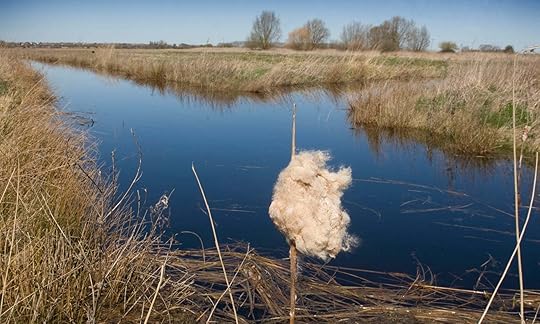
The fens - image from The Guardian
They share an appreciation for the beauty of the land, whether the fenlands of the Great Level or the new, exciting lands of the New World. Those are lyrical passages.
This is a novel of man in and versus nature, of colonialism at home and abroad, of both people and landscapes being subdued by political and monetary forces. Land as a source of power and freedom is central. Consideration is given to how one perceives time, Jan holding to a notion that time is a flexible thing, that one can inhabit multiple times simultaneously. This is contrasted with a New World perspective, that disdains any sort of rearward vision, and focuses on material success.
While Jan’s story makes up the bulk of the book, as he addresses his story to Eliza, she gets a chance to narrate towards the back of the book. I would have preferred to have seen their perspectives alternated, instead of being presented so separately, and would have liked learning much more about Eliza’s life before her home turf was so assaulted. A greater balance between their two tales would have been most welcome.
There are elements of excitement and danger, as the prisoners forced to work on the Great Level are less than willing, but are held in check by a dark sort who would look perfectly lovely in an SS uniform. The locals, as well, are not ecstatic about seeing their entire way of life bulldozed out of existence, and do not all endure it peacefully. Eliza’s experience is rich with peril, and we want her to find a way to survive.
Bottom line is that Call Upon the Water is a fascinating look at several places at a time in history most of us do not think about or see much in our diverse readings and entertainments. It is a worthwhile read for that alone. It offers a thoughtful look at the appeal of both nature untrammeled and the satisfying power of taming landscape, counterflows within individuals, as well as in the larger context. The love story is wonderful, for a time. But Jan seemed, despite his lyrical feelings for nature, just too withheld. You can rub two sticks together, but there will not always be a spark. There was one here, for a while, but after the initial heat, the ember never graduated to flame. That said, there is much to like here. And it probably won’t drain all your resources to check it out.
In the summer I may paddle on for days. I catch fish and travel as the wildmen do until I reach the far end of the island where it breaks into numerous inlets and beaches. Then I walk down to the open ocean and feel myself to be not a man but a part of nature, as is a star, or a dolphin that leaps for joy out in the bay. Far away round our earth lies the old world, while here I stand on the new. Waves rush up to my feet and then pull back, marbled with sand and foam.
Review first posted – October 11, 2019
Publication dates
-----UK – July 5, 2018 – as The Great Level - by Chato Windus
-----USA – September 17, 2019 – by Atria Books
=============================EXTRA STUFF
Links to the author’s personal, Twitter and GR pages
Her personal site is not particularly current.
Tillyard is a historian, best known for her bio of the Lennox Sisters, The Aristocrats, which was made into a very successful mini-series in 1999. In addition to her historical works, Tillyard published her first novel, Tides of War, in 2011.
Items of Interest
----- STREET PLAN OF NEW AMSTERDAM AND COLONIAL NEW YORK. - from the NYC Landmarks Preservation commission
-----The Guardian - ‘Weirder than any other landscape’: a wild walk in the Fens - by Patrick Barkham
-----Evening News - Norwich raised historian to release new book - by Rosanna Elliott
The author said: “Growing up in Norwich I was certainly aware of the fens, and I remember passing Ely often on the way to visit my grandparents in Cambridge. The great skies of East Anglia have always been inside me, and I still love flat landscapes and marshes.
“I am sure that inspired my choice of the fens when I thought about climate change, flooding and the changing use and exploitation of land and people.”
“There are little details in the book that come from my family history in Norwich,” said Tillyard, “Jan, my hero, buys boots from Norwich, where there are fine leather workers who have begun to settle there, fleeing from persecution in France.
“This is what my own Huguenot ancestors did. They were leather workers who by the 18th century had set up in Elm Hill in Norwich. The business eventually became Norvic Shoes, with a large factory in St George’s Plain.

November 28, 2018
Ever since I read the review in The Guardian, I have wanted to read this book ..... the story, set in the mid of the 17th century, of Jan Brunt, a Dutch engineer who comes to East Anglia to drain the marshes , is told in a most beautiful prose .... Jan is the narrator and describes his undertaking with love, as for him shaping the land is something more than just making it available for agricultural purposes although fields which are ploughed and give fruit are part of his vision ... His engineering efforts are not centred on money, although he is hired by a group of entrepreneurs who see profit in these drained land. Jan combines his skills and artistry .... And the Fens enchant him ... so does the local woman whom he meets and begins to love .... Jan finds his place on earth in New Amsterdam, which becomes New York, and where he leads modest, solitary life. I liked Eliza, who, though she begins as a slave on tobacco fields, is intelligent and makes her way in the New World. This is a marvellous, marvellous historical novel ...... I literally was unable to put this novel down ...... and it'll stay with me for a long time ..... what else could a reader ask for? ...........

August 28, 2019
Call Upon The Water carries the reader back to the 17th Century of England and America. Jan Brunt is an engineer and a mapmaker. He arrives in England in 1649, the year Charles I was beheaded and The Rump Parliament governs England. His job is to work on the Great Level, to drain and develop wetlands north of Ely.
Tillyard does a wonderful job of detailing the time and place. You get an immediate sense of the unease surrounding the country. In fact, her strength lies in conveying the history of the times, from the beheading to the Irish Wars to the English assumption of Nieuw Amsterdam (New York).
Jan is an interesting character. He is the typical engineer, a left brain sort of person. But he is also awed by nature and history and what he sees in the wilderness.
Once Jan meets Eliza, the writing begins to alternate. Whenever he’s thinking of Eliza, the narrative is second person. Otherwise, the story is told in first person. I can’t say I cared for the alternating methods and would have preferred it remained all told in first person so as to be less distracting.
This is not a book that is going to keep you turning pages or staying awake to read one more chapter. It’s a little lackluster. But there was enough new ( to me) history to keep me interested.
I would recommend this to those who are fans of historical fiction and looking for new subject matters.
My thanks to netgalley and Atria Books for an advance copy of this book.
Tillyard does a wonderful job of detailing the time and place. You get an immediate sense of the unease surrounding the country. In fact, her strength lies in conveying the history of the times, from the beheading to the Irish Wars to the English assumption of Nieuw Amsterdam (New York).
Jan is an interesting character. He is the typical engineer, a left brain sort of person. But he is also awed by nature and history and what he sees in the wilderness.
Once Jan meets Eliza, the writing begins to alternate. Whenever he’s thinking of Eliza, the narrative is second person. Otherwise, the story is told in first person. I can’t say I cared for the alternating methods and would have preferred it remained all told in first person so as to be less distracting.
This is not a book that is going to keep you turning pages or staying awake to read one more chapter. It’s a little lackluster. But there was enough new ( to me) history to keep me interested.
I would recommend this to those who are fans of historical fiction and looking for new subject matters.
My thanks to netgalley and Atria Books for an advance copy of this book.
October 11, 2019
That is what I believed: that time nibbles away at the future, and in that moment puts the present behind its back. The past retreats as each present moment joins it, on and on. Yet that is far too simple. Inside us, time sways backwards and forwards from now to then, here to there, and nothing of it is lost or goes away, but it all hangs everywhere, translucent in the air. Some men turn away, and walk on, saying that the past contains only their former selves and ghosts of people and deeds. Others, like myself, live every day with it. One minute I am in Nieuw Amsterdam, the next pulled on a string into the other time that comes with me, so that here on the Heere Gracht, or as I walk across the marketplace, you and I talk.========================================
Looking back is a game for fools and not one that I like to play.It is 1664. Jan Brunt, a reclusive Dutch bachelor and engineer, lives in what will soon become New York. When he receives a letter announcing the arrival of an old friend, he looks back to the greatest professional and personal challenge of his life, the first his work as an engineer on one of the greatest European development projects of the pre-industrial age, The Great Level, a draining of five hundred square miles of wetland in southeastern England and transformation of it into arable farmland. The second, the relationship he forms with a local woman while working on that vast endeavor, the love of his life. His story flips back and forth between these two periods.
Stella Tillyard - image from BBC
The Great Level is an historical novel of a time, during an ongoing English Civil War, when there was much turmoil, and much change happening in the world. It offers powerful portraits of significant places of the era, London of the interregnum, for example, with surreptitious street vendors peddling images of a decapitated King Charles, and a very visible military presence, of the sort one might expect in an occupied country. Another picture, of what is now East Anglia, shows its idyllic appeal as a natural place, in which the residents fight no wars against the natural order that provides them their livelihoods, and then later offers a dark view of the modernization, the denaturing of the place, with the use of hordes of slave laborers, prisoners of war from England’s ongoing battles. We get a look at 1664 New York, well, Niew Amsterdam, Manatus Eylandt, as the Dutch development of it grows northward, when Wall Street was still a wall, and the swampy edges of the island, as well as many wet inland spots beckoned the real estate developers of the time, and provided ample employment for an experienced Dutch engineer. We witness its handover to the English, who rename it for a crown favorite. And we get a look at the Virginia of the time, heavy with indentured labor, not yet so heavy with slaves. It appears that in the latter 17th century, every place is in need of draining, and conversion of wet land at the edges of solid land is de rigeur for the advancement of certain sorts of civilization, regardless of how that land provided for the residents, who are regarded as primitives, whether they are English fenlanders or Native Americans. Colonialism both at home and abroad requires denigration of the displaced residents.
The fens - image from The Guardian
Eliza is one such. During his early paddling through the vast area to be redesigned in The Great Level, Jan comes across a group of local women bathing. One disrobes as he draws near, unaware. Virginal Janny is shocked
So I see her as I have never seen a woman, her whole nakedness, half in my plain sight, half reflected in the water. And in the same instant, or so it feels, she lifts her head and sees me there. Her furious eyes strip me of everything and make me as naked as herself.Well, not quite. Mortified Janny is smitten at the first instant of seeing his personal siren. When I look up I see the mere, the water and the sky, all unchanged. But I know that everything is altered and translated. I spin the coracle, work abandoned and paddle back to Ely, heavy with whatever is inside me. Guy never had a chance. Of course, he is bewitched in the way many a young man can be. (I was young once, I know) From that day on I live a different life. Something has happened to me…straight away I accept and ingest it. The woman I saw, who saw me, has taken up residence inside me… They begin to encounter each other on the water, then closer, then closer, then, well, you know, they become an item.
Each has something to teach the other, she the ways of the fenfolk, who make use of the bounty of their watery land. Like Professor Doolittle, although not to win a bet, he teaches her to read, write, very much at her request. He is making her over, as his company is making over the land. But she is no passive recipient. He teaches her also how to measure, in essence how to be an engineer. One might see Eliza not only as a siren figure but as a personification of the land itself.
From that day the sun shines on everything in the world. It feels to me as if I have a new knowledge, and that the change that came over me when you first fixed me with your glance was the beginning of it. This knowledge is not from a person or a book. It is a knowledge of what is, neither sacred nor profane, but just the world itself.Already open to such vision, he notes more and more of the nature of the place as he spends more time with Eliza.
Stand still in a full silence and it’s loud with noises. A heron takes flight; he creaks like a ship in sail. Ducks scuffle in the reeds. I hear the beat of wings, the movement of creatures in the grass, water rippling, and the wind that accompanies me everywhere, sighing and roaring. Nature, that seems so quiet, pours out its songs. Even in the darkness there is a velvet purr of sound, of moles underground and field mice above.One of the powerful elements of the novel is the portrayal of Eliza as a powerful woman, not only surviving in the perilous world of men, but using the knowledge she gains to survive the challenges she faces on two continents, and to secure what she wants from the universe, and maybe take a shot or two at what she perceives as dark forces.
One of the lesser elements of the book is the static nature of Jan. He is a bit stiff, personally, while possessing a naturalist’s feel for the untrammeled world. He has some notions of the sort of life he would like to build for himself, but seems unable to adapt to changes in his circumstances, remaining withdrawn and solitary. I hoped for more development of Jan’s character. Both Jan and Eliza are mostly about business, but Eliza seems much the livelier character of the two.
Jan goes through little character development, only from a young engineer to an experienced and confident one. He remains stand-offish, and sinks into the swamp of his unwillingness to act.
The fens - image from The Guardian
They share an appreciation for the beauty of the land, whether the fenlands of the Great Level or the new, exciting lands of the New World. Those are lyrical passages.
This is a novel of man in and versus nature, of colonialism at home and abroad, of both people and landscapes being subdued by political and monetary forces. Land as a source of power and freedom is central. Consideration is given to how one perceives time, Jan holding to a notion that time is a flexible thing, that one can inhabit multiple times simultaneously. This is contrasted with a New World perspective, that disdains any sort of rearward vision, and focuses on material success.
While Jan’s story makes up the bulk of the book, as he addresses his story to Eliza, she gets a chance to narrate towards the back of the book. I would have preferred to have seen their perspectives alternated, instead of being presented so separately, and would have liked learning much more about Eliza’s life before her home turf was so assaulted. A greater balance between their two tales would have been most welcome.
There are elements of excitement and danger, as the prisoners forced to work on the Great Level are less than willing, but are held in check by a dark sort who would look perfectly lovely in an SS uniform. The locals, as well, are not ecstatic about seeing their entire way of life bulldozed out of existence, and do not all endure it peacefully. Eliza’s experience is rich with peril, and we want her to find a way to survive.
Bottom line is that The Great Level is a fascinating look at several places at a time in history most of us do not think about or see much in our diverse readings and entertainments. It is a worthwhile read for that alone. It offers a thoughtful look at the appeal of both nature untrammeled and the satisfying power of taming landscape, counterflows within individuals, as well as in the larger context. The love story is wonderful, for a time. But Jan seemed, despite his lyrical feelings for nature, just too withheld. You can rub two sticks together, but there will not always be a spark. There was one here, for a while, but after the initial heat, the ember never graduated to flame. That said, there is much to like here. And it probably won’t drain all your resources to check it out.
In the summer I may paddle on for days. I catch fish and travel as the wildmen do until I reach the far end of the island where it breaks into numerous inlets and beaches. Then I walk down to the open ocean and feel myself to be not a man but a part of nature, as is a star, or a dolphin that leaps for joy out in the bay. Far away round our earth lies the old world, while here I stand on the new. Waves rush up to my feet and then pull back, marbled with sand and foam.
Review posted – October 11, 2019
Publication dates
-----UK – July 5, 2018 - by Chato Windus
-----USA – September 17, 2019 – as Call Upon the Water - by Atria Books
=============================EXTRA STUFF
Links to the author’s personal, Twitter and GR pages
Her personal site is not particularly current.
Tillyard is a historian, best known for her bio of the Lennox Sisters, The Aristocrats, which was made into a very successful mini-series in 1999. In addition to her historical works, Tillyard published her first novel, Tides of War, in 2011.
Items of Interest
----- STREET PLAN OF NEW AMSTERDAM AND COLONIAL NEW YORK. - from the NYC Landmarks Preservation commission
-----The Guardian - ‘Weirder than any other landscape’: a wild walk in the Fens - by Patrick Barkham
-----Evening News - Norwich raised historian to release new book - by Rosanna Elliott
The author said: “Growing up in Norwich I was certainly aware of the fens, and I remember passing Ely often on the way to visit my grandparents in Cambridge. The great skies of East Anglia have always been inside me, and I still love flat landscapes and marshes.
“I am sure that inspired my choice of the fens when I thought about climate change, flooding and the changing use and exploitation of land and people.”
“There are little details in the book that come from my family history in Norwich,” said Tillyard, “Jan, my hero, buys boots from Norwich, where there are fine leather workers who have begun to settle there, fleeing from persecution in France.
“This is what my own Huguenot ancestors did. They were leather workers who by the 18th century had set up in Elm Hill in Norwich. The business eventually became Norvic Shoes, with a large factory in St George’s Plain.
September 17, 2019
Jan Brunt has moved to Great Britain from the Netherlands in the mid 1600s. He is assigned to work on a marshy wetland, the Great Leve, to develop the area. Jan is a man of order and schedules, and he is knocked out of sorts when he meets Eliza who throws a wrench in all his order.
Jan wants Eliza to better her situation, but in helping her, she then turns on him and corrupts his work. After that, Jan flees to the American colonies.
There, he is met with an additional need for his skills as an engineer and is asked to develop more land. All comes to a halt for Jan when he finds out Eliza is now in the New World, too, and she brings with her all the knowledge Jan taught her. She seeks freedom above all else.
Wow, Call Upon the Water is quite the adventure story. I loved the brave escapades the characters took to the New World. I was fascinated with all I learned about the development of inhospitable lands. The author brought time and place to the forefront in well-done fashion. Jan and Eliza’s characters were so easy to get to know. I wanted the best for each of them.
Overall, Call Upon the Water is a character-driven, solid historical with an alluring and exciting backdrop. I soaked up all I learned and am looking forward to what Tillyard brings us next!
I received a complimentary copy. All opinions are my own.
Many of my reviews can also be found on my blog: www.jennifertarheelreader.com and instagram: www.instagram.com/tarheelreader.
Jan wants Eliza to better her situation, but in helping her, she then turns on him and corrupts his work. After that, Jan flees to the American colonies.
There, he is met with an additional need for his skills as an engineer and is asked to develop more land. All comes to a halt for Jan when he finds out Eliza is now in the New World, too, and she brings with her all the knowledge Jan taught her. She seeks freedom above all else.
Wow, Call Upon the Water is quite the adventure story. I loved the brave escapades the characters took to the New World. I was fascinated with all I learned about the development of inhospitable lands. The author brought time and place to the forefront in well-done fashion. Jan and Eliza’s characters were so easy to get to know. I wanted the best for each of them.
Overall, Call Upon the Water is a character-driven, solid historical with an alluring and exciting backdrop. I soaked up all I learned and am looking forward to what Tillyard brings us next!
I received a complimentary copy. All opinions are my own.
Many of my reviews can also be found on my blog: www.jennifertarheelreader.com and instagram: www.instagram.com/tarheelreader.

July 4, 2019
Set during the fall and rise of King Charles II of England, this story does not bring court intrigues, what it offers instead is an intense depiction of lives of simple people and those with education who used their knowledge to make a mark in history by draining and developing wetlands for human use. And a deeply moving portrayal of a man exploring the power of nature and the power of love.
1649, Jan Brunt, an engineer, arrives in Great Britain from the Netherlands to work on draining and developing wetlands known as Great Level. His work begins with mapping the area, then planning how to drain the whole. This brings original descriptions.
With another Dutchman leader, they “measure and draw, calculate and note (…) They are the first engineers to map this whole wilderness, and take pride in that fact, as if they were explorers out on the ocean.”
One day, as Jan is engrossed in his work of calculations, a native woman approaches him. Her name is Eliza. When Jan relates his own story, he talks about Eliza in the second person narrative. “As the weeks pass you tell me something of your people and how you live together on islands in the meres.” This creates brilliant prose.
His relationship with Eliza and her telling him how her people claim the land from the waters, make him realize that man was not created “to be the lords of creation, but a part of it.”
The project is so vast and ambitious that it requires not hundreds but thousands men to complete the project. Where shall they find them? General Cromwell offers a solution. He will send prisoners from his wars in Ireland.
After a sabotage of his work, he feels the need to change a place and takes the first opportunity that comes his way and travels to the new colonies in America. He travels freely to New Amsterdam. She is taken as a prisoner to the Colony of Virginia. But what unravels is another beautiful story of her opportunity.
In New Amsterdam, 1664, he records his story and witnesses Charles’ conquest of New Amsterdam, renaming it to New York in honor of his brother James, Duke of York.
With original descriptions and beautiful prose, the author brings a masterful story of a man’s quest to control the nature and to be reunited with the love of his life during a time of colonial conquests.
Usually, I prefer stand-alone books, but the way this book ends, I so hope for a follow-up to this richly imagined story.
Source: ARC was provided by the publisher via Netgalley in exchange for an honest review.
1649, Jan Brunt, an engineer, arrives in Great Britain from the Netherlands to work on draining and developing wetlands known as Great Level. His work begins with mapping the area, then planning how to drain the whole. This brings original descriptions.
With another Dutchman leader, they “measure and draw, calculate and note (…) They are the first engineers to map this whole wilderness, and take pride in that fact, as if they were explorers out on the ocean.”
One day, as Jan is engrossed in his work of calculations, a native woman approaches him. Her name is Eliza. When Jan relates his own story, he talks about Eliza in the second person narrative. “As the weeks pass you tell me something of your people and how you live together on islands in the meres.” This creates brilliant prose.
His relationship with Eliza and her telling him how her people claim the land from the waters, make him realize that man was not created “to be the lords of creation, but a part of it.”
The project is so vast and ambitious that it requires not hundreds but thousands men to complete the project. Where shall they find them? General Cromwell offers a solution. He will send prisoners from his wars in Ireland.
After a sabotage of his work, he feels the need to change a place and takes the first opportunity that comes his way and travels to the new colonies in America. He travels freely to New Amsterdam. She is taken as a prisoner to the Colony of Virginia. But what unravels is another beautiful story of her opportunity.
In New Amsterdam, 1664, he records his story and witnesses Charles’ conquest of New Amsterdam, renaming it to New York in honor of his brother James, Duke of York.
With original descriptions and beautiful prose, the author brings a masterful story of a man’s quest to control the nature and to be reunited with the love of his life during a time of colonial conquests.
Usually, I prefer stand-alone books, but the way this book ends, I so hope for a follow-up to this richly imagined story.
Source: ARC was provided by the publisher via Netgalley in exchange for an honest review.

January 28, 2020
When you need an authentic historical placement plus a book you can ponder about for days after finishing, then this is the book for you. I strongly recommend it. Slow and steady it's a lesson. No small thing to learn to prevail in your thoughts over the negatives of life adversities. Be they huge or tiny ones.
Reading about 8 reviews after finishing the read of Call Upon the Water myself, I can truthfully say I liked this book FAR, far more than most other readers did. In fact, I loved this book. It was the book I returned to when the others of fiction and non-fiction in the middling pile disappointed. It was kept like a delicious single mouthful treat after a week of strict dieting. It was savored indeed.
It's an unusual book. It's fully historical fiction as it was written during the last 20th century, especially the early and middle parts of that century. And it is not an "action" book in anyway at all. Nor plotted in tight design or nebulous context complexities. Nor is it like the books of the last 20 years which reign on agendas of wider scope. Usually centered by victims, helpless, hopeless and justified ire. This is the opposite of that. It's about rather embracing the worst to get to next best. It's more life real than most fiction because of it.
It's about engineering the fens, wetland, river mouths, islet marshes to "sound ground". As it was practiced by the Dutch before this period, and other wider groups after. And it takes places in both New and Old worlds of the 1644-1670 plus period span. Our characters have feet in both worlds eventually. And there is great change for more than just their groups.
But like the sea going to solid land through drainage- most of the change is in the composition. And this is that gem of a book which cores on the composition of the individual himself/herself about himself, or herself. What Jan or Eliza believe about Jan or Eliza. And that makes ALL THE DIFFERENCE. Not only in their own lives, but to those places that house them.
Seeing the Roundhead vs Cavalier period from rather "outside" eyes was fantastic too. As was the speech patterns and spellings. This is a superb book to read for that nuance as well. It is divided into parts. And the big surprise was that the last part was primarily for the narrator's thoughts again, but from Eliza. And not the Dutchman Jan- who became our North American John Brown.
This gets a 5 star in another category that is rare, rare. In how it depicts an individual self-determining how they will think of themselves and what and to who they will reveal in their own past realities to "themselves". That's hard to understand, but it's one of the crux issues that is fully human. And one that is nearly occluded in practice within our modern world. Or rarely ventured in fiction or literature either. For one thing, discretion and full honesty to one's core about future "allowing yourself to think this" practiced and practiced by habit; that is no longer taught, encouraged, or even described in most youth learning processes. Not only as a property of conscience taking as per within religion but even within any larger structure for value sense internal determination at all. So people are (and believe it of themselves too) primarily reactors, not actors of their own words/ plays. And only fodders of fate; not self-determining individuals of full will at all. Considering themselves just products of a certain time and environment, and often not even considering what their own thoughts roam to and within. Only seeming to themselves as objects of fate to be pushed, shoved or gathered in to "something" which already exists. People no longer are themselves first and decide what that self will know, think about, be- connote in general. Instead that assume they are just products of environments of their personal worlds. Maybe this modern result is from too much input and not enough pure contemplation and reaching to "settle" to know what's at your core? That's part of it, but it is more than that. Maybe also the lack of internal silence or silences of nature. Regardless, this book nails that feature. How you CHOOSE to live in your own mind. Not just what happens for your physical self to react to and with and for.
You see, I could post about this book for eons. I would love to speak of it to a long passed history and philosophy professor. We could have an excellent cognitive "reality" talk. Others will mention the colonial aspects and "eyes" of injustices. I won't because you've heard that same echoed message too much. Or of the learning to be literate either- what that meant to girls and women in particular- and not only in this 17th century world either. Eliza will tell you.
Most people will call this book BORING. It's full of information about the water of earth and life it carves, as well. But it's primarily about the engineering of the mind to become the person most desired for yourself. Also it's a love story. But the love must be first about self knowledge and best uses of your own powers becomes the stronger message. It's solid ground to grow a new life.
I wish it were longer. Maybe there will be a sequel? That's where it lost the 1 star for me.
Reading about 8 reviews after finishing the read of Call Upon the Water myself, I can truthfully say I liked this book FAR, far more than most other readers did. In fact, I loved this book. It was the book I returned to when the others of fiction and non-fiction in the middling pile disappointed. It was kept like a delicious single mouthful treat after a week of strict dieting. It was savored indeed.
It's an unusual book. It's fully historical fiction as it was written during the last 20th century, especially the early and middle parts of that century. And it is not an "action" book in anyway at all. Nor plotted in tight design or nebulous context complexities. Nor is it like the books of the last 20 years which reign on agendas of wider scope. Usually centered by victims, helpless, hopeless and justified ire. This is the opposite of that. It's about rather embracing the worst to get to next best. It's more life real than most fiction because of it.
It's about engineering the fens, wetland, river mouths, islet marshes to "sound ground". As it was practiced by the Dutch before this period, and other wider groups after. And it takes places in both New and Old worlds of the 1644-1670 plus period span. Our characters have feet in both worlds eventually. And there is great change for more than just their groups.
But like the sea going to solid land through drainage- most of the change is in the composition. And this is that gem of a book which cores on the composition of the individual himself/herself about himself, or herself. What Jan or Eliza believe about Jan or Eliza. And that makes ALL THE DIFFERENCE. Not only in their own lives, but to those places that house them.
Seeing the Roundhead vs Cavalier period from rather "outside" eyes was fantastic too. As was the speech patterns and spellings. This is a superb book to read for that nuance as well. It is divided into parts. And the big surprise was that the last part was primarily for the narrator's thoughts again, but from Eliza. And not the Dutchman Jan- who became our North American John Brown.
This gets a 5 star in another category that is rare, rare. In how it depicts an individual self-determining how they will think of themselves and what and to who they will reveal in their own past realities to "themselves". That's hard to understand, but it's one of the crux issues that is fully human. And one that is nearly occluded in practice within our modern world. Or rarely ventured in fiction or literature either. For one thing, discretion and full honesty to one's core about future "allowing yourself to think this" practiced and practiced by habit; that is no longer taught, encouraged, or even described in most youth learning processes. Not only as a property of conscience taking as per within religion but even within any larger structure for value sense internal determination at all. So people are (and believe it of themselves too) primarily reactors, not actors of their own words/ plays. And only fodders of fate; not self-determining individuals of full will at all. Considering themselves just products of a certain time and environment, and often not even considering what their own thoughts roam to and within. Only seeming to themselves as objects of fate to be pushed, shoved or gathered in to "something" which already exists. People no longer are themselves first and decide what that self will know, think about, be- connote in general. Instead that assume they are just products of environments of their personal worlds. Maybe this modern result is from too much input and not enough pure contemplation and reaching to "settle" to know what's at your core? That's part of it, but it is more than that. Maybe also the lack of internal silence or silences of nature. Regardless, this book nails that feature. How you CHOOSE to live in your own mind. Not just what happens for your physical self to react to and with and for.
You see, I could post about this book for eons. I would love to speak of it to a long passed history and philosophy professor. We could have an excellent cognitive "reality" talk. Others will mention the colonial aspects and "eyes" of injustices. I won't because you've heard that same echoed message too much. Or of the learning to be literate either- what that meant to girls and women in particular- and not only in this 17th century world either. Eliza will tell you.
Most people will call this book BORING. It's full of information about the water of earth and life it carves, as well. But it's primarily about the engineering of the mind to become the person most desired for yourself. Also it's a love story. But the love must be first about self knowledge and best uses of your own powers becomes the stronger message. It's solid ground to grow a new life.
I wish it were longer. Maybe there will be a sequel? That's where it lost the 1 star for me.

January 8, 2019
Beautifully written. Historical facts mixed with a personal story which I enjoyed very much. The main characters are not worked out in depth. The author observes them throughout their lives and relates the observations to the reader. It's a fairytale style of writing, but well done, I felt I was there.

September 17, 2018
Now this should have been a book I enjoyed.
It has chapters set in my place of birth (Kings Lynn) and many others set at the very foundation of the City I visit monthly (New York – as it transitions from New Amsterdam)
Golden Hill
The Kings Lynn (and Ely) part is around the draining of the Fens – a landscape which has inspired great writing such as Fen by Daisy Johnson, Waterland by Graham Swift and Paul Kingsnorth's The Wake.
The New York part similar in many ways to the setting of Francis Spufford’s exuberant debut novel .
Further the book is by a respected historian and set in one of the most fascinating periods of English (and early Colonial) history – the revolution and restoration. Its main narrator is an engineer – just like the wonderful Dublin Literary and Goldsmith winning Solar Bones by Mike McCormack.
Returning to this book ...
The main character and main first party narrator of the book is a Dutchman Jan Brunt – who, with his engineering knowledge developed in the dams and polders of Holland, accepts a position in 1649 as one of the lead engineers on the project to drain the marshes in the Fens around Ely.
Each part of the book starts with a section set in Nieuw Amsterdam, where a largely solitary and withdrawn Jan, still acting as an advisor on water drainage, is confronted with a note promising a visit from someone he has not seen for many years – which in turn causes him to reflect on the events of the Great Level.
The Great Level parts are full of details of the drainage – perhaps the most interesting element is the heavy use of forced labour (firstly Irish and later Covenanter prisoners of war of Cromwell). Sadly though the actual engineering and drainage elements themselves do not come to life – they are neither entertaining or informative and I felt I would have been much better served by a non-fictional treatment of the Great Level. Another element is the almost pagan nature of the marsh dwellers – captured in Eliza a fey, almost ghost like woman who visits him and with whom he forms an intense relationship: however I found this part rather strained credibility.
The sections in the American colonies are stronger – and particularly a whole part which switches to the first party voice of Eliza – an Eliza who is a far more interesting and compelling character and whose hints of her reappearance bring into life the depths of Jan’s character. Her transformation from the character of the first part is best described as like the Doolittle of Pygmalion - presumably deliberately given her first name, but was weakened for me by her somewhat fantasy like presence in the Great Level sections.
So certainly an interesting book but one which felt short of the Great Level of my expectations – the sections set in the UK draining my enthusiasm as efficiently as Jan does the Fens.
It has chapters set in my place of birth (Kings Lynn) and many others set at the very foundation of the City I visit monthly (New York – as it transitions from New Amsterdam)
Golden Hill
The Kings Lynn (and Ely) part is around the draining of the Fens – a landscape which has inspired great writing such as Fen by Daisy Johnson, Waterland by Graham Swift and Paul Kingsnorth's The Wake.
The New York part similar in many ways to the setting of Francis Spufford’s exuberant debut novel .
Further the book is by a respected historian and set in one of the most fascinating periods of English (and early Colonial) history – the revolution and restoration. Its main narrator is an engineer – just like the wonderful Dublin Literary and Goldsmith winning Solar Bones by Mike McCormack.
Returning to this book ...
The main character and main first party narrator of the book is a Dutchman Jan Brunt – who, with his engineering knowledge developed in the dams and polders of Holland, accepts a position in 1649 as one of the lead engineers on the project to drain the marshes in the Fens around Ely.
Each part of the book starts with a section set in Nieuw Amsterdam, where a largely solitary and withdrawn Jan, still acting as an advisor on water drainage, is confronted with a note promising a visit from someone he has not seen for many years – which in turn causes him to reflect on the events of the Great Level.
The Great Level parts are full of details of the drainage – perhaps the most interesting element is the heavy use of forced labour (firstly Irish and later Covenanter prisoners of war of Cromwell). Sadly though the actual engineering and drainage elements themselves do not come to life – they are neither entertaining or informative and I felt I would have been much better served by a non-fictional treatment of the Great Level. Another element is the almost pagan nature of the marsh dwellers – captured in Eliza a fey, almost ghost like woman who visits him and with whom he forms an intense relationship: however I found this part rather strained credibility.
The sections in the American colonies are stronger – and particularly a whole part which switches to the first party voice of Eliza – an Eliza who is a far more interesting and compelling character and whose hints of her reappearance bring into life the depths of Jan’s character. Her transformation from the character of the first part is best described as like the Doolittle of Pygmalion - presumably deliberately given her first name, but was weakened for me by her somewhat fantasy like presence in the Great Level sections.
So certainly an interesting book but one which felt short of the Great Level of my expectations – the sections set in the UK draining my enthusiasm as efficiently as Jan does the Fens.

September 12, 2019
Call Upon the Water
The call is a long one – the voices of Eliza and Jan, fly with the relentlessness of requited but deferred love over water and around the world. From England to New Amsterdam it followed them, and peacefully settled on Manatus Eylandt.
I learned much reading this tale: about the Great Level, fens, fen people, engineering water - draining wet lands. Knowledge had long before now, all with its goal to create arable, ownable, sellable land. Again, I am tossed, incredulous, up against the wall of my own ignorance. To tackle the education of a reader such as me, who needs to understand the work at hand in order to have a real sense of Jan Brunt (aka John Brown), the author does a grand job of describing the place and the people of the fen lands, The Great Level. Yes! A-googling I did go. The names on the maps are still there, the Roman roads still referenced. It is there that the lovers find each other and enjoy limb upon limb, the sunshine, reeds and no social media.
Of course, the fens are drained and that changes everything, including continents, and the story lays out parallel lives, so close, so near. . . . Oh, how I enjoyed the use of first, second and third person to help the reader understand who is narrator in the various sections. I especially loved the second person usage. . .it felt very real to me, as I often use it in my own head when speaking to those I love, all those things I can’t say for all the reasons I can’t say them. Using the Dutch and English references helps as well. I must admit I whimpered a little at the end. I get it though. Not every bow is tied.
I highly recommend this book. 4 stars from me.
A Sincere Thanks to Stella Tillyard, Atria Books and NetGalley for an ARC to read and review.
The call is a long one – the voices of Eliza and Jan, fly with the relentlessness of requited but deferred love over water and around the world. From England to New Amsterdam it followed them, and peacefully settled on Manatus Eylandt.
I learned much reading this tale: about the Great Level, fens, fen people, engineering water - draining wet lands. Knowledge had long before now, all with its goal to create arable, ownable, sellable land. Again, I am tossed, incredulous, up against the wall of my own ignorance. To tackle the education of a reader such as me, who needs to understand the work at hand in order to have a real sense of Jan Brunt (aka John Brown), the author does a grand job of describing the place and the people of the fen lands, The Great Level. Yes! A-googling I did go. The names on the maps are still there, the Roman roads still referenced. It is there that the lovers find each other and enjoy limb upon limb, the sunshine, reeds and no social media.
Of course, the fens are drained and that changes everything, including continents, and the story lays out parallel lives, so close, so near. . . . Oh, how I enjoyed the use of first, second and third person to help the reader understand who is narrator in the various sections. I especially loved the second person usage. . .it felt very real to me, as I often use it in my own head when speaking to those I love, all those things I can’t say for all the reasons I can’t say them. Using the Dutch and English references helps as well. I must admit I whimpered a little at the end. I get it though. Not every bow is tied.
I highly recommend this book. 4 stars from me.
A Sincere Thanks to Stella Tillyard, Atria Books and NetGalley for an ARC to read and review.

October 15, 2018
Stella Tillyard’s The Great Level is an absolute stunner. It’s everything that I want in an historical novel: a completely immersive reading experience, feeling submerged in a previously unknown historical epoch and previously unknown historical locales. After Mike McCormack’s Solar Bones, whoever would have thought that another novel about a civil engineer could be so fully absorbing, especially one located in seventeenth century England and Manhattan. Tillyard recounts the struggles of Dutch civil engineers, supported by wealthy gentry, prisoners, and soldiers, struggle to reclaim arable land from the fenlands surrounding the Isle of Ely. Tillyard invents fully believable characters—and especially Jan Brunt and Eliza—who involve us in their lives.
Jan's voice is especially convincing and powerful. Here he speaks of his work: "But my pleasure, when I talk of my work, has a darkening edge. It has come to me that for one world to be made, another must die. Now, as my vision begins to come into being, I am filled with sadness as well as joy. I have seen that this unimproved world has its own way of being which will will be lost. It has, even, its own splendor." And here Jan speaks of memory: "It is said that the contrary of to forget is to remember, yet that axiom sounds now like something learned at school, a verse recited or a catechism, just a story in language. The contrary of to forget, I see now, is to be a part of, to live with and to share. I watch the ocean disappear behind me and know that a life without a past is a thin one, a life starved of voices and nourishment. I will not forget; I will let memory live. . ."
The Great Level for me is also a testament to the power of browsing in an excellent bookstore. Almost all of what I read now is by less than two handfuls of favorite novelists—Brookner, Green, Modiano, Roth, Rhys, Robinson—or from recommendations gleaned from book reviews, literary friends, or prize lists. But I discovered The Great Level on a table with recently published fiction in Toppings and Company, with a lovely dustjacket and an inviting “signed first edition” ribbon (no sticker, thank you very much).
One small quibble, and one which I hope Chatto & Windus addresses in a future edition. The Great Level is a novel that demands illustrative endpapers and hand-drawn maps of both the Great Level and Manatus Eylandt.
Jan's voice is especially convincing and powerful. Here he speaks of his work: "But my pleasure, when I talk of my work, has a darkening edge. It has come to me that for one world to be made, another must die. Now, as my vision begins to come into being, I am filled with sadness as well as joy. I have seen that this unimproved world has its own way of being which will will be lost. It has, even, its own splendor." And here Jan speaks of memory: "It is said that the contrary of to forget is to remember, yet that axiom sounds now like something learned at school, a verse recited or a catechism, just a story in language. The contrary of to forget, I see now, is to be a part of, to live with and to share. I watch the ocean disappear behind me and know that a life without a past is a thin one, a life starved of voices and nourishment. I will not forget; I will let memory live. . ."
The Great Level for me is also a testament to the power of browsing in an excellent bookstore. Almost all of what I read now is by less than two handfuls of favorite novelists—Brookner, Green, Modiano, Roth, Rhys, Robinson—or from recommendations gleaned from book reviews, literary friends, or prize lists. But I discovered The Great Level on a table with recently published fiction in Toppings and Company, with a lovely dustjacket and an inviting “signed first edition” ribbon (no sticker, thank you very much).
One small quibble, and one which I hope Chatto & Windus addresses in a future edition. The Great Level is a novel that demands illustrative endpapers and hand-drawn maps of both the Great Level and Manatus Eylandt.

March 8, 2020
This historical set in mid 1600's delivers lyrical prose with descriptions of expanses of wetlands reaching mystical heights, romance that is grounded in that landscape and profiles of a Dutch engineer and the woman he meets among the reeds.
Jan Brunt leaves his home in the Netherlands to utilize his engineering skills to drain wetlands, first mapping the Great Level. During his solitary life whilst accomplishing this task he meets Eliza and the bond is made. He teaches her on the subject during their time together and she is able to use that knowledge later in her journey in the New World. Both think of the other after they have been forced apart with Eliza being taken as prisoner to America. Jan eventually moves there as well.
Their experiences are very different, but the book ends with the hint that they will meet again. That remains to be seen, but it's ok with me to leave it here. This book was published in 2018.
Sample:
Early in Jan's work he feels he is being watched. He tells a friend. "'There is no one here concealed,' he says with a smile. 'It is your own loneliness that conjured watchers, as wanderers see phantoms out of fear and hope.' He is mistaken, or has forgotten where we come from. I am a Dutchman and an islander. Water and sky are safe to me as my mother's skirts. I know an empty silence and a full silence. Stand still in a full silence and it's loud with noises. A heron takes flight; he creaks like a ship in sail. Ducks scuffle in the reeds. I hear the beat of wings, the movement of creatures in the grass, water rippling, and the wind that accompanies me everywhere, sighing and roaring. Nature, that seems so quiet, pours out it s songs. Even in the darkness there is a velvet purr of sound, of moes underground and field mice above."
Library Loan
Jan Brunt leaves his home in the Netherlands to utilize his engineering skills to drain wetlands, first mapping the Great Level. During his solitary life whilst accomplishing this task he meets Eliza and the bond is made. He teaches her on the subject during their time together and she is able to use that knowledge later in her journey in the New World. Both think of the other after they have been forced apart with Eliza being taken as prisoner to America. Jan eventually moves there as well.
Their experiences are very different, but the book ends with the hint that they will meet again. That remains to be seen, but it's ok with me to leave it here. This book was published in 2018.
Sample:
Early in Jan's work he feels he is being watched. He tells a friend. "'There is no one here concealed,' he says with a smile. 'It is your own loneliness that conjured watchers, as wanderers see phantoms out of fear and hope.' He is mistaken, or has forgotten where we come from. I am a Dutchman and an islander. Water and sky are safe to me as my mother's skirts. I know an empty silence and a full silence. Stand still in a full silence and it's loud with noises. A heron takes flight; he creaks like a ship in sail. Ducks scuffle in the reeds. I hear the beat of wings, the movement of creatures in the grass, water rippling, and the wind that accompanies me everywhere, sighing and roaring. Nature, that seems so quiet, pours out it s songs. Even in the darkness there is a velvet purr of sound, of moes underground and field mice above."
Library Loan

October 29, 2019
Steady and strong writing but plot was not as solid. The story felt so close to taking me somewhere fantastic but I’m still waiting for that “somewhere.” Thank you to the publisher for allowing me to read an ARC.

December 21, 2019
Like 80% of the books I read, Call Upon the Water is historical fiction. Yet, I found it to be different from almost any other historical fiction that I've read. Most books in this genre seem to be driven by a strong plot line or plot lines. In Call Upon the Water, it is the settings and the inner thoughts of the two main characters that seem to drive the novel. The story takes place in the 17th century in England, America, and a bit of the Netherlands. More specifically, the wetlands (marsh, swamp, fens) of these lands is richly described. I felt transported to muck and mud, humid air, waving reeds, slithering eels and the ague. I'm sure I don't like that environment and it was fascinating to learn how Jan, a 17th century engineer, knew how to drain the wetlands to reclaim it as farmland for the English. It was also sobering to contemplate how we have changed ecosystems for the worse, in many ways. Jan is an interesting character, in some ways stereotypical of a quietly intelligent engineer but with quite an active emotional inner life. I'm sure that is true of more engineers than I think! The other character, Eliza, is a native of the fens, the wetlands. It was interesting to discover a strong, independent-minded, highly-intelligent woman of these origins and what becomes of her is probably the stronger plot line in the book.
I really liked Call Upon the Water. It was a slow, low, and oddly calming read for me.
I really liked Call Upon the Water. It was a slow, low, and oddly calming read for me.

July 20, 2026
A beautiful story that needs a sequel!!
July 22, 2019
I received Call Upon the Water as part of a Goodreads giveaway.
Jan Brunt is an engineer in the mid-17th century who leaves his native Netherlands for the fens of eastern England to drain the area's marshes to create arable lands. There he meets and falls in love with Eliza, a mysterious Englishwoman to whom he imparts knowledge and the secrets of his trade. In a parallel storyline 15 years later, an older Jan finds himself in the Dutch American colony of New Netherland. In this new world, Jan seeks to escape the ghosts of his past, even as they return to him in the most unexpected of ways.
This book was a bit of a slow burn for me. I liked it and found the setting and storyline interesting, but it wasn't unputdownable to me. I think it was because both main characters were a bit reserved and distant, both to the reader and to one another. As I said, though, the subject was fascinating and the Dutch focus is one you don't get to read much about in historical fiction, which so often centers on England, France, and the "great" European powers. Tillyard did a wonderful job of setting the stage and creating the dark, dangerous, and often unwelcoming world in which Jan and Eliza found themselves, and I'm looking forward to reading more from her in the future.
Jan Brunt is an engineer in the mid-17th century who leaves his native Netherlands for the fens of eastern England to drain the area's marshes to create arable lands. There he meets and falls in love with Eliza, a mysterious Englishwoman to whom he imparts knowledge and the secrets of his trade. In a parallel storyline 15 years later, an older Jan finds himself in the Dutch American colony of New Netherland. In this new world, Jan seeks to escape the ghosts of his past, even as they return to him in the most unexpected of ways.
This book was a bit of a slow burn for me. I liked it and found the setting and storyline interesting, but it wasn't unputdownable to me. I think it was because both main characters were a bit reserved and distant, both to the reader and to one another. As I said, though, the subject was fascinating and the Dutch focus is one you don't get to read much about in historical fiction, which so often centers on England, France, and the "great" European powers. Tillyard did a wonderful job of setting the stage and creating the dark, dangerous, and often unwelcoming world in which Jan and Eliza found themselves, and I'm looking forward to reading more from her in the future.

December 21, 2019
Jan Brunt is a Dutchman who moves from the Netherlands to England to work on the drainage of the Fens around Ely. Years later he's living in New Amsterdam and thinking back to his time in England in the 164os/50s when the country was still in tumultuous times following the civil war. I found this a little wordy at times and the story often moved slowly but it was beautifully written and an interesting story. My only quibble is that the text was rather small and it felt a bit of a strain to read it.

September 25, 2019
Some of my friends over the years have been nature lovers and environmentalists who were aware of the need to preserve wetlands as a vital habitat for a variety of species. They took me to visit local wetlands and encouraged me to support the cause of saving the swamps.
Fast forward to 2018 when Where the Crawdads Sing by first time novelist Delia Owens became a mega-bestseller. Nearly everyone I know on Goodreads loved the unexpected tale of the despised and abandoned Marsh Girl, Kya. I am a colossal avoider of widely hyped books, but I loved Kya too. I thought Where the Crawdads Sing was a prototypical American story.
I had jumped to a conclusion too quickly. It was an English story too. That's what I found out through Call Upon The Water by Stella Tillyard which was offered to me in advance of publication for review by the publisher through Net Galley. I seized upon it as an amazing example of serendipity.
In England, the marshes were called fens. There was an 11th century English revolutionary associated with the fens known as Hereward the Wake. He is said to have led opposition to the Norman Conquest from the fens. Eventually, in pursuit of more arable land ,English property owners sought assistance in draining their fens.
Draining wetlands had been central to the history of the Netherlands. For the Dutch, this was an essential nation building process. It's no wonder that when England sought to drain the fens in the 17th century, they called upon Dutch experts.
Call Upon The Water primarily deals with the experiences of one of these Dutch swamp draining experts. Fictional character Jan Brunt arrived in England in 1649 to assist in draining the Great Level. He meets Eliza, a local fenwoman. He is impressed by her intelligence and her interest in his work. He feels compassion for Eliza and comes to love her. Yet he really hasn't got a clue about what motivates her. The trouble is that the reader doesn't really understand her either. This is because of the author's choice to limit Eliza's perspective as a narrator to the final chapters.
If this were a mystery like Where The Crawdads Sing, I would applaud Tillyard for enhancing suspense by causing us to continually wonder about Eliza. I feel that Call Upon The Water is literary fiction, and that the lengthy absence of Eliza's perspective lessens the power of the novel. I found this frustrating and disappointing.
Aside from my problem with Eliza's characterization, I thought Call Upon The Water was an insightful historical novel that caused me to reflect on a variety of issues. I also never thought I could end up admiring a character like Jan Brunt when I identify so strongly with outsiders like Delia Owens' character Kya. That's an achievement as far as I'm concerned. So bravo to Stella Tillyard.
For my complete review see https://shomeretmasked.blogspot.com/2...
Fast forward to 2018 when Where the Crawdads Sing by first time novelist Delia Owens became a mega-bestseller. Nearly everyone I know on Goodreads loved the unexpected tale of the despised and abandoned Marsh Girl, Kya. I am a colossal avoider of widely hyped books, but I loved Kya too. I thought Where the Crawdads Sing was a prototypical American story.
I had jumped to a conclusion too quickly. It was an English story too. That's what I found out through Call Upon The Water by Stella Tillyard which was offered to me in advance of publication for review by the publisher through Net Galley. I seized upon it as an amazing example of serendipity.
In England, the marshes were called fens. There was an 11th century English revolutionary associated with the fens known as Hereward the Wake. He is said to have led opposition to the Norman Conquest from the fens. Eventually, in pursuit of more arable land ,English property owners sought assistance in draining their fens.
Draining wetlands had been central to the history of the Netherlands. For the Dutch, this was an essential nation building process. It's no wonder that when England sought to drain the fens in the 17th century, they called upon Dutch experts.
Call Upon The Water primarily deals with the experiences of one of these Dutch swamp draining experts. Fictional character Jan Brunt arrived in England in 1649 to assist in draining the Great Level. He meets Eliza, a local fenwoman. He is impressed by her intelligence and her interest in his work. He feels compassion for Eliza and comes to love her. Yet he really hasn't got a clue about what motivates her. The trouble is that the reader doesn't really understand her either. This is because of the author's choice to limit Eliza's perspective as a narrator to the final chapters.
If this were a mystery like Where The Crawdads Sing, I would applaud Tillyard for enhancing suspense by causing us to continually wonder about Eliza. I feel that Call Upon The Water is literary fiction, and that the lengthy absence of Eliza's perspective lessens the power of the novel. I found this frustrating and disappointing.
Aside from my problem with Eliza's characterization, I thought Call Upon The Water was an insightful historical novel that caused me to reflect on a variety of issues. I also never thought I could end up admiring a character like Jan Brunt when I identify so strongly with outsiders like Delia Owens' character Kya. That's an achievement as far as I'm concerned. So bravo to Stella Tillyard.
For my complete review see https://shomeretmasked.blogspot.com/2...

August 25, 2019
I was grateful to have the opportunity to this as an ARC thanks to NewHalley and I would have preferred to give 3.5 stars.
This is a story filled with beautiful words and lyrical prose, but some reason I never felt myself to be engaged with the characters ...or with the plot. I wanted to be, but just never quite made it.
I have just finished the book...and need to think some more about it. I will come back and add to my review ...
This is a story filled with beautiful words and lyrical prose, but some reason I never felt myself to be engaged with the characters ...or with the plot. I wanted to be, but just never quite made it.
I have just finished the book...and need to think some more about it. I will come back and add to my review ...
March 29, 2024
It was interesting to learn more about the draining of the fens from this book, but I couldn't seem to get attached to the characters. Readers who love descriptive nature writing may get more out of this than I did, but I don't regret the time spent reading it.

September 28, 2019
The first thing that went through my mind when I read the summary of this book was it sounded a lot like Philippa Gregory’s latest novel, Tidelands, which I have not read but has definitely been on my radar. I picked up Tidelands from my library but I only got a couple of chapters in before I had to return it.
Since then I’ve been meaning to pick it back up and continue the story but I have other books that have been rather diverting. So when this book came up for review I was eager to read it because it sounded so similar.
Tillyard has written a number of novels and clearly has experience in this time period so I was excited to try out this book and see how it was!
This book ended up being a lot shorter than I anticipated and as such, I thought I would finish is super fast but I actually found myself dragging it out over a few days. That’s not to say that it was bad, but it was a novel that isn’t meant to be rushed.
I think one of the things that bogged this book down a little was the language/prose. The prose was rich, but at times too rich and thick to the point of slowing things down a little. There was a lot of detail poured into this one in only a small amount of pages and even though there was a lot to enjoy in the writing, for me it just became a little much.
This book ended up being just ok for me. I thought the author did a great job with the time period and clearly feels comfortable in that time and with the characters, but the lengthy prose was a little much for me and just slowed things down unexpectedly.
I did enjoy how she made the daily lives of normal people come to life on the pages. Not every book needs to be about royalty or someone famous, sometimes its the little guys who have more impactful stories because of their normalcy and this is one of those times. While I don’t know that this book is impactful per say, but I throughly enjoyed getting to know the characters and their daily lives.
A solid three star rating for me!
See my full review here
Since then I’ve been meaning to pick it back up and continue the story but I have other books that have been rather diverting. So when this book came up for review I was eager to read it because it sounded so similar.
Tillyard has written a number of novels and clearly has experience in this time period so I was excited to try out this book and see how it was!
This book ended up being a lot shorter than I anticipated and as such, I thought I would finish is super fast but I actually found myself dragging it out over a few days. That’s not to say that it was bad, but it was a novel that isn’t meant to be rushed.
I think one of the things that bogged this book down a little was the language/prose. The prose was rich, but at times too rich and thick to the point of slowing things down a little. There was a lot of detail poured into this one in only a small amount of pages and even though there was a lot to enjoy in the writing, for me it just became a little much.
This book ended up being just ok for me. I thought the author did a great job with the time period and clearly feels comfortable in that time and with the characters, but the lengthy prose was a little much for me and just slowed things down unexpectedly.
I did enjoy how she made the daily lives of normal people come to life on the pages. Not every book needs to be about royalty or someone famous, sometimes its the little guys who have more impactful stories because of their normalcy and this is one of those times. While I don’t know that this book is impactful per say, but I throughly enjoyed getting to know the characters and their daily lives.
A solid three star rating for me!
See my full review here
January 24, 2021
A wonderful book about life, the universe, and everything.
Immensely atmospheric, it draws you into the old world and new world in the mid 1600s. You don’t want to leave.
Immensely atmospheric, it draws you into the old world and new world in the mid 1600s. You don’t want to leave.

September 12, 2019
While i enjoy historical fiction, i don’t feel a need for it to be written in the impenetrable language of the day. This book sometimes combine unnecessarily arcane phraseology with extravagantly detailed scenes of nothingness. I found myself vacillating between boredom and anger at the inanity of what i was reading. It also doesn’t help that there’s nothing within the book to set the story.
I don’t like to read the back of the book for the summary, but i had to after the first couple of chapters because i just had no understanding of the story being told. Where are we and why? Who is this guy? He’s an engineer. Great. What is he engineering? Well apparently engineer means mapmaker? Where are we? Well, first we’re in new Amsterdam which was part of New York (had to google that, although i had a suspicion based on some long lost school memory). But then we go back in time to Great Britain to some place called Ely Island, another place i had to google because i don’t know anything about England. I just don’t remember having to do that with other books, but maybe i just had already learned enough about their subject matter that i had some basic knowledge of what i was reading about?
Overall, i do not recommend this to anyone reading for a plot. This is for those who love language and ... well, i don’t know what else.
I don’t like to read the back of the book for the summary, but i had to after the first couple of chapters because i just had no understanding of the story being told. Where are we and why? Who is this guy? He’s an engineer. Great. What is he engineering? Well apparently engineer means mapmaker? Where are we? Well, first we’re in new Amsterdam which was part of New York (had to google that, although i had a suspicion based on some long lost school memory). But then we go back in time to Great Britain to some place called Ely Island, another place i had to google because i don’t know anything about England. I just don’t remember having to do that with other books, but maybe i just had already learned enough about their subject matter that i had some basic knowledge of what i was reading about?
Overall, i do not recommend this to anyone reading for a plot. This is for those who love language and ... well, i don’t know what else.

August 12, 2019
Jan Brunt arrives in Norfolk to drain The Fens and increase the amount of arable land, funded by Norfolk's famous son: Oliver Cromwell. In Norfolk, he meets and starts a relationship with Eliza, who later tells her story and becomes a three-dimensional character on a page. The story eventually moves to New Amsterdam, where we find Jan a bit of a recluse, still earning his way as an engineer. I was fascinated by the story of draining The Fens, as Norfolk is just north of Suffolk where I live. The engineering and work involved in bending nature to human endeavour has always fascinated me and I wanted to find out more about how you stop water from spreading in a low-lying piece of land. Ideally, I would have loved a couple of maps: one of Norfolk and one of New Amsterdam, showing the difference between the modern-day maps we are familiar with. Those short-comings aside, this was a great book.
October 23, 2018
There are two problems with this book; one and its pace and two the ending. Mostly told from the point of view of the engineer Jan Brunt, the story creeps along at a frustrating pace until the second voice of Eliza is introduced. She is brave, intelligent and curious and ultimately she turns a punishment into an opportunity.
I can't help but feel that if Eliza's point of view and indeed her story was introduced a little earlier that this story would have been more rounded and engaging. For too long she is just a cardboard cut out character, we know too little of her history and her motivations. The people of the fens must have been worried about the draining of the fans and fearful for their futures, this fact is made much of at the beginning of the book, but then is never really fully examined. I feel this is a great shame and could have been explored and given voice to by Eliza.
I can't help but feel that if Eliza's point of view and indeed her story was introduced a little earlier that this story would have been more rounded and engaging. For too long she is just a cardboard cut out character, we know too little of her history and her motivations. The people of the fens must have been worried about the draining of the fans and fearful for their futures, this fact is made much of at the beginning of the book, but then is never really fully examined. I feel this is a great shame and could have been explored and given voice to by Eliza.

May 9, 2021
I’m sure this is worth more than my 2 stars as it’s beautifully written. It’s just for me.

September 17, 2019
Call Upon the Water by Stella Tillyard is a historical novel that takes place in the Netherlands, Great Britain and the American colony of Virginia in the mid-1600s. Jan Brunt is an engineer talented in mapmaking and his skills are prized.
He is hired to drain and develop wetlands in the Great Level in Great Britain while doing so he meets Eliza, a woman who he immediately falls in love with. They spend a lot of time together and she learns how to read from him and how to read the maps. She betrays him and is punished and sent off to be an indentured servant in Virginia, a chapter or two devoted to this time in her life I found refreshing. Jan goes to America unbeknownst to him that she is there. He is hired to drain the swamp if you will in Dutch American colony of New Netherland, New York today.
One day a boy delivers a message that Eliza wants to meet with him, she is a free woman by this time and wealthy. He mulls this over for a long time. Want to learn more, then you have to get the book.
What I liked about the book, I enjoyed learning about what Jan's trade was, the era, as I love historical fiction and just the geographical areas in the story. What I didn't like was that it was very wordy and not a lot of dialogue. To me, that can put a person to sleep very easily. Guess I have not read a lot of books written this way. Not to say that it was not informative, just that I got bored frequently. I persevered and did find that I did like the book. I give it 4 stars.
He is hired to drain and develop wetlands in the Great Level in Great Britain while doing so he meets Eliza, a woman who he immediately falls in love with. They spend a lot of time together and she learns how to read from him and how to read the maps. She betrays him and is punished and sent off to be an indentured servant in Virginia, a chapter or two devoted to this time in her life I found refreshing. Jan goes to America unbeknownst to him that she is there. He is hired to drain the swamp if you will in Dutch American colony of New Netherland, New York today.
One day a boy delivers a message that Eliza wants to meet with him, she is a free woman by this time and wealthy. He mulls this over for a long time. Want to learn more, then you have to get the book.
What I liked about the book, I enjoyed learning about what Jan's trade was, the era, as I love historical fiction and just the geographical areas in the story. What I didn't like was that it was very wordy and not a lot of dialogue. To me, that can put a person to sleep very easily. Guess I have not read a lot of books written this way. Not to say that it was not informative, just that I got bored frequently. I persevered and did find that I did like the book. I give it 4 stars.

May 12, 2020
This book started off slowly but very calm and peaceful. The writing and descriptions are lush and beautiful, but midway through I started to lose interest because it was moving so slowly. I thought about putting it down but am so glad I didn’t because it started moving right after that. The ending was left a bit open, but I liked the shift of perspective toward the end. I ended up really liking this historical novel!
September 12, 2026
Did not finish. Description is so wordy and slow moving, it never got on its feet. Gave up at p. 86, did not compel me to read more. So many books so little time
October 30, 2025
It was a really fun read but the story is left opened. The whole book is a build up of will the lovers meet again or not. And in the end he makes up his mind to go look for his lover but thats the end. He never actually leaves or finds her. It is left to the reader to decide
Displaying 1 - 30 of 110 reviews