

What do you think?
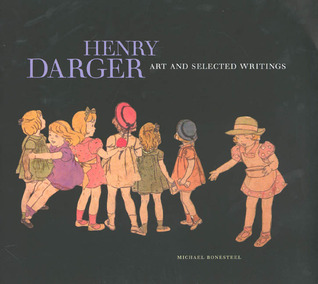
Henry Darger: Art and Selected Writings
In the quarter century since the death of Henry Darger--and the discovery of the astonishing cache of artworks and writings he left behind--this reclusive Chicago janitor has become recognized as one of the most important outsider artists of the twentieth century in America.
This book provides the first comprehensive survey of Darger's art and writings. Included are reproductions of approximately 114 of Darger's collage drawings and fifteen selections from his writings, focusing on his life's work. In the Realms of the Unreal , which is an account of a cosmic struggle against child slavery unfolding on a planet vastly larger than our own. This battle between the forces of good--led by the intrepid Vivian sisters--and the evil Glandelinian nations, was illustrated and extended in Darger's art, including the mural-size watercolor drawings that represent his mature achievement as an artist.
Michael Bonesteel, a Chicago-based art critic and authority on outsider art, provides an introduction to Darger's work and narrates the Dickensian circumstances of his childhood which, along with his profound religious faith and doubt, shaped his extraordinary sensibility. A true American original, Henry Darger combined an unquestionable innocence with a dark and sometimes deeply disturbing vision to create a body of work of originality and lasting impact.In the quarter century since the death of Henry Darger--and the discovery of the astonishing cache of artworks and writings he left behind--this reclusive Chicago janitor has become recognized as one of the most important outsider artists of the twentieth century in America.
This book provides the first comprehensive survey of Darger's art and writings. Included are reproductions of approximately 114 of Darger's collage drawings and fifteen selections from his writings, focusing on his life's work. In the Realms of the Unreal , which is an account of a cosmic struggle against child slavery unfolding on a planet vastly larger than our own. This battle between the forces of good--led by the intrepid Vivian sisters--and the evil Glandelinian nations, was illustrated and extended in Darger's art, including the mural-size watercolor drawings that represent his mature achievement as an artist.
Michael Bonesteel, a Chicago-based art critic and authority on outsider art, provides an introduction to Darger's work and narrates the Dickensian circumstances of his childhood which, along with his profound religious faith and doubt, shaped his extraordinary sensibility. A true American original, Henry Darger combined an unquestionable innocence with a dark and sometimes deeply disturbing vision to create a body of work of originality and lasting impact.
This book provides the first comprehensive survey of Darger's art and writings. Included are reproductions of approximately 114 of Darger's collage drawings and fifteen selections from his writings, focusing on his life's work. In the Realms of the Unreal , which is an account of a cosmic struggle against child slavery unfolding on a planet vastly larger than our own. This battle between the forces of good--led by the intrepid Vivian sisters--and the evil Glandelinian nations, was illustrated and extended in Darger's art, including the mural-size watercolor drawings that represent his mature achievement as an artist.
Michael Bonesteel, a Chicago-based art critic and authority on outsider art, provides an introduction to Darger's work and narrates the Dickensian circumstances of his childhood which, along with his profound religious faith and doubt, shaped his extraordinary sensibility. A true American original, Henry Darger combined an unquestionable innocence with a dark and sometimes deeply disturbing vision to create a body of work of originality and lasting impact.In the quarter century since the death of Henry Darger--and the discovery of the astonishing cache of artworks and writings he left behind--this reclusive Chicago janitor has become recognized as one of the most important outsider artists of the twentieth century in America.
This book provides the first comprehensive survey of Darger's art and writings. Included are reproductions of approximately 114 of Darger's collage drawings and fifteen selections from his writings, focusing on his life's work. In the Realms of the Unreal , which is an account of a cosmic struggle against child slavery unfolding on a planet vastly larger than our own. This battle between the forces of good--led by the intrepid Vivian sisters--and the evil Glandelinian nations, was illustrated and extended in Darger's art, including the mural-size watercolor drawings that represent his mature achievement as an artist.
Michael Bonesteel, a Chicago-based art critic and authority on outsider art, provides an introduction to Darger's work and narrates the Dickensian circumstances of his childhood which, along with his profound religious faith and doubt, shaped his extraordinary sensibility. A true American original, Henry Darger combined an unquestionable innocence with a dark and sometimes deeply disturbing vision to create a body of work of originality and lasting impact.
256 pages, Hardcover
First published December 1, 2000
Ratings & Reviews
Friends & Following
Create a free account to discover what your friends think of this book!
Community Reviews
Displaying 1 - 12 of 12 reviews

December 29, 2007
If Henry Darger is outsider art then let me in right now! This twisted genius had made up his own world behind closed doors in his apartment - and it's a fantastic document of the imagination going beyond nature or sexuality. Those who are sensitive regarding how Children are displayed in his art should stay away - but for the rest of us his vision of hell on earth (or in his mind) is both beautiful, disturbing, graphically perfect, and one's jaw just drops at the scope of his entire work. Often praised now in art circles but still underrated.

May 28, 2008
These are the best! From battles between Civil War soldiers and penile girls in vast underground caves to jouncy girls in pinafores lolling on an old-fashioned porche overshadowed by fantasias of dragonesque blooms in "Jennie Richee" which is Darger's conception of heaven on Earth. He was a master of appropriating the banal for fantastical uses.
But for all my love of the paintings I was very disappointed in Darger's writing . This book was my first introduction to it, and I found the excerpts from his 15,000 page novel numbingly dull. What I read of it left me with the opinion that the novel is the literary equivalent of a giant ball of string (something else Darger also obsessively amassed); that is something collected and collected and collected, the point being to just have more and more and more. The novel appears to have the been the result of the same appropriation of existing materials, just like the paintings, but with none of the transforming artistry into something superior. Though I didn't like the novel I did enjoy the excerpts from his journal (despite feeling like too much of a voyeur).
But I must say I was fascinated by what I read of his "autobiography" which makes no mention of his writing or art in its 10,000 pages, and for the last two thirds is a description of a huge tornado called Sweetie Pie. Poor lonely tortured Henry. Let's just hope he found some joy (and it appears he did!) in his life of what appears to've been profound isolation.
But for all my love of the paintings I was very disappointed in Darger's writing . This book was my first introduction to it, and I found the excerpts from his 15,000 page novel numbingly dull. What I read of it left me with the opinion that the novel is the literary equivalent of a giant ball of string (something else Darger also obsessively amassed); that is something collected and collected and collected, the point being to just have more and more and more. The novel appears to have the been the result of the same appropriation of existing materials, just like the paintings, but with none of the transforming artistry into something superior. Though I didn't like the novel I did enjoy the excerpts from his journal (despite feeling like too much of a voyeur).
But I must say I was fascinated by what I read of his "autobiography" which makes no mention of his writing or art in its 10,000 pages, and for the last two thirds is a description of a huge tornado called Sweetie Pie. Poor lonely tortured Henry. Let's just hope he found some joy (and it appears he did!) in his life of what appears to've been profound isolation.
April 13, 2009
Very well put together. I find Henry Darger's work bizarre and frightening, however, his life inspires compassion. I was disappointed that the author of this book didn't seem to grasp the likelihood that Henry Darger suffered from Tourette's and possibly other syndromes as well, and that the people in his life chose to torment him, institutionalize him, and diagnose him with a misplaced heart rather than give him real help or understanding. I didn't actually finish it - I read the biography bit, looked at the pictures, and read bits of the story.

March 30, 2016
Bizarre, frightening, sensitive, brilliant. The work of a genius.

Want to Read
April 2, 2008i recently went to the henry darger "house" at Intuit and the promotional cards they have for the gallery feature the Vivian Girls with BLURRED OUT PENISES!
i'm calling bullshit on that.
i'm calling bullshit on that.
March 12, 2008
fascinating
April 17, 2025
There's a fire in your eyes that mirrors the one burning in me right now. Let's see if they can be extinguished together.
July 14, 2008
I recently saw an adaptation of Darger's work in play form. I was so intrigued I began reading as much as I could get my hands on. Truly weird, beautiful and whimsical the story of little fairy girls is almost outshone by the act of their creation by the quiet man who worked as a janitor here in Chicago.

August 23, 2008
Henry Darger's work was truly amazing.

November 20, 2008
My favorite book of Darger's work. Wish it weren't out of print.

April 4, 2011
Twisted scared genious.
July 20, 2009
Strange and interesting...more as artifact than art.
Displaying 1 - 12 of 12 reviews