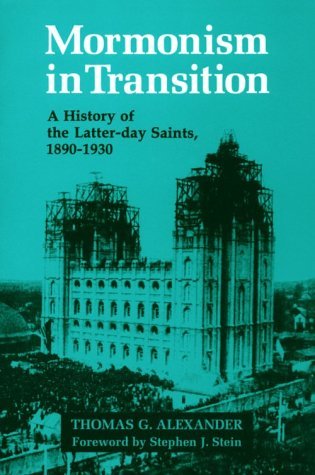
Thomas Alexander’s latest monograph on the history of Mormonism from 1890 to 1930 is a revision of his earlier work on the subject, culminating in two previous editions through University of Illinois Press. Alexander’s work has been widely cited among authors and students within the Mormon scholastic community. Recognizing the tremendous growth in Mormon studies publications over the past three decades, Alexander’s third edition of Mormonism in Transition (Salt Lake City: Greg Kofford Books, 2012) provides up-to-date research that will likely prove useful to its audience for many years to come.
Mormonism in Transition is structured largely in chronological order, beginning with the tumultuous 1890s and the revision of the Church’s social order. Involvement in politics among early Mormon leaders brought significant challenges for some Church members who believed they were obligated to heed the counsel of General Authorities on political positions, not just matters of doctrine. It also ushered in a shift from a closed, community-centered faith to one that was forced to confront a much broader, pluralistic society. In 1891 Wilford Woodruff noted that the Church still had the “right to control the political action of the members of our body” (5). However, by 1898 Church leaders “agreed that they would not interfere in political affairs” (7). Leaders at the time believed General Authorities ought not to run for public office, though the Senate campaign for apostle Reed Smoot would cause the Church to reconsider its position in the political world.
Alexander’s treatment of the Smoot hearings is by no means exhaustive, and readily utilizes the research of Kathleen Flake (27) and Michael Paulos (xiv) among several others. Ultimately Alexander agrees with Flake’s thesis that an early twentieth-century legal theory eschewing political extremism allowed Smoot to enter the mainstream of American politics. Though the transition to political pluralism did not occur overnight, the Church’s involvement in politics seemed only apparent when measures worked in the “best interest of the community” (35). This section also sheds light on the reasons why many contemporary Mormons might favor the GOP over the Democratic Party. A decade of anti-Mormon attacks spearheaded by congressional Democrats (most notably Fred Dubois of Idaho) expelled Church members from the Democratic Party. Dubois’ efforts to disenfranchise southeast Idaho’s Mormon majority prompted local Mormon leaders to oppose him on virtually every issue. The inherently anti-Mormon platform of the Idaho Democratic Party hurt their candidates in elections until 1911, primarily because Church members voted en bloc against candidates that openly disparaged Mormon beliefs. In a state where as many as one-third of registered voters were Latter-day Saints, “anti-Mormon politics [did] not work” (35).
The transition into the 1920s brought even more policy changes for the Church, including a greater effort to maintain a positive image. The secularization of Utah’s politics forced Church leaders to stop publicly endorsing candidates. The administration of Heber J. Grant operated under a policy that it might support important moral issues, recognizing that even if “public opinion generally supported the move, the Church risked a backlash which could undermine the internal harmony necessary to build the kingdom” (58). This policy seems to provide a precedent under which the modern Church functions, most notably with regard to its positions on same-sex marriage and undocumented workers. Many contemporary Mormon intellectuals have argued that the backlash from Proposition 8 in California damaged the Church’s image for many insiders and a significant, vocal number of outsiders. Likewise, the Church’s relatively moderate stance on immigration has stood at odds with the views advocated by many of Utah’s most conservative Mormon legislators.
Another challenge to the Church’s paradigm shift toward modernity was its abandonment of plural marriage. Once regarded as essential for salvation, the phrase “celestial marriage” was almost exclusively used to describe plural marriage prior to the 1890 Manifesto. Faced with scriptural passages like D&C 132:4, Church leaders began to reinterpret Mormonism’s polygamous past with a distinctly monogamous exegesis. According to this new interpretation the “New and Everlasting Covenant” didn’t exclusively refer to polygamy, but also included monogamous temple sealings. Though Mormon fundamentalists were upset about the change, “most considered it little enough in view of the obvious benefits that accrued from a closer harmony to the general attitudes of early twentieth-century America” (74).
Alexander continues his latest edition with a discussion of the Church’s financial and administrative changes (79-131). In 1899 for instance, apostles Francis Lyman and John Henry Smith collected salaries of $250 per month, while bishops, stake presidents, and even stake clerks were paid for their service through tithing money (105-106). The death of Joseph F. Smith in November 1918 also clarified the methods for presidential succession. Even before Smith’s death, 39-year-old Church patriarch Hyrum Gibbs Smith was arguing that he ought to lead the Church upon his cousin’s death, solely by his patriarchal lineage (123). Yet others including future Church presidents David O. McKay, Joseph Fielding Smith, and Heber J. Grant, argued for the now-accepted position that the president of the Council of the Twelve would assume the leadership of the Church upon the death of the prophet (124). Much like the stories of early Mormons claiming to see Brigham Young transfigured as Joseph Smith during the 1844 succession crisis, several Church members reported seeing Heber J. Grant sounding and looking like Joseph F. Smith.
Mormonism in Transition also covers the evolution of the Church’s auxiliary organizations. Prior to the early 1900s the Relief Society enjoyed considerable autonomy from the Church’s priesthood organizations. It “collected funds and maintained its own accounts” (142) which amounted to more than $149,000 in real estate alone ($3.2 million by 2012 standards). It was only in 1915 – under the direction of the First Presidency – that the Relief Society’s finances and property came under the control of local bishops. Alexander also elaborates on the rise of the Church Educational System, (what is, in my opinion at least, the crowning achievement of the Church during its transition). The Church envisioned Ricks College (now BYU-Idaho), Snow College, Weber College (now Weber State University) and Dixie College (now Dixie State College of Utah) as feeder schools for Brigham Young University (174). It was there in 1902 that BYU president Benjamin Cluff decided to embark on an expedition to Central and South America to unearth the Book of Mormon city of Zarahemla, which ultimately ended in failure (176).
The book also provides a fascinating glimpse into the Church’s international missionary program in the period between the First and Second World Wars (223-250). By the mid to late 1920s, Mormon missionaries were viewed much more favorably than their predecessors just a decade before. The improved image was shaped at least in part by a Church hierarchy that became increasingly involved in producing intelligible mass media for an audience that extended beyond the borders of the Great Basin. Though Alexander is careful to not to highlight the Church’s growth internationally until the administration of David O. McKay in the late 1960s (246), Alexander helps readers envision a Church that consistently – although not always clearly – sought to share its beliefs in any country willing to open its borders to missionary work.
The final portion of Mormonism in Transition focuses on doctrinal developments, as well as the reinterpretation of the Word of Wisdom. Alexander cites the influence of temperance movements stemming from Evangelical Protestants (284) and others as the catalyst for a new interpretation of D&C 89. Prior to Heber J. Grant’s presidency, obedience to the Word of Wisdom was not a prerequisite to entering the temple. Today it represents one of Mormonism’s most unique doctrines. Concerned with the “moral tone of the community in which they lived,” (283) Mormon leaders turned to prohibition and abstinence from tea, coffee, and tobacco as a solution to perceived societal problems.
Overall, Alexander presents a sympathetic, albeit balanced view of Mormon history in his latest work. Carefully researched with extensive documentation and use of primary sources, I have no reservations about recommending Mormonism in Transition to virtually any audience. Competent readers of American religious history will find Alexander’s recent treatise an invaluable addition to the ever-growing academic study of Mormonism.