A Nebula Award–winning author reinvents the alien invasion novel with this story of a malevolent, galaxy-consuming hive mind—and its surprising human hosts.
Drunk, angry, abusive, and pathetic, Dan Gurlick exists at the very lowest level of human civilization, sleeping in junkyard cars and scrounging through garbage cans for his dinner. But his last rotting meal contains something a spore that originated from a galaxy many light-years away. First, Dan eats the spore, then, the spore eats Dan; and the homeless alcoholic becomes a host for the Medusa. An insatiable alien hive mind, the Medusa has already consumed the life forms of a billion planets. Now, it hungers for the dominant species of Earth. But to do so, it must somehow unite the planet's intelligent creatures into a single shared an assignment the miserable wretch Dan may prove surprisingly capable of carrying out.
To Marry Medusa is suspenseful, inventive, and surprisingly compassionate; a vibrant and unforgettable exploration of what it means to be more—or less—than human.
This ebook features an illustrated biography of Theodore Sturgeon including rare images and never-before-seen documents from the University of Kansas's Kenneth Spencer Research Library and the author's estate, among other sources.
Theodore Sturgeon (1918–1985) is considered one of the godfathers of contemporary science fiction and dark fantasy. The author of numerous acclaimed short stories and novels, among them the classics More Than Human, Venus Plus X, and To Marry Medusa, Sturgeon also wrote for television and holds among his credits two episodes of the original 1960s Star Trek series, for which he created the Vulcan mating ritual and the expression "Live long and prosper." He is also credited as the inspiration for Kurt Vonnegut's recurring fictional character Kilgore Trout.
Sturgeon is the recipient of the Hugo Award, the Nebula Award, and the International Fantasy Award. In 2000, he was posthumously honored with a World Fantasy Award for Life Achievement.
Note: Contrary to popular perception, this novel is NOT about a group of space-faring bankers that recklessly squander their resources and then cabal with the shadowy interstellar governing overlords to rape the cosmic taxpayers of their hard-earned wealth. That kind of story would just be too far-fetched and frightening.
However, this is almost as scary.
Sturgeon wrote somber, intense, introspective stories that contrasted sharply from the more action-coated, derring-do adventures of the 1950s. His was a peculiar mold whose legacy can be found peeking at us in those works that ask not about what we’ll do and where we’ll travel, but who and what we will become. As much as I love the “other” SF with all my heart, it is Sturgeon’s brand of SF that I think is the most important, the most moving.
The Cosmic Rape (aka “To Marry Medusa”), is one of Sturgeon’s stronger efforts. Intelligent, layered and loaded with things to say about humanity. This is not a story that one’s read for pure enjoyment as its pacing is leisurely even for a book only 150 pages long. It is a story to ponder, to parse, to raise issues and ask questions. It is harsh, dreary and contains some disquieting imagery. But it is memorable and conducive to reflection on who we are as a species.
PLOT SUMMARY:
In short, the plot concerns Daniel Gurlick, a bitter, anti-social, severe alcoholic who has never been able (or desired) to hold a job for more than a few weeks. He hates the world and I would say that the feeling is pretty mutual. Even for Sturgeon, known for populating his stories with misfits and "morally challenged” characters, Gurlick stands apart as a singularly unlikeable protagonist.
Trust me, you’ll see.
Anyway, after being booted out of a dive bar, Gurlick finds a half-eaten hamburger that he proceeds to shove in his mouth...I told you, this guy is a real piece of work). Unbeknownst to Dan, the hamburger contains a spore of an alien hive mind named Medusa. Medusa has assimilated thousands of worlds in multiple galaxies into its collective mind and absorbs Dan to use as the vehicle to bring Earth into the fold.**
**I think it merits a pause to say that this concept struck me as a clear inspiration for the Borg Collective from Star Trek. However, Sturgeon's handling of the idea is superior and far more compelling in my opinion (and I’m a Trek fan).
In addition to Dan's story, each alternate chapter in the novel focuses on a seemingly random person or group of persons. You have a male co-worker about to date rape a female colleague, a homicidal lunatic that hates music, a young boy of freakish size that is abused by his father and others. Eventually, it becomes clear that Sturgeon is showcasing these not so pleasant slices of life in order to make the whole human race a character in the story.
Well, I won't give away what happens when Dan goes about Medusa's business but the book leads to a final confrontation between the independent minded humanity and the collective consciousness of Medusa with unforeseen results.
THOUGHTS:
I just re-read this over the weekend because I have been thinking about this story for over a year since I first read it. In my previous reading, I opined that a slower, more deliberate reading of the story may help unlock some of the subtle depth and of Sturgeon’s work and provide a greater insight into the story.
For once, I was right.
There is so much going on in this story and the structure and motive behind the tale are initially elusive that I think a portion of your brain finds itself playing catch and trying to put two and two together rather than simply absorbing what Sturgeon is saying. I got a lot more out of the story this time around.
The ending, which I found confusing and mind-boggling the first time around, became a moind-blower that hit me right in the wow, leaving me to try and secure an additional source of oxygen for my hyperventilating brain. Truly, a remarkable climax.
As for the rest, dark, intelligent, very original. Did I mention dark?
Wow, this was fascinating. I've read some really fascinating Sturgeon before but this one is nearly as good as my favorite, More Than Human.
There's a ton of great and flawed characters and they were interesting enough to carry us to the freaking huge conclusion. We follow a real villain around for most of early part of the novel, one very reminiscent of The Stars My Destination, where a deplorable man carries the seed of some truly awesome changes.
More than that, however, is the inescapable mind-blowing change of becoming a Medusa, a single head where every hair is each of us. A single mind. Every one of us knows what everyone else on the planet has learned. A total and ultimate godhood that is, nevertheless, just us.
Sturgeon has always been one of the most fearless writers I've ever had the pleasure of reading. When he sets his teeth into an idea, he goes all out and blows our minds. It's one thing to say he does something like this, but it's another entirely to see the buildup leading to a nearly instantaneous conversion. Or the reason for the conversion. Or the battle with another hive mind.
I was like... damn! This was a very short novel, too, and he NAILED IT.
This is a spicy classic. It may never be everyone's cup of tea, but I think I can rank it up there with Bester. :)
This novel is an expansion of a novella titled To Marry Medusa which appeared in H.L. Gold's Galaxy Magazine in the August 1958 issue. (With interior illustrations by Leo & Diane Dillon!) It's a good story about a hive-mind alien invasion and the Earthmen who thwart it. (It? Them?) Sturgeon wrote a staggering amount of very good short fiction, but never was very successful at novel length. I prefer the shorter version of this story, which Baen reprinted several years later.
Wow! How did Sturgeon do that? Color me impressed!
A friend had been raving about Sturgeon’s writing, and suggested To Mary Medusa as a good entry point. However, my initial experience of the novel was something less than auspicious. You see, Sturgeon’s characters were all just different flavors of terrible — ranging from simply unsympathetic to grossly despicable and creepy — I pretty much hated all of them. The fact that there was no discernible connection between these blighted characters didn’t help matters.
But I persisted. I trust my friend’s literary judgement, and the novel, after all, was short. But there was something else. Despite how much I disliked the characters, Sturgeon managed to make them all compelling. I didn’t care for them, but I wanted to find out how their stories played out and eventually intersected. Convincing a reader to invest in unsympathetic, unlikeable characters is an impressive literary feat!
And then there was the clever playing out of his Big Idea and plot. From early on you will suspect that To Mary Medusa is a variety of the David and Goliath trope, with the alien Medusa being Goliath and humanity David. Yet even with this fact clearly telegraphed, Sturgeon managed to make his climax and resolution absolutely unexpected and surprising. It is in the best tradition of hopeful science fiction. Not satisfied to simply have humanity triumph against impossible odds, Sturgeon managed to imagine a gloriously positive next stage of evolution, where transcendence and immanence are resolved. As he does so, the reason for all the disparate unsympathetic characters becomes clear — the story just would not have worked so brilliantly without them.
In Theodore Sturgeon's International Fantasy Award-winning novel of 1953, "More Than Human," six extraordinary young people with various extrasensory mental abilities blend their powers together to create what the author called a "gestalt consciousness." And in his next novel, the Staten Island-born Sturgeon amplified on this idea of shared consciousness, but upped the ante quite a bit; instead of a mere half dozen souls forming one hive brain, Sturgeon posited the notion of a mind containing the thoughts and experiences of the life-forms of 2½ galaxies! The book was "The Cosmic Rape," which followed "More Than Human" by five years. This book was Sturgeon's third sci-fi novel out of an eventual six (the author was much more prolific as a short-story writer). "The Cosmic Rape" was initially released as a 35-cent Dell paperback in August '58, the same month that the novella-length version of the book, entitled "To Marry Medusa," appeared in the 35-cent "Galaxy" magazine. I'm not sure of the respective word counts of the two versions, but suffice it to say that the novella took up 59 pages of the magazine, with illustrations, while the Dell book--which I was fortunate enough to acquire in a NYC used-book store--reaches to 160 pages. (Those readers who think they might prefer the shorter version may find it in Sturgeon's 1965 collection entitled "The Joyous Invasions," by the way.) The novel finds the then-40-year-old author at the peak of his abilities and craft, as it turns out, although it was hardly a perfect affair...for this reader, at least.
In the book, the reader is introduced to a man who just might be the seediest, vilest and most pitiful character in sci-fi history. He is Dan Gurlick, an alcoholic, homeless bum who spends his days cadging drinks at the local bars, eating out of garbage cans, sleeping in an abandoned truck in the local junkyard, and hating and resenting every single person on Earth, muttering the word "bastits" as a sort of mantra. Gurlick's life is suddenly altered one day when he devours a greasy cheeseburger from an alleyway garbage can; a burger that contains a "wrinkled raisin" that is actually a spore of the Medusa, that galaxies-spanning supermind alluded to above. The practically limitless mental capacity of the Medusa easily coerces Gurlick to do its bidding: to steal money to acquire metals and supplies so that machines might be built to help bring all of humanity into the Medusa matrix...a proposition that does indeed come to pass! But Gurlick, surprisingly enough, is only present for perhaps half of the book's length. In alternating chapters, Sturgeon introduces us to a half dozen other unfortunate characters, and thus we get to meet Paul Sanders, who is about to drug and date-rape a married woman who works in his office; Guido, a 17-year-old Italian boy whose various crimes of juvenile delinquency all center around a mysterious hatred of music; Dimity Carmichael, a sexually repressed spinster; Mbala, an African who must go out into the spirit-haunted jungle at night to defend his yam patch; 5-year-old Henry, a neurotic nervous wreck as a result of some truly bad parenting; and 4-year-old Sharon Brevix, who gets lost in the wild when her parents inadvertently leave her behind during a family move. The reader wonders just why Sturgeon keeps introducing new, unrelated characters in every other chapter, but remarkably, things do manage to cohere by the book's end. The author knew just what he was doing here (no surprise, really), and uses each character to either make a point and/or advance his Medusa plotline. It is some pretty fascinating stuff, actually.
Sturgeon was a sci-fi author who always brought an emotional yearning and a polished, literary quality to his pulpish conceits, and "The Cosmic Rape" is surely a good example of this. The book is beautifully and poetically written, evincing a love of language, and veering off at times in unexpected directions. It is often wryly humorous (one barfly is said to be holding a beer that is "warm as pablum and headless as Ann [sic] Boleyn"), occasionally moving (such as the scene in which Gurlick actually "gets lucky") and always highly imaginative (I love the descriptions of some of the alien planets that Gurlick gets to see via the Medusa). And most importantly, in the book, Sturgeon manages to make a persuasive argument as to the desirability of living in a hive mind, and truly, the lot of the average human does seem to be much improved after the great change. Indeed, the lives of four out of six of those other sadsack characters are surely transformed for the better; the other two...well, perhaps I'd better not say. I wouldn't want to spoil any surprises--of which "The Cosmic Rape" sports any number--for prospective readers. How wonderful it is to witness mankind's sudden gaining of universal communication, understanding and cooperation; not only amongst all Earthfolk, but while communing with the inhabitants of those 2½ galaxies, as well. As the author winningly tells us, "...it was abruptly possible for mankind to live with itself in health. Removed now was mankind's cessgland, the secretions of which (called everything from cussedness to Original Sin) had poisoned its body since it was born, distorting decencies like survival and love into greed and lust, turning Achievement ('I have built') into Position ('I have power')...." It is a compelling and desirable vision, to be sure, convincingly spun by the author.
As I said up top, though, I did have a few small problems with Sturgeon's work here. For one thing, I was never entirely clear how those alien machines were supposed to bring all of humanity together into mental communion, with their mechanical blarings and wailings, and couldn't at all wrap my own mind around why it was necessary for Gurlick to impregnate an Earthwoman before mankind could be absorbed into the Medusa fold. I also could not quite figure out, in the scene where Gurlick almost rapes three young women, why it was necessary for the trio to run off for help, and to be talking to their rescuer when they returned. Couldn't this all have been done telepathically, without the need for spoken words, after mankind attains perfect mental rapport? And while I'm going on, am I the only one who had a tough time visualizing Guido's two hideouts, the first in the attic of his detective nemesis, the other in a buried house next to a Roman highway? And finally, while I'm carping away, I was not fond of the final fate that the author reserves for Gurlick, and found it hard to believe that anyone would prefer a life of happy but resentful hatred over a life filled with a universe of gratification--mental, physical and spiritual. Just one of those aforementioned twists that Sturgeon keeps pulling out of his sleeve.
Anyway, these are mere quibbles. Scottish critic David Pringle, in his "Ultimate Guide to Science Fiction," calls "The Cosmic Rape" a "short but telling treatment of an alien hive-mind and its takeover of the Earth," but neglects to mention how different, how memorable and how visionary it is. This is a book to be read slowly, while savoring Sturgeon's wonderful prose and contemplating the possibilities that he sets forth. You may never be fully satisfied with your single, solitary mentality again....
(By the way, this review originally appeared on the FanLit website at http://www.fantasyliterature.com/ ... a most ideal destination for all fans of Theodore Sturgeon....)
Can’t wait for the honeymoon! To Marry Medusa by Theodore Sturgeon.
Sturgeon manages to take some classic figures in a seemingly pulpy story like this and spice them with a very creative shift in perspective. A peculiar chap as always.
First of all, I tend to seek/read as little as I can about plot and details in general before starting a book and feel that in this case, it was rewarding to do so. My experience was like a clumsy child running after someone on a bike, I had no clue or clear idea why parts of the narration were presented and well… what was happening. Don’t worry, it doesn’t take too much to catch up and it is a short book too.
One disclosure point I have to throw out there is my personal terror/fascination with the idea of an invaded individuality, I can’t seem to let go from my goblin hands the concept of individual self, sorry for me, no can do Nirvana. This personal fascination will tip the balance for sure.
The first part of the book is like setting the orchestra, with its players tuning the instruments: we are presented with a set of characters in a wide range of circumstances: the nefarious drunk, a rapist about to attack, one chaotic delinquent intrigued by a clever police officer, a friend giving relationship advice, the sad child. The constant between the unrelated stories is an unflattering look at humanity, but avoiding dipping in the angst and drama, a bit like windows to random people.
As the music starts playing, it is Gurlik, the nefarious drunk, who carries the plot and… literally carries Medusa, the alien threat that seeks to absorb humanity in its own hive-mind and sends Gurlik in a somewhat funny path of knowledge, using the information acquired to put in motion its plan.
When the music is raging on, the pace quickens, the battle starts and the puzzle takes shape. Let´s stop here with the plot and just add some thoughts for after-reading.
Plotwise, you can read a lot of implications that are not specified and it isn’t a flaw, sure, it would be nice to have more details, but as a story, it works very well like that, it was neatly planned and executed by Sturgeon. The structure, length, pace and webbing are finely arranged and even if that fantastical resolution is not the “right” answer, it is asking worthy questions.
In some way, this book was more like 4 stars, but the extra star is just for the interesting questions that come forward, the hand pointing the way to that clumsy running child chasing funky ideas.
Probably the most far-out story to come out of the great genius of Theodore Sturgeon, who loved unusual concepts and was one of the most original authors of the 20th century.
Some of the initial chapters, where Gurlic is involved, are incredibly funny.
The overall execution is not perfect. In fact, some of the initial chapters start making sense only in the second half of the book, and even when you get there you wonder if they were necessary at all.
However, I have no idea how else this insane plot might have been written as a novel. It is a very difficult novel to pull off. All I can say is, the basic concept is so powerful that I was very much willing to overlook some clunkiness in the structure, in the machine of this novel.
A book filled with sense of humor, wisdom, hope, imagination and a fascination with the immense potential of the human race.
Sturgeon had already explored the concept of the "Gestalt" organism in "More than human", therefore he must have been in love (or obsessed) with the idea. In this novel, he takes it to new, inter-galactic levels.
He wasn't the only one to imagine a "globally conected world" in the '60s, but it's clear how strongly he felt about this type of vision. Interesting how our world is actually - gradually - getting closer and closer to that vision.
No, things are not always the same like the cynical ones among us might say. Sturgeon was spot on in theorizing that we are actually better as a whole when we are connected and when we better understand each other.
Вратата на безименен вертеп в безименен град зейва и отвътре, сипейки проклятия и заплахи, изхвръква Гърлик. Той е без дом, без работа и без приятели, от много, много време насам. Онова, което запълва вакуума в сърцето му, е озлоблението: достатъчно озлобление, за да си мечтаеш да стъпиш върху лицето на целокупния свят и да скачаш отгоре му. Светът обаче е твърде голям и силен да го смачкаш току-така; дори един немилостив барман може да се окаже непобедим враг. Гърлик ще трябва да се задоволи да смачка премръзналия помияр край кофата за боклук; да се ограничи с триумфа в битката за парче недояден бургер.
В същия този момент, някъде другаде: Пол Сандерс сипва в шерито на прелестната (и, уви, омъжена) колежка Шарлоте нещо, което да го улесни в неговата собствена битка със съпружеската ѝ вярност. Африканецът Мбала се препъва в нощта с ослепели от ужас очи към нивата си, където зъл демон ограбва реколтата от гулии вече няколко седмици. Седемнайсетгодишният Гуидо дебне в къщата на инспектора, който си е поставил за цел да го спре, преди да извърши поредното престъпление – и агонизира от звуците на цигулката… толкова много звуци, тъй много музика тук и навсякъде… и всичката трябва да секне. Петгодишният Хенри подсмърча в един от ъглите на детската си градина, сам, смръзнал се, смъртно уплашен: какво чудовище се е притаило наоколо, та майка му все го наглежда скришом през оня прозорец, нищо че учителките са я помолили да не се натрапва постоянно в живота му? (Може ли чудовището да е… баща му?) Медуза се готви да приобщи още един разумен вид към множеството, което обхваща.
Медуза е групов разум, кошер от интелекти, ширнали се през две галактики и част от трета. Човечеството е разумният вид, който е на ред да бъде погълнат. Гърлик – мръсният, малограмотен, мразещ Гърлик – става средството, чрез което ще се осъществи поглъщането. (Понеже заедно с парчето от бургера той току-що е изгълтал и спората на Медуза.) И тъй като космическият нашественик, при все галактическия си опит, никога не е попадал на разум, възникнал у всеки индивид поотделно, а не като симбиотична рожба на групата, ятото, колонията, той стига до извод, че човечеството се намира в неестествено, фрагментирано състояние. Затова първата задача на Гърлик ще е да го обедини – човечеството; да открие начина, по който човешките умове да заработят като един отново. Поне така си мисли Медуза.
The Cosmic Rape от Теодор Стърджън (аз бих го превел като „Космическото обладаване“) е къс роман, сто и петдесет странички – но трясва далеч по-зашеметяващо от повечето епични „тухли“. В англоезичния свят наричат Стърджън „Въплътената любов“. Не се оставяйте на това очакване… инак, като мен, началото на романа ще ви шокира. Със страх, похот, отричане на собствените нужди, ненавист. Всеки нов герой сякаш е различно въплъщение на чудовището „човешко падение“; и е толкова по-чудовищен, защото мислите и действията му са простички, познати: там, на мястото на Мбала, Гуидо или Пол, можеше да съм аз, нали?
А любовта? Тя къде остава? ...
Целият отзив – в конкурса на Сборище на трубадури за фантастична рецензия:
Alas, I've finished the last (not in published order, I read them in a very scattershot manner) Theodore Sturgeon novel. I think it was a great one to end on, because it has pretty much all the elements I've come to love about his writing. Poetic prose, sly humor, quirky characters, human psychology, forward thinking explorations of gender and sex and sexuality. Oh, and aliens. The plot, loosely, is that a hivemind alien race called The Medusa comes to Earth intending to take over by subsuming the human race into itself, like its done to countless other races across the universe. Unfortunately for The Medusa, human consciousness is distinct and separate and individualistic, so the project becomes uniting the human consciousness so it can be more easily subsumed. Wild, right? This relatively short novel unfolds slowly, with chapters alternating between The Medusa story and seemingly unrelated vignettes of the lives of individual humans. The chapter introducing the African yam farmer particularly threw me for a loop---how the heck was Sturgeon going to tie this in with the American family who lose their 4 year old child on a road trip? And the Italian street criminal who steals a violin from the police officer who is pursuing him? And the guy who is determined to date rape a coworker? And the derelict who becomes the host of The Medusa after eating a trash hamburger he finds in an alley? Well, he does tie them all in, and more. Gloriously. I'm gonna put this one at #3, after Godbody and Venus+X. But I would select this as a really good first Sturgeon novel for someone unfamiliar with his work, since it has all the best elements in a pretty short read. Check it out!
The Cosmic Rape is a delightful spin on the old alien invasion scenario, with a hive-mind organism, known as the Medusa, in which all individuals are connected in a "gestalt consciousness" (think the Borg, only totally organic). Medusa finds itself stymied attempting to assimilate humanity because of the individual and independent nature of human consciousness. The Medusa figures out how to connect human consciousnesses, thinking that would make them easier to absorb, only to have humans turn their new capabilities against the invaders in spectacular fashion. This is great stuff here. The literary quality of Sturgeon's prose, the intriguingly fragmenting nature of the narrative, bouncing between far-flung different characters whose connection to the story is not immediately apparent, Sturgeon's splendid vision of how an interconnected humanity would function and, last but not least, a wacky but also dark sense of humor (the drunken misanthrope Gurlick is an absolute riot) all make this one of the best classic sci-fi novels I've read. Most highly recommended, 5 of 5 stars.
A tiny seed of the global hive organism Medusa has waited patiently on Earth, until at length it meets homeless misfit Dan Gurlick and uses him as the instrument of its fusion with humanity. Except that humanity isn't what Medusa expected.
I blame Kurt Vonnegut. By naming his character Kilgore Trout, he caused me to question the existence of (and therefore disregard) Theodore Sturgeon. This will be my third and final complaint about the issue, but I'm still astounded that it's taken me so long to actually read Sturgeon's work. Thankfully, I now have (but damn you, Mr. Vonnegut, for your thoughtful gesture of respect).
There's nothing special about the plot of To Marry Medusa - alien hive mind meets humanity, the resolution - John Campbell all the way, or the mechanism - diverse threads pulled together. There's not even that much to say about the style. The tone of the story is what pulls this all together - the feeling, the sympathy, and the careful balance of elements. Sturgeon has a wonderful sense of how much to mix in and when. When to add a dash of pathos, when to pull back. It's a basic cake, but baked by a master pastry chef.
Sturgeon doesn't fall into any of the classic traps of the genre. He respects his characters while still creating an entirely engaging and credible story. He has the subdued tone of Clifford Simak, with the human understanding of Clarke, and perhaps the other way around. In any case, he's able to convey some pretty grandiose ideas in manageable, entertaining terms.
All in all, highly recommended. I may have come to Sturgeon very late, but I'm a wholehearted convert, and this book is the book that clinched the deal.
Much to my surprise, I can't immediately pull up a link between To Marry Medusa and Arthur C. Clarke's 2001. There's a line in Medusa that seems a direct inspiration for Clarke, but if no one's mentioned it by now, perhaps it's coincidence.
A short, but thoughtful - and unusual - story of alien invasion. The 'Medusa' is a hive mind which has taken over galaxies - and now one of its spores is here on Earth. However, the being it infects is Gurlick - a man that pretty much anyone would consider a waste of life - a stupid, drunken, violent loser. The Medusa, a sophisticated intelligence, is nonetheless unable to understand humanity, because the concept of intelligence that does not function communally, but is confined to isolated individuals, is incomprehensible to it. Humanity is saved!?!? But the book encourages us to think about values and the definition of civilization - the Medusa is indeed a frightening concept - but its spread is not a malicious act. First published in 1958, this novel goes against the popular concepts of the limitations of science fiction from this time period. It may not be Sturgeon's best work, but it is definitely worthwhile.
A single polyp of a vast alien intelligence lands by chance in a drunken bum, frustrating its attempts at world domination. Like last week’s More Than human, I thought this was clever and well-written and undermined by a lot of third-act philosophizing, truly the bane of mid-century science fiction. Still, for a genre I don’t really enjoy, I kind of enjoyed this.
Dan Gurlick is a pathetic human being, which is undoubtedly why nobody likes him. He has no identifiable positive personality traits, his motivations and desires are base, and he lacks the skills and knowledge to appropriately acquire the things he wants. Life suddenly changes for Gurlick when he accidentally ingests the spore of an alien hivemind named Medusa. Medusa has been all over the universe enfolding the collective minds of the species it finds. When Medusa becomes conscious on Earth, in Gurlick’s mind, it’s surprised to find that human brains are not connected. Perhaps humans have sensed Medusa’s plan and have protected themselves by disorganizing. The hivemind plans to use Gurlick’s limited brain to figure out how to put human minds back together so it can engulf them. To get Gurlick’s cooperation, Medusa promises to give him whatever his nasty heart desires.
Theodore Sturgeon’s To Marry Medusa, originally published as the longer novel The Cosmic Rape in 1958, is a not just an exciting hivemind science fiction story, it’s also a beautiful but frightening speculation about what life would be like if humans shared a collective consciousness. At first the idea is naturally horrifying, but Sturgeon makes us reconsider by interspersing humanity’s response to Medusa with vignettes of several characters experiencing loneliness, loss, lust, jealousy, fear, or budding faith. A group mind could be a powerful thing, but if we all share the same mind, what is the value of one of us?
I listened to Blackstone Audio’s version of To Marry Medusa, narrated by Stefan Rudnicki who is the reason I chose to read this book in audio format. As always, he does a great job except that I think he said the word “unties” when he meant “unites” at one point, though perhaps it was a typo in the book. I wouldn’t usually pick on something so seemingly trivial, but those two words have opposite meanings and, in this context, it confused me for a moment.
For such an old SF hivemind story, To Marry Medusa is surprisingly fresh and deeply thought-provoking. I’m putting the rest of Theodore Sturgeon’s work on my TBR list.
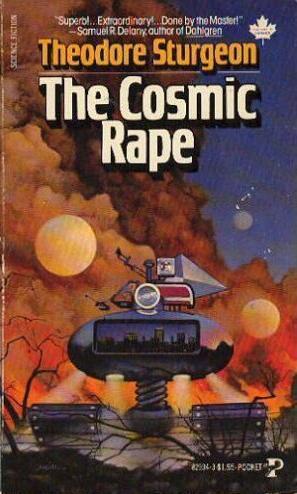
AKA 'The Cosmic Rape'. I had this book as a kid but didn't finish it. Wouldn't every kid be excited over this cover?
1 hour in: the audiobook is only 4 hours, narrated by the great Stefan Rudnicki. It seems like 'new wave'. All the characters are unpleasant, a la M. John Harrison's Light. I guess this was a fad back then. Samuel Delany would blurb it. One early chapter includes the use of a 'date rape drug'. Half the chapters are about some kind of alien fungus, and the other half are basically mainstream character studies. Maybe it all comes together in the end in some clever way. This book also has what I call 'athletic prose' where you stand back and go 'ooo' but get distracted from the story (vs Scott Sigler). At least that's my attitude towards it. New wave. What did Leonard Maltin call the Ralph Bakshi animated film Wizards, 'turgid and unappealing'?
Hmm, the alien chapters are kind of dazzling actually. The other chapters seem like a waste of time.
Halfway through. Ok, some characters are starting to repeat. Is the music hater talking to himself? I think the savage guy actually sees something sfnal.
3/4 through. Ok, this is getting good. All the characters are 'coming together', ha ha. I was listening in the car, but I will finish the last hour at home so I can concentrate better. Some things happened that were meant to be shocking, but I just got confused by them.
Half hour to go. Holy crap, what a mind-f***.
All done. It ends up pretty good. Maybe too fast? Don't blink, or you might miss something. I'll probably check out More Than Human, which seems similar.
"Which stars do you know—Polaris? Good. And the bright one yonder, that’s Sirius. Look at them now: at Polaris, at Sirius. Quickly now: Polaris, Sirius. And again: Sirius, Polaris. How far apart are they? It says in the book, thousands of light-years. How many? Too many: never mind. But how long does it take you to flick your gaze from one to the other and back? a second? A half-second next time, then a tenth?... You can’t say that nothing, absolutely nothing, has traveled between the two. Your vision has; your attention has."
Cool book. Complex at times but really nice how things cross in the story. I really like some of the characters, Guido is my favorite, though, because his personality and development and his reasons for doing what he did are really unique and nice. Dimity is also one of the cool characters because she speaks nothing but the truth about sex and the things people tend to believe about that subject. I wish she would say more, though.
THIS IS MY REVIEW OF THE BOOK TO MARRY MEDUSA BY THE HUMAN AUTHOR THEODORE STURGEON:
A boring and lifeless record of teenage alt-rock with an artistic value close to zero. It's not even catchy, let alone something more. Besides, the album cover is intentionally awful.
Raramente le guerre hanno cause nobili, ma non tutte le invasioni sono obbligatoriamente assassine. E' un concetto che sembriamo aver dimenticato in questo 2004 di guerra asimmetrica, di eserciti e di terroristi, di informazioni negate e pilotate... Ci sono state, nella storia, anche invasioni buone. Anche idee che, in un lampo, hanno migliorato tutte le vite (o il maggior numero possibile). Sturgeon voleva essere di questa partita: il mondo è difficile, non è un pranzo di gala, ma se cerchi il bene, se vuoi il riscatto, puoi trovarlo. Spesso, grazie ai più derelitti.
dall'introduzione di Piero Colaprico
Dallo spazio profondo arriva Medusa, creatura di cui nessuno conosce gli scopi. Nata su altri mondi, avida di vita, capace di nutrirsi di interi pianeti e di intere razze, si avvicina alla Terra... Ma Sturgeon non è un autore catastrofico: al contrario, è un romanziere sottile e imprevedibile. Quello che prende vita nei Figli di Medusa è dunque il dramma di un rinnovamento, una "prova del fuoco" per tutta l'umanità che sta per diventare, a sua volta, figlia di Medusa.
İlk olarak 1958'de "The Cosmic Rape" adıyla basılan kitabın, daha sonra 1977 yılında "To Marry Medusa" başlığıyla daha yoğun ve kısa bir versiyonu basılmış. Bu kitap da bu ikinci versiyonun 1999 yılında Türkçeye kazandırılmış hali. Dünya dışından gelen kovan zihin Medusa'nın, Gurlick adlı acınası ve umursamaz karakterle işbirliği yaparak Dünya ile ilgili gerçekleştirmek istediği planını okuyoruz kitap boyunca. Kitabın yarısından fazlasında Gurlick dışında toplam altı farklı yan karakter tanıtılıyor.
Çeviriyle mi alakalı bilmiyorum fakat "Medusa'yla Birleşmek" başından son sayfalarına dek okuyucuyu dışlayan bir anlatım içerisinde, uzun ve boş cümlelerle dolu, sevimsiz karakterlerin yer aldığı bir kitaptı benim için. Her bölümde farklı bir yan karakterin ortaya çıkması, kitabın sürükleyiciliğini bozan en önemli etmen olmuş. Aşırı sıkılarak okuduğum ve bir an önce bitirmek istediğim için sonlarına doğru kitabı atlayarak okumaya başladım.
Belki orijinal dilinde tekrar okumak denenebilir ama genel olarak beğenmediğim bir kitap oldu.
The only other book by Sturgeon I've read is the more famous "More Than Human," which, with its aggrandizement of humanity, I did not enjoy. This shorter, much weirder work revisits the theme of gestalt consciousness or "hive mind" in a more original fashion. Sturgeon's turgid prose struck me here as more ironic, therefore more enjoyable, and I was also intrigued by the freewheeling structure, never able to predict where the narrative would go. Still, I don't think I will delve any more into this author's stuff -- his apparent love of mankind and his basic optimism are not things I can tolerate. AKA "To Marry Medusa."
Parecchio tempo fa trovai in qualche libreria dei libri in offerta, inclusi alcuni Urania di autori classici che però non avevo mai approfondito. Uno di questo è Theodore Sturgeon, che avevo avuto modo di conoscere solo attraverso qualche racconto incluso in raccolte di genere.
I figli di Medusa è uno dei due suoi romanzi acquistati in quell'occasione e che, negli ultimi giorni, ho letto con un misto di curiosità e perplessità e, giunto al termine, la prima è stata poco appagata e la seconda parecchio alimentata.
Si tratta di un romanzo abbastanza atipico perché non esiste un vero protagonista se non, se vogliamo, la creatura aliena dalla mente alveare che cerca di invadere il nostro pianeta usando come veicolo un essere umano a dir poco abietto: ogni capitolo è, invece, focalizzato su individui che hanno in comune il solo appartenere alla razza umana e le cui vicende sono a volte curiose, altre noiose, ma soprattutto non si incastrano nella storia se non per dire "li ho citati prima", per fornire una sorta di - inutile - background a soggetti che non sono più che pedine.
Il risultato è che nel momento in cui l'idea di fondo del romanzo esplode e va a fondersi in una narrazione più omogenea, per quanto breve, si resti col sapore amaro del "tutto qui?": il che è un peccato, perché il messaggio di fondo che evidentemente l'autore voleva trasmettere è estremamente interessante, solo che è scritto in modo da non avere alcun tipo di appeal, almeno per quanto riguarda me, ovviamente.
Nel momento in cui mi trovo a dover usare il messaggio per scusare la scrittura qualcosa non va e la delusione supera l'apprezzamento.
Lo stile è asciutto, sintetico, a volte crudo: ci sono scene inserite più per volontà che per necessità, inclusa la morte volontaria e cruenta di un bambino per il bene supremo. Chi mi conosce sa che non mi scandalizzo, ma solo se scelte e immagini non sono (o non sembrano) fini a se stesse: qui l'impressione è che lo siano, tanto che leggendo alcune parti mi sono chiesto più di una volta se stessi comprendendo bene ciò che avevo letto (e anche questo dice molto sulla qualità della prosa).
Ho un altro suo romanzo in coda e prima o poi gli darò una possibilità, considerandone la brevità: per ora, però, io e Sturgeon non andiamo d'accordo.
Basically the story is a combination of Parasyte with the Human Instrumentality Project from Neon Genesis Evangelion, and the end reminds me of the premise of the Matrix (namely, the un-utopian design) and the premise of "The Ones Who Walk Away from Omelas" While the rest of humanity is given final, blissful peace by perfect union of souls--killing its doubt, solitude, fraud-complex issues, and the like--Gurlick, the catalyst to humanity's deific evolution to multi-galactic, inter-species hivemind, is rewarded for his service by a guaranteed eternity of anguish, suffering, and hatred as an abused homeless man, because that existence, for him, is the best bliss that he can imagine. That is the existence which, to him, smacks of paradise.
This had a surprising amount of depth to it for a dime sci-fi novel; it speaks deeply on the human condition, especially in the last several chapters which get heavy-handed with the philosophy, casting aside the pulp novel upon which it had to be built. It's definitely worth a read, IMO.
This entire review has been hidden because of spoilers.
Una ben strana invasione quella che ci viene descritta da Sturgeon in questo romanzo. Verso metà del romanzo uno si chiede che cosa ci stiano a fare tutti quei capitoli intermedi all'azione principale, ed è solo nella seconda metà che si iniziano a tirare le fila. Considerando che è stato scritto nel 1958 direi che regge bene al passare del tempo. Certe scene, tipo quella dello stupro della belloccia dopo averla drogata, sono ancora molto attuali. Anche quelle delle violenze su minori. Ma il finale è un atto di speranza, anche se a oggi risulta meno realistico di quanto risultasse all'epoca. 3 stelle.
The alien was smaller than a raisin, similar to an undifferentiated cell unit of a jellyfish or coral, it called itself Medusa and had never encountered an intelligence in millions of years that was not a hive-mind. When it reached Earth and attached itself to a human it assumed that it was communicating with the entirety of the human race - and this caused problems. The angry, illiterate alcoholic to which it attached was hardly a prize specimen but eventually Medusa decided that humans had somehow split apart from its single supermind and is determined to put humanity back together. The book follows Medusa’s attempt to re-integrate humanity through an examination of a number of everyday tragedies; a would-be rapist, a lost child, an African yam farmer, a young boy terrified by a vindictive parent and a man for whom music is incitement to violence. When the Medusa succeeds in creating the Human Hive-mind its plans to take it over get rudely subverted. A short but entertaining and thought-provoking novel from Theodore Sturgeon. A couple of hours well spent!
Beautifully well writ. Reminiscent of Philip K. Dick's ability to write from the perspective of different characters. The scene where the Brevix family is driving to their new home is probably one of the most realistic and amazingly paced scenes I have ever read concerning this particular event.
I had some trouble understanding the ending. It ends in a strangely anticlimactic way. Not that the ending isn't great, but it seems that the story was built up for so long and then just dropped really quickly.
Sturgeons vision of the Medusa, an intergalactic hive mind that incorporates species into a vast super consciousness is fascinating. That the sport of the Medusa encountered a miserable cuss like Gurlick was also a comically petty foil against the looming omniscience that would bring humanity into its fold.
Unfortunately this compelling story gets a little lost in the threads of other mortals that only tangentially forward the story. While the novel is not long, it feels like it would have made an even better short story.