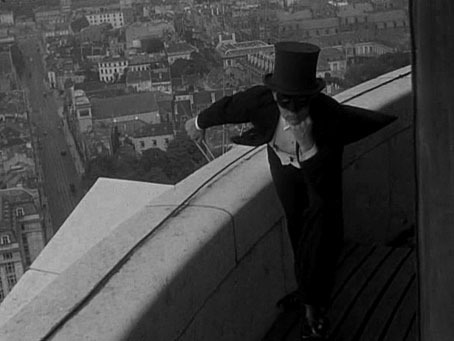
There are no ghosts here, despite the title. 'Just' a criminal mastermind terrorizing the faubourgs of Paris and the countryside chateaux, cca. 1910.
"Fantomas."
"What did you say?"
"I said: Fantomas."
"And what does that mean?"
"Nothing ... Everything!"
"But what is it?"
"Nobody ... And yet, yes, it is somebody!"
"And what does the somebody do?"
"Spread terror!"
The audience loves to be scared and often enough cheers for the smooth criminal who lives by his wits and challenges the rules of society, even if he is an unrepentant thief and a murderer. The French public bought the story penned by Pierre Souvestre and Marcel Allain in huge numbers, spawning about forty sequels in novel form, more than ten movie adaptations, a television series, comics, fanfiction, plays and art exhibitions. A valid argument can be made that "The Pink Panther" is a comic rewriting of the original Alain & Souvestre hero. How did Fantomas become such a cultural phenomenon? What sets him apart from the other pulp heroes at the turn of the twentieth century?
I believe two aspects of his personality make Fantomas stand out from the pack : his audacity and his ruthlessness. Without going into plot spoilers (a synopsis would totally ruin the numerous surprises awaiting the reader), the defining characteristic of the criminal cases investigated by the Fantomas counterpart in the French Police Force, Inspector Juve, is the high risk of exposure, the very narrow margin for error and the talent for improvisation that gives Fantomas an edge in the game of cat and mouse with the police. An even greater advantage for Fantomas is his complete disregard for rules of civility and a total absence of scruples. He is a serial killer, no halfways or doubts about it
I know I said earlier there are two main ingredients in the recipe for success of this feuilleton, but I had forgotten the third and probably the most important one : the mystery surrounding his identity! In the beginning, even the existence of Fantomas is in doubt. He may be only a figment of the imagination from too excitable reporters, or a way for incompetent policemen to blame their failures on some very clever opponent. Even later, when we learn more about the crimes and about the chase, Fantomas' identity remains obscure. He is a chameleon, changing not only his clothes and his assumed identity, but also his apparent age, his skin tone, hair colour, speech patterns, and so on. Credibility is sometimes sacrificed in favour of thrilling developments and cliffhanger section endings. Same goes for character development, which comes secondary to fast action and plot twists, as many as possible in the given format.
Sidenote : an interesting trick in the writer's arsenal that is used repeatedly here is to give the reader enough clues to spot the criminal and to 'solve' the murder before Inspector Juve, who doesn't have acces to all the information that is passed on to the reader. In this way, the novel is not a type of 'whodunit' but more an early example of police procedural.
Stylistically and plotwise, Fantomas is a bridge between the previous century's serialized melodramas of Eugene Sue or Charles Dickens and modern crime novels, both police procedurals and pulps focused on the criminal element in society. Inspector Juve is modelled on the likes of Sherlock Holmes and Vidocq, has extraordinary deductive powers and uses the best in terms of modern devices available to the investigator. Fantomas is emphatically not a gentleman robber, although he occasionally likes to play that role. The locations are still preponderently upper class : a castle, a luxury hotel, the mansion of a British peer, etc. The visits to the more impoverished segments of society are, for now, treated more as comic relief than social commentary.
The prose feels often dated and melodramatic to the modern reader, but I believe it is in line with the taste in popular entertainment of the public before the first world war. Context is as usual a great help to appreciate the novel for its important role in the development of the modern pulps and not to judge it based on current sensibilities.
Bonus points : the first book is available in English translation at Project Gutenberg.