Jump to ratings and reviews
Rate this book

The Definitive FDR: Roosevelt: The Lion and the Fox (1882–1940) and Roosevelt: The Soldier of Freedom

Rate this book
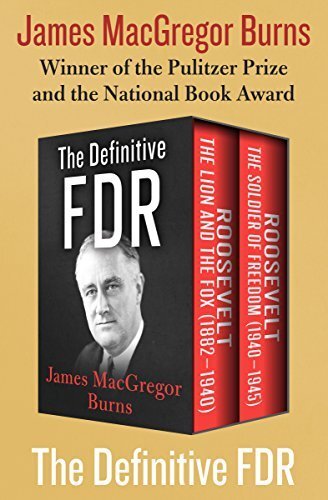
A Pulitzer Prize–winning historian’s dramatic biography of Franklin Delano Roosevelt, US president during the Depression and WWII. Franklin Delano Roosevelt was the longest serving president in US history, reshaping the country during the crises of the Great Depression and World War II. James MacGregor Burns’s magisterial two-volume biography tells the complete life story of the fascinating political figure who instituted the New Deal.   The Lion and the Fox (1882–1940): Before his ascension to the presidency, FDR laid the groundwork for his unprecedented run with decades of canny political maneuvering and steady consolidation of power. Hailed by the New York Times as “a sensitive, shrewd, and challenging book” and by Newsweek as “a case study unmatched in American political writings,” The Lion and the Fox details Roosevelt’s youth and education, his rise to national prominence, all the way through his first two terms as president.   The Soldier of Freedom (1940–1945): The Pulitzer Prize and National Book Award–winning history of FDR’s final years examines the president’s skillful wartime leadership as well as his vision for postwar peace. Acclaimed by William Shirer as “the definitive book on Roosevelt in the war years,” and by bestselling author Barbara Tuchman as “engrossing, informative, endlessly readable,” The Soldier of Freedom is a moving profile of a leader gifted with rare political talent in an era of extraordinary challenges.

1989 pages, Kindle Edition

Published September 5, 2017

Loading...
Loading...

About the author

James MacGregor Burns

77 books84 followers
An award-winning author of presidential and leadership studies, James MacGregor Burns was the Woodrow Wilson Professor of Government Emeritus at Williams College and Distinguished Leadership Scholar at the James MacGregor Burns Academy of Leadership of the School of Public Policy at the University of Maryland, College Park. He received his bachelor's degree from Williams College and his Ph.D. in political science from Harvard, and he also attended the London School of Economics. A member of the American Academy of Arts and Sciences, he was past president of the American Political Science Association and the International Society of Political Psychology.

Ratings & Reviews

What do you think?
Rate this book

Friends & Following

Create a free account to discover what your friends think of this book!

Community Reviews

5 stars
53 (55%)
4 stars
26 (27%)
3 stars
14 (14%)
2 stars
1 (1%)
1 star
1 (1%)
Displaying 1 - 10 of 10 reviews
Profile Image for Richard Marney.
843 reviews57 followers
November 23, 2025
A lively yet serious historical portrait of this important figure during two of the greatest challenges in the 20th century - the Great Depression and WW II. An enjoyable and informative read.
Profile Image for Jeffrey Zeltzer.
15 reviews
February 5, 2019
The President for the Times 1932-1945

This is the five-star definitive biography of a brilliant, confident, enigmatic and multi-faceted leader told magnificently. James MacGregor Burns' thoroughly researched two-volume tome comes alive to any reader. If you desire to know Roosevelt and the America and world of this age, read it.
26 reviews2 followers
March 3, 2024
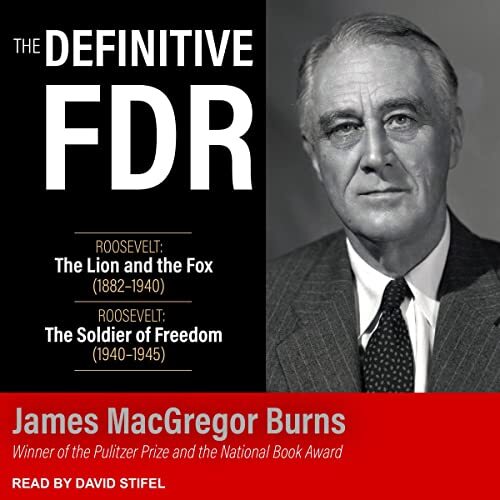
Well, this was a long one! This was an audiobook comprising of two biographical books on FDR, one focusing on his pre-WW2 years, and the other on his WW2 years.

It was fascinating, getting to see both more of FDR, and of the second world war from the American political perspective. To my surprise I found the first book the most exciting, delving into his transformation from idealistic crusader to shrewd politician, seeing his political battles with "Bossism", and how he dealt with his illness. The second book was still interesting, especially learning how difficult it was for him to convince the American public "why" they had to fight the second world war, and seeing him in the difficult position of having to fight full elections whilst also leading his country through one of the most cataclysmic wars of all time.

It could have been shorter and still got the same message across. Too often it tried to pull some deep political philosophy from minor decisions, and spent too long running the same analysis of his actions over and over, but that's something which can be forgiven in a book of this ambition.

Overall I'd recommend this to anyone who was interested in getting into the political force behind America's second world war leadership, but if you just want a quick biography there may be lighter books out there for you.
Profile Image for Keith.
1,134 reviews14 followers
July 17, 2026
Five stars. James MacGregor Burns's two-volume political biography of Franklin Delano Roosevelt is among the finest works of American political history I have ever read, and FDR himself is the most compelling subject in my ongoing reading of presidential biography — more complex than Hoover, more morally interesting than Coolidge, arguably greater in consequence than anyone since Lincoln. Commissioner Gordon's formulation in Frank Miller's The Dark Knight Returns has been rattling around my head since I finished this book: "He was too big." That is exactly right.

The Two Volumes

Roosevelt: The Lion and the Fox (1956) covers FDR's life from his birth in 1882 through his election to a third term in 1940. The title comes from Machiavelli, who argued that the ideal ruler must combine the cunning of a fox with the strength of a lion — and Burns's central argument is that Roosevelt embodied both qualities in unusual measure, deploying them strategically across the long arc of a political career that began in the New York State Senate in 1910 and ended only with his death in office in 1945. The New York Times called it "a sensitive, shrewd, and challenging book"; Newsweek called it "a case study unmatched in American political writings."

Roosevelt: The Soldier of Freedom (1940–1945) picks up where the first volume ends and covers FDR's wartime presidency — the most consequential five years in the history of the modern American state. This volume won both the Pulitzer Prize and the National Book Award in 1971. It is, in my assessment, the stronger of the two, because the wartime material forces Burns to grapple with FDR at his most difficult: the man who saved liberal democracy while doing terrible things in its name.

The "Biggest" President

I think of FDR as the "biggest" president the United States has ever had — bigger even than Lincoln in the scope of what he faced and what he changed. He governed through two of the defining crises of the twentieth century: the Great Depression and the Second World War. He served longer than any president before or since — twelve years, four terms, dying in office in April 1945. He transformed the relationship between the federal government and the American people, creating the social safety net through the New Deal and the national security state through the war. The America of 1945 was a fundamentally different country from the America of 1933, and FDR was the primary agent of that transformation.

Roosevelt As Pragmatist — And Opportunist

Burns is precise about what kind of political thinker FDR was, and it is not what the ideologues of left or right would want him to be. "Roosevelt was no theorist." He strived to be the president of all the people and showed no consistent allegiance to any ideological framework — left or right. He was a pragmatist: trying whatever policy seemed as if it could make things better for the country. Burns calls this "the politics of broker leadership" — FDR as a man who mediated between competing interests rather than advancing a coherent doctrine.

Burns also repeatedly describes FDR as an opportunist — sometimes in the best sense, sometimes in the worst. The worst example is his refusal to collaborate with Herbert Hoover in the four months between FDR's election in November 1932 and his inauguration in March 1933. The banking system was collapsing. The Depression was deepening. Hoover desperately wanted Roosevelt's cooperation on emergency measures. FDR refused, unwilling to take any responsibility for a crisis he hadn't caused and unwilling to give Hoover any credit for solutions he hadn't conceived. This was ugly. The country came first in FDR's rhetoric but not always in his behavior, and Burns does not hide it.

There is also a fascinating chapter Burns devotes to "Roosevelt As a Conservative" — exploring links to Edmund Burke-style conservatism and to early American political thought. This is counterintuitive but accurate: FDR was striving to save the capitalist economic system, not to replace it. The New Deal was a rescue operation for capitalism, not a revolution against it. He was a conservative in the Burkean sense: change what must be changed in order to preserve what is worth preserving. This connects to my own politics more than it might seem. The modern US politician I most admire is Elizabeth Warren — an unabashedly progressive who wants to maintain capitalism but with effective, common-sense regulation and a strong social safety net. Her political beliefs are closest to my own, and she is pragmatic at heart, fighting for reforms that can actually get through. FDR's New Deal is the historical precedent for exactly that kind of reformist pragmatism.

The Terrible Things

Burns does not avoid FDR's worst decisions. The most damning is Executive Order 9066, signed on February 19, 1942 — seventy-four days after Pearl Harbor. The order never used the word Japanese or the word camps. It authorized the military to declare areas "from which any or all persons may be excluded." As George Takei notes in his graphic memoir They Called Us Enemy , "as for what kind of 'persons' would be 'excluded,' that quickly became obvious" (pp. 22–23). Approximately 120,000 Japanese-Americans — citizens and legal residents alike — were imprisoned for up to four years without charges, without trials, without meaningful legal process. Burns consistently refers to these facilities as concentration camps, which is the accurate term.

Burns compares FDR to Thomas Jefferson in this respect: very pro civil liberties in general, but finding many exceptions when the political moment seemed to demand it. A hypocritical stance in both men, and in both cases a genuine moral failure rather than a temporary lapse.

Takei's father Takekuma Norman Takei makes the argument I find most powerful about the internment, because it refuses to use FDR's failure as a reason to abandon faith in American democracy:

"Roosevelt pulled us out of the Depression, and he did great things. But he was also a fallible human being…and he made a disastrous mistake that affected us calamitously. But despite all that we've experienced, our democracy is still the best in the world because it's a people's democracy and the people can do great things." (pp. 195–196)

And Takei's own formulation of why this history matters: "That remains part of the problem — that we don't know the unpleasant aspects of American history...and therefore we don't learn the lesson those chapters have to teach us. So we repeat them over and over again" (p. 174).

Burns's broader chapter on "The Culture of War" in the second volume adds another layer: the cynicism that warfare produces, the gap between the ideals for which wars are publicly fought and the actual motivations of the people fighting them. Burns reveals that the average American soldier and civilian cared most about the country returning to normalcy — not about bringing democracy and peace to the rest of the world. The rhetoric and the reality were not the same. FDR knew this, and navigated the gap with characteristic skill and characteristic evasiveness.

Roosevelt as Grand Strategist

The chapter on FDR as grand strategist is one of the most analytically interesting in the second volume. American losses in World War II were shockingly light by the standards of the other major combatants — around 400,000 dead, compared to the Soviet Union's estimated 27 million. But did FDR achieve his larger war aims? Burns is honest that the answer is complicated. The world that emerged from 1945 was not the world FDR had envisioned — a stable international order underwritten by great-power cooperation, the "Four Policemen" maintaining peace while colonized peoples gradually achieved self-determination. Instead: the Cold War, the nuclear standoff, the collapse of the European empires in chaos rather than order, the Soviet domination of Eastern Europe that FDR's Yalta agreements did nothing to prevent. Whether he could have done better given the constraints he faced, or whether he was naive about Stalin, or whether he simply ran out of time, Burns considers carefully without delivering a final verdict.

The Dark Knight Returns and the Pearl Harbor Question


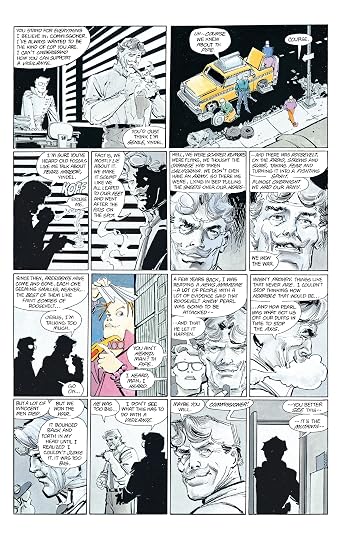
In Frank Miller's graphic novel The Dark Knight Returns (1986), an aging Commissioner Gordon tells a story about FDR to explain his tolerance of Batman's vigilantism. He describes the shock of Pearl Harbor, the fear, the chaos — and then Roosevelt on the radio, strong and sure, turning fear into a fighting spirit:

"Years later, this report came out that Roosevelt might have known Pearl Harbor was coming and let it happen. That rattled around in my head for days. How horrible it would be if it were true. Then again, it's what got us into the war. A lot of men died... but in the end, it saved millions. I bounced back and forth like that until I realized... it was too big for me to judge. He was too big."
The Pearl Harbor foreknowledge conspiracy — the claim that FDR knew the attack was coming and deliberately allowed it to happen — is almost certainly false. The FDR Presidential Library states plainly that "no document or credible witness has been discovered that proves either claim," and the senior historian at the National World War II Museum calls the theory "not supported by a shred of evidence." Burns himself does not raise it. What the record shows is something considerably less dramatic and considerably more forgivable: missed intelligence signals, institutional failures, overconfidence, and the genuine difficulty of anticipating an attack of that specific scale and location.

But Gordon's formulation — "he was too big" — remains true in a different sense. FDR operated at a scale of consequence that makes ordinary moral judgment feel inadequate. I am not comfortable with "the ends justify the means" as a general moral principle. But I am honest enough to acknowledge that in evaluating FDR, the scale of both the ends and the means is so large that simple moral arithmetic breaks down. Burns gives you the tools to make that judgment for yourself without making it for you. That is the mark of a great biographer.

Burns as Biographer

Burns was a political scientist as much as a historian, and this shapes his approach in ways that are both a strength and a mild limitation. The strength: his analysis of FDR's political methods — how he built coalitions, how he managed subordinates, how he read public opinion, how he deployed his remarkable personal charisma — is as good as anything I have read on the subject. The mild limitation: some readers will want more of FDR the person — the private man, the husband, the father — and Burns gives somewhat less of this than biographers like Jean Edward Smith do.

But the political analysis more than compensates. If you want to understand how American political power actually works — how it is built, maintained, exercised, and lost — this is the right book.

Verdict

Five stars. The Definitive FDR belongs alongside Robert Caro's The Power Broker as one of the finest works of American political biography — comprehensive, analytically rigorous, honest about its subject's failures, and fully alive to his greatness. Whether or not FDR was "too big to judge," as Gordon puts it, Burns gives you everything you need to try.


[Image: Hardcover Book Cover]


[Image: Audiobook Cover]

Citations:

Burns, J. M. (2017). The definitive FDR: Roosevelt: The lion and the fox (1882–1940) and Roosevelt: The soldier of freedom (1940–1945) (Kindle Edition). Open Road Media. https://www.amazon.com/gp/product/B07...

FDR Presidential Library and Museum. (n.d.). Pearl Harbor. https://www.fdrlibrary.org/ph-curricu...

Miller, F. (1986). Batman: The dark knight returns. DC Comics.

NPR. (2016, December 6). No, FDR did not know the Japanese were going to bomb Pearl Harbor. https://www.npr.org/2016/12/06/504449...

Takei, G., Eisinger, J., Scott, S., & Becker, H. (2019). They called us enemy. Top Shelf Productions.

Title: The Definitive FDR: Roosevelt: The Lion and the Fox (1882–1940) and Roosevelt: The Soldier of Freedom (1940–1945)
Author(s): James MacGregor Burns (1918–2014)
Year: 1956 (Vol. 1), 1970 (Vol. 2), 2017 (combined edition)
Genre: Nonfiction — Biography, Political History
Page count: 2,226 pages
Date(s) read: 6/18/26–7/17/26
Book 145 in 2026
52 reviews1 follower
December 13, 2023
A very detailed biography of probably the most important statesman of the twentieth century. Roosevelt’s life tells us that a great leader could be manipulative, trickster, liar , opportunist but what makes him great Is the set of core beliefs and principles which he holds. Roosevelt walked with a fine balance of courage and caution and principles and practicality. His life also points that to be a successful leader in a democracy one should focus on short term goals. One also wonders that if he would have lived a bit longer, probably the humanitarian catastrophe of atomic bombing of Hiroshima and Nagasaki would not have happened.
12 reviews1 follower
March 21, 2022
If you are one that enjoys U.S. presidential biographies this two volume set is a must read. The author tends to be negative about FDR when not writing factually. Overall very thorough and unbiased with factual content. While a long read for me, by the time I finished I found myself yearning for a bygone day in American politics.
Profile Image for Newell.
Author 5 books3 followers
May 21, 2023
This is unquestionably a definitive history of one of the most consequential presidents of the U.S. There are many lessons to learn about leadership.
Profile Image for Ben Mozingo.
83 reviews1 follower
Want to Read
May 15, 2024
Abandoned this biography after about 10%. Don't really like the pacing and I am reading that there is a better biography out there.
38 reviews1 follower
April 18, 2025
Great read

I never read a book that a Pulitzer Prize before. Now I have. Very detailed description of FDR's life from birth to death.
Displaying 1 - 10 of 10 reviews