Jump to ratings and reviews
Rate this book

They Don't Dance Much: A Novel

Rate this book
In this classic country noir, featuring a new introduction by Daniel Woodrell, a small town farmer takes a job at a roadhouse, where unbridled greed leads to a brutal murder

Jack McDonald is barely a farmer. Boll weevils have devoured his cotton crop, his chickens have stopped laying eggs, and everything he owns is mortgaged—even his cow. He has no money, no prospects, and nothing to do but hang around filling stations, wondering where his next drink will come from. As far as hooch goes, there’s no place like Smut Milligan’s, where Breath of Spring moonshine sells for a dollar a pint.
 
A bootlegger with an entrepreneurial spirit, Milligan has plans to open a roadhouse, and he asks Jack to run the till. The music will be hot, the liquor cheap, and the clientele rough. But the only thing stronger than Milligan’s hooch is his greed, and Jack is slowly drawn into the middle of Smut’s dalliances with a married woman, the machinations of corrupt town officials—and a savage act of murder.

315 pages, Kindle Edition

First published January 1, 1940

23 people are currently reading
894 people want to read

About the author

James Ross

1 book5 followers
James Ross (1911–1990) was an author of noir fiction. Born in North Carolina, he worked as a reporter for the Daily News (Greensboro) for many years. He wrote his first and only novel, They Don’t Dance Much, in 1940. The book, considered “country noir,” was praised by the likes of Raymond Chandler and Flannery O’Connor. During the decade that followed, Ross published several short stories in literary journals such as Partisan Review, the Sewanee Review, Collier’s, and Argosy while he worked on another novel, In The Red, which was never published.

Ratings & Reviews

What do you think?
Rate this book

Friends & Following

Create a free account to discover what your friends think of this book!

Community Reviews

5 stars
100 (25%)
4 stars
185 (47%)
3 stars
81 (20%)
2 stars
18 (4%)
1 star
4 (1%)
Displaying 1 - 30 of 80 reviews
Profile Image for Guille.
1,007 reviews3,284 followers
December 26, 2021

En el epílogo, George V. Higgins, además de lamentarse por la mala influencia que tuvo sobre este tipo de literatura la timorata sociedad bienpensante americana de la época, nos dice algo importante sobre James Ross: “Hizo avanzar el oficio de la narrativa todo lo que podía avanzar en el momento en que escribió, pero nadie presto atención. O muy poca gente”.

Es muy probable que fuera difícil, por lo escandaloso o transgresor, escribir en aquella época sobre el racismo, la explotación encubierta de trabajadores blancos o negros, la crueldad, la ignorancia generalizada, la hipocresía de una sociedad empobrecida, pacata y alcoholizada, la corrupción como parte inherente del “buen” funcionamiento de la sociedad, la ambición por encima de todo y de todos.

Todo ello, que posiblemente confiera valores adicionales a la novela, no son para mí factores que puedan aumentar el disfrute de una lectura. Solo puedo decir que Mal dadas es una novela entretenida, bien escrita, con un tono general de novela negra, ágil, con una trama mínima enmarcada en grandes pasajes dialogados que retratan muy bien como era (es) esa llamada basura blanca y esos negritos falderos de los blancos.

Una novela correcta.
Profile Image for Still.
642 reviews118 followers
April 3, 2019
Just finished this novel moments ago and I'm feeling pretty much pole-axed by the quality of the writing and the stunning and beautifully written ending.
It's a cross between James M. Cain and William Faulkner. Naaaaahhh, not Faulkner. Not really.
It's in a league of its own.
It's tough and it's hardboiled and a richly rewarding read.

If you're a fan of Country Noir you owe it to yourself to read this.


I'm going to have to cogitate on this one a while.
Might try to write a more coherent review of this tomorrow or the next day.
Doubt I'm capable of doing this literary masterpiece justice.
It's absolutely the best novel I've read since Donald Ray Pollock's The Devil All The Time or the last Daniel Woodrell.

*******************

2nd time around and I'm as numb after reading the last page as I was the first time I read this novel.

Two hard cases team up to start the finest roadhouse Depression-era North Carolina ever saw.
The legal liquor and the bootleg liquor fly off the shelves.
Two slot machines and only one of them ever pays off ...but rarely at that. Every card deck is personally shaved by the owner.
Everything is working out.
Then greed and murder get the best of the two.

This novel is as brilliantly written and as suspenseful as I originally judged it to be.
Unforgettable!
Highest Possible Recommendation.
Profile Image for Francesc.
483 reviews283 followers
October 22, 2020
Interesante novela, con un lenguaje crudo y directo.
Aunque es un tipo de escritura que me gusta por ser muy sencilla (no simple), a la novela le falta emoción. Casi todo el libro es una descripción de la vida cotidiana de unos hombres en un bar de carretera de la época.
En general, le falta chispa, pero reconozco que la historia es atractiva.

Interesting novel, with a crude and direct language.
Although it is a type of writing that I like because it is very straightforward (not simple), the novel lacks emotion. Almost the entire book is a description of the daily life of some men in a road bar of the time.
In general, it lacks spark, but it's true that the story is attractive.
Profile Image for James Thane.
Author 10 books7,071 followers
November 21, 2013
This Depression-era novel quickly sank from view when it was first published in 1940. A new edition was released in 1975, with an introduction by George V. Higgins, a crime novelist who was then at the peak of his career. But even with his endorsement, the book was still little-noticed. Perhaps the third time will be the charm and the book has now been re-released with an introduction by Daniel Woodrell, a great writer perhaps best known for his book, Winter's Bone.

The main protagonist is a North Carolina farmer named Jack McDonald. Jack is about as down on his luck as any man can get in the middle of the 1930s. The Boll weevils have destroyed his cotton; he can't pay the money he owes at the bank, and the county is about to seize his land for back taxes. Jack makes what seems to be the only logical decision at this point and decides to get drunk.

He buys a jar of moonshine from a filling station operator named Smut Milligan. Smut's joint is on the outskirts of the small town of Corinth at the junction of River Road and Lover's Lane. Smut sells gas and a little food along with his bootleg whiskey. He also has some gambling going on in the back room and he pays off the sheriff who looks the other way.

Smut is an ambitious man, and over a drink he tells Jack that he's planning to open a road house and expand his operation to include a dance hall, tourist cabins and a real restaurant. He offers Jack a job as his cashier and, having no other viable prospects, Jack accepts the offer which includes room and board.

Any reader will certainly understand that a character who signs on with a guy named Smut has probably got a lot of trouble in his immediate future. Milligan will gradually entangle Jack in a variety of evil schemes and in classic noir fashion, Jack slowly sinks before our very eyes, taking one ill-advised step after another until he's finally in the jam of a lifetime.

It's hard to imagine how a book this good could have possibly been overlooked for nearly seventy-five years. Ross writes beautifully and completely immerses the reader in the sordid world he creates. He's particularly good at portraying the class distinctions that existed in a small, rural southern community at this time, and he's created a cast of believable and very memorable characters.

This is a book that will remind many readers of the stories of James M. Cain, particularly The Postman Always Rings Twice. Ross is certainly in Cain's league; his story is just as gripping, and he certainly deserves to be remembered along with the other of the best writers of his generation. They Don't Dance Much will certainly appeal to any reader who likes his or her crime fiction dark and dirty. Thanks to Otto Penzler, the Mysterious Press and Daniel Woodrell for bringing it back to life.
Profile Image for Melki.
7,291 reviews2,611 followers
July 27, 2013
"A murder's a bad thing. Here I was mixed up in one and it looked like experience was all I was going to get out of it."

Smut Milligan is a bootlegger who opens a roadhouse, and finds himself drowning in debt. Creditors are closing in and he stands to lose it all. But, wait...there's a rumor that one of his customers keeps a large stash of money hidden somewhere on his property. So, Smut takes his trustiest employee, Jack McDonald, along to pay the man a visit. It turns out to be a very unsocial call, and soon the men share a dark and deadly secret.

Money changes everything and life quickly becomes a game of who can turn the other guy in and collect the cash WITHOUT implicating himself.

Some of the characters who hang out at the roadhouse love to debate whether or not crime pays. The answer is it can, but possibly NOT the person (or persons) who commit the crime.

This is a great Southern noir read that should be considered one of the classics of the genre.

Thanks, again, to Mantan for bringing this one to my attention.
Profile Image for Kiekiat.
69 reviews124 followers
August 3, 2018
They Don't Dance Much is a noir novel set in 1930's North Carolina. It was the only book its author, James Ross, ever completed, and after reading it one wonders why Ross did not go on to produce many more novels. The book was out-of-print for many years after being published in 1940 and Mysterious Press wisely chose to re-publish the book in 2013, with a forward by Daniel Woodrell.

Apparently the book received encomiums from Raymond Chandler and Flannery O'Connor, upon publication, but even accolades from such august writers did not enhance book sales.

The book is a great first effort and it probably helps that Ross was a journalist with excellent writing skills and good descriptive powers. The book has been lumped into a category called "Country Noir," but this is mainly because it is set in rural North Carolina. If it had been written by James M. Cain it would simply be labeled as a noir novel.

The book's story line is pretty simple. The narrator is a failed cotton farmer who goes to work for a local thug who has plans to turn his small gas station into a roadhouse. He fulfills these plans and hires the narrator/farmer to work as his cashier. The roadhouse turns out to be a great success and draws many customers. But success leads to envy and scheming and the desire for greater success and what ensues is a complex interplay between the town's power brokers and the club's owner and some horrible events occur during the machinations of the roadhouse owner, Smut, and the town's elite, who are trying to wrest the roadhouse from his control.

One of the book's main points is that, as with much in life, things are not what they seem in this placid little North Carolina burg, and the town is not so simple as someone passing through might suspect.

It is hard to know for certain why the book never entered the canon of noir fiction. Many great books have fallen by the wayside for seemingly no reason. If I had to guess, though, I would say that some of the reason for the book's fading into obscurity lies in its accurate depiction of North Carolina speech, circa 1940. Every black person is called by the "N" word and this is done more of a matter of course than as a direct slur. Ross is simply writing in the dialect of the time and a Southerner would easily pick up on the nuances of black-white relations, which are far less black and white (pardon the pun) than an outside observer would be able to observe. Without understanding the complicated (and obviously unjust) race relations of the time, a casual reader might get the impression that Ross is a racist or that the characters are monstrous people. Some of them ARE monstrous people but less so from the way they talk than by their actions.

The book appears to have been written by a novelist well-steeped in the noir genre. One reason, perhaps, that Ross did not follow it up is because he had no character other than the narrator who could realistically have continued on in any type of sequels--and the narrator, taken alone, was not a strong character like a Sam Spade or Philip Marlowe who could drift from story to story with ease. Still, Ross clearly had the talent to continue to write tales in this genre and I'm glad Mysterious Press recognized the book as a neglected noir classic and decided to release it again. Like the best noir fiction, it explores the darker side of humanity without trying to explain it and gives an accurate, slice-of-life depiction of life in rural North Carolina in the late 1930's.
Profile Image for Zoeytron.
1,036 reviews898 followers
May 19, 2013
Originally published in 1940, this down and dirty tale of murder and mayhem is well-deserving of a second publishing. It is labeled as country noir, which is spot on; interesting that the term probably wasn't even around when it was written. I keep wanting to refer to it as a potboiler, but it is so much better than that.

With the name of Smut Milligan, you just know the guy is going to be a mighty unsavory individual. Yep, he is. Any idea about someone who is called Badeye Honeycutt? As you might guess, this fellow has a glass eye that either doesn't fit quite right or is slightly cocked. Sad to say, Badeye's 'good' eye is also slightly cocked. You can take it from there. Nuances fall by the wayside here, the author pulls no punches with the unforgiving nicknames of his characters and they are fun. Mean, but fun. Slop Face for a pimply-faced young sprout and Crip Wood for a townie with a bad limp.

The book is chock full of quaint colloquialisms. 'Making a fuss like a hog over a slop trough' - maybe you have heard the phrase, maybe not - but the picture it evokes is crystal clear. How long has it been since you have heard it said that so-and so gives you the creeps? It's in here!

There is nary a redeeming character in the tale, and hopefully no one to whom you can relate. Yet the story works beautifully. This was a goodreads giveaway. So glad I got the chance to read it. It's a winner!
Profile Image for Larry Carr.
285 reviews4 followers
December 24, 2023
Just learned of the existence of They Don’t Dance Much (originally published 1940), and its author, James Ross. From the forward by Daniel Woodrell… “This is rural North Carolina in the 1930s and everybody seems to recognize everybody else, know their faces if not their home addresses and hat sizes. Ross writes in classically laconic, wised-up American prose. His voice suits then and now, and will still carry well tomorrow.” … “They Don’t Dance Much, a novel that was often declared dead but has never been successfully buried, offers a persuasive portrait of a rough-and-ready America as seen from below, a literary marvel that is once again on its feet and wending its way toward the light.”

Our Protagonist Jack. “made up my mind to cook an omelet when I got home, provided the hens had laid an egg since I left. But I couldn’t get started. I got up to go and I dreaded walking four miles. The sun had gone down, but it was still hot. The back of my shirt stuck to me. I went inside and got a ten-cent beer. The beer cooled me off and I thought it was ten cents well spent. … I had beer number three, and by then the situation looked better to me.” … “ there I was: ‘McDonald, Jackson T., 45 acres, West Lee Township.’ I hadn’t paid the taxes in two years and I might have known it was coming. Just the same it wore me out to see my land advertised for taxes. My prospects for a crop that year were lousy. I had a land-bank payment to meet that fall. My mule had the gout, or something like it. Now this had to come up. It knocked all the comfort out of the three bottles of beer.”

Sidekick/boss/nemisis Smut. “That was the way I felt that night, too. Brittle, and dry-mouthed, and a little uneasy. Like I was going to do something that didn’t have anything to do with anything I’d ever done before.” … “Smut struck a match on his shoe and held it to the cigarette. He held this match like he did the other one, to see if his sweetheart had changed her mind. This time there was a strong red glow after the flame went out. ‘Loves me now,’ he said. ‘Must want to go to a dance.” … “ Time of the war when cotton were forty cent a pound I clear over a thousand dollar in Marlboro County, in South Callina.’ ‘What’d you do with it?’ Smut asked. ‘Throwed it away. Lived high as a kite till the money was gone. Had a Ford machine, a talkin Victrola. Kept a jar of liquor on the kitchen table, day and night.’ … “Yadkin College ain’t much of a college, but the year I was there I learned a lot of new ways to spend money, and no new ways of making any.’… “Smut had been living on the streets for some time then … must have been eighteen then, and he was grown. He hung around Corinth that summer, working in filling stations and playing baseball on Saturdays. That fall he went off to Harrell Junior College, but they kicked him out as soon as the football season was over. After the football season was over he’d come back to Corinth and hang around till spring, when he’d go back to another college and make his board and room playing on the baseball team. In the summer he could always make enough to live on by playing baseball with some mill team.” … “I didn’t see hair nor hide of him for three or four years. Then in 1935 he came back. One Saturday afternoon I walked into the City Bowling Alley. He was running the joint just like he’d been there all the time.”

Smut’s Roadhouse. “I was green as a stalk of corn, and the first two days Smut had to show me my way…The carpenters and the masons started putting up a new building right beside the filling station. While they were working we kept on doing business at the old stand. When they finished the new building Smut aimed to have them remodel the filling station into a dance hall and connect it with the new part.”

Locals. “Bert Ford was a strange man to me. His pal, Wilbur Brannon, was just as strange. He turned night into day. I never could figure out what it was that made Wilbur and Bert friends. They were from different classes. Wilbur’s folks used to be big landowners before the Civil War; there’s still a lot of niggers around Corinth named Brannon. [slipped that one in there] … the folks of his own class mostly shunned Wilbur Brannon. They hadn’t forgotten him going to the penitentiary. Then he never went to church and never pretended to work. A lot of folks thought it was going against Nature to sit up all night too, and sleep in the daytime. But Wilbur went his own way and let other folks go theirs.”

Smut’s Business & Sidelines. “On Saturdays we generally sold as much as fifty pints of liquor, corn and government together. Smut took in a lot from the two slot machines—especially from the one that was busted and wouldn’t pay off. He sold some heavy groceries, and tobacco, and odds and ends to the farmers. I could see he was making good money.” … “The River Bend Roadhouse. Dine and dance. Drink liquor and make love. Slot machines and high dice. Name your sin and your favorite utensils. We’ll have it.’ Lola looked around her to make sure the coast was clear. Then she looked up at Smut and smiled at him in a way to make her husband have a running fit” … “hell’s bells, what I took off them tonight ain’t a drop in the bucket. They both got plenty money.’ ‘Wonder how they got it,’ I said. Smut kicked his shoes against the wall. ‘God knows; I don’t,’ he said. ‘What I’d like to know is a way to separate them from it.’ Cabin Amenities. “It was light enough to see in there, but that was all. It was more like a sort of thick twilight. Smut said an atmosphere like that would aid business and help increase the population of the county at the same time. That was always Smut: trying to kill two birds with one stone.”

BIG FORMAL OPENING, OCT. 28 RIVER BEND ROADHOUSE DINE AND DANCE FRESH PIT BARBECUE CHICKEN DINNERS EVERYBODY WELCOME. … “to serve the public with Superior Sea Food, Sizzling Steaks, Curb Service, Dancing Accommodations, Hot Rhythm, and Various Other Things, at his location on River Road and Lover’s Lane. Special Accommodations for Tourists” … “They all liked to hear the Nickelodeon. One of the would match another one to see who put the nickel in the slot. When the piece played out they would match again and get another record going. They liked the mournful-sounding records that were sung by hillbilly singers. Their favorite was some bird named Basil Barnhart, the Bear Mountain Barytone. It was a pity the bears let him get away.” … “ another class of folks from Corinth came out that night to investigate. They were the people that are supposed to be nice folks, but like a dram now and then. And when nobody is looking like to kiss somebody else’s wife and pinch her on the behind and let their hands drop on her thigh, always accidentally, of course. They all stayed out in their cars because they could get drunk more privately out there. The best folks are the ones that will go to the most trouble to keep other folks from knowing when they get drunk. Anyway, it was a good opening night. Everybody in Corinth, but the best folks and the niggers, was there. They spent a lot of money too.”

The Educated View. “Charles Fisher looked at them like they weren’t being serious enough, and he went back to the problems of the South. ‘The main trouble down here is the improvidence of the native stocks,’ he said, ‘coupled with an ingrained superstition and a fear of progress. They are, in the main, fearful of new things.’ I think they merely dislike the pain that is attendant to all learning. They don’t want to learn anything new. It requires too much effort. Of course we have the pick of the natives in our hosiery mills. It isn’t like a cotton mill. We pay much better wages and we have a different type of hand altogether.’”

What’s a Fella to Do? “ ‘Maybe I could get in the CCC,’ I said. ‘Now that I’ve lost my farm I don’t have any visible means of making a living.’ ‘I doubt it,’ Smut said. ‘Even if you do they put a boss over you that works you just like you was on the chain gang. You got to get up when they say get up; go to bed when they say go to bed; eat what they hand you to eat, and swallow it when they say swallow; they let you go to town every other Saturday night and give you a prophylactic when you come back, whether you looked at a woman or not.’”

Fork in the Road. “the last we said to each other that night, and I suppose Smut went to sleep then. But I couldn’t sleep. I was worried about what we’d done, and I was sore with Smut for pulling me into a murder without saying anything to me before-hand.” Yeh the path taken, in Jack’s case stumbled down… you may want to follow along…

Afterword By George V. Higgins. “having observed Walpole’s dictum to the letter: Prefer coarse, vulgar talk, he counseled” [Prevailing Prudent Censorship] “James Ross wrote They Don’t Dance Much in thrall of those constraints. Raymond Chandler was writing tough novels about tough guys at the same time, under the same restrictions, and succeeding in the same fashion: anyone who paid attention knew that Philip Marlowe was carrying on with the female characters when the novelist stepped out for a glass of water Hammett’s characters weren’t uniformly chaste either. Ross was bolder than either of them, hard-boiled as they were” … “Baxter Yonce, and the sheriff, and Rufus, even Lola Fisher and Ox, the ballplayer of indeterminate age cameoed into the novel in the full flower of his pungency: all are very hard characters, lean, mean, and reeking of purposive, corrupt, amorality.” … “My own view is that realistic literature should be as realistic as possible. When the novelist bows to convention and averts his eyes, the eyes of the reader are forcibly averted also.” … The point is that Ross was studying the void. His skill was profound. Pressing the limits, as they then existed, as far as he possibly could, he lightened considerably the dark glass through which the reader sees the abyss, and recoils from it. But there remains the fact that this man, who clearly knew to his very sinews the characters he wrote about, was obliged to soft-pedal, not much, but a little, the harshness of the created reality in which they took life.”… “James Ross was a writer out of his season. That was too bad for him, and until this novel was retrieved from the neglect of almost thirty-five years, too bad for us, too. He wrote with a fine disregard for what was popular, courageously, and his editors printed what he wrote, with equal courage, and nobody noticed. He advanced the craft of fiction as far as it could be advanced when he was writing, and no one was paying attention.”

“Life’s hard, life’s very hard. It’s harder without luck. -But that, of course, was what he was telling us.”
Profile Image for Andy Weston.
3,203 reviews227 followers
January 15, 2019
There’s an uncharacteristic slow build up to this novel of southern noir set in the outskirts of a Depression-era mill town in the north of North Carolina. In that build up Smut Mulligan turns his filling station into a roadhouse that sells moonshine and runs crooked card games, it’s not difficult to see that things will soon turn nasty.
The narrator is Jack McDonald, who is out of work having just lost his family farm, and throughout the story is something of a hanger-on. It is a window into the desperation and depravity of the day, a tale of folk with low expectations still trying to get rich quick.
Sometimes the characters and settings of a novel are so well-described that the author pretty much can’t go wrong with the story. What is not appealing about a 1940 work of noir fiction set around a North Carolina roadhouse and that features characters with names like Smut Milligan, Catfish Wall, and Badeye Honeycutt? But despite the funny character names this is grim and serious stuff. Add to that illicit stills, card and fixed dice games, love triangles, bare knuckle boxing, the stifling heat of the Carolina summer, and it’s a winner. Ross was a mystery guy though, an enigma; he only authored the one novel and that had praise from the likes of Daniel Woodrell, Raymond Chandler, and George V. Higgins.

Smut Milligan was a couple of years older than I was, but I knew him pretty well. His first name was Richard, but everybody called him Smut. I don’t know what his last name really was. He didn’t know either. He was adopted by Ches Milligan and his wife when he was a baby. Ches Milligan used to run a grocery store in Corinth. His wife ran him. When she had his spirit broken—from what they tell me—she took a notion to go to an orphanage in Raleigh and get a baby there. She wanted a boy baby. She liked to tell males where to head in.
He was a tough kid in school and played hooky a lot. In the fall he’d traipse off to hunt muscadines and in the spring he went fishing in Pee Dee River, and sometimes in Rocky River. He gave the Milligans a lot of trouble. The old lady probably wished she’d let him stay in the orphanage. But she died when he was about sixteen. From then on Smut didn’t have any argument about what he did.
Profile Image for Laura.
882 reviews320 followers
April 14, 2014
I found that the book had a slow start but picked up about half way through. I liked how the narrator started the book the same way that he ended the book.....with pretty much nothing. He played his role well. The stuff in between held my attention causing me to think maybe things might work out for the narrator. Also, for a book written in 1940 I thought it was a pretty good little novel with some well placed surprises. This book is full of characters that are never going anywhere and excel in the art of missed opportunities.
Profile Image for Rog Pile.
Author 11 books3 followers
November 8, 2012


James Ross (1911-1990), said by William Gay to be “the man who invented Southern noir,” wrote only one novel, They Don't Dance Much.

The story is set in a North Carolina backwoods town, in the Depression years, and as the story opens, the narrator Jack Macdonald has just lost his farm through non-payment of taxes.

Jack spends a lot of his time hanging around the garage and roadside store run by his friend Smuts Milligan. Smuts has some big plans for the store, and soon Jack is working for him as Smuts expands his business into a roadside diner and dance hall.

But business turns out not to be as good as Smuts had hoped and soon he's looking for alternative sources of income. The novel's curious idyllic backwoods charm is interrupted by a harrowing torture and murder as Smuts tries to learn the secret of an old recluse's hoard.

It’s a novel of rare brilliance. Raymond Chandler described it as “a sleazy, corrupt but completely believable story of a North Carolina town.”

When Daniel Woodrell reviewed Joe R Lansdale’s Mucho Mojo (1994) in The New York Times, he cited as Lansdale’s predecessors James M. Cain, Erskine Caldwell and Jim Thompson, but went on to say: “James Ross is scarcely ever mentioned, though his one novel, They Don’t Dance Much (1940), might be the finest of the lot.”

Originally posted at Black Alibis
Profile Image for Tom Mooney.
917 reviews401 followers
April 26, 2018
Before McCarthy, before Gay, before O'Connor and Farris Smith and Rash and Woodrell, there was James Ross's They Don't Dance Much.
Published in 1940, the original southern noir novel stands the test of time very well. It tells the story of Jack McDonald, a failed farmer who takes a job at a roadhouse in the small town of Corinth, NC.
He falls under the wing of the owner, Smut Milligan, who eventually embroils Jack in a brutal murder.
The novel brilliantly depicts the semi-hillbilly community, which is a mix of drunks, flashy rich guys and downtrodden wives. Ross combines a compelling plot with highly evocative writing and wonderful, eccentric characters.
From what I can tell, the book has had a turbulent history, being shifted from publisher to publisher and never doing too well. I guess some of the racial language may be a little fresh for the modern ear but it is very much a novel worth reading and is at the heart of all the southern noir, country noir and southern gothic writing that has followed it.
Profile Image for Diego González.
194 reviews96 followers
August 15, 2016
Una novela que podría haber firmado James M. Cain, novela negra hard-boiled en una expresión bastante pura. América profunda, la Gran Depresión, alcohol ilegal en dosis poco menos que industriales, unos individuos cuya ambición es directamente proporcional a su carencia de escrúpulos, una mujer fatal, racismo por todas partes y un crimen bastante atroz como guinda del cóctel. Un relato desesperanzado, sucio y mugriento, como el escenario en el que se desarrolla.
Profile Image for L J Field.
607 reviews16 followers
May 23, 2025
Really good noir novel that I’ve read exceptional reviews of for a very long time. The only problem is that the end of the book fell flat for me.
Profile Image for a_reader.
465 reviews2 followers
June 18, 2015
I read the introduction by Daniel Woodrell first, then read the book itself, then went back to the introduction again and reread it. I wanted to understand exactly why Woodrell praises this book so much. I'm not so sure about this one. My main objection was the narrator Jack. Although he thought he knew what was going on in that roadhouse he was actually pretty slow to put one and one together. I also thought that the relationship between Jack and Smut after the crime was committed was odd and non logical, to the say the least. I think James Ross missed an opportunity to fully delve into the psychological despair and paranoia that the characters would experience while waiting to see if they can get away with their crimes.

Profile Image for Diane Barnes.
1,618 reviews446 followers
April 1, 2014
I was expecting more from this book because of excellent reviews and recommendations, but it just wasn't there for me. The characters were wooden and one-dimensional, and the story was simplistic.
Profile Image for Tim Schneider.
625 reviews3 followers
July 1, 2023
One of those "great lost" books that were praised by another great author (in this case Raymond Chandler) that largely disappeared from sight and was seldom reprinted. This was Ross' first and only novel though he wrote a few short stories and was a reporter. This would be an early example of "country noir" of the sort that would be popularized by Charles Williams being published by Fawcett Gold Medal. Apparently this book was compared to James M. Cain at the time of publication which allegedly upset Ross. I personally don't see it. Cain is a much more succinct writer. But I also can't see taking umbrage at being compared to Cain.

Jack McDonald is a failed farmer just kind of floating through life at the tail end of the Depression. What little he owns is mortgaged to the hilt and about to be repossessed and/or sold for taxes. He takes a job with Smut Milligan, local bad-boy and small-time entrepreneur, who is starting up a roadhouse just outside town and on the road to Florida. The place deals in bootleg liquor, dance music, and cabins that can rent by the hour. And it's a surprise success. But for all that success, Milligan still has money problems and the local political boss eyeing his little roadhouse for a hostile takeover. Being a true noir there's a murder and a femme fatale. And Jack McDonald definitely gets himself in over his head.

Compared to most of his contemporaries, and certainly to the later Gold Medal authors, Ross takes this one at a pretty leisurely pace. I was honestly not really feeling it for the first half of the book. It was fine and it was well written, but I just wanted it to get to the point a little faster. It does finish strong. In fact the ultimate ending is incredibly satisfying. Is it a lost masterpiece? I don't think so. But it definitely didn't deserve to be ignored. If it's not the equivalent of Chandler (what is?) or the best of Cain, it's easily as good as or better than better known novels by other contemporaries like Horace McCoy or W.R. Burnett.
Profile Image for AC.
2,221 reviews
April 8, 2024
James Ross wrote but one book, and ended as a big name literary agent. It is an early example of southern noir and is very well written — but too long, too slow. I can see why Flannery O’Connor (who liked the book) once quipped of They Don’t Dance Much, “it don’t sell much”. There are also some major flaws in character development. One of the main characters never develops, and the other main character “develops” in a manner that the reader is totally unprepared for. On the whole, lost interest after about 2/3 in.
Profile Image for Guy.
72 reviews49 followers
April 7, 2013
“The Riverbend Roadhouse. Dine and dance. Drink liquor and make love. Slot machines and high dice. Name your sin and your favorite utensils. We’ll have it.”

Originally published in 1940, They Don’t Dance Much by James Ross is back in print again thanks to Mysterious Press. James Ross, who died in 1990, published just one novel and a few short stories before making a permanent career in journalism. They Don’t Dance Much didn’t exactly make a splash when it was first published, but the novel’s reputation as a rare gem is gaining momentum. My digital copy comes with a grabber intro from Daniel Woodrell (Winter’s Bone):


"So we are sitting in a greasy spoon, a tavern, a living room, talking about books that we love that didn’t catch a break, hard-luck books of such obstinate appeal that, though they died early, just won’t stay dead."

After reading They Don’t Dance Much, a very dark, gritty tale, it’s easy to make the literary connections between James Ross and Daniel Woodrell, and it’s clear why this “country noir“ set in rural North Carolina in the depression years of the 1930s has a timeless appeal. The story is told in a no-frills, laid-back style by a young man, Jack McDonald, who’s inherited a small farm but is about to lose it thanks to $40 back taxes. Drowning in petty debt, including the cost of his mother’s funeral, Jack jumps at the chance at a job at a roadside tavern owned by local bad boy Smut Milligan who has somehow, and somewhat suspiciously, made good after disappearing for a few years and then reappearing with some cash.

Before he blew town, Smut Milligan had a hot and heavy relationship with town sexpot, Lola, the daughter of the local horse doctor, and in common with Smut, Lola also wanted the good things in life. Smut plans to hit the big time by expanding his filling-station business with a roadside diner, backroom gambling, and illegal corn whiskey. In addition, since the human vices are always lucrative, Smut’s crafty plans include several secluded cabins rented by the hour for adulterous assignations or for courting couples who’ve been drinking too much. Lola doesn’t have the same business opportunities as Smut, but she does have a killer body, so using her natural assets, she’s managed to snare the town’s richest man, Charles Fisher, the only son and heir of the region’s richest man who owns the local hosiery mill.

There’s nothing pretty or marginally decent about any of the characters in the book; this is a hard-scrabble town during the Depression with people ready and willing to do whatever it takes to get by, so there’s no quibbling about feeling guilty or wavering in a moral dilemma. A couple of the regular customers are Bert Ford, a reclusive man, a former strike buster, who’s rumoured to have a fortune buried in his back garden, and Wilbur Brannon, a disbarred doctor and former jailbird caught selling morphine as a sideline. Smut’s employees are a motley bunch of hard characters whose desperate lives careen into criminality; there’s Rufus, the cook, fresh from a chain gang, Catfish Wall, maker of bootleg corn whiskey, and Badeye Honeycutt as the bartender. The attitudes of many of the characters in They Don’t Dance Much reflect the racial attitudes of the times, so the black characters are ridiculed and seen, not so much at the bottom of the food chain, but outsiders tolerated for their usefulness more than anything else.

The town is run and controlled by various shady figures with an inflexible hierarchy in place. When Jack loses the family farm at the beginning of the novel, the scene is set for the idea that wealth and assets are sucked upwards, so Jack’s only means to make a grueling marginal living are seized by the government. Fletch Monroe, the town’s perpetually drunken newspaper editor who disappears on “three-week benders” is a tool for the moneyed classes, and his “news,” when it’s not months behind, reflects the interests of the local power-barons, who include the unsavory Smathers family who own and operate the Smathers Furniture and Undertaking Company as well as the Smathers Finance Company. By starting the Riverbend Roadhouse, Smut is trying to move out from the underclass, and become a man of substance. The Roadhouse, with its card games (some crooked), dance floor, steaks, and spittoons, has a hopping business, and that, unfortunately, brings attention to the joint. The sheriff “You do a little remembering for me and I’ll do a lot of forgetting for you,” turns a blind eye to Smut’s illegal corn whiskey operation. The banks are itching to call in any late loans, and then there’s Astor Legrand, a lawyer who has the local and state government in his pocket, and if anyone wants anything done in the region, Legrand gets a piece of the pie. Smut’s success attracts the murky, shadowy power structure in the county, and on the cusp of belonging to a different class of citizen, he knows it’s just a matter of time before someone tries to take the roadhouse away from him. Smut drags Jack into some very unsavory business, and this begins a sequence of violence and greed.


“If you start out on the bottom you got to be tougher than all the folks that’s between you and the top,” Smut said.

Profile Image for Mariano Hortal.
843 reviews202 followers
December 31, 2013
Publicado en http://lecturaylocura.com/mal-dadas-d...

Según va acabando el año, uno no espera encontrarse ya obras de nivel muy alto; sin embargo, este año, en su mes de diciembre, hemos vivido uno de esos momentos increíbles en los que las editoriales lo han dado todo; solo tenéis que ver mis últimas reseñas para comprobar el nivel, bastante alto, de lo último publicado, y eso que me falta todavía bastante por leer.

Uno de estos libros de calidad alta es, sin dudarlo, el “Mal dadas” del norteamericano James Ross (1911-1990) que nos acaba de traer Sajalín. El caso de este escritor me ha recordado poderosamente al de William Lindsay Gresham del que esta misma editorial sacó “El callejón de las almas perdidas”; otro de esos autores sin suerte en vida y que han sido olvidados a pesar de la indudable calidad de sus obras. Ross, a pesar del éxito de crítica de esta obra no pudo publicar ninguna más, no encontró editorial que apostara por él.

Escrita en 1940, “Mal dadas” está ambientada en los tiempos posteriores a la Gran Depresión; una época en la que acompañaremos a Jack McDonald, prototipo de “perdedor” clásico, que no tiene un sitio donde caerse muerto y que se agarrará a lo que pueda para intentar avanzar, o más bien sobrevivir:

“-¿Mis bienes inmobiliarios? A ver hombre, el banco agrario tiene hipotecada la granja por más de lo que vale. Por los muebles de la casa no me darían más de veinte dólares, y eso con suerte; dudo que se puedan sacar ni siquiera diez. Debo cuarenta de impuestos. Todo eso va por delante de tu factura. Tengo algunos aperos de labranza: unos quince dólares. Y una mula que no vale nada. También hay algunas gallinas, pero si han puesto un solo huevo en los últimos meses debe de haber un perro que ha ido por mi casa y se lo ha zampado.”

Él no es el único perdedor, estamos hablando de una época en donde se sentía más lejano que nunca la posibilidad del sueño americano, esa posibilidad de hacerse a uno mismo y prosperar era muy difícil en una sociedad donde faltaban los recursos y la hipocresía se convertía en una defensa ante esta indefensión:

“Hay una diferencia entre la gente como dios manda y la gente como dios manda de verdad. Los segundos son los que más esfuerzos hacen para que nadie se entere de nada cuando se emborrachan. De esos en Corinth apenas había un puñado. “

Corinth, el pueblo en el que está ambientado, se convierte en el epítome de cualquier ciudad norteamericana de la época; sus habitantes, esos emprendedores que, ante la falta de herramientas legales no dudarán en hacer lo que haga falta para crecer, para superar los pagos a plazos que les endeudan hasta casi no poder respirar:

“-No me haría ninguna gracia tener que quemarte los ojos para obligarte a decirme la verdad -dijo. “

En esta frase de Smut Milligan a Bret Ford, tras una presentación impecable de Ross de la época con todas sus estrecheces, empezamos a vislumbrar los elementos que la acaban convirtiendo en una novela negra brutal en la que los dos protagonistas Smut y Jack juegan, en su complicidad, un juego de ajedrez cargado de tensión que no puede acabar satisfactoriamente para ambos; esa ambición mutua, ese egoísmo, les llevará a hacer lo que sea, a llegar hasta las últimas consecuencias “por un puñado de dólares”.

Este juego te deja sin aliento y nos lleva a un final de infarto que no estará claro hasta las últimas páginas; los perdedores parece que no puedan salir de ese estado de permanente miseria:

“Entonces entré en la que había sido mi cabaña, cogí la bolsa atada con un pedazo de cordón de ventana, salí y cerré la puerta. Ya se hacía de noche. El viento del este era húmedo y cortante. Me subí el cuello de la cazadora y me calé el sombrero hasta las orejas. Se había puesto a lloviznar cuando crucé el patio para llegar a la carretera. “

El fantástico epílogo de George V. Higgins resume a la perfección el sentido final de una obra sorprendentemente adelantada a su tiempo, una novela negra de quilates, una obra para leer indefectiblemente:

“Escribió con una sutil indiferencia hacia las modas, con valentía, y sus editores, con el mismo coraje, publicaron lo que les entregó. Pero nadie se enteró. Eso debió de ser lo más difícil de soportar: nadie se enteró. Hizo avanzar el oficio de la narrativa todo lo que podía avanzar en el momento en que escribió, pero nadie presto atención. O muy poca gente. La vida es dura, muy dura. Aún más cuando no hay suerte.

Y eso, por descontado, era lo que quería contarnos el autor.”

Qué duro es ser ignorado. Qué dura es la vida.

Los textos provienen de la traducción del inglés de Carlos Mayor para la obra “Mal dadas” de James Ross en esta edición de Sajalín Editores.
Profile Image for James.
Author 21 books44 followers
April 15, 2014
Set deep in the south during the Great Depression with a wide cast of believable, rough and tumble characters, James Ross’ They Don’t Dance Much is almost Shakespearian in its exposure of the darkness of the human soul, combining the best elements of Raymond Chandler, Flannery O’Connor, James M Cain, Jim Thompson, and even hints of William Faulkner’s Southern Gothic aesthetics.

People may not often hear Ross’ name beside the likes of these writers, but they should, because James Ross is at least as good, and in some cases better, than his more celebrated contemporaries.

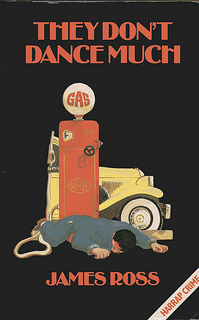
Mysterious Press has recently re-released They Don’t Dance Much, and even though it’s not a “new” book, I’m going to go ahead and gamble on the statement that this is the best book of 2013…or at least the best book of 2013 that was written over 70 years ago. Mysterious Press (associated with the Mysterious Bookshop in lower Manhattan, a GREAT place for crime, mystery, and pulp books, by the way) brought Ross’ book back to life with a hell of an eye-catching cover (admittedly one of the main reasons why I bought it) and the book did not fail from first word to last.

The story is masterfully orchestrated, with seemingly random and innocuous characters and story points slowly forming into key elements of later crimes and saving graces. Nothing feels forced or gimmicky, and even the few points that you can “see coming a mile away” feel written for that exact purpose. Tension is built with well-placed turns and strong, realistic dialogue. Casual chatter slowly turns into motives, which turns into action, and then the inevitable unraveling of the best laid plans into a life of threats, worry, and long nights staring into the darkness as the other shoe threatens to fall at any time. Friend becomes enemies, and enemies become happenstance saviors. It’s a real shame Ross never published another novel, because if he had written as many books as Cain, Chandler, or Hemingway, he’d be widely recognized as one of the greats, the original Southern Noir master.

But you know what? Even with just one novel under his belt, that’s just what James Ross is anyway. They Don’t Dance Much a tough, down-in-the-dirt look at aching desire, insatiable greed, and southern criminalities. It’s a 5 out of 5, a 10 out of 10, however you want to call it. Go get it.
Profile Image for Lee.
548 reviews65 followers
July 27, 2013
Set in rural 1930s North Carolina at a highway roadhouse of low repute, this novel first published in 1940 has been getting some buzz as the place where country noir began (and which was promptly lost; the book never sold well). I approached it expecting a good deal of almost over the top violence, but that is an improper modern frame to bring to it. There is violence, and a bit of gore, but Ross metes it out measured and dry. There is not the sense that he's trying to shock you and provide voyeuristic gruesomeness. So that was a noticeable surprise for me.

The story is told through the eyes of Jack McDonald, a no-accounter who loses his small farm and finds work just outside town with Smut Milligan, and old acquaintance. Smut has built up a minor bootlegging/gambling concern and he aims to expand his operation with a new roadhouse and dance hall. Jack becomes Smut's right hand man, as the only other person about the place with a lick of sense. They attract mainly a crowd of low social status - mill workers blowing their weekly paychecks and some regular drunks - that is not particularly rough for all that.

Smut develops financial problems, and sees a chance to resolve them through a murder/robbery. He brings Jack into it to assist for a cut of the proceeds. Afterwards, however, Smut cuts Jack out and threatens him. Jack plots out a plan of revenge that he hopes will take care of Smut and allow himself to get away with the money.

I found the story entertaining, and the writing smart and well done. There's a good amount of cynical humor which was also a bit of a surprise. The picture it gives of a rural 1930s South rings true and as something different to read was quite interesting. Would definitely recommend. A shame that Ross never got a second novel published.
Profile Image for Fred Forbes.
1,139 reviews88 followers
March 19, 2014
Daniel Woodrell, "The Dickens of the Ozarks" says in his introduction "... a novel that was often declared dead but has never been successfully buried, offers a persuasive portrait of rough and ready America as seen from below..." I forgot who recommended this to me, a Goodreads person I believe, but I would like to thank them. Interesting story, surprising plot twists that keeps one guessing, and well written. I was surprised at how well Ross was able to construct North Carolina in the 30's until it dawned on me that this book was published in 1940 so events were fairly fresh. Interesting that this was his only novel as he went on to write mainly short stories.
Profile Image for Alex Lewis.
174 reviews
March 28, 2013
This is a curious piece. About as hard boiled as it gets within the constraints of what was publishable in the 1930s. If written today, there would be far worse language (F-word, F-word, F-word) and more lurid sexual detail. This novel conveys the sordid, seamy nature of the characters and setting without needing the modern language.

This is James Ross's only published novel. He has been called a "one hit wonder," but it's quite a good hit, and better one hit than none.
Profile Image for Sergio Acera.
38 reviews28 followers
May 15, 2021
Seguramente se merece una estrella más, por lo que dice George V. Higgins en el epílogo, y creo que he puesto 4 estrellas a novelas no mejores que ésta, pero aunque la novela me ha gustado, no ha llegado a emocionarme tanto como esperaba.
Profile Image for Steve.
1,082 reviews12 followers
May 7, 2020
One of the granddaddies of Country Noir, Southern Noir, Hardboild Lit, Proletarian Lit.
Ross is not even really a "One Hit Wonder" (this is the only book he published, in 1940, passed in 1990!), since this book did not sell well at the time, and has only become a bit of a cult novel since it was reprinted in 1975.
Like Tom Kromer's "Waiting for Nothing", or Jack Black's "You Can't Win" - you can't.
Great local color and plot development. The main murder, and disposal of the body, is particulalry brutal and shocking!
This has sent me down a bit of a rabbithole - finding his 8 other published stories. Found 5 so far. There are some nice short pieces about Ross (he later went on to become a literary agent, after being a journalist earlier in his life) as a "One Hit Wonder" online. Anthony Hatcher's in the "Oxford American", the most recent, and best.
Profile Image for Lovely Andy.
170 reviews6 followers
November 14, 2023
Un "noir rurale"!
L'America profonda, le ingiustizie senza rimedio, le scene pulp.
Se vi piace Joe Lansdale, in questo libro scritto nel '40 troverete roba buona.
Profile Image for David.
734 reviews366 followers
March 11, 2014
According to this 2013 appreciation of this novel by Jonathan Yardley in the Washington Post, and (probably reliable) information elsewhere on the Internet, this is a novel that all the cool kids like, including Raymond Chandler, Flannery O'Connor, and George V. Higgins. The cool kids have it right. This is a great novel. Even this Yankee liked it.

While I am grateful for Mysterious Press for saving this novel from oblivion, I am also cranky enough to note no human being seemed to mindfully read the new edition of this book from beginning to end before publishing it. If they had, they would have noticed several errors, presumably occurring in the computer-aided process of converting the book from one format to another. Several times, the word “the” becomes “he”. In the very last paragraph of the book, there is “Night was corning on” instead of “Night was coming on”. There are other similar examples. It's a little distracting. As I tell my students, you can't rely on spellcheck to catch all your mistakes, you have to read it yourself, or get a friend to read it for you.

The quality I enjoyed the most is that it doesn't have writerly tricks. Although it is set in a rural North Carolina town, it contains no “eye dialect” (i.e., words misspelled to reproduce the alleged native patois), but it has an ear for the way people sound and a talent for getting it down right. For example, we learn the first-person narrator had one year of college education and seems a little less dim than his fellow roadhouse employees, but the narrator never seems unbelievably well-schooled or improbably articulate over the course of the 200+ pages you are with him.

This novel takes place in a grim world. Nearly everybody is stupid and mean. If you read to get away from stuff like that, you may want to give this a wide berth. It will not restore your faith in mankind.

The Mysterious Press edition also had an introduction with a short list of forgotten authors of similar literature from the same period which deserves a look. They include

Edward Anderson - Thieves Like Us, Hungry Men
Tom Kromer - Waiting for Nothing
Horace McCoy - They Shoot Horses, Don't They?, I Should Have Stayed Home

There's also William Faulkner, but he's not forgotten, so far.
Displaying 1 - 30 of 80 reviews

Can't find what you're looking for?

Get help and learn more about the design.