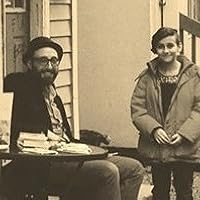
Michael Grant was an English classisist, numismatist, and author of numerous popular books on ancient history. His 1956 translation of Tacitus’s Annals of Imperial Rome remains a standard of the work. He once described himself as "one of the very few freelances in the field of ancient history: a rare phenomenon". As a popularizer, his hallmarks were his prolific output and his unwillingness to oversimplify or talk down to his readership.
Grant was prolific as an author but, like many academics, writes dryly. This 'biography' of Peter is basically a review of the biblical literature mentioning Peter, seeing what's left after the miracles are discarded. What's left isn't much and that, still speculative.
I would have appreciated much more historical context than Grant provides, particularly as regards Jewish/Gentile relations under the Roman Empire. This would have allowed Grant to apply his expertise as a classicist to the subject. Sadly, there are no significant contributions proffered.
I couldn't even finish this. He should have put a warning on this book that this was not a biography of Saint Peter, but an attempt to discredit Christianity.
Why do I have a dog in this fight? I probably don't really. I picked up the book because I was curious. I have become interested in church history recently, especially the early history. And I find myself reading books and articles. I am not a historian. And I don't know a ton about the church honestly. Maybe that's why this book rubbed me the wrong way. Nobody is a bigger expert that somebody with a little information. Anyway, I gave the book my time, and... having an opinion, I'll share it.
On the one hand, its a discussion of the difficulty of establishing historical fact. The revisions to the Gospels. The doubts about their authorship. The historical mindset of writers of the period who include exaggeration or miraculous details to edify and illustrate, and the difficulties that the modern reader has understanding 'typology' or the conviction that all significant events must be presaged by the events, relationships, or sayings of the old testament like an endless fugue or series of variations on a theme.
Fine and good. Interesting. I didn't really know about typology, and that explains a lot. And I get it. We can't know Peter. And a great deal of the doubts are well-documented by the author, who often cites competing scholarship to establish facts like the unclear authority of the Gospels.
My issue was that it seemed that in the next breath he would make assumptions without any support and then argue from them. For example, he asserts that Paul, in 'not unnatural egotism', along with the author of Acts, tries to diminish Peter's role by 'moving the actions and sayings from one to the other'. Unable to establish a single author, it seems odd to make this characterization of the author's motives and build an argument on it. It is in these areas where he might actually assert something that this writer includes no support or citations, as in the places where he says that "the tradition that Peter was poor and humble... seems mistaken" because Peter was from an important trade route, and then generalizes from the supposition.
I also felt that there were stodgy readings of the Gospel's themselves that showed a lack of imagination. The statement that Peter's weakness serves to show up the perfection of Jesus, though on the surface true, felt facile. I agree with the author that there may have been confusion in ancient listeners about 'turn the other cheek'. But I've read contemporary writers who have shown that the image may be far more an act of defiance than weakness, by making someone strike you with an unclean hand and recognize your humanity. In the same way as giving your cloak with your coat will make them confront your nakedness. In cases when metaphor or parable are included, although the write worked hard in his introductory chapters to describe the imaginative and imagistic thinking of the people of the time, he seems unable to employ it himself as a tool for understanding.
Perhaps my review reveals more of my ignorance than anything else. So, as a layman, to laymen, I wouldn't spend your time on this book. If anybody has read this far, and can recommend a better book on Peter... in particular the historical Peter and his probable life in Rome leading up to his matyrdom, I would like to read it!
First of all you have to understand that I am a devotee of St. Peter. However, I often find myself dissatisfied with books written about him. This unfortunately was no exception.
Mr. Grant attempts to paint a picture of St. Peter using the historical method. Not easy as the only places one finds contemporary information on St. Peter is Scripture and patristics. Mr. Grants first chapters were on this very problem. I gave him the benefit of the doubt but eventually found myself skimming.
In the end I was left with a picture of St. Peter as a man who probably did not perform any miracles; whose career* was out shined by Paul and James; and was a failure in his ministry. He was a man to be pitied.
If you want a book that makes you see Peter as a real person an are not stuck on absolute historical accuracy (cause that is just not possible with biblical figures) I highly recommend "St. Peter, the Apostle" by William Thomas Walsh as a much warmer, richer book.
*Career---Career? A career is what you study for and use to support yourself and any dependants. Peter's career was Fisherman. Chasing around the known world spreading the Good News was not a career it was an apostolate. Thanks for letting me rant.
This biography of Saint Peter is interesting and very well written. Grant tries his best to uncover the real Peter from within the Gospels.
Grant disputes the tradition that Peter was of poor and humble origins. “Although Jewish, Bethsaida was partly Greek-speaking, and stood in Gentile surroundings, helping to justify the phrase ‘Galilee of the Gentiles (or nations)’. The place had been raised to city status by the tetrarch Philip, son of Herod the Great, in 4/2 BC, when it was given the name of Julias after the emperor Augustus’s daughter. And Jesus was said to have spoken of the town in uncomplimentary terms. It may not have reacted favourably to his mission. Besides, discontent was high among the peasants of rural, agrarian Galileee, who bore an oppressive tax burden (relevant to Jesus’s parables which were largely agricultural in character). Nevertheless the name ‘Bethsaida’ means ‘house of fishing’, and this was a flourishing activity there. Moreover, the town was on one of the most important trade routes of the Near East, the Via Maris. All in all, the tradition that Peter was poor and humble, cherished by St. John Chrysostom, seems mistaken. This is rather typical of the New Testament, which tends to stress, indeed to overstress, the low social status of the apostles.” (55)
Grant discusses at lengths the depiction of Peter, his strengths and weaknesses. This was very compelling and, frankly, an item to which I hadn’t given a thought. He summarizes by saying, “The Gospels offer repeated evidence of their writers’ view of Peter as a rather feeble character. True, this is partly in order to attack the Jewish Christians, and partly, too, because Peter is taken to represent the other apostles, and their failures to live up to their call, and the lessons they provide regarding the severe demands of discipleship. Moreover, Peter’s weakness also serves to show up, by way of contrast, the perfection of Jesus. Thus Peter is made to appear, personally, as an unsatisfactory figure.” (67) The fact of the matter was that Peter clearly was a strong figure, but one who is made to suffer in comparison to the ideal of Jesus. Additionally, he did not exercise firm and steady control over the apostles, and this ultimately lead to him being criticized heavily by the Gospel writers. “Despite his human deficiencies and setbacks, among which the Denials are recorded as being so painfully prominent, Peter was, in the last resort, as loyal and faithful to Jesus as human nature permitted him to be. In Jesus, and in his message and mission, Peter’s belief was unqualified and unlimited. That is why Jesus chose him and set him apart. And that is why Peter, next to his leader, was the greatest Christian of all time.” (71) In the moment where leadership was required, “It was he who took the lead when, three days after the Crucifixion, Jesus’s few surviving followers became convinced that they had seen him resurrected in front of them. This conviction initiated the long process by which the unsuccessful mission of Jesus’s lifetime was transformed into triumph after death. It was indeed a revolution kept tenuously alive, largely through the endeavours of Peter. And it has been almost the only revolution in the history of the world that has taken permanent effect. One reason why this Christian revolution has proved so arresting and lasting is that it gave Judaism an entirely new life by attaching it to one single figure and person. This person, in contrast to the divinities of pagan mystery religions, had made his appearance upon earth and had lived there, which is why it is permissible and desirable to try to write his biography and that of his principal follower, Peter…Thus Peter, by playing such a major part in Jesus’s mission, and then by assuming the Christian leadership after Jesus’s death, was highly prominent in a process which transformed the thoughts and perceptions of a major part of the human race, and still governs the lives of many millions of believers today.” (83) This is as fitting a conclusion of the role of Peter in world affairs as I believe can be written.
Not central to the biography, but I found Grant’s brief discussion on the omissions various gospel writers made intriguing, specifically those regarding the purported miracles of Jesus. “Nevertheless, a certain air of mystery not surprisingly remained. As the Gospels show, there could be curious diversities of opinion about what had actually taken place when ‘miracles’ were reported (thus Matthew omitted the healing of the blind man of Bethsaida because he did not believe that Jesus’s use of saliva was credible).” (12) Additionally, I sincerely appreciated Grant’s reiteration that each of the parables “originates from, and implies, the single-minded belief that the Kingdom of God was actually being installed, and that he himself was installing it, since that is what God had ordered him to do.” (78)
Much is written of the clash with Paul. Grant ably discusses our records from Galatians and Acts, at variance with one another. Multiple conclusions can be drawn from these differences in the accounts of the Apostolic Council, with the only conclusion that two separate Christian missionary areas emerged under the leadership of different men. Similarly, Grant finishes in the discussion between Paul and James. Grant calls Peter the first “head of Church,” but reveals James to be its first leader who could overrule Peter. Ultimately, it is Pauline Christianity that has made the most lasting impact on the world. (143)
Overall, there is not too much new scholarly material here and that probably should not be a surprise. This is a summing up, and a focused simplification, of the Peter that comes to us through the Gospels, with a smattering of factual criticism mixed in. It is a highly readable and interesting account.
This was a tough read, mostly due to the writing style. There is a copious bibliography, which is a plus. The reader is well-armed to do their own follow-up research.
I was hoping for more history, however. Surprisingly, there isn't a lot of information mentioned about Peter outside the New Testament and writings amongst fellow believers, and almost nothing contemporaneous to his life.
Still there is an interesting picture painted of the machinations amongst the early converts following Jesus' death, the challenges of spreading the faith to Jews and Gentiles, and the disagreements arising from that. Some of this is speculative but not outlandish if one applies the lens of human nature to supporting documentation. An interesting epilogue is the effort of the church in Rome to assert its primacy and political control of the religion.
Now that I know what I'm in for, it might be worth another read.
I read this in high school, which seems like two lifetimes ago. What I remember was mainly this: the book was wonderfully researched, but gave people of faith no credit. While I understand a "scientific" historian can not take the Gospel accounts as face-value sources and accept plainly that events did happen as portrayed, an historian can also not discount faith as a factor in shaping history. Again, it's been 12 or 13 years since I've read this, and I was still young, but I remember these impressions. I also believe that Michael Grant was/is a fairly old man and had been in academics for decades upon decades. This would seem, though stereotypically, to back up the image of a professor who's convinced himself that after so many years of study he can, and has a duty to, scoff at simpleminded people of faith. Am I being too harsh? All I know for sureis this: I love St. Peter for how he learned humility from Jesus Christ…
Rather than give the negative, I am going to try here picking out the most positive elements of the book, the most worth sharing in my opinion.
First is this understanding of the word "sign" that appears repeatedly through the the Gospels: "The Hebrew word oth needs to be continually borne in mind. It means the sign, the semeion as John translated it, which not only was an announcement and description of a miraculous happening, but also actually helped bring that happening about."
First, this is interesting in its own right. Second, I think there is a real ancient insight here that has been lost in our skeptical era. What "is" for humans often relies just as much or more on what is believed than any underlying fact. Liberals especially tend to forget this to their detriment.
The discussion of typology is well done and enlightening as another reviewer noted.
This is not a great book, but it is short, and for that length providing well more than an average book's insight. I am enough of a doubting Thomas to appreciate the rigorous, historical-critical method here, and enough of a believer to have faith that there was more to my namesake and his life than this biography would admit.
I stumbled on this book in a used book store just a few days after seeing a powerful performance of Lagrime di San Pietro (Peter Sellers production)--review here http://www.latimes.com/entertainment/...
Unlike the music, the book is not concerned with meaning and metaphors but is very dry history. That doesn't mean it's bad but being written by a historian (University of Edinburgh) it is a long meditation about what we know, what we can know, and what we cannot know about Peter. It does not touch anything religious or emotional. For example, the betrayal of Christ and Peter's tears (of the music) is not even mentioned in the book.
The book is excellent. And maybe it is best in its discussion of the conflict between James and Peter and between Peter and Paul concerning the gentiles. Should the new religion be a reformed version of Judaism and keep to the Jewish customs and laws OR is this going to be a universal religion. Most people know what happened.
Also recommended The Kingdom, by Carrere and Badiou's Saint Paul.
Grant is a well known historian and does a good job with this subject, but it's nothing new. Some of it seems odd. For instance, the goofiness of the disciples, he says, may have been an anti-Jewish addition to downplay their importance. Really? It just shows they were human and is endearing if anything. Or the claim the Jesus' baptism must be true because the Church would never have included it if it could have avoided it. I dunno. Why would that be? He seems to assume the Church was writing these documents after coming to its dogma, rather than taking its dogma from the documents it inherited from the apostles. And for another he makes the modern assumption that historians can never attest to a miracle because, obviously, they don't happen. I don't think that makes sense, really. Anyway, it's a quick read, and if you don't know much about Peter, it's worth reading.
2.5 stars. The author admits to the issues that made me rate this book not very highly: there just isn't enough historical record to say a lot of meaningful things about Peter without having to rely on tradition and conjecture. Therefore the book ended up like "he might have done this, or he might not; he might have said this, or he might not" etc. I can't say I expected much more because I am aware that the material on Peter is sketchy and slight, but it made for a bit of a dry read in the end because of it. I did notice that the author was quite good at giving evidence that something was *un*likely, but we were often expected to take it for granted when he told us something was likely, without showing any kind of evidence to support the claim.
Not as good or interesting as I was hoping, still insightful in to the early church. A few of the chapters were informative yet others seemed to deal with Peter only in passing which was disappointing. I thoroughly enjoyed a documentary on Amazon called In the Footsteps of St. Peter with David Suchet and was hoping this would offer similar scope and perspectives.
Grant’s book is interesting, but I think he draws too much from Biblical accounts and later traditions in accounting for the activities of Peter. I tend to be more skeptical. Still worth reading, however. His bibliography might be worth using as a source for future exploration on the topic of the holder to the keys of the Kingdom.