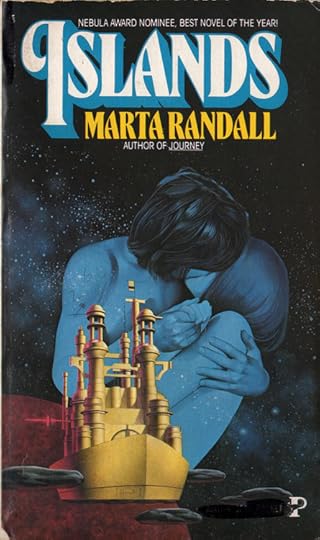
Nebula Award Finalist. She will never be one of them. When the immortality treatments failed, she knew her destiny would not be as glorious and carefree as the immortals. The immortals rebuilt the Earth after the great floods, but she is not one of them, and she doesn't seem fit to live anywhere amongst them. When she finds refuge aboard the ship Ilium and begins ocean floor navigation, an adventure immortals would envy, she discovers a secret place. But she knows if she can unlock the power that the immortals lost on an island buried far beneath the land, the world and the immortals' future will never be the same again.
An unexpectedly eloquent blind-buy from the back sci-fi stacks of my local purveyor of esoteric books. In the far future, we've overcome mortality, leading to stagnated progress, and a general terror of any danger that might cause some scar or injury for the rest of eternity (ideas like "you only live once" and "I'm gonna die someday anyway" being well out of use). Oh, and the fetishization of death, present even in death's face now, comes up again in equally pathological variation.
Our protagonist, on the other hand, is the one living human for whom immortality treatment has inexplicably failed, destined to grow old among 100-year-old 21-year-olds. Deftly patches in 50 years of backstory out of sequence and interleaved with the present plotline, for swift and smartly developed story. The ending goes a little wild, arguably, but hey, it was the 70s. Will be investigating more Marta Randall. This is a promising and buried entry to her.
Parts of this book have aged poorly; the basic theme of immortality leading to stagnation is at this point overdone and trite, and the focus on ecstatic drug use and psychic transcendence (and drug use _leading_ to psychic transcendence) is . . . well, it's very, very 70s. But I'm willing to forgive a lot of that for the writing, which is lovely, and the complex characterization of an older female protagonist. I picked this and a couple other Marta Randalls up from the Open Road Media book-give last year knowing nothing about her; I don't know that I'll rush to read the others, but they're definitely staying in the to-read queue.
Jo Walton re-read this recently. Her thoughts are always worth reading: "Randall’s first science fiction novel. In a world of immortals, the treatments don’t work on one person, who is an oddity because she is aging. I found myself oddly out of sympathy for her, only able to live a mere two hundred years, and I hated the attitude of the society to children and child abuse—it doesn’t seem to me how immortals would behave; I’d think they’d have stronger bonds and longer childhoods. And their attitude to disability is also horrible, and it’s funny, I’ve thought a lot about living forever with disability—it beats the alternative—and in conclusion, this is weird. Read other Randall before this one." https://www.tor.com/2022/09/08/jo-wal...
Sometime in the 21st century the most incredible scientific breakthrough of all - immortality - is achieved…and thereafter hardly any innovation occurs at all as the urgency to develop things vanishes. Into this world comes Tia, a woman for whom the immortality treatments have failed - an occurrence so rare that she thinks she is the only one. Marta Randall takes us on a journey through Tia’s life, who at age 60 still looks about 30 but has been through bitterness, resentment and love in order to make sense of her curtailed life. For the bulk of the book we empathise clearly with Tia - about the casual nothingness of Immortal lives - of their mayfly interests - and the message that ultimately all we have are memories of pleasure (and life-affirming sex) to keep us humanly grounded. But then…well..I’m not sure why MR chose the ending she did here (I understand she edited quite heavily for an ebook release in 2001) but it feels false and frankly…like a cheat. It doesn’t ruin the book but it no longer keeps us with Tia and it could probably have been avoided to make a more human ending. (I’ve read much worse first novels by the way…)
Continues fine. I'm enjoying the dynamics of the crew and the resonance of the past, both Tia's past and the long past. The dive is begun. I can't wait to see, and can't guess, what's coming next.
***
Strong, strong finish. I was right, I didn't see that coming.
Boy, would this book have rocked my entire world view when I was a teen. It's pretty amazing now.
There are two types of sci-fi books: those where the technology is a center-piece, and those where the technology exists to enable conversations about humanity. Islands by Marta Randall is the latter.
I was a little afraid of Islands. The back copy mentions that in a future world where mortality has been defeated, Tia Hamley is an anomaly. The [immortality] Treatments didn’t work. She alone will grow old and die.
I don’t normally dig on such heavy topics—I read for fun. And yet I read it anyway, because it was on my shelf and if I was going to read it anyway, I might as well read it now. ‘Now’ being late on a weeknight. I had planned on reading a few pages just to grease the wheels and then going to bed. Thirty pages later, I was struggling to not start the next chapter.
The story starts off incredibly human. We get to know Tia as she is now—a 60-something year old woman, much wiser than her peers thanks to the knowledge of her eventual death. We get to see Tia young and convinced of her eventual immortality. We get to see her shortly after the Treatments fail, morose and unplacatable. We see her lover(s), her friends, her experiences. The world is decidedly sci-fi, but the focal point of every scene is Tia and her connection to those around her—or, more often than not, her lack of connection.
For most of Islands, this feels like the extent of the plot. The back copy promised more—something to do with finding a secret power buried in a sunken building—but I was entirely content to wait on that. Just watching Tia was enough.
Why it was enough is hard to articulate. A good amount of it has to do with how expertly Marta Randall weaves her characterization. There’s the obvious quality of it—characters are clearly fleshed out and full of contradictions and nuance. There was something more, though. Each character felt like a puzzle. There were the things we obviously knew about them, and then there were the gaps, the incongruities, the sticky-bits. Every time I learned something new about a character, it held all the satisfaction of putting another piece into a puzzle.
Then there was the quality of the prose itself. It would have been so easy for poor Tia, the lone mortal, to come across as whiny. She thinks of mortality, she talks about mortality, she researches both mortality itself and how the people of the past faced mortality. She really digs in, and yet I wanted to read every word because the languid beauty of the prose itself elevated these (very real to us) concerns beyond Tia to humanity’s general search for meaning, for comfort, for stability.
So many times I’d finish reading a paragraph and pause, thinking how beautiful it was, and yet I could pluck no easily tweetable line to underscore its beauty. Without the whole, the individual part just didn’t shine, but with the whole, it was so evocative and heart-breakingly beautiful that I feared I’d start crying on the bus.
Even though I generally don’t like things that are emotional or, well, human, I would have been entirely content if Islands stayed this course until the back cover. The aforementioned sunken power eventually surfaces, though, and with it a plot that’s more than Tia’s relationship with herself and her world.
Naturally, I won’t discuss the ending, but I will say I don’t love it. It’s not so bad, though, that it affects my love of everything leading up to it. It’s just ... well, I can’t say anything. I’d spoil something somehow and the book is absolutely worthy of a read, regardless of the ending. Besides, I’ve read a few reviews that specifically loved the ending, so my issue might not be yours. If you love character-centric books written with poetic beauty, read Islands.
I have a TW, now, but it’s also a bit of a spoiler. As someone who often doesn’t do well with TW-worthy topics, I will offer up-front that I was both able to weather the depiction and felt like going into the scene blind added to the moment. Obviously, though, you gotta do what’s best for you.
The next paragraph is the spoiler:
There is a depiction of domestic violence within a relationship with an extremely fucked-up person. The violence is not drawn out, glorified, or sugar-coated, but there is a level of perversion that is beyond the norm.
[I read old fantasy and sci-fi novels written by women authors in search of forgotten gems. See more at forfemfan.com]
"Nominated for the 1977 Nebula Award for Best Novel
*Note: I read the 1980 Pocket edition which, according to Locus, was modified (to what extent I do not know) from the original 1976 first edition.
Marta Randall, the first female president of SFWA, is one of numerous female science fiction writers from the 70s that are seldom read today. A while back Ian Sales alerted me to Randall’s work in his very positive review of A City in the North (1976) on SF Mistressworks. Recently, while [...]"
Wow, Marta's writing is just wow. Although some aspects could've used some work and some of it was very 70s (which I still quite enjoyed), the story was such an interesting concept. It was something that was centuries into the future and yet still had details that related to our society, even now. Dying in a world of youth is somehow exactly what happens. You die with a world that never ages, except instead, you slowly wither as even your loved ones stay alive. Which is somehow worse. A reread would be necessary to catch any details.
This entire review has been hidden because of spoilers.
This was strange in very 70s ways, lots of period focus on the plight of aging women taken to sfnal extremes, lots of sex, an interesting background of post-climate-change earth, a plot that didn't really hang together or make sense but did let Randall show the things she wanted to show. I will read more by her (The Sword of Winter was a favourite of mine as a teenager), but I really don't need to read this one again.
It took me many hours to read this short book, and even at the end of it I had no idea about what I read. Was I supposed to relate to Tia? To the immortals? I wondered at first about how they sustain a growing population if no one ever dies, but apparently everyone can die in accidents. Why aren't more people dead then? There shouldn't have been such stigma around death, because accidents do happen, especially when the immortals are cast as dissolute and ignorant.
This was strange but still very intriguing. I like the timeline jumps, it definitely kept the pace up, and the character work on Tia was very good. It’s easy to feel for her and feel taken in by her dilemma. The concept feels fresh even though the book was written decades ago, and I honestly wouldn’t have been able to guess it was written so long ago by how modern the writing feels. I think the plot got a bit too convoluted by the end, but I still really enjoyed this more than I thought. Marta Randall is an excellent science fiction writer.