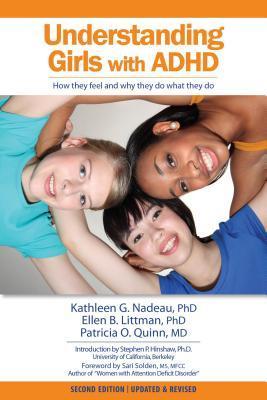
A ground-breaking book on the needs and issues of girls with attentional why they are often undiagnosed, how they are different from boys, and what their special needs are in school, in their social world and at home. Age-related checklists from pre-school to high school help parents and professionals better identify and help girls with AD/HD.
This is a comprehensive overview of the issues that face girls with AD/HD, and the importance of addressing them as early as possible. The authors discuss how to recognize AD/HD in girls (for example, the "H" doesn't look like stereotypical hyperactivity), the unique risks of AD/HD in developing girls, and how to address the condition.
I, particularly, found the sections on socialization helpful: my daughter has ADD, and for the most part I have always understood her behaviour quite well, even before the diagnosis. But I never understood why she didn't have close friends, and why playdates always ended badly. The descriptions of failed social interactions in the book helped.
Lots of interesting food for thought in here, which is new to me but probably not to someone who has been grappling with the topic for a while. ADD is particularly difficult in girls because it exaggerates behaviours which are considered masculine: risk-taking, aggression, physicality. The multiple demands of femininity — being tidy, pretty, together, contained, considerate of others — are difficult enough for neurotypical women but really play to the weaknesses of girls with ADD. I feel like I have a lot more reading and thinking to do on this topic, and that my understanding of feminism will be the stronger for it.
I diverge from the authors on two points: First, I'm not yet convinced that ADD is a disorder; I think it's quite possibly a normal neurological variation that is evolutionarily advantageous at the group and possibly individual level. I haven't done a lot of reading on that, yet, though. Second, the authors recommend "behaviour modification" — punishment and rewards — to alter a child's behaviour. My new understanding of ADD hasn't affected my belief that positive, democratic parenting is the way to go — my child is not a rat in a Skinner box, no matter how many disorders she has.
The book is clearly written and easy to read (although the copyediting often leaves something to be desired, and there is no index).
Oh my goodness, I love this book! The big take-away is that the symptoms that we associate with ADHD are the symptoms boys with ADHD have, but girls with ADHD often act differently. While reading the book and the information in it about the symptoms girls often have, I thought of two different kids who may very well have ADHD that I previously hadn't considered. Who knew that shy kids could have ADHD? Or that kids who are really good in school could have ADHD? The author provided great ideas for treatment options. I was surprised (although I shouldn't have been) when the book perfectly described one of my children, and it served to remind me that we really are dealing with a disorder and not just a child who likes to be oppositional. The one negative for me is that we are already doing almost everything it suggests and feel like we still have a long ways to go. I definitely suggest reading this book if you have daughters who are struggling in any areas of their lives.
Though this book has a lot of information and tells a lot about how ADHD differs from male to female presentation and how it manifests in different ages of girls, I found it to be pretty negative and not really focusing on how to use their differences in a good way. This book does give a lot to think about and questions to reflect on but I think there are better books out there.
I picked this book up during Christmas or spring break at a library book sale where I was on a hunt to fill a bag full of books to get my money's worth. I saw this one and said "Hey! I was recently diagnosed with ADHD, maybe this would help me understand myself a little more." What I got was a lot of sadness about how many signs of ADHD I was displaying as a kid that were never caught by my parents or my teachers. And my mom was a counselor who specialized in adolescence! Instead I was diagnosed with depression and anxiety, like many other girls with ADHD are. I knew that was common before reading this book but this helped me understand why a little more.
It took me forever to read this book, as it is nonfiction and pretty bland at points. Much of it is looking at studies and stating facts. I liked the case studies occasionally given and wished the book was based around those a little more. The reason that I gave this book 3 stars over four or five is that it gave a surface level analysis on how to treat ADHD. They could have gone to much more detail on the subject.
Additionally, this is a gripe that I don't really hold against the authors too much, but there is not much content on women with ADHD. It really is based truly on pre school through high school. I would have liked to have more information there, but that is my selfish request.
I would recommend this book for parents who think their daughter has ADHD or recently got a diagnosis. It is a great starting point for someone with little background on the subject. I would also recommend it to teachers or counselors who may have to interact with girls with ADHD on a daily basis.
I wept with relief and grief for my own experiences.
I wept with gratitude that I found this book before ADHD had a chance to undermine my daughter's spirit and self-worth.
This book is filled with many a-ha moments and helpful strategies. It should be a must-read for anyone dealing with ADHD, either personally or as the parent/teacher of a girl with ADHD.
This book will change the course of my daughter's life.
Somehow nobody in my generation (me and my siblings) in my family was diagnosed with ADHD but a majority of our kids have been. Funny how that works hahah. As we’ve become parents we’ve all talked about how we realize that it totally runs in our family, us included, and definitely in previous generations and family lines as well. Breaking family cycles is pretty fun but also requires research as we learn how we all tick and scaffold the next gen for success.
This book taught me a lot about myself, my family, and the young people I’ve taught and interacted with. I wish I had read it when I first started teaching—it would have completely changed my approach to SO many policies and students. It is pretty blunt and can be discouraging, so be prepared to balance that out with a book that also unapologetically celebrates neurodiversity, but it also comes with many great tools. I would recommend it to EVERYONE whether adhd runs in your family or not—especially if you teach or work with young people.
This was a great read! I feel like I not only understand myself better but my youngest daughter who has recently received a diagnosis for ADHD. It was really hard to read about the ways some of the little girls felt at certain times because I remember feeling the same. I was also surprised that ADHD is usually present with other disorders such as eating disorders, learning disorders and even substance abuse. I even read a section that perfectly described myself and that was a very hard pill to swallow for someone who only realized they had ADHD only AFTER having kids of my own. Talk about a mental and emotional roller coaster. Great read especially for getting guidance on treatment, either with a coach, medication or a combination. I am very glad that I read this book and plan to get an updated version soon.
This book was easily skimmed. The information was relatable with lots of questions for consideration. However, it was very binary. Clearly, its a book about GIRLS with ADHD but there is no mention of kids assigned female at birth or issues along the gender spectrum. There were also lots of gender stereotypes within, including the writing being geared towards mothers and male/female parent relationships. If you can put those issues to the side (I assume an updated edition will correct for these concerns) it gives a quick researched-based look into how ADHD differs in female presenting kids compared to male presenting kids.
This book has an abundance of information on how girls with ADHD may be different from boys with ADHD when it comes to symptoms and hormones. As a parent, it was scary to find out that ADHD is a lot more complex and involves more than just inattentiveness and hyperactivity. However, knowledge is power, and with this book, you will empower you to have those conversations that will help your daughter receive the interventions and services that she may need. Also, it will help you understand the symptoms better, and therefore be able to develop a strong relationship with your daughters.
I underlined so much in this book. It explains so much to me: about my childhood, my daughters, and how to address their future years as teenagers and young adults. I especially love that it's broken down into different life stages and explains how a girl is affected by her ADD at each point in her development. This makes so much more sense than other books who just lump all the symptoms and characteristics together.
Useful guide for helping girls with ADHD from preschool through high school. Describes symptoms, challenges, and ways to help.
Notes We've Come a Long Way, But There's Still Far to Go Signs of ADHD • School-phobia or avoidance • Low self-esteem • Low academic performance despite high IQ and creativity • Poor organizational skills, messiness • Sleep problems • Shyness, poor social skills • Disheveled appearance, grooming problems • Hyper-talkativeness • Blurting out answers without raising hand • Social withdrawal • Tendency to miss or misunderstand directions • Test anxiety • Forgetfulness
Behavioral problems for many girls with ADHD begin after puberty, so they don't meet DSM-5 requirement of symptoms before age 12.
Girls with ADHD are more likely to have anxiety, depression, especially in adolescence. As adults, they're more likely to have psychiatric admission, mood disorder, substance abuse, schizophrenia. They're more likely to have suicide attempt.
Girls who feel confident about their academic competence, regardless of their achievement, experience increased academic success.
"Catch" girl with ADHD being good as often as possible, so you're not always catching her being bad.
Learning More About the Brain and Other Biological Factors ADHD is highly hereditary.
Multiple studies have found structural differences in ADHD brains.
The Elementary School Years: What's Normal and What's ADHD? Girls with ADHD lag peers by ~3 yrs in social and emotional development.
Girls with ADHD may experience anxiety, depression starting in elementary school. If they are not given help, they could develop mood disorders by young adulthood.
Girls with ADHD are more likely to have ODD and Conduct Disorder (CD). They tend to be more covert (e.g., stealing, lying) than overt (e.g., physical fighting).
Structure home life. Have routines, even on weekends. Invite girl's input by asking to choose from 2 options you present.
Maintain realistic expectations. Use chore charts with reward system. Have chores done daily at routine time.
Give girl as much responsibility as realistic. Don't fix all their problems; help them develop independence.
Let girl have a break after school, because they've been trying to hold it together all day at school.
Regular exercise reduces symptoms.
The Middle School Years: New Challenges Impulsive girls with ADHD are more prone to rule-breaking and joining other rule-breakers. They're more likely to experiment with smoking, alcohol, drugs, sex. They're more likely to develop addictions.
It's not enough to get girls away from things they're addicted to; you must replace troublesome peers with more positive ones, by getting them involved in structured, supervised activities.
The High School Years: More Demands and Greater Risks for Girls with ADHD Girls with ADHD have greater risk of self-injury, eating disorders, violence, depression, suicide.
Girls with ADHD are more likely to have sex earlier, out of desire to get attention. Getting girls involved in support groups for girls with ADHD and other extracurricular activities can reduce likelihood.
Girls with ADHD are more likely to drive unsafely. They should get more driving practice, drive in less distracting situations (lighter traffic, without distracting peers), pay attention.
To help girls combat depression, encourage them to discover and embrace strengths rather than dwelling on weaknesses and failure.
Executive Functioning Skills: Keys to Success If girl with ADHD has meltdown, wait until she's calm, then teach problem-solving skills in supportive way, inviting her input.
Giving negative consequences and making girl feel bad doesn't help her overcome negative behavior. Instead, talk through situation, helping her develop skills and habits to do better next time.
Giving too much support deprives girl of developing independence and confidence. Giving too little support causes her to be discouraged and not try hard enough.
Help girl build executive functioning • Build working memory with memory games. Encourage her to write things she can't remember. • Increase persistence by challenging her to persevere, and reward and praise her when she does. • Help her learn techniques for getting started (e.g., collect materials, find work space, break large tasks into small pieces, earn fun activities by completing tasks). • Improve time awareness. Consider audible timers, Time Timer (visual timer), calendar, agendas. • Reduce forgetfulness. Develop routines, set alarms, reminders. • Improve planning skills. Plan together for practice. • Develop organizational skills. Reduce her belongings, have a place for everything, clean up after activities.
Effective Approaches for Managing ADHD Girls with ADHD benefit from spending time in nature. Even seeing nature through window is better than nothing.
Girls with ADHD often go to sleep too late to get enough sleep.
Medication for ADHD: Making the Decision Isn't Easy Multiple studies have shown stimulant medication helps with ADHD in 65-75% of kids and adolescents. However, meds aren't enough, because they don't teach executive function skills.
This is a very readable and comprehensive book, focusing on recognizing and handling ADHD in girls. I would recommend it highly for parents of girls with ADHD and all teachers.
Perhaps I need to give this one a chance again, but I really found it to be outdated and to overlook a significant amount of information that I am understanding from the ADHD community now.
This was on my to-read shelf for a few years and which I had found the time to read it sooner. Full of useful information for the wide spectrum of girls with ADHD, although even at six years old, there are some things in the book that seem due for an update. I will absolutely read the next edition whenever it gets published.
1% Study by Stephen P. Hinshaw Ph.D., what are results of the 15 year follow up (in progress during publication of the book) on his lifelong study of girls and women with ADHD?
I'll watch later when I work myself up to listening to loosely scripted chatter. It also looks like Dr. Hinshaw published a book two years after the publication of Understanding Girls with ADHD (https://www.goodreads.com/book/show/5...). Adding that to my to-read list. That's all that ever happens to that list. I read one book and add several more that looked interesting because the topic of the book was interesting. It's comforting to know I will die before that list runs out and there will always be good books to read. Anyway,
19% "All school systems must by law have programs to identify children at risk for behavior or learning problems."
Which is the exact opposite of what I've been told from teachers in the Washington public school system. Teachers are not allowed to "diagnose" children, which means anything from say "I think your child has ADHD, dyslexia, etc." or even "I think you should have your child evaluated for ___". If it is the law that schools are required by law to have programs to identify children at risk for behavior or learning problems, maybe someone should inform the teachers? The best I've ever received from a teacher is "your child has problems transitioning" or something about handwriting or not wanting to do a task over and over they've already conquered. I had no idea what this was code for!!
This sentence refers to the Child Find mandate under the Individuals with Disabilities Education Act (https://www.congress.gov/bill/108th-c...). Holy 162 pages long.
PART C- INFANTS AND TODDLERS WITH DISABILITES SEC. 631 FINDINGS AND POLICY. "(a)"(5)‘‘(5) to enhance the capacity of State and local agencies and service providers to identify, evaluate, and meet the needs of all children, particularly minority, low-income, inner city, and rural children, and infants and toddlers in foster care.
SEC. 635. REQUIREMENTS FOR STATEWIDE SYSTEM. "(a)"(1) A rigorous definition of the term ‘developmental delay’ that will be used by the State in carrying out programs under this part in order to appropriately identify infants and toddlers with disabilities that are in need of services under this part. ‘‘(3) A timely, comprehensive, multidisciplinary evaluation of the functioning of each infant or toddler with a disability in the State, and a family-directed identification of the needs of each family of such an infant or toddler, to assist appropriately in the development of the infant or toddler. ‘‘(5) A comprehensive child find system, consistent with part B, including a system for making referrals to service providers that includes timelines and provides for participation by primary referral sources and that ensures rigorous standards for appropriately identifying infants and toddlers with disabilities for services under this part that will reduce the need for future services. ‘(6) A public awareness program focusing on early identification of infants and toddlers with disabilities, including the preparation and dissemination by the lead agency designated or established under paragraph (10) to all primary referral sources, especially hospitals and physicians, of information to be given to parents, especially to inform parents with premature infants, or infants with other physical risk factors associated with learning or developmental complications, on the availability of early intervention services under this part and of services under section 619, and procedures for assisting such sources in disseminating such information to parents of infants and toddlers with disabilities.
SEC. 654. USE OF FUNDS. ‘‘(B) improve the knowledge of special education and regular education teachers and principals and, in appropriate cases, paraprofessionals, concerning effective instructional practices, and that— ‘(iii) provide training in methods of— ‘‘(III) early and appropriate interventions to identify and help children with disabilities;
I see nothing preventing teachers, child education experts, from saying your child might need help. It is within the parents' right to reject the help, but they should also have the right to hear something is wrong in the first place.
71% Mindfulness training in the classroom
Suggestions more for parents helping classroom performance. Going to start with organizational tools but wanted to mark this to go over later if needed.
72% More ADHD friendly classrooms
Many suggestions for teachers wanting to improve their classrooms for girls with ADHD. but most of these suggestions help any student regardless of gender or learning variety. My favorite is one my husband has already figured out how to naturally implement without calling attention to any one student: allow girls with ADHD to move around. Instead of sitting most of the class, he has white boards lining the wall and students stand to work out problems in randomly assigned groups. There is no pier pressure or threat of rejection if not chosen, no stress of needing to choose. If you're standing, you're naturally making more movement than sitting to move to different parts of the board. Other suggestions include problem solving together with a student instead of casting blame when something doesn't happen like an assignment not getting solved on time, allow emailed homework so there is less risk of forgetting homework at home, having multiple times for taking a test, and more! Going to have dearest husband listen to this part, even though he already does many of these already.
Excellent book! I love how it takes you through what each of life's stages looks like with adhd. It is very descriptive and so helpful in demonstrating what different types of adhd might look like at each stage of a girl's life. I do not like how it continues to refer you to an adhd coach, counselor, or psychiatrist or psychologist. It would be helpful to have some directions of what to do. (There are some small behavioral instructions for younger years.) Unfortunately, at the end of the book, it references several resources that will not be available to readers in rural settings and smaller centers. I'm not even sure if all of the resources are available outside of the US.However, these concerns only occur in the last 2-3 chapters. On the whole, I'd HIGHLY recommend this book for any person who knows a girl with adhd!
A comprehensive guide to not only understanding, but how to cope with girls suffering from ADHD. Filled with data and scientific information, but not overly scientific to the point of non comprehension. Easy to read.
I like that it addresses the societal differences and expectations between boys and girls. Girls are more likely to go undiagnosed, therefore suffer longer (into adulthood), because they have a different presentation of symptoms, which tend to be less obvious, more internalized (distracted, poor time management, disorganized, overwhelmed); whereas boys are typically more hyperactive/impulsive, more disruptive, and therefore more likely to get an earlier diagnosis.
Bottom line: early intervention is best (self esteem/success); have a strong support system that includes parents, teachers, and a range of professionals;
Dit boek duidt erg goed hoe adhd bij meisjes zich anders kan uiten dan bij jongens. Het is ook vrij eerlijk wanneer wetenschappelijke inzichten niet conclusief zijn. - Maar het had ook op 50 pagina's gekund. Er wordt enorm veel herhaald. - De structuur is chaotisch. Een extra niveau in de onderverdeling van de hoofdstukken had veel kunnen doen. - De Nederlandstalige vertaling is écht gebrekkig. Ik vond 2 DT-fouten. Ook zijn de checklists onbruikbaar omdat men soms gebruik maakt van negatieve vraagstelling.
Zeker handig voor ouders die willen ontdekken of hun dochter mogelijk adhd heeft, en hoe ze kunnen ondersteunen. Maar dit boek had veel beter gekund.
Excellent information written by a most respected ADHD expert, and the first to emphasize ADHD differences and diagnoses in girls. Describes three types (hyperactive, inattentive, combined), what to look for at different ages, and comprehensive treatment options. One chapter emphasizes executive function skills. Written for parents, teachers, and practitioners and relying on brain science and ADHD research, this is not a light read but more of a book to refer to throughout the diagnosis and treatment process.
Honestly all parents of girls with ADHD should read this. There was a lot of information in here that every parent should be aware of. However, I did find that there wasn’t as much guidance on what to do to help girls with ADHD so much as education on what to look out for (although towards the end of the book I did finally start to get some tidbits on this). Still a very worthwhile read and probably one to keep on the shelves to refer to periodically throughout each of my daughter’s developmental stages.
Boken gav mig större förståelse för min adhd utifrån ett könsperspektiv som jag tycker är oerhört viktigt. Denna hjälpa mig verkligen att få in perspektivet "flickor" /kvinnor i min egen diagnos. Tidigare hade jag endast läst om diagnosen ur ett manligt perspektiv. Denna gav mig svar på varför det har varit som det har varit under min uppväxt och den ger även forskningsstöd i varför flickor hamnar utanför radarna och varför flickor kan uppleva adhd på ett annat sätt en som bara hyperaktivt.
My review of the first 2/3rds: Maybe this was progressive in its time (that’s what the tone of the narrators seems to imply), but it’s quite out of date (it was published 30 years ago). It’s good to have research specific about girls with ADHD, but the tone is so belittling with such outdated ideas of parenting I’d imagine today’s researchers would have rebuttals for much of the advice given. Review of the last third: Skip to chapter 8 and just read the last part of the book. 2.5
This is a thorough coverage of all topics related to girls with ADHD. I like how the authors explain the issue of reasons why it goes undiagnosed, possible issues they may have and then ways we can help girls that do have a diagnosis.
As a pediatrician, great resource! As a mom, some scary facts, but also informative and very good advice! I rated it a 4 instead of 5 as I'm just not in love with the narrator. Slightly too monotonous.