

What do you think?

Great Society: A New History
The author of the New York Times bestsellers The Forgotten Man and Coolidge offers a provocative and conversation-changing look at President Lyndon B. Johnson’s Great Society and how its failures reverberate to this day.
In The Great Society, Amity Shlaes argues that just as Franklin Delano Roosevelt’s New Deal overshadowed a generation of forgotten men, Lyndon B. Johnson’s Great Society gave rise to a silent majority, a coterie of dispossessed citizens—made famous by Richard Nixon and celebrated by Donald Trump—who rejected what they saw as the federal government’s overreach. Drawing on her classic economic expertise and deep historical knowledge, Shlaes challenges the traditional narrative of 1960s America and Johnson’s experiment, recasting the story of the Great Society as a tale of hubris that remains consequential for America fifty years later.
Contemporary Americans share many of the concerns that bedeviled Presidents Kennedy and Johnson and their voters. Racial differences, economic opportunity and outcomes, abuse of political power, and establishment corruption trouble us now just as these issues preoccupied the nation then. Yet today, poverty remains intractable and is actually growing, and the costs of programs such as Medicare and Medicaid are spiraling as the number of people claiming benefits grows. The question the Great Society tried to answer remains the same: how can we build a better future for all Americans? Shlaes contends that only an understanding of the historical record can make optimism—and practical solutions—possible.
A deep analysis of the government policy that has shaped politics and society for fifty years, The Great Society is an authoritative and well-reasoned reinterpretation of Johnson’s signature achievement and the momentous period in which it was conceived.
521 pages, Kindle Edition
Published November 19, 2019
About the author
Amity Shlaes
14 books420 followersAmity Shlaes graduated from Yale University magna cum laude with a bachelor’s degree in English in 1982.
Shlaes writes a column for Forbes, and served as a nationally syndicated columnist for over a decade, first at the Financial Times, then at Bloomberg. Earlier, she worked at the Wall Street Journal, where she was a member of the editorial board. She is the author of "Coolidge," "The Forgotten Man," and "The Greedy Hand, all bestsellers. Her first book, "Germany" was about German reunification.
Miss Shlaes chairs the board of the Calvin Coolidge Memorial Foundation, situated at the birthplace of President Calvin Coolidge. Michael Pack of Manifold Productions is making a documentary film of her movie "Coolidge." Her new book is "Forgotten Man/Graphic" with artist Paul Rivoche. This book is for classrooms and thinkers everywhere.
Shlaes writes a column for Forbes, and served as a nationally syndicated columnist for over a decade, first at the Financial Times, then at Bloomberg. Earlier, she worked at the Wall Street Journal, where she was a member of the editorial board. She is the author of "Coolidge," "The Forgotten Man," and "The Greedy Hand, all bestsellers. Her first book, "Germany" was about German reunification.
Miss Shlaes chairs the board of the Calvin Coolidge Memorial Foundation, situated at the birthplace of President Calvin Coolidge. Michael Pack of Manifold Productions is making a documentary film of her movie "Coolidge." Her new book is "Forgotten Man/Graphic" with artist Paul Rivoche. This book is for classrooms and thinkers everywhere.
Ratings & Reviews
Friends & Following
Create a free account to discover what your friends think of this book!
Community Reviews
Displaying 1 - 30 of 126 reviews

July 29, 2020
Amity Shlaes’ 2018 analysis of Johnson’s Great Society programs is informative and enlightening – if a little dry.
Shlaes casts a critical eye on the progressive policies that still shape our lives more than fifty years later. While she is openly skeptical of the results, to her credit, she provides an objective review of the good that was accomplished then and the foundations for a better society that we can see now, particularly in civil liberties and better racial equality.
Shlaes greatest rebuke, however, is on the well-intentioned but failed attempts to alleviate poverty and she offers well researched economic explanations for how and why many of the results were unsuccessful.
A conservative approach to a complicated period on our history, but also a well written chronicle and one that should be read by proponents of modern progressive ideals.
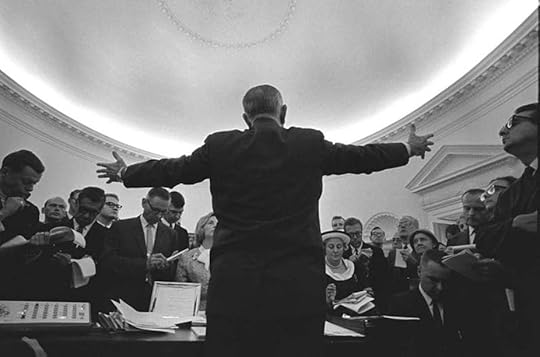
Shlaes casts a critical eye on the progressive policies that still shape our lives more than fifty years later. While she is openly skeptical of the results, to her credit, she provides an objective review of the good that was accomplished then and the foundations for a better society that we can see now, particularly in civil liberties and better racial equality.
Shlaes greatest rebuke, however, is on the well-intentioned but failed attempts to alleviate poverty and she offers well researched economic explanations for how and why many of the results were unsuccessful.
A conservative approach to a complicated period on our history, but also a well written chronicle and one that should be read by proponents of modern progressive ideals.

March 16, 2020
A few weeks ago, I watched "Once Upon a Time in Hollywood," and Quentin Tarantino’s movie delivered to me what I have been seeking. Namely, the exact point America careened off the path to flourishing, abandoning our long, mostly successful search for ever-increasing excellence and achievement. It was 1969. As the shadows lengthen and the darkness spreads, perhaps it does not matter when twilight fell. But why twilight fell does matter, and much of the answer can be found in the pages of Amity Shlaes’s new book, "The Great Society," which narrates the decade’s massive expansion of government, and of elite power, all in the service of the Left, that we were told was certain to give us Utopia, but instead destroyed our civilization.
That America was being destroyed was not completely obvious at the time. In fact, America sixty years ago could absorb a lot of abuse—until the early 1970s America still seemed mostly on track, just more colorful around the edges, as shown in Tarantino’s movie. In it, the older America, of a sense of duty and a desire for achievement, tempered by human foibles, is contrasted with the new America, of thieving, murderous hippies, emancipated from unchosen bonds by the social changes imposed on us during the 1960s, and acting badly, as men and women always do when so emancipated. A society composed of such cannot succeed or accomplish anything at all, something known to wise men throughout all ages, but which we were made to forget, to our harm and sorrow.
The movie ends differently than real life—in real life, the hippies won, and as a result we have accomplished nothing of any importance since 1969. Do not forget—it has been fifty-one years since 1969, when we landed men on the Moon, and 1969 was sixty-six years after men first flew. Compare the eras, and weep, for we now know that 1969 was our apogee, and that ever since, we have blindly stumbled along a crooked path that leads nowhere. But in failure lies opportunity. I think that if we play it right, the 1960s will merely have been a detour off the path. We can now return to the straight path—but only if we have the will to make hard choices, to sell the present, for a time, to pay for our future. As the Wuhan virus spreads through our hollowed-out society, perhaps, indeed, now is the time. We will see.
That the 1960s spelled the effective end of America is not, to the perceptive, news. In fact, it is apparently the subject of two recent books I have not yet read, though I will: Ross Douthat’s The Decadent Society and Christopher Caldwell’s Age of Entitlement. But those are books pitched to a small audience, and most Americans, even today, live under a spell. For fifty years, our ruling class has used their control of education and televisual media to indoctrinate our children and hoodwink our adults by painting an utterly false picture of the 1960s. The party line has been that the decade was a shining time for America, when we overthrew old verities and emancipated everyone in society, resulting in a coruscating new dawn of liberty for America. And by unfortunate coincidence, our elites had, and gladly used, a peerless tool to silence objections, because it was in the 1960s that African Americans, the sole American group worthy of any type of emancipation or the subject of any relevant and unjust oppression in American history, actually got the civil rights promised them in 1865. This allowed any objection to any aspect of the Left edifice built in the 1960s to be cast as racism and ignored—which it still is today, hugely reinforced by new, malicious Left doctrines such as intersectionality, thereby creating the very real risk of racial conflict in any American rebirth. I do not have a solution for that, yet.
On to the book. Shlaes is known as a historian of the early twentieth century. Her biography of Calvin Coolidge and her history of the Great Depression (The Forgotten Man) are modern classics. This is straight history with no ideological overlay. Shlaes is not really here to criticize the 1960s, or their most visible manifestation, the so-called Great Society. Yes, the hubris of the men at the nation’s helm is on pristine display, but Shlaes presents the facts almost without comment, letting the reader draw his own conclusions.
The author organizes her chapters by short periods, months or years. She also pulls through certain themes, among them the television series Bonanza, which first aired at the turn of the decade, and went off the air a few years into the 1970s. Bonanza, reruns of which I watched with my grandfather as a child, was an optimistic show, reflecting an optimistic America—one where anything could be accomplished with hard work and the right attitude, most of all knowing and doing one’s duty. In 1960, Americans correctly perceived themselves as strong and the federal government, which had vastly less reach than today and directly touched the average American’s life nearly not at all, as a partner in continuing that strength. Big business, labor, and the government openly cooperated to everyone’s perceived benefit. True, there was always some tension about how the pie got distributed, with intermittent conflicts between labor and management, and fears in many quarters that socialism was lurking just around the corner. In 1960 through 1962, there were some rumblings of economic discontent, and, almost unnoticed, the pernicious adoption by President Kennedy of an executive order allowing government employees to unionize. But there was little to suggest new problems ahead.
Trouble was being brewed by the Left, though. Of course, the Left had long been striving to get a grip on America, but had never managed to dominate even the most obvious areas, such as factory workers. The unions were, in fact, mostly ferociously anti-Communist, and a key part of the necessary and heroic suppression by Americans of Communism during the 1930s, 1940s, and 1950s. Realizing this, the traditional American hard Left had switched to dominating the culture, the institutions, and morphed into the New Left. Shlaes acknowledges this was a multi-decade program of the Left: “The ‘long march through the institutions’ that Antonio Gramsci sketched out and Rudi Dutschke demanded had succeeded.” (In America, this was the project of the infamous Frankfurt School; I have covered that history elsewhere.) In effect, therefore, this book is a history of how the New Left took power, and ruined America.
Shlaes focuses on the Port Huron meeting of June 1962, which sowed the seeds of much of the rest of the decade. Port Huron was a meeting of well-to-do young New Left activists, organized and paid for by the United Auto Workers, naively eager to enlist young people in the goal of helping keep the pie properly divided. Politics was nothing new for the great union leaders, such as Walter Reuther, but what the UAW and its elders did not realize is that the young leftists they recruited believed pies grew on trees, and anyway were less interested in pies, and more interested in destruction of the American system and its replacement by something entirely new. The older American Left, exemplified by Reuther, wanted social democracy in the European mold. The New Left wanted, as the ideological Left has always wanted since the 1700s, a complete reworking of society to achieve a new, utopian paradise of justice and equality. But Reuther and his compatriots could not see this.
The degeneration heralded by the New Left did not manifest itself into sudden existence, it had long been in preparation, and had multiple parents, not just the Frankfurt School. It began in earnest sixty years before, among the Progressives who rejected America and demanded its replacement by a technocracy. Such men took advantage of, in sequence, crises to implement their vision—first World War I, then the Depression, then World War II. To the observant, by the 1960s signs of the rot created by the Left were all around, from the destruction of classical architecture to the perversions of higher education William F. Buckley called out in God and Man at Yale. The clear-eyed among us, such as Ronald Reagan, warned us, but even then, the elite rained contempt on Reagan and his message, thereby strengthening those actively seeking to undermine America.
Why the Left has the will and ability to execute such a strategy over a century and the Right has, so far, not, is a topic for another time. But that reality is on full display in this history, beginning with the Presidency of John Kennedy. It was those young Port Huron-type leftists, along with their slightly older leaders, such as Michael Harrington, who in 1961 quickly began to strongly influence the direction of America. Kennedy surrounded himself with men who were open to left-wing goals, and insufferably utopian, though most were still not wholly of the New Left. (Shlaes narrates how an obsessive topic of discussion among Kennedy’s White House staff, immediately after Kennedy’s inauguration, was wondering how they would spend their time in the last two years of Kennedy’s term, after they had solved all the nation’s problems during the first two years). But when Kennedy was shot, and Johnson came to power, it immediately became clear that Johnson wanted nothing more than huge federal programs, in the mold of the New Deal, only bigger and better, to cement his legacy—programs that the Left, with its infrastructure in waiting, could and did easily use for their own purposes.
Shlaes deftly sketches Johnson’s tools—his solid Democratic majorities in Congress, his own political abilities, the manufactured sense of emergency used to circumvent democratic checks (always a favorite tool of the Left). We go through 1964, with a cast of characters once famous who have now left the stage—everyone from Daniel Patrick Moynihan to Sargent Shriver. Right off the bat Johnson and the men who advised him rammed through massive “anti-poverty” legislation based on New Left principles. In November, Johnson was elected to the Presidency in his own right by a landslide. This cemented Johnson’s desire and ability to execute the now-named Great Society, which meant fountains of cash distributed at all levels (along with many other pernicious non-monetary changes, such as huge increases in legal immigration). One level was the federal government, where massive new programs sprouted like weeds. But a second level was handouts of tax dollars to states, most of all to large cities, where poverty and Democrats were concentrated. Shlaes goes into great detail about these various programs, everything from the massive new housing developments to Head Start. Some of the mayors, especially Republican mayors, resented that the price of free money from Washington was toeing the line that Washington set, but they had no real choice, and Johnson’s compliant Congress changed the laws whenever necessary to ensure that local control was a mere fiction. And a side effect of money sluicing down from, and controlled from, above was more erosion of America’s intermediary institutions, a bulwark against leftist domination, but already in decline due to government expansion of previous decades.
These Great Society programs all had as a primary goal the funding of the Left as an institution, and were the beginning of the massive self-sustaining ecosystem of the modern Left, where to this day enormous sums flow from government, business, and private individuals and entities to fund a galaxy of leftist pressure groups. In 1965, for example, Mayor Richard Daley of Chicago was handed money for a “community action program” to hire one thousand full-time “community action representatives” at a salary of $4,070 each (about $35,000 today). Such “representatives” were instructed from Washington, in the form of a 262-page book that encouraged organizing the poor to protest to demand handouts, using the techniques pioneered by Saul Alinsky. (In later years, an ambitious young man, growing up in Hawaii, would move to Chicago and slot himself directly into this by-then long-existing ecosystem, ultimately leveraging it to make himself President.) This funding and support from well-connected elders has always been lacking on the Right, which is a problem the Right must solve in order to achieve any of its goals.
Shlaes also touches on the importance of the radical leftist judiciary in cementing the Great Society, creating law out of whole cloth that fit with the ideology being implemented. Such decisions included Goldberg v. Kelly, deeming government handouts a property right; Reynolds v. Sims, rewriting the Constitution to ensure states with big cities were ruled by those cities; and many other Supreme Court decisions. And on a lower level, thousands of suits were brought by the government-funded Legal Services Corporation, created to serve the poor in their minor disputes such as divorces and property, but weaponized to instead frustrate any legislative choice that did not conform to the goals of the Left, and still used for that purpose (joined today by nearly all the top law firms in America). Such domination of the judiciary by the Left, on display most recently in the practice of federal district judges immediately blocking any action by Donald Trump not approved by the Left by issuing illegitimate nationwide injunctions, is another major problem blocking future Right victories. Only by crushing such Left judicial opposition, and restoring the federal judiciary to its proper extremely modest role, or by having Right judges finally use their power in the same way as Left judges have for sixty years, can the Right win.
Meanwhile, Tom Hayden and other firebrands of the New Left were moving even further leftward, unhappy that the Great Society was not radical enough. In 1965 and 1966, openly supporting Communism in North Vietnam became the new chic, and Hayden and his compatriots traveled to North Vietnam, receiving the usual Potemkin village treatment and eagerly believing the lies they were fed. (Later, Hayden and his wife Jane Fonda would name their son after a Vietnamese Communist assassin who had tried to kill Robert McNamara by bombing a bridge over which his motorcade was to pass.) This drove a wedge between the leftists in the White House and the even more radical set outside it, but also ensured that further movement Left continued, as the younger generation of leftists replaced the older.
Soon enough, no surprise . . . [Review completes as first comment.]
That America was being destroyed was not completely obvious at the time. In fact, America sixty years ago could absorb a lot of abuse—until the early 1970s America still seemed mostly on track, just more colorful around the edges, as shown in Tarantino’s movie. In it, the older America, of a sense of duty and a desire for achievement, tempered by human foibles, is contrasted with the new America, of thieving, murderous hippies, emancipated from unchosen bonds by the social changes imposed on us during the 1960s, and acting badly, as men and women always do when so emancipated. A society composed of such cannot succeed or accomplish anything at all, something known to wise men throughout all ages, but which we were made to forget, to our harm and sorrow.
The movie ends differently than real life—in real life, the hippies won, and as a result we have accomplished nothing of any importance since 1969. Do not forget—it has been fifty-one years since 1969, when we landed men on the Moon, and 1969 was sixty-six years after men first flew. Compare the eras, and weep, for we now know that 1969 was our apogee, and that ever since, we have blindly stumbled along a crooked path that leads nowhere. But in failure lies opportunity. I think that if we play it right, the 1960s will merely have been a detour off the path. We can now return to the straight path—but only if we have the will to make hard choices, to sell the present, for a time, to pay for our future. As the Wuhan virus spreads through our hollowed-out society, perhaps, indeed, now is the time. We will see.
That the 1960s spelled the effective end of America is not, to the perceptive, news. In fact, it is apparently the subject of two recent books I have not yet read, though I will: Ross Douthat’s The Decadent Society and Christopher Caldwell’s Age of Entitlement. But those are books pitched to a small audience, and most Americans, even today, live under a spell. For fifty years, our ruling class has used their control of education and televisual media to indoctrinate our children and hoodwink our adults by painting an utterly false picture of the 1960s. The party line has been that the decade was a shining time for America, when we overthrew old verities and emancipated everyone in society, resulting in a coruscating new dawn of liberty for America. And by unfortunate coincidence, our elites had, and gladly used, a peerless tool to silence objections, because it was in the 1960s that African Americans, the sole American group worthy of any type of emancipation or the subject of any relevant and unjust oppression in American history, actually got the civil rights promised them in 1865. This allowed any objection to any aspect of the Left edifice built in the 1960s to be cast as racism and ignored—which it still is today, hugely reinforced by new, malicious Left doctrines such as intersectionality, thereby creating the very real risk of racial conflict in any American rebirth. I do not have a solution for that, yet.
On to the book. Shlaes is known as a historian of the early twentieth century. Her biography of Calvin Coolidge and her history of the Great Depression (The Forgotten Man) are modern classics. This is straight history with no ideological overlay. Shlaes is not really here to criticize the 1960s, or their most visible manifestation, the so-called Great Society. Yes, the hubris of the men at the nation’s helm is on pristine display, but Shlaes presents the facts almost without comment, letting the reader draw his own conclusions.
The author organizes her chapters by short periods, months or years. She also pulls through certain themes, among them the television series Bonanza, which first aired at the turn of the decade, and went off the air a few years into the 1970s. Bonanza, reruns of which I watched with my grandfather as a child, was an optimistic show, reflecting an optimistic America—one where anything could be accomplished with hard work and the right attitude, most of all knowing and doing one’s duty. In 1960, Americans correctly perceived themselves as strong and the federal government, which had vastly less reach than today and directly touched the average American’s life nearly not at all, as a partner in continuing that strength. Big business, labor, and the government openly cooperated to everyone’s perceived benefit. True, there was always some tension about how the pie got distributed, with intermittent conflicts between labor and management, and fears in many quarters that socialism was lurking just around the corner. In 1960 through 1962, there were some rumblings of economic discontent, and, almost unnoticed, the pernicious adoption by President Kennedy of an executive order allowing government employees to unionize. But there was little to suggest new problems ahead.
Trouble was being brewed by the Left, though. Of course, the Left had long been striving to get a grip on America, but had never managed to dominate even the most obvious areas, such as factory workers. The unions were, in fact, mostly ferociously anti-Communist, and a key part of the necessary and heroic suppression by Americans of Communism during the 1930s, 1940s, and 1950s. Realizing this, the traditional American hard Left had switched to dominating the culture, the institutions, and morphed into the New Left. Shlaes acknowledges this was a multi-decade program of the Left: “The ‘long march through the institutions’ that Antonio Gramsci sketched out and Rudi Dutschke demanded had succeeded.” (In America, this was the project of the infamous Frankfurt School; I have covered that history elsewhere.) In effect, therefore, this book is a history of how the New Left took power, and ruined America.
Shlaes focuses on the Port Huron meeting of June 1962, which sowed the seeds of much of the rest of the decade. Port Huron was a meeting of well-to-do young New Left activists, organized and paid for by the United Auto Workers, naively eager to enlist young people in the goal of helping keep the pie properly divided. Politics was nothing new for the great union leaders, such as Walter Reuther, but what the UAW and its elders did not realize is that the young leftists they recruited believed pies grew on trees, and anyway were less interested in pies, and more interested in destruction of the American system and its replacement by something entirely new. The older American Left, exemplified by Reuther, wanted social democracy in the European mold. The New Left wanted, as the ideological Left has always wanted since the 1700s, a complete reworking of society to achieve a new, utopian paradise of justice and equality. But Reuther and his compatriots could not see this.
The degeneration heralded by the New Left did not manifest itself into sudden existence, it had long been in preparation, and had multiple parents, not just the Frankfurt School. It began in earnest sixty years before, among the Progressives who rejected America and demanded its replacement by a technocracy. Such men took advantage of, in sequence, crises to implement their vision—first World War I, then the Depression, then World War II. To the observant, by the 1960s signs of the rot created by the Left were all around, from the destruction of classical architecture to the perversions of higher education William F. Buckley called out in God and Man at Yale. The clear-eyed among us, such as Ronald Reagan, warned us, but even then, the elite rained contempt on Reagan and his message, thereby strengthening those actively seeking to undermine America.
Why the Left has the will and ability to execute such a strategy over a century and the Right has, so far, not, is a topic for another time. But that reality is on full display in this history, beginning with the Presidency of John Kennedy. It was those young Port Huron-type leftists, along with their slightly older leaders, such as Michael Harrington, who in 1961 quickly began to strongly influence the direction of America. Kennedy surrounded himself with men who were open to left-wing goals, and insufferably utopian, though most were still not wholly of the New Left. (Shlaes narrates how an obsessive topic of discussion among Kennedy’s White House staff, immediately after Kennedy’s inauguration, was wondering how they would spend their time in the last two years of Kennedy’s term, after they had solved all the nation’s problems during the first two years). But when Kennedy was shot, and Johnson came to power, it immediately became clear that Johnson wanted nothing more than huge federal programs, in the mold of the New Deal, only bigger and better, to cement his legacy—programs that the Left, with its infrastructure in waiting, could and did easily use for their own purposes.
Shlaes deftly sketches Johnson’s tools—his solid Democratic majorities in Congress, his own political abilities, the manufactured sense of emergency used to circumvent democratic checks (always a favorite tool of the Left). We go through 1964, with a cast of characters once famous who have now left the stage—everyone from Daniel Patrick Moynihan to Sargent Shriver. Right off the bat Johnson and the men who advised him rammed through massive “anti-poverty” legislation based on New Left principles. In November, Johnson was elected to the Presidency in his own right by a landslide. This cemented Johnson’s desire and ability to execute the now-named Great Society, which meant fountains of cash distributed at all levels (along with many other pernicious non-monetary changes, such as huge increases in legal immigration). One level was the federal government, where massive new programs sprouted like weeds. But a second level was handouts of tax dollars to states, most of all to large cities, where poverty and Democrats were concentrated. Shlaes goes into great detail about these various programs, everything from the massive new housing developments to Head Start. Some of the mayors, especially Republican mayors, resented that the price of free money from Washington was toeing the line that Washington set, but they had no real choice, and Johnson’s compliant Congress changed the laws whenever necessary to ensure that local control was a mere fiction. And a side effect of money sluicing down from, and controlled from, above was more erosion of America’s intermediary institutions, a bulwark against leftist domination, but already in decline due to government expansion of previous decades.
These Great Society programs all had as a primary goal the funding of the Left as an institution, and were the beginning of the massive self-sustaining ecosystem of the modern Left, where to this day enormous sums flow from government, business, and private individuals and entities to fund a galaxy of leftist pressure groups. In 1965, for example, Mayor Richard Daley of Chicago was handed money for a “community action program” to hire one thousand full-time “community action representatives” at a salary of $4,070 each (about $35,000 today). Such “representatives” were instructed from Washington, in the form of a 262-page book that encouraged organizing the poor to protest to demand handouts, using the techniques pioneered by Saul Alinsky. (In later years, an ambitious young man, growing up in Hawaii, would move to Chicago and slot himself directly into this by-then long-existing ecosystem, ultimately leveraging it to make himself President.) This funding and support from well-connected elders has always been lacking on the Right, which is a problem the Right must solve in order to achieve any of its goals.
Shlaes also touches on the importance of the radical leftist judiciary in cementing the Great Society, creating law out of whole cloth that fit with the ideology being implemented. Such decisions included Goldberg v. Kelly, deeming government handouts a property right; Reynolds v. Sims, rewriting the Constitution to ensure states with big cities were ruled by those cities; and many other Supreme Court decisions. And on a lower level, thousands of suits were brought by the government-funded Legal Services Corporation, created to serve the poor in their minor disputes such as divorces and property, but weaponized to instead frustrate any legislative choice that did not conform to the goals of the Left, and still used for that purpose (joined today by nearly all the top law firms in America). Such domination of the judiciary by the Left, on display most recently in the practice of federal district judges immediately blocking any action by Donald Trump not approved by the Left by issuing illegitimate nationwide injunctions, is another major problem blocking future Right victories. Only by crushing such Left judicial opposition, and restoring the federal judiciary to its proper extremely modest role, or by having Right judges finally use their power in the same way as Left judges have for sixty years, can the Right win.
Meanwhile, Tom Hayden and other firebrands of the New Left were moving even further leftward, unhappy that the Great Society was not radical enough. In 1965 and 1966, openly supporting Communism in North Vietnam became the new chic, and Hayden and his compatriots traveled to North Vietnam, receiving the usual Potemkin village treatment and eagerly believing the lies they were fed. (Later, Hayden and his wife Jane Fonda would name their son after a Vietnamese Communist assassin who had tried to kill Robert McNamara by bombing a bridge over which his motorcade was to pass.) This drove a wedge between the leftists in the White House and the even more radical set outside it, but also ensured that further movement Left continued, as the younger generation of leftists replaced the older.
Soon enough, no surprise . . . [Review completes as first comment.]

February 7, 2020
The glaring statistic never mentioned in Great Society is that the social programs enacted during the 60’s achieved what they set out to and poverty fell from a high of 19% (’64) to a low of 11% (’74) (https://aspe.hhs.gov/system/files/pdf...). Shlaes never mentions this inconvenient fact because it would conflict with this work of historical revisionism that subtly attempts to make the case that government programs are bound to fail and have negative consequences. But what can one expect from an author who wrote a book of praise for Calvin Coolidge and is the chairperson for handing out the ‘Hayek Prize’ for the Manhattan Institute?
It’s subtle in that the book is for the most part made up of inside political baseball – mostly reporting on the goings-on and interactions of key players within the Kennedy, Johnson & Nixon administrations. Heck, the last 1/3 of the book has more to do with Nixon’s focus on international affairs and battle with Arthur Burns at the Fed on monetary policy and the inevitable ending of Bretton Woods while social policy largely takes a back seat. It’s also subtle because Shlaes is an old-school conservative who doesn’t outright opine on drowning the government in a bathtub (a la Grover Norquist) as one is instead peppered with dog whistles along the way (the only social scientist mentioned along with the way is Thomas Sowell: eye-roll!) As a work of pure history it’s too terrible when she sticks to facts, however it doesn’t have anything that’s not covered more in depth and better elsewhere.
It’s subtle in that the book is for the most part made up of inside political baseball – mostly reporting on the goings-on and interactions of key players within the Kennedy, Johnson & Nixon administrations. Heck, the last 1/3 of the book has more to do with Nixon’s focus on international affairs and battle with Arthur Burns at the Fed on monetary policy and the inevitable ending of Bretton Woods while social policy largely takes a back seat. It’s also subtle because Shlaes is an old-school conservative who doesn’t outright opine on drowning the government in a bathtub (a la Grover Norquist) as one is instead peppered with dog whistles along the way (the only social scientist mentioned along with the way is Thomas Sowell: eye-roll!) As a work of pure history it’s too terrible when she sticks to facts, however it doesn’t have anything that’s not covered more in depth and better elsewhere.

January 13, 2020
One of the reviews of this book by a prominent newspaper referred to the author as a revisionist historian. I would add the adjective selective. To make her case of the failures of the great society she cherry picks programs that were less than successful and neglects government programs that moved the needle. She also tars and feathers unions particularly Walter Reuther head of the UAW. At least unions help create and sustain the middle class, which today is fighting to survive in an era of disparate income inequality.
I was interested in reading this book after seeing a play about the great society. I have to say this was a disappointing read as it was so one sided. I thought historians were supposed to be objective social scientists. Maybe Ms. Shlaes is more of an advocate for rugged individualism than a historian.
While she is a very good writer, I can not recommend this book as a historical work.
I was interested in reading this book after seeing a play about the great society. I have to say this was a disappointing read as it was so one sided. I thought historians were supposed to be objective social scientists. Maybe Ms. Shlaes is more of an advocate for rugged individualism than a historian.
While she is a very good writer, I can not recommend this book as a historical work.

May 24, 2020
Should be required reading for ANYONE who thinks the govt can even ease poverty.
55 years of failure makes more sense in view of the labyrinthine tiers of govt and regulations, policy wonks whose ideas are untethered from reality, and endless politics.
At its core the book highlights that those in govt believe that folks simply can’t help themselves.
Oh, and going off the gold standard was the result of being unable to pay for the breadth of social programs. This was the beginning of the end of American fiscal solvency. Fast forward and the US is $25 trillion in debt.
55 years of failure makes more sense in view of the labyrinthine tiers of govt and regulations, policy wonks whose ideas are untethered from reality, and endless politics.
At its core the book highlights that those in govt believe that folks simply can’t help themselves.
Oh, and going off the gold standard was the result of being unable to pay for the breadth of social programs. This was the beginning of the end of American fiscal solvency. Fast forward and the US is $25 trillion in debt.

October 18, 2020
Earlier this year I read The Forgotten Man by Amity Shlaes and enjoyed it enough that I added her Great Society: A New History to my reading plans. Great Society is a sequel, or perhaps simply a continuation, of the themes Shlaes introduces in The Forgotten Man. Both are titled “A New History” and some reviewers have described them as revisionist history. I view them as a new perspective on these periods in American history. In both she works outlines her themes and conclusions in her Introduction. The Introduction to Great Society is 17 pages in length and is worth reading at the beginning and again after completing Great Society. Whether you agree or not, Shlaes presentation of her perspective of this period, 1961-1972, and the conclusions she draws are quite impressive. She then proceeds to present a narrative history of the period that provides support for her “take” on the period and her conclusions. Does she twist or misrepresent facts to accomplish this goal? I am no expert, but I don’t think so. Certainly, the events she chooses to highlight and emphasize are the ones that support her argument, which seems justified, and I am not aware of significant events she leaves out that would countradict her logic. Also, to her credit, she does not intervene, interject or interrupt throughout the narrative history in order to make her points. She does not say, “See, this demonstrates...” or even “This series of events shows...”. I think to her credit she brings the narrative history to a close without any wrap-up of her arguments or conclusions. Thus, my recommendation to return to the Introduction and reread it.
So what are some of the arguments that Shlaes makes that might not be considered mainstream?
The 1960’s was a time, like the 1930’s, when America experimented with the ideas, vision and objectives of socialism or social democracy.
There were successes: the Man to the Moon program, civil rights legislation and Medicare/Medicaid. Shlaes qualifies these successes, particularly Medicare/Medicaid, to a degree but in general doesn’t spend much time on them as a result.
Greatest failures: the war on poverty and the national housing program.
Programs/reforms were not measured for results and were frequently rebranded, concealing questionable results.
The federal government took on a planning role and relegated private business to a support role.
Consequences: inflation, high interest rates, massive federal debt, shift to federal authority over state rights and a widening gap between white and black unemployment rates.
The youth movement in the 1960’s had its impact on the culture of the United States, but it failed to significantly change the political and economic foundations of the country.
I thought this statement towards the end of the Introduction of Great Society best summarized Ms. Shlaes' assessment of this period in America:
“The trouble with the 1960s leftists was not that they were traitors. Few were. The trouble was that they were wrong.”
While I found myself agreeing with many of Shlaes’ conclusions and agreed that sometimes the vision or objective was simply wrong, I felt more often the problems lay in execution. It is often much easier to come up with a potential solution than it is to implement a plan to achieve that desired objective. Regardless, Ms. Shlaes gave me much to think about here and for that I am grateful.
So what are some of the arguments that Shlaes makes that might not be considered mainstream?
The 1960’s was a time, like the 1930’s, when America experimented with the ideas, vision and objectives of socialism or social democracy.
There were successes: the Man to the Moon program, civil rights legislation and Medicare/Medicaid. Shlaes qualifies these successes, particularly Medicare/Medicaid, to a degree but in general doesn’t spend much time on them as a result.
Greatest failures: the war on poverty and the national housing program.
Programs/reforms were not measured for results and were frequently rebranded, concealing questionable results.
The federal government took on a planning role and relegated private business to a support role.
Consequences: inflation, high interest rates, massive federal debt, shift to federal authority over state rights and a widening gap between white and black unemployment rates.
The youth movement in the 1960’s had its impact on the culture of the United States, but it failed to significantly change the political and economic foundations of the country.
I thought this statement towards the end of the Introduction of Great Society best summarized Ms. Shlaes' assessment of this period in America:
“The trouble with the 1960s leftists was not that they were traitors. Few were. The trouble was that they were wrong.”
While I found myself agreeing with many of Shlaes’ conclusions and agreed that sometimes the vision or objective was simply wrong, I felt more often the problems lay in execution. It is often much easier to come up with a potential solution than it is to implement a plan to achieve that desired objective. Regardless, Ms. Shlaes gave me much to think about here and for that I am grateful.

March 5, 2020
This is a well written and researched book. The book, for me, was written in such a way that lets the reader determine her/his own views on the subject. I spent a great deal of time pondering and reflecting on the content of the book. Having been a child during the Great Society era, I agree with the fact that the federal government, during this era, redefined its role in the arts, on media (television and radio), and public schools. As, Shlaes taught us, "Washington left no area untouched" (p. 6). In turn, the federal government became intrusive in the 1960s. The lesson learned was that the hypocrisy of how the middle class and the poor were treated began to limit our ability to innovate. One of the biggest lessons we should take from this book and the 1960s and 1970s is our need to find ways to truly evaluate programs, which we still do not have. Any time there are programs initiated by government we need to be able to answer whether the programs were worth and cost and if they achieved what was promised. This made me think of another of Shlaes great books, Coolidge, where we learned of Coolidge's disdain for using legislation to experiment. In my blog post Remember Freedom Is Yours Until You Give It Up: https://byronernest.blog/2020/01/25/r... I spoke of how Harry Truman always spoke of the nuances of leadership, and the Great Society must be studied, which Shlaes did, in the nuanced context of the relationship of the Vietnam War, poverty, and civil rights.
~Dr. Byron L. Ernest
~Dr. Byron L. Ernest

July 13, 2020
Writing narrative history is an often-attempted, occasionally-mimicked, rarely-perfected skill. History, despite the opinions which so commonly fly about about social and traditional media, is complex, and weaving diverse strands of historical stories into a cohesive whole is a difficult feat. The late Thomas Fleming (The New Dealers' War: F.D.R. and the War Within World War II, The Illusion of Victory: America in World War I, A Disease in the Public Mind: A New Understanding of Why We Fought the Civil War) was a master of this craft.
Amity Shlaes has herself developed a reputation as a very fine historical writer, previously detailing respected works on The Great Depression and President Calvin Coolidge. However, her latest book (and the first of her works that I've read), Great Society, left me slightly disappointed. To be sure, I know much more about the political and cultural problems of the 1960s after having read this book, but as a work of narrative history it leaves something to be desired.
Shlaes' effort is to weave a story of not just the "Great Society" programs of Lyndon B. Johnson, but to assess at a high level those programs along with their social and political precursors and progeny. The scope of the book, then, is not just the period of Johnson's presidency, but the entire decade of the 1960s, plus a year or two on either end. Shlaes runs her narrative through a wide range of figures - politicians like Johnson, Richard Nixon, Ronald Reagan, George Romney, and an entire gaggle of Kennedys; businessmen from stodgy old-school GE executives to trailblazing tech innovators; bureaucrats like the earnest Pat Moynihan and the put-upon Arthur Burns; social activists like labor union leader Walter Ruether and socialist Tom Hayden; and, improbably, the cast of Bonanza.
The sheer number of figures makes following the narrative a challenge, a problem compounded by Shlaes often playing fast and loose with her timeline. In one passage, for instance, we see President Johnson shuffling Defense Secretary Robert McNamara off to the World Bank in order to politically neuter him, but a few pages later we find Johnson consulting McNamara about the Tet Offensive in Vietnam. It turns out that the narrative has jumped forward in time several months, only to bounce back, giving the impression that McNamara held two jobs at one time (and wasn't performing either one particularly well).
These challenges with the book are probably a bit nit-picky, because Shlaes' overriding goal is obviously to show the failures in the attempts to centrally plan the economy (and foreign policy, and society at large), and in this goal she generally succeeds. At both the beginning and the end of the book, Shlaes invokes F.A. Hayek to show the problems with planning, noting that government agents, whether elected politicians or the new class of bureaucrats that found employment in the 1960s, simply do not have the right information, or enough of it, to make the millions of decisions that take place every day in a complex society - and that, when these figures attempt to do so, unintended consequences that often dwarf the initial problem rear their ugly, inevitable heads. This was a problem encountered, and occasionally acknowledged, by the planners of FDR's New Deal, and it's no surprise to find that the Great Society-era planners had no more success in overcoming the laws of nature than their New Deal predecessors had.
Towards the end of the book, Shlaes captures nicely the problem that faced the planners of the Kennedy-Johnson-Nixon administrations. After detailing Nixon's Camp David summit, at which it was decided that price and wage controls would be enacted and the gold standard abandoned in order to deal with the inflation and unemployment brought on by a decade of failed spending and planning, Shlaes writes:
"The story of the 1960s was public reform upon reform: first community action, then housing, then the random tinkering with the currency system, then guaranteed income and the assault of the lawyers. Like the Vietnam record, the record of the 'Best and the Brightes' at home suggested that planning was far tougher than authorities pretended. Indeed, the only reason they all had to make these momentous choices at Camp David at this time was that all the earlier reforms proved so costly that foreign governments were losing faith in the United States. Might not this effort at managing the economy, the most extravagant planning hubris of all, fail as well?"
The answer implied, obviously, is yes, though the question is pregnant with enough possibilities that one could plausibly anticipate a sequel. But until then, Shlaes has provided a useful, if not particularly succinct, history of the 1960s, one which resonates with many of the problems (riots, cultural self-flagellation, politically-motivated violence, campus turmoil) that we are experiencing in 2020.
"There is nothing new underneath the sun," wrote the author of Ecclesiastes. Reading Great Society in 2020 once again proves that statement's veracity.
Amity Shlaes has herself developed a reputation as a very fine historical writer, previously detailing respected works on The Great Depression and President Calvin Coolidge. However, her latest book (and the first of her works that I've read), Great Society, left me slightly disappointed. To be sure, I know much more about the political and cultural problems of the 1960s after having read this book, but as a work of narrative history it leaves something to be desired.
Shlaes' effort is to weave a story of not just the "Great Society" programs of Lyndon B. Johnson, but to assess at a high level those programs along with their social and political precursors and progeny. The scope of the book, then, is not just the period of Johnson's presidency, but the entire decade of the 1960s, plus a year or two on either end. Shlaes runs her narrative through a wide range of figures - politicians like Johnson, Richard Nixon, Ronald Reagan, George Romney, and an entire gaggle of Kennedys; businessmen from stodgy old-school GE executives to trailblazing tech innovators; bureaucrats like the earnest Pat Moynihan and the put-upon Arthur Burns; social activists like labor union leader Walter Ruether and socialist Tom Hayden; and, improbably, the cast of Bonanza.
The sheer number of figures makes following the narrative a challenge, a problem compounded by Shlaes often playing fast and loose with her timeline. In one passage, for instance, we see President Johnson shuffling Defense Secretary Robert McNamara off to the World Bank in order to politically neuter him, but a few pages later we find Johnson consulting McNamara about the Tet Offensive in Vietnam. It turns out that the narrative has jumped forward in time several months, only to bounce back, giving the impression that McNamara held two jobs at one time (and wasn't performing either one particularly well).
These challenges with the book are probably a bit nit-picky, because Shlaes' overriding goal is obviously to show the failures in the attempts to centrally plan the economy (and foreign policy, and society at large), and in this goal she generally succeeds. At both the beginning and the end of the book, Shlaes invokes F.A. Hayek to show the problems with planning, noting that government agents, whether elected politicians or the new class of bureaucrats that found employment in the 1960s, simply do not have the right information, or enough of it, to make the millions of decisions that take place every day in a complex society - and that, when these figures attempt to do so, unintended consequences that often dwarf the initial problem rear their ugly, inevitable heads. This was a problem encountered, and occasionally acknowledged, by the planners of FDR's New Deal, and it's no surprise to find that the Great Society-era planners had no more success in overcoming the laws of nature than their New Deal predecessors had.
Towards the end of the book, Shlaes captures nicely the problem that faced the planners of the Kennedy-Johnson-Nixon administrations. After detailing Nixon's Camp David summit, at which it was decided that price and wage controls would be enacted and the gold standard abandoned in order to deal with the inflation and unemployment brought on by a decade of failed spending and planning, Shlaes writes:
"The story of the 1960s was public reform upon reform: first community action, then housing, then the random tinkering with the currency system, then guaranteed income and the assault of the lawyers. Like the Vietnam record, the record of the 'Best and the Brightes' at home suggested that planning was far tougher than authorities pretended. Indeed, the only reason they all had to make these momentous choices at Camp David at this time was that all the earlier reforms proved so costly that foreign governments were losing faith in the United States. Might not this effort at managing the economy, the most extravagant planning hubris of all, fail as well?"
The answer implied, obviously, is yes, though the question is pregnant with enough possibilities that one could plausibly anticipate a sequel. But until then, Shlaes has provided a useful, if not particularly succinct, history of the 1960s, one which resonates with many of the problems (riots, cultural self-flagellation, politically-motivated violence, campus turmoil) that we are experiencing in 2020.
"There is nothing new underneath the sun," wrote the author of Ecclesiastes. Reading Great Society in 2020 once again proves that statement's veracity.

June 2, 2021
A mildly contrarian history of failed 1960s social spending that lacks the rigor of previous works.
Amity Shlaes' "The Great Society: A New History" purports to be a critical look at LBJ's Great Society on par with her previous work "The Forgotten Man" which did the same for FDR's New Deal. The premise for both is that despite all the "best and brightest" minds approaching the problem of The Great Depression or post-war poverty, they either exacerbated/extended the problems or outright failed.
While The Forgotten Man was a thorough examination of the alphabet soup of New Deal policies and did an outstanding job of highlighting their consequences (intended and otherwise), The Great Society feels less coherent. It's more a general history the 1960s through Nixon's first term and there's a less obvious conclusion that the Great Society failed to do what it set out to do.
That the massive social spending and attempts at price/wage controls didn't end or reduce poverty and all that central planning made things worse on both an economic scale and in creating perverse social incentives isn't as controversial a position than Shlaes' earlier "The New Deal failed" position from The Forgotten Man. So in that respect, The Great Society is less revelatory and less satisfying than The Forgotten Man -- Shlaes needed to do a more comprehensive and deeper dive into the real impacts of the various programs rather than just a 10,000 foot level history of them.
Overall, a good 10-year history that, like the Great Society, doesn't do what it set out to do.
Amity Shlaes' "The Great Society: A New History" purports to be a critical look at LBJ's Great Society on par with her previous work "The Forgotten Man" which did the same for FDR's New Deal. The premise for both is that despite all the "best and brightest" minds approaching the problem of The Great Depression or post-war poverty, they either exacerbated/extended the problems or outright failed.
While The Forgotten Man was a thorough examination of the alphabet soup of New Deal policies and did an outstanding job of highlighting their consequences (intended and otherwise), The Great Society feels less coherent. It's more a general history the 1960s through Nixon's first term and there's a less obvious conclusion that the Great Society failed to do what it set out to do.
That the massive social spending and attempts at price/wage controls didn't end or reduce poverty and all that central planning made things worse on both an economic scale and in creating perverse social incentives isn't as controversial a position than Shlaes' earlier "The New Deal failed" position from The Forgotten Man. So in that respect, The Great Society is less revelatory and less satisfying than The Forgotten Man -- Shlaes needed to do a more comprehensive and deeper dive into the real impacts of the various programs rather than just a 10,000 foot level history of them.
Overall, a good 10-year history that, like the Great Society, doesn't do what it set out to do.

December 30, 2019
This book deserves two appendices - one from Daniel Patrick Moynihan who wrote in an article for Public Interest (reprinted in the National Interest - https://nationalaffairs.com/public_in...) - "Our best hope for the future lies in the extension to social organization of the methods that we already employ in our most progressive fields of effort. In science and in industry ... we do not wait for catastrophe to force new ways upon us... We rely, and with success, upon quantitative analysis to point the way; and we advance because we are constantly improving and applying such analysis." The other is from Frederich Hayek and predates the period discussed by Shlaes. "The Uses of Knowledge in Society" (https://fee.org/articles/the-use-of-k...) takes the opposite point to Moynihan - that it is impossible for those in the center to know or anticipate the individual knowledge that each of us possess. Had he known the Moynihan article Hayek would have torn it to shreds. The period immediately before and after the creation of the Great Society, that mishmash of programs which spent tons of money and accomplished little (there are plenty of other books which demonstrate the folly of most of those programs) was one of ascendancy of the Moynihan point of view. Hayek argued that pricing allows us to make decisions which make sense, not always, but mostly. When you substitute macro evaluations for micro a lot can go wrong.
I am a big fan of Moynihan - he was a very smart guy. At one point when he was a Senator, I had the opportunity, with a group of about six academics, to have dinner with him and talk tax policy. Each of the academics, when the Senator began to talk, instinctively began to take notes. He was a charming and smart guy who influenced federal policy for a generation and a good deal of his work was important for clarifying how things should work.
Shlaes does her usual job of researching a period and then coming up with interesting conclusions. This is not like the book on the Depression (where she came up with a unique interpretation of the causes and end of the depression - "The Forgotten Man") Early in the book she argues that Kennedy, Johnson and Nixon were basically one president all convinced that putting the right kind of experts on any societal problem would solve them. Shlaes does an amazing job of describing the policy debates in and outside of the three administrations that formed key things which influenced a generation from the stumbling into the Vietnam War, to trying to eliminate poverty, to all sorts of other programs an initiatives.
Many of the major programs were developed not with high minded policy research, if indeed there really is such a thing, but with base political intrigues. For me the most fascinating descriptions came from the discussions of Johnson's attention to the Vietnam war with his reliance on "numbers" guys like McNamara. Johnson's ego thought he could manipulate events both domestically and internationally. The blot on his record is that in both Vietnam and the War on Poverty he overestimated his brilliance. But he was not alone in that problem. The other discussion was the August 1971 convening of Nixon's economics team which eventually proposed a series of disastrous economic policies including wage and price controls, tariffs and floating gold changes which ultimately defined the rest of the decade as pretty horrible. In both cases experts were baffled by the knowledge of time and place.
I am admittedly a skeptic of much of what passes for policy analysis. But there is certainly a place for careful research. But this book should bring caution to all who believe that we can solve our problems in the way that Moynihan espoused.
I am a big fan of Moynihan - he was a very smart guy. At one point when he was a Senator, I had the opportunity, with a group of about six academics, to have dinner with him and talk tax policy. Each of the academics, when the Senator began to talk, instinctively began to take notes. He was a charming and smart guy who influenced federal policy for a generation and a good deal of his work was important for clarifying how things should work.
Shlaes does her usual job of researching a period and then coming up with interesting conclusions. This is not like the book on the Depression (where she came up with a unique interpretation of the causes and end of the depression - "The Forgotten Man") Early in the book she argues that Kennedy, Johnson and Nixon were basically one president all convinced that putting the right kind of experts on any societal problem would solve them. Shlaes does an amazing job of describing the policy debates in and outside of the three administrations that formed key things which influenced a generation from the stumbling into the Vietnam War, to trying to eliminate poverty, to all sorts of other programs an initiatives.
Many of the major programs were developed not with high minded policy research, if indeed there really is such a thing, but with base political intrigues. For me the most fascinating descriptions came from the discussions of Johnson's attention to the Vietnam war with his reliance on "numbers" guys like McNamara. Johnson's ego thought he could manipulate events both domestically and internationally. The blot on his record is that in both Vietnam and the War on Poverty he overestimated his brilliance. But he was not alone in that problem. The other discussion was the August 1971 convening of Nixon's economics team which eventually proposed a series of disastrous economic policies including wage and price controls, tariffs and floating gold changes which ultimately defined the rest of the decade as pretty horrible. In both cases experts were baffled by the knowledge of time and place.
I am admittedly a skeptic of much of what passes for policy analysis. But there is certainly a place for careful research. But this book should bring caution to all who believe that we can solve our problems in the way that Moynihan espoused.

December 17, 2022
A must read book for anyone wanting to learn the truth about LBJs Great Society policy in the 1960s.
Amity Shlaes proves again how methodical research and fairness in analysis can make a compelling read and also proves how much current historical writing lack the above.
Because of liberal political dominance amongst historical writers and higher education, the general public was to assume that FDR and LBJ were these godlike presidents who waged war on poverty and created social institutions that would care for the poor.
This book unravels that myth and shows that The Great Society, rather than uplifted millions of poor people, actually led to the cycle of more poverty that so many Americans find themselves in the current Era.
What is also refreshing is that the author offers a fair assessment of Nixon, who continued some of the LBJ initiatives in a political attempt to bridge the partisan gap. So rather than make this a partisan argument between administration's, the author evaluates the policies and demonstrates that the policies simply won't work.
A great book and should be a must read for students.
Amity Shlaes proves again how methodical research and fairness in analysis can make a compelling read and also proves how much current historical writing lack the above.
Because of liberal political dominance amongst historical writers and higher education, the general public was to assume that FDR and LBJ were these godlike presidents who waged war on poverty and created social institutions that would care for the poor.
This book unravels that myth and shows that The Great Society, rather than uplifted millions of poor people, actually led to the cycle of more poverty that so many Americans find themselves in the current Era.
What is also refreshing is that the author offers a fair assessment of Nixon, who continued some of the LBJ initiatives in a political attempt to bridge the partisan gap. So rather than make this a partisan argument between administration's, the author evaluates the policies and demonstrates that the policies simply won't work.
A great book and should be a must read for students.
June 30, 2021
The “Great Society” by Amity Shlaes revealed causes and effects through I time I lived yet never quite understood. Social, political and economic uncertainties became real from an inside view based on diaries, quotes and writings of the many individuals influencing decisions. Events were presented from the perspective of those making decisions as well as those experiencing the effects. I found it remarkable that the “Great Society” unraveled complex issues without presenting a single editorial.

December 16, 2019
A worthy follow-up to The Forgotten Man, Shlaes reminds us that The New Deal was not the only attempt to remake America's economy or society from above, and that many of the ideas considered novel are echoes of past failures. One would not have to reach particularly far to find echoes of John Connally or LBJ in Trump's economic programme or in the speeches of the Democratic primary field. The Great Society's failures are an interesting melange of populism and technocracy, of blustering vulgarians and seemingly altruistic experts convinced they could do better for states and localities from above than what could these communities could ever see bubble up from below. And we would be well advised to study them closely, lest we be saddled with some of the same consequences - economic stagnation, hollowed communities, and seething unrest - that accompanied the last round. And as with The Great Society, where innocuous policy gestures begat sweeping changes to the economic and political landscape (e.g. government employee unionization), we can doubtless expect unintended consequences to follow. The LBJs and Sargent Shrivers of that era and the Elizabeth Warrens and Bernies and Donald Trumps of this one would have been better served by Burke than by either populism or technocracy.

January 1, 2020
I really enjoyed this book. The book follows the presidencies of JFK, LBJ, and Nixon. She focuses specifically on the construction of the modern welfare state, which started with FDR's New Deal but then saw a renaissance with the Democratic presidents of the 60s. Many of our modern welfare state institutions were created in this era, as people in power became focused on "solving" poverty and other social ills. The book also speaks to other related phenomenons at the time like the growth of union power and the rise of Ronald Reagan.
I often find myself despairing of the state of political divisiveness in our country right now. A side benefit of reading about the 60s is a reminder that things could be much worse and that we've come back from a lot worse. There were race riots that put Ferguson to shame. Bomb threats and detonations were a regular event. Bobby Kennedy, a major contender for the White House, and MLK were shot and killed two months apart from one another. That's just insane! There's something oddly comforting to see how much worse it could be.
The author tracks how these programs largely failed in accomplishing their stated goals. As such, the author definitely has a point-of-view. In spite of her bias, I felt that she did a good job of being even-handed and honest. This book has an viewpoint, but it is definitely not polemic punditry like you might encounter in a book by someone like Ben Shapiro. If feels like she is honestly trying to present the facts as she sees them. As someone who is sympathetic to this view, it's quite possible that this is the confirmation bias talking.
I often find myself despairing of the state of political divisiveness in our country right now. A side benefit of reading about the 60s is a reminder that things could be much worse and that we've come back from a lot worse. There were race riots that put Ferguson to shame. Bomb threats and detonations were a regular event. Bobby Kennedy, a major contender for the White House, and MLK were shot and killed two months apart from one another. That's just insane! There's something oddly comforting to see how much worse it could be.
The author tracks how these programs largely failed in accomplishing their stated goals. As such, the author definitely has a point-of-view. In spite of her bias, I felt that she did a good job of being even-handed and honest. This book has an viewpoint, but it is definitely not polemic punditry like you might encounter in a book by someone like Ben Shapiro. If feels like she is honestly trying to present the facts as she sees them. As someone who is sympathetic to this view, it's quite possible that this is the confirmation bias talking.

January 11, 2020
This was an exceptional accounting of how seemingly good ideas combined with politics always fail to achieve their objectives. Neither Democrats nor Republicans could get past the reality that socialism and government initiative to change people’s behavior always seem to fail. Smart people living in intellectual bubbles with little or no experience or expertise at building things or getting things done (other than political goals) always seem to come up with harebrained ideas that don’t work in the real world. There is very little correlation between good intention and good results. It’s not just us. Other countries have tried and failed to build utopian, egalitarian societies. The outcomes are always bad and when programs fail, the answer is to spend .ore money

March 10, 2020
it's probably not fair for me to rate this, because i've decided not to finish it. but opting not to finish a book when you've read about 320 out of 420 pages is something of a statement in itself.
i just found this to be leaden & dreary to read. i am certainly interested in the history of government expansion in this period, but i found it all was presented in a very uninteresting way - this union organizer met this person, this activist met with those folks, the president thought this.
the paragraphs are endlessly long and the writing was not interesting to me.
i don't like to leave books unfinished, but i could not cope with the prospect of another hundred pages, so back to the library it goes.
i just found this to be leaden & dreary to read. i am certainly interested in the history of government expansion in this period, but i found it all was presented in a very uninteresting way - this union organizer met this person, this activist met with those folks, the president thought this.
the paragraphs are endlessly long and the writing was not interesting to me.
i don't like to leave books unfinished, but i could not cope with the prospect of another hundred pages, so back to the library it goes.

March 21, 2021
While the book is a critique of the era's progressive agenda, it was far less hostile than I had anticipated (with a notable exception for Walter Reuther), painting a portrait of the initiatives as flawed instead of failed. Taking a dissenting perspective, it highlights programs and stats that insinuate negative consequences, like high government spending and stock market trends presented as a subheading to each chapter, while downplaying, but not ignoring, the positive impacts, like juxtaposing improving poverty rate trends against poorly managed housing projects. As expected, it was one-sided, but not aggressively contrarian.
February 4, 2020
very interesting read on the 1960's and early 1970's anti poverty efforts out of Washington DC.
no one comes off as very good in this decades long fiasco that ended up costing billions of dollars and accomplishing little meaningful change
It is shocking how Johnson simply let McNamara run the Vietnam War like he ran an automobile company ... from a board room !
Shlaes write a very readable book and does not take sides in the debate which is a refreshing change
no one comes off as very good in this decades long fiasco that ended up costing billions of dollars and accomplishing little meaningful change
It is shocking how Johnson simply let McNamara run the Vietnam War like he ran an automobile company ... from a board room !
Shlaes write a very readable book and does not take sides in the debate which is a refreshing change

March 10, 2020
Amity Shlaes makes the case that a number of folks from the left and the Democrat party in the 1960's wanted to turn America into a socialist society. LBJ Great Society policies were a disaster. Government bureaucrats checking public housing projects at night to make sure husband were not living with their wives and kids. Polies that encourage families to break-up. Very good book with lots of details on the players. I highly recommend it. She is a great writer and very easy to read.
Read
March 13, 2020The Fatal Conceit, as illustrated by American history. Of course, like the rest of us, Shlaes enjoys the fascinating characters of the central planning circus far more than the gritty details of the central planning. Decades ago, Charles Murray's Losing Ground already covered the statistical facts of our social policy fiasco; Shlaes now gives us a review of the colorful egos who were behind them.

January 30, 2020
A challenging book. It should be about 3 times as long to adequately cover the subject. Several important aspects of the War on Poverty are just barely mentioned, such as the 1966 mid-term elections. The role of the Vietnam War is minimized. Parts of it are quite thought-provoking, others not so much.

June 12, 2020
As someone who admires the author in general, this book was very disappointing. Ungodly amounts of scholarship are channeled into discussing matters that are not relevant to the Great Society at all, in particular the amount of effort Shlaes devotes to the Vietnam War and to Nixon's ending of the dollar's ties to gold. Too bad.

July 2, 2020
I have no problem with Shlaes' thesis, but the book is discursive and dwells on minutiae. It was not worth my time. I felt the same way about "The Forgotten Man".

June 20, 2020
I knew before I began reading this book that it would take a conservative approach to the Great Society programs, which I did not deem a problem, as many were clearly problematic. I was also interested to read the author's argument for putting Nixon into the collection of Great Society presidents, along with Kennedy and Johnson. The book was well-written and it certainly provided a nice inside look at much of the Nixon economic record, most notably the Family Assistance Program designed by Daniel Moynihan and the manipulation of the currency that took place under Fed Chair Arthur Burns. But there were many, many things that disappointed me about this book. For one, its scholarship was shoddy. There were many claims that simply had no supporting evidence: high taxes stifle initiative (we weren't innovating in the 1950's? hmmm...); the anti-poverty programs of the 1960's were the big cause of the '65 Watts riot (not racism? hmmm....). In addition, there were so many factual errors about the Vietnam War that I stopped counting: there were TWO attacks, not one, in the Tonkin Gulf in the summer of '64; the Marines first came ashore in March, not August, 1965; Khe Sanh was a combat base with one air strip, not an "air base;" Nixon announced in late April, 1970 an INVASION of Cambodia (he called it an "incursion") not simply a bombing campaign. If she has made so many errors in this part of the book, how can the reader trust the other contentions that they might not have the time to fact-check. I did not like her "guilt by association" approach to criticizing government programs. Tom Hayden worked on the War on Poverty and he visited the USSR; ergo- the War on Poverty must have been communist? That is the type of approach employed by Fox News to attack their targets. (Perhaps not surprising, as the author has appeared a number of times on that network.) I'm sure that she would not want the Republican Party to be judged based on the fact that former Klan Grand Wizard David Duke is now a Republican. And why did she even bring in Charles Reich's book "The Greening of America," whose naiveté caused it to be disregarded very quickly, or the Robert Redford movie "The Candidate"? What did the crimes of the Manson family have to do with her central thesis? Shlaes is clearly anti-union, a sentiment shared by her two political heroes, Calvin Coolidge and Ronald Reagan. But she didn't seem to have a problem with Reagan's time as the head of the Screen Actor's Guild. While there are many things for which unions could be criticized, I wonder what the reaction would be if she publicly expressed her sentiments about unions while in some of West Virginia's coal mining towns, where the dignity and safety of work was bolstered again and again by the United Mine Workers. In 2010, the Upper Big Branch mining disaster killed 29 of 31 miners in that mine, which was, notably, a non-union mine. Coincidence? The book is convincing in its argument that the Great Society's Office of Economic Opportunity and its housing programs were disasters, but these points have been made before (in Allen Matusow's "Unraveling of America," for instance). But does the failure of some government programs somehow prove that all government programs are bad? Even in the book, the author discusses how the high tech industry could afford to take chances and innovate in the 1950's and 1960's because of the confidence they had that the Defense Department would be there at the end with government contracts. She begins each chapter with a breakdown of the government spending in a particular year on "guns" (defense) and "butter" (domestic). By the late 1960's, the government was clearly spending too much money, and the resulting stagflation impacted the economy for decades. But all of her focus is on the domestic programs; couldn't the argument be made that we were spending too much on "guns?" And why did she say nothing about the most expansive and perhaps ineffective government programs of the last two generations: the nation's prison systems? In the end, her argument sounds less like a scholar and more like a series of Republican talking points. Every public program should be scrutinized and evaluated. But this extreme libertarianism has created a level of government nihilism that left our nation unequipped to handle one of the greatest health crises of its history. And perhaps the resulting challenges to our health care system, where one's ability to receive decent care is tied to employment, is convincing more and more Americans that perhaps universal health care isn't such a bad idea. The author might be sensing a sea change taking place in the nation, as the millennial generation clearly does not share her revulsion to the ideas of socialism. But I'm not sure if this book makes for a convincing counterargument.
January 10, 2025
This has been a really stimulating book for me, but not one that delivered many answers.
- Shlaes is a brilliant writer. The narrative is sprawling (a little too much, perhaps), but she is still able to identify themes and weave them together into one story that remains engaging. I'll definitely be reading more from her.
- I'm not sure how to take her central point that the reforming work of the 60s was idealistic and well-intentioned, but ultimately naive and harmful. On the one hand, she certainly shows how certain policies ended up having a negative effect; however, it's not clear if this is a failure in the progressive philosophy itself or the rushed execution of this philosophy at the time. On the other hand, it does seem like she is leaving out important data that would seem to suggest certain reforms were ultimately helpful, at least to some degree.
- I found it interesting and odd to use Pruitt-Igoe as a metaphor for the reforms of the 60s, considering Pruitt-Igoe was established long before Johnson (even Kennedy) became president and was therefore not a central part of the Great Society plan. She ends the book with the destruction of Pruit-Igoe, illustrating the failure of the Great Society. But the Great Society's explicit policies have lived on in large measure and are hugely popular among American people. It's a smart metaphor, but I find it ultimately misleading.
- I think my biggest takeaway at this point is that there needs to be a great deal of humility and caution in all progressive "Great Society" talk. We cannot build a new world in a rush, certainly not before the next election cycle. The benefactors of welfare programs need to be involved in the making of those programs.
- Despite the cautions this book justly offers, I still find myself drawn to Johnson's words from 1964: "Your imagination, your initiative, and your indignation will determine whether we build a society where progress is the servant of our needs, or a society where old values and new visions are buried under unbridled growth." While certain reforms may have been implemented poorly or may be in need of contemporary reform, the 60s impulse to identify economic prosperity as a means to moral and societal development seems to me to be the correct impulse. Unbridled growth can bury the old values and new visions which are what make life truly exciting and worthwhile.
- Shlaes is a brilliant writer. The narrative is sprawling (a little too much, perhaps), but she is still able to identify themes and weave them together into one story that remains engaging. I'll definitely be reading more from her.
- I'm not sure how to take her central point that the reforming work of the 60s was idealistic and well-intentioned, but ultimately naive and harmful. On the one hand, she certainly shows how certain policies ended up having a negative effect; however, it's not clear if this is a failure in the progressive philosophy itself or the rushed execution of this philosophy at the time. On the other hand, it does seem like she is leaving out important data that would seem to suggest certain reforms were ultimately helpful, at least to some degree.
- I found it interesting and odd to use Pruitt-Igoe as a metaphor for the reforms of the 60s, considering Pruitt-Igoe was established long before Johnson (even Kennedy) became president and was therefore not a central part of the Great Society plan. She ends the book with the destruction of Pruit-Igoe, illustrating the failure of the Great Society. But the Great Society's explicit policies have lived on in large measure and are hugely popular among American people. It's a smart metaphor, but I find it ultimately misleading.
- I think my biggest takeaway at this point is that there needs to be a great deal of humility and caution in all progressive "Great Society" talk. We cannot build a new world in a rush, certainly not before the next election cycle. The benefactors of welfare programs need to be involved in the making of those programs.
- Despite the cautions this book justly offers, I still find myself drawn to Johnson's words from 1964: "Your imagination, your initiative, and your indignation will determine whether we build a society where progress is the servant of our needs, or a society where old values and new visions are buried under unbridled growth." While certain reforms may have been implemented poorly or may be in need of contemporary reform, the 60s impulse to identify economic prosperity as a means to moral and societal development seems to me to be the correct impulse. Unbridled growth can bury the old values and new visions which are what make life truly exciting and worthwhile.

December 28, 2022
'Great Society,' a conservative history of the U.S. from the Kennedy to the Nixon administrations, is in turns interesting, misguided, and effective.
It's interesting because so much of the popular history of this period is written from a liberal perspective. It's refreshing to get a different point of view, and that difference serves as a thought-provoking challenge to the consensus.
It's misguided because author Amity Shlaes fundamentally misunderstands the work of Adam Smith and his vision for a nation's economic and social prosperity. When one builds one's worldview on a given philosopher's ideas, one should read that philosopher.
It's effective, though more as polemic than history. Shlaes's thesis is that liberals, and liberal ideas, hurt those they are trying to help. By cherry-picking those initiatives which failed, she makes her case quite persuasively. However, she undermines the force of her argument by taking long detours into, for example, the adventures of Tom Hayden in Viet Nam. One suspects she's more interested in digging up dirt on The Libs than the argument she's actually trying to make.
Nevertheless, this is an interesting and entertaining book that provides great insight into the worldview of a significant segment of the American populace. If you're interested in this sort of thing, it's worth reading.
It's interesting because so much of the popular history of this period is written from a liberal perspective. It's refreshing to get a different point of view, and that difference serves as a thought-provoking challenge to the consensus.
It's misguided because author Amity Shlaes fundamentally misunderstands the work of Adam Smith and his vision for a nation's economic and social prosperity. When one builds one's worldview on a given philosopher's ideas, one should read that philosopher.
It's effective, though more as polemic than history. Shlaes's thesis is that liberals, and liberal ideas, hurt those they are trying to help. By cherry-picking those initiatives which failed, she makes her case quite persuasively. However, she undermines the force of her argument by taking long detours into, for example, the adventures of Tom Hayden in Viet Nam. One suspects she's more interested in digging up dirt on The Libs than the argument she's actually trying to make.
Nevertheless, this is an interesting and entertaining book that provides great insight into the worldview of a significant segment of the American populace. If you're interested in this sort of thing, it's worth reading.

April 21, 2020
A pretty decent summary of the last 40-50 years of (mostly) liberal politics in the US. I thought the most telling feature of the narration was the concluding chapter wherein the Pruitt-Igoe housing complex in St Louis was dynamited over a few years in an attempt to “solve” problems that likely sprang from non-ownership. So much of LBJ’s “Great Society” (which had sprung from “New Deal” thinking and was seamlessly endorsed up through Nixon) turned out to be not quite so great. A fair rejoinder to today’s socialist desires.

to-read-per
June 12, 2020Author on Stu 5/11/2020.
July 12, 2021
I can't claim to have understood all of it, but what I did understand was eye-opening, sometimes appallingly so.

February 26, 2020
It reads like a series of essays. They are strong, and Shlaes writes well, but it wasn't as cohesive as The Forgotten Man
Displaying 1 - 30 of 126 reviews