Frank Miller's " Love and War", with art by Bill Sienkiewicz, follows Wilson Fisk, the Kingpin of Crime, as he kidnaps the blind wife of a doctor in order to force that doctor to treat Fisk's own wife, Vanessa, who suffers from an unknown ailment. Daredevil works to find the kidnapped wife, but Miller tells most of the story from Fisk's point of view. Like much of Miller's work, the female characters exist solely to advance the plot of the males, but Fisk remains a compelling villain. One could almost sympathize with him if not for the evil deeds he does. Sienkiewicz's art is lovely and expressionistic, designed to convey certain emotions rather than realistically portray the events of Miller's story. His rendering of Fisk as resembling an oversized infant fits Miller's characterization of Fisk and his feeling of helplessness in this story. Miller's work is considered some of the defining storytelling of Daredevil for reinvigorating the character and this is no different. Fans will find plenty to enjoy, though references to established parts of the Daredevil mythos and Sienkiewicz's expressionism may be somewhat alienating to new readers. This is a must-read for the character, but not an introductory story.
Frank Miller is an American writer, artist and film director best known for his film noir-style comic book stories. He is one of the most widely-recognized and popular creators in comics, and is one of the most influential comics creators of his generation. His most notable works include Sin City, The Dark Knight Returns, Batman Year One and 300.
Librarian Note: There is more than one author in the Goodreads database with this name.
The art was really out there at times. It’s no surprise that it reminded me so much of the Elektra series as Bill Sienkiewicz did the art for this GN as well.
I’m not sure why Victor, a drug addict working for the Kingpin, was made into such a main character. Though, I thought the way he was drawn was definitely appropriate…
I liked the ending where Vanessa and Paul went off together. It didn’t leave me frustrated, only curious as to where Vanessa goes from there.
I’d recommend this for people who want a more focused look into the Kingpin and the relationship he had with his wife in 1986.
A beautiful, hallucinatory, dark, twisted fairy tale where the villains think they’re heroes, heroes perform villainous acts and the fair maiden rescues herself.
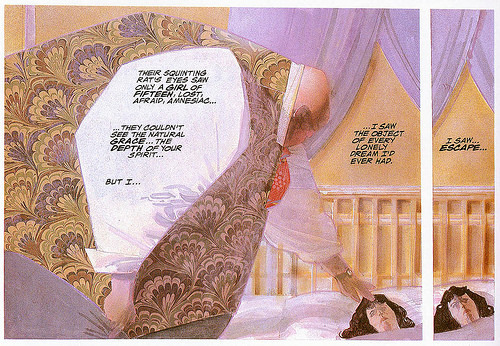
Bill Sienkiewicz’s kinetic, angular, mixed media artwork is absolutely jaw-dropping. This was groundbreaking stuff back in ‘86, although oft imitated since.
I admit I have zero understanding of Daredevil, can he fly? He certainly seems to jump off of really tall bulidings with damsels in distress in his his arms, he must fly.
That's the level of confusion to be found for a novice reading this Daredevil book from Frank Miller. I have no base nowledge and Miller has left out the basics in his story, but he also seems to have left out a story that makes sense. I'm as lost now as I was at the start.
The art of Bill Sinkiewicz on the other hand is phenomenal, that alone was worth the investment. Every panel of every page is beautiful, the kind of thing I'd love to see blown up to wall sized prints to revel in every glorious detail.
We’ve got some really pretty watercolors here. These gorgeous colorations meld their ways this way and that, binding together each and every page. Yet the seen is really the only thing tying it all together.
Other than the visual connectives, the entirety feels incomplete as the action which is abruptly and haphazardly implemented at various points. These flourishes only appear to move forward the lulls in between, saturated with dumb dialogue.
Of course, the good guy fights the bad but, its something of a confusing mess to figure out what’s going on after page 10. Yet another Frank Miller disaster is the main course here.
Sinkiewicz regge l'intera storia in punta di pennello. La vicenda in sè risulta persino banale, ma è in grado di far provare compassione persino per un arcicattivo, con il solo uso dell'inquadratura di una schiena. Il gigante cattivo è disperato e noi improvvisamente ci troviamo a esserlo con lui. Non adatto come introduzione al personaggio, per il resto è una splendida aggiunta alle storie di Devil.
From a female standpoint, the plot has not aged that well since 1986 - it's shock full of damsels-in-distress and male obsession - but it has its points, it has an interesting way of telling its story, and above all, this is a book worth checking out for the artwork.
This. Art. Is. Gorgeous. It's so far away from the mainstream, it's like a series of enchanted watercolours and collages, it's absurd sometimes, romantic most of the time, and always brilliant. There are some visuals of how Daredevil percieves the world around him that are just pure genious. I loved it.
The graphic novel is filled with some phenomenal artwork, but Frank Miller's writing fails to give off the emotional vibe that the book's trying to convey.
Meh, dreamy sequence didn't do much for me. Kind of felt like a floaty type story where catch things the deeper you look into it, but I never felt the need. It was the weakest think Miller wrote on daredevil by a long shot.
bill Sienkiewicz cooked. this is a dizzying, hallucinatory story that is more dark and disturbing than your typical daredevil comic book is allowed to be. worth a read, but definitely hold off until after you've read the rest of miller's work on the character.
Y una relectura más. El inmenso (y les aseguro que nunca jamás se vio tan grande) Wilson Fisk alias Kingpin es el hombre que lo tiene todo: un imperio criminal que funciona aceitadamente, poder por sobre jueces, políticos y empresarios, control sobre todos tráficos habidos y por haber. Y sin embargo, le falta algo: su esposa, Vanessa, se encuentra en un profundo estado catatónico al parecer sin retorno. En una movida desesperada, Kingpin secuestra a otra esposa, la de un especialista francés a quien obliga -bajo amenaza de volverlo viudo al instante de fracasar- a tratar a Vanessa. Claro que no puede impedir que el Diablo meta la cola, aunque en este libro Daredevil sea apenas poco más que un secundario. A la hora de escribir sobre estos personajes, raros autores tienen la experiencia de Frank Miller. Vamos, que el tipo prácticamente construyó su carrera haciendo al Hombre sin Miedo. Y sin embargo acá el guión es, cuando mucho, correcto. No hay más trama que la reseñada someramente más arriba e incluso el desarrollo de esta es por demás simplón (y abusa de unas casualidades verdaderamente nefastas para que los personajes se vayan encontrando a medida que la trama avanza). Lo mejor de la trama pasa por mínimos momentos entre Turk y Daredevil y algún apunte en Víctor, el psicópata que será el brazo ejecutor del plan de Kingpin. Pero uno no guarda- atesora- este libro en su biblioteca por el guión de Miller (hay otros, muchos otros, que merecen por eso ese lugar) sino que lo hace por el infernal laburo que se manda Bill Sienkiewicz en cada una de las páginas de esta novela gráfica. Sienkievicz es, para mí sin duda alguna, uno de los cinco mejores dibujantes de historieta en activo del mundo y acá, en este momento (1986), estaba prendido fuego, dibujando los kilos (si se me permite la expresión). Cada página de este Love and War es para enmarcar.
I don’t have much to say about this one. As far as Daredevil stories goes for Frank Miller, this is a weaker one. It was bloated, it rehashed old storyline’s (Vanessa and Kingpin) but failed to resolve them in any interesting way, and it focused on a horribly psychotic side character which I deem to be a failure. It’s not at all very interesting to read the ramblings of a murderous, drug addled, psychopath who is into kidnapping and controlling women to fulfil an older lust of his. On top of it being cliche, it’s boring. Although, I must admit that the way Frank Miller writes him is believable and that I enjoyed how he juxtaposed the characters inner dialogue while simultaneously contradicting his actions. That was tidy. The reason why I think the psychotic henchmen story was a bad angle to focus on is that it doesn’t say a whole lot. Past the shock value of what he was doing it doesn’t make sense that Kingpin would employ this guy to begin with and Miller doesn’t use the character to make any commentary on any issue. It just comes across as crass. The worst part is that the character makes up most of this issue. And outside of the fact that Frank Miller seems to be a little too good at writing a rapey sociopath who self medicates, it’s just not very interesting or memorable. As I’m writing this now I’m thinking of lowering the score because of how much I disliked it.
But if you’re wondering if this is an essential Frank Miller Daredevil story? It isn’t.
I enjoyed this but not as much as Elektra: Assassin. It was published in 1986, the same as the Elektra series, it must have come out in the first part of the year. Another collaboration between Frank Miller and Bill Sienkiewicz, again, his artwork is impressionistic here. The Kingpin, who is really the central character here, looks as big as a mountain. The story involves the Kingpin's wife, Vanessa, and bringing her back to full health. The Kingpin will do anything it takes to help her, including kidnapping the wife of a brilliant French doctor. It's help to Daredevil to help them out. The artwork is just brilliant, the story is not as impactful to me as the Elektra stuff. It is really a tragic tale about the Kingpin and would make great material for the Netflix TV show.
Well, having read this previously and I am coming to this with a lot of expectations. In part because Frank Miller's run on Dardevil was so character redefining. Unfortunately, from the story offered here, the reader sees none of that. Conversely, the artist Bill Sienkiewicz really delivers with this graphic novel. While this graphic novel doesn't really exemplify the highest achievement from either, it does showcase the artist more so than the writer. In many ways this isn't really a story about Daredevil as it is about the Kingpin and that is where much of the faults with the story come from. Daredevil really takes a backseat in the overall narrative structure, since the real conflict is with the Kingpin himself and how he comes to deal with his wife's state of health.
Written by Frank Miller and drawn by Bill Sienkiewicz (the team who also made Elektra Assassin), this fairly thin volume deals with Daredevil, a blind woman and her husband, a psychotic kidnapper, and last but not least the Kingpin.
In terms of storytelling and narrative content, Love and War is both short and somewhat fragmented, and as such perhaps not Miller's finest hour. But at the same time, Sienkiewicz artwork pulls me into a different world (and I realise that I really, really do need to read his Stray Toasters, simply because of this simple fact), and despite its fragmentation hold the work together nicely, somehow.
And it is not as if Miller's job is a lost cause either, I hasten to add, but it might not appeal to all of Miller's fans, and it is certainly not typical of his Daredevil material. Although, his use of the Kingpin here strongly ties in with his run.
Love and War. A graphic novel contemporary with Miller's second run on Daredevil. It's beautifully illustrated by Bill Sienkiewicz and it's on an important topic: Wilson Fisk's attempt to revive his wife. By the time you get to the end, you even realize that it's a rather subversive superhero story. But along the way, that story is kinda' shallow: one kidnapped woman, one insane stalker, and that's pretty much it. [4/5]
La historia de Miller correcta (tampoco tiene demasiado sentido) y el trabajo de Sienkewicz bastante bueno pero no me termina de convencer el estilo que usa acá. Así que en resumen, por historia y dibujo, aprobado con las 3 estrellas de rigor. Quizá mejore el puntaje en alguna relectura
Cores e desenhos absolutamente magníficos. Estou completamente apaixonada pelo trabalho do Bill Sienkiewicz. O roteiro é mediano, tem seus altos e baixos, mas cada quadro, cada pedaço da formatação da página já salva este título pra mim.
I've read this shit like three times this thing fucking haunts me
Honestly I think this is worth the read for the presentation alone. The art is incredible. It's surreal and distinct and unlike anything I've ever seen. I want to take every panel and absorb it into my bloodstream. The whole thing just flows; even the positioning of the text is so deliberate and effortless. The dreamlike storytelling and the pacing was so fucking good. I even loved the random third POV. I was absolutely enraptured. Fuck I wanted to fall in love with this SO BAD it was so close to being SO GOOD
I want cut Miller's head open and dissect the remains because I need to understand how this man can write a character whose fatal flaw is objectifying a woman he doesn't know, while simultaneously objectifying every woman in the SAME EXACT STORY. Literally the entire plot is that the women are pawns in all the men's games and everyone wants to fuck this poor blind lady. The ending is really weirdly abrupt, I was genuinely wondering if the copy I got was missing pages or something. I feel like I'm having a fucking aneurysm trying to figure out what happened, if maybe I'm misunderstanding something, because Miller and Sienkiewicz have put so much thought into every minute detail of the presentation. The plot cannot be so lacking in care, right? Right???
Idk how to rate this I think this altered my brain chemistry and then proceeded to drop me off a cliff
Heads up, this is more of a Kingpin story - Daredevil is barely in this. Baseline info would definitely be helpful before diving in. I recommend Daredevil (1964) issues #170-#172, then #179-#180. I think that should give you the gist, plus they're really good
This is not your standard superhero story. Marvel's graphic novel series of the mid 80s allowed the creators to explore different aspects of the characters, or tell stories that wouldn't fit the restrictions of a standard monthly comic. This one sees Frank Miller and Bill Sienkiewicz to tell an unusual Daredevil story.
Frank Miller had recently finished his run on the monthly DD title, a run which had redefined the character and won much critical acclaim. Unfortunately, this story doesn't really do justice to the graphic novel format - it's a story that could easily have been told over the course of a couple of issues of the monthly comic. The graphic novels also served as a means to introduce new readers to characters they may not be familiar with - it doesn't work in this respect either. The story doesn't really explain who Daredevil is, or who the Kingpin is - but this is not solely the fault of the author, the artist bears some of the responsibility as well.
Sienkiewicz has a very distinctive style, and it is not to everyone's taste. The longer deadlines involved with a graphic novel allow Sienkiewicz to produce watercolours rather than the usual pencil and ink, which certainly suits his somewhat quirky style. However, for readers not familiar with the characters, it can be very hard to work out what their abilities are. The artwork itself is beautiful, but it fails in its job of enhancing the story.
This review is actually from this current reading. Couldn't remember anything about it so I decided to reread it.
First, Miller and Sienkiewicz are prized creators to me, especially for the 80's. It's a little hard for me to say but I didn't really like this. The book really isn't about DD, it's a Kingpin story. It's a turning point for him, triggered by something to do with his wife (no spoilers), Vanessa. It feels like a backstory, meant to be in the ongoing series, but was pulled out and put into this graphic novel.
The writing is standard Frank for the time. Almost everything is in captions, and he excels in creating a mood and feeling not only for each character but the overall story. It always feel gritty and grimy, his Daredevil world, it's just a shame Daredevil isn't in it more. Overall it feels unfinished, like it could have been expanded a little more and if this really does fit into Miller's DD run, it would have been nice to know exactly where. Maybe when it was originally released it was clear and obvious, but decades later I'd have to flip through those original issues. Bill's art is always phenomenal. His style always seems to complement Miller's writing.
Updating my review from 2 to 3 stars. The story could be improved with more details but the art makes up for it.
Arte fantástica, a cargo de Bill Sinkiewicz... Quanto ao argumento, achei confuso. Mas este foi o primeiro livro que li acerca do Demolidor, por isso não sou um conhecedor da personagem e talvez isso não tenha ajudado a compreender totalmente a história. Gostei também da história extra que edte livro contém acerca de Elektra. O estilo artístico de Frank Miller é realmente distinto e brilhante.
Another good Daredevil story from Frank Miller. The artwork can be confusing at times, but still was easier to follow than Elektra: Assassin. Overall this story focuses on the Kingpin's wife, and I think the ending of this graphic novel was eventually followed up on in the regular comic. Not Miller's best Daredevil story, but still good stuff.
Miller's run on the Daredevil took a more artistic turn with Love and War, not least due to the astonishing art by Bill Sienkiewich, which is equivalent of the finest painters. I cannot fathom how this was done in 1986. It must have been mind blowing to experience back then.
The story is short but fascinating. As often in Miller's stories, the villains are the center of the story. In this case, The Kingpin and his hired psycho assasin are the main characters. We witness The Kingpin's manical love and the utter crazyness of his henchman that rapidly develops into an inner incoherent, babbling monologue of madness.
I'm convinced Grant Morrison and Dave McKean must have felt inspired reading this before venturing into Arkham Asylum. Both the art and the maniacal topics seem somewhat similar.
Unfortunately, the story ends on a bit of a weak note, fading out in a way that is not worthy of the rest of this graphic novel. Also, parts of the story seems a bit too coincidental.
So... if this was just a bunch of pictures in a gallery, they would be awesome. The art is interesting and beautiful.
But this is a comic book, and in a comic book, the art must serve the story. This didn’t.
I’m torn. I want to like it. It obviously took a lot of work and thought... but there was something wrong. A few things, as a matter of fact.
The story was really esoteric. It wasn’t straightforward at all. Which is... cool? I dunno. I wasn’t feeling it. I respect what Frank Miller was trying to do, but it really didn’t come together very well.
This is a great graphic novel, but that didn't become apparent to me until I read it a second time. Frank Miller didn't write a Daredevil story. He wrote a Kingpin story that just happens to have Daredevil in it. The art, by Bill Sienkiewicz, is mindblowing. Sienkiewicz's Kingpin will always be the definitive rendition of the character in my book, and it is a shame that nobody has ever imitated it. That last page with the Kingpin hunched over his desk is hands down one of the most beautiful illustrations I've ever seen.
Una trama non particolarmente originale e un ruolo quasi secondario per il Devil. Eppure l'albo e' molto bello. Bello per le tavole super, per la sceneggiatura e anche per alcuni comprimari (uno in particolare che scoprirete) azzeccati. Kingpin non e' mai stato cosi' criminalmente umano!
Visually impressive, with a very distinct style and some beautiful artwork. Lacking a decent story though, it simply makes no sense and has no flow.one for purists only.



 ">
">