The dramatic real life stories of four young people caught up in the mass exodus of Shanghai in the wake of China's 1949 Communist revolution--a precursor to the struggles faced by emigrants today.
Shanghai has historically been China's jewel, its richest, most modern and westernized city. The bustling metropolis was home to sophisticated intellectuals, entrepreneurs, and a thriving middle class when Mao's proletarian revolution emerged victorious from the long civil war. Terrified of the horrors the Communists would wreak upon their lives, citizens of Shanghai who could afford to fled in every direction. Seventy years later, members of the last generation to fully recall this massive exodus have revealed their stories to Chinese American journalist Helen Zia, who interviewed hundreds of exiles about their journey through one of the most tumultuous events of the twentieth century. From these moving accounts, Zia weaves together the stories of four young Shanghai residents who wrestled with the decision to abandon everything for an uncertain life as refugees in Hong Kong, Taiwan, and the United States.
Benny, who as a teenager became the unwilling heir to his father's dark wartime legacy, must decide either to escape to Hong Kong or navigate the intricacies of a newly Communist China. The resolute Annuo, forced to flee her home with her father, a defeated Nationalist official, becomes an unwelcome exile in Taiwan. The financially strapped Ho fights deportation from the U.S. in order to continue his studies while his family struggles at home. And Bing, given away by her poor parents, faces the prospect of a new life among strangers in America. The lives of these men and women are marvelously portrayed, revealing the dignity and triumph of personal survival.
Helen Zia is the author of Asian American Dreams: The Emergence of an American People, a finalist for the Kiriyama Pacific Rim Book Prize (Bill Clinton referred to the book in two separate Rose Garden speeches). Zia is the co-author, with Wen Ho Lee, of My Country Versus Me: The First-Hand Account by the Los Alamos Scientist Who Was Falsely Accused of Being a Spy. She is also a former executive editor of Ms. magazine. A Fulbright Scholar, Zia first visited China in 1972, just after President Nixon’s historic trip. A graduate of Princeton University, she holds an honorary doctor of laws degree from the City University of New York School of Law and lives in the San Francisco Bay Area.
Zia gives us personal accounts of four people who experienced the terror and hardship of the 1937 Japanese invasion and occupation of China followed by civil war and the Communist takeover in 1949. She follows them as they escape from Shanghai to Taiwan, Hong Kong, the U. S. or move to another city in China. Each destination delivers its own unique traumas as each person tries to maintain contact with family that are scattered everywhere and make a new life out of chaos. The four people are very different from each other in personality and circumstances, but they all find themselves in the same city facing the same threats and uncertainty.
Zia interviewed hundreds of people to write her book. She settled on the four to show the range of experiences in Shanghai during the war years 1937-1949 and of Chinese expatriates trying to establish a new home in the 1950s. The personal stories give us a multifaceted picture of Shanghai which was a unique Westernized city in China filled with a variety of peoples: Rich British and other Europeans, Sikh traffic police, stateless Jews and White Russians that had escaped European wars, vast numbers of extremely poor Chinese and a small number of middle class Chinese that were typically educated and spoke English, and a very few wealthy Chinese.
Zia’s account is heartfelt. One of the four was her mother. It should be noted that while Zia references the plight of the multitude of homeless displaced refugees with no resources and no hope, this book is not about them. Each of the four people had help to survive even if reduced to pennilessness. They had family and friends with resources and the education or wherewithal make reasonable judgements about their situation and take action. But with middle or upper class backgrounds they were very fearful of the communists who were targeting them. Their family members and friends suffered similarly and Zia profiles many of them adding to the depth of the presentation.
When the Pacific War started in 1937, Shanghai filled with refugees escaping the fighting, sleeping and dying on the streets. Wagon’s scoured the streets every morning to pick up those that had died. Japan soon took control of the city with the exception of foreign enclaves where middle class Chinese also lived for safety including the four. But after Pearl Harbor the Japanese took over the entire city. Japanese administration was brutal and Shanghai became an extremely dangerous place to live. The Japanese demanded loyalty and tried to turn it into a Japanese city. The Nationalists continued fighting the Japanese in China’s interior as well as fighting the Communists who also fought the Japanese while continuing the war with the Nationalists. Nationalist and Communist agents operated extensively in Shanghai. Siding with any of the three sides could easily get you killed by the other two. Anyone of any stature had to decide where they fit and what profile to keep. These were life and death decisions and what saved you under the Japanese occupation could be your death when the Nationalists took over in 1945 or later when the Communists took over in 1949.
With the Communist takeover each of the four leave Shanghai, not as a group, each of their stories is completely separate. They do not know each other. Wherever they go they face a difficult future. In China it is interrogations, reeducation programs and forced relocation. In Taiwan it is lack of work as the island is overwhelmed by the relocation of Chiang Kai-sheck’s government and forces. In Hong Kong it is refugee status in at best a rundown tenement. In America it is strident discrimination with the threat of deportation ever present. I won’t go into the individual stories to avoid spoiling the book for the reader. Following their plight and decisions as they cope with one oppressive situation after another makes for a fascinating read, almost like four individual short novels. These individual stories are interspersed chronologically. Zia does a wonderful job of putting it all together, but it can be hard to keep from confusing incidents in one person’s life with those in another. This is not a hopeless book. Perseverance pays off and good things do happen. Highly recommended.
at the beginning of this year I resolved to Consume Less, Produce More, which is symptomatic I think of my general tendency to Be Very Unhappy That I'm Happy And Do Stupid Things As a Result. Another word for this personality trait is ambitious and another one is greedy. I hoped to write more words and listen to fewer podcasts, practice more violin and read fewer books.
at the end of this summer my parents came to new york before our Annual Family Vacation, and at our first dinner of the whole affair my father completely neglected his unadon to inform me that this book "will explain to you grandma and grandpa's generation," which was also to say that it would explain to me his generation because hardship endured rolls over to kids in the form of unrepayable debt. He offered me a piece of glazed eel mid-rave and I took it, because I love eel, but also because I've never really explained being "kind of vegetarian" to my parents.
Now that China is so Big and Shiny it is easy to forget that there are alive today gum-smacking greybeards who grew up during China's civil war. By "easy to forget" I mean I forgot. Helen Zia interviewed I think more than one hundred of these survivors about their smoother-skinned days and chose four to pack into this dense-knit fact-packed epic. Everyone in this book is running away from Shanghai and everyone clutches tightly to sundry items and family ties because you never know whether today's litter will be tomorrow's lifeline.
Or as Ali Wong puts it: "you better hold onto that retainer from the third grade, ’cause it might come in handy as a shovel when you’re busy stuffing gold up your butt and running away from the Communists."
Or my dad, when I paid for dinner in an attempt to pay my own debts: "If you don't keep that receipt how will you know that you paid the right amount? They could charge you whatever they want."
But my dad doesn't really have a hoarding problem, and neither do my grandparents, because eventually the retainers and receipts become liabilities, and you can sail farther when unmoored from your arrears. You're still in the red, of course, but it fades away until it's just a crimson flag with yellow stars on the horizon of your youth, and now you're a high school dropout in remedial ESL for community college hopefuls and now you're a PhD candidate writing a thesis in words most English speakers will never use and now you're a consultant explaining to your daughter that if she doesn't change her wifi password from the default anyone who understands digital beamforming in wireless communications could hack into her network and lock her out of the Internet. "How can you live like this," my father complained as I finally changed our wifi password to [redacted], but of course the real question is How did you leave behind your whole family to sit in a fanless Vancouver immigration office and end up having read more books than I have this year?
Frick!
My grandpa won't eat sushi because he so hates the Japanese soldiers who occupied his house, a silly restriction because salmon is pink ocean butter. One storytelling session he raged that he had to bow to them whenever they crossed paths in the street (soldiers, not sushi). Which I remembered when I read of the same thing in this Non Fiction book. They could charge you whatever they want.
Frick!!!
I think I read this book for the same reason that I eat meat around my parents: I consume to prove that their forfeitures were not in vain, and that I want to understand them, and that I want the same things that they do. And it's true, I do, I love books, I love my mom watching me eat a piece of glazed eel, I love eel. I love to be able to tell my dad Hey I finished this book you recommended to me which means Hey here we are in America after a thousand kowtows to money and fate and I saw my overdrawn account in full just now, so thank you dad! this was a great book! I can't believed i stopped consuming! i'll never give up reading again!
My head tells me the book is worth four stars, but my gut reaction says it is good, NOT very good. This means I should give it three stars. What is going on?
Please read the GR book description. It is excellent. There is no need to repeat what is written there.
The book presents a large quantity of historical information. What was occurring in China as well as world events are covered over a period from the 1930s to the end of the 1950s. Sino-Chinese wars, Japan’s invasion and occupation of areas of China, the Second World War as it played out in the Far East, the conflicts between General MacArthur and President Truman, the Cold War, the Korean War and the political situation in both Taiwan and the British colony of Hong Kong are all covered. What was happening in China and on the world-scene shaped the lives of the four individuals the book shines a spotlight on. In that so much history is covered, each event is covered briefly. This is problem number one for me. The scope of the book is too wide. What is a problem for me, may not be so for others.
The four central figures are Ho, Benny, Bing, and Annuo, born in the years 1924, 1928, 1929 and 1935 respectively. The latter two are women and the first two men. We learn at the book’s end that is the author’s mother. A large number of family members and acquaintances swell the number to keep track of to more than just a few.
The book opens in 1949—Shanghai is falling to the Communists and Bing is leaving the city. The telling then jumps back in time and switches to Benny. We meet each of the four as children and move progressively forward in time, while continually flipping back and forth between them.
Chapter titles indicate whose life-story is being spoken of. At the start of each chapter, readers are given the year and the current age of the person. Each chapter is about one of them. The four individuals do not meet.
We observe the impact national and world events have on the lives of the four. What happened to each when Pearl Harbor was attacked, when Shanghai falls under Japanese control, when the Communists threw out the Nationalists, when the Korean War erupted, and so on and so forth. With the steady forward march of time and flow of historical events, we observe how these events influence the lives of Ho, Benny, Bing and Annuo. In viewing four rather than just one, readers are given the opportunity to compare the lives of people having different backgrounds.
A lengthy epilogue details the lives of the four after the 1950s.
There are problems though. Jumping back and forth between the different lives makes the writing disjointed. To prevent confusion, much information must be repeated. This is tiresome. The jumping around drove me nuts; once I got settled into the life of one, that was banged shut and I was pushed to another. Each time I had to readjust and recall who was who. There become many to keep track of.
The telling reads as narrative non-fiction. The dialogues and that which the four say and think are based on conversations the author has had with them and other emigres. There is a fictional element to the telling that bothers me. Conversations may be based on personal accounts, but the exact words seem fictional to me. Several times we are told that so-and-so “straightened her shoulders”, stepped forward and did this or that. What is delivered is thus a mix of fact and fiction.
Eventually, all four flee China. We observe through their lives how Shanghainese exiles were received in Taiwan, Hong Kong and the United States. I found particularly interesting the situation in Taiwan; I had not read about this before.
Nancy Wu narrates the audiobook. She overdramatizes. She whispers and draws out sentences to increase suspense. I don’t like this at all. I could hear her words, so I am willing to give the narration two stars. The audiobook should have included a PDF file with maps.
By the end of the book I could keep straight who was who. Do I feel close to any of the four? No, not really, but the book offers a review of Chinese and world events from the 1930s through the 1950s. The author has drawn a good picture of the Shanghainese emigre experience during the middle of the 1900s. The book provides interesting facts, but how different elements are put together and told, I like less.
1.1 million Jews exterminated, starved, gassed, etc. in Auschwitz. 300,000 Chinese slaughtered, beheaded, raped, etc. in Nanking. 146,000 Japanese bombed, burned, irradiated etc. in Hiroshima and Nagasaki.
Though numbers like these conjure images of the horrors of World War II, it is easy to grow numb to the value that each of these statistical points held as human lives.
Last Boat Out of Shanghai is as powerful as an attempt as any to humanize the story of China as it buckled under the weight of Japanese occupation only to find itself bending to Mao Zedong’s ideology shortly thereafter. Helen Zia isn’t a particularly illustrative writer, but her statement of history coupled with human impact is on point.
Zia selects 4 children of drastically different social backgrounds and follows their maturation through China’s most profoundly affecting modern moments to better depict the way in which the entire country’s people were affected. Despite its subtitling, the book is as much, if not more, about the consequences of Japan’s onslaught as it is about the rise of the communists. War and revolution are history’s great equalizing factors: poor (Annuo), wealthy (Benny), adopted (Bing), or familial (Ho), none are exempt from the gaze of conflict’s cold cut corollaries. At times, each has the opportunity to rise on the back of rocky times, but more often than not, they are brought to their knees.
Shanghai itself is an ever present, near omnipotent character, tying each of the 4 together despite the way the war effectively made them like leaves in the wind, blown to all parts of China or even the US in the name of survival. Shanghainese are a proud, lavish, frequently boisterous bunch, and this does not change no matter how many miles come between them and their former home, anchoring the way they lead their day-to-day lives to the choices they make in protecting themselves and their families.
I came upon this book when musing upon my grandparents' stories of escaping Guangdong as political dissidents during Mao's reign. I think a part of me wanted to learn more about the how of where my family came from, but another part was admittedly steeped in doubt. Something about my grandmother's tales of being adopted as a de facto child slave from a Japanese internment camp, or my grandfather's daydreams gone past of his nationalistic protests whilst standing on empty milk boxes, felt otherworldly to me. Surely this was the kind of mythical stuff that the elderly fed to their youth to render gratitude and obedience from every orifice. And yet, Last Boat Out of Shanghai proves these stories were all too common in early Communist China.
Like Zia, I, too, am the child of survivors of war and revolution. It's humbling to know that my grandparents could've easily been a Benny, Annuo, Ho, or Bing. There’s much to mourn here, but there is so much more to celebrate: the human spirit carries on no matter what.
Author Helen Zia has given us this well researched and objective account of the great city of Shanghai and her resilient people.
Zia first describes how the city’s residents survived the brutal occupation by Imperial Japanese forces for years before World War II. Readers who have experienced the very sad account described by Iris Chang in The Rape of Nanking will understand how bad it was in Shanghai. Then, when they kicked out the Japanese, they had to contend with the gangster like Nationalists before they were finally booted out by … Maoist Communists. Damn.
This also made me think obliquely of Persepolis by Marjani Satrapi. The Iranian people fought for reforms from an aristocracy only to be taken over by a brutal theocracy.
We follow young people as they navigate the turbulent times, some fleeing their home to start again in America and others staying behind to live under totalitarian rule under Mao. Zia is able to describe how these people retain who they are and keep alive the best of what was old Shanghai and build a better life for themselves and their families. The author also provides an excellent history of this place in this time in history, mainly the late 1940s, and we have a glimpse into what it was like on this world stage.
I’ve had the honor to represent some Chinese folks over the years and I was impressed by their work ethic and dedication to family and this work emphasizes these qualities.
We need to read more books about the suffering of the Chinese people through decades of wars and conflicts. This book was a surprise for me, I didn’t expect too much of it but really enjoyed it.
Since my summer 2019 visit to China, I've read The Rape of Nanking and The Last Boat Out of Shanghai (LBOS). Both essentially begin in 1937. The former was about Japanese atrocities committed in Nanking (also known as Nanjing) in the winter of 1937-38 while the latter title extends historical coverage beyond Shanghai of the WWII era. Against this harrowing history, LBOS provides stories of survivors.
In 1931, Japan had gained control of Manchuria in northern China but harboured greater ambition. The young Republic of China still had strong dissension between the Nationalists and Communists despite the continued military hostilities with Japan. Their differences were partially set aside as the Second Sino-Japanese War commenced with Japan's invasion of Tientsin in 1937. Although conquest didn't occur as quickly as originally believed, Japan soon enough also gained control of Beijing and then Shanghai by November 1937.
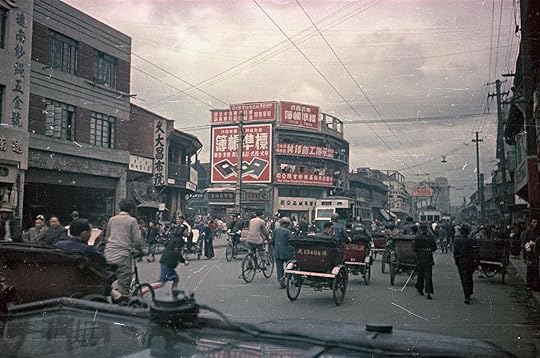
Shanghai had nothing but superlatives in its description - from the "Pearl of the Orient" to the "Paris of the East." With a significant presence of Europeans and Americans in their International Settlement and French Concession, this was a modern, sophisticated, and economically vibrant city. As such, all varieties of characters and segments of society populated Shanghai.
LBOS follows four individuals and their families as they experience the dynamic swings of societal crisis during a foreign war, then a civil war, and finally some of their experiences as refugees.
Benny Pan was born in 1928 to a family that had grown wealthy via employment with the foreign businesses in Shanghai. His father Zhijie, however, threw his lot in with the powers to be in order to live the lifestyle of the rich and famous. Following the Nationalist's President Chiang Kai-shek' s corrupt example, Zhijie allied with criminal elements in Shanghai and later brutally collaborated with the conquering Japanese against Chinese. Benny was forever tainted with the sins of his father once the Communists won the civil war. In conjunction with his elite education in a foreign missionary university, Benny was not allowed permission to flee and through his life, readers learn of China under Communist control, including the disastrous "Great Leap Forward" of the Cultural Revolution.
The family of Ho Chow (born in 1924) derived their income from their tenant farmers. As the Japanese military advanced in 1937, the Chow family split up in order to increase their survival chances. Ho joined the majority of the Chow clan in Shanghai's foreign settlements as many regarded that as the safest sanctuary. As the brightest, Ho had the best chance in his family to leave China for advanced studies and to earn money for the rest of them. As he forged a life in the US, during a time of growing anti-Communist sentiment, Ho learned of the precarious life of the land owners in Mao's China.
The father of Annuo Lin (born in 1935) worked for the Nationalist government and her mother was a trained physician. Her father left his family for years in his patriotic fervor to serve the Nationalalists. Her mother earned money, shielded the family from anti-Nationalist hunters by assuming forged identities, and crossed war zones with the children when summoned by her spouse to join him in Free China during the Japanese occupation. With Annuo's family comes the description of how Taipei changed from a Japanese colony to the "temporary" capital of the Republic of China.
The last person is Bing Woo (born in 1929) who illustrates the fragility of life for females from poor families in a society that valued only the sons. In her third family, the Woos, Bing finally had a stronger safety net. "Elder sister" Huiling was a glamorous and opportunistic survivor, who had married a foreigner who was both gainfully employed and paid in stable US dollars. Through Huiling's machinations, Bing traveled to the US and married a Chinese-American before her entry visa expired.
The personal stories against this tumultuous backdrop were worthy of 5 stars. I liked the variety of perspectives and, certainly, the 1948 and 1949 accounts were nerve-wracking because time was running out if one finally decided to flee. It is a terrible calculation to make - whether to abandon all that is familiar (plus your property, possessions, and status) or to remain and take your chances with an anti-capitalist regime. Many believed that life under fellow Chinese, Communist or not, couldn't be worse than under the Japanese, especially those who knew about the events in Nanking. The author wrote that there are no official estimates, nor acknowledgement, of the extent of the mass exodus. Zia estimated about 25 percent of Shanghai's 6 million left in the late 1940s.
But I am not rating this 5 stars. Whenever I sensed the author's voice superimposed over her 4 main characters, which was when they were all young in Part 1, the tone put me off a bit and felt inauthentic. Then there's her choice of how she organized the 4 biographies, which occasionally felt discordant. It would have helped if Zia had included a timeline of key historical events. The realities at that time were sufficiently dramatic that it didn't need the additional touches Zia had incorporated. So LBOS wasn't stellar, but it was pretty good and I'm glad that I had read it. Not only did I learn about China's history but also American foreign policy and history.
In this book you can see how the turbulence in China from 1937 into the Communist era was experienced by 4 survivors. Through the author’s commentary you also come to appreciate the unique character of Shanghai, in which all 4 have roots. One of these survivors, you learn at the end, is the author’s mother.
The four profiled have different beginnings and paths and may be representative of thousands They are, in order of their appearance in the book:
Benny’s story begins in 1937 when he is 7 years old. He is the first son of a Shanghai family of wealth and prestige. His father is not just an ordinary collaborator with the Japanese occupiers; he heads one of its most brutal police units. He oversees imprisonment, torture and capital punishment. The family’s lavish lifestyle is described and well as the first class education Benny is receiving at St. Johns high school and university. Benny does not leave China in the major period of exodus and his subsequent treatment in the communist era is described. You see how difficult decisions and uncertainty faced by young people was as he engineers his sister’s escape to something of life in Hong Kong. His path to freedom in the US is unusual.
Ho, 13 in 1937, is from a family of rural landowners. By collecting rents they live reasonably well. As the war with the Japanese and the civil war between the Nationalists and the Communists grinds on, paying the tuition for their exceptionally bright son becomes more and more difficult. Through Ho you see the pressure put on children to shoulder the responsibility for their families. Ho’s diligence gets him to an American university where you see him experience Catch 22 immigration rules, the quota of 103 immigrants a year and the cold war’s anti-communist labeling of all Chinese.
Bing is 6 years old when she is given by her parents into an “adoption” which is a euphemism for being a servant to someone who will feed her. Bing is lucky that her parents stipulate that she go to school, but this adoption does not last long. The next family is a blessing in disguise in that this family lives in Shanghai and she acquires Elder Sister Betty. Betty treats her like a real sister while Bing attends to grumpy "Ma". The gorgeous Elder Sister enjoys the Shanghai night life, is very much a wheeler dealer, She marries a Danish ex-pat who earns American dollars. Kristian becomes critical to Bing and Betty escaping once the communists takeover Hong Kong. Once in the US you get a glimpse of Chinese life in California and New York at the time and how Chinese marriage customs play out.
Annuo is 2 years old in 1937. Her father is an important administrator for the Nationalists. He is authoritarian and is hypercritical of her. She is always glad when he is away administering one province or another. When he comes back, he gets through Japanese and Communist army lines by looking like a peasant. With her mother and brother she walks 400 miles, again evading armies, to see him. With the collapse of the Nationalist government there is an escape to Taiwan. You learn the difficulties of starting over in Taiwan and the Nationalist’s poor treatment of the Taiwanese. Annuo, despite her father’s impossible rules and chips at her self esteem, persisted (like Ho) in her studies and through them was able to immigrate to the US.
This book results from many long interviews with the 4 people and hundreds of others. The result is history coming to life. If you are interested in China and how mid 20th century events buffeted its people, you will not want to miss this.
The book Last Boat Out of Shanghai tells the story of four people who faced Mao's Revolution in China and about their experiences. These people all lived in Shanghai, although their lifestyles and experiences were very different. This is an important piece of history to cover, because the experiences of people in Shanghai and the rest of China during World War II and Mao's Revolution are often overlooked, especially in the American context. This book offers valuable firsthand accounts about what it was like to live through these events and adds a needed complexity to how we view the rise of Communist China in history. It also offers insights into the current refugee crisis, as the author intends, because of how it shows how refugees have been treated throughout the Twentieth Century while also demonstrating what they offer and how they will benefit the countries where they are accepted. As a teacher, I would use this as a way to help students gain better understanding of the time periods we are studying with regards to China. It could be incorporated into lessons on World War II on the Pacific Front as well as lessons on the Cold War. Overall, I highly recommend this book as a way to read the perspectives of others to learn more about an understudied era of history.
This is non-fic about people, who lived in Shanghai in the 1930s-40s and witnessed first hand the Japanese occupation, Chinese nationalists and communists. I read is as a part of monthly reading for March 2020 at Non Fiction Book Club group.
The book starts in 1949 with an overview about plight of 1 to 1.5 mln Shanghainese (of 6 mln city), who run from incoming communists. Most of them are rich and middle-class families, not more usual poor refugees, whom we often see in other stories.
The book then backtracks and starts in the mid-1930s by introducing all four main characters of different background. Each part of the book is for a selected time period and tells these four uncommented (except by Shanghai itself) stories. This kind of narration is not very well suited because only you ‘get into the shoes’ of one person, you’re transferred to a completely different set of people.
The persons are: - Ho, a boy, born on a farm in 1924, a son of landlord. His family runs to the city from Japanese. He is a bright one in the family and therefore destined for paid education, first in China and then in the US. - Benny, a boy, born in 1928 in a family of compradors (local agents for western businesses). As a student, his father fought for recognition of Chinese people rights, but ended up a high level police official under Japanese occupation. - Bing, a girl, born in 1929 in the family of Chinese nationalist father and progressive mother. Father worked underground during the war and a girl grew up without him. They had to run to Taiwan with other nationalists - Annuo, a girl, born in 1935 in a poor family who sell her to a childless woman for this ought to help with fecundity. She is then transferred to another family, with excessively strict mother and socialite elder sister There are a lot of interesting facts about the daily life.
This is a very interesting book about the Chinese exodus from Shanghai after the Communist takeover. It follows the lives of four individuals. The individuals include individuals from the wealthy class, those who collaborated with the Japanese, ordinary Chinese, and Chinese peasants. The book traces their lives from birth through Japanese occupation in World War II to Nationalist rule under Chiang Kai-Shek, and their decisions to leave following the Communist takeover and their efforts to survive in their new lands including the United States, Taiwan, Hong Kong, Australia and Denmark. The book is much more than simple refugee stories. It paints a stark picture of life in China from the 1930s to the 1950s.
If you do not know about the ramifications of the Japanese occupation of China and the Communist takeover, nor the Nationalist occupation of Taiwan, this book will provide you with a wealth of information. I strongly recommend it.
From 1931 onward, the Chinese people were confronted with continuous Japanese aggression, humiliation, occupation, and inhumanity. In Helen Zia’s new book, LAST BOAT OUT OF SHANGHAI: THE EPIC STORY OF THE CHINESE WHO FLED MAO’S REVOLUTION the author seems to begin here story in 1937 when the Japanese launched their invasion of China, however as she develops her story it is important to realize that the Japanese had their eyes on China as far back as the Sino-Japanese War of 1894-5, the Twenty-One Demands of 1915 during World War I, and their incursions into Manchuria in 1931. By 1937 the situation had grown worse as Japan launched a large-scale invasion. Japanese brutality has been well documented by the “Rape of Nanking,” and numerous other atrocities, including a policy of torturing and killing civilians. After eight years of fighting the Japanese were finally defeated in August 1945 and what followed was the no longer dormant civil war between the Communist Chinese led by Mao Zedong and the Nationalists, led by Chiang Kai-Shek that resulted in the Maoist victory in late 1949.
Everyone was not enthralled with the arrival of communist troops closing in on Shanghai. During the World War II Shanghai was divided into a Chinese section and an international one with a French concession where Chinese, Europeans, English and others were safe from the Japanese for a good part of the war. Rich foreigners and native Chinese members of the middle class who had cooperated with the west, Christian missionaries, and those educated during at that time feared for their lives. The city of Shanghai was the symbol of Chinese westernization and the focal point of escaping the mainland from oncoming Communist soldiers. According to Zia , a child of two refugees, there is nothing written in English on the plight of those who attempted to flee in 1949. Her new book is designed to fill that vacuum.
Zia’s narrative traces the lives of four people, beginning with Benny Pan, the privileged nine-year-old son of an accountant and an officer in the police auxiliary who will become Police Commissioner in Shanghai; Ho Chow, the thirteen year old son of a land owning gentry family; Bing Woo, an eight year old girl who has been given away two times by her blood family and the first family that accepted her; and Annuo Liu, the two year old daughter of a rising Nationalist leader. Zia will follow the lives of these characters and members of her family well into the present. In all instances in dealing with these characters deference was paid to Chinese traditions as a dominant theme. Whether issues dealing with family relationships, key decision-making, or dealing with outside threats the opinion of women gave way to those of men despite the danger it might create for family members. Another constant in the lives of these four characters was the fear of the Japanese to the point that several individuals discussed had to take on new identities to survive, especially those who had to travel back and forth into the interior of China to be with fathers, or escape arrest.
Zia does a masterful job explaining the origin of western control of the international section of Shanghai where people sought refuge and escape from the oncoming Japanese. In doing so, Zia integrates the history of western imperialism in China dating back to the First Opium War, 1839-1842 that produced the first unequal treaties that gave first England, then other countries extraterritorial rights in China. Outside of Shanghai, Chinese peasants lived a life of poverty, and the dichotomy emerged of “abject misery coexisting with unabashed opulence.” The author employs the family histories of her main characters to describe the racist and ethnocentric attitudes and actions taken by foreigners in China.
As Zia presents her narrative many important historical events and occurrences are discussed. Among the most interesting is the fact despite the danger and violence of Japanese occupation, roughly 20,000 Ashkenazi Jews were accepted in Shanghai and escaped the Holocaust. By early 1943 over 7600 allied nationals, mostly American, British and Dutch were sent to internment camps which Zia points out were not as accommodating as those created in the United States for over 120,000 Japanese-Americans. After the Japanese surrendered the issue of collaborationists raised its ugly head affecting family members who were arrested for their work with the Japanese. Interestingly, as soon as the Pacific war ended, the Japanese continued to fight the Communist Chinese in the northeast under orders from the Americans and the Nationalists. This angered the residences of Shanghai, but the burgeoning civil war between the followers of Mao Zedong and Chiang Kai-shek took precedence over everything.
The difficulties of displacement and reorientation following the Japanese defeat is on full display through Zia’s protagonists. Issues of legitimacy in all aspects of society emerged, i.e.; students who had left for the interior during the war v. students who remained in Shanghai and were educated at universities. Demonstrations, some rioting were all part of the landscape of Shanghai between the end of the war and the arrival first of the Nationalists and then the Communists.
Zia spends a great deal of time discussing the Nationalist seizure of Taiwan after the Maoist victory and the harsh dictatorship that was imposed by Chiang Kai-Shek and his forces. She follows American domestic politics and its impact on Bing and Ho as they tried to renew their lives in the United States and deal with immigration authorities as the Cold War evolved. The McCarthyite period, the outbreak of the Korean War, and other events impacted all of Zia’s subjects greatly.
As the narrative unfolds, Zia introduces several interesting characters that have important roles to play in the lives of Benny, Bing, Ho, and Annou. Chief among them are Betty Woo, Bing’s adopted sister who seems to be able to support her family through her charm and savvy as she arranges marriages, money, and whatever needs that must be met. Annou’s father is a disaster as he “hates” his youngest daughter, and Benny’s father, a Nationalist insider who is eventually captured and imprisoned by the Communists. His father’s background became a source of his own suffering as Zia describes his treatment by the Maoist government through numerous campaigns including the Cultural Revolution.
At certain points in the narrative the book devolves into a description of a series of human waves to escape oncoming tragedy. First, the Japanese in 1937, then the Communist Chinese in 1949. In each case massive numbers of refugees are created in Shanghai and later Taiwan, Hong Kong, and parts of Southeast Asia. The mass exodus of 1949 produced an estimate of 1.5 million of Shanghai’s 6 million residents scattering anywhere governments would accept them. Zia’s protagonists and their families are part of that exodus and she follows their stories to the present day. What is clear is that the suffering of refugees during that period in history was a catastrophe for those people as are the refugee issues faced by survivors of the current Syrian Civil War, events in the Sudan, Yemen, Darfur, as well as migrants currently seeking entrance into the United States.
Zia’s work is to be commended as she presents a history of western imperialism, Shanghai, the diaspora of many Chinese as they disperse to Taiwan, Hong Kong, the United States and elsewhere after 1949. She narrates Chinese history through the eyes of her subjects and provides the reader excellent insights into events on the mainland, Taiwan, and Hong Kong. Zia writes well and is sensitive to the experiences of her subjects and how they were impacted by historical events. It is interesting that New York will become an area that all four of Zia’s subjects find common experience and lastly, she should be commended for her presentation of the Shanghai diaspora.
Background: Sis and I and our cousins on mom's side of the family were born in the US, while our parents grew up during WWII. Mom was born in Shanghai and her father worked for China Merchant Marine. At first they owned a house in Little Tokyo, then lived in row houses in Japanese-controlled compounds, near 76 Jessfield. In December 1948 mom's family took a Merchant Marine ship to Japan. I first started hearing their generation's stories when I was 22, sis was 18, and my cousin was 20. I remember being stunned. I would periodically look at my cousin to see him furiously processing everything and realize OK, I'm not crazy, he's hearing the same thing. Sis has a fairly detailed family history and pictures from my mom, who is now 86. Mom's family didn't starve the way others did because they learned to speak Japanese, Cantonese, Mandarin, Shanghainese, and English.
Reading this book was like suddenly encountering a much more complete jigsaw puzzle of our family history. Thank You for writing this book. Now that sis and I have read it, we are able to ask my mom more targeted questions and fill in the gaps. In addition, we now have two much younger cousins who tragically never got to hear their dad's stories (mom's oldest brother), and this book is vital for them as well. Their father was accepted to Jiao Tong University, but just as he was starting there, the family left Shanghai. He graduated from Todai.
Historically engrossing, Last Boat Out of Shanghai chronicles the lives of four Chinese individuals and how their lives were shaped from an early age through their struggles to adulthood. Moving us from the interior of China and Shanghai to Hong Kong, Taiwan, and the U.S., the author traces the footsteps of Benny, Annuo, Ho, and Bing across the years, their hardships, and their resilience in struggling against life’s challenges in a political climate that suppressed freedom and curtailed the ability to make even the smallest of choices, first under the Japanese during World War II, followed swiftly under Communist rule. The plight of Ho stranded in the U.S. as an international student facing deportation to a China in internal turmoil lays before us the stark reality of tough choices. Well researched and sometimes excruciating in detail, the author shares the stories of these four individuals with the world. Particularly for the U.S. audience, this historical saga is especially important, as the tendency is to fixate primarily on illegal and legal immigration across its southern border - there is a hunger by many across the world to move to the U.S. I found the book a tad long but overall well done and it’s an important political, cultural, and historical read.
I picked up this book as something extra for a buddy read.
While I majored in Chinese History in college, I had not read too much on the subject over the past 30 years.
This book is not the type of history I typically enjoy. I tend to prefer the meta-history, wherein we learn more about the overarching events that affect a person or place. Focusing on a small group of individuals tends to loose me.
This book did not.
It traces the lives of several young Shanghai youth as they grow in war torn Shanghai and then flee to different parts of the world (namely Taiwan or the US.)
The book really becomes interesting when the Korean War begins and people migrate to Formosa (Taiwan). This section of the book caught my attention because I started elementary school in Taiwan. Learning about the history of the area where I lived as a kid was interesting.
In history classes in the US, I’ve of course learned about WWII. What I’ve never learned about was US deep influence and involvement with the second Sino-Japanese war and how that relationship continued to influence China’s civil war between the nationalists and communists. I’ve also never learned much about the politics of the civil war itself or about Shanghai’s refugees and the country’s brain drain during that time period. Through 4 individual stories, I’ve also gained insight into the US political climate of educated Chinese during that time period. This entire book was extremely engaging and insightful. I also love that it was written by the daughter of a Shanghai refugee.
Amazing. Inspiring. Suddenly I was at the epilogue, and I was and am stunned. Highly recommended. And should I ever be so lucky as to have children of my own, this will be absolute mandatory reading. Highly recommended for all ages.
Incredibly captivating and addictive to read, the author did a great job of telling the stories of these 4 individuals while providing the reader with the necessary historical facts to fully understand the context in which these events are happening. If you're someone who doesn't tend to reach for non fiction because you find it dry/boring, I definitely recommend this since it is so centered around these 4 individuals that you become invested in their journey and struggles with what's going on politically and culturally. Nancy Wu's narration is, as always, flawless. This book really got me thinking about my own family's history and the circumstances by which they ended up in Hong Kong because of the Chinese Civil War and this is definitely a new favourite non fiction for me.
The Goodreads summary of this book says it follows the lives of four young people fleeing the 1949 Communist takeover of China. It is that but their story actually begins with the Japanese invasion of China, which predates US involvement in WWII, continuing all the way to very recent times. You may think you know their story, I'll bet you don't.
Helen Zia describes the interesting often sad tales of each of the four individuals in her book, each worthy of a separate book themselves. But more than simply tell you about someone else's life she tells you what it means to you.
This isn't about Chinese and China, it is about you, me, and everyone in the world regardless of our nationality, politics, religious beliefs, or where we live.
This was fascinating and well worth the read. I appreciated that the author told the stories of people from different backgrounds that all faced dire circumstances when Mao came into power. I was unsurprised about the prejudices that those who chose the US as their safe haven faced, especially given the nasty tactics the FBI and CIA use to root out “threats”. I appreciated the opportunity to learn more about different Chinese cultures and the history of the communist revolution through non-American eyes.
The Last. Boat Out of Shanghai is an excellent engrossing read. Zia proffers snapshots of four people who escaped from China prior to the onslaught of the Communists. Each story is fascinating and equally gripping. The notes are extensive as well as the bibliography. The author provides a follow up to each person showcased in the book. It's a must read for anyone interested in Chinese or Asian history. Thanks to NetGalley for the advance copy.
Best book I’ve read this year! So interesting and suspenseful. And a great book to read during a pandemic as it follows four young people whose lives are put on hold/disrupted/turned upside down by forces out of their control (a big ‘ol war). Good perspective! But mostly just a great read.
When future historians look back at the most consequential events of the century just past, it seems likely they’ll place four or five episodes at the top of their lists. The Russian and Chinese Revolutions, of course. The thirty-year war that encompassed the two conflicts we now call the First and Second World Wars. And decolonization, beginning with the independence of India. But at the very top of that list is almost certain to be the decades-long upheaval that culminated on October 1, 1949, with the founding of the People’s Republic of China. And Helen Zia has done an extraordinary job of portraying the decade that preceded it through the lives of four remarkable young people who fled Shanghai in Last Boat Out of Shanghai.
Four characters carry this eye-opening story
Zia uses the tools of biography to paint a wide-screen view of China’s troubled history from 1937, when Japan launched World War II by invading the country, to 1949 and beyond. Her principal subjects are two women and two men among the estimated one million Chinese who fled Shanghai as the Red Army neared the city.
Bing Woo
Bing Woo had been twice cast off as an unwanted girl child, first by her birth parents, then by an adoptive mother. In 1937 she was living with her third family, a “frightened girl of nine,” when Japan invaded Shanghai and other ports on China’s coast. And Bing was twenty when she stepped with her adoptive “Elder Sister,” Betty Woo, onto the General Gordon—the repurposed American warship put to work as the eponymous “last boat out of Shanghai”—en route to the United States. Three weeks after her departure, the People’s Liberation Army marched victorious into Shanghai.
Annabel Annuo Liu
Annuo (pronounced “ann-wah”) Liu was two in 1937. She was the daughter of a largely absentee father, an official in the Nationalist government, and a mother trained as a physician. Over the ensuing years, Annuo’s father was repeatedly promoted. Because his increasing visibility posed risks for the family, he forced them to leave the city and undertake a long and perilous journey to join him in the interior.
He repeated the practice in 1949, sending them from Hangzhou (near Shanghai) to Hong Kong, en route to Taiwan. There, he forebade Annuo’s mother to work. “He could not tolerate losing face by having a working wife.” At the same time, he imposed a long list of unreasonable restrictions on the thirteen- and fourteen-year-old girl. She was a star student desperate to enroll at Taiwan’s leading university to study English literature, but he stood in the way of that, too, forcing her to take up the law instead.
Benny Pan
The image at left shows Benny Pan as a teenage bodybuilder attempting to please his powerful father. At nine years of age, Benny was “a privileged child of Shanghai,” living in the luxurious confines of the French Concession when war broke out in 1937. His father, Pan Zhijie, later known as C. C. Pan, was a well-to-do accountant with the British-run Shanghai Municipal Police. Following the invasion, he secured first one promotion, then another, eventually ending up as Police Commissioner for the region that encompassed the gangster-dominated Badlands.
Pan Zhijie swore an oath to the notorious Green Gang, which closely collaborated with Chiang Kai-shek and his Nationalist Party. After the invasion, Benny’s father—and the Green Gang—switched sides. They actively collaborated with the Japanese, presiding over the torture and execution of suspected Chinese Nationalist and Communist agents alike, gaining great wealth as a result. Late in 1948, Benny’s father was imprisoned by Nationalist troops on their return to the city. To escape the association with him, Benny fled Shanghai for the interior at age twenty.
Ho Chow
Ho Chow, thirteen in 1937, was “the playful second son” of a family of “landowning gentry for generations.” They lived in an enormous compound behind a moat in the farming town of Changshu in the fertile Yangtze River Delta. The boy was unusually bright, with “a gift in mathematics and science,” and fiercely pursued his studies, often against great odds during the war and the turmoil and uncertainty that followed it. He graduated first in his class from Shanghai’s Jiao Tong University, the “MIT of China.”
In 1947, Ho emigrated to Ann Arbor to study mechanical engineering at the University of Michigan, determined to acquire the tools he’d need to launch an automobile manufacturing company. After much difficulty with the INS, he managed to obtain work for an American company, where over the years he garnered “more than sixty industrial design patents.” And he did in fact found a small company of his own in New Jersey.
Eventually, all four—Bing, Annuo, Benny, and Ho—ended up in the United States and married. And they all later patronized the same Shanghainese restaurant in Manhattan, where they might well have encountered one another.
A time of terrible trouble
All the while she recounts the intimate and all too often excruciatingly painful stories of her four subjects’ lives, Zia surveys the disintegrating society in which they lived. To grasp the tumultuous reality of China in that era it’s no surprise that more than one million people fled Shanghai.
** Inexpressible cruelty and sadism practiced by the invading Japanese troops, their “scorched-earth approach of ‘Kill all, loot all, burn all'” displayed most dramatically in the Rape of Nanjing and in their use of “special bombs containing fleas infected with bubonic plague, cholera, anthrax, and other deadly germs.”
** The utter incompetence of Chiang’s Nationalist government, which seemed at times to exist merely to enrich him and the members of his family with billions siphoned from American aid and onerous taxes on the population.
** Chiang’s sociopathic disregard for the life of his countrymen, illustrated most profoundly when “as many as eight hundred thousand civilians drowned after the Nationalist army blew up dams holding back the Yellow River” to slow the Japanese advance.
** The collapse of the Chinese economy in runaway inflation, which impoverished hundreds of millions.
** Decades long-civil war between Nationalists and Communists, only sporadically interrupted by cooperation to resist the Japanese
A wrenching, eight-year war while revolution simmered
The eight-year war during which Japanese troops occupied large swaths of China dominates the stories unfolding in Last Boat Out of Shanghai. And Zia reveals facts about the war that are little mentioned in other accounts.
For example, “the Imperial Japanese Command had planned for Shanghai to fall in three days.” It took them three months. And “they had expected China to surrender in three months.” Those three months stretched to eight years. There’s an old joke that casts light on the challenge the Japanese faced. The two opposing armies have met in a big battle. Three hundred thousand Chinese die, but just 50,000 Japanese. Then another big battle takes place. There, 250,000 more Chinese die, and 75,000 Japanese. Pretty soon, the joke goes, “no more Japanese.” The seemingly inexhaustible demographic reserves of China, with its population then of half a billion, simply wore down the Japanese military machine. The Imperial Army won nearly every battle but emerged from the war thoroughly beaten.
After the Revolution
Although Zia devotes the lion’s share of her attention to the war years and the troubled time of revolution and civil war that followed, she pursues the stories of all four of her subjects after October 1, 1949 as well.
** For Benny Pan, who remained in mainland China for decades, the experience included the Great Leap Forward, the Cultural Revolution, and years of ill treatment at the hands of authorities because of his class background.
** Annuo Lu suffered through life as an impoverished refugee in Hong Kong until she was able at length to travel across the water to Taiwan. There, she and her family remained stranded for years, enduring the dislocations and harsh rule of the Kuomintang government as well as her tyrannical father.
** Both Bing Woo and Ho Chow fled Shanghai and made their way directly to the United States, where they learned first-hand how many roadblocks immigrants face in a xenophobic society.
About the author
Chinese-American journalist Helen Zia (born 1952) is considered a key figure in the Asian-American movement and is active in promoting LGBTQ rights. Last Boat Out of Shanghai is her third book. It was inspired by the experiences of the war and the revolution she heard from her mother, Bing Woo.
Read through page 40 (actually 55 pages total because of the prologue. A petty yet real peeve: when pages you’re definitely meant to read aren’t paginated with the rest, making it always seem like you’ve read less than you have). This is the kind of narrative nonfiction I tend to like, but whether because of my mood or the author’s style, this one was feeling like a slog.
Also not a fan of novelizing real stories: when describing a dash through town someone took as a young boy to inform his mother of an ongoing bombing raid, related to the author presumably in old age, I’m pretty sure he would not have recalled every sight and person he passed on his way, let alone all this dialogue, facial expressions, dialogue beats, etc. Especially when more than one subject’s story is told in this level of detail. If I wanted a novel I would just read one; there’s no shortage.
Of all the unjust, unfair, and inhuman ways people devise to make each other miserable, restricting the ebb and flow of international migration is one of the least justifiable and most small-minded. Serious attempts to make people stay in certain geographical areas just because of their ethnic origin has a long and wicked history, but the bureaucracy of it began in earnest during WWI. As the stakes and the levels of human misery rose in WWII, the bureaucracy rose concomitantly to meet that misery with new diabolical levels of hideousness of its own. Passports were not even required before WWI, but by the time WWII was in full swing, racism, xenophobia, and nationalism all conspired to add immeasurably to the toll in human misery. The Last Boat Out of Shanghai is an eloquent testimony to the narrow-minded, short-sighted, automatically cruel work of governments both apparently free and totalitarian to make it difficult for people in the grip of war to do what they naturally need to do: escape, move to safer places, and live out their innocent lives without the injustice and arbitrary heartlessness of governments making that more difficult at the least -- and all too often impossible.
Fortunately, The Last Boat Out of Shanghai bears equally eloquent witness to the courage and grace of ordinary people and their ability to survive and work out solutions to the problems governments throw at them. This is non-fiction storytelling of a rare and high order. The lives of the four main characters are detailed with an elegant simplicity and deep insight and the reader comes to care about them profoundly. The book reads like a thriller and the reader should be warned that once she picks it up she may be compelled to keep going at the risk of a sleepless night or two. Recommended without reservation.
I learned a lot and enjoyed these impactful stories. My only complaint was that it was a bit too long. The author followed the lives of four different people. I was confused at the beginning of the book trying to keep all of the people straight. I would have been just as happy if the author would have written about one or two people.
Helen Zia presents four compelling storylines and the ways in which a portion of China's 20th century history - picking up in 1937 and extending into the 1950s (plus a good-size epilogue which goes even further) - affected each of their lives.
Well narrated by Nancy Wu. I'm still wrapping my brain around the scope of this book, because there's a LOT in here. The idea to ground history in individual stories (or did she ground the individual stories in history?) was an excellent one, and I'll certainly be on the lookout for more of Helen Zia's work in the future. Incredibly written.
Book Review: Last Boat Out of Shanghai: The Epic Story of the Chinese Who Fled Mao's Revolution by Helen Zia
As a bibliophile, I approached this book as falling under the category "...And Now for Something Different", - and what an incredible read!
Helen Zia deftly weaves a tale of history, drama and exodus in a tumultuous era clouded by the fog of war. Out of the stories of thousands interviewed, people who were actually there - that so-called "Paris of the Orient", the author chooses wisely - four characters with vivid memories rendering authenticity, packed with a full range of deep emotions, who in part and in whole, epitomize the exodus.
Benny, privileged son of a police major general who collaborated with the Japanese invaders. Will his family pay the price? Annuo /Annabelle, daughter of a nationalist resistance commander and Koumintang officer under General Chiang, who put his country and ideology above his family. Ho, son of landowners, the gentry class that dominated China's vast rural countryside, whose father died at an early age and whose mother endeavored to push her son to pursue an education in Japanese-occupied then communist-liberated China. Bing, twice-abandoned child, who found acceptance, perhaps even love, in a family who adopted her and a domineering elder sister, who in the end, loved her the most.
Both the Shanghainese and the foreign Shanghailanders, were resilient - even stereotyped as rich blowhards. "Plus ça change, plus c'est la même chose". ("The more things change, the more they remain the same"). Faced with the corrupt Kuomintang of Sun Yat-sen and Generalissimo Chiang Kai-sek, the brutality of the Japanese occupation, the furious American-armed Nationalist resistance, they coped, they made do, they survived.
But when Chairman Mao and the People's Liberation Army took over after the Japanese surrendered, death was not a question of if, but of who, when and how.
In the foreground of the exodus were invariably unwelcoming lands of the exile, whether in Hong Kong, Taiwan, or even the United States. With the massive diaspora of 50 million Chinese in preceding centuries, deep resentment or discriminatory exclusion laws greeted Shanghai refugees. Until 1943, for example, the United Stated enforced an immigration quota of just 105 visas per year.
Escaping from Mao was just one small step, even as no one then could have foreseen Red China's murderous Cultural Revolution of 1966-67 when millions of its own citizens were massacred.
But not all will leave with the "Last Boat Out of Shanghai", the General Gordon and its 1,946 passengers. Some would choose to stay, whether by choice or fate. Or perhaps traverse through a different route, leading to the same place. This book is about salvation and all will be haunted by its memories.
Review based on an advance reading copy provided by NetGalley, Random House Publishing Group and Ballantine Books.
This was the next pick for the book club. The stories were interesting enough. It definitely rounds out a lack of knowledge about the history of that part of the world at that time for me. But, it didnʻt grab me. When I put it down I wasnʻt wondering what happened to the people, instead I remembered to pick it up because I was going to talk about it with other people and needed to hear the rest of it. History isnʻt my favorite subject to read, but this was just a well-written story. At the end, I guess it was an epilogue, the author says that she is the daughter of one of the people, and lists a bunch of notables who left China (I only recognized a couple of names), and says that these people who I thought throughout the entire book would meet each other, apparently never did although they might have been at the same places at the same times.... There were a couple of interesting facts in the epilogue, but I thought it could have been 1/10 as long and been much better for it. In fact, it soured my opinion of the entire book. The author became a bit preachy about refugees and how intelligent Chinese are and disparages the research that says that first generation Americans excel. Really almost entire last section could be taken out. The interesting part was the one sentence, that said that one of the characters was her mother. And another couple anecdotes about big sister.
Last Boat Out of Shanghai is a narrative history of four Chinese during the war years, from the Japanese Invasion in 1937, to the full-blown World War II, to the Civil War between CCP and Chinese Nationalist, later to the Korean War, until the McCarthyism in 1950s. This is a history of survivors of war and exiles who start over again in a new country. Well-researched. Characters vividly portrayed.
Helen Zia is is the perfect writer for such a history book about China and America. Bing Woo (吳蓓苓), one of the four major characters, is actually the author's mother. Another character, Annabel Annuo Liu (刘安诺), is also a writer who writes in Chinese and English. The most complex therefore fascinating character is Bing Woo's elder sister, Bette Woo, a westernized Shanghai beauty, an opportunist yet not un-principled, capable and a true survivor.