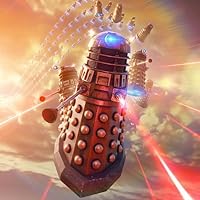
On the planet of Lobos, the Doctor halts a violent war between the native Loba and human colonists. Job done, the TARDIS crew departs – only for Ryan to discover he’s left his phone behind. Again.
Upon returning, the Doctor finds that the TARDIS has slipped hundreds of years into the future – and that something has gone badly wrong. The Loba are now slaves, serving human zealots who worship a godlike figure known as The Good Doctor.
It's time for the Doctor to face up to the consequences of her last visit. With Lobos on the brink of catastrophe, will she be able to make things right?
Featuring the Thirteenth Doctor, Yasmin, Ryan and Graham, as played by Jodie Whittaker, Mandip Gill, Tosin Cole and Bradley Walsh.
Here is the first novel featuring the 13th Doctor, as played by Jodie Whittaker in the BBC TV series. There are a huge amount of Doctor Who novels and audio adventures and I have been reading them since the old Target novels from the 1970s. The problem is finding the few good ones among the vast amount of badly written ones. Having loved the first four new TV episodes featuring Jodie Whittaker I thought I would take a risk on this book. Did it pay off ? Well, it certainly started off well, with decent characterisation of the Doctor and her new companions. This was no easy task when they have barely been established in the TV series yet. The plot is nicely handled, with the Doctor returning to a planet after a previous visit to find that her earlier interference has changed history -and not for the better! In some ways it is quite an old fashioned Who tale, with the Doctor and her companions being split up and facing difficulties separately. What I enjoyed most about the novel was the way Juno Dawson judged the humour perfectly and how it added to the story rather than retracted from it. This was her first Doctor Who novel-I hope it won't be her last.
I’ve always enjoyed stories that explores the impact that The Doctor has on other people’s lives, the series has touched on it a few times.
Returning to Lobos hundreds of years late, The Doctor soon realises just how much of an impact she has made from her previous visit.
This is the first novel to feature the Thirteenth Doctor, I was really impressed on how Juno Dawson really captured the mannerisms of this crew. It must be really difficult to write a tie in novel to be realised soon after the series aires. This really did feel like an extension to the TV series.
A really engaging story that tackles the impact of religion on a culture. It’s a highly impressive Who debut by Dawson. I hope she gets a chance to write more novels for this TARDIS team.
This the first outing in book form for The 13th because we have already had comments like the Tardis took us to other places before Rosa (a brilliant story ) this is easy to fit in. This is lot like Dodo in the William Hartnell's story The Ark in that Dodo sneezing changed history. In this we have Ryan leaving his phone behind on Lobas. Like Ark we have the Tardis moves in time yet plot comparison is very similar but Not lot people, except the hard core fans get it. Specially as the Ark was not a popular story. It was more two different stories in one. This old saying of how dangerous time traveling is, or as Doctor McCoy in Star Trek knows the Prime Directive this Ryan 's Dodo moment. I knew some body would have to do the chase joke but Didn't exception it in the first pages of the first book. You will laugh out loud with 'dog' jokes lot Stewi Griffin & Brian From Family Guy & lot of sexist jokes. But The biggest joke is who the Good Doctor is. It isn't who you think. This Pointless read it to score no points.
This is a book that is based on the television series. It has The Thirteenth Doctor along with Graham, Yaz, and Ryan. In this one The Doctor and her companions are on a planet that is at war. They help negotiate a peace treaty. They revisit this planet many years later and that treaty did not take and this planet has a totally different look than when they left it.
I did not enjoy this book like many other reviewers did and I believe that might be more on me. The run of The Thirteenth Doctor was not my favorite so it was going to be a difficult task for me to enjoy a book about her. The reason this book did not capture me though was the setup as it led me to believe we were doing something else. I really like the idea of our heroes revisiting a planet and seeing how they affected it beforehand. We came back to this planet because Ryan left his phone there. The problem was that these two plot points never came to fruition. Instead we arrive where things are different and we just have an adventure. Why introduce these ideas if we are never going to explore them and tease me with them? We could have had the same exact adventure without them. It is a shame too because there is a good story here. The idea of a religious order controlling a race of people is relevant. The characters from the show were fine also and the new characters added to the overall story.
This book was not for me but I believe other readers will enjoy it. There is a story here that deserves to be read. There were just other factors that led to me not enjoying it. This particular incarnation of The Doctor does not work for me. I also was led to believe we were going down a different path that I was excited to explore. When we did not I just could not get into it. A classic case of "it's not you. It is me".
This is perhaps the best story 13 has had so far, and that makes me sad. This shows the difficulties of being a female Doctor in ways that the show never has, and every companion has something to do that gives them a bit of character( another thing the show hasn’t done successfully). Apart from all that, it’s a great Who story, because it takes into account what the Doctor’s actions bring to a community after they’re gone. The Doctor’s speeches are fantastic and inspiring, too!
I like Juno Dawson's work and this was fun insofar that she got the characters exactly right.
But I also feel like that maybe a white British person wasn't the best choice to write an analogy based around slavery. I had some doubts about how well the novel engaged with this topic throughout, but the ending really made them coalesce. Not only is there a recurring argument of "the rebels are just as bad as the Temple" - i.e. the people fighting against slavery are just as bad as the people enforcibg slavery- there's also the solution at the end. Because it ends with the religious and secular authorities who had been responsible for enforcing slavery for 600 years promising to investigate themselves and do better. Not even a mention of strategies for the long-time work it would need to dismantle the systems and thought processes of slavery. Or reparations for the enslaved populations. Which......just didn't sit right with me as a positive solution. Also, a central point of the novel is that the Doctor et al just left after the first peace treats and then things went to shit. And then.....they do essentially the same thing in the end??? Except for the admonishment to "tell the story right this time?" I know that some of this is die to the format of the show, but that particular aspect is also an issue *in* the show and it would have been nice for the novel to subvert that.
So....yeah....I wish I could rate this higher because I have liked other works by the author. But this is basically a white fantasy of racial reconciliation that pretends that slavery, discrimination and prejudice will just vanish if someone smart enough explains to people that slavery is bad.
This entire review has been hidden because of spoilers.
The First Thirteenth Doctor Novel, and I enjoy very much. The Story is really well paced it didn't slow down nor sped up higher. The Doctor is such a cheerful Incarnation, She still has that Intimidating Nature. I would say this would be perfect for the Series 11 Episode.
Ugh, I wish the show was as good as this. The Doctor, her companions, the story, the ending, it was all good. We got so many Doctor moments, we got doctor speech and each on of the companions had something to do that was important to the story.
With every new season of Doctor Who comes a new set of tie-in novels featuring the current Doctor. As season 11, the first season to feature Jodie Whittaker as the Thirteenth Doctor, just recently premiered, it's time for the tie-in books to be released. The first of these, The Good Doctor, was released October 26 and was written by the New-to-Who author, Juno Dawson. It's a novel that explores the impact the Doctor's visits can have on a world and how religions might spring forth from them. It's a pretty darn good book.
I love the idea of the Doctor inadvertently being the central figure of a religion. It only makes sense that someone who gets involved in the affairs of so many different civilizations would end up being a part of a religion or two. Former showrunner, Steven Moffat, briefly flirted with this idea during the Matt Smith Era (as it's hinted that the Doctor has become a legendary, mythological figure in lots of cultures and also basically ended up being a central figure in the creation of the Church of the Silence - a church literally created to make sure he never says his name to the Time Lords on Trenzalore), but there's never really been any meaningful exploration of the idea - in New-Who, at least - until now. Juno Dawson's novel is a remarkable exploration of how the Doctor's actions could influence a society to create a religion based around her, and then for that religion to get several facets of the Doctor completely wrong. I don't want to go into any real detail as to just how this religion gets these facets of the Doctor wrong, but let's just say that they get a lot of it pretty majorly wrong and that ends up fueling much of the conflict of the book.
The other major part of the book is a pretty typical Doctor Who plotline where there are two groups of people with differing ideologies for how their society should be run fighting against each other and the Doctor has to step in and sort it all out. The Temple, the main religious rulers who were inspired by the Doctor's acts on the planet six hundred years earlier, is in charge and rule with a pretty big authoritarian fist while an underground group of rebels, made up of Lobos (anthropomorphic dog-like beings) and humans who don't agree with the Temple's rules, are plotting ways to take down the Temple and give equality to all beings of the planet. Naturally, the Doctor, Ryan, and Graham end up getting captured by the Temple while Yaz is captured by the rebels and this separation of our core group is what ultimately brings these two warring sides together in a climactic clash.
Juno Dawson does a remarkable job at capturing the feel of Jodie Whittaker's Doctor and this new era of Doctor Who. This whole story feels like an episode we could see in this season and the Doctor and the companions all sound and feel exactly like they do in the series. Dawson perfectly captures and replicates the voices of the characters while also exploring and developing them some. We get a glimpse in this novel at how much Graham does care about Yaz, something we haven't really seen in the show as of yet. We get a sense that the four of them have been traveling for a while, so it's likely set some time after Arachnids in the UK. The novel trods along at a nice pace, never dawdling too much but also spending a good amount of time on each scene and allowing the story the room to breathe sometimes.
I love the idea of the Doctor influencing a planet so much that they develop a religion around her. I love the idea of that planet's religion getting much of the Doctor fundamentally wrong. I love how Dawson explores this idea. I love how this horrible religion based around the Doctor has ended up being a terrible thing for many of the inhabitants of the planet. I love how the Doctor reacts to this religion and how it propels her through the novel to set things right. So much of this book was definitely great. My one complaint would be its length. I wish it was longer and had a bit more time to explore the Doctor's relationship to religion and show us more of how the idea of her being the central figure of a religion actually impacts her on an emotional level. That's a very small complaint, though, as these novels aren't designed to be all that long and the authors who write them just don't have the room in the novels to explore themes like this as much as I'd like. For what it's meant to be, this novel is great. It explores this central idea in a really interesting and impactful way. It captures the spirit of this new Doctor and her companions perfectly and it gives the audience a new, interesting story that feels right at home with what they're watching on TV. It's great reading for anyone who loves this new Doctor!
I just loved it. Juno Dawson captures 13 really well, and explores so pretty heated issues in this one. It lost a star for the portions of narrative that were unevenly paced.
Still this is definitely one of my favorite Doctor Who novels.
The story itself did not seem very original, or surprising, however the character's essence can be felt and appreciated much more in the book, and it is as if you were watching a chapter of the series.
Some Doctor Who stories really try to reach a message to people that is important. I'd say this is one of them. Now, some issues with the plot stem from the fact that the story ends in an "age of harmony" as if the oppressed Loba people immediately forgave, personally, this is where fiction shows itself, the Loba ought to have demanded more obvious reconciliation than simply investigations on the promise of the church for their oppression from the humans before an age of harmony could begin. I also didn't love that the Doctor appointed unilaterally unelected officials but then again I can only hope that this fictional planet held elections sometime later (though the epilogue suggests monarchy )
Aside from those gripes though this is a solid story about combating hate, disinformation and racism. Themes which are always necessary in popular media. Most would agree enslaving aliens is objectively bad and that the fight of the Loba against their oppressors is right and just yet today we question constantly the actions of the oppressed against their oppressor. If it's acceptable in fiction, the same it is in real life.
I have more thoughts but I'll leave it there, I'm sure you get the gist of what I'm getting at. But by now if you read my reviews you know where I stand.
Dopo aver concluso un ennesima guerra sul lontano pianeta Lobos, il Nostro Dottore, la sua Tredicesima incarnazione che lo ha portato per la prima volta ad essere donna, va via assieme alla sua nuova gang ma uno di loro ha dimenticato il proprio telefono e dunque, ritornando sul pianeta, scoprono che sono passati un po' di anni e si è creata una religione sul Dottore, ma non su di lei bensì su uno dei suoi compagni, Graham che, non appena rimette piede sul pianeta, viene adorato come un dio.
Nella serie tv il primo Dottore donna viene interpretato da Jodie Whittaker.
Un romanzo che ci fa riflettere sui paradossi temporali e sull'impatto che possono avere le religioni sui popoli se interpretate male. Vi è pure una riflessione sulla schiavitù, sul vizio che ha l'uomo di schiavizzare altri esseri viventi. E poi la storia è avventurosa, piena di peripezie fino ad arrivare addirittura a uno scontro del Dottore in un'arena come nell'antica Roma.
In the world of writing TV adaptations, the hardest books to write are the ones with brand new characters because the author has little more to work with than a description of what the character should be about. The essential spark - what the actor makes of the bare bones of their written character - is missing at this early point.
It is therefore to the authors credit that this book turns out so well, all the characters in the book feel like the ones we have watched over the latest series of Doctor Who where we get to meet not only a new Doctor but three new companions as well.
The story is a pretty basic one, where The Doctor visits a place once then returns centuries later to find himself being worshipped as a god. This theme has been explored by Doctor Who in the past, most notably by the 4th Doctor in the classic story The Face of Evil (though in that case The Doctor is reviled as an evil god rather than a good one).
I deliberately used the word "he" in the previous paragraph because gender politics plays a major part on this story. In this case our new female Doctor is superseded as god by companion Graham, and women are distinctly second class (which is still above the third class status of the original natives of the planet, later colonised by humans). This idea of people deferring to the older male companion while ignoring the female Doctor is explored in the series, where for the most part The Doctor is shown to be clearly in charge and Graham is in a secondary role. The most notable exception is in the episode The Witchfinders where The Doctor expresses frustration with not being in charge. It was something of a concern for me when I first read about the cast list for the 13th Doctor, as seemed that the BBC was putting in extra companions to shore up a Doctor that they didn't have total faith in (they did the same with the 5th Doctor, who at the time was the youngest Doctor and possibly didn't have the same authority in the minds of the public as the previous older incarnations). Of course Jodie Whittaker is clearly in charge in the series, but this doesn't come across as strongly in the book.
It helps that the author has a unique perspective on how such a story might play out, given that she has previously written other books before she transitioned. I was intrigued enough by her own story to borrow a copy of her autobiography from the library.
So this is my long-winded way of saying I really enjoyed the book and I am looking forward to more stories as strong as this one.
Juno Dawson does something that hasn't been done since the 1966 story "The Ark": set a story in the same place, but suddenly jump forward several centuries to deal with unexpected complications. In this case, it's even better than that first attempt; it manages to consider the consequences of history far more than the second half of "The Ark", and it also includes some melancholy reminiscences about the legacy & responsibilities of the Time Lords. My only real issue is that the current line of books doesn't continue the complexity of the Virgin or BBC "Doctor Who" books , resulting in the original story forming only a prologue, when it would have been half of the entire novel in the good old days. Luckily, Juno Dawson moves mountains with the material she has, and even manages to throw in the most obscure "Four to Doomsday" reference as an Easter egg for the most hardcore fans. Very satisfying.
This novel continues the current season of Doctor Who's examination of the "human factor" in the Doctor's travels, though while the television show seems to look largely at how the Doctor impacts her companions, this one is about literal god-building. There have been a few stories in the past that have dealt with the Doctor's mythologizing factor - The Face of Evil being perhaps the first, though it was a fairly common theme in the Eleventh Doctor years - but not many, if any, have focused on it quite so directly as here. The Doctor and her companions - Graham, Ryan, and Yaz - broker a peace treaty between human settlers and a canine-like species (the Loba) on a distant planet. When they return to that planet 600-years-later (a TARDIS-whoopsy just trying to get Ryan back his dropped cell-phone), they find the TARDIS (now known as the Tordis) and the "Good Doctor" have become central figures in a religion that is gripping the planet and driving the enslavement of the Loba and the punishment of heretics. Graham, a retired bus driver, is the one proclaimed to be the "Good Doctor" and a throwaway line about dogs being a man's best friend are cited as proof that Loba are meant to be human servants.
From this point, the story progresses in much the way any Doctor Who story will: there are capturings and misunderstandings and bad people and good people and allies and enemies and scrambles through tunnels/sewers/hallways and chase scenes and cliffhangers. There is virtually nothing new from the action of the plot and either you like the handful of shapes that Who story takes or you don't, and if you don't, then you probably won't be picking this book up.
However, the book's primary injection into the Whoniverse is a detailed focus on the question of, "What comes after?" How many times has the Doctor saved the day and left without a word? And how many times does that victory hold? Does that no-longer-doomed colony keep up the good work, that no-longer-doomed wo/man stay on the path of righteousness? The greatest fantasy of Who is that, more often than not, a single visit from the Doctor is enough to alter the course of history to the positive, but considering that the bulk of the Doctor's adventures have been on Earth (and the Terrestrial Disasopora), and that s/he has to keep coming back to save the day and right wrongs, clearly that is not the case. A colony barely surviving an invasion/plague/dictator is still going to have to hard-scrabble for maybe generations (and at least years) to fix all the damage done. Times of empty are a hard thing to overcome, even for the hopeful. Surely, some of those colonies turned to strong-but-amoral leaders or to barbarianism or to treaties with other potential invaders just to survive.
This is general an important slice of Whovian philosophy. Juno Dawson is doing good work getting there.
The flaw of her storytelling, perhaps, is two-fold. First, the religion of the "Good Doctor" tries not at all to be any different than Catholicism (blended with a few bits of other religions, but not too cleverly), especially the flavor Catholicism took a few centuries ago. This means, the main critique isn't necessarily on the Doctor and her general hubris and never-look-back attitude, her responsibility for violating the first rule of the Time Lords, but on a religious extremism: belief in a second coming and in Heaven and the religious justification of slavery and violence. These are things worth a poke and a prod and even an angry retort, sure, but it bruises the thoughtfulness of the tale by diluting it. By the time the Doctor faces her ghosts, the book only has a couple of pages to deal with the Doctor's feelings about this. It gets some points back by also critiquing the violence of the rebellion against the church, but the "easy" set-up of having virtually everyone be in the wrong and unable to help themselves without the Doctor's second intervention feels a bit of a cop-out.
The second flaw is more minor, and that's the fact that very little of the religion is actually based on the Doctor and his/her mythos. Sure, there is the Tordis and the concept of flying through time and space, but outside of Graham's immensely misrepresented line, it is just old-school Catholicism created whole cloth and stapled around a couple of trappings. It would definitely been more "fun" had the religion been more a direct perversion of the Doctor's actions and words.
Still, a good book and nice kick off of the new series of books. And it fits perfectly into the Chibnall era by hinting at other adventures unnamed (Moffat and Chibnall have both done a good job of seeding gaps in the storyline, of making us feel like we are only touching random bits of a much more epic story...and perhaps opening the door for Big Finish to come in). The companions are a little underdeveloped (as happens with novels written before the show even hits the screens) but that sometimes leads to us getting a slightly different take on them. Graham is a bit more...forceful, maybe...and the Doctor and Yazmin seem a bit more close.
And to end this review on one of the highlights, let us take a look at the obvious element in the room. The religion of the Good Doctor is predicated on the Doctor being male, and holds that females are a weaker sex (and note, when the religion latches on to one of them being the Good Doctor, it is the older, white male and not the younger black man). While clearly this is a bit of irony and a shout out to Christianity's downplay of important females (in the Bible and beyond), it also makes a nice jab towards a lot of the pre-critique of Whitaker...that she is a pretender to the throne. Dawson directly attacks these claims with a very-nearly-fourth-wall-breaking section:
"A woman?"
"Indeed."
"And how do you know she's lying? You said yourself the Good Doctor's return was foretold. Maybe the outward appearance -"
its so funny in doctor who when the doctor says 'the first law of the timelords is don't interfere! :D' and then they go and fundamentally changes a society like. yup. uh huh. and this does a really good job of showing how Actually That Might Not Always Be A Good Thing. the little cult that shows up I think was pretty interesting the way they got Everything so warped like. yup that's messed up. also the colonialism really sucked but like hey colonialism Does Suck. good characters in this one. also yaz I love yaz
This was for some reason surprisingly even more enjoyable than I had expected. It felt like a true epsidoe of Doctor Who as everything was done really well. I could just imagine the characters saying all of this!
It was really humorous as well; at one point they mentioned eating and it made me chuckle cause I always wonder, during their adventures on the show, aren't they hungry?! Especially with all that back and fo-ing in time... I'd be super hungry! It was even funnier still when they actually made a passing comment about Bradley Walsh (who plays Graham) on his game show, The Chase! Does that count as a paradox?! XD Once I realised the Loba were some sort of dog like creature all I could think of was very strong furries... I mean, it certainly made it easier to visualise, that's for sure.
Unfortunately there were a lot of typos that I couldn't ignore and that sort of thing irritates me when I'm reading, even as small an issue as it is. I also wasn't keen on the fact that when a character that was a Loba was talking they were often referred to just as their species... That wasn't done with the human characters so why was it written that way for them? Couldn't help but pick up on it as the fact of specism/rascism was one of the main themes and that felt a little hypocritical to the whole point.
Despite this... hiccup? I've just got to say how much I love this series of Doctor Who, and in extension this book, because they often bring up topics to do with inequality and having a diverse main cast allows us further exploration of these issues, which is even more interesting when it's translated to the struggles of alien species. I love that this book also questions religion, not rudely, but in a respectfully curious way.
This was very entertaining, a quick read, but certainly packed a punch!
During this year's unfathomable absence of Doctor Who, I have been drawn to the BBC-commissioned book series. While a couple of titles in the past have drawn my interest, I must admit to preferring the TV show episodes or indeed Big Finish Audio. This is meant as no dismissal of the talents of the writers, just a personal love of live action adventures in space and time.
That being said I did enjoy The Good Doctor, especially as it is the first official book featuring the controversial Thirteenth Doctor. It confirmed to me that Whittaker's performance is not only strong but very much 'Doctor-ish'. Also I could picture Bradley Walsh expressing Graham's often befuddled observations here, as well as Mandip Gill and Tosin Cole speaking Yaz and Ryan's lines respectively. It also intrigued me to notice very light subtext to a flirtatious intimacy between the Doctor and Yaz, whom some in the fan base seem so very keen to 'ship'.
However, while the characters are well-realised, I'm afraid the plot isn't so much. While I appreciate how it holds up a mirror to the 'old guard' fans of the show who still mumble and grumble about a woman Doctor, the landscape of Lobos is not described as being very alien nor are the background characters fleshed out beyond their key affiliations and plot functions. Also the idea of just how a throwaway comment significantly alters an entire culture isn't sufficiently explored. It merely sets off the plot and is then all but forgotten.
Nevertheless I am aware that such a book is primarily targeted at a much younger audience than I am. I have also certainly been spoiled by Big Finish's complex storytelling and the visual thrills of the main series. In that case, The Good Doctor is as good as most in the BBC book series. It is a fun and very serviceable space filler between TV episodes.
I recommend this to Doctor Who fans, especially those who are craving more adventures with the Thirteenth Doctor.
After the Doctor brokers a peace on the planet Lobos between the dog-like Lobans and human colonists, Team TARDS sets course for Earth . . . only to have to return when Ryan realizes that he has left his phone behind accidentally. When the TARDIS materializes, however, they find that they are off by six centuries — and that, in their absence, a religion has emerged that is centered around "the Good Doctor" and is used to justify misogyny and the enslavement of the Lobans. With Yaz arrested and Graham mistaken for the returned Doctor, the real one must get to the bottom of this before a new war breaks out that would lead to the deaths of thousands.
While I have read quite a few Doctor Who franchise novels over the past several months, this is the first one that I have read that is centered around one of the post-revival regenerations. Not only that, but it is one that involves the newest Doctor and her companions, a quartet that I have enjoyed but which I haven't formed a definite impression of in my mind. This may have helped me to enjoy the book more, as I was gauging the characters less by their on-screen portrayal and more by what the author provided. And Dawson's plot and characters combine to make for an entertaining novel with some interesting things to say about religion and gender politics. It's definitely a lot more fast-paced than the other Doctor Who novels that I've read, perhaps reflecting to a degree the more frenetic pacing of the post-revival show. This had both its strengths and weaknesses, but it never detracted from my ability to enjoy Dawson's rollicking adventure.
¿Sueles leer novelas ambientadas en universos que aparecieron por primera vez en el cine o la televisión?
Reconozco que esta ha sido mi primera incursión en las novelas tie-in, pero ha valido muchísimo la pena. Ya conocía a su autora, Juno Dawson, por su novela «Las brujas de su majestad», que me encantó. Y como también soy muy fan de la Doctora, pues supe que debía leerlo sí o sí.
El resultado fue una aventura muy bien hecha, tanto que casi parecía un capítulo más de la temporada. Oía a la perfección las voces de los actores en los diálogos y el nivel de acción encajaba muy bien con Doctor Who.
Y, además, la crítica. En «The Good Doctor», la Doctora y sus acompañantes vuelven a un planeta que ya habían visitado y descubren que su anterior visita ha cambiado drásticamente el curso de la historia. ¡Hasta ha aparecido una religión basada en ellos! Pero descubren que la historia se ha tergiversado y en vez de propagar un mensaje de amor y unión, esa religión se basa en la misoginia y la esclavitud.
Al final, es una aventura rápida pero profunda que se puede devorar en una tarde. Gana puntos si has visto las últimas temporadas de Doctor Who, claro. Yo la he disfrutado mucho y me ha sacado de un pequeño bloqueo lector.
Esta fue una lectura para el #TransRightsReadathon.
A Doctor Who story that has better characters and plot than the last series. (Sorry) A tale of how religion is used for all the wrong reasons, and prejudice is just nasty. It's nothing we haven't read/seen before in Doctor Who, and while this means the themes of common sense, being nice to each other and don't follow blindly are as subtle as a brick over the head, it gives our new Tardis team a good opportunity to show what they are all about. Yay gets some quality character moments, and yes the writer has remembered she is a trainee police officer and uses her skills! Finally. Graham gets his deadpan moments and what I think of Bradley moments; the really mate you're not really going to do that completely stupid thing are you? Ryan even gets time to shine. Apparently he gets travel sick. The author has captured the Doctor far better than most of the television episodes, but then you just write for the Doctor. There are a couple of moments about her being a woman now, and there's a big plot thing around her being a woman, but of course that was going to appear because how can people not just get over that fact? An enjoyable romp that I have read before, and probably more weighted, but for the first of the run of the 13th Doctor team (and let's face it, they are a team, not Doctor and companions) not a bad effort.
A lot of this feels like a run of the mill adventure, but it does come with some good commentary and excellent utilisation of the 13th Doctors fam. The way that the the story presents a truth that is layered with lie after lie and exploited to justify hierachy and oppression under the guise of religion is very relevant and the doctor now being a woman adds a layer of struggle for her to fight through. Graham, Ryan and Yaz are more distinct in their personalities and have more to do than they ever did in the show, and each has depth to them that shows in how they react to their scenario: Graham is pushed into a somewhat comedic scenario where he is clearly out of his depth and the story acknowledges this well. Ryan and Yaz understand the oppression that is being faced more readily due to their own experiences. There's nothing too outstanding here to push it above a 7/10, I feel that the writing could have conveyed more tension and drama, but it's a fun outing.
This is the first Doctor Who novel I’ve seen with the Thirteenth Doctor and it is a story that could really only be told by her and her companions. They go to a planet and broker a peace between warring factions, only to go back a moment later, in their time, 600 years on the planet, to see that women and half the population are subjugated. This is funny and fun, but it’s also more thoughtful than most Doctor Who novels I've read. “She strolled around the library, pausing at a tall, thin teak cabinet, padlocked shut…. ‘Hmm. Wonder what they keep in here? The really potent misogyny and racism maybe?’ ‘This ain’t your fault.’ The Doctor, usually so daft, was suddenly very serious. She let the padlock clang against the cupboard. ‘Isn’t it?’” (92) I bought this at Barnes & Noble on 12/26/18 for $9.89.
As the first Doctor Who book I've ever read, I loved it! Juno Dawson has written a brilliant story that perfectly depicts the Doctor we all know and love. The humour was perfect, Graham desperate to be back in time for Pointless! I'm definitely hoping to read more books in this series now.
I liked this a lot more than I expected to. Tie-in novels tend to be weakly written and occasionally cringe. This one was soft in places but generally strong: good story, excellent use of characters, hard to put down, & ultimately satisfying. Much appreciated.
An insipid, paint-by-numbers novel. Dawson offers nothing original in terms of content and almost less than that in delivery, as if the BBC range editors were fixedly determined to scrub the word ‘new’ from ‘New Series Adventures’. Clare Corbett tries her best.