

What do you think?

The Heart of the Qur'an: An Introduction to Islamic Spirituality
"Neither as Christians or Jews, nor simply as intellectually responsible individuals," says Hixon, "have members of Western civilization been sensitively educated or even accurately informed about Islam." As tensions between America and the Middle East grow, we should promote cross-cultural understanding, not violence. This new edition, with a new foreword and commentary by Neil Douglas-Klotz, allows the reader to drink from the illuminating fountain of the Holy Qur'an--the foundation of Islamic culture. First published in 1988, Hixon's poetic meditations on over nine-hundred passages from the Qur'an show that they are not relics from the past but exist in a timeless present, communicating as vividly as when they were first uttered. Through clear and accessible language, Hixon illustrates how the teachings of Islam can be applied to contemporary everyday life issues such as love, relationships, justice, work, and self-knowledge. In addition to the selections themselves, the book contains readable, lively introductions to the tradition of Islam, its basic precepts, and what it says about other religions. As the first such work in English to be written by a Muslim, The Heart of the Qur'an continues to show that Islam is among the great wisdom traditions of humanity.
270 pages, Paperback
First published January 1, 1988
Ratings & Reviews
Friends & Following
Create a free account to discover what your friends think of this book!
Community Reviews
Displaying 1 - 8 of 8 reviews

Read
June 16, 2015Bismilah,
Published in 1988, The Heart of the Quran: An Introduction to Islamic Spirituality, by Lex Hixon is not a new book on the market but it has been republished with an additional introductory commentary by Neil Douglas-Klutz in 2003. This second edition’s content remains the same and is divided into two main parts: an introduction entitled “Islam and Its Spirituality” making up about 16% of the book’s content and the second part “Meditations on the Holy Qur’an” (84%). It’s crucial you read the introduction first. Don’t skip it. The Verse interpretations or “meditations” are dependent on it. It explains the author’s approach and his understanding of the Qur’an.
Approach the text with an open heart. Open mindedness means letting go of what you know, even if only for the time being. It means humility: admitting your understanding could be flawed, admiring the text at hand and respecting the author. Leave all your predetermined notions and labels at the door. You will see the word “Sufi.” Don't let that turn you away. You nafs is gonna bring up all the negative images, feelings, associations you might have with the word, and then the whole book is going to be one big bid’ah. Don’t block the book from giving you. If you have trouble with the word, its best to address that first before reading. Remember, when learning about something new, for example, carpenting, it's best to go and learn from the source: a wood shop, not from what the blacksmith heard.
I should also bring to your attention that this book is closer to an interpretation than a translation. Lex Hixon attempts to “stay close to he basic meaning of the text while further unfolding some of the beauty and profundity of the original” (Hixon 26). This book isn't suggesting that the literal meaning has less value than the ‘metaphorical’ meaning - but the whole purpose of this book is to capture the *feeling* the emotional connotations that classical Arabic words carry, even if this means adding some words. “HOTQ attempts to suggest the spiritual richness of the original text in a dignified contemporary English” (Hixon 25).
An example of how shaykh* Lex Hixon is trying to imagine the tone of the Quran can be found in the following verse on page 75:
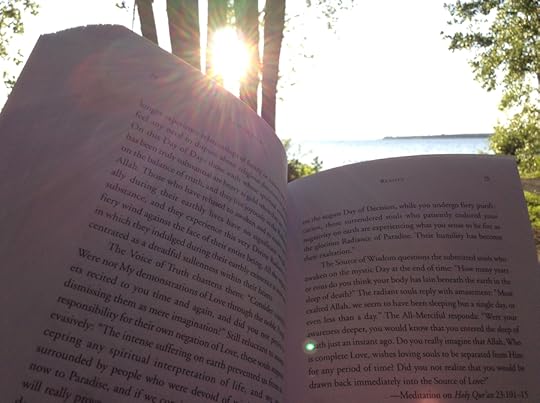
Here the tone or the voice of Allah can be felt: it is soft, merciful, loving, protectively jealous over His servants. Unfortunately, I haven't felt this much softness in other English interpretations or translations. Even in Arabic, if one isn't deeply connected to Arabic root words and history (unlike me who only knows Arabic on a very shallow level), one might misinterpret the meaning or worse — not detect this love and concern in God’s words.
Another piece of advice I can give you when reading this book is have husn-than (a good opinion) of the author. Lex Hixon was a god-fearing man. If you are whispered to otherwise, read this book with a teacher. If the opportunity arises where you can study it with an elder, seize it. It’s the safest way to go.
I can’t tell if this is an “accurate” interpretation of the Quran. I don’t have the knowledge of the Arabic Quran to assess it. But Alhamdulilah I trust the teachers who recommended it. It’s really clear. Beautiful. I felt it. I felt Allah while reading it. I felt Him talking to me, in English. What more would a servant want other than hear His Lord address him?
Published in 1988, The Heart of the Quran: An Introduction to Islamic Spirituality, by Lex Hixon is not a new book on the market but it has been republished with an additional introductory commentary by Neil Douglas-Klutz in 2003. This second edition’s content remains the same and is divided into two main parts: an introduction entitled “Islam and Its Spirituality” making up about 16% of the book’s content and the second part “Meditations on the Holy Qur’an” (84%). It’s crucial you read the introduction first. Don’t skip it. The Verse interpretations or “meditations” are dependent on it. It explains the author’s approach and his understanding of the Qur’an.
Approach the text with an open heart. Open mindedness means letting go of what you know, even if only for the time being. It means humility: admitting your understanding could be flawed, admiring the text at hand and respecting the author. Leave all your predetermined notions and labels at the door. You will see the word “Sufi.” Don't let that turn you away. You nafs is gonna bring up all the negative images, feelings, associations you might have with the word, and then the whole book is going to be one big bid’ah. Don’t block the book from giving you. If you have trouble with the word, its best to address that first before reading. Remember, when learning about something new, for example, carpenting, it's best to go and learn from the source: a wood shop, not from what the blacksmith heard.
I should also bring to your attention that this book is closer to an interpretation than a translation. Lex Hixon attempts to “stay close to he basic meaning of the text while further unfolding some of the beauty and profundity of the original” (Hixon 26). This book isn't suggesting that the literal meaning has less value than the ‘metaphorical’ meaning - but the whole purpose of this book is to capture the *feeling* the emotional connotations that classical Arabic words carry, even if this means adding some words. “HOTQ attempts to suggest the spiritual richness of the original text in a dignified contemporary English” (Hixon 25).
An example of how shaykh* Lex Hixon is trying to imagine the tone of the Quran can be found in the following verse on page 75:
Here the tone or the voice of Allah can be felt: it is soft, merciful, loving, protectively jealous over His servants. Unfortunately, I haven't felt this much softness in other English interpretations or translations. Even in Arabic, if one isn't deeply connected to Arabic root words and history (unlike me who only knows Arabic on a very shallow level), one might misinterpret the meaning or worse — not detect this love and concern in God’s words.
Another piece of advice I can give you when reading this book is have husn-than (a good opinion) of the author. Lex Hixon was a god-fearing man. If you are whispered to otherwise, read this book with a teacher. If the opportunity arises where you can study it with an elder, seize it. It’s the safest way to go.
I can’t tell if this is an “accurate” interpretation of the Quran. I don’t have the knowledge of the Arabic Quran to assess it. But Alhamdulilah I trust the teachers who recommended it. It’s really clear. Beautiful. I felt it. I felt Allah while reading it. I felt Him talking to me, in English. What more would a servant want other than hear His Lord address him?
November 27, 2023
This is currently one of my favorite books. It's hard to judge books of this nature on a hierarchy because you might read something when you were ready for it, when you weren't ready for it, it might be new information, it might be better written old information, and etc. However, Lex Hixon has again exceeded my expectations on what a book can convey. I wish he had written far more because he might be one of my favorite authors.
As for the text itself. Lex Hixon was a practicioner who had a Sufi teacher and had spiritual experiences related to the topic which were confirmed by his teacher. This isn't to say that we should use this to put him on some pedestal or even to put value in it much at all, but to indicate that this isn't some dry theology. The point in which this text comes is from experienced and lived spirituality. Due to this the content is far more lively and open.
I have always had a problem with finding good modern material of Abrahamic religions. I've read the Quran (The Gracious Quran) and read a few authors in differing traditions. However, being from America, not speaking/reading Arabic, not being exposed to Islamic culture, and etc. has made the Quran a significant challenge. Many hurdles exist and so much understood that there's always arguments that the text can't be translated. I believe that this hurdle of "initiation" is met with and accomplished with this work. There were passages that moved me to tears, passages which resonated with me so much that I wanted to read the section over and over, and filled with inclusiveness. To say that it changed some of my spiritual practices is an understatement and it is the result of this very book that I have adopted a new daily living practice.
I can not express my gratitude enough to Lex Hixon and can't recommend this book enough to anyone who is interested in the subject and found the material a challenge. While I believe Rumi and/or Ibn Arabi are also incredible authors I would submit that "The Heart of the Qur'an" is the door that is easy to open for many.
As for the text itself. Lex Hixon was a practicioner who had a Sufi teacher and had spiritual experiences related to the topic which were confirmed by his teacher. This isn't to say that we should use this to put him on some pedestal or even to put value in it much at all, but to indicate that this isn't some dry theology. The point in which this text comes is from experienced and lived spirituality. Due to this the content is far more lively and open.
I have always had a problem with finding good modern material of Abrahamic religions. I've read the Quran (The Gracious Quran) and read a few authors in differing traditions. However, being from America, not speaking/reading Arabic, not being exposed to Islamic culture, and etc. has made the Quran a significant challenge. Many hurdles exist and so much understood that there's always arguments that the text can't be translated. I believe that this hurdle of "initiation" is met with and accomplished with this work. There were passages that moved me to tears, passages which resonated with me so much that I wanted to read the section over and over, and filled with inclusiveness. To say that it changed some of my spiritual practices is an understatement and it is the result of this very book that I have adopted a new daily living practice.
I can not express my gratitude enough to Lex Hixon and can't recommend this book enough to anyone who is interested in the subject and found the material a challenge. While I believe Rumi and/or Ibn Arabi are also incredible authors I would submit that "The Heart of the Qur'an" is the door that is easy to open for many.

May 6, 2017
I would recommend this book only to those with an interest in the history of Islam and/or spiritual exploration in America. As the author points out this book is not in any sense a translation, but rather his meditations gleaned from various translations published up to the early 80's ( The book took something like eight years to publish.) Hixon's introduction is quite good in discussing his own pull towards the Sufi path and relationship with his spiritual guide. His meditation is at its best, in the final juz (section) of the Qur'an where he really brings out the poetic essence of the text. Aside on that, it feels like one of those "selections from [insert religious holy book here]" where the author picks a particular theme; copies passages about the theme, and ignores the rest of the text and context. If you want to learn about Islam read Omid Safi's "Memories of Muhammad" if you want to learn about the thoughts of a (rather extraordinary) spiritual seeker of the late 20th century, read this book.

Read
October 18, 2021I’m leaving off a rating of this book, as I am not Muslim so I’m not well equipped to rate it. It really is not meant as an introduction for those with no understanding of Islam. Though I read it with a Muslim, it is so very ethereal at times that it was difficult to follow. Regardless, it opened my eyes to how Islam discusses Jesus, views heaven and how you get there, and their take on religious ecumenism, at least from the POV of a Sufi. I would recommend starting with some other book if you’re looking for an introduction to Islam as an outsider!

December 26, 2015
This is a deeply inspiring book, serving as a very helpful introduction for anyone who wants to begin to understand the meaning of The Qur'an. Beautiful transliterations of a large number of original Arab texts help illuminate the likely intention of verses, which might otherwise not be appreciated unless guided by a suitable teacher. Hixon's prose is beautiful and easy to read. Highly recommended.
September 20, 2007
Mystical interpretation/rendering of selected Surahs from the Quran. Very interesting to read along with one or more different translations or other commentaries.
September 23, 2015
excellent book... amazing
January 17, 2019
The title describes the book. It provides a more mystical, spiritual interpretation on the Qur'an. La creme de la creme.
Displaying 1 - 8 of 8 reviews