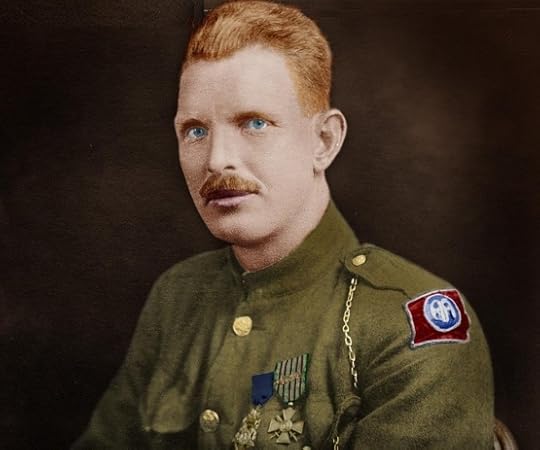
October 8th, 1918—amid the last of the Allies attempts to the Germans, Sergeant Alvin York of Tennessee, found himself and his platoon of only seventeen men trapped in the thick of heavy machine gun fire. Rather than retreating or calling upon the artillery to take out the nest, York single-handedly took out twenty-five Germans, dropping them one-by-one, and captured many more.
This is only one of the many tales of York’s famed heroism, which were heralded as some of the most impressive battle stories in history of modern warfare. Sergeant York contains the legendary soldier’s war diaries, which offer up-close snapshots of his fabled military career.
Included in this new edition of a classic work are new forewords written by York’s son and grandson, which provide both personal and historical recollections of their predecessor. In Sergeant York, experience the fascinating life of an American hero.
Famed American hero Alvin Cullum York. known as "sergeant York," in World War I single-handedly attacked a German post.
The Army drafted him, and he, swiftly of the most decorated and accomplished soldiers, received the congressional Medal of Honor for his heroic action in the Meuse-Argonne offensive among other notable accolades. An article in the Saturday Evening Post circulated and detailed actions publicly to a large readership. When he returned, largely due public outpouring and celebration greeted him.
SERGEANT YORK: HIS OWN LIFE STORY AND WAR DIARY Edited by Tom Skeyhill
Gary Cooper played Alvin C York in the 1941 movie Sergeant York. Having watched that movie on television years ago, I was always fascinated with York’s story. I recently came across the ebook of his story edited by Tom Skeyhill and published by Racehorse Publishing and decided to give it a read. I’m so glad I did. I found it helpful for me to have heard Cooper speak in the mountain “dialect” in which York’s diary is written—and it made me smile in awe.
The main purpose for publishing York’s story, after turning down many profitable offers to do so, was so that York could fund his cherished educational programs for the people of his mountains in Tennessee.
York’s coveted story is the retelling of the actual events and miraculous victory that took place in France’s Argonne Forest on October 8, 1918 during World War I. When the day started, he was a Corporal in the United States Army, Company G, 328th Infantry, 82nd Division. York would be promoted to Sergeant as a result of his actions taken in the Argonne. Additional awards would come York’s way: The Congressional Medal of Honor, the Distinguished Service Cross, France’s Croix de guerre and Legion d’honneur, the Italian Croce di Guerra, and other service decorations.
The war story of Alvin C York is fascinating; but, to me, I was more impressed by the overall person that he was. He was one of eleven children born in a one room log cabin in the mountains of rural Fentress County, Tennessee. Everything the Yorks had was provided by the mountains. Alvin’s daddy taught him to hunt and to shoot and they could be found on Saturdays at the local shooting matches competing with their neighbors. But the solace and sustenance that the mountains provided also sheltered them from the educational opportunities that could be found “outside”.
Upon returning from Europe after the war, York reflected on his experiences in his travels and he knew that although he had received 3 weeks of schooling every year for 5 years and had read his first book at the age of 20, the children growing up in the mountains would be at a clear disadvantage to the opportunities available to others. York made it his mission to bring education to those children.
Included with the book were about 10-15 pictures taken of York and his surroundings. Also, at the end is included the website: www.sgtyork.org for The Sergeant York Center for Peace and Valor, “a nonprofit organization to ensure the legacy of Alvin C York is not lost or forgotten. Proceeds from this book go to support efforts to rebuild York Historic School."
The journals of Sergeant Alvin York were originally compiled and edited by Tom Skeyhill in 1930. This 1998 copy included some black & white photos and was edited by Richard Wheeler.
Most U.S. citizens have little knowledge of America’s involvement in World War I as it was not a part of their educational curriculum. What the public recalls is primarily York’s life and heroics through actor Gary Cooper’s Oscar winning portrayal in a Hollywood film. The impact of this black & white movie remains so strong that Cooper’s daughter, Maria Janis Cooper, was selected in 2011 to the Board of Trustees of the National World War I Museum.
This firsthand account offers additional insight into York’s mind. Growing up in the rural mountains of Tennessee I knew York bonded with his brothers. Getting drunk on moonshine and involved in fighting was a common part of his early manhood. It’s common to protect one’s turf, but I did not realize that many his brawls occurred along the Tennessee/Kentucky border.
Throughout life York’s knowledge, admiration and appreciation for nature remained as strong as his family roots. He was very proficient with a rifle as a necessity to provide food. Folks familiar with York know that exposure to religion turned his life around. How the conscious objector became a true national war hero is a great simple story told by the man who shunned fame.
The “Editor’s Note” on page 130 incorrectly stated of York’s division: “The 82nd Division was called the Rainbow Division, since it was made up of various nationalities.” The famous 42nd Division held that moniker.
Sergeant York and the Great War by Alvin C. York presents his Life Story and War Diary: The inspiring true story of "the reluctant World War I infantryman who became an American legend"-in his own words (The New York Times). On October 8, 1918: Amid the last of the Allies' attempts to defeat the Germans, Sgt. Alvin York of Tennessee, who had initially applied for conscientious objector status that was denied, found himself and his platoon of only seventeen men trapped in the thick of heavy machine gun fire. Rather than retreating or calling upon the artillery to take out the nest, York single-handedly took out twenty-five Germans, dropping them one by one, and captured 132 more. This is only one of the many tales of York's famed heroism, which were heralded as some of the most impressive battle stories in the history of modern warfare. Sergeant York contains the legendary soldier's war diaries, which offer up-close snapshots of his fabled military career. Included in this new edition of a classic work are new forewords written by York's son and grandson, which provide both personal and historical recollections of their predecessor. In Sergeant York, experience the fascinating life of an American hero from his humble upbringing in rural Tennessee and his conversion from a young hell-raiser to a very religious person who did not approve of war. Very inspirational true story that is also out as a film on DVD.
❝ The war had come and gone. Millions of boys had been killed and wounded. Millions of dollars had been poured out jes like water. Homes all over the world had been desolated. Some of the old countries had been all mussed up and the new ones had come up and sort of takened their places. The Whole outside world seemed to have changed. But not our valley. ❞
If you haven't once in your life heard of Sergeant Alvin York of Tennessee than you are missing out. I first came along his story because Adventures In Odyssey broadcasted his story (I recommend that if you prefer audio dramas). It was very powerful but a year or so went by and I didn't think too much more of it until a friend at church came to me with this book. He told me that I should read it as this is in Alvin's own words (it was so powerful this way). Anyway, I started it on Memorial Day as I saw fit and I slowly began to read it each night.
There's something powerful about seeing a life go from what we as humans call hopeless, and then see God's redemption completely restore them to a life they couldn't have dreamed of (even if hard times still do exist). I loved that Sergeant York was open about his faith and how he held to his faith strongly. He's such an amazing role model of how we can truly overcome anything. Overall, if you ever want to read an inspiring true story of a soldier for America and a soldier of Christ than this is my number 1 recommendation 😊
Content: Language: None written Violence: Fist fights are mentioned, obviously the war is described from Alvin's pov but nothing is gory or detailed, southern fashion there are hunting matches etc which are slightly detailed Sexual: Nothing detailed, Alvin does briefly mention how he doesn't partake in celebrating the end of the war with women as most of the soldiers do but nothing is implied or detailed Alcohol/drugs: Alvin does mention how he used to drink and get drunk but I felt it was valuable in his story and it's was inspiring to hear of how he overcame it TWs: War & losing fellow soldiers Age recommendation: 11/12+ (I would recommend younger readers to read along with their parents so they understand it better)
I found this book while visiting his homestead in Tennessee. I don't give 5 stars easily, but this book told the story of an amazing man ~ in his own words. There is much to be learned about strength of character from Sergeant York ~ maybe more-s0 today. What a great book to read in time for for Veterans' Day!
“I only did my duty to God and my country, and every man should do this.”
The true story of an extraordinary man of conscience who also happened to be an incredible shot with a rifle. York’s struggle with the conflicting dictates of his faith and his patriotism is perhaps a more compelling story that his battlefield exploits, and those—though documented—are so incredible as to seem like pulp fiction.
“Great care has been taken to preserve his mountain dialect.”
Writing this in York’s semi-literate dialect may have played well in the 1920s, but today’s reader will find it obscure and dishonest. This is obviously a “as told to” book with New Yorker Tom Skeyhill as the ghost writer.
“And that is the greatest victory I ever won. It’s much harder to whip yourself than to whip the other fellow, I’m a-telling you, and I ought to know because I done both. It was much harder for me to win the great victory over myself than to win it over those German machine guns in the Argonne Forest. And I was able to do it because my mother’s love led me to God, and He showed me the light, and I done followed it.”
York was older than most doughboys. More mature. He’d had his time of smokin’, cussin’, drinkin’, swearin’ and lawlessness after his father died. He’d come to the Lord. He tried to avoid serving because he felt killing—even in combat—against God’s dictates. Eventually he was persuaded otherwise.
“I had orders to report to Brigadier General Lindsay, our brigadier commander, and he said to me, ‘Well, York, I hear you have captured the whole damned German army.’ And I told him I only had 132.”
Then and now any account of that morning in the Argonne Woods must reflect on the improbability of one man overpowering and capturing most of a battalion of heavily armed veteran enemy. Yes, York was a crack shot and a cool head, but he himself credits divine intervention. York didn’t want to kill or be killed, and paradoxically may have saved lives on both sides by his quick action and leadership.
“I’m a-telling you the hand of God must have been in that fight. It surely must have been divine power that brought me out. No other power under heaven could save a man in a place like that. Men were killed on both sides of me and all around me and I was the biggest and the most exposed of all. Without the help of God I jes couldn’t have done it. There can be no arguments about that. I am not going to believe different as long as I live.”
Having watched the 1941 movie as a youth, this story made a lasting impression on me. I rewatched the movie recently so felt inspired to search for a book. I came across this one and was glad to have a mix of commentary and York's own words from his diary. I learned more about the man, his time as a youth, his passions, his perspective on history, his take on faith, and his endeavors that took place after the events of the movie. He was a simple man, a humble person, and a good model of what it means to be faithful.
A great read for anyone interested in history. Alvin C. York went from obscure Tennessee mountain man to the greatest American soldier of WWI. Written by York, with the help of a writer, you get the true measure of York, with all his flaws, strengths, and unflinching belief in his fellow man. The book tells his story growing up dirt poor and uneducated in the eastern mountains of Tennessee all the way through his heroic war accomplishments. Amazing story. Amazing man.
I enjoyed this a lot. One because I already knew a lot about Alvin York and two because his journal is just downright funny!
i.e. "I was the third in a family of eleven children, eight boys and three girls....there was a whole litter of us and we jes sort of growed up like a lot of pigs. I jes sorter mean that we were most always turned loose out-of-doors on the mountainside, kinder running wild, playing and haunting around."
Some of Alvin's favorite words are: Kinder, sorter, knowed, and growed. But despite his lack of education (which was only through 2nd grade) he was a man who knew what his duty was and did it, not asking anything in return.
So yeah, It was good. I enjoyed it and York is always pretty amusing.
This book was quite the enjoyable read! Written in the endearing, country hand of Alvin York himself but edited by amazing historians, and included pictures made this book well worth it! I would recommend this book to all ages! (The most comical aspect of this book? Alvin's continued allusions to laughing which he communicates to us by the rather frequent exclamations of "Ho, ho!" :D Made me chuckle with delight!)
This book is hard to read at first because the words (miss spelled or not) are taken straight from his diary; it's like he's talking right to you. After the first few chapters I couldn't put the book down. Sergeant York is an amazing man of God. It is so wonderful how God can change the wildest man into a gentle God fearing man. This story that York tells proves that God keeps His promises! I would definitely read this book again!
Thomas/Tom Skeyhill was a writer that became interested in the story of Alvin Collum York, WWI's most decorated soldier. Tom followed his curiosity to the hills of Tennessee, where he befriended the veteran and was the final in a string of persons and events that finally convinced York to publish his diary and follow through on his own earlier attempts at transcribing his memory of the events leading up to and including his taking 132 German prisoners almost single-handedly. York was famously introverted and refused numerous offers to publicize his story, himself insisting that "to take money like that would be commercializing my uniform and my soldiering." (300) Besides, his simple upbringing and lack of "larnin" belied a keen instinct, for his refusal rested upon his observation that "they jes wanted me to show how I done killed the Germans in the Argonne." (300) That Skeyhill was able to finally convince York to share his story in as near to his own words as possible reveals a bond of trust uncommon between popular culture and its combat veterans. Skeyhill seems well aware of this, and treats his subject matter with care and precision.
The first three chapters are in Skeyhhill's voice, giving the context to his visitation(s) with York before the biographer switches (with permission) to writing in York's own firsthand voice. Diffusing the otherwise questionable literary editorial choice of not-quite-ghostwriting is Skeyhill's careful use of "mountaineer" dialect; deferring to York's own linguistic nuance and at times confusing grammar unique to the frontier folk language of his time and place. In fact, Skeyhill's interest from the get-go is to give York voice its fullest possible expression, weaving in his transcription of York's personal war diary (which was against military regulation, given their proclivity for revealing operational intelligence were diarists to be captured). Several pages are dedicated to reproducing images of the text itself, as well as helpful pictures of York's home and situation in the rural mountains in the Cumberland Mountains.
I have become something of a connoisseur of veterans narratives lately, especially those that have coverage in film as well. The 1941 movie Sergeant York starred Gary Cooper in the title role, earned him his first Oscar for Best Actor. The popularity of the movie can be attributed to the timing of its release just two days before the July 4th holiday and just over five months prior to Pearl Harbor. However, the film (as opposed to the book) took many liberties and betrayed much of York initial convictions surrounding the use of his life story. Though the 1941 film probably has sept more into the minds of Americans, the book acts as a helpful antidote to the overt (inaccurate) nationalizing fervor of the Warner Brothers work (which was pulled from theaters within months for violating the Neutrality Acts of the 1930's, which forbade propaganda). Though the book predated the movie by over a decade, it is well served as a counter-narrative to that which was promoted by the cinematic embellishment that followed it.
Though York was known for his heroic acts in battle, they must not be separated from the pacifist convictions that initially formed his imagination about war. Indeed, "hit is a most awful thing when the wishes of your God and your country get sorter mixed up and go against each other." (154) When he received his draft notice at 29 years old, he had put the life of a fighter behind him. In response to the question whether he claimed exemption to military service based on religious scruples, he wrote to the draft board, which his own pastor served as director, "Yes, don't want to fight." (His draft card is viewable online via the National Archives, but also see p.157). His church and everyone in it was opposed to war based on the fifth commandment, "Thou shalt not kill." The regional board, despite his pastor's support and explicit claim that his entire local church was opposed to all war, refused to recognize his objection. So York appealed three times, and they stood firm the same number. If finally took 48 hours of prayer on a mountain near his home to convince him that God would protect York and that he could go to war even if it was against his and God's will. His peace to do what he was ordered came by way of his realization that "no matter what a man is forced to do, so long as he is right in his own soul he remains a righteous man." (176, emphasis added) So off he went to war, troubled and troubling all the way. Like Job before him, York's intense faith would inspire God to "believe in and watch over" him. (201)
The book spends a full half of its length before it finally gets to this point. In fact, York insisted that any depiction of his life not be overshadowed by the specter or war. When he signed the contract with Warner Brothers for the movie, he stipulated that no war scenes whatsoever be showed. He even required that he have final say over the leading lady, for he would not have his wife depicted by any of the infamous glamour girls of hollywood. Gary Cooper, who would play him on screen, was initially reluctant to portray the war hero because of the explicit pacifism inherent to York's story (as well as not being himself a veteran), for Cooper was among the minority in America in being in support of American intervention in Europe during WWII. In order to land the popular and talented actor, producers forged York's signature to a document insisting Cooper play the lead. Whereas the movie does cover some of York's life according to Skeyhill's account, slightly over half the movie is of Cooper in uniform, either in garrison in Camp Gordon, GA or on the battlefield in France. To be fair, the same proportion exists in the book, but no such agreement was made between York and Skeyhill, and York had much more control over the literary final product than he did the cinematic one.
The climactic scene of both the book and the movie is the one that takes place in the Argonne Forest in France, where York describes having been instructed to take out a machine gun nest to assist in his unit's advance toward Berlin in October, 1918. That the Armistice would occur just a month later did not deter intense fighting nohow, and York remembers the event vividly for Skeyhill. Having come across an enemy command post, his unit suffers a 50% attrition when the machine guns turn inward and take the lives of six of his men, including all the ranking noncommissioned officers. Taking command, he instructs the privates (the lowest in rank) to secure the few prisoners they had while he went off to silence the automatic weapons fire. His familiarity with rifles as a young man hunting for food in the mountains left him with a finely tuned marksmanship that enabled him to conserve ammunition and move between firearms rapidly, using a pistol when his carbine ran out of ammunition.
~ Random Ruminations; York refuses to lean on ideologies and streotype soldiers, even as a conscientious objector opposed to war. His experience in WWI left him with the impression that "war brings out the worst in you. It turns you into a mad, fightin' animal, but it also brings out something else, something I jes don't know how to describe, a sort of tenderness and love for the fellows fightin' with you." (212) Even of his enemies, he speaks so highly that he avoids the affects of dehumanization that can lead to post-traumatic stress or moral injury. About one German soldier who refuses to surrender and continues to fire at York and even the Germans under his care, York writes "I had to tech him off... he was probably a brave soldier boy. But I couldn't afford to take any chance." (234)
But he is also unwilling to call war good, for "God would never be so cruel as to create a cyclone as terrible as that Argonne battle. Only man could ever think of doing an awful thing like that." (215)
Whereas the movie depicts York rather derogatorily gobbling at the Germans like turkeys in order to get them to poke their heads out, the actual story is not nearly as dehumanizing. While York does indeed rely on strategy similar to that which he used hunting wild game, it is never to make animal noises at his targets - that surely would have given away his position and compromised his safety. Instead, it was the practice of firing on the trailing animal so that those ahead do not know they are being attrited. "That's the way we shoot wild turkeys at home." (228) He does the same to the German soldiers, though only to those who are so busy firing on him or his buddies that he cannot call out to them to surrender; the urgent need is to stop them firing, and their heads were the only parts of them he could see. He "done hollered to them to come down and give up. [He] didn't want to kill any more'n [he] had to." (228)
For the rest of his life he was left to think about what he done, both good and bad. He tried to forget it for awhile, never telling anyone, even his own mother. Lamentingly, he remarks "If they had done surrendered as I wanted them to when I hollered to them first, and kept on hollering to them, I would have given them the protection that I give them later when I tuk them back." (236) The words "surrender" or "give up" never leave the lips of Gary Cooper during the same scene in the movie.
Alvin York was born and raised in the backwoods mountains of Tennessee, which he loved and called home his entire life. He was born in a one room log cabin the third child of eleven kids. His parents were hardworking people who raised them with chickens and hogs and cows and lots of fresh air (their was more room outside then inside). Alvin describes his father as the best marksmen in the area and in the mountains, hunting and shooting a gun was not only natural but necessary and one of their favorite pastimes. Turkey shooting matches was a weekly affair and this sport became very valuable as Alvin became an excellent and very accurate marksman. Gaining this skill became an integral part of winning battles over German armies while Alvin York fought in World War 1.
This book is the story of Alvin York’s life and how he became famous with his sharpshooter skills and ability to lead when his commander dies in battle. His war story is quite extraordinary yet his humble upbringings kept him from ever becoming prideful about his accomplishments.
This book documents York’s life through his own personal diary. Because of his poor backwoods education, his grammar and spelling is poor but it was not changed or edited to keep it authentic. This book gives you a view of not only a war hero but of what life was like in the mountains of Tennessee where modern conveniences had not been known to these poor mountain people. After becoming famous, Alvin also worked hard to bring better roads and education to the people he loved in the mountains.
This is a wonderful story to read to your children! It also includes pictures and professional writing of more details of World War One. I skipped some of these details while reading to my 6th and 6th grade in order to keep their attention. Also their were some chapters such as chapter 5 titled, Turkeys Don’t Live Long, where I skipped most of it because it gets boring with all the details of their shooting contests.
Also I wanted to note that my children already knew who Alvin York was because Focus in the Family did a wonderful production of his story on Adventures in Odyssey that was very entertaining and educational! My kids have listened to it over and over again and it summarizes everything in this book beautifully! I would highly recommend! However I did read this book due to it being “required” reading by the curriculum we are using, My Fathers World.
I only knew a little about Sergeant York because I once saw the movie with Gary Cooper playing York. It was wonderful to read this overtly Christian testimony in York's own words. I didn't even mind his English errors, because he did such a good job at organizing and choosing the details of his life to talk about. His version of "haha" (Ho! Ho!) tickled me. I read it to decide whether to include it in our read-aloud list with the kids this year, but I have decided not to read it aloud. It is wonderful, especially as an example of moral character for my boys, so I definitely want them all to read it, but I will just have the older boys read it now in their literature assignments, and my younger kids will do the same when they get old enough. The accounts of all of the gore and death in the Argonne are too sad for the younger kids. I was also a little more able to understand why the Americans joined the war, though I admit that I still feel a fog over my understanding about WW1, especially what the US was doing there.
Considering the competition faced by Sergeant York in 1942, it is quite an achievement for Gary Cooper to have won the Academy Award for Best Actor in a Leading role, especially ahead of Orson Welles
This was the year of Citizen Kane, which is for many scholars the best motion picture ever, How Green Was My Valley, which has won Best Picture in 1942, Suspicion and The Maltese Falcon, two of the best movies ever made. As the magnificent William Goldman, winner of two Academy Awards for Butch Cassidy and Sundance Kid and All The President’s Men, author of the quintessential Adventures in the Screen Trade writes, these were years when outstanding, memorable, archetypal features did not even make it to the short list of the Oscars, given that so creative, brilliant, and masterful those filmmakers were.
Having said that, it must be said that there could be some aspects of the hero that one could reject, from his hillbilly manner of speaking to aspects of his early behavior and the rather unintelligent style he has at times. However, Alvin C. York aka Gary Cooper is the ultimate role model, Ubermensch at the end of the film, who demonstrates that ha has almost all the Character Strengths in the book, with Wisdom, after the initial foolishness, Courage, Humanity, Transcendence and Temperance in full display with their elements:
Bravery, Integrity, Vitality, Persistence, Love, Kindness, Social Intelligence, Appreciation of Beauty and Excellence, Hope, Gratitude, Humor, Spirituality, Pity and Forgiveness, Prudence, Humility and modesty, Self- regulation, Creativity, Love of learning, Curiosity, Open- mindedness and Perspective. Alvin York has not started with such a rainbow of qualities, some of which need development anyway, considering that the protagonist is far from being an erudite, well read, educated man and as a young man he used to drink a lot, shoot trees and write his initials with bullet holes, causing the religious service to stop with his uproar.
He wakes up from what seems a continuous hangover, has a revelation when he runs after a fox and sees his now grown up neighbor, Gracie Williams and falls in love with the girl and beats an opponent to eliminate competition. Alvin plans to marry, but he wants to buy more land, to be able to provide for a family, enters an arrangement with a man who takes an advance for the plot, establishes a deadline, then agrees to move it to allow the hard working hero to get all the debt together at a cruel turkey shoot, where the birds seem sitting ducks, but then that was another époque, with different standards, only to change his mind.
When the Promised Land is given to someone else, the protagonist is ready to beat the liar into the ground, the other men present stop him and he later buries his misery into bottles of alcohol and drunkenness, after one such night he has trouble riding home in a storm in which he is struck by a thunder. Halleluiah, this another epiphany, so to say, after falling in love with Gracie, Alvin finds god, goes to the man who forfeited their understanding and instead of getting violent, as the liar feared, the hero is kind and accommodating, interested in buying his wagon back, adopting a new, Christian attitude to things.
Indeed, as he is drafted to join World War I, the protagonist becomes a conscientious objector, only to have his application rejected and therefore he is sent to a training camp, where he astonishes commanding officers with his incredible shooting, which gains him a promotion and encouragement from a major. However, Alvin York is still against killing and he has to enjoy a few days off, reading The History of the United States to determine him to accept the new status as corporal and eventually teach others how to shoot.
The zenith of this man’s participation in the war effort comes in the thick of battle, during a difficult maneuver that has the Americans falling at the back of the German troops, only to be decimated by machine gun fire, which someone has to try to stop, if it would only be possible for a man. Alvin York takes the initiative and almost single handedly takes about one hundred and fifty prisoners, including officers and shooting more than twenty, applying the technique he had previously explained, of shooting a group of turkeys, starting with the last in the pecking order and not the alpha male.
Alas, his friend is killed when a couple of prisoners throw a grenade and the former objector does not hesitate for a second to kill the soldier responsible and he is indeed asked by the major what happened to the qualms the hero had, which the latter explains that he still has, but when his comrades were massacred all around, he had to go to the first hill, shoot the first group manning a machine gun, then the next, after that a series of other enemies, without apparent end to this prodigious sniper activity. This heroic act is rewarded and first the French command, then the British, followed by the American military leaders confer their most prestigious medals to the incredibly brave Corporal, advanced to Sergeant now.
Back in America, Alvin York is celebrated as a star and he is offered contracts that would bring him about half a million dollars, which could be half a billion today, for endorsing various breakfast meals, participating in movies and other endeavors, all of which make the protagonist reflect. On the one hand there would be so much land that this rather (too?) simple, uneducated, error prone, but affable farmer could buy with that fortune, but on the other hand, he states that he only did his duty in Europe, therefore he should not profit from acts that he had to commit for his country.
While Sergeant York is a hero, he is not much of a writer. Not his fault, and I think he would admit he isn't much of a writer. The first 120 pages aren't even about him, but about life in Tennessee both during the Civil War and his lifetime. It didn't really go into depth of his own life. York seemed to avoid as much as he could, which I understand is just the kind of humble man he was, but it doesn't make for a great biography. It was repetitive, and gave scant details, especially when it came to giving context. The way he wrote about the Argonne, you wouldn't know it was the greatest offense effort in U.S. Military history. We also don't get much besides the details of that one fight, but even the way it was done was pretty dry. I think reading or watching others discuss Argonne and York would get you much more than this biography unfortunately.
This autobiography is a must read for any history buff! I have seen the Gary Cooper movie "Sergeant York" many times, and when I saw this book I was intrigued, so I purchased it. I was not disappointed! It is so fascinating to read about Alvin York's life in his own words and dialect. I was extremely touched and recognize more than ever what a true hero Alvin York was. It is not a literary masterpiece, but is a true story that gives the reader a view of the cultural perspective of early 20th century rural Tennessee, as well as a true account of a remarkable heroic act during World War I. York's religious perspective is particularly heart-warming and refreshing.
My second time reading this for our homeschooling. Loved it just as much the second time.
Truly every American needs to know the story of Alvin York. I love that this is almost told entirely through York himself and in his authentic Tennessee dialect and misspellings, etc.
What an incredible story of God transforming York’s life, then protecting him and using all of York’s skills to “accomplish the greatest individual feat of any of the armies in World War 1,” then using York again to improve his community and state and region in amazing ways after he comes home from the war.
Audiobook. I saw a FB reel about Sgt York and found his story interesting, so I checked out this book about his life to learn more.
The narrator did a really good job recreating the accent of Sgt York, and at points in the book, I felt like we were sitting together on a front porch while I heard him tell me his life story.
He lived an incredible life, and his humility in the midst of his heroism both on the battlefield and once he returned home determined to help the children of his county is inspiring. His strong faith in God is evident throughout the book as well.
Thoroughly enjoyed reading about this war hero and man of God. Some of the reviews mentioned difficulty in reading the misspelled words from his diary and colloquial speech, but as a southerner I found reading it aloud to my son fairly enjoyable 😂 My only critique was that I found the format a little confusing with sections included from Alvin York’s wartime diary, the author’s interviews, and editors notes- I was a little unclear on how those were compiled as many of the diary entries seemed to be written at a later date.