ARC provided by NetGalley in exchange for an honest review.
Here's the thing: fairy tales are sexist in general, if not downright misogynistic. If you are reworking a fairy tale for today's audience, you are already contending with hundreds of years folk tradition feeding the zeitgeist. Let's also remember that fairy tales were never originally intended for children. Some were cautionary tales for those entering adulthood (a concept which is fluid and depends greatly on the period in history) or for entertainment on long winter evenings (no NetFlix back then) or they concealed historical events when it was too dangerous speak openly of them (magical realism has actually been going on for hundreds of years.) With all that in mind, what I'm driving at is that firstly, fairy tales and almost universally unpleasant. And secondly, that if you want to create something that resonates with a modern audience, you, the writer, must understand that you are starting from a position of considerable disadvantage. It's easy to say of events that occur in this book, and in many other books, 'well that's just how things were' (never mind that you are writing a fantasy novel...) but it's also extremely lazy to do so. Personally, I think writers have a responsibility to not add more fuel to the sexism bonfire. Yes, books reflect life, but life also starts to reflect books, or their themes at least, if enough writers start changing the message and enough people start reading it.
This review will contain spoilers so if you want to read this book unspoiled, don't read on.
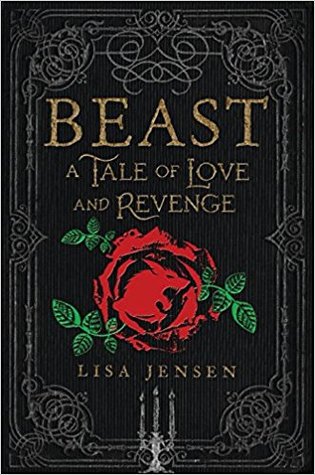
The Plot Beast: A Tale of Love and Revenge is, it will surprise no one, a retelling of Beauty and the Beast. However this time it's from the pov of young, naive servant girl, Lucie. We start the story much earlier ('Beauty' is somewhat incidental to the entire plot) and see the young chevalier in his chateau well before he becomes the beast. Here's the first stumbling block: The chevalier rapes Lucie about 10% of the way into the book. He is conceited, pleasure loving and entitled, cruel and greedy and thoughtless in the worst possible way. For those of you troubled by rape scenes, it's on screen and in the pov character's experience. Lucie then finds she is pregnant and tries to drown herself in the river. She is saved by an old wise woman. Lucie begs the old wise woman for revenge - and incidentally a way to get rid of the child (which is so poorly explored and so contrived in how it happens, it's laughable or would be if it was a less serious subject than 'I don't want to have my rapist's baby'...yeah just let that sit for a little bit.) The plot then swings into the familiar (thanks to Disney) version of the original fairy tale - the old woman punishes the chevalier with a monstrous beastly form. Lucie gets turned into a candlestick, incidentally - not the magical, mobile Disney kind either. She is literally a consciousness trapped, immobile in an inanimate object. The fairy tale is more or less faithfully followed, with a slight detour through Jean Cocteau's 1948 film La Belle et
le Bete, before coming to a very bizarre and slightly tasteless ending.
Before we get to the tricky stuff
Honestly, I'm not sure I would have enjoyed this if the author had picked a different idea to explore in this book and a different twist at the end. I wasn't especially keen on the style of the narrative, the pace was slow and having an inanimate object narrate a good portion of the book made it even slower since Lucie is literally sat in a cupboard or on a table for most of it. It didn't embrace any of the deep point of view or close psychic distance, or the multi dimensional characterisation I personally look for in a book. I continued to read because it was an ARC not because I was enjoying the experience. So in that respect the book wouldn't have been for me anyway. It was just an additional disappointment that it mangled a favourite fairy tale, showing little understanding of the original while it was at it.
Problems
A glance at the other reviews will show you how many people were offended by that rape scene, especially with how it resolved with the rest of the story. I wasn't offended but I found it contrived and I did roll my eyes at the ending. Lucie falls in love with Beast. It's a bit more complicated than 'girl falls in love with her rapist' but it can certainly be read that way so I'm not surprised other readers were upset.
I think the author was exploring the 'magic bullet' argument. If you're not familiar with this argument, it is a thought experiment whereby anyone can be rehabilitated of the past crimes and violent proclivities (rape, murder, torture, paedophilia etc) with a single one shot cure. The thought experiment assumes that everyone is completely rehabilitated, no back sliding - the perpetrator becomes a literally different person. The question this experiment poses is this: does the cured perpetrator deserve to be punished for the crimes of the person they were before the cure rehabilitated them? So in this case the chevalier raped Lucie - and was apparently no only a serial seducer and philanderer but a serial rapist as well, whose behaviour was rooted in his own awareness of his physical beauty and prowess and his privileged, wealthy position - whereas Beast has no memory of being the chevalier and is kind, compassionate, thoughtful and desperately lonely. Beats is literally a completely different person, so should he be punished for the crimes of Jean-Loup? (And I did laugh at that name - John Wolf? C'mon!) The conclusion Lucie comes to as she pursues her revenge (fairly ineffectually since her revenge consists of her sitting motionlessly and gloating on the Beast's suffering) is that no, he shouldn't be punished.
I think the author was trying to open a debate on punishment versus revenge. It's a shame she completely bypassed important aspects such as accountability and atonement. Logic would state that the only realistic answer to the 'magic bullet' argument is 'no, that new person does not deserve to be punished for the crimes of the old person'. If you answer 'yes' then your concern is with revenge not punishment and therefore you are part of the problem. What the thought experiment does not take into account is that the victims of crimes, especially terrible crimes such as rape and murder and child abuse, have rights too. All too often victims of rape and paedophilia are not listened to, their voices go unheard. The desire of certain contingents of people to not address their suffering and listen to the terrible things that happened to them, but instead to focus entirely on the perpetrator and consider it a success if they are rehabilitated, robs them of their voice even further. In those circumstances, it would be hard as a victim not to draw the conclusion that the perpetrator's life and well being is considered of far more worth than theirs is. Since it was this low grade, constant back ground hum of 'you're less valuable than the man who wants to rape you' that is rape culture in its essence, the 'magic bullet' argument simply adds another note to this already crushing song. And so does this book in that respect. Instead of taking a brave step into the unknown and having the chevalier learn and understand the sheer breadth and consequences of his actions upon another, having him suffer and rehabilitate somewhat that way, the author has taken what I feel to be a cowardly decision and allowed Beast not to be held accountable for the actions of Jean-Loup. It simply isn't good enough. Don't we have enough books and films and magazines and reality shows already carolling that 'boys will be boys' and therefore won't be held accountable for their actions, without adding yet another one? Because that is how this reads.
Beast never really feels responsible for the harm done to Lucie. They both start talking of the chevalier as if he is a separate person. Then it turns out that Jean-Loup is a sort of parasitic sub persona, cast over the poor innocent Beast like a mask. Beast is real. Jean-Loup is not. Hmm ok so the man who raped Lucie isn't real so doesn't it follow that she wasn't really raped by that logic? This is a dangerous line to walk because it is literally mirroring the minimisation so many rape survivors experience. Having Lucie then fall in love with Beast is just the final rotten cherry on a very distasteful cake. Because Lucie doesn't heal and move on by herself. She needs to fall in love with another man (ok a beast) in order to do that. The tiny amount of agency the character has at that point just evaporates. It would be lovely if writers could establish that a character who experiences rape can and will recover without the interference of a better man. In fact if writers could just hand power back to characters who have been raped and let them make conscious decisions to be with someone or not, maybe explore the ramifications if they decide they do want to be in a relationship, that would be awesome.
This is the problem with rape as a plot point. It has a history of silence and shame behind it so if you drop it on the table, you damn well better be prepared to discuss it properly. It is the kind of subject that will take over if not handled with care. In my opinion it hasn't been handled with care here at all. And here's the thing - it didn't have to be rape. Why couldn't the chevalier have seduced Luci and got her into bed with her consent? Why couldn't he have then grown bored with her and gone on to the next conquest? If Lucie had discovered herself pregnant then, it would have been a much more interesting discussion on love and betrayal. Rape needs to stop being the go to plot point just because it's short hand for 'this guy is ee-villlll', seriously try some characterisation and stop being so lazy.
The Problem of Lucie
Lucie is a supremely unlikeable and rather dull character. She is irritatingly naive at the start, and while the attack on her is not her fault at all, you do find yourself rolling your eyes at her obsession with the handsome chevalier. After she gets her revenge, she is even more unlikeable. It's hard to like anyone so consumed with hatred and a desire for revenge, especially when they have no agency to act on it. I suppose Lucie becoming a candlestick could be a heavy handed metaphor for being so blinded with hatred that you can't move on but it just didn't work for me. Reel in Rose (aka Beauty) and we get another of my pet peeves - a subtle but constant waft of girl on girl hate. It's noticeable in the way that Lucie finds Rose's choice of reading materials to be frivolous, that she is reluctant to admit Rose is brave or kind, that Rose is a merchant's daughter looking for money etc etc. Rose herself has little characterisation - like most of the other secondary and tertiary characters tbh - and at points you wonder why the hell she's even in the story.
Contrivance
So much of this plot is contrived. The magic system and the curse don't make sense. The character journeys feel forced. The weird appearances of Jean-Loup's mother are out of sync with the plot. I really hate contrived resolutions and that's how I felt about the 'twist' at the end of this book.
Ultimately this just didn't work for me. I don't think the author was setting out to offend people and if I'm right and this was the 'magic bullet' argument, then I guess I can kind of see what she was doing. I still feel it was a cop out. Worse, I feel it's added to a body of literature stretching back into history that all reinforce the idea that it's beholden of the victim to forgive on terms and time that suits society and even the perpetrator, rather than leaving at least that much power in the victim's hands. I feel it's also added to a number of other problematic arguments around rape culture. Honestly, I don't recommend this but if you're a die hard for Beauty and the Beast retellings, go for it. I'm not offended, just mildly disappointed - I probably won't be reading anything by this author again.