

What do you think?

L'impossibile volo
Eskibahçe è un tranquillo paese dell'Anatolia, adagiato sul fianco di una collina e popolato da personaggi un po' strani: Iskander il Vasaio, Philothei la Bella, Ibrahim il Folle, Drosoula la Brutta, il Cane, Ali il Portatore di Ghiaccio e molti altri. Ognuno ha una storia da raccontare, che si intreccia indissolubilmente con quella degli altri. Lì greci, turchi e armeni vivono in pace, chiamandosi «infedeli» a vicenda, ma con il sorriso sulle labbra. È l'impero ottomano a tenere tutti uniti sotto un'unica bandiera, e sarà sempre l'impero ottomano, con le sue guerre, la sua decadenza e il suo uomo del destino Mustafa Kemal Atatürk, a innescare ovunque la violenza incontrollabile che raggiungerà anche il paese sul fianco della collina. Gli abitanti saranno allontanati dalle loro case, uccisi, deportati o mandati al fronte. Dei pochi sopravvissuti, qualcuno si ricorderà che un tempo lì vivevano uomini di fede diversa ma capaci di stare insieme a lungo e in pace.
608 pages, Paperback
First published April 24, 2004
About the author
Louis de Bernières
69 books2,294 followersLouis de Bernières is an English novelist. He is known for his 1994 historical war novel Captain Corelli's Mandolin. In 1993 de Bernières was selected as one of the "20 Best of Young British Novelists", part of a promotion in Granta magazine. Captain Corelli's Mandolin was published in the following year, winning the Commonwealth Writers Prize for Best Book. It was also shortlisted for the 1994 Sunday Express Book of the Year. It has been translated into over 11 languages and is an international best-seller.
On 16 July 2008, he was awarded an Honorary Doctorate in the Arts by the De Montfort University in Leicester, which he had attended when it was Leicester Polytechnic.
Politically, he identifies himself as Eurosceptic and has voiced his support for the United Kingdom's exit from the European Union.
On 16 July 2008, he was awarded an Honorary Doctorate in the Arts by the De Montfort University in Leicester, which he had attended when it was Leicester Polytechnic.
Politically, he identifies himself as Eurosceptic and has voiced his support for the United Kingdom's exit from the European Union.
Ratings & Reviews
Friends & Following
Create a free account to discover what your friends think of this book!
Community Reviews
Displaying 1 - 30 of 1,736 reviews

January 22, 2015
No man is an Iland, intire of it selfe; any mans death diminishes me, because I am involved in Mankinde
John Donne
To destroy
When is it a duty? When is it a right? When is it a sin? What makes one human being violate another’s body and spirit? What makes Cain to pick up the stone? What convinces one man that the death of thousands would make the world a better place? And on the contrary: Who, what and when should we save? Iskander the Potter believes that it is not the individual’s fault and that it is all done by "the great world". And isn’t "the great world" just a combination of myriad small worlds that collide and intertwine over and over again, shaping “the big picture”? The world is shaped by the people who live in it, by their own personal worlds. So yes, everyone is responsible for their actions. However, no one is a lonely island. Inevitably we are influenced by other people and events. How can anyone stay moral in an immoral world? Especially when it is the only way to survive.
"But we are always confined to earth, no matter how much we climb to the high places and flap our arms. Because we cannot fly, we are condemned to do things that do not agree with us. Because we have no wings we are pushed into struggles and abominations that we did not seek, and then the years go by, the mountains are levelled, the valleys rise, the rivers are blocked by sand and the cliffs fall into the sea”
Where does the truth lie, then? What do we stand to lose in the name of what we believe in? What do we stand to lose in the name of what others believe in? When do we go with the flock, when do we sacrifice ourselves? How much are we ready to sacrifice in order to preserve ourselves? Is survival worth all cost? Can anyone truly know how much they are able to bear or is it only in the aftermath that we realize that we might have paid a price too high?
“We are forgetting how to look at others and see ourselves”
It is said that he, who saves one, saves the whole world. Then does he, who destroys one, destroy the whole world? Because we all are the world and everything we do – regardless of its nature – comes back to us. Actually, I don’t believe it ever truly leaves. I believe there are no two people entirely different or entirely alike. What we do to others, we always do to ourselves as well. Because we are all connected. I am all the saints, I am all the sinners. I am the best, I am the worst. I am everyone, everything. I am the whole world. And yet, I am just me. How do we choose between ourselves and the rest of the world? And like this isn’t enough, how do we cope with the multiple sides of our own personalities? Are we all just birds without wings, ruled by "the great world", desperately aiming for the sky, knowing that we would never reach it? Or are we mighty eagles, ready to adjust and rule it as we please?
Who are the victims, who are the predators? Are we shaped by the world that we live in or is it we who shape it and bear the responsibility for its nature? I believe both of those are true. War brings the best and the worst out of people, but in the end we are all the same. Humans. And, as said in "Memoirs of a Geisha", "Whatever our struggles and triumphs, however we may suffer them, all too soon they bleed into a wash, just like watery ink on paper."
“Don’t pity the eagle
Who can climb the sky and fly
But for the little wingless bird
Cry.
Fire will be found by
Birds that fly too high
And all his feathers burn
And he’ll fall down and die.
What bird has two nests
Only one shall remain
And his wings burn
And he’ll not fly again.
What if I make a high nest
But the branch sinks low?
They will take my little bird
And I will die of woe.
Oh my little bird
Who will chase you?
Who will put you in a cage
And tenderly embrace you?
It’s not possible to light a
Candle that doesn’t drip,
And it’s not possible to love
And never weep.”
Read count: 1

September 11, 2008
ETA on completion: Chrissie, stoip saying you love the book. Explain why! Everything explained below remains true. Other books are emotionally captivating, intellectually interesting, filled with humor and sorrow, What is it that makes this one different for me? It is that this book has a message. It looks at people and life and it says loud and clear how stupid we human beings are and how wonderful too! Does that make sense to you? Do you see life that way too?
Read with:
Twice a Stranger: The Mass Expulsions that Forged Modern Greece and Turkey and Salonica, City of Ghosts: Christians, Muslims and Jews 1430-1950 and Not Even My Name: A True Story.
*******************
Few books have so emotionally moved me.
I know now that this book will get five stars, although I have only read about half.
Do not read this book, Listen to it. The narrator of the audiobook is John Lee. I bought the paperback. Then I went and bought the audiobook at Audible for two credits. I do not regret this splurge. This is a winner. I am not capable of separating the written book from the narration. As a whole it is simply ……perfect!
On an intellectual level it teaches. It teaches about life in a small village near Izmir, Turkey – which was called Smyrna when the novel takes place, in the early 1900s. The depiction of the village life, bustling with Greeks and Turks, Christians and Muslims teaches and amuses. There are Armenians too. So many different people and cultures and traditions - and they all blended and lived in harmony. Of course harmony scattered with village disputes and love affairs, pranks and numerous other everyday normal experiences. On the intellectual level you also learn about Attaturk. You learn about the battles of World War I. You do not just learn. You are in the trenches along with the men.
How dry this could all be. But you see this book is never dry. Each village character and even Attaturk becomes a close comrade. This is because every sentence emotionally pulls you in. There is satirical humor. What humor! You will be laughing at the worst of the war scenes…… I feel almost embarrassed to admit this. This author makes you laugh at the most horrific, and then he grows serious and a profound observation is elucidated. Wonderful vocabulary! And now someone has died. I am in tears, I laugh and I cry and I think and I learn.
I am emotionally captivated time after time after time.
I worried that I would not keep track of the diverse characters. This is no problem. The same characters remain from start to end,
I have never read such a marvelous seduction scene. Never! I have never encountered in a book the childish fright a young girl feels with her first bleeding, followed by the delightful discovery of womanhood. I have never so physically felt myself in the trenches at war. Horror and irony and laughter and profound philosophizing are all there in one scene. What writing! What narrating! Please listen to this book. If you have never tried audiobooks, start right here. You will be hooked. I am still a baby with audiobooks. This is a whole new world opening up to me. I want to share the experience with you. Please, listen to this book. If the audio format is inaccessible, OK, then read it.!
There is not one thing I can criticize in this book.
Read with:
Twice a Stranger: The Mass Expulsions that Forged Modern Greece and Turkey and Salonica, City of Ghosts: Christians, Muslims and Jews 1430-1950 and Not Even My Name: A True Story.
*******************
Few books have so emotionally moved me.
I know now that this book will get five stars, although I have only read about half.
Do not read this book, Listen to it. The narrator of the audiobook is John Lee. I bought the paperback. Then I went and bought the audiobook at Audible for two credits. I do not regret this splurge. This is a winner. I am not capable of separating the written book from the narration. As a whole it is simply ……perfect!
On an intellectual level it teaches. It teaches about life in a small village near Izmir, Turkey – which was called Smyrna when the novel takes place, in the early 1900s. The depiction of the village life, bustling with Greeks and Turks, Christians and Muslims teaches and amuses. There are Armenians too. So many different people and cultures and traditions - and they all blended and lived in harmony. Of course harmony scattered with village disputes and love affairs, pranks and numerous other everyday normal experiences. On the intellectual level you also learn about Attaturk. You learn about the battles of World War I. You do not just learn. You are in the trenches along with the men.
How dry this could all be. But you see this book is never dry. Each village character and even Attaturk becomes a close comrade. This is because every sentence emotionally pulls you in. There is satirical humor. What humor! You will be laughing at the worst of the war scenes…… I feel almost embarrassed to admit this. This author makes you laugh at the most horrific, and then he grows serious and a profound observation is elucidated. Wonderful vocabulary! And now someone has died. I am in tears, I laugh and I cry and I think and I learn.
I am emotionally captivated time after time after time.
I worried that I would not keep track of the diverse characters. This is no problem. The same characters remain from start to end,
I have never read such a marvelous seduction scene. Never! I have never encountered in a book the childish fright a young girl feels with her first bleeding, followed by the delightful discovery of womanhood. I have never so physically felt myself in the trenches at war. Horror and irony and laughter and profound philosophizing are all there in one scene. What writing! What narrating! Please listen to this book. If you have never tried audiobooks, start right here. You will be hooked. I am still a baby with audiobooks. This is a whole new world opening up to me. I want to share the experience with you. Please, listen to this book. If the audio format is inaccessible, OK, then read it.!
There is not one thing I can criticize in this book.

January 29, 2012
Tracing the fall of the Ottoman Empire and the birth of the modern republic of Turkey, this novel alternates the first and third person narratives of a range of characters from the fictional town of Eskibahçe (meaning Garden of Eden) in southwest Turkey with an account of the life of Mustafa Kemal, later Mustafa Kemal Ataturk, the first leader of modern Turkey.
At the turn of the 20th century, the inhabitants of Eskibahçe comprise Muslim Turks, Christians of Greek origin and Armenians. They live together in relative harmony, forming friendships and inter-marrying. Both Christians and Muslims hedge their bets somewhat, with Muslims asking their Christian friends to offer prayers of intercession and Christians having a profound respect for the local imam. The lives of the inhabitants of Eskibahçe are torn apart by World War I and Turkey’s subsequent war with Greece, together with the Armenian genocide and the forced exile of Turkish Christians to Greece and of Muslim Greeks to Turkey.
In beautiful and accessible prose, de Bernières creates a strong sense of time and place. I found the chapters dealing with the Gallipoli campaign particularly powerful. The story of this WWI campaign is well-known to Australians and New Zealanders, who commemorate the landing at Gallipoli on 25 April 1915 as a national day to honour those who have served their country in time of war. It was extremely moving to read an account of the campaign – including an account of the fellowship and respect which grew between the Turkish and the Australian and New Zealand soldiers – from a Turkish point of view. The account of the forced exodus of Armenians in 1915 (and the subsequent Armenian genocide, which in terms of the novel occurs “off-stage”) and that of the expulsion of Greeks from Turkey and of Muslims from Greece after the signing of the “Convention Concerning the Exchange of Greek and Turkish Populations” in 1923 are also powerful and moving.
It took me a while to become completely engaged with the characters and the narrative. This is a long novel and de Bernières introduces his characters and builds tension slowly. While there is plenty of humour – a lot of it sardonic - the work is a serious indictment of extreme nationalism, of religious dogma and of war and its atrocities. However, it also explores human resilience and the type of love and friendship which can survive even the horror of war and ethnic and religious conflict . In a sense, Eskibahçe represents a Turkey in which different religious and ethnic communities could live in harmony before the choice to do so was taken away from them. And the tragic love story of the Muslim boy Ibrahim and the Christian girl Philotei which forms part of the narrative represents the tragedy which befell Greek Christians expelled from Turkey to a land which was not their own. In the process of describing the devastation on which this novel centres, de Bernières does not spare himself in criticising those he considers responsible for what occurred.
Before I started reading the novel, I was reasonably familiar with the political situation in Turkey since the 1980s. By reading it I learned a lot about the beginnings of modern Turkey and was able to put what I already knew into historical context. This is not an easy novel to read. However, it made me both laugh and cry and for a patient reader with an interest in 20th century international relations, the novel is a rewarding literary experience. Thanks to my GR friend Chrissie for recommending it to me.

March 1, 2014
4.5 Stars
Birds without Wings by Louis Bernieres.
A dense, mesmerising, harrowing and yet humorous novel that will bring out all emotions that a reader can experience but did not think possible in one story.
Set in the peaceful fictional village of Eskibahce in south west Turkey and home to Turkish Muslims and Greek Christians who have lived for centuries side by side and tolerate and enjoy for the most parts each other's traditions and religions. The author introduces us to a village of characters and when the war is declared and the outside world intruded the twin scourges of religion and nationalism lead to forced marches and massacres and the peaceful fabric of life is destroyed. Birds without wings is a personal and political story showing the costs of war.
"Where does it all begin? History has no beginnings, for everything that happens becomes the cause of pretext for what occurs afterwards, and this chain of cause and pretext stretches back to the Palaeolithic age, when the first Cain of one tribe murdered the first Cain of Another".,/I>
The story is based on a small fictional village in south-western Coastal Anatolia called Eskibahce, although fictional I believe the village is actually based upon Kayakoy a village near Fethiye the ruins which still exist today. Once a thriving Greek Village this town of over one thousand houses two churches, fourteen chapels and two schools was completely deserted in 1923 when the Greek inhabitants living throughout Turkey were deported to Greece by the Government in an exchange policy.
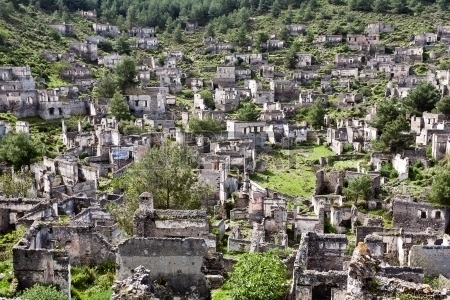
The destruction of the Ottoman empire in the First World War and its aftermath put and end to a beautiful tradition of religious and ethnic tolerance and the descriptions depicted by the author of the atrocities inflicted on women and children in this novel are very harrowing(one in particular will never leave my mind) but while it was difficult reading in places I only had to read about it............thousands of woman and children had to endure it. There is also wonderful humour though out the story and some laugh out loud moments that read like a breath of fresh air.
The writing, the characters, the setting and the history is all impeccably crafted. I did however have a hard time getting into the novel as I found the first 100 pages hard going and only for a friend had warned me about this I could easily have put this book aside and missed out on a wonderful read. I think the novel at 625 pages was quite a long read and perhaps could have been shortened as some of the chapters are overwritten and very descriptive. That aside I loved and enjoyed the novel very much and I would recommend this for lovers of history.
Birds without Wings by Louis Bernieres.
A dense, mesmerising, harrowing and yet humorous novel that will bring out all emotions that a reader can experience but did not think possible in one story.
Set in the peaceful fictional village of Eskibahce in south west Turkey and home to Turkish Muslims and Greek Christians who have lived for centuries side by side and tolerate and enjoy for the most parts each other's traditions and religions. The author introduces us to a village of characters and when the war is declared and the outside world intruded the twin scourges of religion and nationalism lead to forced marches and massacres and the peaceful fabric of life is destroyed. Birds without wings is a personal and political story showing the costs of war.
"Where does it all begin? History has no beginnings, for everything that happens becomes the cause of pretext for what occurs afterwards, and this chain of cause and pretext stretches back to the Palaeolithic age, when the first Cain of one tribe murdered the first Cain of Another".,/I>
The story is based on a small fictional village in south-western Coastal Anatolia called Eskibahce, although fictional I believe the village is actually based upon Kayakoy a village near Fethiye the ruins which still exist today. Once a thriving Greek Village this town of over one thousand houses two churches, fourteen chapels and two schools was completely deserted in 1923 when the Greek inhabitants living throughout Turkey were deported to Greece by the Government in an exchange policy.
The destruction of the Ottoman empire in the First World War and its aftermath put and end to a beautiful tradition of religious and ethnic tolerance and the descriptions depicted by the author of the atrocities inflicted on women and children in this novel are very harrowing(one in particular will never leave my mind) but while it was difficult reading in places I only had to read about it............thousands of woman and children had to endure it. There is also wonderful humour though out the story and some laugh out loud moments that read like a breath of fresh air.
The writing, the characters, the setting and the history is all impeccably crafted. I did however have a hard time getting into the novel as I found the first 100 pages hard going and only for a friend had warned me about this I could easily have put this book aside and missed out on a wonderful read. I think the novel at 625 pages was quite a long read and perhaps could have been shortened as some of the chapters are overwritten and very descriptive. That aside I loved and enjoyed the novel very much and I would recommend this for lovers of history.
July 15, 2012
This, for me, is one of those rare and treasured reads, a book that will stay with me forever. It tells the story of a small village in Smyrna starting about 1900, before it became Turkey. It is divided into many short chapters, and is told mostly in the third person. Sprinkled throughout, though, are chapters told from the point of view of several of the villagers, some of whom we meet as children, while others merely recount events from their young lives from the perspective of mature adults.
I loved this book because I loved the people who inhabited it, and the author made me feel that I know them. More than that, though, he made me feel he knows me. This was my first experience with Louis de Bernieres, but it won't be my last.
I am no history buff, so the description scared me off a little. I wasn't sure if I would understand it. Then I took a look at the first page, and the writing pulled me in immediately. Here is the start of the second paragraph:
How can you not read a book that starts with such wisdom, such truth and eloquence? I couldn't resist. This is a wise book, full of humor. You'll need the humor, because there is also great tragedy here. The characters feel very real. It's about life, the good, bad and ugly. We get to know the village and its people, its customs, superstitions, and traditions. It's about strength and courage and beauty and friendship. It's about community and family, and war's far-reaching, often devastating effects.
I started with a library copy, then bought the book halfway through because I knew I would want to reread this, and I'd want to be able to lend it out. I'd also like to highly recommend the audiobook, narrated by John Lee. He is a gifted narrator. His inflections and delivery, in my opinion, are perfect for the prevailing tongue-in-cheek tone of the story.
I feel as though I should have taken notes as I read, because I don't feel I'm doing this book enough justice here. I would really like to revisit this in a few years, once I have a better understanding of WWI. You really don't need the historical background going in to be able to enjoy the book. Trust me, I had almost none. However, I already want to reread it. Next time, with the background, I know I will appreciate it even more.
I also want to thank my good friend Chrissie for encouraging me to read this, in spite of the fact that I was unfamiliar with the history. What a tremendous book. I feel that it has been stitched into my soul, a rare treasure.
I loved this book because I loved the people who inhabited it, and the author made me feel that I know them. More than that, though, he made me feel he knows me. This was my first experience with Louis de Bernieres, but it won't be my last.
I am no history buff, so the description scared me off a little. I wasn't sure if I would understand it. Then I took a look at the first page, and the writing pulled me in immediately. Here is the start of the second paragraph:
There comes a point in life where each one of us who survives begins to feel like a ghost that has forgotten to die at the right time, and certainly most of us were more amusing when we were young. It seems that age folds the heart in on itself. Some of us walk detached, dreaming on the past, and some of us realize that we have lost the trick of standing in the sun.
How can you not read a book that starts with such wisdom, such truth and eloquence? I couldn't resist. This is a wise book, full of humor. You'll need the humor, because there is also great tragedy here. The characters feel very real. It's about life, the good, bad and ugly. We get to know the village and its people, its customs, superstitions, and traditions. It's about strength and courage and beauty and friendship. It's about community and family, and war's far-reaching, often devastating effects.
I started with a library copy, then bought the book halfway through because I knew I would want to reread this, and I'd want to be able to lend it out. I'd also like to highly recommend the audiobook, narrated by John Lee. He is a gifted narrator. His inflections and delivery, in my opinion, are perfect for the prevailing tongue-in-cheek tone of the story.
I feel as though I should have taken notes as I read, because I don't feel I'm doing this book enough justice here. I would really like to revisit this in a few years, once I have a better understanding of WWI. You really don't need the historical background going in to be able to enjoy the book. Trust me, I had almost none. However, I already want to reread it. Next time, with the background, I know I will appreciate it even more.
I also want to thank my good friend Chrissie for encouraging me to read this, in spite of the fact that I was unfamiliar with the history. What a tremendous book. I feel that it has been stitched into my soul, a rare treasure.

February 22, 2023
English review
A question for the author regarding this specific quote from the book:
”In 1876, Bulgarian Christians massacred an unknown number of peasants of Turkish origin.”
I am curious: what historical context or official sources did he use for such a claim? Does he have any at all? As far as I am aware, official historiography—including English-language sources—states exactly the opposite. The author has swapped the roles of victims and executioners, replacing "Ottomans/Turks" with "Christians" in the events of the Bulgarian April Uprising of 1876. These events were widely covered by the British and American press of the time and led to international condemnation of the Ottoman massacres.
A small example:
The Turkish Atrocities in Bulgaria
"Mr. Disraeli was right when he wittily remarked that the Turks usually terminated their connection with people who fell into their hands in a more expeditious manner than by imprisoning them. And so they do. Mr. Disraeli was right."
Even Turkish researchers have studies on the matter and devote many passages to justifying themselves, mentioning another English politician from that era—Gladstone:
Turkish Academic Source
"With the Pomak Ahmed Ağa Barutanli lies the responsibility for the ensuing massacre... The Muslim perpetrators slew large numbers of Christians, including many women and children. They burnt houses and buildings, in some cases with people inside them."
The book doesn't care for history as facts, but as wishes.
As for the birds—sometimes they are wingless because their wings were hacked off with a very blunt knife, and then those same amateur "ornithologists" ask in wonder: “But why does this bird not fly? Look how clumsy and unfit it is!”
Nostalgia is a very human quality. The trouble starts when it becomes selective, biased, and bypasses unpleasant facts—or outright denies and rearranges them in favor of a desired but never-existent reality. This is precisely how propaganda is born, damaging minds across borders and eras, especially when repeated over and over. If the world’s agenda were set solely by a beautiful but conveniently blind sentimentality, as it is in this novel, humanity would have achieved little spiritual or technical progress.
The view of the Ottoman Empire in its final years (1900–1918) focuses on the small Anatolian town of Eskibahçe in Lycia, where Muslims and Christians have coexisted for centuries. A peculiarity here is that the Christians also speak Turkish. While some argue this was typical for Cappadocia rather than Lycia, I won't judge—language and religion aren't always linked, much like the Pomaks in Bulgaria.
In Eskibahçe, life flows unchanged, frozen in time, with its good and bad sides. The good sides are the tolerance and connection to the land. The bad sides are the total isolation and a medieval level of ignorance and cruelty. Both Christians and Muslims take equal "righteous" pleasure in stoning an adulteress; when she survives, the women (!) drag her to the local brothel, where their husbands (!) happily line up. The author’s nostalgic tone never wavers—the reader is almost expected to be moved by the "sincerity" of these tolerant children of nature. And as for the adulteress—when, years later, the "righteous" husband who watched the crowd try to kill her wants to sleep with her in the brothel, she nearly cries with gratitude for his "magnanimity," calling him "my lion." What a heroic hero of the old days, right? And the stones? Just a normal punishment, apparently... It’s a pity they weren’t aimed at him, but I can at least dream.
The adoring gaze toward the Ottoman Empire intensifies with every page. It is presented as a pinnacle of tolerance, where all subjects have mingled over centuries. It’s portrayed as almost "unnatural" and offensive that Greeks, Serbs, and Bulgarians dared to be ungrateful for this supreme blessing and had the audacity to want their own small states. Meanwhile, Armenians are depicted as traitors. This "terrible" Russia is accused of genocide against defenseless Muslims, cynically using Armenians against their "innocent" Ottoman brothers. Thus, logically—what is a true Ottoman to do but slaughter them?
I am far from thinking Russia is "the good guy" and Turkey is "the bad guy." There are no purely good or bad actors on the global stage. Both empires have much to repent for, but both also had achievements. However, one cannot simply tell a reader they are a "criminal" for wanting a home of their own back (their former states have been ruined in the 14th century with the Ottoman invasion) because the imperial dormitory was allegedly more "idyllic." This one-sided, apologetic tone and complete bias toward the Empire is more than my patience can bear.
The plot is a series of sketches of various characters. The style is steady and rich. I regret I won't finish the vignettes about Mustafa Kemal, who is a hero of the 20th century to me (despite his own skeletons). But I don't regret the other characters—their superstition is elevated to a virtue by the author and equated with tolerance. The female characters are identical: ignorant, superstitious, and cruel without exception. Not a single "normal" woman to be found. I understand all these characters will suffer in the brutal Greek-Turkish ethnic cleansings after WWI. Sadly, because of the way the history is presented, I find myself indifferent to their fate. That is the most terrible thing one human can say about another, and it signifies incompetent and biased writing on truly important themes.
I am disgusted and deeply disappointed!
———
A few more "insights" from the author that revolted me with their manipulativeness:
“Unsurprisingly, but unfortunately for themselves, orthodox Armenians were often seduced by their own religious affiliations into supporting the Russians against their fellow Ottomans, and many joined the Russian armies.”
Now everyone is prepared: the only "good" Armenian is a dead one... Don't be surprised later.
”The deputies in the new parliament, Turks, Greeks, Arabs, Albanians, Jews, Serbs, Armenians, Bulgarians and a Vlach, prove themselves incapable of any ideal higher than ethnic self-interest.”
In what capacity, for heaven's sake, were these Greeks, Serbs, and Bulgarians in an Ottoman parliament around 1905, considering they had their own parliaments and independent states for 30 years? Did Sofia rent out deputies to a foreign capital? (Note: Ethnic Bulgarians in the Ottoman parliament were subjects from Macedonia/Thrace, not citizens of the Kingdom of Bulgaria).
“Cossacks assisted by Bulgarian revolutionaries and peasants seized all the property of Muslims. Cossacks would surround the villages to prevent any escape, disarm the inhabitants and send the Bulgarians in to slaughter them.”
I'll leave this without comment. It’s senseless. It is the first time in a 21st-century book that I have seen such profound ignorance—or rather, something so fundamentally biased it’s forbidden by the Ten Commandments.
“On 2 May 1915, Enver Pasha sent a fatal telegram to Tâlat Bey... proposing that the only way to deal with an intolerable situation was to remove all Armenians... with many directives coming out of Istanbul that there should be no ill treatment... the government could not control what actually happened at such great distances.”
So, just in case anyone missed it: the "savages" (the Kurds) are to blame. Along with circumstances beyond Ottoman control. The Ottomans? Innocent, old chap!
“It is not possible to calculate how many Armenians died... To argue about whether it was 300,000 or 2,000,000 is in a sense irrelevant and distasteful.”
Regarding the "distaste": I’ll take the risk of being "distasteful" and look at the facts and figures. Logic dictates that more victims imply more intent and better organization for genocide. The devil is precisely in the ugly details.
————
Bulgarian review:
Въпрос към автора за този негов цитат: ”In 1876, Bulgarian Christians massacred an unknown number of peasants of Turkish origin.” Интересно ми е какъв исторически контекст сте използвали за това свое твърдение и какви официални исторически източници? Изобщо имате ли такива, защото официалната историография, включително англоезичната, доколкото знам, излага точно обратното твърдение. Или (не)волно сте разменили местата на жертви и убийци, “християни” с “османци”/ “турци” в събитията от българското въстание от април 1876 г, широко отразено в тогавашната британска и американска преса (англоезични са, все пак), довело до кланетата на българи от страна на обичната ви османска империя?
Малък пример:
https://attackingthedevil.co.uk/relat...
"Mr. Disraeli was right when he wittily remarked that the Turks usually terminated their connection with people who fell into their hands in a more expeditious manner than by imprisoning them. And so they do. Mr. Disraeli was right. "
Вероятно сте чували все нещичко за своя сънародник Дизраели?
Ако не сте, както изглежда, самите турци имат изследвания по въпроса и отделят доста пасажи да се оправдават, и дори споменават друг ваш явно непознат сънародник от епохата - Гладстон, но едва ли сте чували и за него, очевидно е твърде неизвестен:
https://dergipark.org.tr/tr/download/...
"With the Pomak Ahmed Ağa Barutanli lies the responsibility for the ensuing massacre. Killing and plundering continued for several days. The Muslim perpetrators slew large numbers of Christians, including many women and children. They burnt houses and buildings, in some cases with people inside them."
Не обичате никак историята в качеството и на наука, нали? Тя обаче в някои отношения е сходна точно с балистиката. И чистосърдечно мразите детайлите от нея, които не Ви харесват? Благодаря, въпросите са риторични!
А относно птиците - те понякога са без криле, защото им ги режат с много тъп нож, и после същите тези любители-орнитолози учудено питат: “А защо тази птица не лети? Вижте я колко е неумела и непригодна!”
———
Носталгията е много човешко качество. Лошото е, когато е избирателна, пристрастна и заобикаля и избягва неприятните факти, или направо ги отрича или наглася, за сметка на една желана, но никога несъществувала действителност. Тогава всъщност се заражда пропагандата, която уврежда без оглед на граници и епохи. Особено, когато се повтаря отново и отново. Ако единствено красивата, но удобно сляпа където трябва сантименталност налагаше дневния ред, както е в този роман, човечеството нямаше да е постигнало особен духовен и технически прогрес.
Погледът към Османската империя от нейните последни години (1900 - 1918 г.) тук е съсредоточен върху малкото анадолско градче Ескибахче, в Ликия, в което от векове съжителстват мюсюлмани и християни. Особеното в случая е, че християните също говорят турски. В други ревюта се твърди, че такива случаи са типични за Кападокия, не за Ликия, където се е говорел някакъв вид гръцки. Не се наемам да преценявам, просто не знам, но често - както например в Ливан или Сирия - религията и езикът не са непременно свързани. Така е и с помаците у нас. Такива случаи има доста.
В Ескибахче животът тече непроменен и застинал във времето от незапомнени времена, с добрите и лошите си страни. Добрите са толерантността и връзката със земята, хората си общуват почти свободно независимо от религията, отдадени на простичките си радости. Лошите са свързани с тоталната изолация от останалия свят и царуващото средновековно по жестокостта и обема си невежество. И християни, и мюсюлмани с еднаква праведна наслада хвърлят камъни по прелюбодейка, и тъй като тя оцелява, жените (!) я закарват в местния бордей, където мъжете им (!) щастливо и се нареждат на опашка. Носталгичният тон на автора не секва нито за миг - от читателя почти се очаква да се умили от чистосърдечието на тези толерантни деца на природата. А за прелпбодейката - когато след години праведният и съпруг, поискал тълпата да в убие и гледал през цялото време, иска да спи с нея в бордея, тя само дето не се разплаква от признателност за великидушието му и дори го нарича “лъв мой”. Какъв героичен, героичен герой от старите времена, нали? А камъните са си нормално наказание, какво толкова… Жалко, че не са по него, но мога поне да си помечтая.
Умиленият поглед към Османската империя се засилва с всяка страница и започва да прелива. Тя е средоточие на толерантност, всички поданици са се омесили с вековете, и е направо противоестествено и оскърбително, че гърци, сърби и българи смеят да не са коленопреклонно признателни за тази висша благодат и имат наглостта да искат собствени мънички държавици. А пък арменците са предатели. Как не ги е срам! Тази ужасна Русия пък върши геноцид срещу беззащитните мюсюлмани и нагло използва арменците срещу клетите им, невинни османски братя, и - следователно и съвсем логично - какво му остава на един истински османец, освен да ги изколи?
Далеч съм от мисълта, че Русия е “добрата”, а Турция е “лошата”. Изобщо, изцяло добри и лоши на световната сцена няма. И двете империи имат много за какво да се каят, както и някои постижения. И двете са включили в границите си куп народи със сила, но пък не винаги са били зверове, културните влияния са безспорни и често са били от полза (ако си оцелял първата вълна на насилието, разбира се). Днес те са неразривна част от наследството ни, и когато миналото се е оттекло, красотата и пластовете могат да се видят и оценят на спокойствие - когато обаче си вече свободен и в собствения си дом. Не може някой просто да дойде да каже на читателя, че той е престъпник да иска свой дом, защото в имперското общежитие ще му е по-идилично.
Едностранчивият поглед, оправдателният тон и пълната пристрастност към империята е повече, отколкото читателското и човешкото ми търпение може да понесе.
Сюжетът е поредица от скици, посветени на различни герои от Ескибахче. Стилът е равномерен и богат, чете се леко. Много съжалявам, че няма да дочета винетките с Мустафа Кемал, който за мен е един от героите на 20 век, макар, естествено, той да си има своите собствени скелети в гардероба. За останалите персонажи обаче не съжалявам - тяхното суеверие е издигнато в добродетел от автора, и е приравнени на толерантност. Женските образи са абсолютно еднотипни - невежи, суеверни, природно ограничени и доста жестоки, без изключение. Как пък не успя да намери поне една нормална жена? Доколкото разбирам, всички герои ще пострадат при кървавите и брутални гръцко-турски взаимни етнически прочиствания след първата световна война. Тъжно, но с начина си на поднасяне на историята, се постига обратния ефект - съдбата им ми е безразлична. Което е най-страшното, което един човек може да каже за друг, добре че това тук е само книга. Което означава единствено некомпетентно и пристрастно свършена писателска работа по действително важни теми и събития.
Отвратена съм и съм дълбоко разочарована!
———
Още малко “прозрения” на автора, които ме възмутиха с манипулативността си:
“Unsurprisingly, but unfortunately for themselves, orthodox Armenians were often seduced by their own religious affiliations into supporting the Russians against their fellow Ottomans, and many joined the Russian armies.”
Сега всеки вече е подготвен, че добрият арменец е мъртвият арменец… Да няма учудени после.
”The deputies in the new parliament, Turks, Greeks, Arabs, Albanians, Jews, Serbs, Armenians, Bulgarians and a Vlach, prove themselves incapable of any ideal higher than ethnic self-interest.”
Интересно в какво свое качество, по дяволите, са били тези гърци, сърби, българи и власи в османски парламент около 1905 г., при условие, че от около 30 години са си имали собствени парламенти и независими държави? Или от държавната столица София сме командировали наши депутати в чужда столица, дали сме ги под наем на османския парламент?
“Cossacks assisted by Bulgarian revolutionaries and peasants seized all the property of Muslims. Cossacks would surround the villages to prevent any escape, disarm the inhabitants and send the Bulgarians in to slaughter them. ”
Тук го оставям без коментар. Безмислено е. За първи път - в книга от 21 век - виждам подобно не просто невежество, не и пристрастност, а нещо толкова дълбоко фундаментално, че даже го има забранено в една от десетте божи заповеди.
“On 2 May 1915, Enver Pasha sent a fatal telegram to Tâlat Bey, the Minister for the Interior, proposing that the only way to deal with an intolerable situation was to remove all Armenians from behind Ottoman lines, and replace them with Muslim refugees from elsewhere. Over the next few months this policy began to be implemented, with many directives coming out of Istanbul that there should be no ill treatment. The plan was to auction the possessions of each family and give them the money when they arrived at their destinations, so that they could start life afresh.”
“the government could not control what actually happened at such great distances in places where there were virtually no systems of communication or of command and control. ”
“escorted them and considered them to be traitors. These troops were often not proper soldiers, since those were at the fronts, but Kurdish irregulars, recruited from wild and ignorant tribesmen ”
Така, ако есе още има неразбрали: диваците, т. е. кюрдите са виновни. Както и независещи от османските власти обстоятелства. Османците? Те са невинни, old chap!
“It is not possible to calculate how many Armenians died on the forced marches. In 1915 the number was thought to be 300,000, a figure which has been progressively increased ever since, thanks to the efforts of angry propagandists. To argue about whether it was 300,000 or 2,000,000 is in a sense irrelevant and distasteful, ”
Относно липсата на вкус - ще си позволя да предложа да бъдем зле възпитани и с очевидна липса на вкус да потърсим фактите с помощта и на цифри, защото логиката, която е безвкусна, е за сметка на това проста: повече жертви водят до наличие на повече умисъл, на по-добра османска организация с цел геноцид. Или на други фактори - дяволът е тъкмо в грозните детайли.
A question for the author regarding this specific quote from the book:
”In 1876, Bulgarian Christians massacred an unknown number of peasants of Turkish origin.”
I am curious: what historical context or official sources did he use for such a claim? Does he have any at all? As far as I am aware, official historiography—including English-language sources—states exactly the opposite. The author has swapped the roles of victims and executioners, replacing "Ottomans/Turks" with "Christians" in the events of the Bulgarian April Uprising of 1876. These events were widely covered by the British and American press of the time and led to international condemnation of the Ottoman massacres.
A small example:
The Turkish Atrocities in Bulgaria
"Mr. Disraeli was right when he wittily remarked that the Turks usually terminated their connection with people who fell into their hands in a more expeditious manner than by imprisoning them. And so they do. Mr. Disraeli was right."
Even Turkish researchers have studies on the matter and devote many passages to justifying themselves, mentioning another English politician from that era—Gladstone:
Turkish Academic Source
"With the Pomak Ahmed Ağa Barutanli lies the responsibility for the ensuing massacre... The Muslim perpetrators slew large numbers of Christians, including many women and children. They burnt houses and buildings, in some cases with people inside them."
The book doesn't care for history as facts, but as wishes.
As for the birds—sometimes they are wingless because their wings were hacked off with a very blunt knife, and then those same amateur "ornithologists" ask in wonder: “But why does this bird not fly? Look how clumsy and unfit it is!”
Nostalgia is a very human quality. The trouble starts when it becomes selective, biased, and bypasses unpleasant facts—or outright denies and rearranges them in favor of a desired but never-existent reality. This is precisely how propaganda is born, damaging minds across borders and eras, especially when repeated over and over. If the world’s agenda were set solely by a beautiful but conveniently blind sentimentality, as it is in this novel, humanity would have achieved little spiritual or technical progress.
The view of the Ottoman Empire in its final years (1900–1918) focuses on the small Anatolian town of Eskibahçe in Lycia, where Muslims and Christians have coexisted for centuries. A peculiarity here is that the Christians also speak Turkish. While some argue this was typical for Cappadocia rather than Lycia, I won't judge—language and religion aren't always linked, much like the Pomaks in Bulgaria.
In Eskibahçe, life flows unchanged, frozen in time, with its good and bad sides. The good sides are the tolerance and connection to the land. The bad sides are the total isolation and a medieval level of ignorance and cruelty. Both Christians and Muslims take equal "righteous" pleasure in stoning an adulteress; when she survives, the women (!) drag her to the local brothel, where their husbands (!) happily line up. The author’s nostalgic tone never wavers—the reader is almost expected to be moved by the "sincerity" of these tolerant children of nature. And as for the adulteress—when, years later, the "righteous" husband who watched the crowd try to kill her wants to sleep with her in the brothel, she nearly cries with gratitude for his "magnanimity," calling him "my lion." What a heroic hero of the old days, right? And the stones? Just a normal punishment, apparently... It’s a pity they weren’t aimed at him, but I can at least dream.
The adoring gaze toward the Ottoman Empire intensifies with every page. It is presented as a pinnacle of tolerance, where all subjects have mingled over centuries. It’s portrayed as almost "unnatural" and offensive that Greeks, Serbs, and Bulgarians dared to be ungrateful for this supreme blessing and had the audacity to want their own small states. Meanwhile, Armenians are depicted as traitors. This "terrible" Russia is accused of genocide against defenseless Muslims, cynically using Armenians against their "innocent" Ottoman brothers. Thus, logically—what is a true Ottoman to do but slaughter them?
I am far from thinking Russia is "the good guy" and Turkey is "the bad guy." There are no purely good or bad actors on the global stage. Both empires have much to repent for, but both also had achievements. However, one cannot simply tell a reader they are a "criminal" for wanting a home of their own back (their former states have been ruined in the 14th century with the Ottoman invasion) because the imperial dormitory was allegedly more "idyllic." This one-sided, apologetic tone and complete bias toward the Empire is more than my patience can bear.
The plot is a series of sketches of various characters. The style is steady and rich. I regret I won't finish the vignettes about Mustafa Kemal, who is a hero of the 20th century to me (despite his own skeletons). But I don't regret the other characters—their superstition is elevated to a virtue by the author and equated with tolerance. The female characters are identical: ignorant, superstitious, and cruel without exception. Not a single "normal" woman to be found. I understand all these characters will suffer in the brutal Greek-Turkish ethnic cleansings after WWI. Sadly, because of the way the history is presented, I find myself indifferent to their fate. That is the most terrible thing one human can say about another, and it signifies incompetent and biased writing on truly important themes.
I am disgusted and deeply disappointed!
———
A few more "insights" from the author that revolted me with their manipulativeness:
“Unsurprisingly, but unfortunately for themselves, orthodox Armenians were often seduced by their own religious affiliations into supporting the Russians against their fellow Ottomans, and many joined the Russian armies.”
Now everyone is prepared: the only "good" Armenian is a dead one... Don't be surprised later.
”The deputies in the new parliament, Turks, Greeks, Arabs, Albanians, Jews, Serbs, Armenians, Bulgarians and a Vlach, prove themselves incapable of any ideal higher than ethnic self-interest.”
In what capacity, for heaven's sake, were these Greeks, Serbs, and Bulgarians in an Ottoman parliament around 1905, considering they had their own parliaments and independent states for 30 years? Did Sofia rent out deputies to a foreign capital? (Note: Ethnic Bulgarians in the Ottoman parliament were subjects from Macedonia/Thrace, not citizens of the Kingdom of Bulgaria).
“Cossacks assisted by Bulgarian revolutionaries and peasants seized all the property of Muslims. Cossacks would surround the villages to prevent any escape, disarm the inhabitants and send the Bulgarians in to slaughter them.”
I'll leave this without comment. It’s senseless. It is the first time in a 21st-century book that I have seen such profound ignorance—or rather, something so fundamentally biased it’s forbidden by the Ten Commandments.
“On 2 May 1915, Enver Pasha sent a fatal telegram to Tâlat Bey... proposing that the only way to deal with an intolerable situation was to remove all Armenians... with many directives coming out of Istanbul that there should be no ill treatment... the government could not control what actually happened at such great distances.”
So, just in case anyone missed it: the "savages" (the Kurds) are to blame. Along with circumstances beyond Ottoman control. The Ottomans? Innocent, old chap!
“It is not possible to calculate how many Armenians died... To argue about whether it was 300,000 or 2,000,000 is in a sense irrelevant and distasteful.”
Regarding the "distaste": I’ll take the risk of being "distasteful" and look at the facts and figures. Logic dictates that more victims imply more intent and better organization for genocide. The devil is precisely in the ugly details.
————
Bulgarian review:
Въпрос към автора за този негов цитат: ”In 1876, Bulgarian Christians massacred an unknown number of peasants of Turkish origin.” Интересно ми е какъв исторически контекст сте използвали за това свое твърдение и какви официални исторически източници? Изобщо имате ли такива, защото официалната историография, включително англоезичната, доколкото знам, излага точно обратното твърдение. Или (не)волно сте разменили местата на жертви и убийци, “християни” с “османци”/ “турци” в събитията от българското въстание от април 1876 г, широко отразено в тогавашната британска и американска преса (англоезични са, все пак), довело до кланетата на българи от страна на обичната ви османска империя?
Малък пример:
https://attackingthedevil.co.uk/relat...
"Mr. Disraeli was right when he wittily remarked that the Turks usually terminated their connection with people who fell into their hands in a more expeditious manner than by imprisoning them. And so they do. Mr. Disraeli was right. "
Вероятно сте чували все нещичко за своя сънародник Дизраели?
Ако не сте, както изглежда, самите турци имат изследвания по въпроса и отделят доста пасажи да се оправдават, и дори споменават друг ваш явно непознат сънародник от епохата - Гладстон, но едва ли сте чували и за него, очевидно е твърде неизвестен:
https://dergipark.org.tr/tr/download/...
"With the Pomak Ahmed Ağa Barutanli lies the responsibility for the ensuing massacre. Killing and plundering continued for several days. The Muslim perpetrators slew large numbers of Christians, including many women and children. They burnt houses and buildings, in some cases with people inside them."
Не обичате никак историята в качеството и на наука, нали? Тя обаче в някои отношения е сходна точно с балистиката. И чистосърдечно мразите детайлите от нея, които не Ви харесват? Благодаря, въпросите са риторични!
А относно птиците - те понякога са без криле, защото им ги режат с много тъп нож, и после същите тези любители-орнитолози учудено питат: “А защо тази птица не лети? Вижте я колко е неумела и непригодна!”
———
Носталгията е много човешко качество. Лошото е, когато е избирателна, пристрастна и заобикаля и избягва неприятните факти, или направо ги отрича или наглася, за сметка на една желана, но никога несъществувала действителност. Тогава всъщност се заражда пропагандата, която уврежда без оглед на граници и епохи. Особено, когато се повтаря отново и отново. Ако единствено красивата, но удобно сляпа където трябва сантименталност налагаше дневния ред, както е в този роман, човечеството нямаше да е постигнало особен духовен и технически прогрес.
Погледът към Османската империя от нейните последни години (1900 - 1918 г.) тук е съсредоточен върху малкото анадолско градче Ескибахче, в Ликия, в което от векове съжителстват мюсюлмани и християни. Особеното в случая е, че християните също говорят турски. В други ревюта се твърди, че такива случаи са типични за Кападокия, не за Ликия, където се е говорел някакъв вид гръцки. Не се наемам да преценявам, просто не знам, но често - както например в Ливан или Сирия - религията и езикът не са непременно свързани. Така е и с помаците у нас. Такива случаи има доста.
В Ескибахче животът тече непроменен и застинал във времето от незапомнени времена, с добрите и лошите си страни. Добрите са толерантността и връзката със земята, хората си общуват почти свободно независимо от религията, отдадени на простичките си радости. Лошите са свързани с тоталната изолация от останалия свят и царуващото средновековно по жестокостта и обема си невежество. И християни, и мюсюлмани с еднаква праведна наслада хвърлят камъни по прелюбодейка, и тъй като тя оцелява, жените (!) я закарват в местния бордей, където мъжете им (!) щастливо и се нареждат на опашка. Носталгичният тон на автора не секва нито за миг - от читателя почти се очаква да се умили от чистосърдечието на тези толерантни деца на природата. А за прелпбодейката - когато след години праведният и съпруг, поискал тълпата да в убие и гледал през цялото време, иска да спи с нея в бордея, тя само дето не се разплаква от признателност за великидушието му и дори го нарича “лъв мой”. Какъв героичен, героичен герой от старите времена, нали? А камъните са си нормално наказание, какво толкова… Жалко, че не са по него, но мога поне да си помечтая.
Умиленият поглед към Османската империя се засилва с всяка страница и започва да прелива. Тя е средоточие на толерантност, всички поданици са се омесили с вековете, и е направо противоестествено и оскърбително, че гърци, сърби и българи смеят да не са коленопреклонно признателни за тази висша благодат и имат наглостта да искат собствени мънички държавици. А пък арменците са предатели. Как не ги е срам! Тази ужасна Русия пък върши геноцид срещу беззащитните мюсюлмани и нагло използва арменците срещу клетите им, невинни османски братя, и - следователно и съвсем логично - какво му остава на един истински османец, освен да ги изколи?
Далеч съм от мисълта, че Русия е “добрата”, а Турция е “лошата”. Изобщо, изцяло добри и лоши на световната сцена няма. И двете империи имат много за какво да се каят, както и някои постижения. И двете са включили в границите си куп народи със сила, но пък не винаги са били зверове, културните влияния са безспорни и често са били от полза (ако си оцелял първата вълна на насилието, разбира се). Днес те са неразривна част от наследството ни, и когато миналото се е оттекло, красотата и пластовете могат да се видят и оценят на спокойствие - когато обаче си вече свободен и в собствения си дом. Не може някой просто да дойде да каже на читателя, че той е престъпник да иска свой дом, защото в имперското общежитие ще му е по-идилично.
Едностранчивият поглед, оправдателният тон и пълната пристрастност към империята е повече, отколкото читателското и човешкото ми търпение може да понесе.
Сюжетът е поредица от скици, посветени на различни герои от Ескибахче. Стилът е равномерен и богат, чете се леко. Много съжалявам, че няма да дочета винетките с Мустафа Кемал, който за мен е един от героите на 20 век, макар, естествено, той да си има своите собствени скелети в гардероба. За останалите персонажи обаче не съжалявам - тяхното суеверие е издигнато в добродетел от автора, и е приравнени на толерантност. Женските образи са абсолютно еднотипни - невежи, суеверни, природно ограничени и доста жестоки, без изключение. Как пък не успя да намери поне една нормална жена? Доколкото разбирам, всички герои ще пострадат при кървавите и брутални гръцко-турски взаимни етнически прочиствания след първата световна война. Тъжно, но с начина си на поднасяне на историята, се постига обратния ефект - съдбата им ми е безразлична. Което е най-страшното, което един човек може да каже за друг, добре че това тук е само книга. Което означава единствено некомпетентно и пристрастно свършена писателска работа по действително важни теми и събития.
Отвратена съм и съм дълбоко разочарована!
———
Още малко “прозрения” на автора, които ме възмутиха с манипулативността си:
“Unsurprisingly, but unfortunately for themselves, orthodox Armenians were often seduced by their own religious affiliations into supporting the Russians against their fellow Ottomans, and many joined the Russian armies.”
Сега всеки вече е подготвен, че добрият арменец е мъртвият арменец… Да няма учудени после.
”The deputies in the new parliament, Turks, Greeks, Arabs, Albanians, Jews, Serbs, Armenians, Bulgarians and a Vlach, prove themselves incapable of any ideal higher than ethnic self-interest.”
Интересно в какво свое качество, по дяволите, са били тези гърци, сърби, българи и власи в османски парламент около 1905 г., при условие, че от около 30 години са си имали собствени парламенти и независими държави? Или от държавната столица София сме командировали наши депутати в чужда столица, дали сме ги под наем на османския парламент?
“Cossacks assisted by Bulgarian revolutionaries and peasants seized all the property of Muslims. Cossacks would surround the villages to prevent any escape, disarm the inhabitants and send the Bulgarians in to slaughter them. ”
Тук го оставям без коментар. Безмислено е. За първи път - в книга от 21 век - виждам подобно не просто невежество, не и пристрастност, а нещо толкова дълбоко фундаментално, че даже го има забранено в една от десетте божи заповеди.
“On 2 May 1915, Enver Pasha sent a fatal telegram to Tâlat Bey, the Minister for the Interior, proposing that the only way to deal with an intolerable situation was to remove all Armenians from behind Ottoman lines, and replace them with Muslim refugees from elsewhere. Over the next few months this policy began to be implemented, with many directives coming out of Istanbul that there should be no ill treatment. The plan was to auction the possessions of each family and give them the money when they arrived at their destinations, so that they could start life afresh.”
“the government could not control what actually happened at such great distances in places where there were virtually no systems of communication or of command and control. ”
“escorted them and considered them to be traitors. These troops were often not proper soldiers, since those were at the fronts, but Kurdish irregulars, recruited from wild and ignorant tribesmen ”
Така, ако есе още има неразбрали: диваците, т. е. кюрдите са виновни. Както и независещи от османските власти обстоятелства. Османците? Те са невинни, old chap!
“It is not possible to calculate how many Armenians died on the forced marches. In 1915 the number was thought to be 300,000, a figure which has been progressively increased ever since, thanks to the efforts of angry propagandists. To argue about whether it was 300,000 or 2,000,000 is in a sense irrelevant and distasteful, ”
Относно липсата на вкус - ще си позволя да предложа да бъдем зле възпитани и с очевидна липса на вкус да потърсим фактите с помощта и на цифри, защото логиката, която е безвкусна, е за сметка на това проста: повече жертви водят до наличие на повече умисъл, на по-добра османска организация с цел геноцид. Или на други фактори - дяволът е тъкмо в грозните детайли.

January 21, 2013
One of the GoodReads groups I am in, The World's Literature, is focusing on literature from and about Turkey this year. Birds Without Wings was one of the February picks (discussion will end up here,) and even though I started it a while ago, it took me staying up until 2 am this morning to get through it.
This is an incredibly well-executed novel. The author tells the story of Turkey in the early 20th century, from its development from the Ottoman Empire or Anatolia, into a time where the people living there embraced the word Turk, Turkish, Turkey (prior to that change, it had been a pretty derogatory term.) This is the second book I've read this year to include Mustafa Kemal, but while the other book focused on his violent acts from an outsider perspective, Birds Without Wings entwines his story from youth to Atatürk, and explains his pivotal role in where the country is now. It is done rather without judgment, just the facts. Well, I'm not sure. The Armenians are removed and the Christians are removed and the violence surrounding it is implied but not focused on.
The core of the story isn't Mustafa Kemal, however. It focuses on the people living in a small village where people speak Turkish written in a Greek alphabet, where friendships cross religious and ethnic lines, but war and governmental change creates conflict in all those areas. It is a sad but true transformation from tolerance to division. The story is told from multiple perspectives, from Iskander the Potter to the mistress of the wealthiest man in town. The writing is dense, filled with local color, and goes by quickly with the changing perspectives.
The author's opinion is clear throughout the novel, mourning the past where different people could live together in the days of the Ottoman Empire. This quotation sums up a great deal of the tone of the book:
"It was said in those days one could hear seventy languages in the streets of Istanbul. The vast Ottoman Empire, shrunken and weakened though it now was, had made it normal and natural for Greeks to inhabit Egypt, Persians to settle in Arabia and Albanians to live with Slavs. Christians and Muslims of all sects, Alevis, Zoroastrians, Jews, worshipers of the Peacock Angel, subsisted side by side and in the most improbable places and combinations. There were Muslim Greeks, Catholic Armenians, Arab Christians and Serbian Jews. Istanbul was the hub of this broken-felloed wheel, and there could be found epitomised the fantastical bedlam and babel, which, although no one realised it at the time, was destined to be the model and precursor of all the world's great metropoles a hundred years hence, by which Istanbul would, paradoxically, have lost its cosmopolitan brilliance entirely. It would be destined, perhaps, one day to find it again, if only the devilish false idols of nationalism, that specious patriotism of the morally stunted, might finally be toppled in the century to come."
This is an incredibly well-executed novel. The author tells the story of Turkey in the early 20th century, from its development from the Ottoman Empire or Anatolia, into a time where the people living there embraced the word Turk, Turkish, Turkey (prior to that change, it had been a pretty derogatory term.) This is the second book I've read this year to include Mustafa Kemal, but while the other book focused on his violent acts from an outsider perspective, Birds Without Wings entwines his story from youth to Atatürk, and explains his pivotal role in where the country is now. It is done rather without judgment, just the facts. Well, I'm not sure. The Armenians are removed and the Christians are removed and the violence surrounding it is implied but not focused on.
The core of the story isn't Mustafa Kemal, however. It focuses on the people living in a small village where people speak Turkish written in a Greek alphabet, where friendships cross religious and ethnic lines, but war and governmental change creates conflict in all those areas. It is a sad but true transformation from tolerance to division. The story is told from multiple perspectives, from Iskander the Potter to the mistress of the wealthiest man in town. The writing is dense, filled with local color, and goes by quickly with the changing perspectives.
The author's opinion is clear throughout the novel, mourning the past where different people could live together in the days of the Ottoman Empire. This quotation sums up a great deal of the tone of the book:
"It was said in those days one could hear seventy languages in the streets of Istanbul. The vast Ottoman Empire, shrunken and weakened though it now was, had made it normal and natural for Greeks to inhabit Egypt, Persians to settle in Arabia and Albanians to live with Slavs. Christians and Muslims of all sects, Alevis, Zoroastrians, Jews, worshipers of the Peacock Angel, subsisted side by side and in the most improbable places and combinations. There were Muslim Greeks, Catholic Armenians, Arab Christians and Serbian Jews. Istanbul was the hub of this broken-felloed wheel, and there could be found epitomised the fantastical bedlam and babel, which, although no one realised it at the time, was destined to be the model and precursor of all the world's great metropoles a hundred years hence, by which Istanbul would, paradoxically, have lost its cosmopolitan brilliance entirely. It would be destined, perhaps, one day to find it again, if only the devilish false idols of nationalism, that specious patriotism of the morally stunted, might finally be toppled in the century to come."
January 14, 2008
I so wish that the editor had been a bit more stringent with this book so that more people would read it! Even adoring the book as I did, I found I would have preferred it with one or two fewer plot lines. It is an incredibly historically informational novel peopled with (a few too many) warmly flawed and incredibly real characters.
I think the author's ability to provide a variety of viewpoints (via the different Muslim, Catholic, Turkish and Greek characters we meet) on a time period that is hotly debated even today makes this a book that should be required reading for all Americans.
I think the author's ability to provide a variety of viewpoints (via the different Muslim, Catholic, Turkish and Greek characters we meet) on a time period that is hotly debated even today makes this a book that should be required reading for all Americans.


September 21, 2014
Hopefully, a proper review will follow in the next few days. One of those special novels that drew me in from the first page and kept me riveted until the very last. The characters became people I really did care about. I will think about them for a long time to come.
My top quotes from the novel:
“Man is a bird without wings and a bird is a man without sorrow.”
“There comes a point in life where each one of us who survives begins to feel like a ghost that has forgotten to die at the right time, and certainly most of us were more amusing when we were young. It seems that age folds the heart in on itself. Some of us walk detached, dreaming on the past, and some of us realize that we have lost the trick of standing in the sun. For many of us the thought of the future is a cause for irritation rather than optimism, as if we have had enough of new things, and wish only for the long sleep that rounds the edges of our lives”.
The second quote sounds depressing but when spoken by the character Isklander the Potter, it is not. Rather you understand his assessment of life for him now, after the wars, , after he has seen his village plundered and changed forever.
De Bernieres has that extra special gift in storytelling. A huge thank-you to Chrissie in the All About Books group for her fantastic review which lead me to read this unforgettable novel. Most Highly Recommended. 4.5★
My top quotes from the novel:
“Man is a bird without wings and a bird is a man without sorrow.”
“There comes a point in life where each one of us who survives begins to feel like a ghost that has forgotten to die at the right time, and certainly most of us were more amusing when we were young. It seems that age folds the heart in on itself. Some of us walk detached, dreaming on the past, and some of us realize that we have lost the trick of standing in the sun. For many of us the thought of the future is a cause for irritation rather than optimism, as if we have had enough of new things, and wish only for the long sleep that rounds the edges of our lives”.
The second quote sounds depressing but when spoken by the character Isklander the Potter, it is not. Rather you understand his assessment of life for him now, after the wars, , after he has seen his village plundered and changed forever.
De Bernieres has that extra special gift in storytelling. A huge thank-you to Chrissie in the All About Books group for her fantastic review which lead me to read this unforgettable novel. Most Highly Recommended. 4.5★

April 26, 2012
This book should come with a warning. It will sadden you beyond measure. Set in a coastal village at the end of the Ottoman empire in what is now Turkey, it follows the fortunes and misfortunes of a large cast of characters. As Christians and Muslims, they have lived together peaceably for generations, and would continue to have done so without the virulent rise of nationalism in the "great world" around them. So the author argues, as the entire village is swept up in the wars and civil wars erupting at the start of the last century, and the lawlessness and ethnic cleansing that accompanied them.
At 550+ pages, it is a long novel, its many stories told in a variety of voices and at a leisurely pace. Richly detailed, it also fills a broad canvas as the specifics of village life alternate with accounts of political movements abroad, following in particular the career and ambitions of the man who became Atatürk, first leader of modern-day Turkey. Readers may contest de Bernière's accounts of historical events - for example, the Armenian genocide - but his overall argument remains consistent, that nationalism has been a scourge that brought misery and suffering to millions and continues to do so. While life for his Ottoman villagers is not without its cruelties and injustices, it was edenic by comparison with the horrors that befall them as the nation-state of Turkey is born - including the agonies of trench warfare, forced marches of whole populations, and unspeakable brutalities suffered by noncombatants caught in the firestorm of military conquest.
Finally, by the end of the novel, the reader is left with an almost unutterable sense of sadness, loss and waste. Its saving grace is surely de Bernière's rapturous use of language, a gift for storytelling, and an attitude toward his characters that envelops them with both a loving and ironic embrace. He gives them what the "great world" has been unable to - a respectful concern for their welfare and a wish that they be remembered and not utterly forgotten. Readers may also find Orhan Pamuk's novel "Snow" illuminating.
At 550+ pages, it is a long novel, its many stories told in a variety of voices and at a leisurely pace. Richly detailed, it also fills a broad canvas as the specifics of village life alternate with accounts of political movements abroad, following in particular the career and ambitions of the man who became Atatürk, first leader of modern-day Turkey. Readers may contest de Bernière's accounts of historical events - for example, the Armenian genocide - but his overall argument remains consistent, that nationalism has been a scourge that brought misery and suffering to millions and continues to do so. While life for his Ottoman villagers is not without its cruelties and injustices, it was edenic by comparison with the horrors that befall them as the nation-state of Turkey is born - including the agonies of trench warfare, forced marches of whole populations, and unspeakable brutalities suffered by noncombatants caught in the firestorm of military conquest.
Finally, by the end of the novel, the reader is left with an almost unutterable sense of sadness, loss and waste. Its saving grace is surely de Bernière's rapturous use of language, a gift for storytelling, and an attitude toward his characters that envelops them with both a loving and ironic embrace. He gives them what the "great world" has been unable to - a respectful concern for their welfare and a wish that they be remembered and not utterly forgotten. Readers may also find Orhan Pamuk's novel "Snow" illuminating.

February 26, 2017
I have an unusual relationship with de Benieres' novels. I loved the lyrical Captain Correlli's Mandolin (the film is a disaster, with Nicholas Cage giving possibly the worst performance in cinematic history), but the novel itself has it all: humour, tragedy, love, war, relationships and history. I enjoyed the wit and colour of The War of Don Emmanuel's Nether Parts. But after three reading swings at The Partisan's Daughter, I eventually struck out on what could only be defined as overly twee masturbation.
Birds Without Wings, despite the hype, is an awful novel. And I'll give some reasons:
1. The setting is a fallacy. Both Greek and Turkish historians acknowledge that the area he has set it in was Greek speaking rather than Turkish (coastal Lycia). He should have set it in Cappadocia if he wanted Turkish speaking Greeks. I know children and grandchildren descended from the region. I also love Ottoman and Turkish history. There's also a strong presence in Australia from both communities. This wouldn't have been so bad, but de Benieres claims to have 'researched' the area. Well he didn't research it at all.
2. It is so earnest in its sentimentality that it reeks. Rather than let the story and characters speak to readers, it beseeches us to get sentimental. The more natural evocation that worked so well in Captain Correlli is absent here.
3. The vignettes never truly build, and we end up with just a series of overly earnest sketches. It ends up being a choppy mess.
4. The language is too twee for the feel of the novel. It's awkward and desperate.
Anyway, that's my opinion, and I think you should ignore subjectivity here, because this is a disastrous tome of a novel, from a writer who can do so much better.
Birds Without Wings, despite the hype, is an awful novel. And I'll give some reasons:
1. The setting is a fallacy. Both Greek and Turkish historians acknowledge that the area he has set it in was Greek speaking rather than Turkish (coastal Lycia). He should have set it in Cappadocia if he wanted Turkish speaking Greeks. I know children and grandchildren descended from the region. I also love Ottoman and Turkish history. There's also a strong presence in Australia from both communities. This wouldn't have been so bad, but de Benieres claims to have 'researched' the area. Well he didn't research it at all.
2. It is so earnest in its sentimentality that it reeks. Rather than let the story and characters speak to readers, it beseeches us to get sentimental. The more natural evocation that worked so well in Captain Correlli is absent here.
3. The vignettes never truly build, and we end up with just a series of overly earnest sketches. It ends up being a choppy mess.
4. The language is too twee for the feel of the novel. It's awkward and desperate.
Anyway, that's my opinion, and I think you should ignore subjectivity here, because this is a disastrous tome of a novel, from a writer who can do so much better.

August 6, 2017
L'impossibile volo è la traduzione impropria ma comunque abbastanza azzeccata dal titolo originale Birds without wings: gli uccelli sono sempre presenti lungo tutto il racconto e costituiscono un filo conduttore attraverso una vicenda lunga anni, e le riflessioni ispirate da questo filo conduttore non mancano di grande attualità. Il canto degli uccelli accompagna i protagonisti dall’alba al tramonto e dal tramonto all’alba, sottolinea gli eventi cruciali, fa da controcanto agli eventi di guerra; uccellini di ogni specie vengono donati e ricevuti in dono; i personaggi sono spesso paragonati a uccelli, o ne prendono il nome o ad un uccello devono il loro soprannome, per tramite dei volatili essi tentano di comunicare con i morti, comunicare con Dio e comprendere il significato della propria esistenza. Il racconto si apre con due dei protagonisti che, da bambini, sono convinti di poter volare come uccellini; e si conclude sull’anno 1923 con la cittadina di Telmessos che cambia nome in Fethiye in onore di un aviatore ottomano (dunque a suo modo un volatile). Quando si osserva il cielo con i suoi pochi occupanti – gli uccelli o i pochi aerei – è sempre per rimpiangere la sua immensa distanza dalla terra e dal mondo terreno. Il desiderio di volo pervade tutta la lettura.
“Gli uomini sono strani uccelli, di un tipo che non vola un granché.”
“Per gli uccelli con le ali niente cambia; essi volano dove vogliono, incuranti dei confini, i loro bisticci sono cose da nulla. Noi, invece, siamo costretti in terra, non importa quanto in alto ci arrampichiamo e quanto agitiamo le braccia. Non potendo volare, siamo condannati a fare cose che non ci appartengono. Non avendo ali, siamo sospinti verso infamie e battaglie che non cerchiamo…”
Il racconto si svolge in una antica cittadina nei pressi delle coste dell'Anatolia, tra la fine del XIX e l'inizio del XX. La narrazione è corale, i narratori sono gli stessi protagonisti le cui voci si alternano a quella del narratore onnisciente. Queste due caratteristiche messe insieme ne fanno un romanzo dal respiro amplissimo: il crollo dell’impero ottomano, la Grande Guerra, la nascita di uno stato indipendente turco, e l’intersecarsi di questi eventi con i fatti di vita dei singoli protagonisti sono un intreccio di grande impegno. Impegno sia per lo scrittore, che ha dovuto abbracciare con lo sguardo un qualcosa di enorme, e impegno anche per il lettore perché comunque non è solo lettura di intrattenimento ma anche istruttiva. Per quanto mi riguarda, su Mustafa Kemal Ataturk sapevo poco e niente, mentre ora un’idea me la sono fatta, anche se devo ammettere che le parti di racconto dedicate specificamente a lui sono un po’ meno incisive del resto. Superlative invece le descrizioni di Istanbul e di Smirne di inizio secolo scorso.
La narrazione parte a rilento perché deve introdurre numerosi personaggi, ciascuno con la sua presentazione e la sua storia, nessuno di essi è inutile rispetto l’intreccio complessivo della storia, anche se subito risulta difficile intendere dove l'autore va a parare: la storia che racconta stavolta è molto più imponente rispetto Il mandolino.
Quel che a suo tempo mi aspettavo di trovare ne L’imbroglio del turbante di Serena Vitale, l’ho invece trovato qui, a distanza di diversi anni. La dolcezza dei paesaggi e delle atmosfere tra le vie della piccola cittadina rurale e tra le antiche rovine Licie e in seguito il crollo dell’impero ottomano, il crollo di tradizioni e certezze che duravano da secoli, e l’irrompere dell’orrore della guerra. Sul finale non manca nemmeno una certa emozione assistendo alla nascita di una nuova nazione e, da parte dei suoi cittadini, nonostante tutte le tribolazioni patite e gli orrori che sono stati commessi, un certo orgoglio per la presa di coscienza di questa nuova cittadinanza.
Tutto il libro è estremamente denso di temi e ricco di significati che si intersecano: oltre la storia, la geografia, la religione, ci sono ovviamente i temi della guerra, della tolleranza e della convivenza pur nelle diversità, l’amore per la terra natìa, il rapporto con la natura e la vita agreste della cittadina all’inizio del XX secolo, la condizione di fragilità dell’essere umano e della sua quotidianità. C’è l’intento molto tolstojano di dimostrare in modo pratico e concreto, raccontando tutta la concatenazione degli eventi, come la storia fatta dai generali e capi di stato coinvolge e travolge i semplici cittadini e comuni mortali, e come a loro volta generali e capi di stato in realtà non fanno la storia ma sono anch’essi influenzati da piccoli e apparentemente insignificanti eventi. Non manca nemmeno un collegamento diretto con l’altro romanzo di De Bernières, Il mandolino del Capitano Corelli, per stuzzicare la curiosità di chi ancora non l’ha letto e per strappare un sorriso a chi già conosce la storia e così può estendere gli intrecci tra i due romanzi. Un ottimo inizio per le letture del 2015.
“Gli uomini sono strani uccelli, di un tipo che non vola un granché.”
“Per gli uccelli con le ali niente cambia; essi volano dove vogliono, incuranti dei confini, i loro bisticci sono cose da nulla. Noi, invece, siamo costretti in terra, non importa quanto in alto ci arrampichiamo e quanto agitiamo le braccia. Non potendo volare, siamo condannati a fare cose che non ci appartengono. Non avendo ali, siamo sospinti verso infamie e battaglie che non cerchiamo…”
Il racconto si svolge in una antica cittadina nei pressi delle coste dell'Anatolia, tra la fine del XIX e l'inizio del XX. La narrazione è corale, i narratori sono gli stessi protagonisti le cui voci si alternano a quella del narratore onnisciente. Queste due caratteristiche messe insieme ne fanno un romanzo dal respiro amplissimo: il crollo dell’impero ottomano, la Grande Guerra, la nascita di uno stato indipendente turco, e l’intersecarsi di questi eventi con i fatti di vita dei singoli protagonisti sono un intreccio di grande impegno. Impegno sia per lo scrittore, che ha dovuto abbracciare con lo sguardo un qualcosa di enorme, e impegno anche per il lettore perché comunque non è solo lettura di intrattenimento ma anche istruttiva. Per quanto mi riguarda, su Mustafa Kemal Ataturk sapevo poco e niente, mentre ora un’idea me la sono fatta, anche se devo ammettere che le parti di racconto dedicate specificamente a lui sono un po’ meno incisive del resto. Superlative invece le descrizioni di Istanbul e di Smirne di inizio secolo scorso.
La narrazione parte a rilento perché deve introdurre numerosi personaggi, ciascuno con la sua presentazione e la sua storia, nessuno di essi è inutile rispetto l’intreccio complessivo della storia, anche se subito risulta difficile intendere dove l'autore va a parare: la storia che racconta stavolta è molto più imponente rispetto Il mandolino.
Quel che a suo tempo mi aspettavo di trovare ne L’imbroglio del turbante di Serena Vitale, l’ho invece trovato qui, a distanza di diversi anni. La dolcezza dei paesaggi e delle atmosfere tra le vie della piccola cittadina rurale e tra le antiche rovine Licie e in seguito il crollo dell’impero ottomano, il crollo di tradizioni e certezze che duravano da secoli, e l’irrompere dell’orrore della guerra. Sul finale non manca nemmeno una certa emozione assistendo alla nascita di una nuova nazione e, da parte dei suoi cittadini, nonostante tutte le tribolazioni patite e gli orrori che sono stati commessi, un certo orgoglio per la presa di coscienza di questa nuova cittadinanza.
Tutto il libro è estremamente denso di temi e ricco di significati che si intersecano: oltre la storia, la geografia, la religione, ci sono ovviamente i temi della guerra, della tolleranza e della convivenza pur nelle diversità, l’amore per la terra natìa, il rapporto con la natura e la vita agreste della cittadina all’inizio del XX secolo, la condizione di fragilità dell’essere umano e della sua quotidianità. C’è l’intento molto tolstojano di dimostrare in modo pratico e concreto, raccontando tutta la concatenazione degli eventi, come la storia fatta dai generali e capi di stato coinvolge e travolge i semplici cittadini e comuni mortali, e come a loro volta generali e capi di stato in realtà non fanno la storia ma sono anch’essi influenzati da piccoli e apparentemente insignificanti eventi. Non manca nemmeno un collegamento diretto con l’altro romanzo di De Bernières, Il mandolino del Capitano Corelli, per stuzzicare la curiosità di chi ancora non l’ha letto e per strappare un sorriso a chi già conosce la storia e così può estendere gli intrecci tra i due romanzi. Un ottimo inizio per le letture del 2015.

December 18, 2018
[4+] Birds Without Wings is my favorite kind of historical novel. De Bernieres transported me to the fictional village of Eskibahçe in the last years of the Ottoman Empire. His writing is so vivid that the town residents felt alive to me. I also learned quite about about the historical period and the break up of the Ottoman Empire. I listened to the audio version, wonderfully narrated by John Lee.

October 23, 2021
في إحدى قرى الجنوب الغربي لتركيا، وتحديداً قرية "إسكي بهتشه" -وهي من وحي خيال المؤلف- حيث سيتخذ منها الكاتب مسرحاً لروايته التاريخية هذه. وربما السبب في ذلك هو عدم الوقوع في فخ سرد أحداث قد لا تكون حقيقية بالنسبة لمكان بعينه، وأيضاً ليمنح نفسه فرصة الإبحار بمخيلته في أرض لم يعرف عن أهلها الكثير، سوى الحكايات التي سمعها من الناس أثناء بحثه لكتابة روايته تلك. قد يبدو من حديثي أني متحفز نحو الكاتب والرواية، ولكن دعني أوضّح لك في نقاط بسيطة ما وصلت إليه من قرائتي تلك.
يبدأ الفصل الأول من الرواية على لسان "إسكندر الفواخرجي" وهو يستعيد الذكريات حول قريته وكم كانت الحياة جميلة ورائعة رغم قلة الموارد، ولكن كان هناك أُلفة بين المسلمين والمسيحيين من أهل البلدة. وهذه النقطة تحديداً سيتحدث عنها الكاتب فيما بعد وهو يحكي عن التهجير وتبادل السكان الأتراك واليونانيين الذي صاحب "معاهدة لوزان". وأيضاً يحكي لنا إسكندر عن حكاية "إبراهيم المجنون" وحبه لـ "فيلوثي" والتي سنعرف حكايتها بالتفصيل على لسانها أيضاً فيما بعد، فالكاتب هنا جعل من روايته رواية متعددة الأصوات بدلاً من سردها على لسان راوي واحد. ربما يكون قد نجح إلى حدِ ما في سرد الحكايا من وجهة نظر أصحابها، ولكنه لم يستطع أن يوظّف أسلوب الراوي العليم -الذي استخدمه- بصورة جيدة كما سيتضح لنا مع توالي الفصول.
على الرغم من كثرة الشخصيات التي ذكرها الكاتب في روايته واستخدامه عدة رواة، لكن يمكنني بسهولة تحديد خطين متوازيين تسير فيهما الرواية. الأول وهو قرية "إسكي بهتشه وسكانها"، والخط الثاني هو "قصة صعود مصطفى علي رضا أفندي" الذي سيُصبح فيما بعد "مصطفى كمال أتاتورك" ديكتاتور تركيا الأول. وكما ذكرت مسبقاً فالكاتب هنا يُريد أن يوضح الحالة التي كانت عليها تركيا والتي اصبحت عليها فيما بعد بعد توالي الأحداث وظهور "أتاتورك"، لا أعلم إذا كنت محقاً في ظني هذا أن للكاتب ميول خاصة لإظهار السلام والتآلف بين الناس وهم "عثمانليون" وحالة التنافر والاستنكار التي أصبحوا عليها فيما بعد وهم "أتراك".
وبالنظر إلى بناء الرواية، فأراها "مفككة" حيث يمكن تقسيم الرواية إلى ثلاثة أجزاء أو بالأحرى إلى ثلاثة روايات دون التأثير على أي منها. دعني أوضح لك وجهة نظري بطريقة سهلة، في الثلث الأول من الرواية يحكي لنا عن سكان القرية وربما سنقرأ الجزء الأكثر متعة في الرواية كلها، وهي قصة "رستم بك" والتي ستعيد إلى خاطرنا "ليالي ألف ليلة وليلة" والتشابه بينهما من حيث الحبكة وأسلوب السرد. وفي الثلث الثاني من الرواية نجد الكاتب يحكي فيها عن "حملة جاليبولي" وما صاحبها من وصف للمعارك وحالة الجند والصور التي وصفها الكاتب للمعارك، والتي تذكرني بشكل كبير برواية الألماني "إريك ريمارك" والتي كانت تدور أحداثها أيضاً في زمن الحرب العالمية الأولى بإختلاف الجبهة التي تدور في رحاها الحرب. المميز في هذا الجزء هو وصف الكاتب لمشهد الخراب الذي حلّ بالقرية بسبب أخذ كل الرجال الذي باستطاعتهم الإمساك بالسلاح، ليتركوا البلدة خاوية لا فيها من يزرع الأرض أو يقيم شئون الناس. وهو المشهد تحديداً الذي استطاع "شولوخوف" أن يحفره بذاكرتي بروايته الأسطورية تلك. وفي النهاية، سيتبقى لنا الثلث الأخير الذي يوضح فيه ما آلت إليه الأمور بعد كل تلك الأحداث الدموية التي صاحبت الحرب والإتفاقيات التي وُقعت وشرّدت الكثير من أوطانهم بسبب الدِين أو العِرق.
في النهاية، لا أود أن أقول خاب أملي مع الرواية، حيث كنت أنتظر منها المزيد حول أتاتورك وتلك الفترة التي صاحبت انهيار الدولة العثمانية، ولكن سأكتفي بالقول أني خرجت بعدة نقاط أفادتني بالبحث عنها. وهذه من مزايا الرواية التاريخية، فليس من الضروري أن يكون كل شيء فيها حقيقي وموثق، ولكن بالضرورة ستفتح لك أبواباً للبحث والقراءة.
شاركتني في قراءة الرواية الأستاذة فاطمة محمدي، واستمتعت بالحديث معها حول الرواية وتبادل الآراء حول كل ما جاء فيها.
يبدأ الفصل الأول من الرواية على لسان "إسكندر الفواخرجي" وهو يستعيد الذكريات حول قريته وكم كانت الحياة جميلة ورائعة رغم قلة الموارد، ولكن كان هناك أُلفة بين المسلمين والمسيحيين من أهل البلدة. وهذه النقطة تحديداً سيتحدث عنها الكاتب فيما بعد وهو يحكي عن التهجير وتبادل السكان الأتراك واليونانيين الذي صاحب "معاهدة لوزان". وأيضاً يحكي لنا إسكندر عن حكاية "إبراهيم المجنون" وحبه لـ "فيلوثي" والتي سنعرف حكايتها بالتفصيل على لسانها أيضاً فيما بعد، فالكاتب هنا جعل من روايته رواية متعددة الأصوات بدلاً من سردها على لسان راوي واحد. ربما يكون قد نجح إلى حدِ ما في سرد الحكايا من وجهة نظر أصحابها، ولكنه لم يستطع أن يوظّف أسلوب الراوي العليم -الذي استخدمه- بصورة جيدة كما سيتضح لنا مع توالي الفصول.
على الرغم من كثرة الشخصيات التي ذكرها الكاتب في روايته واستخدامه عدة رواة، لكن يمكنني بسهولة تحديد خطين متوازيين تسير فيهما الرواية. الأول وهو قرية "إسكي بهتشه وسكانها"، والخط الثاني هو "قصة صعود مصطفى علي رضا أفندي" الذي سيُصبح فيما بعد "مصطفى كمال أتاتورك" ديكتاتور تركيا الأول. وكما ذكرت مسبقاً فالكاتب هنا يُريد أن يوضح الحالة التي كانت عليها تركيا والتي اصبحت عليها فيما بعد بعد توالي الأحداث وظهور "أتاتورك"، لا أعلم إذا كنت محقاً في ظني هذا أن للكاتب ميول خاصة لإظهار السلام والتآلف بين الناس وهم "عثمانليون" وحالة التنافر والاستنكار التي أصبحوا عليها فيما بعد وهم "أتراك".
وبالنظر إلى بناء الرواية، فأراها "مفككة" حيث يمكن تقسيم الرواية إلى ثلاثة أجزاء أو بالأحرى إلى ثلاثة روايات دون التأثير على أي منها. دعني أوضح لك وجهة نظري بطريقة سهلة، في الثلث الأول من الرواية يحكي لنا عن سكان القرية وربما سنقرأ الجزء الأكثر متعة في الرواية كلها، وهي قصة "رستم بك" والتي ستعيد إلى خاطرنا "ليالي ألف ليلة وليلة" والتشابه بينهما من حيث الحبكة وأسلوب السرد. وفي الثلث الثاني من الرواية نجد الكاتب يحكي فيها عن "حملة جاليبولي" وما صاحبها من وصف للمعارك وحالة الجند والصور التي وصفها الكاتب للمعارك، والتي تذكرني بشكل كبير برواية الألماني "إريك ريمارك" والتي كانت تدور أحداثها أيضاً في زمن الحرب العالمية الأولى بإختلاف الجبهة التي تدور في رحاها الحرب. المميز في هذا الجزء هو وصف الكاتب لمشهد الخراب الذي حلّ بالقرية بسبب أخذ كل الرجال الذي باستطاعتهم الإمساك بالسلاح، ليتركوا البلدة خاوية لا فيها من يزرع الأرض أو يقيم شئون الناس. وهو المشهد تحديداً الذي استطاع "شولوخوف" أن يحفره بذاكرتي بروايته الأسطورية تلك. وفي النهاية، سيتبقى لنا الثلث الأخير الذي يوضح فيه ما آلت إليه الأمور بعد كل تلك الأحداث الدموية التي صاحبت الحرب والإتفاقيات التي وُقعت وشرّدت الكثير من أوطانهم بسبب الدِين أو العِرق.
في النهاية، لا أود أن أقول خاب أملي مع الرواية، حيث كنت أنتظر منها المزيد حول أتاتورك وتلك الفترة التي صاحبت انهيار الدولة العثمانية، ولكن سأكتفي بالقول أني خرجت بعدة نقاط أفادتني بالبحث عنها. وهذه من مزايا الرواية التاريخية، فليس من الضروري أن يكون كل شيء فيها حقيقي وموثق، ولكن بالضرورة ستفتح لك أبواباً للبحث والقراءة.
شاركتني في قراءة الرواية الأستاذة فاطمة محمدي، واستمتعت بالحديث معها حول الرواية وتبادل الآراء حول كل ما جاء فيها.
March 14, 2014
That such a place existed and the way it was lost, is heartbreaking. This is a story of the complicated and complex cultural bag called the Ottoman Empire and its emergence as Turkey. What a revealing story beautifully told by Mr. Bernieres. I bogged down midway through during the war scenes, but once past that point it was a race to the end. On to an easy and mindless read after this epic story.

October 13, 2015
Everyday, every single day there are those heart-breaking stories of people fleeing their countries, by road, crossing razor sharp barbed wire fences.
People fleeing in flimsy rubber dinghies, being caught in storms and waves, toddlers dying, flung on shores, beautiful lifeless dolls.
Heartbreaking, just heartbreaking...
And then my mind races to the beautiful, beautiful ‘Birds Without Wings’.
My mind moves with anguish to the turn of the Century, to the Ottoman Empire with its freedom of religion and to the tiny Anatolian town of Eskibahçe, ‘The Garden of Eden’.
In Eskibahçe, Turks, Greeks and Armenians live in relative peace. If the Imam’s wife felt that she had problems she ran to Philotei’s Mother a Greek.
‘Please pray to the Panagia for me...’ and without hesitation Philotei’s Mother says
‘Yes of course Sister’ rushing to make a small offering to the Panagia.
Like any other small town, Eskibahçe has all types of people, in addition to the multifarious races and creeds.
We have Iskander the Potter, who fashions bird-whistles, filling them with water, so that they gurgle and warble when played.
Iskander the Potter not only loves quotations, but makes up his own too...
'Man is a bird without wings, and a bird is a man without sorrows'
The two little friends, Karatavuk the Turk and Mehmetcik the Greek go about in red and black waistcoats, gurgling and warbling like birds, inseparable until war breaks out.
They are now, even as teenagers conscripted to fight this ‘Holy War’.
Karatavuk, participates in the battle of Gallipoli in the name Allah. Mehmetcik, is forced into a labour battalion because although an Ottoman, he cannot fight for his Motherland simply because he is a Greek Christian... sick to the pit of his stomach, he defects and becomes a notorious bandit.
From the day Philothei was born, everyone marveled at her beauty, but Beauty always comes at a price as Philothei realises when as a teenager every man old or young, could not take his eyes off her and Philotei has to wear a scarf to cover her face.
Philothei however, has eyes only for Ibrahim who even as a young boy followed Philotei everywhere. They are engaged to be married, with no impediment from either family for such marriages were common in Eskibahçe.
The War however, takes away their Joy...
Rustem Bey, the exceedingly handsome and rich landlord and town protector, tolerates his adulterous wife, Tamara Hanim, for a long time and then casts her out to be stoned enthusiastically by Muslims, as well Christians.
Feeling a certain loneliness he takes up a mistress, Layla who as time moves on loves him dearly, she later flees to Greece her homeland, that she had left such a long time ago.
Oh to speak in Greek, she exclaims, but weeps inconsolably when she writes Rustom Bey a farewell letter. These little round circles on her letter are tear drops realises Rustom Bey.
Abdulhamid Hodja, the Imam, who loves his horse Niloufer, talks to her, dresses her mane with little braids, ribbons and little bells. When the army takes Nilofer away, Abdulhamid Hodja dies slowly and sadly of a broken heart.
Father Kristoforos, depends on his meager congregation for sustenance, both holy men who call each other infidel, yet are good friends.
The various cultures, habits blend with each other and life in Eskibahçe is quite peaceful until the
War comes...
War the great Interrupter.
Just when things are going on quietly and peacefully, the lives of the inhabitants of Eskibahçe are torn apart by World War I, Turkey’s subsequent war with Greece, the Armenian genocide and the forced exile of Turkish Christians to Greece and of Muslim Greeks to Turkey.
War and carnage go hand in hand, the utter waste of lives, the brutality of the troops towards civilians in the name of religion and ethnic superiority is unbearable, summed up;
“In the long years of those wars there were too many who learned how to make their hearts boil with hatred, how to betray their neighbours, how to violate women, how to steal and dispossess, how to call upon God when they did the Devil’s work, how to enrage and embitter themselves, and how to commit outrages even against children. Much of what was done was simply in revenge for identical atrocities...”
In the end who was the better?
The Christians? The Muslims? They were just people in a barbaric war.
They went one better in committing atrocities; Christians butchered, maimed, raped and pillaged the Muslims.
The Muslims butchered, maimed, raped and pillaged the Christians, forever repeating the vicious cycle that is history repeating itself.
The Gallipoli campaign, commemorated by the ANZAC Day on 25 April 1915, as a national day to honour those who have served their country in World War I.
Strangely although bitter enemies ... after sometime the Turkish troops and the ANZACS share a strange comradeship, after all they share the same appalling hardships too, trenches filled with water, lice on every part of their bodies...hiding in every crevice, food gone bad and the thousands of soldiers dying not from war injuries but from diarrhea.
Strangely there is a growing fellowship and respect between the Turkish and the ANZACS. They start playing games; they tease each other, and as with all prolonged battles, bond with each other as well.
"Those heroes that shed their blood
And lost their lives.
You are now lying in the soil of a friendly country.
Therefore rest in peace.
There is no difference between the Johnnies
And the Mehmets to us where they lie side by side
Here in this country of ours.
You, the mothers,
Who sent their sons from far away countries
Wipe away your tears,
Your sons are now lying in our bosom
And are in peace
After having lost their lives on this land they have
Become our sons as well."
The warm sentiments between Turkish and Australian nations were best voiced in the message of the Great Leader Mustafa Kemal Atatürk, which was sent to the Australian and New Zealander mothers in 1934.
Taken from Wikipedia.
The Forced exodus of Armenians in 1915...
The subsequent Armenian genocide...
The expulsion of Greeks from Turkey and of Muslims from Greece after the signing of the “Convention Concerning the Exchange of Greek and Turkish Populations” in 1923...
Is the History of Politicians, safely ensconced in their plush offices, drinking champagne, smoking cigars, huge maps on their walls with red flags indicating enemy positions, arbitrary treaties for the betterment of Nations, for ethnic cleansing.
The long marches with people displaced from their homes and countries where they had lived for centuries, leaving behind their comfortable homes, their gardens, their pets, their dead in cemeteries, for some unknown land where they would live with people of same ethnic origin, and who supposedly would speak their language.
People, women even pregnant ones, children, babies, marching in all types of weather, thousands upon thousands dying on the way, sometimes brutally murdered, raped, the carnage, the atrocities executed upon women and children, these are stories of common people in a War.
Who should we mourn for then?
Should'nt we mourn the brutality that Men of all faiths are capable of inflicting on their fellow Human beings?
For this is what War does...
People fleeing in flimsy rubber dinghies, being caught in storms and waves, toddlers dying, flung on shores, beautiful lifeless dolls.
Heartbreaking, just heartbreaking...
And then my mind races to the beautiful, beautiful ‘Birds Without Wings’.
My mind moves with anguish to the turn of the Century, to the Ottoman Empire with its freedom of religion and to the tiny Anatolian town of Eskibahçe, ‘The Garden of Eden’.
In Eskibahçe, Turks, Greeks and Armenians live in relative peace. If the Imam’s wife felt that she had problems she ran to Philotei’s Mother a Greek.
‘Please pray to the Panagia for me...’ and without hesitation Philotei’s Mother says
‘Yes of course Sister’ rushing to make a small offering to the Panagia.
Like any other small town, Eskibahçe has all types of people, in addition to the multifarious races and creeds.
We have Iskander the Potter, who fashions bird-whistles, filling them with water, so that they gurgle and warble when played.
Iskander the Potter not only loves quotations, but makes up his own too...
'Man is a bird without wings, and a bird is a man without sorrows'
The two little friends, Karatavuk the Turk and Mehmetcik the Greek go about in red and black waistcoats, gurgling and warbling like birds, inseparable until war breaks out.
They are now, even as teenagers conscripted to fight this ‘Holy War’.
Karatavuk, participates in the battle of Gallipoli in the name Allah. Mehmetcik, is forced into a labour battalion because although an Ottoman, he cannot fight for his Motherland simply because he is a Greek Christian... sick to the pit of his stomach, he defects and becomes a notorious bandit.
From the day Philothei was born, everyone marveled at her beauty, but Beauty always comes at a price as Philothei realises when as a teenager every man old or young, could not take his eyes off her and Philotei has to wear a scarf to cover her face.
Philothei however, has eyes only for Ibrahim who even as a young boy followed Philotei everywhere. They are engaged to be married, with no impediment from either family for such marriages were common in Eskibahçe.
The War however, takes away their Joy...
Rustem Bey, the exceedingly handsome and rich landlord and town protector, tolerates his adulterous wife, Tamara Hanim, for a long time and then casts her out to be stoned enthusiastically by Muslims, as well Christians.
Feeling a certain loneliness he takes up a mistress, Layla who as time moves on loves him dearly, she later flees to Greece her homeland, that she had left such a long time ago.
Oh to speak in Greek, she exclaims, but weeps inconsolably when she writes Rustom Bey a farewell letter. These little round circles on her letter are tear drops realises Rustom Bey.
Abdulhamid Hodja, the Imam, who loves his horse Niloufer, talks to her, dresses her mane with little braids, ribbons and little bells. When the army takes Nilofer away, Abdulhamid Hodja dies slowly and sadly of a broken heart.
Father Kristoforos, depends on his meager congregation for sustenance, both holy men who call each other infidel, yet are good friends.
The various cultures, habits blend with each other and life in Eskibahçe is quite peaceful until the
War comes...
War the great Interrupter.
Just when things are going on quietly and peacefully, the lives of the inhabitants of Eskibahçe are torn apart by World War I, Turkey’s subsequent war with Greece, the Armenian genocide and the forced exile of Turkish Christians to Greece and of Muslim Greeks to Turkey.
War and carnage go hand in hand, the utter waste of lives, the brutality of the troops towards civilians in the name of religion and ethnic superiority is unbearable, summed up;
“In the long years of those wars there were too many who learned how to make their hearts boil with hatred, how to betray their neighbours, how to violate women, how to steal and dispossess, how to call upon God when they did the Devil’s work, how to enrage and embitter themselves, and how to commit outrages even against children. Much of what was done was simply in revenge for identical atrocities...”
In the end who was the better?
The Christians? The Muslims? They were just people in a barbaric war.
They went one better in committing atrocities; Christians butchered, maimed, raped and pillaged the Muslims.
The Muslims butchered, maimed, raped and pillaged the Christians, forever repeating the vicious cycle that is history repeating itself.
The Gallipoli campaign, commemorated by the ANZAC Day on 25 April 1915, as a national day to honour those who have served their country in World War I.
Strangely although bitter enemies ... after sometime the Turkish troops and the ANZACS share a strange comradeship, after all they share the same appalling hardships too, trenches filled with water, lice on every part of their bodies...hiding in every crevice, food gone bad and the thousands of soldiers dying not from war injuries but from diarrhea.
Strangely there is a growing fellowship and respect between the Turkish and the ANZACS. They start playing games; they tease each other, and as with all prolonged battles, bond with each other as well.
"Those heroes that shed their blood
And lost their lives.
You are now lying in the soil of a friendly country.
Therefore rest in peace.
There is no difference between the Johnnies
And the Mehmets to us where they lie side by side
Here in this country of ours.
You, the mothers,
Who sent their sons from far away countries
Wipe away your tears,
Your sons are now lying in our bosom
And are in peace
After having lost their lives on this land they have
Become our sons as well."
The warm sentiments between Turkish and Australian nations were best voiced in the message of the Great Leader Mustafa Kemal Atatürk, which was sent to the Australian and New Zealander mothers in 1934.
Taken from Wikipedia.
The Forced exodus of Armenians in 1915...
The subsequent Armenian genocide...
The expulsion of Greeks from Turkey and of Muslims from Greece after the signing of the “Convention Concerning the Exchange of Greek and Turkish Populations” in 1923...
Is the History of Politicians, safely ensconced in their plush offices, drinking champagne, smoking cigars, huge maps on their walls with red flags indicating enemy positions, arbitrary treaties for the betterment of Nations, for ethnic cleansing.
The long marches with people displaced from their homes and countries where they had lived for centuries, leaving behind their comfortable homes, their gardens, their pets, their dead in cemeteries, for some unknown land where they would live with people of same ethnic origin, and who supposedly would speak their language.
People, women even pregnant ones, children, babies, marching in all types of weather, thousands upon thousands dying on the way, sometimes brutally murdered, raped, the carnage, the atrocities executed upon women and children, these are stories of common people in a War.
Who should we mourn for then?
Should'nt we mourn the brutality that Men of all faiths are capable of inflicting on their fellow Human beings?
For this is what War does...
This entire review has been hidden because of spoilers.

October 10, 2016
Ναι, ναι ναι το τελειωσα. Χειροκροτήστε με. Πραγματικά μετά το πιο άκυρο αναγνωστικό μου καλοκαίρι που για λόγους δουλειάς το διάβασμα πήγε πίσω το να ολοκληρώσω πλέον καποιο βιβλίο και πόσο μάλλον δύσκολο και ογκώδες καταγράφεται ως κοσμοϊστορικό γεγονός.
Αρα ένας εξτρα πόντος στο Λουι ντε Μπερνιέρ
«Για τα πουλιά που έχουν φτερά, τίποτε δεν αλλάζει. Πετάνε όπου θέλουν και δεν ξέρουν απόσύνορα και οι τσακωμοί τους δεν κρατάνε. Εμείς όμως είμαστε δεμένοι στη γη, όσο και αν σκαρφαλώνουμε ψηλότερα, όσο και αν πασχίζουμε να φτερουγίσουμε με τα χέρια μας. Δε μπορούμε να πετάξουμε και είμαστε καταδικασμένοι να κάνουμε πράγματα που δε μας ταιριάζουν. Δεν έχουμε φτερά και αναγκαζόμαστε να πάρουμε μέρος σε πράξεις βίας και αγριότητας που δεν τις θελήσαμε. Και ύστερα, απ’ όλα αυτά, τα χρόνια περνούν, τα βουνά ισοπεδώνονται, οι κοιλάδες ψηλώνουν, τα ποτάμια στερεύουν και οι ξέρες βυθίζονται στη θάλασσα »
Ένα βιβλίο σκληρό και συνάμα ειλικρινές, ένα μήνυμα απέναντι σε κάθε ειδους φανατισμό. Δεν συνίσταται για τους «Ελληνάρες» αναγνώστες.
Αρα ένας εξτρα πόντος στο Λουι ντε Μπερνιέρ
«Για τα πουλιά που έχουν φτερά, τίποτε δεν αλλάζει. Πετάνε όπου θέλουν και δεν ξέρουν απόσύνορα και οι τσακωμοί τους δεν κρατάνε. Εμείς όμως είμαστε δεμένοι στη γη, όσο και αν σκαρφαλώνουμε ψηλότερα, όσο και αν πασχίζουμε να φτερουγίσουμε με τα χέρια μας. Δε μπορούμε να πετάξουμε και είμαστε καταδικασμένοι να κάνουμε πράγματα που δε μας ταιριάζουν. Δεν έχουμε φτερά και αναγκαζόμαστε να πάρουμε μέρος σε πράξεις βίας και αγριότητας που δεν τις θελήσαμε. Και ύστερα, απ’ όλα αυτά, τα χρόνια περνούν, τα βουνά ισοπεδώνονται, οι κοιλάδες ψηλώνουν, τα ποτάμια στερεύουν και οι ξέρες βυθίζονται στη θάλασσα »
Ένα βιβλίο σκληρό και συνάμα ειλικρινές, ένα μήνυμα απέναντι σε κάθε ειδους φανατισμό. Δεν συνίσταται για τους «Ελληνάρες» αναγνώστες.

August 4, 2023
This is a stunning, engrossing, mind bending work of historical fiction that left me spellbound at the end of its 550 pages. It tells the story of the Great Exchange between the Turks and the Greeks after WWI. This event was one of the greatest disasters in history. But the story starts before that. It not only covers the Gallipoli War during WWI and introduces Mustafa Kemal Ataturk, the brilliant founder of modern-day-Turkey, who led the Ottoman Turks to victory against the Allies, but it also follows the Greco-Turkish war. During this war, Smyrna, present day Izmir, the city that I was born in, was burned down. This is a great tragedy because it was one of the most cosmopolitan and popular cities of its times.
Soon after this horrible event, politicians of both countries executed an even worse happening— the Great Exchange, a crazy idea of nationalism whereby all Muslims living in Greece (who considered themselves Greek) had to return to Turkey and all Christians living in Turkey had to return to Greece. Before this population exchange, the Greeks and Turks were so intertwined that some Turks even wrote Turkish with Greek letters. My grandfather who lived during that time had a close Christian neighbor who offered him all his property before he was forced to leave. The effect of this mass exchange was devastating and over a million people lost their homes and their lives as they knew it.
The Greeks and the Turks are still so intertwined. At the Aegean beach town where I spent my summers, you can see the storefronts of the Greek island Chios. And we hear Greek radio because we are so close. My own grandfather was from Crete and then came over to Cyprus, an island that inhabits both Greeks and Turks.
I highly recommend this to my fellow historical novel lovers and especially to my Greek and Turkish friends and those that love Turkey!
Soon after this horrible event, politicians of both countries executed an even worse happening— the Great Exchange, a crazy idea of nationalism whereby all Muslims living in Greece (who considered themselves Greek) had to return to Turkey and all Christians living in Turkey had to return to Greece. Before this population exchange, the Greeks and Turks were so intertwined that some Turks even wrote Turkish with Greek letters. My grandfather who lived during that time had a close Christian neighbor who offered him all his property before he was forced to leave. The effect of this mass exchange was devastating and over a million people lost their homes and their lives as they knew it.
The Greeks and the Turks are still so intertwined. At the Aegean beach town where I spent my summers, you can see the storefronts of the Greek island Chios. And we hear Greek radio because we are so close. My own grandfather was from Crete and then came over to Cyprus, an island that inhabits both Greeks and Turks.
I highly recommend this to my fellow historical novel lovers and especially to my Greek and Turkish friends and those that love Turkey!
December 13, 2008
This book breaks your heart, but in a good way. DeBernieres' has a beautiful, eloquent, lyrical style, the effect of which is augmented by the tragic nature of much of his content. He also imbues his story with much pathos and humor. By doing so, he avoids heavy-handedness.
Birds Without Wings is a marvelously ambitious book. It is a epic about conflict and coexistence between Muslim and Christian Turks, Kurds and Armenians, set over the course of decades.
The book is historically informative, as it attempts to describe events without overly politicizing them. There are no "good guys" and "bad guys" in this book, but DeBernieres is not an apologist or moral relativist. Plainly, he feels that many of his characters are, to varying degrees, responsible for the tragedies he describes.
It is also a great character study. There are many characters, and DeBernieres devotes care and attention to each of them, developing a pastiche of individualized profiles. DeBernieres humanizes each of these characters (regardless of their ethnic/national identity) without rationalizing their (at times brutal) behavior.
DeBernieres is unique amongst writers in his ability to express moral complexity. Depending on the context, his characters can be heroic or savage, parochial or free-minded. There is an underlying optimism to this book, but there is no naivete.
Finally, this is an elegy to a lost way of life in the Eastern Mediterranean. It is clear that the author understands this culture well, and loves it, but he never lapses into romanticism.
This is a great book.
Birds Without Wings is a marvelously ambitious book. It is a epic about conflict and coexistence between Muslim and Christian Turks, Kurds and Armenians, set over the course of decades.
The book is historically informative, as it attempts to describe events without overly politicizing them. There are no "good guys" and "bad guys" in this book, but DeBernieres is not an apologist or moral relativist. Plainly, he feels that many of his characters are, to varying degrees, responsible for the tragedies he describes.
It is also a great character study. There are many characters, and DeBernieres devotes care and attention to each of them, developing a pastiche of individualized profiles. DeBernieres humanizes each of these characters (regardless of their ethnic/national identity) without rationalizing their (at times brutal) behavior.
DeBernieres is unique amongst writers in his ability to express moral complexity. Depending on the context, his characters can be heroic or savage, parochial or free-minded. There is an underlying optimism to this book, but there is no naivete.
Finally, this is an elegy to a lost way of life in the Eastern Mediterranean. It is clear that the author understands this culture well, and loves it, but he never lapses into romanticism.
This is a great book.
February 25, 2009
I LOVED this book. It's a story of true friendships which are torn apart by superficial definitions of separateness. It covers the topics of beauty, birth, a parent's love, a brothers love, unrequited lovers, addiction, the reality of death of old age and the brutality of untimely death. This book tells the story of Ataturk and the Armenian forced migration in a balanced and objective yet intimate way. It tells the story of the unity of the Greeks and the Turks before Wilson's nationalism had stained it.

July 16, 2008
I could not get into this book.
I read and loved Corelli's Mandolin but never felt any of the same attachment to the characters in Birds. This one was a disappointment for me.
I read and loved Corelli's Mandolin but never felt any of the same attachment to the characters in Birds. This one was a disappointment for me.

October 1, 2011
I thought about giving this book an extra star because of the lovely descriptive writing, but in terms of plot and characterization, I would actually rate this quite low. The plot is simply a retelling of the "ethnic cleansing" of Greek-speaking Muslims and Turkish-speaking Orthodox Christians that occurred in Greece and Turkey after World War I, and the characters never felt like more than mouthpieces for the author's outrage at the suffering inflicted on thousands of completely innocent people who were forced to leave their homes and travel to what was, for them, a foreign country, simply because of their religious affiliation. None of the characters seem particularly three-dimensional, and the most vivid memory I have of the novel is actually the descriptions of the little village on the coast of Anatolia, which sounds lovely.
The author also seems to have a political agenda that I kept being confronted by - although he doesn't deny that the Turkish authorities and people working for them committed atrocities, his descriptions of the atrocities commited by the Greeks are much more vivid, and then he turns around and says something like "the Turks did the same things when they got into power."
Also, he seems to heavily imply that the Armenians brought their genocide on themselves by "treacherously" aiding the Russians in World War I, and I'm pretty sure there were huge massacres of Armenians in the Ottoman Empire between 1895-1897, long before World War I, during the same period that the author seems to regard as a golden age of multicultural and multiethnic tolerance. (There were at least tens, if not hundreds, of thousands of Armenians murdered and tortured during this period, so I beg leave to wonder at this supposed tolerance that was only disturbed by the Young Turks and their revolution. I think that it's a misleadingly rosy view of the Ottoman Empire during the period of its slow decline.) Moreover, the accusations of treachery during wartime, in any case only applied to a small proportion of the Armenian population and doesn't explain why thousands of people who had nothing to do with the Russians were also deported, raped, tortured and murdered. By not mentioning the earlier massacres - about which Barry Unsworth wrote a fine historical novel called The Rage of the Vulture - de Bernieres doesn't provide any context for WHY the Armenians already felt little allegiance to the Ottoman Empire that had treated them so callously. So that really turned me off the novel! (De Bernieres also implies that the Armenians under Russian command did the same things to the Kurds who had been so responsible for murdering Armenians as though everyone were equally guilty, and I'm not 100% convinced that's actually true.)
All in all, a very unsatisfying read, and not the awesome followup to Corelli's Mandolin for which I was hoping!
The author also seems to have a political agenda that I kept being confronted by - although he doesn't deny that the Turkish authorities and people working for them committed atrocities, his descriptions of the atrocities commited by the Greeks are much more vivid, and then he turns around and says something like "the Turks did the same things when they got into power."
Also, he seems to heavily imply that the Armenians brought their genocide on themselves by "treacherously" aiding the Russians in World War I, and I'm pretty sure there were huge massacres of Armenians in the Ottoman Empire between 1895-1897, long before World War I, during the same period that the author seems to regard as a golden age of multicultural and multiethnic tolerance. (There were at least tens, if not hundreds, of thousands of Armenians murdered and tortured during this period, so I beg leave to wonder at this supposed tolerance that was only disturbed by the Young Turks and their revolution. I think that it's a misleadingly rosy view of the Ottoman Empire during the period of its slow decline.) Moreover, the accusations of treachery during wartime, in any case only applied to a small proportion of the Armenian population and doesn't explain why thousands of people who had nothing to do with the Russians were also deported, raped, tortured and murdered. By not mentioning the earlier massacres - about which Barry Unsworth wrote a fine historical novel called The Rage of the Vulture - de Bernieres doesn't provide any context for WHY the Armenians already felt little allegiance to the Ottoman Empire that had treated them so callously. So that really turned me off the novel! (De Bernieres also implies that the Armenians under Russian command did the same things to the Kurds who had been so responsible for murdering Armenians as though everyone were equally guilty, and I'm not 100% convinced that's actually true.)
All in all, a very unsatisfying read, and not the awesome followup to Corelli's Mandolin for which I was hoping!

February 14, 2016
This was the best book I've read this year. It was a very satisfying read for me, exactly what I have been searching for. Most of the first half of the book is about life in picturesque small village in south west Anatolia. The first event of note in the story happens in 1900-the birth of Philothei, the most beautiful Christian girl. This is a village that is home to Christians, Muslims, Armenians, Greeks, Turks, and Jews. They are all friends and each ask the other to pray for them. They respect the icons and religious leaders of the other faiths. Ibrahaim is betrothed to Philothei as children because they were "born married", it was understood that Philothei would convert to Islam when she married. It was a warm, engaging story of life in that area of the world, narrated by the main characters from the village. Alternate chapters followed the rise of Mustafa Kemal and then the horrors of the Balkan wars. This was an educational book for me because I had no idea how much I didn't know about the Balkan wars which resulted in the birth of modern Turkey. I gave Birds Without Wings a 4 because of the prose, the characters, the stories, and the pacing. The reason I did not give it a a 5 is I felt that towards the last fourth of story Berniers offered too much history of the wars. He started giving enough to inform the story and point the reader towards a deeper search outside the book, but then devoted whole chapters to the machinations of Kemal, the acts of each country involved and for me it bogged down the flow of the story. The passages narrated by the boys from the village were very interesting and heart wrenching, but the list of dates, names, battles was too much for this story. I would still highly recommend this book to lovers of Historical Fiction, stories of war and, those interested in the development of Turkey.

March 17, 2011
I loved this book. It's now on my list of all-time favorites.
The writing is lush and gorgeous and witty and empathetic. The many characters come alive and are very compelling. The setting is a little village in southwest Turkey, not too distant from Symrna (Izmir), and the time is the WW I period. The story is mostly told from the point of view of the various villagers and occasionally from the view of Mustafa Kemal (on his way to becoming Ataturk).
We get a fascinating view of Turkish village life during this period, a period when Turks (then called Ottomans), Armenians, and Greeks mingled together mostly peacefully and respectfully. Muslims and Christians (infidels) sometimes bet on the odds by having their neighbors of opposite faith say a prayer for them in their difficulty. The women especially made these requests of their friends of opposite faith and the Islamic men didn't really mind because everyone knew that God didn't care much about what women did.
WW I changed all. Not only was the Great War horrible and brutal but the reasons for it were not comprehended by most of the villagers. It touched them nonetheless. Their sons were killed or maimed or scarred for life, friends and neighbors were lost forever as populations were evacuated (Armenians) or exchanged (Turkish Greeks and Greek Turks). If you have ever traveled in Turkey and seen and heard about the Greek influence left in Turkey by way of the architecture, this book will make all of that a felt reality.
I think this book is a masterpiece.
The writing is lush and gorgeous and witty and empathetic. The many characters come alive and are very compelling. The setting is a little village in southwest Turkey, not too distant from Symrna (Izmir), and the time is the WW I period. The story is mostly told from the point of view of the various villagers and occasionally from the view of Mustafa Kemal (on his way to becoming Ataturk).
We get a fascinating view of Turkish village life during this period, a period when Turks (then called Ottomans), Armenians, and Greeks mingled together mostly peacefully and respectfully. Muslims and Christians (infidels) sometimes bet on the odds by having their neighbors of opposite faith say a prayer for them in their difficulty. The women especially made these requests of their friends of opposite faith and the Islamic men didn't really mind because everyone knew that God didn't care much about what women did.
WW I changed all. Not only was the Great War horrible and brutal but the reasons for it were not comprehended by most of the villagers. It touched them nonetheless. Their sons were killed or maimed or scarred for life, friends and neighbors were lost forever as populations were evacuated (Armenians) or exchanged (Turkish Greeks and Greek Turks). If you have ever traveled in Turkey and seen and heard about the Greek influence left in Turkey by way of the architecture, this book will make all of that a felt reality.
I think this book is a masterpiece.

November 16, 2010
Louis de Bernieres won the Commonwealth Writers Prize, Best Book, 1995 for Captain Corellis' Mandolin. I doubt whether Birds without Wings will win any kind of prize or much praise.
This is a sprawling novel set against the background of the collapsing Ottoman empire, the Gallipoli campaign and the ensuing struggle between Greeks and Turks that resulted from World War I.
I was overwhelmed by all of this and underwhelmed by the awful cliched ‘narrator’ style employed by de Bernieres. When I read a novel like this, I want the characters to come alive for me. I want to live and breathe and taste and touch with them. I don’t want to feel as if I’ve fallen into some third rate American mobster movie.
I don’t ever want to read another page of what ‘Veled the fat’ or ‘Iskander the Potter’ did or said. I was hoping for a Harry the Hammer to pop up for light relief. I do understand that de Bernieres is trying to capture the essence of the culture here, but leaving out these tags would have cut the book by a good 100 pages and it needs it. Desperately.
Birds Without Wings tries to be both intimate and sweeping. It reflects de Bernieres's obsession with the impact that the madness of war, nationalism and religious fanaticism has on individuals.
I think this is a noble thing to want to achieve in a book.What a pity that the book was so boring and the characters so flat that I didn’t get what the author so obviously wanted me to.
This is a sprawling novel set against the background of the collapsing Ottoman empire, the Gallipoli campaign and the ensuing struggle between Greeks and Turks that resulted from World War I.
I was overwhelmed by all of this and underwhelmed by the awful cliched ‘narrator’ style employed by de Bernieres. When I read a novel like this, I want the characters to come alive for me. I want to live and breathe and taste and touch with them. I don’t want to feel as if I’ve fallen into some third rate American mobster movie.
I don’t ever want to read another page of what ‘Veled the fat’ or ‘Iskander the Potter’ did or said. I was hoping for a Harry the Hammer to pop up for light relief. I do understand that de Bernieres is trying to capture the essence of the culture here, but leaving out these tags would have cut the book by a good 100 pages and it needs it. Desperately.
Birds Without Wings tries to be both intimate and sweeping. It reflects de Bernieres's obsession with the impact that the madness of war, nationalism and religious fanaticism has on individuals.
I think this is a noble thing to want to achieve in a book.What a pity that the book was so boring and the characters so flat that I didn’t get what the author so obviously wanted me to.

June 12, 2018
Χμμμ, δεν ξέρω πώς να το κρίνω αυτό το βιβλίο. Γενικά όταν διαβάζω ιστορικά μυθιστορήματα και ειδικά αυτά που αφορούν τους πολέμους μεταξύ Ελλάδας - Τουρκίας, προσπαθώ να είμαι όσο πιο αντικειμενική μπορώ, να μην αφήσω τον πατριωτισμό να με επηρεάσει. Έλα όμως που δεν είναι πάντα εύκολο.
Χωρίζω από μόνη μου το βιβλίο σε τρία μέρη.
Στο πρώτο μέρος, περιγράφει τη ζωή στο Εσκίμπαχτσε, όπου ζουν μαζί χωρίς προβλήματα Αρμένιοι, μουσουλμάνοι και χριστιανοί κάπου στις αρχές του 20ου αιώνα. Η περιγραφή είναι εξαιρετική, τόσο ο χώρος όσο και τα άτομα που παρουσιάζονται περιγράφονται όμορφα και με σαφήνεια. Ιδιαίτερα καλά περιγράφεται ο τρόπος ζωής, η καθημερινότητα και η αρμονική συμβίωση ανάμεσα στους πιστούς των θρησκειών που είχαν βρει τρόπο να απομακρύνουν τους φανατισμούς και να σέβονται ο ένας τη θρησκεία του άλλου.
Στο δεύτερο μέρος... αρχίζουν οι πόλεμοι και πολλοί από τους πρωταγωνιστές του βιβλίου πολεμούν ή υφίστανται τις συνέπειες των πολέμων. Είναι εξαιρετικά τα κεφάλαια που ένας εκ των βασικών πρωταγωνιστών (δεν θέλω να πω ποιος) περιγράφει τις αναμνήσεις του από τη συμμετοχή του στον πόλεμο και την εμπειρία του από τις μάχες στα χαρακώματα, είναι θαυμάσια η περιγραφή του τρόπου που διεξαγόταν παλιότερα οι μάχες, πριν κυριαρχήσουν οι μηχανές και τα αεροπλάνα.
Να πω επίσης ότι εμβόλιμα στην πλοκή υπάρχουν κεφάλαια που ονομάζονται "Μουσταφά Κεμάλ" και όπως καταλαβαίνετε από τον τίτλο είναι καταγραφή της ζωής του Κεμάλ και των ιστορικών γεγονότων που διαδραματίζονταν. Οι ιστορικές αυτές αναφορές συμπορεύονται και προχωρούν στο χρόνο ταυτόχρονα με την πλοκή και τη ζωή των πρωταγωνιστών της ιστορίας
Τώρα όσον αφορά το "τρίτο μέρος" είναι λίγο δύσκολο να το δω αντικειμενικά. Το βιβλίο είναι γραμμένο ξεκάθαρα από τη μεριά των Τούρκων (ή σωστότερα των Οθωμανών), οπότε στην ουσία εξιστορεί την "άλλη πλευρά" της ιστορίας. Σε φέρνει αντιμέτωπο με τα εγκλήματα που έκαναν οι Έλληνες, βάζει Τούρκους να περιγράφουν τα όσα είδαν όταν μπήκαν στα μέρη τα οποία μόλις είχε εγκαταλείψει ο Ελληνικός στρατός και όπως και να το κάμουμε δεν είναι ωραίο να βρίσκεσαι αντιμέτωπος με εγκλήματα που έκαναν οι ομοεθνείς σου. Δεν είναι ανθελληνικό το βιβλίο- κάθε άλλο, μη δώσω τέτοια εντύπωση. Μιλάει και για τη γενοκτονία των Αρμενίων και για τα εγκλήματα των Τούρκων, απλά μιλάει και για όσα έκαναν οι Έλληνες.
Σε αυτό το μέρος, το τμήμα που καταλαμβάνει η καταγραφή ιστορίας είναι λίγο μεγαλύτερο σε σχέση με το υπόλοιπο βιβλίο, οπότε η προσωπική ζωή των πρωταγωνιστών του βιβλίου μένει λίγο πίσω, αλλά πραγματικά δίνει μια αρκετά καλή περιγραφή των γεγονότων που προηγήθηκαν της μικρασιατικής καταστροφής και της στάσης που κράτησαν οι Ευρωπαίοι σε όλα αυτά τα γεγονότα.
Δεν ξέρω, αν θεωρείτε τον εαυτό σας ώριμο αναγνωστικά ώστε να διαβάσετε ένα βιβλίο που βάζει ορισμένα πράγματα στη θέση τους (ειλικρινά τώρα, υπάρχει άνθρωπος που πιστεύει ότι σε έναν πόλεμο μόνο η μια πλευρά εγκληματεί;) να το διαβάσετε οπωσδήποτε, το μόνο που μπορεί να σας εμποδίσει από το να του δώσετε βαθμό 10/10 είναι ο θιγόμενος εθνικός εγωισμός- ή τουλάχιστον έτσι νομίζω εγώ.
https://kiallovivlio.blogspot.com/
Χωρίζω από μόνη μου το βιβλίο σε τρία μέρη.
Στο πρώτο μέρος, περιγράφει τη ζωή στο Εσκίμπαχτσε, όπου ζουν μαζί χωρίς προβλήματα Αρμένιοι, μουσουλμάνοι και χριστιανοί κάπου στις αρχές του 20ου αιώνα. Η περιγραφή είναι εξαιρετική, τόσο ο χώρος όσο και τα άτομα που παρουσιάζονται περιγράφονται όμορφα και με σαφήνεια. Ιδιαίτερα καλά περιγράφεται ο τρόπος ζωής, η καθημερινότητα και η αρμονική συμβίωση ανάμεσα στους πιστούς των θρησκειών που είχαν βρει τρόπο να απομακρύνουν τους φανατισμούς και να σέβονται ο ένας τη θρησκεία του άλλου.
Στο δεύτερο μέρος... αρχίζουν οι πόλεμοι και πολλοί από τους πρωταγωνιστές του βιβλίου πολεμούν ή υφίστανται τις συνέπειες των πολέμων. Είναι εξαιρετικά τα κεφάλαια που ένας εκ των βασικών πρωταγωνιστών (δεν θέλω να πω ποιος) περιγράφει τις αναμνήσεις του από τη συμμετοχή του στον πόλεμο και την εμπειρία του από τις μάχες στα χαρακώματα, είναι θαυμάσια η περιγραφή του τρόπου που διεξαγόταν παλιότερα οι μάχες, πριν κυριαρχήσουν οι μηχανές και τα αεροπλάνα.
Να πω επίσης ότι εμβόλιμα στην πλοκή υπάρχουν κεφάλαια που ονομάζονται "Μουσταφά Κεμάλ" και όπως καταλαβαίνετε από τον τίτλο είναι καταγραφή της ζωής του Κεμάλ και των ιστορικών γεγονότων που διαδραματίζονταν. Οι ιστορικές αυτές αναφορές συμπορεύονται και προχωρούν στο χρόνο ταυτόχρονα με την πλοκή και τη ζωή των πρωταγωνιστών της ιστορίας
Τώρα όσον αφορά το "τρίτο μέρος" είναι λίγο δύσκολο να το δω αντικειμενικά. Το βιβλίο είναι γραμμένο ξεκάθαρα από τη μεριά των Τούρκων (ή σωστότερα των Οθωμανών), οπότε στην ουσία εξιστορεί την "άλλη πλευρά" της ιστορίας. Σε φέρνει αντιμέτωπο με τα εγκλήματα που έκαναν οι Έλληνες, βάζει Τούρκους να περιγράφουν τα όσα είδαν όταν μπήκαν στα μέρη τα οποία μόλις είχε εγκαταλείψει ο Ελληνικός στρατός και όπως και να το κάμουμε δεν είναι ωραίο να βρίσκεσαι αντιμέτωπος με εγκλήματα που έκαναν οι ομοεθνείς σου. Δεν είναι ανθελληνικό το βιβλίο- κάθε άλλο, μη δώσω τέτοια εντύπωση. Μιλάει και για τη γενοκτονία των Αρμενίων και για τα εγκλήματα των Τούρκων, απλά μιλάει και για όσα έκαναν οι Έλληνες.
Σε αυτό το μέρος, το τμήμα που καταλαμβάνει η καταγραφή ιστορίας είναι λίγο μεγαλύτερο σε σχέση με το υπόλοιπο βιβλίο, οπότε η προσωπική ζωή των πρωταγωνιστών του βιβλίου μένει λίγο πίσω, αλλά πραγματικά δίνει μια αρκετά καλή περιγραφή των γεγονότων που προηγήθηκαν της μικρασιατικής καταστροφής και της στάσης που κράτησαν οι Ευρωπαίοι σε όλα αυτά τα γεγονότα.
Δεν ξέρω, αν θεωρείτε τον εαυτό σας ώριμο αναγνωστικά ώστε να διαβάσετε ένα βιβλίο που βάζει ορισμένα πράγματα στη θέση τους (ειλικρινά τώρα, υπάρχει άνθρωπος που πιστεύει ότι σε έναν πόλεμο μόνο η μια πλευρά εγκληματεί;) να το διαβάσετε οπωσδήποτε, το μόνο που μπορεί να σας εμποδίσει από το να του δώσετε βαθμό 10/10 είναι ο θιγόμενος εθνικός εγωισμός- ή τουλάχιστον έτσι νομίζω εγώ.
https://kiallovivlio.blogspot.com/

January 27, 2021
This is the second book I read for de Bernières, after enjoying Captain Corelli's Mandolin... and although I promised myself that I needed a break from the author for some time, here I am picking up his other book in less than a year... thanks to Popsugar!
The story is set in Eskibahçe, a little village in southwestern coastal Anatolia, where Muslims, Christians & Jews lived a normal harmonious life of love, friendships & unbreakable neighbor bonds... Narrated by characters that lived in the village: the lovebirds Philothei & Ibrahim, the village's Imam Abdulhamid Hodja & his wife Ayse, Philothei's best-friend Drosoula, the best friends Karatavuk & Mehmetçik, the town's Aga Rustem Bey & his wife Leyla & mistress Leyla.
As you can see, there is plenty of characters in this book, but don't be alarmed, as the simplicity of the writing, and the first-person narration gives you a better perspective of each person's view, how they felt, and what they have gone through... and boy do they go through a lot in that little village!
The first half of the book is filled with charming stories of how they all co-existed, as they were left alone to go on with their lives. Then WWI happened, and the Turkish war of independence forced them to be torn when the Greeks living there were deported to Greece through a massive government-mandated population exchange between the two countries. It was inhuman!
If you are not familiar with that era, then this is a good source for a history lesson, as there were a lot of chapters dedicated to Mustafa Kemal, and the true face of the Battle of Gallipoli, with its ugliness, cruelty, trauma, and violence... It was extremely hard to read and knowing that it happened (and still does in other parts of the world till this day), break you.
And if you are intimidated by the size of the book (625 pages), then I recommend doing the audio along with it, narrated by Christopher Kay... He did an amazing job in making the characters come to life, with his voice & his emotions. There were moments where his voice broke, and that is when your heart skips a beat.
I love this book and consider it as one of the best historical fiction I have read in a long time.
Popsugar 50 - A free book from your TBR list (gifted)
The story is set in Eskibahçe, a little village in southwestern coastal Anatolia, where Muslims, Christians & Jews lived a normal harmonious life of love, friendships & unbreakable neighbor bonds... Narrated by characters that lived in the village: the lovebirds Philothei & Ibrahim, the village's Imam Abdulhamid Hodja & his wife Ayse, Philothei's best-friend Drosoula, the best friends Karatavuk & Mehmetçik, the town's Aga Rustem Bey & his wife Leyla & mistress Leyla.
As you can see, there is plenty of characters in this book, but don't be alarmed, as the simplicity of the writing, and the first-person narration gives you a better perspective of each person's view, how they felt, and what they have gone through... and boy do they go through a lot in that little village!
The first half of the book is filled with charming stories of how they all co-existed, as they were left alone to go on with their lives. Then WWI happened, and the Turkish war of independence forced them to be torn when the Greeks living there were deported to Greece through a massive government-mandated population exchange between the two countries. It was inhuman!
If you are not familiar with that era, then this is a good source for a history lesson, as there were a lot of chapters dedicated to Mustafa Kemal, and the true face of the Battle of Gallipoli, with its ugliness, cruelty, trauma, and violence... It was extremely hard to read and knowing that it happened (and still does in other parts of the world till this day), break you.
And if you are intimidated by the size of the book (625 pages), then I recommend doing the audio along with it, narrated by Christopher Kay... He did an amazing job in making the characters come to life, with his voice & his emotions. There were moments where his voice broke, and that is when your heart skips a beat.
I love this book and consider it as one of the best historical fiction I have read in a long time.
Popsugar 50 - A free book from your TBR list (gifted)

December 24, 2024
Published in 2004, Birds Without Wings is a sweeping historical saga set in Anatolia in the early 20th century, during the collapse of the Ottoman Empire and the rise of modern Türkiye. The novel portrays the destructive impact of nationalism on a small village community where Muslims, Christians, and various ethnic groups have been living together peacefully for years. The storyline contains a mix of fictional characters and historical figures.
The structure includes multiple viewpoint characters of different religions, nationalities, and ethnicities. There is a parallel historical narrative following Mustafa Kemal Atatürk's rise to power as well as the stories of these fictional characters. One of the primary narratives involves the love story between Ibrahim, a Muslim Turk, and Philothei, a Greek Christian, who have known each other since childhood. The writing is descriptive and includes a few local folk tales and myths.
The novel provides insight into the impact of World War I (1914-1918), Armenian forced deportation and genocide (1915-1916), and the Greek/Turkish population exchange of 1923. It serves as both a critique of extremism and a celebration of cultural diversity. It is one of those books that zooms in and out to examine how large-scale historical forces affect individual lives. It is certainly relevant in today’s world, with its increase in nationalism, religious conflicts, and forced migrations in many parts of our world.
The structure includes multiple viewpoint characters of different religions, nationalities, and ethnicities. There is a parallel historical narrative following Mustafa Kemal Atatürk's rise to power as well as the stories of these fictional characters. One of the primary narratives involves the love story between Ibrahim, a Muslim Turk, and Philothei, a Greek Christian, who have known each other since childhood. The writing is descriptive and includes a few local folk tales and myths.
The novel provides insight into the impact of World War I (1914-1918), Armenian forced deportation and genocide (1915-1916), and the Greek/Turkish population exchange of 1923. It serves as both a critique of extremism and a celebration of cultural diversity. It is one of those books that zooms in and out to examine how large-scale historical forces affect individual lives. It is certainly relevant in today’s world, with its increase in nationalism, religious conflicts, and forced migrations in many parts of our world.

April 18, 2022
Corelli's Mandolin is probably de Bernières most famous/popular novel, but it is my least favorite of those I've read. My memory says that it does not have the complexity of writing as does his South American novels. I loved this novel and its return to that complexity that I prefer. Of course, it isn't just the writing. Late in the novel, I considered this is another juxtaposition of war and peace. Not Tolstoy's novel, of course, but the contrast between war and peace makes for a good theme and the author does it well here.
The "peace" characters - done well, I might add - are set in a small town on the western edge of the Ottoman Empire before World War I. It is a small town of mixed ethnicity where the people get along with each other and respect one another. They are mostly Muslim and Christians with Turk and Greek ancestry. The families have inter-married over many generations and there is no real distinction between Turk and Greek and Greek is no longer spoken. However, one interesting side plot is that the Christian teacher is Greek and so the Christians learn to write the Turkish language with the Greek alphabet. The Muslims don't learn to write at all, being made to memorize the Koran.
I am not a student of The Great War, but my fascination with it continues. I learned so much in this novel! For me, the novel was more than that. I think I have never flagged so many lines in a novel as I did with this one. I have played backgammon online every day for years. (My brother taught me, so that we could have regular contact though we lived 2000 miles from each other.) Backgammon was created thousands of years ago somewhere in lands that eventually came to be the Ottoman Empire. I began to flag the references, most on the lines of: He shuns the Muslim cafes, and goes instead to the Kristal, the Olympus, the Yonyo, where he and his friends can play backgammon for five-para coins, drink beer and stuff themselves with meze in the ribald company of Greeks.
The other group of flags mostly had to do with birds. There are references to birds throughout the novel, just for themselves, their beauty, and how their variety affects us all. There are two, however, that de Bernières used to explain his title. The second one is in the last few pages of the novel and make the most sense in that place. Another one is much earlier in the novel. Iskander the Potter is a Muslim. One day he fashioned some bird whistles for his son and his son's Christian friend. All their lives they used the bird whistles to call to one another. But in giving them the whistles "Man is a bird without wings," Iskander told them, "and a bird is a man without sorrows."
I have said before that I have a fictitious top-ten list of books. It is a crowded list, and probably fluid below the top three or four. Today this is on the list. Maybe some day I'll be lucky enough to read another that I'll have to squeeze onto that list.
The "peace" characters - done well, I might add - are set in a small town on the western edge of the Ottoman Empire before World War I. It is a small town of mixed ethnicity where the people get along with each other and respect one another. They are mostly Muslim and Christians with Turk and Greek ancestry. The families have inter-married over many generations and there is no real distinction between Turk and Greek and Greek is no longer spoken. However, one interesting side plot is that the Christian teacher is Greek and so the Christians learn to write the Turkish language with the Greek alphabet. The Muslims don't learn to write at all, being made to memorize the Koran.
I am not a student of The Great War, but my fascination with it continues. I learned so much in this novel! For me, the novel was more than that. I think I have never flagged so many lines in a novel as I did with this one. I have played backgammon online every day for years. (My brother taught me, so that we could have regular contact though we lived 2000 miles from each other.) Backgammon was created thousands of years ago somewhere in lands that eventually came to be the Ottoman Empire. I began to flag the references, most on the lines of: He shuns the Muslim cafes, and goes instead to the Kristal, the Olympus, the Yonyo, where he and his friends can play backgammon for five-para coins, drink beer and stuff themselves with meze in the ribald company of Greeks.
The other group of flags mostly had to do with birds. There are references to birds throughout the novel, just for themselves, their beauty, and how their variety affects us all. There are two, however, that de Bernières used to explain his title. The second one is in the last few pages of the novel and make the most sense in that place. Another one is much earlier in the novel. Iskander the Potter is a Muslim. One day he fashioned some bird whistles for his son and his son's Christian friend. All their lives they used the bird whistles to call to one another. But in giving them the whistles "Man is a bird without wings," Iskander told them, "and a bird is a man without sorrows."
I have said before that I have a fictitious top-ten list of books. It is a crowded list, and probably fluid below the top three or four. Today this is on the list. Maybe some day I'll be lucky enough to read another that I'll have to squeeze onto that list.
Displaying 1 - 30 of 1,736 reviews