Zen Masters, instead of being followers of the Buddha, aspire to be his friends. Zen is not a sect, but an experience.
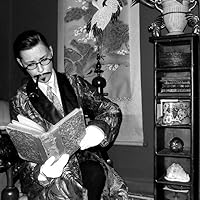
I first discovered this little gem of a book in the days of my youth, back in the ‘80s. Along with with a couple of Alan Watts books, it represents nearly my entire education in Zen, yet left me with a lifelong fascination for this particular manifestation of Buddhism. In the collection are 101 Zen Stories, The Gateless Gate, a collection of koans, and Ten Bulls, a collection of woodblock illustrations on the stages along the path of Enlightenment.
I do not claim to have become enlightened in any sense a Zen master would recognize, (though this book was handy during that brief phase in my youth where I played at being a profound charlatan guru). Yet I treasure the wisdom, philosophy, and humor that I learned from this book in spite of myself. (I’ve included a couple of examples below.) This is a book to return to repeatedly throughout your life. It’s easy to digest in small doses, so keep it where it comes to hand easily and often.
Peter Coyote expertly narrates the audio version of this book (the reason I’m rereading it now).
Buddha told a parable in a sutra.
A man traveling across a field encountered a tiger. He fled, the tiger after him. Coming to a precipice he caught hold of the root of a wild vine and swung himself down over the edge. The tiger sniffed at him from above. Trembling, the man looked down to where, far below, another tiger was waiting to eat him. Only the vine sustained him. Two mice, one white, and one black, little by little started to gnaw away the vine. The man saw a luscious strawberry near him. Grasping the vine with one hand, he plucked the strawberry with the other. How sweet it tasted.
* * * * *
In a temple in the northern part of Japan, two brother monks were dwelling together. The elder one was learned, but the younger one was stupid and had but one eye. A wandering monk came and asked for lodging, properly challenging them to a debate about the sublime teaching. The elder brother, tired that day from much studying, told the younger one to take his place. “Go and request the dialogue in silence,” he cautioned.
So the young monk and the stranger went to the shrine and sat down. Shortly afterwards the traveler rose and went into the elder brother and said, “Your young brother is a wonderful fellow. He defeated me.”
“Relate the dialogue to me,” said the elder one.
“Well,” explained the traveler, “first I held up one finger, representing Buddha, the enlightened one. So he held up two fingers, signifying Buddha and his teaching. I held up three fingers, representing Buddha, his teaching, and his followers living the harmonious life. Then he shook his clenched fist in my face, indicating that all three come from one realization. Thus, he won, and so I have no right to remain here.”
With this, the traveler left.
“Where’s that fellow?” asked the younger one, running into his elder brother.
“I understand you won the debate.”
“Won nothing! I’m going to beat him up!”
“Tell me the subject of the debate,” asked the elder one.
“Why, the minute he saw me he held up one finger insulting me by insinuating that I have only one eye. Since he was a stranger I thought I would be polite to him so I held up two fingers, congratulating him that he has two eyes. Then the impolite wretch held up three fingers suggesting that between us we only have three eyes. So I got mad and started to punch him but he ran out and that ended it!”