Jump to ratings and reviews
Rate this book

The Old Slave and the Mastiff

Rate this book

A profoundly unsettling story of a plantation slave's desperate escape into a rainforest beyond human control, with his master and a ferocious dog on his heels.

This flight to freedom takes them on a journey that will transform them all, as the overwhelming physical presence of the forest and its dense primeval wilderness reshapes reality and time itself.

In the darkness, the old man grapples with the spirits of all those who have gone before him; the knowledge that the past is always with us, and the injustice that can cry out from beyond the grave.

From a Prix Goncourt writer hailed by Milan Kundera as the "heir of Joyce and Kafka," The Old Slave and the Mastiff fearlessly portrays the demonic cruelties of the slave trade and its human costs ­- a wise, loving tribute to the Creole culture of Martinique, and a vividly told journey into the heart of Caribbean history and human endurance.

118 pages, Kindle Edition

First published January 1, 1997

130 people are currently reading
4583 people want to read

About the author

Patrick Chamoiseau

92 books199 followers
Patrick Chamoiseau is a French author from Martinique known for his work in the créolité movement.

Chamoiseau was born on December 3, 1953 in Fort-de-France, Martinique, where he currently resides. After he studied law in Paris he returned to Martinique inspired by Édouard Glissant to take a close interest in Creole culture. Chamoiseau is the author of a historical work on the Antilles under the reign of Napoléon Bonaparte and several non-fiction books which include Éloge de la créolité (In Praise of Creoleness), co-authored with Jean Bernabé and Raphaël Confiant. Awarded the Prix Carbet (1990) for Antan d’enfance. His novel Texaco was awarded the Prix Goncourt in 1992, and was chosen as a New York Times Notable Book of the Year. It has been described as "a masterpiece, the work of a genius, a novel that deserves to be known as much as Fanon’s The Wretched of the Earth and Cesaire’s Return to My Native Land".

Chamoiseau may also safely be considered as one of the most innovative writers to hit the French literary scene since Louis-Ferdinand Céline. His freeform use of French language — a highly complex yet fluid mixture of constant invention and "creolism" — fuels a poignant and sensuous depiction of Martinique people in particular and humanity at large.

(from Wikipedia)

Ratings & Reviews

What do you think?
Rate this book

Friends & Following

Create a free account to discover what your friends think of this book!

Community Reviews

5 stars
348 (31%)
4 stars
417 (37%)
3 stars
254 (22%)
2 stars
70 (6%)
1 star
19 (1%)
Displaying 1 - 30 of 224 reviews
Profile Image for Adina.
1,294 reviews5,511 followers
March 17, 2024


Patrick Chamoiseau is an author from Martiniques and this novel won the BTBA award which is now discontinued. This is surreal and touching short novel about an old slave who decides to escape and the hound who follows him. Dark visceral, poetic, mythical. A story about the horrifying nature of slavery.

The translator kept many of the Creole words in order to preserve the atmosphere and authenticity of the original. However, he also introduced quite a few notes which reduced somewhat the flow of my reading.
Profile Image for Debra - can't post any comments on site today grrr.
3,264 reviews36.5k followers
July 19, 2019
Finalist for National Book Critics Circle Award in Fiction

Translated from French, this is the tale of an elderly slave's escape through the lush rain forest on Martinique. The old man is hunted by the Master and his hound. Will he survive? Will he evade the hound that is relentless in its pursuit of the man?

This book is heavy on metaphors and is told through an almost stream of consciousness. I will admit, I am not a fan of stream of consciousness story telling. So, parts of this just didn't work for me, as it is not my cup of tea. There is also symbolism in this book, but the real gem, for me, was the translator's note at the end of the book. I almost wish I would have read that section first.

This short book is interesting, but the writing style was just not for me.
Profile Image for Sue.
1,438 reviews651 followers
May 27, 2018
Slave Old Man is unlike anything I have ever read before. Set on a plantation in Martinique during the time of slavery, it chronicles the “marooning”, the running away, of one old, seemingly elderly, slave who has had enough. This man remembers the voyage from Africa, the horrors on the ship, the years of work. Now he will run.

And with that this short novel becomes a fever dream, a magical and horror filled journey into a primeval place, the Great Woods. The writing is not linear in the same way that this journey is not straight. It twists and turns, soars and plunges along with old man. It is also scattered throughout with words in French or Creole (and English approximations). There are also notes on some major terms at the end of the book, as well as a brief history of Martinique and information on the author, including his purpose and process in his writing.

This was a different and exciting reading experience for me. I know it’s not the type of book to be to everyone’s taste, but if you enjoy a touch of magical realism, encountering a genuine voice of Caribbean Creole culture with all the history that entails, and a poetic yet visceral narrative, then this could be for you. As for me, I intend to find more from this author.

A copy of this book was provided by the publisher through NetGalley in return for an honest review.
Profile Image for Lauren .
1,834 reviews2,550 followers
June 12, 2022
Chamoiseau's mythic tale centers on "the most docile of the docile" - an old enslaved man who runs the sugar syrup production at a plantation in colonial Martinique. Quiet, keeps to himself, wise and observant. He has seen the many other slaves' attempts at escape from the plantation, always ending with the Master and his mastiff bringing back the runaways and exacting horrible punishment on these people to deter others from trying the same thing.

Establishing this history and scene, the old man attempts his own escape from decades of enslavement. He leaves the plantation lands for the first time, entering a mystical Martinique, one with fantastical creatures and landscapes, all the while pursued by the Master and his mastiff.

Chamoiseau's writing is allegorical, and heavy with meaning. Translator Linda Coverdale's copious end notes provided rich context for the story, everything from historical, folk lore and medicine, African and Amerindian culture, and flora and fauna of Martinique. Coverdale included many French and Creole phrases / idioms with subsequent translations, giving that verbal and aural flavor to the story. Beautifully done.

The ending was fascinating. It secured this one as a 5-star read for me, and one of my favorites of the year.
222 reviews53 followers
February 20, 2019
The U.S. publication of "L'Escave vieil homme et le molosse," kept the "slave old man," yet omitted "and the mastiff," from the title which I found perplexing, but Chamoiseau's novel sings in translation and Linda Coverdale provides an essential afterword and notes that help illustrate how Chamoiseau is drawing from Edouard Glissant and expanding his themes in this novel, especially that of "collective memory," Condensed Romantic prose, rich in imagery and Creole originations keeps the reader engaged throughout, but it is in the afterword that the full depth and layers of meaning are revealed.
Profile Image for Jill.
Author 2 books2,058 followers
May 11, 2018
For those readers who love the power of prose, Slave Old Man is an astounding achievement — exhilarating, hallucinatory, primal, electrifying, and just plain delicious.

It’s a slim tale whose size belies its big message, an old man—considered “the most docile among the docile” of the slaves, slips from a Martinique plantation with the plantation owner’s savage mastiff in close pursuit. The forest becomes almost mythical: an “old man slave running through the Great Woods, not toward freedom: toward the immense testimony of his bones.”

It is hard not to read another level into this story: the monsters that lurk out there, ready to pounce, as we stumble and fall through our oft undefined journey. This is an archetypal tale, and the slave comingles with the history of slavery, all the bones that bear witness and lie there, bleached out, ready to surrender their tales. This old unnamed slave and his timeless tale leaves behind his own bones—a “cartload of memories-histories-stories and eras gathered together.

The final few pages of the story are stunning in their power. It is a book I greatly admire, even though that admiration doesn’t quite rise to the level of love. A lengthy afterward by Linda Coverdale, who certainly did not have an easy task translating from the French and Creole, a glossary of Creole terms, and a preview translator’s note complete the contents of the book. Recommended for those who enjoy erudite and aesthetic novels.
Profile Image for Faith.
2,229 reviews677 followers
August 18, 2018
The slave old man, whose real name was lost long ago, has lived out his days on this sugar plantation in Martinique, apathetic and virtually invisible. One morning he does not report to his job because he has run off into the Great Woods to try to escape from slavery. He is pursued by his master who "clothes his absolute power in white linen, and a pith helmet gives him the allure of a conquistador fallen from a fold in time". He has a mastiff used to hunt down fugitive slaves. Ironically, the mastiff had undergone the same sea voyage and abuse as the slaves and now "... black flesh whetted the dog's appetite". My favorite part of the book was the end, when the mastiff and the slave old man finally face each other. However, the book was tough going for me before that point.

Martinique Creole and creolized French words were left intact in this translation. That's not really helpful to most readers if comprehensibility and readability were goals. There are endnotes that explain these terms, but it's disruptive to check them while you are reading the book. I kept thinking that I should like this book, but it was so hard to read that it really took too much effort. The author's writing style is incredibly dense, poetic and hallucinatory. I admit that I am not a fan of magical realism, but even for that genre, this book seemed way over the top. "[the slave] sees the vertigo of uneven swerves in the art of forgotten embroideresses, the thronging gaps of lights, the couplings of fulls and empties in the labyrinthic nuanced colors of ochres and saffron." Even the mastiff's head is full of strange images, like "chessboards of reveries". "[the dog] sees itself bound to this old man slave who gives off no vibration at all, nothing but the brute density of unplumbable matter, crammed with damps and slit-eyed suns." Too many pages of this book ran on like this. This was certainly an interesting subject and I realize that some reviewers think this author has exceptional gifts, but I wouldn't read another book by him if you paid me.

I received a free copy of this book from the publisher.
Profile Image for Will.
278 reviews
January 25, 2019
Bravo to the NBCCA for choosing this as a 2018 Finalist, a novel unlike most found on an American awards list.

For me, style and language are the powers that drive this story of a runaway slave pursued through the forest by his 'Master' and a vicious ‘monster’ mastiff. The writing is original, dazzling, dream-like and very poetic. It is prose that enforces the folktale quality of the book, propels the reader forward and heightens the experience of the chase through a dense and dangerous environment.

A longer review may follow - I'm struggling with what I want to convey and I need to spend a little more time thinking about this one.
Profile Image for Paul Fulcher.
Author 2 books1,956 followers
June 1, 2019
Stories of slavery do not interest us much. Literature rarely holds forth on this subject. However, here, bitter lands of sugar, we feel overwhelmed by this knot of memories that sours us with forgettings and shrieking specters. Whenever our speech wants to take shape, it turns toward remembrance, as if drawn to a wellspring of still-wavering waters for which we yearn with an unquenchable thirst. Thus did the story of that slave old man make its way to me. A history greatly furrowed by variant stories, in songs in the Creole tongue, wordplay in the French tongue. Only multiplying memories could follow such a tanglement. Here, careful with my words, I can proceed only in a light rhythm, floating on those other musics.

Linda Coverdale's wonderful translation of Martinique author Patrick Chamoiseau's L'esclave vieil homme et le molosse was the winner of the 2019 Best Translated Book Award, under its US title Slave Old Man.

(for some reason the British title is The Old Slave and the Mastiff and the American one Slave Old Man - can't understand why neither could pick the obvious Slave Old Man and the Mastiff)

Now I have to admit that I struggled with my one previous Patrick Chamoiseau novel, his Prix Goncourt winning Texaco, translated by Rose-Myriam Rejouis and Val Vinokurov (see Garth Risk Hallberg's take here https://www.theguardian.com/books/201...). I could understand Milan Kundera's hailing of the novel as "Truly poetic ... the unbridled improvisation of a storyteller who is swept along by his own talking and who oversteps the frontier of the plausible when he wants to — joyfully, and with quite stunning ease," but can't say I really understood much of what I was reading.

Slave Old Man and the Mastiff (I'm going to use my own title) more satisfying, thanks to Linda Coverdale's wonderful job in not only translating the mixture of French and Creole into her own lyrical register, but providing an introductory note, afterword and a number of helpful footnotes (reading on a Kindle made referring to these a pleasure), which, combined, are half the length of the novel itself.

description
Coverdale explains in her introduction, how Creole was developed by Caribbean slaves both as a fusion of the Babel of their tribal and European langauges, but it also allowed plantation storytellers to say far more than 'their listening masters could ever understand', using the language, as Chamoiseau says in his Creole Folktales, in a way ‘that is opaque, devious – its significance broken up into a thousand sibylline fragments’, and she effectively incorporates the Creole into her text, often providing a word followed by its English translation (djok-strong), or adding a small additional gloss.

Each chapter (cadence in Chamoiseau's terminology) of the novel begins with a passage from works by Édouard Glissant, a foundation figure of Martinique and indeed Caribbean literature, putting Chamoiseau's novel in dialogue with his, as well as a poetic epigraph from an anonymous work Touch.

So the novel opens:

(from Glissant)
There is, before the cabin, an old man who knows nothing of ‘poetry’ and in whom the voice alone resists. Grizzled hair on his black head, he bears in the mêlée of lands, in the two histories, before-land and here-land, the pure and stubborn power of a root. He endures, he treads the fallow land that yields not. (His are the deeps, the possibilities of the voice!) I have seen his eyes, I have seen his wild lost eyes seeking the space of the world.

then:
Immobile dreams of bones
of what was, is no more,
and yet persists in the foundation of an awakening


Touch
folio I

and the novel proper:

In slavery times in the sugar isles, once there was an old black man, a vieux-nègre, without misbehaves or gros-saut orneriness or showy ways. He was a lover of silence, taster of solitude. A mineral of motionless patiences. Inexhaustible bamboo. He was said to be rugged like a land in the South or the bark of a more-than-millennial tree. Even so, Word gives us to understand that he blazed up abruptly in a beautiful bonfire of life.

the original French:
Du temps de l'esclavage dans les isles-à-sucre, il y eut un vieux-nègre sans histoires ni gros-saut, ni manières à spectacle. Il était amateur de silence, goûteur de solitude. C'était un minéral de patience immobile. Un inépuisable bambou. On le disait rugueux telle une terre du Sud ou comme l'écorce d'un arbre qui a passé mille ans. Pourtant, la Parole laisse entendre qu'il s'enflamma soudain d'un tel boucan de vie.

The novel is set on a Martinique sugar plantation and its group of slaves:

The Plantation is small, but each link among its memories vanishes into the ashes of time. The bite of the chains. The rwasch of the whip. The rending cries. Explosive deaths. Starvations. Murderous fatigues. Exiles. Deportations of different peoples forced to live together without the laws and moralities of the Old-world. All of that quickly muddles, for those gathered there, the rippling of recollections and the depth-sounding of dreams. In their flesh, their spirit, subsists only a calalou-gumbo of rotting remembrance and stagnant time, untouched by any clock.

Every month or so one of the younger slaves succumbs to a fevered desire to escape, and flees into the jungle, where they are pursued and inevitably caught by the Master and his huge and savage dog, the mastiff.

There was, as happened almost every month, a young nègre convinced he was wilier than his predecessors and who was hit out of the blue by la décharge. I am going to tell you about the décharge. The old slaves knew about this: it was a bad sort of impulsion vomited up from a forgotten spot, a fundamental fever, a blood clot, a désursaut pas-bon: a not-good jump-up, a shivering summons that jolted you raide off the tracks. You went around being taken to pieces by an impetuous inner presence. Your voice took on a different sound. Your gait grew gently grotesque. A religious flutter set your cheeks and eyelids trembling. And your eyes bore the customary fiery marks of awakened dragons.

The eponymous Slave Old Man is, to outside appearances, placid and content in his lot, the fixer who makes everything function smoothly (one he is gone many minor hitches emerge in the production process), having been on the plantation so long his Master can't actually remember his arrival. But underneath, the décharge burns in him as well, and one day he too flees into the forest:

He turns around toward that Plantation where he has worn out his life; he looks at the distant buildings, the sugar-works chimney with its leaping flames, so familiar; he hears one last time the sound of the now-widowed machines. The shiver slips away at his nape. Then, the slave old man plunges into the tall trees. The ancient howl of the mastiff begins to undo the domain, provoking the eleventy-thousand strange little hitches already described, and faced with which the science of slavery gave way.

And there he, and the master and the mastiff in pursuit, plunges into the depths, allowing Chamoiseau and Coverdale to give full and lyrical voice to the descriptions of the Martinican scenery and the local folklore:

He had the impression of descending endlessly, of reaching even the fondoc-fundament of the earth. There he thought to find the vomiting of lava or the fires said to flame from the foufoune-pudenda of femmes-zombis. The torn rachées of his heart throbbed within him, stirring liquid, glowing embers that shattered his body to rejoin the sky. Such incandescence summoned up wild earthy fumes in his bones. Leaves, roots, trunks, took on the odor of ashes graced with those of green corn and newborn buds.
...
He expected to suddenly see the monsters feared by the folktales: the impish Ti-sapoti, the dog-head women, the fireball soucougnans, the flayed-flying-women perfumed with phosphorus, the unbaptized misery of coquemares, and the persecuted zombie persecutors.
...
The old man rediscovers a primordial darkness. Revealed by the blindfold, it is not comparable to the darkness at the beginning of his flight. This night neither envelopes the trees nor flows from the sky. He knows it is released inside him as he runs. He senses its growing épaissi, its thickeningness, like a patterning of the balan-rhythm of his running. It seems to allow him to exist a little closer to the center of his being. His skin is skimming up the promise of the coming sun. Infinite variations solicit his dermis: the earthy aura of the tall trees; the increasing keenness of a shaft of light; the oceanic armpit of a ravine; the mummified silence where ferns exhale the odor of eternal death and stubborn life. For the moment, he has no sensation of going up or down. Suspended within himself, he travels through a sensory topography that molds itself to his body.
...
These Great Woods that knew the Before, that harbored the communion host of an innocence gone by, and which still trembled with primal forces – these woods moved him now.


The labels attached to the Slave Old Man evolve as his journey does (e.g. to 'old man') and the text even switches from third to first person mid paragraph, remaining their for the rest of the novel, to symbolise his rediscovery of his own identity:

Light was strong but no longer as violent. It came from the outside, doubtless from the inside, shining upon him sweetly. The things around him were formless, moving, as if seen through very clear water. I opened my eyes wide to see better, and the world was born without any veil of modesty. A vegetal whole in an imperious evening dew. I … The leaves were many, green in infinite ways, as well as ochre, yellow, maroon, crinkled, dazzling, indulging themselves in sacred disorder.

And even the mastiff and the slave master have an epiphany of sorts, one that the author suggests may, at least, echo positively in future generations:

In him, now, other spaces were bestirring themselves, spaces where he would never go, perhaps, but where one day no doubt, in a future generation, hopefully in the full radiance of their purity and legitimate strength, his children would venture, as one confronts a first misgiving.

An impressive translation, not a straightforward read but a worthy BTBA winner.
Profile Image for Viv JM.
735 reviews172 followers
June 23, 2019
5 astonishing stars!

This book blew me away. I am not sure I have ever read a book with such amazing use of vivid and immersive language and imagery as this and the fact that it is translated makes that even more of an accomplishment. What a deserving winner of the Best Translated Book Award. Highly recommended.
Profile Image for Nancy Oakes.
2,019 reviews917 followers
June 16, 2019
beautiful, beautiful book; this one definitely deserves a second read. I completely lost myself in this novel, not just because of story but also because of the writing; kudos to the translator, Linda Coverdale. Just bloody gorgeous.

more to come
Profile Image for Tamara Agha-Jaffar.
Author 6 books282 followers
July 3, 2018
On the surface, Slave Old Man by Patrick Chamoiseau, translated from the French and Creole by Linda Coverdale, is a straightforward story of the struggles of an old slave as he escapes from a Martinique plantation. Chased by a vicious dog and his master, the slave enters a lush rain forest where nature runs rampant, providing fodder for hallucinations and wild imaginings.

But this is anything but a straightforward story. One could argue it is not really a story at all but a thrilling piece of lyrical poetry. The sheer energy and lyricism of the language propels the story forward, embroiling the reader in the lushness of its diction while immersing us in the plushness of the rain forest. The narrative is gripping, fast-paced, and dense.

As the elderly slave breathlessly runs, twists, and turns in this wild terrain, his mind hallucinates with twists and turns. His journey deep into the forest is transformative, triggering a journey deep into his past. What’s real and what’s imagined become inextricably intertwined with the elderly slave populating his narrative with flashbacks of his harrowing journey from Africa; and with references to and imaginings of the Creole culture of Martinique; with Caribbean history, mythology, and folklore. The reader is swept up in a wave with no sure footing as to what is happening. The journey is archetypal. The forest assumes mythical proportions, housing monsters, mysteries, and secrets older than time itself.

This book may not be for everyone. Smatterings of words in French or Creole, references that require flipping to the Notes at the end of the book, prose that is lyrical and non-linear, and the juxtaposition of the real with the imaginary make it a challenging read. But it is a worthwhile read for anyone who enjoys being swept up by exhilarating prose with an electrifying, haunting quality.

Highly recommended.
Profile Image for Moira Macfarlane.
862 reviews103 followers
July 2, 2021
Wrang en tegelijkertijd een ongekend krachtig verhaal. In een taal die in niets lijkt op wat ik tot nog toe las, met woorden die loskomen van het papier. Woorden die ik het best kon horen met het kloppen van mijn hart, niet met het brein in mijn hoofd.
Patrick Chamoiseau (Martinique, 1953) ontwierp voor zijn roman een niet-bestaande literaire taal, een gecreoliseerd Frans, vooral daar waar de duisternis heerst en de oude slaaf in zijn angst zijn demonen ontmoet. Eveline van Hemert heeft om het te vertalen gebruik gemaakt van onze eigen erfenis van kolonialisme en slavenhandel in de Cariben en woorden uit het Sranantongo en Papiamentu gebruikt om de tekst te laten klinken.
'Ik weet niet waarom, maar ik wil mezelf een naam schenken. Ik kan er geen bedenken. Er zijn zoveel namen in mij. Zoveel mogelijke namen. Mijn naam, mijn Grote Naam, zou ze allemaal moeten kunnen roepen. Laten klinken. Opsommen. Verbranden. Recht doen. Maar dat is onmogelijk. Voor mij is niets meer mogelijk. Voor mij gaat het niet meer om wat nodig is of mogelijk. Om wat legitiem is. Ik bezit geen eigen Vaderland, geen eigen taal, geen eigen Geschiedenis, geen eigen Waarheid, en tegelijk bezit ik dit alles, tot in het uiterste van elke onwrikbare term, tot in het uiterste van hun samenklinkende melodieën. Ik ben een mens.'
Profile Image for Maddie C..
143 reviews45 followers
June 5, 2019
3,5

Beautiful prose but also so dense that, paired with the feverish tone of the narrative, I often found myself completely lost. Maybe there's a beautiful parallel there with the giant allegory that is this novel.
Profile Image for Katie.
264 reviews33 followers
May 8, 2018
Told in poetic, challenging and often hallucinatory prose, Slave Old Man is a powerful read. Linda Coverdale has intricately translated Patrick Chamoiseau’s novel from the original French and Creole into lyrical English. Coverdale’s respect for the original text is apparent and I really enjoyed reading her detailed annotations.

Slave Old Man follows an escaped slave as he is chased through the jungles of Martinique by a devilish hound and his master. As the old man runs deeper into the forest, he is also driven deeper into his past. He begins the story as “the slave old man”, then “the old man slave” and finally as “I”. As he dives deeper into the forest and deeper into his past, he begins to find himself and find his voice. In the eerie and lush forest, the master and the hound are also forced to undergo transformations of their own.

Chamoiseau’s novel is short, but each page is packed with meaning. This is a book that demands a re-read. There are so many layers to explore. I loved this book, but I am also certain that plenty of it went over my head. I am already looking forward to experiencing it again.

Slave Old Man is both a searing look at the horrors of slavery and a beautiful celebration of Martinique and Creole culture. Thank you so much to The New Press for sending me a copy to review. I feel lucky to have read it.
Profile Image for Dax.
336 reviews195 followers
July 18, 2018
Chamouseau’s novella is an allegory rich in allegories. The prose is poetic and can actually be challenging to follow when the Old Man begins to hallucinate during his run through the woods. This is a story about a slave fleeing a plantation with a deadly hound at his heels, but most of the turmoil and conflict takes place within the minds of the slave and his master. Both are forced to come to terms with their past and by the end of the story are markedly different as a result of those reflections. The mastiff is a wonderful metaphor. In case the reader misses it, the final chapter explains the significance of the dog as well as why the old man finally decides to run. I’m impressed.
Profile Image for Rebecca.
4,185 reviews3,449 followers
July 11, 2018
(3.5) Chamoiseau is a social worker and author from the Caribbean island of Martinique. Translator Linda Coverdale has chosen to leave snippets of Martinican Creole in this text, creating a symphony of languages. The novel has an opening that might suit a gloomy fairytale: “In slavery times in the sugar isles, once there was an old black man.” The novel’s language is full of delightfully unexpected verbs and metaphors. At not much more than 100 pages, it is a nightmarish novella that alternates between feeling like a nebulous allegory and a realistic escaped slave narrative. It can be a disorienting experience: like the slave, readers are trapped in a menacing forest and prone to hallucinations. The lyricism of the writing and the brief glimpse back from the present day, in which an anthropologist discovers the slave’s remains and imagines the runaway back into life, give this book enduring power.

See my full review on the Pittsburgh Post-Gazette website.
Profile Image for Macartney.
158 reviews102 followers
January 11, 2018
I loved it. So powerful. Extremely primal. It felt mythical, biblical. Elemental to the basic atoms of being human/animal/etc. It’s devastating and thrilling and quite a ride that stays with you after you finish.

I had some initial trouble getting into it: it’s definitely poetry as prose. The language and word choice (so many alliterations!) was so lush it took me time to accilmiate. I think some of that was also from the French - English translation: sentence structure was very French. But with patience, it soon clicked into place, and I couldn’t put it down.

If I’m honest, I wish the last chapter didn’t exist and the afterword was a preface or an online essay I could find. I finished chapter 6 at the end of my bath, and it was so powerful and impactful. Picking it up later that night, Chapter 7 and the afterword were a bit of a letdown. But those are just quibbles. It’s a phenomenal piece of literature that everyone should read.
Profile Image for Esmé.
124 reviews4 followers
January 23, 2023
Undoubtedly well written yet I found this novella so lucid that I wasn't being sucked in to the story but rather counting down the pages until the end. What otherwise might have been a poignant read ended being a bit disappointing... Although maybe I am just discovering that I really don't like magic realism!
Profile Image for Areeb Ahmad (Bankrupt_Bookworm).
753 reviews262 followers
February 10, 2021
"In slavery times in the sugar isles, once there was an old black man, a vieux-nègre, without misbehaves or gros-saut orneriness or showy ways. He was a lover of silence, taster of solitude. A mineral of motionless patiences. Inexhaustible bamboo. He was said to be rugged like a land in the South or the bark of a more-than-millennial tree. Even so, Word gives us to understand that he blazed up abruptly in a beautiful bonfire of life."



Linda Coverdale in her note talks about how Chamoiseau creolizes language, mixing and match French with Creole to deliver a hybrid language charged with breathtaking vitality, "not free-range but free-form". In this novel, the language is not just the lowly vehicle for the story but is the story itself. He calls his chapters 'cadences' which is very fitting as the prose has a steady rhythm of its own, lilting and lush and lyrical. Coverdale has done a marvelous job as a translator, using unusual words to convey the original sense, employing bilingual portmanteaus in order to display his playfulness.

Language and viewpoint also enable subject autonomy. The protagonist is referred to as slave old man at the start in the third person, it turns to old man slave to an old man who was a slave to the old man and then finally becomes "I" mid-paragraph as he gradually reclaims identity and personhood. Another point of note is the forest where the majority of the action happens, a primordial place of ancestry and connection, full of life. A local tale of mythic proportions, it is more than just an allegory & quite unlike anything I have ever read before.


(I received a finished copy from the publisher in exchange for an honest review.)
Profile Image for Bob Lopez.
885 reviews40 followers
April 19, 2019
4.5 for me. Astonishing writing, full of depth and perception, it is a short book in pages, short in plot, but long in description, observation; I think the one issue I had was that the book had an almost lack of personality: it had the coldness of a neutral observer even when the POV switched to first person! It read like the events were occurring at a remove from the SOM and his language.

The writing was stunning despite its academic veneer (I coulda used footnotes rather than endnotes honestly) and I am looking forward to reading more from this author.
This entire review has been hidden because of spoilers.
Profile Image for Eva.
207 reviews137 followers
April 24, 2022
The prose is gorgeous, but not everything in here worked for me. What I found especially irksome were the frequent long, long, long lists and rhetorical repetitions: He saw [...]. He saw [...] and [...]. He saw [...], [...], [...], and he saw [...]. on and on over pages, it's just frequently too much of a good thing. Which is a bummer, because the first few pages made me think I'd found a new favorite. I also found the complete lack of female characters off-putting: women are only described as seductive dark holes or as arms in which one finds joy, thus reduced to their function as sex objects and objectified to the extreme. I also found the switch from third person to first person narration, meant to indicate the development of true selfhood and individuality, clunky and hamfisted: it lessened my immersion. But the book also has huge, incredible strengths and some of the most beautiful passages I've ever read, so I'm settling on 3 stars. Brilliant, but flawed (in my view).
Profile Image for Calzean.
2,770 reviews1 follower
January 14, 2019
I am sure I cannot do this book justice. On a sugar plantation in Martinique an old slave makes a snap decision and runs/shuffles off to freedom. He is pursued by his master and a massive mastiff.
At one stage (and in the middle of a paragraph) as the slave moves further into the jungle the narration changes from "he" to "I". The main part of the story is the battle of the old man with the jungle, the mastiff with the jungle and the old man with the jungle.
It's a deviously clever short tale on the horror of slavery and what happens when living things become nothing more than property.
Profile Image for peg.
338 reviews6 followers
April 20, 2019
Longlisted for the 2019 Best Translated Book Award, this is the second book on the list about the Caribbean and the Creole movement (the other being Dezafi). The many impressionistic images read like poetry to me and it is a strong MAYBE to make the Shortlist.
Profile Image for Krystal.
387 reviews24 followers
January 3, 2018
With advance praise from Derek Walcott, I reveled in this masterpiece that delivers a vivid meditation on the degradation of the human spirit at the hands of colonialist white terrorism!
Profile Image for Alan (on December semi-hiatus) Teder.
2,707 reviews249 followers
June 20, 2019
A haunting vision in a perfect translation package
Review of the English translation hardcover (2018) of the French/Creole original L'Esclave vieil homme et le molosse (The Slave Old Man and the Mastiff) (1999)

This story of an escape into the bush is an immersive tale that is by turns poetic and haunting with a conclusion that does somewhat enter into magic realism and meta-fiction. What bumps it into a 5 rating are the thorough backgrounds that are provided by translator Linda Coverdale. These are comprised of a Translator's Note as introduction, an extensive Afterword and Translation Notes which together make up about 1/3rd of the book's volume.

There are a considerable number of Creole words left untranslated in the body of the text which are then translated and explained in the back end notes section. This does somewhat impede your reading flow in a first run through but not that significantly due to the novella length. Leaving these words in the text body does add to the entire immersive experience so you should be prepared to go with it.

Trivia and Links
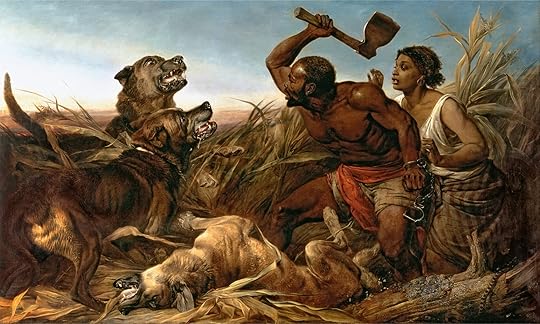
Most of the English language translation editions use a cropped image from the painting "The Hunted Slaves" (1861) by Richard Ansdale (1815-1885). The full image would have given the wrong impression of the number of dogs and people involved.

Image source: Wikipedia Commons
Profile Image for Val.
2,425 reviews88 followers
June 22, 2019
My copy is called "The Old Slave and the Mastiff" and the cover is not quite the same.
An elderly, docile slave leaves his body and escapes his condition, and is then hunted through the forest by his master and a mastiff. Both the old man and the dog take on an almost supernatural form.
There are two ways to interpret this story. A modern rational explanation would suggest that the old man dies and the master and mastiff are pursuing the idea of freedom and the legends growing up around the old man. In African mythology the border between life and death is considered porous, so a mythological explanation would be that the old man is still living in a spiritual sense and brought back to life by the forest.
Patrick Chamoiseau has said in interviews that the book is about story-telling and the last chapter is about telling this story. One of the inspirations for his book is the works of Edouard Glissant (the brother?), none of which I have read, but the translator, Linda Coverdale, includes several details about his themes and his importance to Caribbean literature.
Four to five stars for the original book;
Five stars for the translation.
This is less obscure than "Texaco", but I might now read that one again.
I might read this one in the original French as well.
Displaying 1 - 30 of 224 reviews

Can't find what you're looking for?

Get help and learn more about the design.