I received your Paris card. I waited but you did not return the 23rd. I waited until the 31st, but you did not return. What happened? Where are you? —Sabine
Sabine's Notebook ended with a disturbing disclosure—Griffin and Sabine had somehow eluded each other once again. The Golden Mean beings with an even more disturbing development:
I was sure I understood. Yet you were not here when I returned and there was no sign that you ever had been here... Today comes your card saying you were in this house for three days after my return. I am bewildered... —Griffin
It seems that each cannot exist in the presence of the other. Yet neither can continue without the presence of the other. And so, in this final volume of the Griffin & Sabine trilogy, they struggle against the mysterious forces that keep them apart. Time is running out: Sabine's crystalline visions of Griffin's artwork grow cloudy and dim, and a threatening stranger begins to appear everywhere she goes. The Golden Mean is the tale of Griffin and Sabine's journey towards one another, sometimes dreamy, sometimes desperate, sometimes nightmarish. The golden mean—the harmony of perfect balance—is what they seek in the haunting conclusion of this extraordinary correspondence.
Told in the compelling style of the first two best-selling volumes of the trilogy, The Golden Mean allows readers to open richly decorated envelopes and draw forth intricately illustrated letters, to decipher the quirky handwritten postcards with their macabre and magical artwork, to indulge, in other words, in the wonderfully illicit activity of reading someone else's mail.
Nick was schooled in England and has a BA in Fine Art (painting). He has authored 25 books, 11 of which have appeared on the best seller lists, including 3 books on The New York Times top ten at one time. Griffin & Sabine stayed on that list for over two years. His works have been translated into 13 languages and over 5 million have been sold worldwide. Once named by the classic SF magazine Weird Tales as one of the best 85 storytellers of the century. He has written articles and stories for numerous international newspapers and magazines. His Wasnick blogs are much followed on Facebook and Twitter. His paintings, drawings, sculptures, collages and prints have been exhibited in shows in UK, France and North America. In 2010 Nick's major retrospective exhibition opened at the MOA in Denver. His works are in private collections throughout the world. Nick has a lifetime BAFTA (British Oscar) for the CD-ROM game Ceremony of Innocence, created with Peter Gabriel's Real World, featuring Isabella Rossolini and Ben Kingsley. He has two iPad apps, Sage and The Venetian and is working on a third. Three of his books have been optioned for film and his stage play based on the Griffin & Sabine double trilogy premiered in Vancouver in 2006.
Produced artwork for more than 300 book covers (including works by Roth and Updike), illustrated Viking Penguin's new translation of Chaucer's Canterbury Tales. He's designed theater posters for the London plays of Tom Stoppard and Alec Guinness.
For 20 years Bantock has spoken and read to audiences throughout North America, Europe and Australia. Given keynote and motivational speeches to corporations and teachers state conferences. He's given dramatic readings on the radio and the stage and has been interviewed (way too many times) for TV, radio and print.
Bantock has worked in a betting shop in the East End of London, trained as a psychotherapist, designed and built a house that combined an Indonesian temple and a Russian orthodox church with an English cricket pavilion and a New Orleans bordello. Between 2007 and 2010 was one of the twelve committee members responsible for selecting Canada's postage stamps.
Among the things Bantock can't do: Can't swim, never ridden a horse, his spelling is dreadful and his singing voice is flat as a pancake.
The third act of the Extraordinary Correspondence by Nick Bantock, The Golden Mean continues to be a gripping and stunning work of performance art and delivers an extraordinary and satisfying conclusion. The payoff is certainly worth it here. This is the final installment of the original trilogy, as the Morning Star trilogy picks up with different characters that become involved with the discovery of the Griffin and Sabine’s letters and The Pharos Gate: Griffin & Sabine's Lost Correspondence (returning to the two main characters) wouldn’t come out for another 23 years. For a better discussion on the aesthetics of these works, see my review of Griffin and Sabine, but I will restate how delightful it is that Bantock makes the reader a part of the performance through clever use of letters that create a tactile experinece. This book starts right where the last concludes, with Griffin confused how he arrived back at his apartment before the date Sabine left and not only does not find her there but there is no evidence anyone was ever there. The long-distance romance between the two only blossoms more as they discover strange forces might be working to thwart them from meeting.
This final chapter also introduces a third writer of letters and the inclusion of a villain really shakes up the narrative in a fun way. While Bantock leaves this one fairly open-ended and with a new mysterious occurrence it still would make for a satisfying conclusion if the story was never expanded upon again. What really works best here is that Griffin and Sabine are on equal footing and understanding, working together against a common enemy by the end. It is enjoyable to the last drop and would be particularly satisfying to anyone who has experienced a long-distance relationship. Clever, artful and just a great time. This is best read as an entire trilogy (definitely read in order) and the whole is definitely greater than the sum of its parts. I'm so glad I discovered this series.
NICK Bantock's The Golden Mean (Griffin & Sabine trilogy #3) continues where Sabine's Notebook left off. The book is in the form of correspondence between two lovers Sabine and Griffin. It contains 15 beautifully-illustrated postcards and four letters that are tucked inside intricately-designed envelopes.
Griffin's postcard to Sabine, telling her about the storybook he is writing for children.
I had bought the tome towards the beginning of the new millennium and kept it in my library to read it someday. Then I forgot all about it. Then I took it out towards the middle of last year, put it on a table and once again forgot all about it. Finally, on January 8 I rediscovered it while searching for another book to read. I picked it up and started reading it immediately. I am glad that I did as it contains an enchanting story of two lovers who have been separated since quite long.
Sabine's postcard addressed to Dr. Matthew Sedon in Nairobi, Kenya.
The woman is writing from an island in the South Pacific and the man is writing from Devon, England. The distance between the two seems to be growing greater and greater. And all the more so because of the intrusion of a stranger -- Formatti -- into Sabine's life. Will the two lovers finally get to meet to end their separation into marriage? Or will the intruder, Formatti, prove to be an iron wedge between the two? He certainly is colder than cold steel!
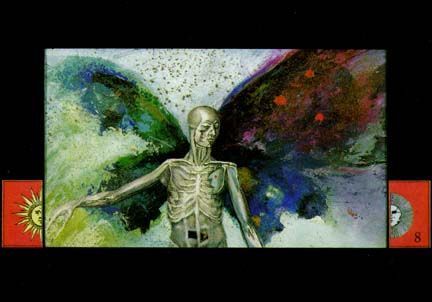
A butterfly skeleton. Does it signify fluttering to freedom from the throes of danger and, thus, death?
I was most willing to give the book five stars because of the stupendous epistolary between Sabine and Griffin and the amazing artwork. However, I decided to give it only four stars because of the inconclusive ending. I also felt cheated on behalf of its author Nick Bantock who instead of ending the trilogy here extended it to yet another trilogy. I am sure he takes his readers to be suckers.
A goldfish crashes through a champagne glass. It could be an allusion to Sabine escaping from her island fortress and the tentacles of Formatti.
If I could sum up my feelings about this particular book and series it would be this:
I wasted my valuable time believing that this series would get better and have the ending resolved but I was wrong. Knowing that now I believe this should have been one long standalone book to hell with it. I love the artwork, the letters, and the whole creative part of this book but I believe this story did not stand up to par with the creative artwork. I believe in my humble opinion that the first book was the best out of this series.
This book leaves off where Griffin came back home and supposedly learn that Sabine has never been there and Sabine waited forever for him to come home but she had to catch her flight back to the islands. They write letters to each wondering if they will ever meet and I believe which the book gives subtle hints which that they live in parallel worlds. It is impossible for no one to have not witness Sabine in London so that is the only logical reasoning in this magical realism story.
Then out of nowhere this became a thriller when this random man shows up and starts stalking Sabine. He is a supposedly a telepathic reporter looking for cases of telepathy like out of the X-Files and wants her letters. She is worried that something evil will happen and Griffin wants to protect her so they decide to meet half-way to Alexandria where there is a famous portal to another world. And that is it. You do not know whether they finally met, about this evil man, or if they are still together except for a random postcard to a doctor.
I am livid that the author did the same shit again and didn't provide a satisfying ending. There is other books that feature Griffin and Sabine and in the beginning I wanted to read them but now I refuse. Why do I have to invest more time on them if you could have done that with this book? If the ending was quite good I would have no problem delving into these spinoffs but I guarantee you it is going to be the same formula repeated in which they never meet but get close and fail again.
I am very disappointed with this series I was going to rate this lower but because of the artwork I cannot give it lower than a two because then I will not be doing justice. Would I recommend this book? Hell to the No! I suggest reading the first book and making up your own conclusion whether Griffin and Sabine ever met and lived happily ever after. The End.
Just when Griffin and Sabine's story is starting to feel a bit stagnant, a postcard appears with unfamiliar handwriting from a character yet unseen in the series. The new character makes an odd request, and the result is an unexpected twist that shifts the tone from surreal to unnerving.
With few words, Nick Bantock stirs the imagination and hints at something from a veiled realm:
Academically bright as he is, [he] never has been able to smell a shadow.
I will take you to the garden and show you the dark trees they call the twelve apostles and tell you about the one night a year when you can see the thirteenth.
The Golden Mean is visually rich. The postcards and letters exhibit the implication of bold textures and diaphanous layers of dusted color. Still others are stunning for their simplicity. All are subtly nuanced; little details like whether or not a card is postmarked or dated remain meaningful.
The ending speaks for itself and, as always, the mystery continues.
I once went to a Nick Bantock reading where he boasted of his success in the face of his teachers of English literature who had, to put it nicely, not encouraged him. This reading, and I suspect a large part of the book tour, was a proud snub in the face of all that. He was intent upon getting the message out that his teachers had told him that he couldn't write and, boy, had he shown them. Having read the first book of the series, I would have proudly stood to his defense, in full agreement. This book was inventive, innovative, physically beautiful, and wove a lovely tale. The experience of reading this book was about as special as the book itself. But then I read the second book of the series and, sadly, the third. Now, no cliche rings truer to me than the notion that within everyone is ONE great work of art, and ONE work does not make a writer. Skip 2 and 3 - 'nuff said.
This is the final book in the Griffin and Sabine trilogy, and I would highly recommend reading all three of these visual novels back to back. Love how this story unfolds. Am checking my mailbox now to see if I got a postcard from a stranger ....
When my friend gifted this set of books to me, I was awed simply at the design and presentation of the book. The concept was so unique, and new to me, that it blew me away. I kept staring at the book and the art till my eyes ached. I love and appreciate art, though I can't claim to understand every artwork I see. Possessing a hardcover book with so much art in it added to the overwhelming feeling. And then I started reading. The epistolary is a voyeuristic genre, but this book takes voyeurism to another level. The act of actually picking up another's letter from its envelope and reading is just one of the levels. The artwork of both Griffin and Sabine is not just decorative - it is an intensely private pathway to their minds; it gives insight into their psychological states, and adds another layer to the story. Art is like that - deeply personal and public at the same time. As for the story, the ending left me confused. However, I'm trying to make peace with it. I have two takes on the end. One is that Griffin and Sabine found each other, and since they no longer needed to view each other through dreams and visions, they started seeing works of someone else. But why that someone is a doctor and why an artist is having visions of prescriptions, I am not clear about. What strengthens my idea that they have been brought together is the fact that the last letter uses the plural 'we' and the stamp is the first painting that Sabine asked Griffin to send her. The second idea I have is a little weak and has a lot of gaps. I think Griffin was a patient of severe multiple personality disorder and had been sending those letters to himself (how from different parts of the world each time, I can't justify). Finally, he made peace with the personalities, having made them meet each midway, which got things sorted in his head somehow. Maybe he actually started getting visions after this, and he starts connecting with Dr. Matthew. (Yeah, I know this one doesn't sound a strong enough argument.)
This entire review has been hidden because of spoilers.
I hated the additional character added to this one. I guess the author ran out of ideas and so put that in for some drama, but it was dumb.
Definitely lost the magic that was there in the first one, although I did like the stamp on the very last postcard.
I borrowed the next trilogy from my friend so I'll go ahead and read them. They only take about 30-40 minutes to read all the way through so it's not a huge commitment.
For a "conclusion" to a trilogy, this book is really lacking. I just don't get the hype. Griffin himself says it best: "To tell the truth, I don't know about the story, but I quite like the pictures."
I loved The Golden Mean maybe a little bit less than the other books, even though the plot definitely advances here. It’s the end of the original trilogy, and there’s just so much that we don’t know because of the frustrating format. It makes sense that we can’t know it, but it’s still infuriating to get to the end and be left with so many questions about the story and what exactly happened. I’m very curious about that last postcard, don’t get me wrong! I’d love to read more!
But… this particular volume felt a little bit thinner, and the fact that the later books are all available second-hand only (and expensive) is really sad.
It’s still absolutely beautiful, with letters each in their own envelopes (though the envelopes are a little less well stuck to the page in this than in my copies of the first two books). It’s a lovely, tactile, multimedia experience, and I thoroughly recommend it even with its frustrations. I’ll continue reading the series when I can, though sadly it won’t be soon, unless I have a Fairy Godmother somewhere!
Eh. I didn't hate this, but it's disappointing considering how interesting the first book was. Even though the art and format of this book was the same, for some reason the author decided to essentially completely change the plot! A new character was introduced and I'm honestly not sure why. It was like the author wanted to introduce thriller elements so that the plot would be more interesting, but I don't think it worked.
I've read in other reviews that people didn't like the ending, but I really did! It's definitely up to interpretation, but I thought it was fitting.
Since this series (and all the books in it) are super short, I'd recommend it even though the last book was a bit of a let down. It's interesting enough that it's worth the read imo.
though much of this prose was awfully pretty, the narrative stuttered and failed. disappointed & wishing this trilogy might have ended differently. oh well. not everything is bound for success, i suppose.
The final book of the trilogy, and Griffin and Sabine have yet to meet one another, other than through the gorgeous postcards and letters in the book.
This one introduces a third character, who appears to have something to do with their inability to actually meet, but who he is and what his actual intentions are is left somewhat vague.
Griffin is back in England and Sabine in her home. It looks as though they are back to where they began, but they are also determined to meet one another.
Again, there is the slightly guilty thrill of opening an envelope addressed to someone else and reading the letters. Also, the artwork is very much part of the story.
Despite looking like an upscale, adult interactive book, this isn't a simple child's story with "happily ever after". The ending leaves much to the reader's imagination as to what happens to the pair.
After the last book in this series, I mentioned that I might be losing patience with the story. Maybe some people like unanswered questions because they feel like they can create the story they want in their minds. I can create my own stories in my mind -- I want to know what the author is thinking for his characters, and I get the feeling that Bantock was just being lazy because he wasn't sure himself how this was going to end. It got into such a convoluted mess that I half-expected Griffin to wake up and realize it was all a dream. The collages and letters are beautiful, but sadly their content made no sense to me.
What the actual hell was this? Honestly, it was so disjointed and pointless that it could have been omitted entirely. The addition of the stalker made no sense and had no resolution, just like the main storyline had no resolution. How can the author call us a conclusion without even answering the biggest question spanned across the three books? I'm convinced this author had no idea what to do or how to finish the story so here we are with a fantastic book number one, a mediocre and frustrating book number two, and a flat out stupid book number three.
While I expected to ask a lot of questions to unveil the whole trilogy's mystery, more specifically the extraordinary telepathy and correspondence, I did not like how it ended. It may have been a happy ending for Griffin and Sabine but I felt I needed more of that suspense from Victor in this finale.
But I still recommend this series especially if you like opening letters, reading postcards, and you are into experimental and abstract art. ;)
A worthy conclusion to the trilogy, the art is as good as ever and the tale of Griffin and Sabine is brought to a worthy, if mysterious, end.
I’m still not decided if the books should have stopped at one or expanded into the three that we have. The first one had a touch of magic that seemed to be missing from the others. It seemed as the story advanced it sought to explain more than was necessary which wasn’t possible in the short length it has. This perhaps got in the way a little and made some of the correspondence more prosaic than it might otherwise have been.
I don’t know, I’m waffling a bit, all the books are very good, the artwork is of a consistently high standard and I enjoyed the story, despite a dip in the second and some of the third book.
C'est vraiment frustrant cette fin, tout simplement parce qu'il n'y en a pas. Toutes ces pages où les personnages font des théories sur leur lien et l'explication ne viendra jamais. On introduit un antagoniste qui ne sert à rien ??
Je ne sais pas si le but de l'auteur est de montrer que le plus important soit que les deux personnages se sont trouvés, que leur lien est indescriptible mais je trouve ça mal fait. Si depuis le début, il ne fallait pas chercher d'explication alors pourquoi les personnages essayent sans cesse de comprendre pourquoi ils sont liés ? La fin est frustrante, ce qui enlève du charme aux cartes, malheureusement.
Update : en fait j'ai un doute si c'est le dernier livre ?? Je ne comprends plus à l'aide
This entire review has been hidden because of spoilers.
Maybe I'm too much a seeker of happy endings (and one's that make sense), but this left me dissatisfied. I liked elements of it (new characters, new places, beautiful envelopes!), but I had too many WHAT?! moments to feel really settled here. Ending felt like the author didn't want a mystery but instead wanted to write more books, which I later found out he did, so that was no fun. Glad I read the whole series though, an interesting escape and still a nice testament to love!
This entire review has been hidden because of spoilers.
My fingers were shaking as I turned the pages for this one, desperate to pull the letters out and digest them as quickly as I could. Every bit of information making me more and more infatuated. By the last few letters, nothing mattered but what was on them & everything else melted away, i almost forgot to breathe.
The beautiful connection between two strangers who have never met. The romance and mystery and the story which progresses through the series of postcards and letters exchanged between Griffin and Sabine, leaves the reader wanting more at the end of book. As the story is progressing, one starts wondering if they are real of figment of imagination. While a voyeuristic touch of reading someone's mail is fun, the illustrations are glorious. Love every page of this series!
I love this trilogy of books but I felt that this ended on cliff hanger. What happens next? It may be the last book in a trilogy but it doesn't feel like it.







![Profile Image for s.penkevich [hiatus-will return-miss you all].](https://i.gr-assets.com/images/S/compressed.photo.goodreads.com/users/1735525095i/6431467._UX200_CR0,11,200,200_.jpg)