The epistles of St. Ignatius are presented here in their entirety, with the historic insight imparted in an excellent translation to English. Saint Ignatius of Antioch was one of the foremost early Christians, acceding to the role of Bishop of Antioch in circa 67 A.D. . During his tenure as bishop he would author several Epistles - or letters - to various figures of the time. These writings are treasured as some of the earliest Christian texts extant. Travelling widely during his life, St. Ignatius placed much effort in spreading the influence of Christianity. His writings are notable for coining the term 'Catholic Church', which remains in use to this day. This edition includes letters which are generally considered authentic, being as they were individually referenced by the Roman historian Eusebius during the 4th century A.D. . These are as follows: Epistle to the Ephesians, Epistle to the Magnesians, Epistle to the Trallians, Epistle to the Romans, Epistle to the Philadelphians, Epistle to the Smyrnaeans, Epistle to Polycarp, Bishop of Smyrna. For the sake of completeness, this edition also contains several epistles whose authenticity is disputed among historians and theologians. The general consensus is that these letters are spurious and were attributed to St. Ignatius a long time after his death. These include: Epistle to the Tarsians; Epistle to the Antiochians; Epistle to Hero, a Deacon of Antioch; Epistle to the Philippians; The Epistle of Maria the Proselyte to Ignatius; Epistle to Mary at Neapolis, Zarbus; First Epistle to St. John; Second Epistle to St. John; The Epistle of Ignatius to the Virgin Mary. This edition contains all original notes, as appended to the English translation originally printed in 1885.
"Ignatius of Antioch (Ancient Greek: Ἰγνάτιος Ἀντιοχείας, Ignátios Antiokheías; ad c. 35 or 50 – 98 to 117), also known as Ignatius Theophorus (Ιγνάτιος ὁ Θεοφόρος, Ignátios ho Theophóros, lit. "the God-bearing"), was an Apostolic Father and the third bishop of Antioch. He was reputedly a student of John the Apostle. En route to Rome, where he met his martyrdom by being fed to wild beasts, he wrote a series of letters which have been preserved as an example of very early Christian theology. Important topics addressed in these letters include ecclesiology, the sacraments, and the role of bishops."
St. Ignatius of Antioch is one of my friends. I return to him year after year not just within the liturgy of the hours, but also in personal reading. This is great spiritual reading. It's short, concise, and directed.
For the historian and seeker, Ignatius provides the 'missing link' in the connection between the Church founded by Jesus Christ and the Roman Catholic Church you know today. He sees the unity of the community in the bishop, who is Christ himself for the people.
His zeal for martyrdom can be difficult to stomach, but for me it challenges me to grow in my faith.
Why don't evangelical Christians study these historical texts more? There seems to be something taboo about quoting the early church fathers, yet nothing taboo about quoting 20th century sources, Puritans, or whomever else after, say, Calvin. These epistles from Ignatius Bishop of Antioch to the churches at Ephesus, Magnesia, Rome, Smyrna, Philadelphia, Tralles, and to fellow bishop Polycarp are great history. If you've ever asked "what happened next?" while reading Paul and Peter's epistles, read Ignatius.
I believe these works also help in determining whether we're interpreting a New Testament text correctly. How does Ignatius quote from the gospels and epistles? He's writing to Ephesus and others after Paul, Peter, and John did, knew their strengths and weaknesses. Ignatius is writing from Syria (Antioch). He came to be Bishop of Antioch around 67 A.D. knew Polycarp, would have known John and was likely discipled by him. He died a martyr in 108 A.D. Ignatius was the first to use the word "catholic" for the universal church, which was later given a capital "C" and that makes Protestants today uncomfortable.
I find Ignatius continues the concern found in Peter and Paul's epistles for orthodoxy. Ignatius comments on the eucharist, the body and the blood, remind many of transubstantiation and makes them uncomfortable. Without a commentary, I see him referring more to the danger of gnostic influences who denied that God took on flesh. I also am reminded that the order of succession was important to the early church; if you didn't get your teaching from either the circulating gospels or epistles, or from someone who knew and got their commission from the Apostles, then it was in error. I think this sheds light on his exhortation not to take the eucharist or be baptised apart from an elder. He has similarly strong Pauline and Johannine concern about the influence of Judaizers: "For Christianity did not believe in Judaism, but Judaism in Christianity."
Ignatius wrote these epistles rather hastily, likely on his way to martyrdom. For early Christians, that was just a given reality-- Jesus, his disciples, and the next generation expected and met that end with joy and peace. But Ignatius wanted them to meet it holding fast to the right gospel as well.
"I am God's wheat, and I am to be ground by the teeth of wild beasts, so that I may become the pure bread of Christ."
The style reminds me of Paul, in the sense that both people are writing letters!
I think one of my bigger takeaways is the constant discussion of the bishop, which seems to eclipse that of the presbytery and the deacons (though the latter two are still usually appended as a “and likewise” kind of comment.) I’d want to learn more about how he understood these offices. It also sounds like the bishop would always be interacting with the lay people—is this the case today too?
I also thought reading the letters would be super shocking or startling, as some of the reviews seem to suggest, but I didn’t seem to see anything like that (apart from the constant talk about the bishop), at least coming from a Protestant/Evangelical view. I guess that’s a good thing? 😆
It was also nice to just read the continued encouragement of St. Ignatius to the communities he was writing to; again, a bit reminiscent of Paul (maybe because we are coming out fresh from a Paul course.)
A good (and relatively short) read! Perhaps will revisit since I may have missed some things.
Firstly, that St. Ignatius truly didn’t see justification as a one and done thing where Christ is attained (past participle). His emphasis on salvation being a future reality really hits hard against my previous Protestant views. He truly saw his salvation as something he would reach in faithfulness (by the grace of God) not mere belief.
“Now I begin to be a disciple... Let fire and cross, flocks of beasts, broken bones, dismemberment.. come upon me, so long as I attain to Jesus Christ.”
Secondly, he constantly warned the church from divisions and and religious activities not authorized by the bishop. His reverence for the role of the Bishop and his view of those operating outside of the Bishop is crystal clear, thus confirming the Catholic idea of a visible church. He also makes clear the three fold office of bishop, priest, and deacon.
“See that ye all follow the bishop, even as Jesus Christ does the Father, and the presbytery as ye would the apostles; and reverence the deacons, as being the institution of God. Let no man do anything connected with the Church without the bishop. [] Wherever the bishop shall appear, there let the multitude [of the people] also be; even as, wherever Jesus Christ is, there is the Catholic Church. [7 Whatsoever [the bishop] shall approve of, that is also pleasing to God, so that everything that is done may be secure and valid.”
And thirdly, his view on the Eucharist being the true body and blood of Christ and that this Eucharist could only be truly administered under the authority of the bishop.
“Be careful, therefore, to take part only in the one Eucharist; for there is only one Flesh of our Lord Jesus Christ and one cup to unite us with His Blood.”
“Let that be deemed a proper Eucharist, which is administered either by the bishop, or by one to whom he has entrusted it.” Letter to the Smyrnaeans, Chapter 8).
To those seeking the true church, this book is extremely confirming.
Jag vill först säga att jag läst en annan utgåva, så jag är inte säker på att min rekommendation går även för kindle-versionen. Ignatius tar upp tre teman genomgående: Att undvika inbördes strider, undvika att ändra i religionen genom personlig gnosis, och vidmakthålla ett avstånd mot världen och dess smuts. Detta går i Ignatius personliga fall så långt som till en längtan efter martyrkronan.
Ignatius är befriande ärlig med sina preferenser - det viktiga är att folk håller ihop, visar respekt till och med mot sina minsta medlemmar, och förhåller sig ödmjuka mot varandra och mot de lokala biskoparna. Genom denna ortopraxi menar Ignatius att praktisk kristendom föds; vilket inte vill säga att doktrin är oviktigt enligt Ignatius - framförallt i relation till treeninghetsförnekare är han mycket skarp - men den förefaller oviktigare. Återkommande är order att skydda änkor, och vidmakthålla harmoniska familjeförhållanden. Flera av breven är adresserade till enskilda individer - diakonissor, diakoner, äldstar, och till och med jungfru maria (detta ligger under "spuriösa brev").
Om man är intresserad av förnicensk kristendom rekommenderar jag denna bok. Som vishetslitteratur duger den, men är inte det som jag självklart skulle gå till först.
I read St. Ignatius' letter to the Church in Philadelphia as a part of my sermon prep for Revelation 3:7-13. I decided to read the rest of the volume. The version I had access to was 2 volumes, so it only contained 4 of Ignatius' letters.
These letters are a great look into the early church, composed of the generation of people just after the apostles.
A news article came out a few weeks ago claiming the discovery of the oldest known inscription stating that Jesus is God, from ~230AD. This puzzled me, as all stupid headlines do, because the article authors (and many scholars) act as if this is A) surprising, B) new, or C) necessary. The more I read (of the Fathers, of Church history), the more I'm shocked at the willful incredulity of many people, especially concerning the antiquity of Christian doctrine and the unity of Christian teaching. Both can be plainly found in Ignatius of Antioch, who fired off a flurry of letters before he was executed in Rome.
Ignatius (along with Polycarp) was taught by Saint John himself, the author of the fourth Gospel. Ignatius plainly states in his letters that Paul "was sanctified, who obtained a good report, who is worthy of all felicitation; in whose foot-steps I would fain be found treading, when I shall attain unto God; who in every letter maketh mention of you in Christ Jesus." Here he's writing to the Ephesians, which means that that final sentence actually gives direct primary document testimony that Paul did in fact write that epistle (contrary to contemporary scholarship, who rely on mistrusting eyewitnesses, dismissing ancient consensus, and other methodological absurdities).
Most infuriatingly of all, in almost every single one of his letters, he makes a point of including a proto-Apostles Creed which explicitly states that Christ is God, and that Christ had human flesh, died, and bodily rose (on a couple occasions he makes fun of "certain persons who are godless, that is unbelievers, [who] say that He suffered only in semblance, being themselves mere semblance"). All of his letters were written somewhere between 108-140 AD, with the earlier dates being more likely (during the reign of Trajan, c. 98-117 AD). The reason why I'm infuriated is that for some reason, the burden of proof is on orthodox Christianity to prove its legitimacy, when you could not get any more antiquity, unanimity, continuity, and consistency if you tried. Not only do all of the Gospels state that Christ was God, but almost every Church Father since also attests to this. The burden of truth rather should be on the much later, much more esoteric gnostics to prove they're the "real" church, or on contemporary scholars to prove that the ancient testimonies aren't trustworthy. But the gnostics are such obvious forgeries and perversions that they don't deserve any further rebuttal than Irenaeus already gave them. As for contemporary scholars, they are much smarter, but dare I say not much wiser.
So with all that idiocy out of the way, what else do we learn from Ignatius? For one, he is extremely concerned about oneness, about unity: of the Church, of God, and of the Church with God. He knew one of the last living apostles (if not the last), and with them all gone he knows how imperative it is to keep the faith. Contrary to contemporary insults against their intelligence, he and every other ancient knew how quickly legends can spring up, how teachings can change, and how stories can become corrupted, which is why he emphasized so strongly that they adhere to people who were taught by the original apostles, namely the Bishops.
In making this assertion, possibly the one he is most concerned about across all of the letters, he makes an interesting argument along the lines of what would later be called the "Great Chain of Being:" ...yet not to him [the bishop], but to the Father of Jesus Christ, even to the Bishop of all. For the honour therefore of Him that desired you, it is meet that ye should be obedient without dissimulation. For a man doth not so much deceive this bishop who is seen, as cheat that other who is invisible; and in such a case he must reckon not with flesh but with God who knoweth the hidden things. Here Ignatius sets up a chain of transmission, responsibility, and power from God the Father, to Christ, to the bishops and other church leaders (through the Holy Spirit).
Other quotes which echo the same thing:
...that ye run in harmony with the mind of God: for Jesus Christ also, our inseparable life, is the mind of the Father, even as the bishops that are settled in the farthest parts of the earth are in the mind of Jesus Christ.
...joined with him as the Church is with Jesus Christ and as Jesus Christ is with the Father, that all things may be harmonious in unity. Let no man be deceived. If any one be not within the precinct of the altar, he lacketh the bread [of God].
Though Ignatius was implicitly denouncing the gnostics and what would eventually become the Arians, his warnings also align with Mormon and progressive Christian tendencies:
...As children therefore [of the light] of the truth, shun division and wrong doctrines; and where the shepherd is, there follow ye as sheep. For many specious wolves with baneful delights lead captive the runners in God's race; but, where ye are at one, they will find no place.
...Abstain from noxious herbs, which are not the husbandry of Jesus Christ, because they are not the planting of the Father. Not that I have found division among you, but filtering.
I found this last sentence very interesting, not "division," but "filtering;" I don't know what the original Greek is, but I think this very filtering out of false doctrine is something that contemporary progressive Christians are so deathly afraid of; they can't give up their false gods (social trends, politics), and thus damn themselves, separating themselves from the unity of the traditional church:
For if He should imitate us according to our deeds, we are lost. For this cause, seeing that we are become His disciples, let us learn to live as beseemeth Christianity. For whoso is called by another name besides this, is not of God.
(Hence people who put social trends and politics before doctrine, etc.). As a rule, I don't find it necessary to argue against progressive Christian readings. All I will say is: though they think they take more seriously Christ's command to love our neighbors, they (like Tolstoy and Calvin and all others who cherry pick the verses/books/church fathers who they want to read), the progressives are easily the worst group in terms of perverting the Gospel. Their central problem is that they simply do not believe "There is one only physician, of flesh and of spirit, generate and ingenerate, God in man, true Life in death, Son of Mary and Son of God, first passible and then impassible, Jesus Christ our Lord." They place themselves in the place of God, asking God to conform to their trendy morality, rather than the other way around. To do this, they make soteriological exceptions in the direction of universalism, they conveniently forget Christ's teachings about judgement, they forget Christ's extremely harsh moral teachings about sexuality (Matt 5, Mark 9), and they choose to forget every Apostle and Church Father's teachings which back these up. As Ignatius says earlier in his epistles:
They that are of the flesh cannot do the things of the Spirit, neither can they that are of the Spirit do the things of the flesh; even as faith cannot do the things of unfaithfulness, neither unfaithfulness the things of faith. Nay, even those things which ye do after the flesh are spiritual; for ye do all things in Jesus Christ.
To me, ever since I was a child, one of my central beliefs, even deeper than some verbal dogma I recited, something I felt and knew to be true inside my every waking moment, was the "in, not of the world" distinction. To me, this is where progressive Christianity ceases being Christian altogether. As Ignatius sums it up, "The Work is not of persuasiveness, but Christianity is a thing of might whensoever it is hated by the world." This directly echoes the sentiments of Paul in 1 Corinthians where he boasts of Christ, not of logical argumentation or social conformity. Christianity became the juggernaut it currently is because it was and still remains counter-cultural and non-conformist in literally the only way which actually matters. It is the only religion in the world which could inspire such strangely beautiful martyrdoms, ones where zealous men and women (such as Ignatius) willingly went to their deaths, not resisting, not launching a guerilla war, not starting some revolution (Ignatius warns Christian slaves to not get egotistical about their spiritually high rank in the eyes of God!). Christ's teachings, straight from the apostles, through the guidance and inspiration of the Holy Spirit, is the only thing which could prompt Ignatius to write the beautiful sentence "I am God's wheat, and I am ground by the teeth of wild beasts that I may be found pure bread [of Christ]."
Thus through death, life and resurrection. What a profound, shocking claim. Let's be careful, lest we water it down with trends, allegorization, or selfish fears. Let us instead boast in it.
Recommended to me by my friend Zach Miller, I found the Letters of Ignatius (Popular Patristics) to be an interesting study of martyrdom. If I’m being honest Ignatius occasionally came off as masochistic almost desiring to die, but I think a better reading would be Pauline IE “To live is Christ, to Die is gain”. I was surprised to find myself more impressed by the expanded pseudo-Ignatius which I felt enriched and clarified many of the saints points as well as St John Chysostom’s biography which drew out Ignatius’ death as a public testimony to all of Rome. I was particularly moved by his call to “bless those wild animals” before his devouring in the coliseum. He saw his suffering and death as a reflection of Christ and believed that where he ended, Christ began.
I’ve included a few of my favorite quotes:
“Grant me this brothers: do not hinder me from living, do not wish that I should die. Do not give the world the who wishes to be God’s, nor charm him with the material. Allow me to receive the pure light. When I have arrived there I will truly be human.” (Pg 71)
“I however do not place my hopes in one who died for me in appearance, but in reality” (147)
When talking about unity in the church and submission to the bishop: “As to a single temple of God you should all run together, as upon one altar, upon one Jesus Christ, who came forth from one Father and is one with him, to whom re returned.” (pg 49)
It’s great to see that the same faith in Christ and joy in the church has marked God’s people throughout the ages. I don’t see Ignatius’ split between επίσκοπος and πρεσβύτερος, but I understand his desire to develop unity behind one person in such a discordant time. Still seems too weak of an argument to have such a hierarchical church polity though. I definitely love how much he lifts up the cross as the centerpiece of our faith as well as our fellowship. True communion must come out of true doctrine. Separating them leads to either a theological club with no familial bonds or a social club with no larger meaning, both perversions of the church.
Blessed Ignatius led by the Spirit of God stood firm as a rock in the faith and provided unbelievable insight into the apistolic mind. He is one of the first five church fathers I read and his explicit statements on church government and other matters of Christian practice convinced me to re-evaluate my faith in the best of ways. Thankful for these precious letters!
I learned about Saint Ignatius months ago from one of Lee Strobel's books, The Case of the Historical Jesus. I decided to buy the epistles to learn more. He was one of the first bishops of Antioch and a student of Saint John, who wrote the revelation. The text of these epistles is known in three different recensions, or editions: the Short Recension, found in a Syriac manuscript; the Middle Recension, found only in Greek manuscripts; and the Long Recension, found in Greek and Latin manuscripts. They are a good source of information for those who want to learn the beliefs of the first church, back in the first century, but also proof of the apostolic succession from the Prophet to the bishop.
[Disclaimer: this review was written some time after my completion of the book. Please judge it accordingly.]
The letters of St. Ignatius, Bishop of Antioch, form one of our most important documents for our understanding of the early church. With his execution looming, Ignatius took the time on his journey, lugged around in chains by the brutish Roman soldiers, to write to various Christian communities, mainly to stress the importance of unity and togetherness within the church but, more covertly, to stress the primacy of the bishop over all other clergy and congregation. (In connection to the priority of a ‘united’, καθολικός, church, he is also credited with coining the ‘Catholic’ church. His letters also give us some hints of the goings-on in these communities in the second century, and of Ignatius’ approval or disapproval of them, but I think the most important contribution is to show where the disconnect between the life and times of Christ and the church as we know it start to arise.
Reviewing them more as historical documents than as religious texts, I suppose I am not as taken with them as others seem to be: an interesting point, for instance, is that he repeatedly encourages the churches not to engage with travelling prophets and other ‘disruptive’ figures, but writes to Polycarp giving him advice on how to engage them. He seems to me to be playing the game pragmatically here, on the assumption that the congregations are impressionable and can be led astray where Polycarp is not likely to budge from his own place of authority. He knows where his allies are when it comes to his agenda of unity, order, and episcopacy.
More critically, on the other hand, if he really does see himself in the same position as Christ, then he is more egotistical than the subsequent martyrs who tended to refuse the comparison. (He also underlines the point by saying that the bishop symbolically is Christ, or should be in the eyes of the community.) This could perhaps suggest he worked on the assumption that other churches and officials really would take his advice, though we have no evidence that they actually did so. He may have really believed this, and believed it was the best thing for the church and the wellbeing of its congregation, but there seems to be a consciousness of this posturing in his letters while at the same time he tries to downplay it through his own obsequiousness to other churches.
Authenticity, naturally, is always a thorny issue with such early texts, as it is with Paul, though Ignatius’ inclusion in Eusebius is usually a good testament to their reliability. Any edition should make clear that some of the letters are considered forgeries, so this should be a caveat lector accounted for. Unfortunately the person of Ignatius is heavily characterised by those who took up his cause later on — he seems to have had much more impact in the long term than in his own time, though of course it’s difficult to get an idea of whether the letters’ recipients would have taken heed of his advice or not.
All in all, it’s important not to let the ultimate triumph of Ignatius’ vision get in the way of how we assess these letters — he may be a preeminent church father to us, but was probably not viewed as such an authority in his own time. Of course, martyrdom helps matters somewhat, and he could only anticipate that status in his own lifetime. Whatever the cause of his arrest was, he seems very apologetic about it, and very eager not to have the church of Antioch tarred with the same brush as they carry on without him. For a historian, it’s important to avoid hindsight bias and to do our best to review the second-century context, even when evidence scarcely makes it possible to do so; for a Christian, to remember the humbleness and precariousness of the Christian church in its origins.
Inácio foi um bispo da igreja de Antioquia na virada do século II d.C. que foi martirizado publicamente em Roma. Suas cartas, que somam 7 no total, são suas últimas recomendações e conselhos para outros bispos e suas igrejas, em estilo bastante parecido com Clemente, aproximadamente uma década antes, e principalmente Paulo.
Em comparação com Clemente, Inácio é bem mais apaixonado por Jesus, e é consciente do que ele chama de "enraizamento" na fé e no Amor, através do Espírito Santo. Assim como Clemente, há um foco acentuado no testemunho e vida prática perfeitos, com implicações de mérito nessa vida santificada, coisa tipicamente católica e já diferente do que Paulo escreveu. A prática perfeita parece ser o objetivo ao invés da consequência da vida entregue ao Espírito Santo.
Além disso, o martírio é um tema recorrente nas cartas. Enquanto escreve, Inácio está sendo escoltado até Roma para ser executado em um espetáculo público, jogado para ser comido por animais, talvez no Coliseu. Como seria de se esperar, Inácio está em paz com seu sacrifício em nome de Jesus. Mas me soou exagerada a voluntariedade dele em morrer executado, quase como se ele estivesse torcendo para que acontecesse. Como se ele preferisse ser vitimizado e morrer mártir do que viver em ministério nesse mundo. Fiquei pensando que até o martírio pode ser egoísta, se o objetivo for a glória de ser um mártir.
The Epistles give us the story of Ignatius, a Bishop in Antioch. He was a true Christian willing to die for Christ's name. He believed in the Eucharist, and condemned those who denied the Host as truly the Body and Blood of Christ.
pg 67-68: pg8: "They abstain from the Eucharist and from prayer, because they confess not the Eucharist to be the flesh of our Saviour Jesus Christ, which suffered for our sins, and which the Father, of His goodness, raised up again. Those, therefore, who speak against this gift of God, incur death in the midst of their disputes. But it were better for them to treat it with respect, that they also might rise again. It is fitting, therefore, that you should keep aloof from such persons, and not to speak of them either in private or in public, but to give heed to the prophets, and above all, to the Gospel, in which the passion [of Christ] has been revealed to us, and the resurrection has been fully proved. But avoid all divisions, as the beginning of evils."
This historical record disproves the Protestant conspiracy theory that the Early Church denied the Eucharist as literally the Body and Blood of Christ. It is proof of the basic Eucharistic doctrine held by the Orthodox and Catholic Churches on the Body and Blood of Christ.
A disciple of St. John, a central theme in his letters is a call to unity, and in particular, to be united with the bishop and do nothing without the bishop's consent.
Is this the first reference to some sort of real presence in the Eucharist? "Take note of those who hold heterodox opinions on the grace of Jesus Christ which has come to us, and see how contrary their opinions are to the mind of God ... They abstain from the Eucharist and from prayer because they do not confess that the Eucharist is the flesh of our Savior Jesus Christ, flesh which suffered for our sins and which that Father, in his goodness, raised up again. They who deny the gift of God are perishing in their disputes."
I found my way to these writings of Ignatius as a result of having read A History of Christianity by Joseph Early during which I compiled an outline of Christianity that extends from 586 BC to the 1970’s.
My, perhaps overly ambitious, endeavor was to periodically read Christian writers throughout the history of Christianity. My tendency has been to jump sporadically about this time line, having read: Justin Martyr (100-165) and Paul Tillich (1886-1965) and Dietrich Bonhoeffer (1906-1945), among others. However, Ignatius of Antioch is the earliest on the list after the time of Christ. Prior to Ignatius the timeline consists solely of philosophers, such as Plato, Epicurus, and Zeno.
Ignatius of Antioch (35-107) is believed to be one of the little children Christ held in his arms and blessed as is described in Mark 9:36-37. Ignatius was a pupil of the Apostle John and was appointed the Bishop of Antioch by Peter.
Because he wouldn’t renounce Christianity, Ignatius was arrested and transported to Rome where he was executed. His seven epistles recount his journey during which he preached and converted many, including his guards. He emphasized the importance of martyrdom and essentially instituted a theology of martyrdom. It was at this time that Christians begin to seek martyrdom rather than flee persecution.
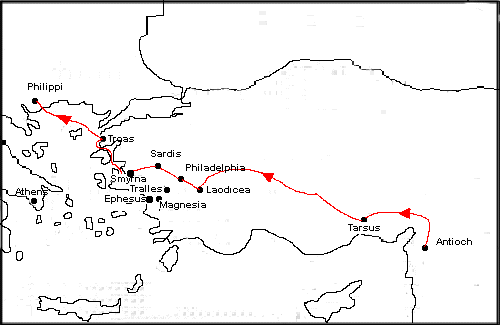
Most Probable Route of Ignatius to Rome
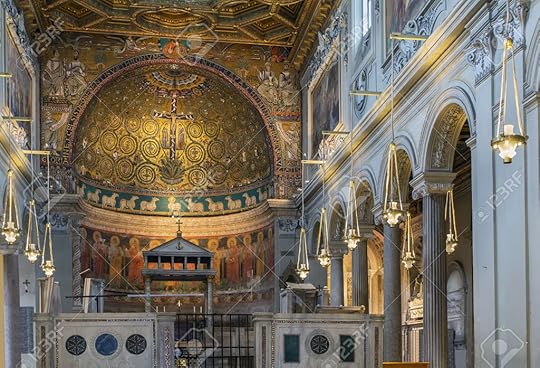
After he was devoured by wild beasts in the Colosseum , his hard remains were carried back to Antioch by his companions and interred outside the city gates. However, in 637 his remains were transferred to the Basilica of Saint Clement in Rome where they are supposedly interred today. The Catholic church revers the remains of Ignatius as holy relics.
Tomb of Ignatius in Saint Clements Basilica, Rome, Italy
There is much controversy surrounding the authenticity of these early writings. Like the Bible, the letters of Ignatius have been translated and re-translated many times. A reader of such early writing has to come to the subject matter with the expectation that the writing speaks through the ages and through the perceptions of multiple religious men who have rendered and re-rendered the document in seeking the preservation and study of Christianity.
I certainly can’t recommend this book to someone seeking casual or entertaining reading. This book reads much like the Bible and would be interesting only to those with a relatively deep seated endeavor to study the history of the Christian Church.
Perhaps the most remarkable revelation for me in studying the Christian Church is that it’s not really as old as we tend to think of it. I mean, we’re only talking about 25 or so average lifetimes that have transpired since Christ. Reading these early authors makes it all so recent and real. It should leave the modern religious man questioning what might be his particular role for continuing the growth and evolution of the Christian Church.
These writings of Ignatius serve as a link to the reality of our religion. They are nothing less than a link between the Apostles and the Fathers of the early Church and therefore a link between our contemporary religion and reality. To read early Christian authors such as Ignatius is to explore near the very fountain-head of the Christian experience.
Of interest to me is that Ignatius, in his legitimate concern for the survival of the church, essentially proclaims the infallibility of the Bishop and suggests that anything that creates division is evil. While such a stance was clearly a vital posture to ensure the growth of the early church, it does denounce the Protestant tendency toward private judgement in matters of religion. It is in the writings of Ignatius that we first gain the term “Catholic Church” and the rigidness with which these writings were accepted contribute to the inflexibility of later doctrines. This inflexibility made it difficult for the the church to adapt in changing times, as the forthcoming decades grew into centuries.
However, todays reader must understand that the perspective of Ignatius is from near the spring-head of the Church. In its infancy, the materializing church must coalesce into a cohesive and viable organization. The early Church is nothing less than the emergence of a dynamic new manifestation of God in the world.
But when the Church begins to age substantially, the static early doctrines developed from these early writings begin to lack adaptability to the times. As a result they tend to collapse under corruption. In fact, the Catholic Church eventually becomes plagued with the decay of corruption. This corruption eventually becomes flagrant enough to spur the birth of dynamism anew, as manifested in the Reformation.
One may certainly perceive the early church as purer in comparison to the latter, which eventually becomes poisoned with the horror of the crusades, the inquisitions, the corruptions, the sales of indulgences, and the idolatry of relics. One may easily speculate that such a one as Ignatius, who gave himself into martyrdom, would have stood aghast at the ultimate impurities that eventually came to taint his Catholic Church.
Perhaps the most powerful thing from reading Ignatius is the recognition of the immense power of martyrdom that fertilized the establishment of the Christian Church. Does one need to be reminded that a martyr is a person so firmly convinced of the truths of the Christian religion that he gladly suffers death rather than deny it. These writings put it very well:
“Roman emperor Decius (201-251), was imbued with the spirt of Roman conservatism. He ascended the throne with the firm intention of restoring the prestige which the empire was fast losing, and he seems to have been convinced that the chief difficulty in the way of effecting his purpose was the existence of Christianity. In the year 250 he issued an edict that all Christians of the empire should on a certain day offer sacrifice to the (pagan) gods. The emperor’s aim, in a word, was to annihilate Christianity by compelling every Christian in the empire to renounce his faith. On the publication of the edit of persecution, multitudes of Christians besieged the magistrates everywhere in their eagerness to comply with its demands. Many other nominal Christians procured by bribery certificates stating that they had complied with the law, while still others apostatized under torture. Yet, after this first throng of weaklings had put themselves outside the pale of Christianity, there still remained in every part of the empire, numerous Christians worthy of their religion, who endured all manner of torture, and death itself, for their convictions.” -Introduction to The Epistles of St. Ignatius of Antioch
Such persecutions continued from the year 64, under Nero, until the year 312, when Constantine embraced Christianity. During this time, many Christians endured prison, torture, and murder because they would not give up the confession.
Yet, these horrible persecutions came to be the most amazing testament to others for the truth of Christianity. Countless men and women, in that terrible first age of Christianity, cheerfully sacrificed their goods, their liberties, and their lives, rather than renounce their faith, which they prized above all. These champions of freedom won, by dying, the greatest victory in the history of the human race. Ignatius refers to them as: “…fellow-travelers, God-bearers, temple-bearers, Christ-bearers, bearers of holiness, as those adorned in all respects with the commandments of Jesus Christ…”
Certainly, many of the horrifying Popes that came to power over the subsequent years of the Catholic Church could never meet these criteria that Ignatius describes. I venture to say that, had Ignatius witnessed the actions of these subsequent Popes, he never would have proposed the infallibility of Bishops.
Unlike the unholy legacies left by many Popes, some of which have been identified as the most evil men in history, a martyr seals their departure with their testimony, leaving a solid legacy for subsequent Christians to stand upon. The tragic fact is that the later church eventually became corrupted by materialism, instead of standing firm in the brotherhood that is Christianity. In fact., the Catholic Church eventually becomes that which Ignatius stood against, which is perhaps best summed up with his own words:
“…the children of perdition, the enemies of the Savior, whose god is their belly, who mind after earthly things, who are lovers of pleasure and not lovers of God, having a form of godliness, but denying the power thereof. These make merchandise of Christ, corrupting His word, and giving up Jesus to sale: they are corrupters of women, and covetous of other men’s possessions, swallowing up wealth insatiably” -Ignatius
I find it always interesting to read early work like this. However, since I'm reading this with little instruction or general knowledge of classical works beyond my own explorations, I'm always suspicious that I'm receiving less than I could actually gain. On the other hand these things are overall valuable -- even if I get less than I would otherwise, I'm still gaining more than I had before.
Ignatius was around in the very early days of the church, a leader in the generation after most the apostles had been martyred before Ignatius himself was martyred. Thus, the first section of epistles sheds some light on that early church. It's apparent just reading from these that many things that some claim were later additions have at least been around before Ignatius wrote these - such as the divinity of Chrsist, the Trinity, and the Eucharist.
Ignatius spends a lot of time urging the church body to submit to their leaders and to avoid false doctrine. The leaders he urges to care for those under them and also to avoid false doctrine. The latter I've known just from my studies to have been around for some time - the apostle John wrote to refute the Gnostics, for example. Holding to true doctrine and teachings would be very important in these early days of the church.
Ignatius also writes often about his hope to be martyred. Since we know that indeed he was martyred, it looks like he got his wish. It is a strange hope, I think, for us today. Today we avoid death and self-sacrifice, even those of us who are Christians in the west tend to see death for our faith as a modern-day aberration and not as something to look forward to. It gives me something to think upon at least.
The spurious letters are called as much because they are most likely written a few centuries after Ignatius was martyred, and this it's unlikely he authored them -- funny that. Anyhow, the introduction to these explains that and notes even reading the translations it's obvious. I've found it is and not only that, but there are even inconsistencies between the various spurious works. I'm typing "spurious" a lot because it's a fun word to say. Spurious. The older epistles have a style and similarities in the subject matter. The spurious letters have some of those, but also tend to go off on tangents or cover topics whoever thought was important to cover. Heck, the letter to Philippi spends a lot of time just making a personal rant against Satan as if the epistle was written to him and not the church, so yeah.
The book ends with the account of his martyrdom.
Overall, I found this translation well enough. In the first section there are short and long versions of most of the epistles. However they are presented in a paragraph by paragraph comparison, which I found difficult to read.. I'd have to read one version, go back to the beginning, then read the second to get a better handle of the voice and narrative of each. Since I read this on a Kindle it made for a lot of tapping back and forth. I think I almost, almost got a finger blister from tapping back and forth.
If you like a study of early church history, doctrine, and thought, this is a good one to put in your list.
+ Docetism = belief that Jesus was a ghost or disembodied phantom, not really human, suffered in appearance only (denial of the incarnation)
+ Commentator dates letters to 134, under Hadrian (not Trajan, per Eusebius)
Quotes:
Let nobody be deceived. Anyone who is not within the sanctuary lacks the bread of God. For if the intercession of one or two has such power, how much more is that of the bishop and the entire church? Ig-Ephesians 5:2
We should either be fearful of the wrath that is to come or else love the gracious gift which is now present to us - one of the two, as long as we obtain true life in Jesus Christ. Ig-Ephesians 11:1b
He was born and was baptized, so that he might purify the water through his submission. Ig-Ephesians 18:2b
…obey the bishop and the presbytery in an undisturbed conscience, breaking a single bread, which is the medicine of immortality, an antidote which prevents death, yet enables us to live at all times in Jesus Christ. Ig-Ephesians 20:2b
Therefore, just as, without regard to the Father (being united with him), the Lord did nothing, either of himself or through the apostles, so you are to undertake nothing without regard to the bishop and the presbyters. Do not attempt to consider a private purpose reasonable, but for a common purpose there should be one prayer, one petition, one mind, one hope in love, in blameless joy, which is Jesus Christ, to whom nothing is superior. Ig-Magnesians 7:1
Likewise everyone should respect the deacons like Jesus Christ, and also the bishop, who is a representation of the Father, and the presbyters as a sanhedrin of God and company of the apostles. Apart from these nothing can be called a church. Ig-Trallians 3:1
My desire is crucified, and there is no love of the material burning in me. Rather there is living water speaking in me, saying to me, within, “Come to the Father…” I desire the bread of God which is the flesh of Jesus Christ… and I desire his blood for my drink, which is incorruptible love. Ig-Romans 7:2c-3
Be eager to celebrate one Eucharist. For there is one flesh of our Lord Jesus Christ and one cup of unity in his blood, one altar, just as there is one bishop together with the presbytery and the deacons. Ig-Philadelphians 4
God does not dwell where there is division and anger… For me the archives are Jesus Christ, the sacred archives, his cross and death and his resurrection and the faith which comes from him, by which I desire, by your prayer, to be made righteous. Ig-Philadelphians 8:1b,6c
They abstain from the Eucharist and prayer, since they do not confess that the Eucharist is the flesh of our Savior Jesus Christ… Those who deny the gifts of God thus die whilst disputing!... Flee divisions as the origin of evils. Ig-Smyrneans 7:1,2b
This is a very thorough review of Ignatius's epistles and is largely a re-print of work published in 1885.
It starts with about 50 pages devoted to St. Ignatius's background and early Christian persecution. It then includes a discussion about the various epistles. There are both short and long versions of epistles deemed to be written by Ignatius as well as eight spurious epistles, which some believe are written by the same person who added to Ignatius's original versions to make the longer version.
This book includes the short and long versions of the genuine epistles, the spurious epistles, translations of some partial epistles found in Syria at a later date and wraps up with a contemporaneous account of Ignatius's martyrdom.
Since I was reading for spiritual reasons, rather than academic interest, I stuck larger to the short versions of the genuine epistles and just skimmed the longer versions and the spurious ones. The short epistles seemed to intended as morale boosters and largely followed the same formula of telling readers...
You're doing great! Let's stay united. Listen to your bishop. Avoid those teaching strange doctrine. I'm going to die, but that's ok. Don't forget to listen to your bishop! I love you!
The letter to Polycarp was a little different since it was one bishop writing to another one. I appreciated his advice that Polycarp deal with "troublesome" people with "gentle applications."
The longer letters felt like someone wished Ignatius had written instructional epistles and decided to pepper them with Scripture references and expanded explanations of the teachings referenced by Ignatius.
All in all, I finished this book wishing someone would write letters like Ignatius's genuine epistles to us today.
I am only reviewing the letters by the authentic Ignatius, as I did not read the ones by pseudo-Ignatius. Reading the redacted letters that contain Christological errors is beyond what I'm interested in, though I may come back to it some day if my interest and knowledge of 4th century Christianity improves.
I have read these letters before, so I was somewhat familiar with the structure and Ignatius, however reading them again brought new aspects to light. He does have a strong emphasis on unity, and flowing from that, a strong emphasis on episcopal authority. His love for martyrdom is still strange to me, though I could detect this time his own realization that he might want to be saved (in the letter to the Romans), which makes him more relatable and understandable.
When reading Ignatius, I am reminded again of how different the early church was from my church experience. If Alistair Stewart was correct and Ignatius opposed the scholastic bishops because they took money from the church, then that represents a consistent and radical focus on caring for the poor which is absent from most churches today, but was a consistent part of the early church life.
The letters are short enough that they can be easily read through in a couple hours, and unlike some other early theologians, they don't seem to have depth which rewards coming back to over and over again unless you want to understand the historical period or ecclesiology of the early church.
Игнатий Богоносец, согласно легенде тот самый ребёнок, которого Христос держал на руках и говорил, что "...если не обратитесь и не будете как дети, не войдете в Царство Небесное..." (Мф. 18:2). Ученик Иоанна Богослова, третий епископ антиохийской кафедры, основанной апостолом Петром. Последний живой человек, кто своими глазами видел Христа. Друг Поликарпа Смирнского. Мученик за Христа.
Послания Игнатий писал по пути из Антиохии в Рим на казнь. В посланиях много радостного для православного сердца. Игнатий исповедует Христа Богочеловеком, упоминает о важности евхаристии и соборной молитвы для христианской жизни, говорит о том, что свобода во Христе важнее иудейского закона, пишет о том, что Церковь всегда строится вокруг епископа. И всё это в конце первого и начале второго веков от Р.Х.! Фантастика!
То есть уже в первом веке была и подобная современной экклесиология и христология. Ещё не было монахов, а уже такая аскетическая проповедь. Самое же главное, что это по сути не отличается от того, что проповедуется сегодня в православной Церкви. Прошло две тысячи лет, за века много всякого разного наслоилось на проповедь Евангелия, много наносного и блестящего, но как же радостно, что суть не исказилась и осталась та же, что и 1900 лет назад. Доказательством тому - эти послания иже во святых отца нашего Игнатия Богоносца.
I did not read this printing of Ignatius' letters. I read them free online. That said, here's my review: ----------------- I'm flabbergasted, even disappointed, that most Christians have never read (or even heard of) Ignatius of Antioch. I read his epistles about a year ago, and I still quote them. They're life-changing, because they're a primary source for what the earliest church (around 100AD) was like. And they're easy to read. And short!
After scripture, and perhaps the Didache, these epistles should be priority number one for any devout Christian. They teach what the earliest church believed about Jesus' presence in the Eucharist, and church heirarchy. Especially for evangelical/Baptist Christians – you need to read these epistles!!
Encouraging and interesting Church Father. Points to the Eucharist as the real Body and Blood of Christ; exhorts the laity to submit to the authority of their respective Bishops. Little theological depth (as to be expected from short Epistles), but lots of interesting framing of ideas and poetic imagery. The edition itself is confusing if you just want to read the most authenticated letters - it's more suited to comparing the short/long versions head to head.
Very encouraging read. Letters, that will love, call you to be a better Christian, and to want to come together with love and unity to honour Christ. A few times Ignatius advises to treat non-believers or aggressive people with patience. I think these letter really help with enlightenment and can connect you to the historical roots of Christianity.
I took my time to write out all the letters myself so that I can carry these in my personal journal my whole life.
Easy read. Easy to follow. There are two versions in the text. The shorter and longer. I read the shorter. It was easier and seemed more original than the longer one. The longer one seemed like additions were inserted. Overall a good read about a disciple of John.