

What do you think?

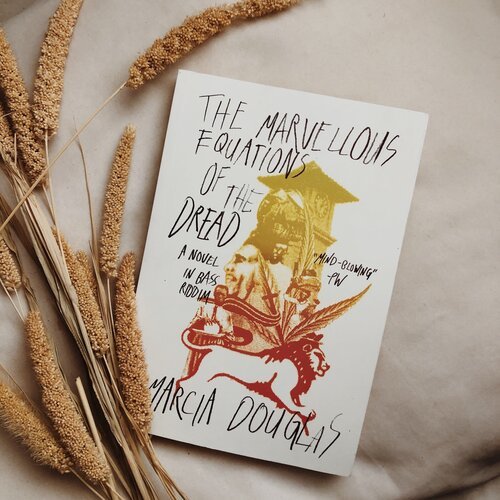
The Marvellous Equations of the Dread: A Novel in Bass Riddim
The ancestors have awakened. Somebody has called them. The long-dead are stirring. Jah ways are mysterious ways.
“Is me—Bob. Bob Marley.” Reincarnated as homeless Fall-down man, Bob Marley sleeps in a clock tower built on the site of a lynching in Half Way Tree, Kingston. The ghosts of Marcus Garvey and King Edward VII are there too, drinking whiskey and playing solitaire. No one sees that Fall-down is Bob Marley, no one but his long-ago love, the deaf woman, Leenah, and, in the way of this otherworldly book, when Bob steps into the street each day, five years have passed. Jah ways are mysterious ways, from Kingston’s ghettoes to London, from Haile Selaisse’s Ethiopian palace and back to Jamaica, Marcia Douglas’s mythical reworking of three hundred years of violence is a ticket to the deep world of Rasta history. This amazing novel—in bass riddim—carries the reader on a voyage all the way to the gates of Zion.
“Is me—Bob. Bob Marley.” Reincarnated as homeless Fall-down man, Bob Marley sleeps in a clock tower built on the site of a lynching in Half Way Tree, Kingston. The ghosts of Marcus Garvey and King Edward VII are there too, drinking whiskey and playing solitaire. No one sees that Fall-down is Bob Marley, no one but his long-ago love, the deaf woman, Leenah, and, in the way of this otherworldly book, when Bob steps into the street each day, five years have passed. Jah ways are mysterious ways, from Kingston’s ghettoes to London, from Haile Selaisse’s Ethiopian palace and back to Jamaica, Marcia Douglas’s mythical reworking of three hundred years of violence is a ticket to the deep world of Rasta history. This amazing novel—in bass riddim—carries the reader on a voyage all the way to the gates of Zion.
325 pages, Kindle Edition
First published October 24, 2016
Ratings & Reviews
Friends & Following
Create a free account to discover what your friends think of this book!
Community Reviews
Displaying 1 - 30 of 61 reviews

February 5, 2019
*Deep breath*
Every time I read this book.
Update: December 26, 2019.
run it/for the people
•
It is easy for those of us who weren't alive in Bob Marley's time, when reggae first became ascendant, to feel little personal connection to that era, to underestimate the music's impact on black consciousness, on Jamaica's consciousness. The giants of the past appear as distant figures, more fixed on foreign merchandise than in our psyche.
Marcia Douglas uprised with word power to remind us that the bass which travelled underground through hundreds of years pulsed in fault lines, through the river bottom, up into the mountains, in the hibiscus--that frequency is in us. We just need to listen.
The book opens with a Taino woman sighting the three raptors on the horizon. But this is not a moment of dread. "...this island is stubborn and will not be moved. The woman has already seen that end from the beginning." This is the book's focus: the people's strength.
Arranged in a reggae music vernacular, steeped in myth and spirit, in each "track" is a character's story, a dream from an angel's book, or glimpses into lives of the ordinary like Leenah, a deaf Rasta woman, and the legendary, such as His Imperial Majesty, Haile Selassie I and Bob Marley—all treated with equal importance. The living and the dead exist side by side as both try to connect in order to uphold a future that is good for all. For our ancestors can shape reality even in death.
You will have to open your mind in fullticipation for how Douglas, Rasta woman novelist, takes our country's language, music, and poetry to capture its beauty, its sufferation, its power.
Listen now. Listen. They are calling your name.
Every time I read this book.
Update: December 26, 2019.
run it/for the people
•
It is easy for those of us who weren't alive in Bob Marley's time, when reggae first became ascendant, to feel little personal connection to that era, to underestimate the music's impact on black consciousness, on Jamaica's consciousness. The giants of the past appear as distant figures, more fixed on foreign merchandise than in our psyche.
Marcia Douglas uprised with word power to remind us that the bass which travelled underground through hundreds of years pulsed in fault lines, through the river bottom, up into the mountains, in the hibiscus--that frequency is in us. We just need to listen.
The book opens with a Taino woman sighting the three raptors on the horizon. But this is not a moment of dread. "...this island is stubborn and will not be moved. The woman has already seen that end from the beginning." This is the book's focus: the people's strength.
Arranged in a reggae music vernacular, steeped in myth and spirit, in each "track" is a character's story, a dream from an angel's book, or glimpses into lives of the ordinary like Leenah, a deaf Rasta woman, and the legendary, such as His Imperial Majesty, Haile Selassie I and Bob Marley—all treated with equal importance. The living and the dead exist side by side as both try to connect in order to uphold a future that is good for all. For our ancestors can shape reality even in death.
You will have to open your mind in fullticipation for how Douglas, Rasta woman novelist, takes our country's language, music, and poetry to capture its beauty, its sufferation, its power.
Listen now. Listen. They are calling your name.

September 7, 2018
I'm not sure I'm entirely confident that I know what I just read, but my skin tastes like the sea and I'm sticky with mango and my heart feels calm

October 2, 2019
This was a stunning undertaking molding the history, music, movement, people, and spirit that is my island.
Updated December 16, 2020
What I saw and felt after reading 5 pages of this story was an identity that I was born into, that I learned, and that I am still discovering; the fights and triumphs, the ever moving-forward tenacity, the hunger and the drive, the light and the dark; my people, my island.
Much like my island, there are mysteries still to be uncovered, there is history in every one of us and what Douglas does with this novel is to invite you to continue your i-ducation.
To enter and know that you will never know all, that there are still depths and heights and widths to be known, to meet, to hear, to see, to touch.
The spirituality that reaches out from these pages from Riva Mumma to the fallen angel right back to the Taino woman who dreamed of what was and is to come is palpable, and it is impossible not to shiver with awareness and a communal connection while reading
Half Way Tree with its four-way connection-direction is the culmination point where reality and spirituality exist side by side and hand in hand; where the duality of existence is a tableau of people, actions, music, death, life, and the universe.
This book was written for us, Jamaicans, for our history, our bones, our spirit, our whole self. Every revelation is a balm and every memory a song, every page turned is a testament of us, to us, for us. Feel the I-brations from the roots of that silk cotton tree through the bones of our feet into the very depths of our souls. Jah Live.
Marcia Douglas' 'The Marvelous Equations of the Dread' revolves around a Bob Marley back from the dead, a homeless fallen angel, a single mother, and Haile Selassie as some sort of celestial spirit.
Yet all this seems to work, and Douglas creates what can only be described as a love letter to the Rastafarian Movement: the language, the beliefs and the livity of their teachings.
Another interesting aspect of this novel is the fact that music plays an important role. Each chapter begins with some part of the creative process of making music.
A truly unique literary experience.
Updated December 16, 2020
What I saw and felt after reading 5 pages of this story was an identity that I was born into, that I learned, and that I am still discovering; the fights and triumphs, the ever moving-forward tenacity, the hunger and the drive, the light and the dark; my people, my island.
Much like my island, there are mysteries still to be uncovered, there is history in every one of us and what Douglas does with this novel is to invite you to continue your i-ducation.
To enter and know that you will never know all, that there are still depths and heights and widths to be known, to meet, to hear, to see, to touch.
The spirituality that reaches out from these pages from Riva Mumma to the fallen angel right back to the Taino woman who dreamed of what was and is to come is palpable, and it is impossible not to shiver with awareness and a communal connection while reading
Half Way Tree with its four-way connection-direction is the culmination point where reality and spirituality exist side by side and hand in hand; where the duality of existence is a tableau of people, actions, music, death, life, and the universe.
This book was written for us, Jamaicans, for our history, our bones, our spirit, our whole self. Every revelation is a balm and every memory a song, every page turned is a testament of us, to us, for us. Feel the I-brations from the roots of that silk cotton tree through the bones of our feet into the very depths of our souls. Jah Live.
Marcia Douglas' 'The Marvelous Equations of the Dread' revolves around a Bob Marley back from the dead, a homeless fallen angel, a single mother, and Haile Selassie as some sort of celestial spirit.
Yet all this seems to work, and Douglas creates what can only be described as a love letter to the Rastafarian Movement: the language, the beliefs and the livity of their teachings.
Another interesting aspect of this novel is the fact that music plays an important role. Each chapter begins with some part of the creative process of making music.
A truly unique literary experience.

December 4, 2020
Highly, highly recommend this book, especially as an audiobook. I buy very few audiobooks, but I am glad to own this one, because I am sure that I will return to it again in the future. I don't think one listen was sufficient to understand the stories and messages that Douglas has woven together here, and I certainly want to revisit the beautiful rhythm of her prose the way she reads it out loud. I was completely enthralled by her writing, and fascinated by both the characters and the history being related. A deeply musical book, on every level.
While I loved this book, it isn't personal for me in the same way it may be for Jamaican readers, so I do want to recommend these reviews that talk a little more about why this book is special: https://www.goodreads.com/review/show... and https://www.goodreads.com/review/show...
While I loved this book, it isn't personal for me in the same way it may be for Jamaican readers, so I do want to recommend these reviews that talk a little more about why this book is special: https://www.goodreads.com/review/show... and https://www.goodreads.com/review/show...
August 5, 2018
I think this excerpt will speak for itself:
"Hear this: A woman at the bus stop has a gun in her brassiere/ the light turns red and/a grandmother dreams of Zion-high/a schoolgirl sucks salt-water tears/pigeons pick mould from a piece of dry bread/green mangoes fall before they can ripe/sorry, no jobs/the baby's milk spoils in the hot sun/the clouds over Kingston heavy with cares-of-life tears/Public Works on strike/weevils in the flour/an eviction notice nailed to the door/rotten chicken-back in the market/sorry, no job/the children's coffins are made of pine/sorry, no/the goat tied to the ackee tree cannot bleat/sorry. The people are vexed with suffocation. Their tears smell like kerosene; soon Kingston will catch fiah."
"Hear this: A woman at the bus stop has a gun in her brassiere/ the light turns red and/a grandmother dreams of Zion-high/a schoolgirl sucks salt-water tears/pigeons pick mould from a piece of dry bread/green mangoes fall before they can ripe/sorry, no jobs/the baby's milk spoils in the hot sun/the clouds over Kingston heavy with cares-of-life tears/Public Works on strike/weevils in the flour/an eviction notice nailed to the door/rotten chicken-back in the market/sorry, no job/the children's coffins are made of pine/sorry, no/the goat tied to the ackee tree cannot bleat/sorry. The people are vexed with suffocation. Their tears smell like kerosene; soon Kingston will catch fiah."

June 26, 2020
The Marvellous Equations of the Dread by Marcia Douglas is a multi-dimensional story, mostly set in the island of Jamaica and written in poetic prose. This book follows the lives of several characters and their individual realizations (or revelations) of Zion.
To say that I am fascinated with the way this book is written would be an understatement. The audiobook is read by author Marcia Douglas, and she has, in my opinion, truly presented “a novel in bass riddim”. I am very happy that I first listened to the audiobook because I cannot for a second imagine bringing this book to life with my mental voice in the way that Marcia Douglas has done with this reading. That said, this book may be a tad bit difficult for people who are not familiar with Jamaican and Rastafarian dialect.
Bass riddim aside, I was genuinely interested in seeing the storyline unfold every step of the way. I love the historical context provided in this book and how well researched it is. I was captivated by the non-conforming way she presented Rastafarianism and Zion.
Overall, this book was an entire experience for me and I think it is a brilliantly written masterpiece. I am absolutely ready to pick up a hard copy and read it again!
To say that I am fascinated with the way this book is written would be an understatement. The audiobook is read by author Marcia Douglas, and she has, in my opinion, truly presented “a novel in bass riddim”. I am very happy that I first listened to the audiobook because I cannot for a second imagine bringing this book to life with my mental voice in the way that Marcia Douglas has done with this reading. That said, this book may be a tad bit difficult for people who are not familiar with Jamaican and Rastafarian dialect.
Bass riddim aside, I was genuinely interested in seeing the storyline unfold every step of the way. I love the historical context provided in this book and how well researched it is. I was captivated by the non-conforming way she presented Rastafarianism and Zion.
Overall, this book was an entire experience for me and I think it is a brilliantly written masterpiece. I am absolutely ready to pick up a hard copy and read it again!

November 27, 2022
This a complex yet beautiful work; poetic and rhythmic yet deep and verbose. A must-read for a foray into Rastafari life and teachings, although the writer took artistic license in retelling stories, in ways that show the author's love of certain social and historical aspects of Rastafari and life in Jamaica, as well as her disdain for other aspects.
There were times I felt that this book praised Rastafari and other times when I felt this book set the stage for a strong rebuke of the religion (almost a poetic and fictionalised version of Clinton Chisholm's Revelations on Ras Tafari). I described this work as complex because so many layered issues are woven into the lines, and you are able to feel the pain and burden of individuals through the lines, lyrically lifting those experiences off of the pages as a novel in bass riddim would. The book, apart from highlighting Rastafari, its strengths and shortcomings, also packed a punch in dealing with infidelity, substance abuse and vices, poverty, corruption, magical realism, sexuality, among others.
I feel there is a deeper message in there for all of us– that we all have inner demons to fight: the pull to a mythical Zion, deification of the mortal men who die (under mysterious circumstances), an uncanny attraction to the colonisers we fight against (even in the blue pyjamas they made?), and that Madmen may not be so mad after all.
This is not the kind of book you speed read, or read only once. 4 Stars.
There were times I felt that this book praised Rastafari and other times when I felt this book set the stage for a strong rebuke of the religion (almost a poetic and fictionalised version of Clinton Chisholm's Revelations on Ras Tafari). I described this work as complex because so many layered issues are woven into the lines, and you are able to feel the pain and burden of individuals through the lines, lyrically lifting those experiences off of the pages as a novel in bass riddim would. The book, apart from highlighting Rastafari, its strengths and shortcomings, also packed a punch in dealing with infidelity, substance abuse and vices, poverty, corruption, magical realism, sexuality, among others.
I feel there is a deeper message in there for all of us– that we all have inner demons to fight: the pull to a mythical Zion, deification of the mortal men who die (under mysterious circumstances), an uncanny attraction to the colonisers we fight against (even in the blue pyjamas they made?), and that Madmen may not be so mad after all.
This is not the kind of book you speed read, or read only once. 4 Stars.

September 12, 2017
Percussive, powerful and well-studied in every i-teration of style, structure and form, this is the best work of fiction I've read in 2017 thus far.

November 26, 2022
A unique book that is wonderfully lyrical and poetic as well as historical in an imaginative way. I appreciate literary fiction that reaches back into history and re-creates it. This is what Douglas does with famous people like Haile Selassie and Bob Marley. There is lots of imagery that readers with limited familiarity with Jamaica and Rastafari will find difficult to understand. That's a writer's privilege. There are also images and references to the painful history of slavery in the Americas, but Jamaica in particular. With all of this, Douglas centers the stories and experiences of women throughout the novel. Is she pushing back on a history in Jamaica and Rastafari culture that is rooted in patriarchy? This is an instructive, intense, and imaginative book. I recommend it.

October 31, 2018
Loved it! Wonderful book,

August 6, 2020
This book took me for a ride and forced me to open my eyes as to how to read a book written in syncopation. It is also layered, you have to pay attention to the layers.
It was not about just reading this book, it was an actual experience. I read books from many Jamaican authors and thoroughly enjoy them. This book, made me really think, question many things and then opens up your eyes and mind at the same time. Knowing quite a bit about the history of Jamaica, the music of Reggae, Rastafarianism it was fairly easy to immerse myself but I also learned what I did not know
I did struggle a bit with some of the writing hence the four-stars but I will re-read it at a later date and see if it is still four or needs five.
You need to be patient with the writing and take your time to read this book. While it is an easy read, it's not a fast read.
It was not about just reading this book, it was an actual experience. I read books from many Jamaican authors and thoroughly enjoy them. This book, made me really think, question many things and then opens up your eyes and mind at the same time. Knowing quite a bit about the history of Jamaica, the music of Reggae, Rastafarianism it was fairly easy to immerse myself but I also learned what I did not know
I did struggle a bit with some of the writing hence the four-stars but I will re-read it at a later date and see if it is still four or needs five.
You need to be patient with the writing and take your time to read this book. While it is an easy read, it's not a fast read.
September 17, 2018
What a book. Douglas primarily follows Leenah and Bob Marley. Giving their histories she fleshes out an island with people long abused by colonialism and politics. Scars deep and old have caused them to lose touch with their past, their future, and themselves. As Bob searches the afterlife for the way into Zion, his people and his beloved island search for their own way as well.
If only it was as straightforward as all that.
The bass riddim of Jamaica drives this novel forward, sending it dancing through time and space; into the afterlife and back. It's vivid and alive and moving and makes you want to get up, stand up, and chant down Babylon.
If only it was as straightforward as all that.
The bass riddim of Jamaica drives this novel forward, sending it dancing through time and space; into the afterlife and back. It's vivid and alive and moving and makes you want to get up, stand up, and chant down Babylon.

June 20, 2018
I really started strong on this. I loved the patois, the Bob Marley duppy thing, the unique formatting, and the Rasta POV often from women (something I've almost NEVER experienced). I still really like this book for that, but for some reason, I stalled about halfway through and never could renew my enthusiasm. Perhaps life has been too crazy this month. It really was charming...I feel like this is one I could return to in the future.
********
Many thanks to New Directions and NetGalley for the advanced copy of this book.
********
Many thanks to New Directions and NetGalley for the advanced copy of this book.

November 30, 2018
somehow calming and invigorating. i can taste the neverending pomegranate... how ethereal, and so of this world, remembering bass one hundred years into the future. a crossroads of cotton, the nutmeg tree inhales and hear its breath. this is not a fiction but a dreamy herstory. there is so much hope in yet unattained joy, and though sadness too, it is never wallowing or tragic or dragging. the author's pen puslsing with the beat of truth and majesty, pawning haile selassie, no blasphemy. angels and flowers and sewing and rhythm oh my. READ IT!
July 26, 2018
Douglas arranges the novel in a unique way, unlike any novel I've read before. The author synthesizes pan-Africanism and Rastafarianism through characters such as Bob Marley; this book furthered my knowledge about black liberation and the rich history of Jamaica. I also appreciated how Leenah was such a strong female character throughout the novel, especially within Rastafarianism. 10/10 recommend!!
July 31, 2018
This book was a wonderful journey, one that I didn't expect to take! As you follow Leenah through the novel you feel as though you are being transported into Rastafari culture. There is amazing use of literary techniques throughout, which help the book stay engaging and quite hard to put down! Overall, I would definitely recommend this book. Marcia Douglas and her incredible writing are simply the best!
July 31, 2018
Easily one of the very best books of 2018, and possibly the early 21st century. A must for anyone interested in reggae, Rastafari, feminism, poetry, Jamaican history, and/or Black resistance. Also a must for anyone who simply appreciates devastatingly beautiful, poetic language, non-linear storytelling, and being entirely enraptured in a text that combines prose, poetry, music, images, and visual art. This book shows new potentials for what novels are capable of doing.

January 15, 2021
Wow - this writing and its unfolding gives me goosebumps like bass rhythms. It's cyclic and multitextured and there's so many snakes, ladders and gaps for the reader to move around the prose which is also poetic. Douglas also animates rasta from female, sensual perspectives. The history is immense but not laborious, and everything pulses together. Transformative.

September 4, 2018
Excellent Rastafari fantasy with a thorough grounding in reality. I loved this book, stretching it out as long as possible by reading a little every night at bedtime. Excellent writing.

October 20, 2025
Book Stats:
304 pages
Genre: Fiction, Caribbean lit, Historical Fiction, Magical realism
Publisher: July 31, 2018 by New Directions
Format: Paperback
Themes:
Jamaica/Caribbean History
Reggae and Rastafarianism
Synopsis:
Reincarnated as homeless Fall-down man, Bob Marley sleeps in a clock tower built on the site of a lynching in Half Way Tree, Kingston. No one sees that the homeless fall down man is Bob except his long-ago love, the deaf woman, Leenah. But each day Bob steps out of the clock into the street, five years have passed. This lyrical and magical book will take you through time and all the way to the gates of Zion.
My thoughts:
Marcia Douglas may be my new favorite author. Jamaican history, spirits, ancestors, Rasta, uprising, music and Bob. This book is exceptional and mind-blowing. She has written a story set with such magic, familiarity, and breathtaking prose. The Marvelous Equations of the Dread can only be described as a beautiful fever dream of Jamaica’s history told in bass riddim. Every word and imagery is meant to pulsate within your soul..ride natty ride. It’s told with such complexity, depth and remixed surreal imagination, yet amplifies such historical accuracy. Marcia Douglas really did her research here: from the meticulous details of Marley’s life, the history of Clock Tower, and Haile Selassie’s rise and reign. Between this book and Augustown, it’s so refreshing to see an authentic perspective of Kingston. This is timeless art and a classic.
304 pages
Genre: Fiction, Caribbean lit, Historical Fiction, Magical realism
Publisher: July 31, 2018 by New Directions
Format: Paperback
Themes:
Jamaica/Caribbean History
Reggae and Rastafarianism
Synopsis:
Reincarnated as homeless Fall-down man, Bob Marley sleeps in a clock tower built on the site of a lynching in Half Way Tree, Kingston. No one sees that the homeless fall down man is Bob except his long-ago love, the deaf woman, Leenah. But each day Bob steps out of the clock into the street, five years have passed. This lyrical and magical book will take you through time and all the way to the gates of Zion.
My thoughts:
Marcia Douglas may be my new favorite author. Jamaican history, spirits, ancestors, Rasta, uprising, music and Bob. This book is exceptional and mind-blowing. She has written a story set with such magic, familiarity, and breathtaking prose. The Marvelous Equations of the Dread can only be described as a beautiful fever dream of Jamaica’s history told in bass riddim. Every word and imagery is meant to pulsate within your soul..ride natty ride. It’s told with such complexity, depth and remixed surreal imagination, yet amplifies such historical accuracy. Marcia Douglas really did her research here: from the meticulous details of Marley’s life, the history of Clock Tower, and Haile Selassie’s rise and reign. Between this book and Augustown, it’s so refreshing to see an authentic perspective of Kingston. This is timeless art and a classic.

December 12, 2019
I love Jamaican fiction, and this was no exception. Douglas has a wonderful ear for dialogue and language, and her characters are all so vivid and intense. Often I find works that cut between generations can feel programmatic; by contrast, this was always vivid and alive, and the jumps through time and perspective, woven in Jamaica's 'bass riddim', felt wholly natural. I hope she writes another novel in the future, but this one is a pleasure.

August 13, 2020
Some very beautiful sentences and an interesting look at a culture I knew very little about but understand more after reading. Some stylistic choices I don't entirely vibe with, I think Leenah's character was underutilized and her ancestry was often equally interesting (which might have been an intentional choice).

July 22, 2024
Rare og kule greier. Er nå veldig glad for at jeg hørte denne i lydbok, da rastafarispråket får skinne som en del av leseopplevelsen. Mye spirituellt fokus, det likte jeg litt egentlig. Klarer du å tenke deg Bob Marley gjenoppstått, hvis ikke, lytt til denne lille artige skrua.

May 19, 2019
This is a gorgeous book. Its lyrical, musical prose I inhaled greedily at almost one go, smelling the ripeness of number 11 mangoes and salt in the wind, hearing the bass riddim of six generations of sufferation vibrating across centuries of colonialism, imperialism, and dogged spirituality. And then because I didn't want the book to end I set it aside for a while and came back to it easily, slipping into its music like a second skin. I'm sorry I have to return this to the library.

January 2, 2021
To say this book is "immersive" somehow still undersells the world Marcia Douglas sews for us from London, Half Way Tree and Zion.
"Dub is what happens when time collapses. But it is not the collapse of all time, just the collapse of their time. Dub is the collapse of their time and the rise of fi wi time." - Isis Semaj-Hall
Douglas plays both cartographer and DJ with these fault lines. And just like any great Dub, she deconstructs and later emphasises moments in Jamaica's history that explains our relationship with ourself and connects our physical and spiritual worlds through relics.
Read My Full Review on Storygraph: https://beta.thestorygraph.com/review...
"Dub is what happens when time collapses. But it is not the collapse of all time, just the collapse of their time. Dub is the collapse of their time and the rise of fi wi time." - Isis Semaj-Hall
Douglas plays both cartographer and DJ with these fault lines. And just like any great Dub, she deconstructs and later emphasises moments in Jamaica's history that explains our relationship with ourself and connects our physical and spiritual worlds through relics.
Read My Full Review on Storygraph: https://beta.thestorygraph.com/review...

September 30, 2018
I didn't know much about Rastafarianism, Bob Marley, or Haile Selassie before reading this.
The story doesn't really match up well with how the novel is summarized. So...fair warning on that. But then again, don't read the book for the story. Read it for the experience of reading it.
Overall, highly recommended for people curious about other cultures. I hope this is read in high schools one day.
The story doesn't really match up well with how the novel is summarized. So...fair warning on that. But then again, don't read the book for the story. Read it for the experience of reading it.
Overall, highly recommended for people curious about other cultures. I hope this is read in high schools one day.

November 4, 2023
wow! this is possibly my favorite of the books we have read so far for core. i loved the multilayered structures and characters. douglas does a great job creating levels of meaning beyond just the literal narrative on the page. instead, readers use the context of the novel, the structure of the sections, and the different types of chapters to create a whole understanding. i was also so lucky to meet douglas in our class, so i appreciated that as well.

August 30, 2018
Reach occasionally exceeds grasp--but that's a good problem.

January 1, 2020
Experimental, fun. A clear departure from her debut. The language may be a bit difficult for some readers, but for those who understand, a good read.

October 8, 2018
This is a really cool experimental novel--some of the most interesting fantasy I've read this year (although it is not marketed as such). It follows the death of Bob Marley, his ascendancy into Rastafarian heaven, and his decision to return to earth in the body of a homeless man. He remains on earth for seven days, each separated from the last by many years of earth-time. There is a strong musical theme, as you might expect from the title and the plot, with the afterlife/underworld being described as "the dub side," etc.
The book incorporates a lot of elements of Rastafarianism, but Douglas doesn't spell most things out--so it piqued my interest to do some outside reading to learn the background. I loved how Douglas worked in Haile Selassie as a character; how Marcus Garvey's Black Star Line plays an important role in the plot; and how Douglas seasons the text with many uniquely Rastafarian terms ("I&I", "higherstanding", etc.). I also thought Douglas did a great job of conveying lyrical Jamaican speech patterns to the point where I felt I could hear the characters speaking, but without resorting to cliched altered spellings such as "mon" (which I feel like would unnecessarily normalize the American accent--after all, a Jamaican spells the word the same way!). Finally, I appreciated Douglas's foregrounding of strong female characters, since (based on my brief research) it seems that Rastafarian culture has often been criticized for its patriarchal nature.
The book incorporates a lot of elements of Rastafarianism, but Douglas doesn't spell most things out--so it piqued my interest to do some outside reading to learn the background. I loved how Douglas worked in Haile Selassie as a character; how Marcus Garvey's Black Star Line plays an important role in the plot; and how Douglas seasons the text with many uniquely Rastafarian terms ("I&I", "higherstanding", etc.). I also thought Douglas did a great job of conveying lyrical Jamaican speech patterns to the point where I felt I could hear the characters speaking, but without resorting to cliched altered spellings such as "mon" (which I feel like would unnecessarily normalize the American accent--after all, a Jamaican spells the word the same way!). Finally, I appreciated Douglas's foregrounding of strong female characters, since (based on my brief research) it seems that Rastafarian culture has often been criticized for its patriarchal nature.
Displaying 1 - 30 of 61 reviews