Along the Mekong, from northern Tibet to Lijiang, from Luang Prabang to Phnom Penh to Can Lo, I moved from one world to another, among cultural islands often ignorant of each other’s presence. Yet each island, as if built on shifting sands and eroded and reshaped by a universal sea, was re-forming itself, or was being remolded, was expanding its horizons or sinking under the rising waters of a cultural global warming. It was a journey between worlds, worlds fragiley conjoined by a river both ominous and luminescent, muscular and bosomy, harsh and sensuous.
From windswept plateaus to the South China Sea, the Mekong flows for three thousand miles, snaking its way through Southeast Asia. Long fascinated with this part of the world, former New York Times correspondent Edward Gargan embarked on an ambitious exploration of the Mekong and those living within its watershed. The River’s Tale is a rare and profound book that delivers more than a correspondent’s account of a place. It is a seminal examination of the Mekong and its people, a testament to the their struggles, their defeats and their victories.
This is a big book, or, at least the topic -- traveling down a 2,700 mile river -- is big. In fact, for a year's journey, the book is surprising slim. I know the author took copious notes, and I don't need to have a description of every meal he ate or flophouse he crashed in, but at times I craved a bit more detail. This is a very minor criticism of what was clearly a labor of love for him. And labor it surely was. Not just based on his ordeals but at times his 'voice' sounded weary as well. Part of this though I interpret as concern for the peoples, lands, and cultures he touched.
I would love to sit over a BeerLao or two and chat with Mr. Gargan about the changes wrought in the last decade-and-a-half. His journey -- completed sometime around Y2K -- is necessarily a snapshot. Having traveled to three of the countries he visited -- Burma (Myanmar), Cambodia, and most recently Laos -- I have seen both the invasive and enabling effects of globalization. There has been some political progress: Lao PDR is no longer the paranoid state as described and the generals are finally not (completely) ruling Myanmar. But, incredibly, Hun Sen is still the Cambodian P.M. The more things change the more they stay the same. China too has bloomed into a global infrastructure-creating juggernaut. This is alluded to in Gargan's book, but what a difference 15 years makes! (We will see much more of this in the years to come as with the 2016 election we have abdicated our role and responsibility of being a global leader and China is eager to fill that gap.)
Back to the book...trained and working as a journalist, Gargan's language is generally descriptive but clear and concise. Only on occasion does he get 'poetic' and with the exception of one clunker (something about a boat's engine being as greased up as a California sunbather), his writing produces no winces.
This is neither a travel book nor a travelogue. Yes, he travels -- all 2700 miles and them-some considering his various mainly unexpected deviations -- and he does 'document' and comment upon what he sees and finds. (He is aided by this in his fluency in the Chinese language.) He is quite vocal in his skepticism of the various powers that play chess on the Southeast Asia board and his concern for all whom he meets is persistent and true. But this is also a journey where his personal history as a Vietnam War protester crosses paths with the lands those wars were fought over/on and the lingering effect it has had on the inhabitants. To his credit he acknowledges but does not harp on our (America's) deleterious impact (truly, no pun intended) on this patch of the world. Every player -- from the French to the Americans to Mao, Pol Pot and the current SE Asian governments have contributed to the general mess, poverty and ruination of the region. At least that is the take-away.
Things have changed since 2003 (the year of publication) and are continuing to do so, for better and worse. Having spent the intervening time resting up, I, for one, would encourage Mr. Gargan to consider a revisit and update with the writing of Volume II: Return to the River...One can hope!
This is a travel tale of the writer’s experiences traveling from the headwaters of the Mekong River in the Himalayas to the Nine Dragon Delta in Vietnam. Published in 2003 it naturally does not bring the reader up to date on all the rapid changes that have taken place in the region in the last 12-13 years, but that is not a criticism. The book describes the author’s attempt to take stock of the varying cultures along the river, and to learn about how they have been affected by, and adapted to, the pressures of the events that have engulfed them. Thus the Chinese pressure to change, or wipe out, Tibetan culture; the effect of American and French wars and influences and damage, and the destructive and even catastrophic damage done by the Chinese government, the Pathet Lao, the Khmer Rouge and the Northern dominated Vietnam government.
The author has a strong journalistic and scholarly history to strengthen his writing, and a willingness to “rough it” so as to get close to people along his way. Perhaps not for every reader, but for me it was a reminder of how little I have known about Tibet, Cambodia and Laos partly, I suppose, because Thailand and Vietnam are so much larger and have been so much more in our news. Some of his experiences and descriptions of the damage done and consequences for Laos and Cambodia were simply awful to read, and important to read. For me the book dragged in sections, in part I suppose because the author seemed to want to spend more time on history that wasn’t necessary for the story he was developing. Nevertheless, a good read.
Although doing my route in reverse, and far more thoroughly, this was really nice to read alongside travelling SE Asia. A valuable supplement to the vague tourist-level knowledge of a country that you tend to get, like the fact he actually went to find Vann Nath (the painter from S21) and speak to him was sooo interesting having seen his paintings with my own eyes. Also just generally very well-written and funny and serious at all the right moments. Excited to see how this book underpins my experience in Thailand.
An excellent read - and extremely well-written. It was very nice to read such an elegant travelogue, though as the cover says it is far more than just some thrown-together notes from a journalist's sabbatical. Gargan is thorough and engaging in his description of the Mekong's journey from its source to the Delta and weaves a vivid tapestry through incorporation of history and personal experiences both far in the past and closer to the present. The only thing that kept putting me off was his need to remind us that his time there was far too short - he kept on writing "I must away...the river, it calls..." or something of that ilk. It got a little frustrating after a bit not only because I wanted to hear more about the places he had visited, but also after the first few times it became quite...overdone. Also, he is quite fond of that rhetorical term where you pair two words of opposite meanings to describe the same phenomenon (paradox? opposite words together? I've forgotten what exactly it is called). But, he would describe things usually in trios "Harsh and sensuous, glamorous and seedy, rollicking and sedate, the Blah Blah was....". It was very nice the first few times, but like the "...oh the river...my soul aches for its touch...etc." it got old after a bit.
Other that those small rhetorical things, I thoroughly enjoyed this book and sincerely hope that Gargan continues to produce such works.
A friend recommended this book as he knew I had travelled to about three-quarters of the destinations travelled by the author. Perhaps that is why I was less excited than I thought I would be when I finished it. Some of the sites along the Mekong I had travelled twenty-odd years ago, others as recently as last month (Luang Prabang), so there was a mix of both romantic nostalgia and small irritations. This is perhaps unfair to the author as The River's Tale is a personal travel diary and therefore does belong to a specific time--late 1990's/early 2000's (I confess I don't remember the actual year) and place. But readers should be aware that Asia has probably changed more in the past 10 years than any other time during its history, so many of the descriptions of both the terrain and the people and their dreams/concerns has changed, some radically. I am specifically thinking here of Laos, Cambodia and Vietnam which have all exploded with tourism and its accoutrements.
A perfect book to read while traveling in Southeast Asia. thought provoking. Also a reminder of how quickly things are changing in Vietnam and Cambodia...mostly for the better.
A literate memoir of a year's solo journey down the length of the Mekong River, from Tibet, through southern China, Laos, Cambodia, and Viet Nam to the South China Sea. Gargan, a New York Times reporter and bureau chief, was always fascinated with Asia and studied Chinese in college. He also served a couple of years in a Kentucky prison for anti war actions during the Viet Nam era. Gargan back-packed his way thousands of miles, using local iffy transportation sources and making contact with natives along the way. Food and transportation were often a challenge. The contacts were often dispiriting, with poverty, government corruption, and a crushing lack of services suppressing hope. Gargan came away with apprehension about the future of the area, but with an appreciation for its beauty and complexity, which he often described in lyrical language. An excellent personalized introduction and overview of a not well understood part of the world.
A decent read, but author Edward Gargan never seems passionate about his pilgrimage. It's an adventure, through some of the biggest hot spots in recent history, but that dynamic seldom comes across. For someone writing about a river, he seems to spend precious little time on the water. In the hands of another writer, this could be much livelier. I do appreciate his thoughts on the disappearance of native cultures, arts and ways of life. But Gargan seems tired of the topic long before the end of his quest.
Gargan’s account of traveling the three thousand miles of the Mekong River through Tibet, Burma, Laos, Thailand, Cambodia, and Vietnam feels like a big step back in time, though the book was released only twenty-five years ago. I liked that it brought back memories of my own travels in Southeast Asia in the ’90s, when there were far fewer tourists and no warm blanket of a global smartphone network. The world was bigger. And Asia has changed enormously since then, and travel writing has changed too. What I liked was how he focused on the people and cultures he encountered, weaving in plenty of 19th- and 20th-century history along the way. Hovering over the whole book is the question that was on everyone’s mind at the time (even more than now): where is China heading, and where is Southeast Asia heading, at such breakneck speed? The book flows well, and Gargan loves a juicy metaphor, though there were moments when I wished George Orwell’s second rule of writing had come to his mind: “Never use a long word where a short one will do.” Gargan, a former foreign correspondent and New York Times bureau chief, may at times have had too vast a reservoir of words to draw from, but he still captured his travels along the river vividly and thoughtfully.
Relentless beneath us, keeping us afloat, was water that first issued from mountains some 1,750 miles away, high up in the northern Tibetan plateau in China's Qinghai Province. It had taken me about five months to reach this point, about midway in a journey along a river that crashes down from Tibet through six Asian countries-China, Burma, Laos, Thailand, Cambodia and Vietnam; seven if you regard Tibet itself as a separate, but occupied, nation—before releasing itself in a vast deltic splay into the South China Sea. For much of this century, the countries.
Colonialism has long been banished from the region; the region's wars are over, although scars remain all too visible on the people and on the face of the land itself. A web of Western modernity, its cultures, economy and politics are settling, not always easily, across much of Asia. The Mekong slices through this history, its residue and prospects.
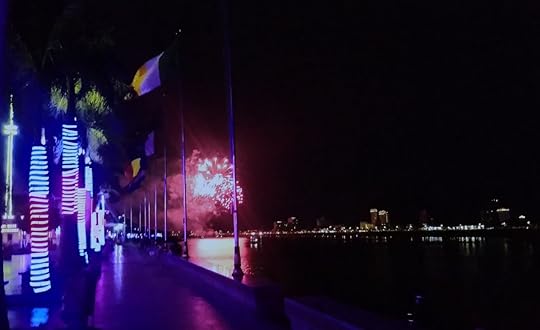
I honestly had not been able to remember if I saw the Mekong River when I was in Cambodia, and I did some digging into the photos and finally remembered on our last night, we did walk from our hotel to the Mekong Promenade and had dinner overlooking the river. It was our last night, and I was all explored out, so I think that is why it didn’t cement in my mind. I just found a video from that night, and there were fireworks across the river, another detail I had forgotten.
Rivers are inherently interesting, both as geographical phenomena and as metaphors for larger questions. They mold landscapes, sunder them with gaping canyons, nurture inland fisheries, lavish the bounty of the lands they travel through onto vast fertile deltas. Historically they have been the earliest and the most basic of trade routes, sources of food (and, of course, drinking water), a place to wash, a splashy frolic for children. Civilizations have emerged next to rivers, in China, India, Europe, Africa and the Middle East. Rivers are sacred in some places-India's Ganges, for example-and are abused and remade in others, like the Columbia in the American northwest. And as much as they sustain life, they also bring death and destruction; regularly the Yangze in central China swells beyond its banks, inundating villages, sweeping away lives in violent, uncontrollable, muddy torrents. Rivers are gentle and placid and mean. They trigger conflict-Bangladesh and India still haggle over water rights to the Ganges. They delineate boundaries everywhere. They provide architects with opportunities for grandeur-Tower Bridge in London, the Brooklyn Bridge in New York. And, in their infant form, they provide middle-aged fly fishermen with places to craft pop philosophies about life and casting for fish. They are the stuff of metaphor and fable, poetry and painting. Rivers move. They come from somewhere and head toward oceans and seas. They flow past societies and civilizations, mute witness to human events. For me, rivers are magnetic. I can sit and watch the water move past for hours. They are places of contemplation-contemplation about the river itself to be sure, but also a place to reflect on the passage of time, of life, of experience.
I loved my Thailand and Cambodia trip, and this book took a wider view of the countries along the Mekong from Tibet to Cambodia, and in wholehearted, humanist prose, told us of the people and places off the beaten track. I loved it all. I have an affinity towards Asian culture, and I am not sure how it got started, although if I had to guess, it was when I started learning about Buddhism. I fell in love with the food, ideas, art, land of many Asian cultures and still am.
Working backwards, from the South China Sea where the Mekong empties into the ocean in Vietnam, 3,050 miles from its headwaters on the Tibetan Plateau at 16,000-17,000 feet above sea level, home to 60 to 100 million people in the watershed, the author spent most of his time in Vietnam on a boat with local people who helped guide and translate.
In his profession of his Vietnameseness, his deeply felt, although simply articulated, passion for his homeland is something that many Westerners either do not understand or refuse to believe. There is, particularly in those American political circles with little real understanding of the world, an unshakable conviction that everyone in Vietnam (and Cuba, China, indeed any Communist country) would flee to the United States if they could. In fact, life is far more complex and nuanced than this. Chan's emotional links to the delta are not unlike the thousands of Chinese graduate students-all of whom know acutely Beijing's reprehensible human rights record-who nonetheless eagerly return to China to make their fortunes, take care of their parents, speak their own language, live lives as Chinese. Are they happy about the absence of democracy in their country, about the controls on what they read and see on television? No. But they have a bond to their homeland, and it is a powerful one.
Market boats narrow, stern-rowed pirogues, filled with baskets of thick-skinned oranges, yellow-red pomegranates, glossy pink and red bell fruits, the juicy and violet jambolan, brown billiard-ball-sized lichees mingled with vegetable skiffs packed with onions, garlic, long beans, bouquets of broccoli; it was a scene that transpired before the war convulsed this country, and it is a scene that has returned. But my conversations with those who were its victims also spoke of the costs of victory by the North; national unification brought with it peace, certainly, but it brought also a rigid authoritarianism that has stunted the lives of the Vietnamese. Even so, Vietnam is in no way the murky, paranoid place that is Laos, nor the traumatized land of Cambodia. It is a country, especially here in the south, that retains a sense of its culture and identity mixed with a yearning for the world beyond.
The author’s time in Phnom Penh and Siem Riep in Cambodia were some of the most powerful sections. I did not expect him to write as much about the Khmer Rouge genocide as he did, and it made me cry, and get that tight feeling in your chest where you can’t take a deep breath, because I have been thinking about that often lately, as well, with what is happening in the US government, like the project 2025 people are intending to turn back time and while not directly kill people (yet?) they are not only pushing back rights and laws, but almost trying to force us into another Dark Age where our research and innovation is completely suppressed. Pol Pot and his regime loosely affiliated with Marxism and Communism wanted to take Cambodia back to the Middle Ages, or "Year Zero," with such distrust of cities, progress, professionals, they forced them all into the countryside and to do manual labor, essentially making slaves of them, and then the genocide to enforce the regime.
I wrote in my travelogue, ‘The Cambodian people were so kind, welcoming, and generous. Their story has to be remembered so we can all be alert to the atrocities human beings can inflict on another, such as what is happening on our border. The Buddhist philosophy of ahimsa, non-violence is a precept that many follow even if their life is threatened.’ I cited this article at the time: https://tricycle.org/magazine/out-kil... One of the insights The River’s Tale gave me was the idea that Pol Pot was inspired by the magnificent feat of building Angkor Wat by mass labor in cruel, tyrannical conditions, thinking that the descendants of those builders can be manipulated to create an agrarian society so he could rule and be enriched. It is another chilling reminder that the past will be repeated if the succeeding generations do not learn the history.
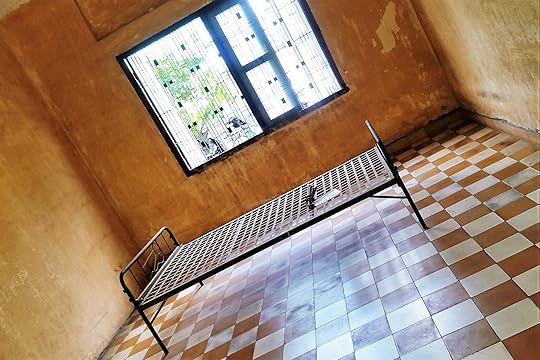
Visiting Tuol Sleng and Choeung Ek was like a long prayer of repentance for the role the US played, of sorrow for the agonies, of fear that I was 1 year old when it started, so in my lifetime, and of determination to witness and tell about it.
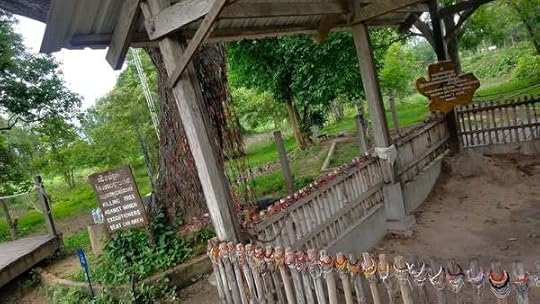
Mass graves containing 8,895 bodies were discovered at Choeung Ek (the Killing Fields) after the fall of the Khmer Rouge regime. Many of the dead were former political prisoners who were kept by the Khmer Rouge in their Tuol Sleng detention center and in other Cambodian detention centers. Today, Choeung Ek is a memorial, marked by a Buddhist stupa. The stupa has acrylic glass sides and is filled with more than 5,000 human skulls. Some of the lower levels are opened during the day so that the skulls can be seen directly.
Where children were said to be beaten, killed, and buried, and each bracelet is a prayer from across the world in their memories.
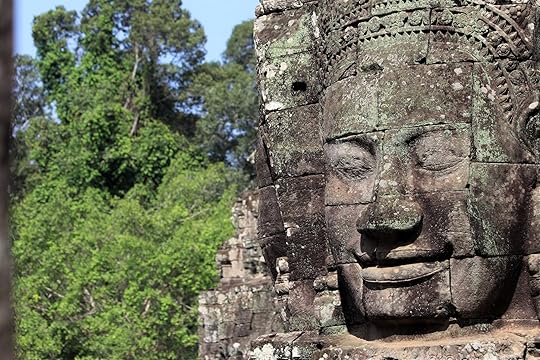
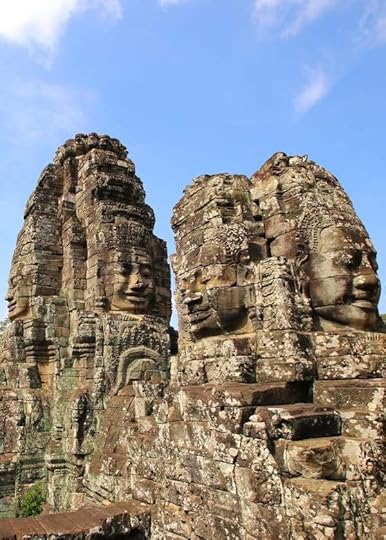
The story of the Cambodian people is not just the genocide, and the book celebrates the beauty and majesty of the temples, and I can say it is one of the most holy places I have ever been. I loved seeing both the Hindu and the Buddhist influences on the temples, as it depended on the ruler of the time what religion was primary, Hinduism at the time of the building of Angkor Wat, the most famous temple, but like the author, the Bayan in Angkor Thom was my favorite.
At the precise center of Angkor Thom looms the Bayon, which from a distance can appear to be little more than a mountain of grayish stone block. But as I approached it repeatedly over several days, the mountain gave way each time to a vision of tiered arcades, low walls scored with steeply pitched staircases and then, on the third level, as if materializing from a dense fog, rise fifty-four towers, each of their four faces carved with the immense visage of the slightly smiling, half-lidded Buddhist image, the same one that overlooked the gates to the city, the image that has come in popular parlance to be called "the Angkor smile."
I disagreed with his perception of the smiles as aloof, kingly, oppressive in their omniscience, but he went to Tuol Sleng first and then the temples, whereas we did the opposite so I felt the faces as kind, serene, at peace and giving peace.
The multiplicity of Lao cultures-although the Lao government recognizes forty-seven ethnic groups, there are, scholars insist, roughly two hundred languages spoken in Laos by an equal number of ethnic peoples-does not lure many of these foreign travelers. And, of course, Laos has also become a magnet because, as one of the world's poorest countries, it is also among the least expensive to visit. The gold and silver ingots of Garnier's time have given way to belly pouches of dollar bills, only four or five of them necessary each day.
The name Mekong (Mae Nam Khong) derives from Lao-Thai words: Mae meaning mother, Nam meaning water, and Sanskrit word khong meaning ganga, referring to the Ganges River. In Laos, the author drove part of the way and then got on the Mekong by boat, although a fast boat was all he could find at first. I may have missed it, but I don’t remember much of the tactile feeling of the river, or if he swam in it anywhere, or the temperature, but he may well have written it and I missed it. In general he answered all the questions I normally have to research with other writers, so I was disappointed I didn’t absorb the feel of the river. Or maybe it was unsafe the entire way, pollution, etc.
As we rocketed down the Mekong glazing the surface of the river like a well-struck hockey puck, I found the contrast between Laos and Thailand so stark that it was jarring- Every mile of Thailand was hung with power lines, modern Japanese-made trucks glided over roads that were yet to see a pothole, a huge golf ball-like weather radar station perched on a bluff, lights blazed from riverfront restaurants. On our left, Laos was rugged, untamed, roadless, without power. Scraggles of bamboo huts on stilts hunkered along the river, and their occupants stared hopelessly at the bright lights just a quarter of a mile away. As dusk eased over us, the Thai shoreline swelled up with tile-roofed houses and low-rise office blocks, and our driver pivoted the boat toward the left shore.
At the headwaters in Tibet, which I haven’t travelled to, he travelled by rented car and driver much of the way and had to turn around and find a new way due to closed border crossings or mountain slides.
Tibet is the nursery of most of Asia's great rivers. Near where we sat, at least in terms of direct-line miles—the journey is arduous the sources of the Yangze, the Yellow and the Salween spill from this plateau. Asia's other major rivers, the Indus, the Brahmaputra and tributaries to the Ganges, tumble from the mountains elsewhere in Tibet. Much of the region here is uncharted, roadless and, to me, that rarest of qualities, timeless.
We pushed south toward Dechen, the northernmost Tibetan town in Yunnan, a town of some twenty thousand people wedged in the crook of a mountain fold. At a broad pass in the mountains, Dakpa, as he always did when reaching the highest point on a road, rolled down the window and bellowed: "Ohhh, lha gyal lo, Ohhh lha gyal lo" —roughly, "The victory of God's word"—a shout of spiritual joy and glory at the majesty of passing one of Earth's great divides. A roadside shrine, a latticework of wood draped in thousands of small red, white, yellow and blue prayer flags, like fluttering handkerchiefs in the thin, frigid air, stood beside the road. Many of the flimsy cotton flags were block-printed with the sacred mantra Om Mani Padme Hum, "Hail the Jewel in the Lotus," a reference to the Buddha himself. Dakpa, who carries a small stash of flags in his backpack, attached two flags-one for health, one for luck—and stood back to gaze at the range of mountains across the river.
A really enjoyable journey from the headwaters of the Mekong in Tibet to the delta nearly 2,000 miles to the south, the author spends the better part of a year slowing making his way through the diverse and troubled landscape of southeast Asia. He speaks with people of various cultural and social backgrounds and revisits the areas horrible past (largely unknown or forgotten in the West) and its hopeful and optimism future.
If you want to visit Tibet, Laos, Vietnam, or Cambodia, this book is worth a read.
I enjoyed reading this travelogue. As a wanderlust myself, it was fascinating to hear about Gargan’s experiences traveling through 6 countries along the Mekong River. I really appreciated the vivid descriptions of the scenery and people he met, his retelling of history, and his research on historical documents and folklore. I felt like I was along for the ride on a one-of-a-kind journey.
My biggest complaint of the book is that at some points, it seemed to drag on. I enjoyed the sections where Gargan interviewed people or went into historical details, but often he would go on and on, using flowery language to describe the scenery and landscape. I also felt that we didn’t get to know the author much - I can understand that if he wanted to take himself out of the picture, but when he did give us snippets of information about himself (he mentions at the end of the book that he spent 2 years in jail for not signing up for the Vietnam War draft) you wanted to know more and felt gypped when he didn’t provide it.
A tale of traveling 1,789 miles over the course of a year from a trickle in the Tibetan plateau to the broad channels of the Mekong Delta in Vietnam, this is a worthy book. A tad overwritten at times, but just forgive him that. "It had been a long day chugging down the Mekong River from Luang Prabang, the old royal capital of Laos, a day of endless arguments with the boatman, a wretched, hollow-cheeked scamster who had relieved me of some 800,000 kip, about $160, with the promise to convey me in clattering splendor for three days downriver . . . barely two hours out . . . the boatman, named Pheng, steered his vessel alongside a floating gas station, one of the occasional pit stops along the river where diesel fuel is served up from steel oil drums. After filling his tank withe the lollipop-red fluid, he informed me that the boat engine was broken and he could go no farther. I told him to fix it. He told me he couldn't. . .Under a devastating sun, deep in an empty landscape, I succumbed to months of frustrations and uncharitably raised my voice, angry that my careful arrangement to travel the Mekong were once again collapsing and that my shark-eyed boatman was intent on ripping me off."
Excellent book! Author is former New York Times journalist who became a journalist after quitting his doctoral studies in East Asian Studies. In mid-life, he took leave from NYT to travel the Mekong River from its origins in Tibet to the South China Sea.
The book is part adventure travel, explaining his adventures trying to arrange various modes of travel and lodging along the way. It also includes the author's observations about the cultural and political environment through which he traveled. For example, he notes that the Mekong did not always form the boundary between Laos and Thailand. this boundary was established after WWII. Those people who were formerly in Laos who were now in Thailand got a more prosperous lifestyle due to Thailand's reliance on capitalism vs. Laos' reliance on communism.
Writing: Gargan's vocabulary struck me first. He deploys a myriad of strong, simple verbs and avoids cliches. He's a journalist, all right. His imagery worked well at times and poorly at times, strangely motivating my page turning. Will his wording trigger an imagined thing/motion realistically or as a (often amusing) caricature? Average is boring.
Content: Elucidating, sad, joyous. A complete know-nothing of upper Southeast Asia before, I now feel somewhat expert. A built-in pronunciation guide would have been convenient (Alan Watts included one in "Tao"), but the Internet substituted well. I feel I learned a lot more than the book promised. Also have a strong urge to replicate Gargan's journey, but the dams will inhibit an attempt.
This was an interesting journey from Tibet to Vietnam. I enjoyed the author's descriptions of the people and places that he saw as he traveled on the river. I tended to skip the historical background on each country he described, as well as his political views about the oppression of China on Tibet. But it did make me want to learn more about what is going on in Tiber, which was just in the news again last week. His descriptions of the people in Cambodia were heartbreaking. My husband served his mission with the Cambodian people and I read him parts of the chapter on Cambodia. He said it was very true and matched the horrible stories people told him about escaping from the Khmer Rouge.
If you want to know what life is like in parts of Asia today, and how the Vietnamese are getting on after the end of the Vietnamese War, and why you should be afraid of China's influence on the countries around it, read this book.
If you like travel books, particularly about places you've never been to and probably will never visit, read this book.
If you want to learn a little more about southeast Asian culture and history than you know already, read this book.
Basically, if you're at all interested in Asia that isn't China, Japan, or India, read this book.
If you need a reason to be glad you live in the country you live in, read this book.
As someone who rarely reads non-fiction except professionally, I would never have read this book if my book club in HCMC had not picked it. I found it slow, but interesting. although having been in Laos, Siem Reap and the Mekong Delta, the fact that that all these areas have chaned dramatically in the last ten years madeit all seem quite outdated. Now the concerns are how the various countries will or will not work together to prevent ruin in the fertile delta by polution and by building dams along the way down.
Although the concept was amazing, a years worth of travel down one of the most interesting rivers, this book fell terribly flat. Gargan filled his pages with boring history missing most of the beauty of place and characters he could have used. I have traveled to some of his destinations and relied heavily on that experience to fill in the tactile details that he missed. It made it hard to pick up and hard to get though. Would not reccomend this book.
Edward Gargan spent a year travelling the length of the Mekong river, from it's origins in Tibet to where it joins the South China sea. In travelling down the river his course took him through several countries and even more cultures, all of whom have their own relationship with the river. Gargan is very good at evoking the place and the people as he travels and has written a fascinating account of the river's growth and the people who inhabit it's banks.
This was a wonderful way to review and remind myself of a great journey I once took along a similar path. I could smell, taste and hear all those incredible pieces of my story while reading this story. I read it simply because I was hoping to rekindle some of those memories and it was just that - all that I needed to enjoy my version of those pieces of the world.
A very interesting travel book. Gargan combines his own experiences traveling along the Mekong, and the impressions of the landscape, buildings, and people he met, with the local cultures' histories, mythologies, and anecdotes, creating a beautiful mosaic of images that bring these remote places close to the reader.
An interesting travelogue, especially because I recognized the atmosphere from my trip to the area. But he bills it as a trip down the Mekong. He doesn't hold very closely to this, taking speedboats, busses, and even planes for much of the way.
Excellent book! The writer made me wish that I was there. It is amazing to that as human beings we can treat others the way we do. The atrocities that were and are being done along the Mekong are unbelievable. It appears that the human spirit may win in the end but there is still a long way to go.
I've just read two excellent travel books. One is THE RIVER'S TALE and the other is LOST ON PLANET CHINA by J. Maarten Troost. Good travel books are hard to find. I'm delighted with both of these books. Nancy
A Good Travel Biography. Ed takes an interesting look at the cultures that have thrived along the Mekong for millennia and the sorrows of their drowning cultures as the currents of modernism erodes them
Kanskje den beste reiseskildringen jeg har lest. Boken får mye pepper for å være for treig, forfatteren bruker for mye tid på reisen og drar ut i for mange ord om opplevelsen. For meg var dette helt perfekt, og jeg SKAL en gang gjennomføre samme rute.
Like the author, I'm very interested in Asia and have traveled by boat on the Mekong. as such, it was a nostalgic read and a delightful one. I was very impressed with the author's vocabulary, and learned many new words.
Though hardly written as a travel guide this books takes you places and it's tale will warm your soul. Fill it up with characters and scenery that will echo with you for some time. Very enjoyable. A years worth of travelling alongside the Yellow river.