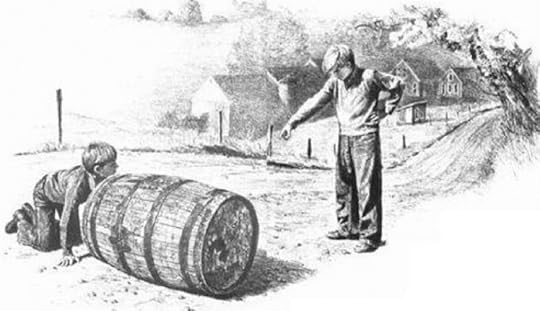
When it came to getting the two of us in trouble, Soup was a regular genius....Soup was my best pal. His real and righteous name was Luther Wesley Vinson, but nobody called him Luther. He didn't like it. I called him Luther just once, which promoted Soup to break me of a very bad habit before it really got formed. As soon as the swelling went out of my lip, I called him Soup instead of Thoop.Here are the stories of that friendship, and of the troubles--stories from a boyhood filled with barrels to roll in, apples to whip, windows to break, ropes to bind prisoners, acorn pepes, and ten-cent Saturday movies.
But then as always nothing was quite as important as a best friend.
Robert Newton Peck is an American author of books for young adults. His titles include Soup and A Day No Pigs Would Die. He claims to have been born on February 17, 1928, in Vermont, but has refused to specify where. Similarly, he claims to have graduated from a high school in Texas, which he has also refused to identify. Some sources state that he was born in Nashville, Tennessee (supposedly where his mother was born, though other sources indicate she was born in Ticonderoga, New York, and that Peck, himself, may have been born there). The only reasonably certain Vermont connection is that his father was born in Cornwall.
Peck has written over sixty books including a great book explaining his childhood to becoming a teenager working on the farm called: A Day no Pigs would Die
He was a smart student, although his schooling was cut short by World War II. During and shortly after the conflict, he served as a machine-gunner in the U.S. Army 88th Infantry Division. Upon returning to the United States, he entered Rollins College, graduating in 1953. He then entered Cornell Law School, but never finished his course of study.
Newton married Dorothy Anne Houston and fathered two children, Anne and Christopher. The best man at the wedding and the godfather to the children was Fred Rogers of Mr. Roger's Neighborhood fame.
A Day No Pigs Would Die was his first novel, published in 1972 when he was already 44 years old. From then on he continued his lifelong journey through literature. To date, he has been credited for writing 55 fiction books, 6 nonfiction books, 35 songs, 3 television specials and over a hundred poems.
Several of his historical novels are about Fort Ticonderoga: Fawn, Hang for Treason, The King's Iron.
In 1993, Peck was diagnosed with oral cancer, but survived. As of 2005, he was living in Longwood, Florida, where he has in the past served as the director of the Rollins College Writers Conference. Peck sings in a barbershop quartet, plays ragtime piano, and is an enthusiastic speaker. His hobby is visiting schools, "to turn kids on to books."
Even though this book pretty much gives directions how to make an acorn pipe and smoke corn silk, with explicit directions on what kind of silk works best, and even though I had to explain to my boys that in the old days, parents, teachers and even random acquaintances could spank kids if the notion crossed their minds, and even though I had to define what "moving your bowels" meant, and remind them not to stick bugs up their friends noses, or play with knives, or tie ropes around people's necks, and even though I personally edited half a page that discussed how it would be ok to cheat a man because he was a Jew, my boys really liked this book. My sensitive 21st century self was a little shocked by some of the antics of Rob and Soup, but there was another part of myself that yearned for the days boys could roam and explore and take themselves to the afternoon movie, and yes, even get in trouble every once in a while.
The great young adult author Robert Newton Peck wrote this book about growing up in the Vermont countryside in the 1920s with his best friend Soup. There's even a one-room schoolhouse. Soup got his name by answering to his mother's call of Soup's On! Now there are over a dozen books in the Soup series now.
In one wonderful scene, Peck and his friends are out playing football. He discusses inflating a football by licking the silver needle before putting it in the football. The taste of that needle on a brisk fall day is unforgettable. I remember playing football with my friends and the taste of that silver needle. Brilliant scene.
I did it! This was my last of the Battle of the Books twenty titles. Better late than never.
So...I was laughing aloud from the start (Have your bowels moved today?), however, by the end I wondered what my fifth graders today would think of this book. A kid in 2016 could certainly not get away with the things these boys pulled. It's a wonder anyone ever survived their childhood, but oh, the stories they can tell!
It is short and made up of several short stories, so if you're trying to entice someone to read, this may be a gateway book.
10/2021: This is a third re-read for our family. It seems like every six years our kids convince us it’s time to work our way through the Soup series again.
5/2015: This was a re-read for our family, but this series has got to be some of our favorite books of all time. They are laugh-out-loud hilarious and they also teach some great moral lessons. My husband and I thought it was high-time we re-read these so our younger children can hear them.
My fourth grade teacher read some of these stories out loud to us. It was by far the most engaging part of the day. My daughter was less impressed with the stories yesterday, but I was laughing so hard I stayed up late to finish. The kicker is these stories are autobiographical!!!!! This is the true Mayberry. Also, I discovered last night that this is the "The Day No Pigs Would Die" author (that book is so well written and it has some sad and disturbing parts which I didn't know going in to it). The hilariousness of Soup is the voice. The author writes in first person so we get his intellectual, vivid descriptions and reasoning as well as his 8 year old words. Such a funny contrast to hear the adult explanations and the child's reality. I love that there are mostly just the two characters and so there's very little "said Soup" or "I said". It's just strings of quotes and it reads like a conversation. Beautiful writing.
I could never get enough of this book! Hilarious and entertaining. The story revolves around Robert and Soup. I have to say These two boys could wreck their whole town If they put their mind into it! In this book You'll see How Robert and soup get themselves into troubles. like, Robert tying up his aunt under the tree while there was a heavy storm out there.. or things like how he survived a barrel race on a steep-drop hill.
How I adored this series! Made me want to move to Vermont. The entire line of Soup books are fun to read and a rare find, a series for young boys. I loved the simplicity of small-town life in the 1920's. Similar to The Great Brain novels, the Soup series is told through the eyes of Soup's best friend, Robert, (a semi-autobiographical sketch of the author) the more naive of the mischievous pair. (The Great Brain is narrated vis a vis the Brain's younger brother.) Short books, not a whole lot of writing, they make for quick reads. As is to be expected the earlier novels fare better than latter additions to the series.
This book dishes out nostalgia in a manner that would make Stephen King proud. I found these two about autumn particularly noteworthy:
“There is no taste in the world quite like it. It’s the taste of an early morning in September, a Saturday when there’s no school. The fields are still wet with morning, and some yellow leaves are already sprinkled on the pasture dew.”
“The wind was as ripe as apples, so full of fall that you could almost bite every breath.”
This is decidedly a mid-grade book -- I was introduced to this book via jealousy of the standard reading group in 5th grade, while I had the misfortune to read something that was challenging and character building. This is ten vignettes without a central theme other than “Soup and Rob get up to shenanigans ten different ways.” I do appreciate the character who had “the brain power of a fully ripened bean” -- a phrase which has made a comfortable home in my personal lexicon for years.
The sequence about the apple whipping and the damage that activity wrought was delightful and made me laugh out loud while reading. The casual racism was offputting, because although appropriate for the pre-WW2 setting, and included a message about what they did was wrong for which they felt shame, it could have been handled a little more deftly since this was published in the 70s, and they could have done better.
I really didn't care for this book. The best parts were that it was quick and that it counted as another state in my Literary Escapes Challenge. (Also, it's technically realistic fiction I guess, but since it was written awhile ago, I counted it as historical fiction)
My grandma loved A Day No Pigs Would Die, so I thought I would check out another book by that author. Funny shenanigans, reminiscent of the stories our grandparents and dad used to tell.
A friend recommended this book - and then a group of friends agreed - for my super picky reader in 6th grade. I grabbed this book and an Arctic adventure book for him and he wrinkled up his nose at Soup and chose the other book.
But as it would be, my husband was gone that night and the boys asked me to read something to them and because my usually right friends so highly recommended this book, I picked up Soup to read aloud.
The boys eyes were wide with "what would you do if we did that?" and I will admit I was a wee bit afraid of them trying some of the dare devil stunts in this book but we laughed a lot at it. The apple and the Baptist church? We were all laughing.
And even in all that, there were some deep lessons learned here. Those "reading between the lines" lessons.
I read more than half the book aloud to the boys that night. The next night with Daddy home, I read a chapter and even my husband told me to keep going. We finished the book as we sat at the dinner table.
What a great collection of wild adventures that boys got themselves into and who knows how they survived. Also, it was funny to me to read this on the day that the boys got a strict talking to about bullying at school.
Looking forward to reading more, and I will be sending this book on to my Dad because I think that it will remind him of parts of his childhood.
This story of two boys in a bygone era has a certain charm, but I can't help reading through a lens almost a century old. I don't fault the boys for their antics, or for growing up in the time they lived. And I understand that the adults also had to live in that time, not mine. But the first several chapters feature several beatings administered to Robert. Given current events, I feel a little cynicism about how something common less than a hundred years ago can cause such trouble now. I am not an advocate of violence in any form. But I am also aware that my opinion, and the one presented in this work, are still being debated today.
4 stars -- 8/3/2025 (second time) - I have such mixed emotions about this book! Told in vignettes, the book is a slice of life from the 1930s. Based on the author's experiences, the ten stories range from hilarity to this reader's heartbreak. I belly-laughed through "Apples and Mrs. Stetson." Likewise, reading "Cheating Mr. Diskin" hurt my heart. This is the second time I have read Soup; this is the first time, though, that I am reading it from this perspective. Sadly, this will be leaving my library shelves for a variety of reasons, but there is also a part of me that feels my upper elementary students will be missing out.
Soup's On, and that is how Luther got his name! Read's like, Anatasia by Lois Lowry, Dog Years by Paulsen or even a book by AVI. Also Jesse Stuart. I enjoyed the part of "Cheating Mr. Diskin"; "Apples and Mrs. Stetson", & "A Barrell of Chicken". Good boy humor of growing up in rural vermont. Life lessons.
This is such a great boys' book. I read it when I was a kid and remember liking it. My husband however remembered everything that Soup and Robert did. He read it to our boys and my 7 year old loved it. We discovered however that our 5 year old couldn't handle the toilet humor.
Well this ol' book was written by a real white feller back in 1974 and while he doesn't do anything to hog wild he is weird about the one Jewish and the one Italian character who show up. I did enjoy reading it and the illustrations are these extremely from-life pencil drawings with expression capture skills that I am frankly still staring deeply into. Very weird drawings in some ways although of course in some ways just very skillfully executed traditional drawings. Anyway this book does have a smidge of poopiness as mentioned above but mostly it's a pretty sweet collection of memories this author has about a friend of his he had when he was young and who grew up to be a Reverend, you find out at the end.
I maybe would have gone down to three stars after the stuff with the two non-WASP characters but there's this, toward the end, which I think is some very strange and fine writing:
"I'll say this much for Miss Kelly--she wasn't mean. Her role in life was not an easy one, with Soup and me around. So afterward, when the waste basket was empty, Miss Kelly told Soup what a good job he did. She said that she liked him a lot. Then the said that when she liked somebody, she called him Soup. But if she didn't like someone, he got called Luther no matter who was listening!"
I like this because it would be easy in a book like this to leave the teacher unsympathetic (most of the grownups in this book are not superstar grownups), but I like that he has this awareness of what she's up against and that what she brought to meet it took some effort on her part. And I really love this funny little business about how she'll call him Luther if she doesn't like him. Luther, or "Soup," after whom the book is named, hates the name Luther, and I like that Miss Kelly let him know that who he is is determined by how he acts, and that she'll respect his desire to be known as the person he wants to be known as--called by the name he's chosen--if he lives up to it. I think that's pretty good for a book this simple.
Soup also gets a new pair of boots which he is excited are orange and squeaky. "It's like having birds between your toes," he says. Pretty weird. Pretty good.
Author and famed internet judge John Hodgman has noted that nostalgia is a toxic impulse. Hodgman considers the two key elements of this to be the mistaken belief to be that "...(a) the past was better (it wasn´t) and (b) it can be recaptured (it can´t)..."
I guess I've been testing this theory out on a recent longish visit to my childhood home. Digging through a stack of my old books, I stumbled upon Soup and the sequel Soup & Me which made me flashback to the halcyon days of a grade school book fair...tables upon tables of books to devour from mice who ride motorcycles, how to eat fried worms, a pest named Ramona, Superfudge, a black stallion, and on and on.
Peck tells some nostalgic tales of growing up in rural Vermont in the 1920s...mostly about getting in trouble with his friend Soup. The past isn't necessarily better. In fact, it's a bit racist (as is our current world): see "Cheating Mr. Diskin." There's also a whole chapter which essentially teaches kid's to build a pipe from an acorn and smoke cornsilk. Corporal punishment is the ending of many of the best tales in the book. And our narrator feels really bad about growing up with only hand-me-down clothes. This works because it presents the past with less of a gold sheen and more of a pock-marked cast iron sheen.
But nostalgia isn't the most important factor in these stories. This is about having a good friend. A good friend gets you through the bad days and makes the good days a little bit better.
--- "Eddie Tacker was so mean he'd pee on a puppy. I know because he did it to mine."
This is a really fun book about the escapades of a pair of boys back in the 1920s. The narrator is a little younger and smaller than his friend Soup, and so often gets the worst of things, but Soup definitely comes through for him when he needs it. The stories reminded me in some ways of books by Patrick F. McManus, although written for a younger audience, farther in the past and with a touch more nostalgia. While this book is quite funny, I think I would want to read it with my child, or at least discuss it with them, not so much because of the safety issues involved (although I suppose there are some) but because of the section where there is discussion about whether or not a minor character is a Jew, and whether or not that would make it OK to cheat him. To be clear, the story doesn't make it seem like cheating a Jew would be a good thing, but the whole issue seems like it would warrant some discussion. I listened to the audiobook version which was well done, and of course listening in the car would be a good way to have that important discussion.
A wonderful piece of historical fiction about boys being boys, roaming free, getting into trouble, and occasionally learning life lessons.
The book is very episodic, I could see having a classroom read just one of the chapters as a short story.
I have seen some people comment about one chapter in particular where the boys are bringing a ball of foil to exchange for money to go see a movie. They need 20 cents, but only have enough foil for maybe 18 cents. So the boys hide a rock in foil. The man they bring it to is Jewish and the boys discuss that it is okay to cheat a Jew. However, the lesson and the way the story progresses make it very clear that it is not okay. Characters are allowed to be imperfect and hold wrong beliefs, good books will make it clear to the reader that these are imperfections and character flaws, great books will allow the reader to make that distinction. This is a great book.
The last chapter about Soup's new shoes was especially moving. It deftly showed the reader what it means to be a real friend.
After finally reading Soup, I recall that my thoughts went something along the lines of "Well, that was pretty good." And then I moved on with my life and halfway forgot about it. And yes, Soup was pretty good. It had lots of funny moments, but it also had more uncomfortable or unpleasant moments than it really needed. This is especially true of the ending, which gave me a good deal of secondhand embarrassment. If you can get past such a high proportion of uncomfortable moments for such a slim book, you may really enjoy Soup. Otherwise, you'll probably read it, shrug with mild amusement, and then hardly ever think of it again.
I read this whole series when I was a kid and loved them. They… haven’t aged well. But as historical narratives, I still find them charming and entertaining and honest. I value their open look at what life was like 100 years ago and i feel like, on a deeper level, there’s a fantastic opportunity to open discussions about social change using these stories.
In the end, I decided not to finish reading it with my 5th grader. The time isn’t right, yet. But when it is, I’ll use these books as more than just entertainment and instead use the excellent writing to open family discussions about thoughtful change and social justice.
My 5th grade teacher read this to our class, a chapter a day, after lunch recess. It's the story of boys in a bygone time, full of the language and mischief that rural boys get into. I miss those days and this story brings me back to them.
It's funny how much I remember of each anecdote, from whipping apples, rolling downhill in a barrel to Soup's new shoes. Even the ones I had forgotten came back as soon as I read the chapter title. I'm glad I had these stories to read as a kid, there couldn't be better ones to try to emulate as a 10 year old kid, or to read with my own 10 year old boys now.
a mix of memoir style boyhood stories in each chapter. the first chapter was hilarious and the one about whipping apples made me laugh so hard I cried. the other chapters are a mix of sober and silly. I read it to my kids and they wanted more every time. my daughter said "who is this kid?!" another time my son said "this guy thinks just like me!" the book has topics that my kids needed explanations for, like whipping as a punishment, that are historical. we talked a lot about how things were different and also choices, like if the character made good choices, and what choices could you make?
I love this book, as well as all the other stories of Soup and Robert. My mom and I read them when I was a kid a lifetime ago. I remember talking about the “simpler times,” and we’d laugh at all their funny adventures.
When my daughter was born, I was excited to introduce her to Soup and we read the books together, and now I get to read them one last time with my son, who is 8.
I am so grateful for timeless books like these that you can read time and again. I may be getting older, but the stories never do.
This is probably my number one re-read book of all time, though I hadn't read it for several years until now. It was my first favorite book as a six-year-old! Now that I'm older, I still appreciate the humor and small-town feel of this book and found myself smiling and even laughing out loud throughout the collection of vignettes from the author's childhood. I will continue to recognize this book as an important part of my childhood.
If like me, you’re returning to this book as an adult, having read it countless times 20+ years ago, I strongly suggest having Kleenex close at hand.
Yes the book is funny and paints a unique picture of a time and place. But what I wasn’t prepared for was the portrait Peck masterfully paints of friendship, kindness and sacrifice.
I was deeply moved by what I thought was going to be a ‘light and fun’ read. ❤️
While in the vein of books like The Great Brain and others, this seems a lesser exemplar. I first encountered the "Cheating Mr. Diskin" episode in a reader or magazine back in the 1970s. It is probably the best chapter.