This fifth volume of the New York Times bestselling series weighs in at a hefty 720 pages. It collects material from Elfquest - Hidden Years #16-29, as well as the entire "Wild Hunt" sequence from Elfquest comics (vol.2). A stunning collection of art and story from Wendy and Richard Pini and others.
The latest collection of the classic fantasy series by Wendy and Richard Pini continues the canonical adventures of the Wolfriders. With Cutter leading his warriors against the human warlord Grohmul Djun, his chief-daughter Ember takes her tribemates far away into unknown lands, where she pits her skills and courage against new threats and unexpected revelations.
Wendy Pini is one-half of a husband and wife team with Richard Pini that created, most notably, the Elfquest series.
Wendy was born in California and adopted into the Fletcher Family in Santa Clara County. Early on, she developed as an artist and was the illustrator of her high school year book. She submitted samples of her artwork to Marvel Comics at 17 that were rejected.
Pini attended Pitzer College and received her B.A. in the Arts and joined the Los Angeles Science Fiction Society.
In 1972, she married Richard Pini and began illustrating science fiction magazines, including Galaxy, Galileo, and Worlds of If. In 1977, Richard and Wendy established a publishing company called Warp Graphics to publish their first Elfquest comic. Elfquest was self-published for 25 years and in 2003, licensed to DC Comics. The comic series has won several awards, including the Ed Aprill Award for Best Independent Comic, two Alley Awards, the Fantasy Festival Comic Book Awards for Best Alternative Comic, and the Golden Pen Award.
Wendy has illustrated other works, including Jonny Quest in 1986, Law and Chaos in 1987, and in 1989, two graphic novels of Beauty and the Beast. Recently in 2007, she completed a graphic novel entitled The Masque of Red Death.
Wendy has received several awards over the last four decades, including the San Diego Comic Convention Inkpot Award, the New York State Jaycees Distinguished Service Award, the Balrog Award for Best Artist, and was inducted into the Friends of Lulu Women Cartoonists Hall of Fame in 2002.
Wendy and her husband currently reside in Poughkeepsie, New York.
I originally started to read the ElfQuest comic books in the 80s while in high school, but the stories contained in these later books are new to me, with the artwork jarring when considering the change in artist. The Pinis were still involved in these stories, but Wendy and Richard were more overall creative consultants and editorializing than involved in the day-to-day.
This fifth volume collects the work from ElfQuest: The Hidden Years #16 - 29, and the Wild Hunt sequences from ElfQuest, Vol. 2. Cutter and his band come across a human warlord named Grohmul Djun, and the Wolf riders must divide the tribe into two groups in order to defeat simultaneous myriad enemies.
This is Ember's first time wearing the mantle of Chief; and thus faces, the multiple errors that come with such a task, the lack of confidence, and the wary, judgmental eyes of the elders. She actually has to confront her own mother in one such scenario. So, no shortage of drama, action, and story that has kept ElfQuest the standard for over 50 years.
As so many other here have noted the change in artists/art styles was jarring, though to be honest I felt the folks who took the reigns on the Wild Hunt storyline were decent draftspeople and capable of the odd truly-arresting panel.
Still, after so many hundreds of pages of the Pini's work on the earlier tales I personally really associate the detailed faces and gentle shading of the original creators as inseparable from my whole "ElfQuest Experience" and as such rate this volume a little lower than the preceding masterworks.
Overview: I enjoy the storyline, and love the characters. As always, the elves of the world of Two-Moons capture my heart and pique my interest. Unfortunately, the art doesn't do the plot and beauty of this fantasy world justice.
What Was Maddening: 🐺The art. The art is, at its best, simply lacking in specific details but, at worst, it's hard to tell the characters apart at times with the crude drawings that are too minimalistic for these series. I love this story and its characters, but the series is losing its enthralling nature that drew me in to begin with.
🐺
2.5/5 I miss Wendy Pini's art, as I have in the past, but even more so with this volume.
This entire review has been hidden because of spoilers.
The stories in this book are great! It all centers around Ember and her Wolfrider tribe, not on the Cutter arm of the tribe, and are stories I'd never read before. I gave 4 stars instead of 5 simply because the art is really inconsistent. It's obvious that several different artists were involved, and while some are nearly as talented as Wendy Pini herself, the last third of the book feels like the drawings were rushed. Not as much attention to detail- eyes without pupils, lack of background details, stuff like that. Still, overall, a great, hefty read and good stories.
The ARCs collected in this book were never my favorite. Which I always found strange, for Ember was always my favorite character - followed by Nightfall, and later Tyleet. I do know that the change in artist was jarring, and it didn't help that the artist seemed to switch between light backgrounds and darker backgrounds from chapter to chapter. (at least it didn't help for my overly sensitive eyes)
Another problem I had, was how the story meandered. There were some good scenes in there, of course, but there is a lot of fluff. Especially in the second part. I enjoy the story of Howling Rock and the Quest to find it, as well as Teir and how Ember grows into her own. The second part, however, the Wild Hunt, never really worked for me. A lot of it felt like filler and fluff, and not really giving anything back to the story. I have to admit that I skimmed a fair bit of it this time around. There's a lot of back and forth, and human troubles and intrigue, that doesn't really lead anywhere. The story grabbed me again with the last couple of issues and the Silent One, but it felt very far lost by then.
This large tome collects the remainder of the Hidden Years series, numbers 16 through 29, plus the Metamorphosis one-shot, and The Wild Hunt storyline from Elfquest volume 2, all of which were first published in the mid to late 1990s, when the Elfquest creators turned their indie comic into a franchise, creating at least a dozen titles (mostly limited series) dealing with the Wolfriders and their kin. Now that they’re collecting those stories which they consider cannon, a lot of those titles have been left in the trash. The only way to experience them is to pick up some back issues. Still, this volume is close to 800 hundred pages, so it should fill your Elfquest itch for a while.
Volume five focuses on Ember, Cutter’s daughter, and her trials in leading a separate tribe from the main Wolfriders pack. The Hidden Years stories take place at the same time as the Shards storyline - where Cutter leads an attack against a warlord to gather the remains of the broken castle. These stories deal with Ember’s inexperience at being chief and her growing pains, as the new tribe look for a place to call their own in a world that is rapidly shrinking and filling up with their natural enemies, humans.
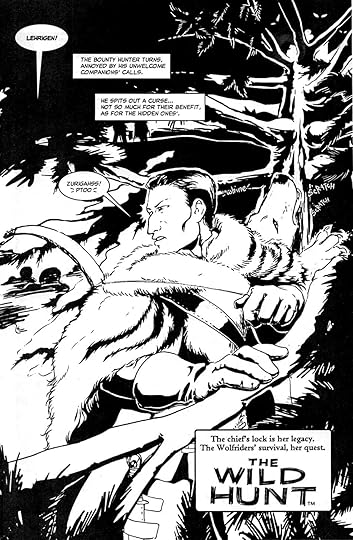
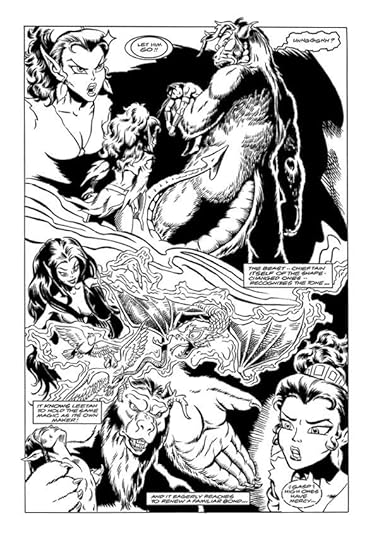
The Wild Hunt stories take place after Shards, and focus on a more experienced Ember dealing with the final few monsters created by Winnowill. They then become embroiled in a series of back and forth raids with the remaining humans warriors, which eventually force the Wolfriders to become more nomadic than they like. This causes stress amongst the group, challenges to Ember’s leadership, and introduces a new antagonist - a ranger type who knows the ways of elves and knows how best to hunt them.
Like certain portions of the previous two volumes, none of the issues here were drawn by Wendy Pini, and most of the stories were written by others as well, with the Pini’s acting in an editorial capacity. This is not to say the stories are bad, but they are different stylistically than early Elfquest volumes where they were only two people working on them. In fact I like the stories quite a bit. Out of necessity, Elfquest had to switch venues to where the human would pose a greater threat. They were always sort of menacing in the past, but not much more than a passing problem. In these stories, they represent a monumental threat. Which leads to the basic philosophy behind all of these stories, how much will the Wolfriders have to change in order to fit into the new world? Will their “way” be compromised or abandoned completely? Well worth a look.
This hefty almost 800 page volume focuses on Ember's tribe of Wolfriders. It begins with them setting out to find a new holt. After a few failed attempts, they settle in the mountains, near a formation they dub Howling Rock. Their new home is beset first by monsters created by Winnowill, then by humans. Early stories focus on Ember learning how to be chief. A new elf, living alone, is encountered and the other elves don't know how to feel about him.
The art is a mixed bag. There's some good stuff, but there's also some of the worst art in the series so far. The drama of the old guard having to adjust to a new, young wolf chief and of Ember trying to figure out how to lead is done well. I don't like that Winnowill is somehow the only evil supernatural being on the whole planet.
Elfquest has been with me since childhood and giving this book a mere three (very weak!) stars feels like a betrayal of old friends, but I couldn't with a good conscience rate it any higher. The drawings in Hidden Years are mostly good, some of them even very good, but the style used in the Wild Hunt story is not Elfquest at all, and the magic for me was completely lost. And it's such a shame, because there are happenings there that I'm sure would have moved me to tears if they were told in Wendy Pini's beautiful art work.
Of course I'm eager to see what happens next to my dear elves, but if Wendy Pini (or someone who masters her style completely) doesn't feel like drawing it yet, I'd rather wait. Because this I didn't enjoy much at all.
Took forever to finish this one. Kept going back and re-reading parts and lingering on pages with better than normal art. Was a bit like how I read the first ones about a million years ago; I had forgotten what fun it is to read "new" ElfQuest -- never got this far into the series as a child.
Wild Hunt-Part suffers from rambling storytelling, which gets more focused towards the end but not really good. The dealbreaker for me was the abysmal pseudomanga artwork which is at the best of times tolerable but mostly just ugly.
As much as I love ALL the Wolfriders, I found the Wild Hunt series much less engrossing than the rest of the Elfquest series -- possibly because it feels more like a Monster Of The Week series than a natural progression of their timeline.
Starting with the split up of the wolf riders in the shards ark we follow ember as she leads a small band of wolf riders as they struggle to find a new Holt to live out there days
ElfQuest is a beautiful exploration of people and culture in a fantasy world that started back in the 1970's and still runs to this day. On this world humans are still very much in their barbaric cavemen days while elves are the fierce hunters but also fun loving children of the forest who just want to be left alone. We meet Cutter and his clan of Wolf Riders just as they're escaping a deadly clash with the humans of their area that results in them burning down the whole forest and its through these elves' eyes that we get to explore this lush world and storytelling.
Back when I was introduced to this world in middle school by my cousin, I was immediately taken with the stunning artwork and the way these characters were portrayed. The Wolf Riders and the other elves in the story are very obviously part of the same race, but show a wide variety in every aspect of their design depending on where in the world they settled (much like actual humans in our world). From the beginning we have a large handful of characters to keep track of, elf, troll and human alike, and yet it never felt like a struggle to keep track of them because of their design and how their names just fit them so well...
It's a general consensus among Elfquest fans that the Hidden Years arc with Ember's tribe kind of sucks. Even my childhood self already thought that, and on re-reading as an adult that opinion hasn't changed much. The art is much worse, and the plot suffers a lot from the fundamental problem that the other half of the cast is out there saving the world and doing wildly interesting things while Ember is stuck having self-doubts and hunting mice...Yeah. The second part of this collected volume, "Wild Hunt" is much better (though the bar was admittedly low). I liked the sea monster storyline, and the human hunter is such a cool antagonist. It still suffers from a lot of issues, primarily it makes some characters kind of ooc and also wildly unlikable (looking at Mender and Krim and Scouter). There's also this generalised sense of anxiety that hangs over all later Elfquest stories in that the world is growing too small and too crowded with humans for them. And there's really no solution or path forward shown in this beyond going to search for even more remote corners of the wilderness.
Much better than I expected. I probably have all of this in comic book form. But at some point I stopped reading them. And it just wasn't as interesting to pick up in passing. And eventually the art seemed inconsistent.
So on this read, I read it straight through - well in thirds - for discussion in a book group. The art was often very good and only occasionally kind of awful - but never so bad to make it impossible to get the story. Some of these stories were retreads - but most of it was a different set of characters just facing some of the challenges Wolfriders always have.
The form of this book is a little bit tough. 800 pages is a bit too heavy.
For much of this, it is parallel with Shards. And when Shards ends, some of the characters move around and it feels a bit abrupt.
The human tracker at the end doesn't really have an explanation or a useful ending. I guess some humans are a bit like wolfriders and that's as good an explanation as is needed.
This one took me a little longer to get through as I wore out my eyes reading online.
In this collection, there are two main stories - Ember and the Wolfriders' quest to find a new home for themselves and then that same group patrolling to protect themselves (and inadvertently, humans) from Winnowill's creatures. In doing so, they manage to make enemies of the humans (and the trolls aren't necessarily happy with them, either, as their sneak holes have been discovered by the humans and blocked up). A retreat to Howling Rock only leads to another human girl trying to become their friend - but she is a traitor to the elves and very much wanting to prove herself to her father and her brother.
This series gets much darker in this collection with a lot of deaths happening (okay, yeah, the War for the Palace definitely had deaths!). Still, I am enjoying myself and look forward to reading more.
If you want to read something that will never make you want to read another ElfQuest book ever again, read this.
If you want to read something that completely breaks characters so they fit a story, instead of writing a story that fits the characters, read this.
If you want the whiplash of art that goes from someone with a bulging eyes and too many teeth fetish to the worst, laziest, sloppiest "computer enhanced" art you ever seen, read this.
If you are looking for where the Final Quest went wrong, start here.
All new content to me, and split basically between 2.5 stories. I loved seeing little Ember grow up and grow into her role as chieftess. It's amazing the wide reach of Winnowill. My only complaint is that one of The Wild Hunt parts was out of order, so Choplicker was suddenly alive after we've been told he's dead. Would recommend if you're reading through the series.
As many before me mentioned the art style it made me think about giving this one less stars because it has been the worst one yet. But I still value the stories and how much the world means to me. It was nice to see parts drawn in the style I loved so for the art it's a 2/5. Sometimes this one felt a bit dragging and I see less growth in the characters but it is still a solid 4/5.
I loved the book! It's amazing!!!😍😍😍I recommend reading the others in the series😁😁😁😗😍😍😍 The book is fun, adventures, kinda romance😍😍, Andddddddddd...A SUPER GREAT BOOK